
EVOLUTION OF THE INTEGRATION MOVEMENT REGIONAL INTEGRATION The

- Slides: 44
EVOLUTION OF THE INTEGRATION MOVEMENT REGIONAL INTEGRATION
The West Indies Federation (195862) �Established in 1958 �Established by the British Caribbean Federation Act of 1956 �The aim was to establish a political union among its members �Antigua and Barbuda, Barbados, Dominica, Grenada, Jamaica, Montserrat, then St Kitts-Nevis-Anguilla, Saint Lucia, St Vincent and Trinidad and Tobago
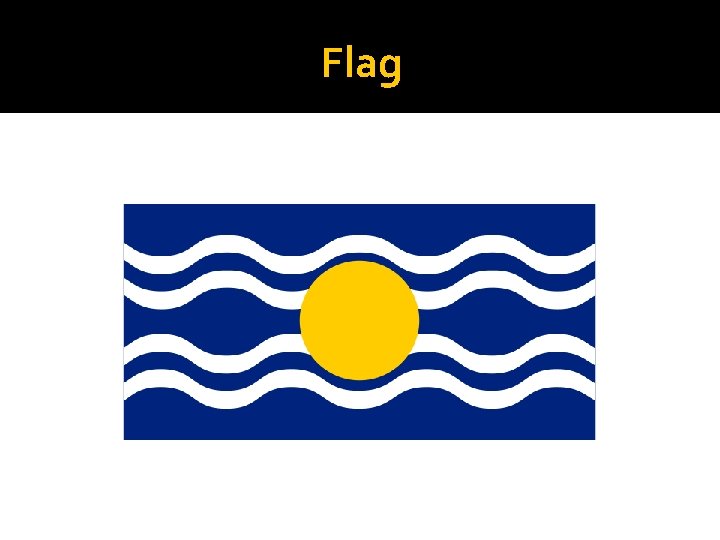
Flag
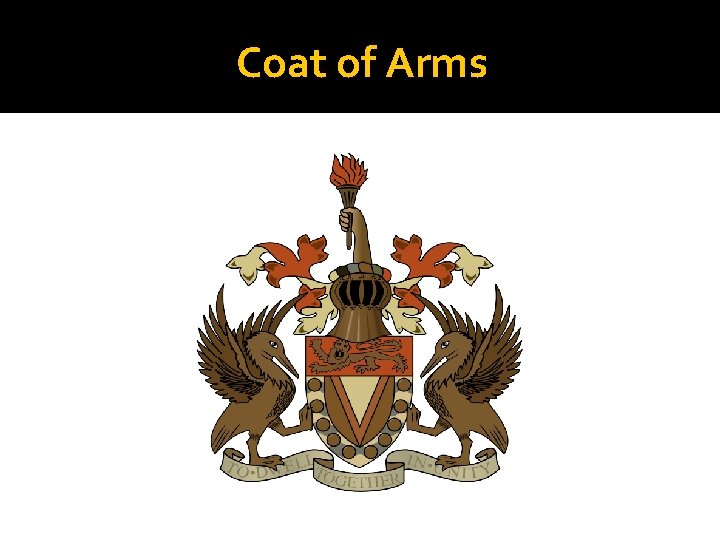
Coat of Arms
Structure of the Federation �The Federal government was headed by an Executive Governor-General, appointed by Britain and included: �A Prime Minister �A Cabinet �A Council of State presided over by the Governor General �A forty five-member House of Representatives �A nineteen-member Senate
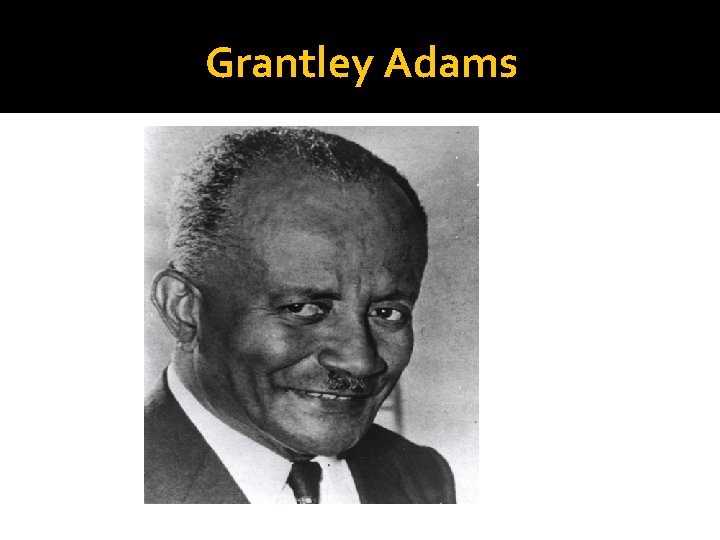
Structure of the Federation �The Governor General was Lord Hailes of Britain �The Prime Minister was Sir Grantley Adams (Premier of Barbados) �The Federal capital was located in Trinidad and Tobago
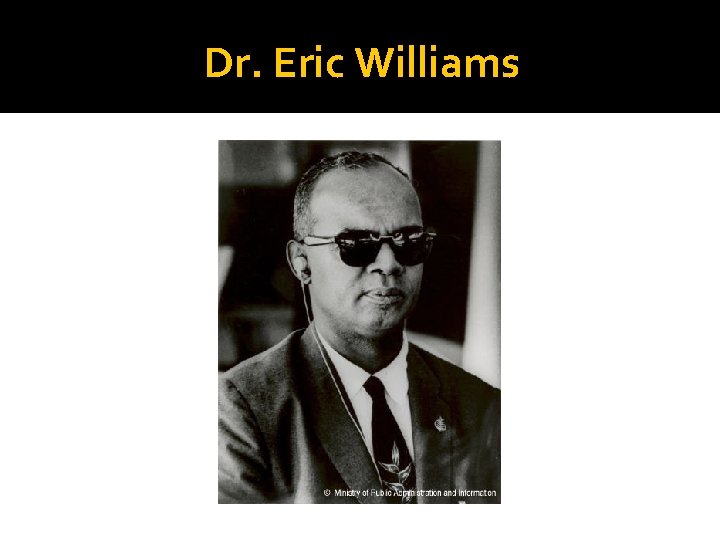
Challenges faced by the Federation �The federation suffered from inadequate financing. �Jamaica and Trinidad and Tobago bickered over their own interests. �Eric Williams was uncompromising in his refusal to accept unrestricted freedom of movement.
Federation �Jamaica was not in favour of accepting a binding customs union and held a referendum in 1961. �Williams’ made his infamous statement- ‘ 1 from 10 leaves 0’ �Must be regarded as the real beginning of more serious efforts towards integration
Achievements �Created a federal civil service �Established the West Indies Shipping Service (in 1962) �Negotiated to acquire the subsidiary of the British Overseas Airways Corporation (BOAC), namely British West Indies Airways (BWIA) �Established then University College of the West Indies (UCWI)
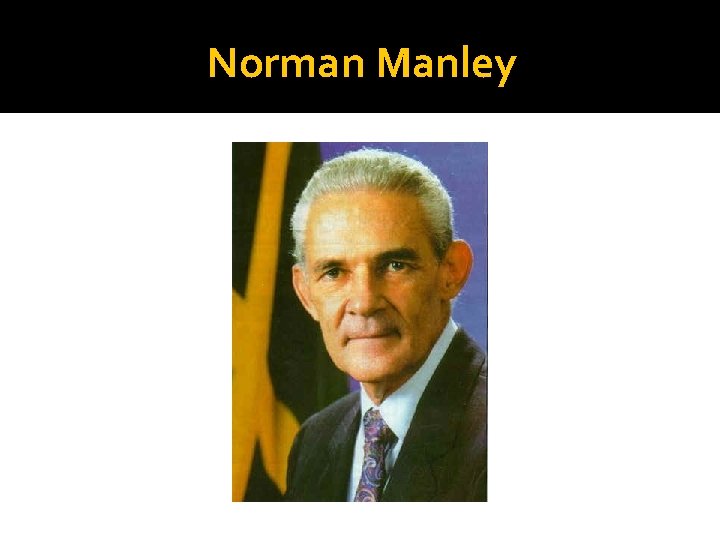
Norman Manley
Dr. Eric Williams
Grantley Adams
From Federation to CARIFTA �After the Federation collapsed in 1962, CARIFTA ( Caribbean Free Trade Association) was formed. �CARIFTA was founded in 15 th December 1965 by: Antigua and Barbuda, Barbados, Guyana and Trinidad and Tobago.
From Federation to CARIFTA �They were joined on July 1 st 1968 by Dominica, St. Kitts Nevis, Anguilla, St. Lucia, and St. Vincent and the Grenadines; and on August 1 st, 1968 by Montserrat and Jamaica. �In 1971, Belize joined the Association.
Purposes of CARIFTA
Purposes of CARIFTA �CARIFTA was intended to encourage balanced development of the region �CARIFTA also encouraged trade liberalization within the Caribbean region �Ensuring fair competition by setting rules for all members to follow to protect the smaller enterprises
Purposes of CARIFTA �The agreement sought to ensure that the benefits of free trade were equitably distributed. �CARIFTA aimed at supporting the development of the coconut industry, through an Oils and Fats Agreement.
How CARIFTA became CARICOM?
How CARIFTA became CARICOM? �In 1973, CARIFTA became the Caribbean Community (CARICOM). �It was established by the treated of Chaguaramas, which was signed by four countries, Trinidad and Tobago, Barbados, Jamaica and Guyana.
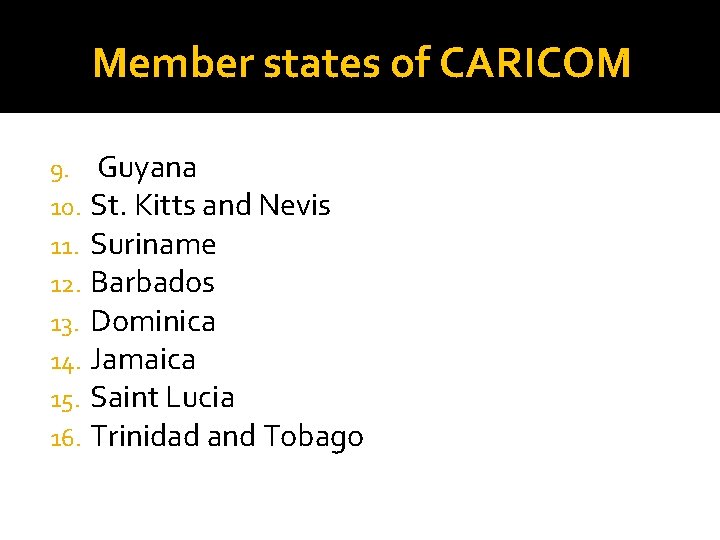
Member states of CARICOM �The sixteen CARICOM members are: 1. Antigua and Barbuda 2. Belize 3. Grenada 4. Montserrat 5. St. Vincent and the Grenadines 6. Turks and Caicos Islands 7. The Bahamas 8. British Virgin Islands
Member states of CARICOM 9. 10. 11. 12. 13. 14. 15. 16. Guyana St. Kitts and Nevis Suriname Barbados Dominica Jamaica Saint Lucia Trinidad and Tobago
CARICOM �CARICOM has over time, made significant and meaningful steps at promoting development within the Caribbean. �The regime governing the free movement of goods is fully implemented. �Jamaica, together with Most Member-States, applies the Common External Tariff (CET).
CARICOM �CARICOM aims at achieving integration and development by, establishing a regime for free trade in services. �The main objective is to facilitate trade and investment in the services sectors. �CARICOM service providers will be able to offer their services throughout the region.
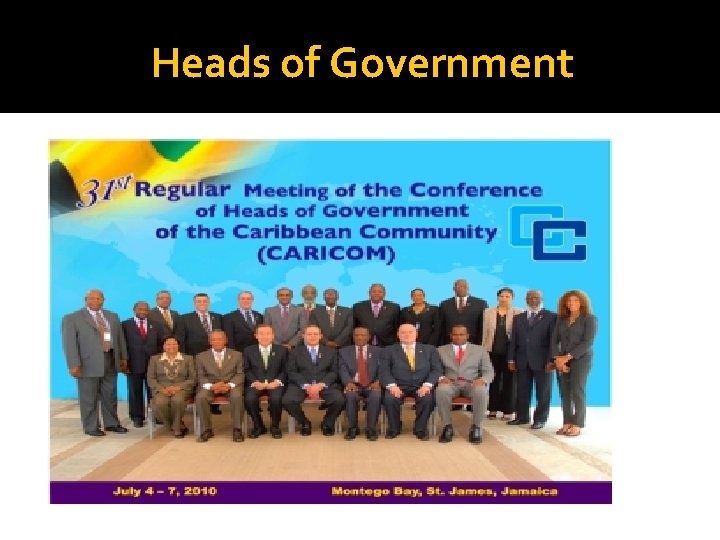
Heads of Government �These heads are the Prime Ministers of each member state. �They meet atleast once a year to decide on: -polices and general directions of Caricom. -which treaties between the Caricom and international bodies should be accepted. -resolving disputes arising among member states.
Heads of Government
Common Market Council �Overseeing operations of free trade among member states. �Ensuring that trade barriers such as taxes , duties, quotas and licensing arrangements are not applied in trading between member states. �To secure the application of a Common External Tariff (C. E. T) among member states.
�Allow free movement of citizens from one member state to another in order to establish business in another member state. �Application of a common policy in dealing with non-member states and transnational co operations.
Institution of Ministers This organ is sub divided into Ministries. For example, the ministers of Health from each member state will form the Institution of the Ministry of Health. • The Institution of Ministers is responsible for -formulating and adoption of common polices for their respective ministries. -resolving problems that arise from their respective ministries. • •
Caricom Secretariat �The head of Secretariat is the head office of Caricom and it is located in Georgetown, Guyana. �The Secretary General (His Excellency Edwin Carrington)heads this organization of Caricom. �The functions include: -making arrangements to facilitate meetings of any organ of Caricom.
�- implementing decisions taken by any organ of Caricom. -undertaking research on issues relating to economic integration. -prepare estimates of expenditure for any project relating to economic integration
Associate Institutions of Caricom �There are several institutions which associate themselves with Caricom in order to help achieved its objectives. These institutions include: Caribbean Development Bank(C. D. B). this bank offers soft loans for industrial, agricultural and tourism projects. The (C. D. B) carries out studies to determine whether projects identified would be profitable.
Caribbean Investment Corporation (C. I. C) �The (C. I. C) was formed for the specific purpose to promote development in the poorer member states of Caricom. �They also provide loans for development projects but only to member states.
University of The West Indies (U. W. I) �(U. W. I) was established in 1948 with three campuses: St. Augustine, in Trinidad, Mona in Jamaica and Cave Hill in Barbados. �The institution provides education in several faculties for all Caricom members who previously had to go abroad to attain higher education.
Caribbean Examinations Council (C. X. C) �This was established in the late 1970’s as a recognized examining body. �This body was established to develop the curricula in the various areas with a Caribbean focus. �Previously examining bodies were located mainly in England the subject matter was more relevant to Europe than the West Indies.
West Indies Cricket Board (W. I. C. B) The West Indies Cricket Board is one of the oldest examples of regional Integration. Its functions Include: -selecting a suitable cricket team from the West Indies to represent internationally -arranging inter-territorial cricket matches -assist in funding in regional and international compititons.
Caribbean News Agency (C. A. N. A. ) They provide news on regional reports and they also buy foreign news from international sources. Some benefits they provide are: -promoting regional culture -keeping the region informed on national and international events. - the cost of obtaining international news is more affordable for local new stations.
Caribbean Broadcasting Union (C. B. U) �The (C. B. U) is a non profit private organization which was formed in 1970 to facilitate radio, and television broadcasts among its members. �They also provides a variety of programs in news, sport and the Caribbean economy
Successes of Caricom �Caricom member states often help each other in times of need and crisis. �United voice in Windward island’s banana dispute. �Caricom assists in Guyana’s election crisis. �Caricom enters Suriname and Guyana border dispute.
Failures of Caricom �Competition among member states in air transport. �Conflict between member states for exploring common resources.
Failures of Caricom �Some Caricom members have more resources than others. �The absence of a common currency. �Accusations that Caricom member states contravened the free trade agreement.