
Evolution of the generational distribution of income consumption
Evolution of the generational distribution of income, consumption, and the lifecycle deficit in Poland between 2004 and 2016 Agnieszka Chłoń-Domińczak, Wojciech Łątkowski SGH Warsaw School of Economics Global Meeting on Population and the Generational Economy August 4, 2020
Economic and social progress in Poland between 2004 and 2016 • • • the real GDP increased by 56. 1% the employment rate for people aged 20 -64 increased from 57% to 69. 3% the unemployment rate declined from 19% to 6. 1% the real average wage increased by 53. 9% the poverty rate declined from 20. 5% (2005) to 17. 3% www. sgh. waw. pl
Research questions • How did the economic, social, and demographic changes that occurred between 2004 and 2016 affect the aggregate labour income and consumption, and the resulting lifecycle deficit? Which components of consumption increased more quickly than others? Are these changes affected by the ageing of the population? • How was the generational distribution of the lifecycle deficit and consumption affected by economic, social, and demographic changes? • Are the evolving NTA age profiles in Poland becoming more similar to those observed in Europe and in selected European countries in 2010? • Do the observed changes in consumption, labour income, and the lifecycle deficit indicate that economic dependency will be sustainable in the future as the population continues to age? www. sgh. waw. pl
• We compare the results for Poland with those for selected countries in Europe that represent different welfare regimes, as well as with the EU average, using the harmonised NTA profiles for European countries for 2010 from AGENTA project – Germany, Sweden, Spain • The selected countries represent – different welfare regimes based on the typology proposed by (Esping. Andersen, 1990) – two different country groups that have been classified according to the generational focus of public policies (Chłoń-Domińczak et al 2019) www. sgh. waw. pl
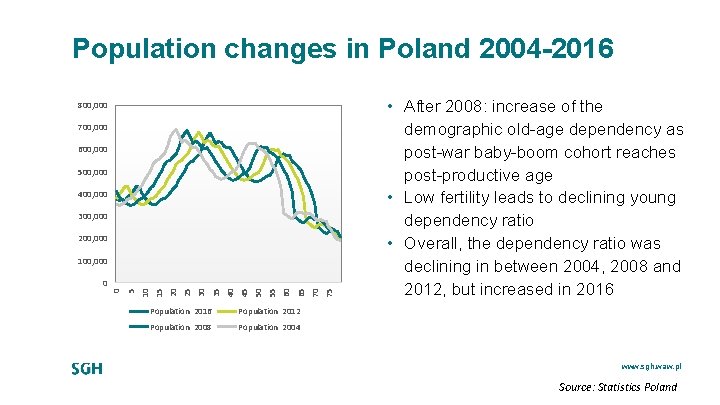
Population changes in Poland 2004 -2016 800, 000 700, 000 600, 000 500, 000 400, 000 300, 000 200, 000 Population 2016 Population 2012 Population 2008 Population 2004 70 75 60 65 55 50 45 40 35 30 20 25 15 5 0 0 10 100, 000 • After 2008: increase of the demographic old-age dependency as post-war baby-boom cohort reaches post-productive age • Low fertility leads to declining young dependency ratio • Overall, the dependency ratio was declining in between 2004, 2008 and 2012, but increased in 2016 www. sgh. waw. pl Source: Statistics Poland
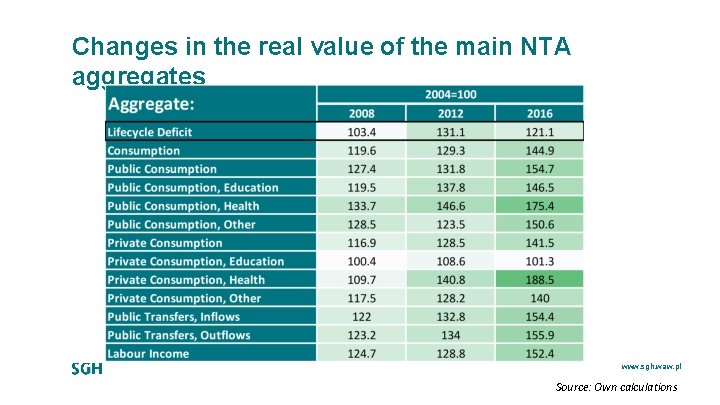
Changes in the real value of the main NTA aggregates www. sgh. waw. pl Source: Own calculations

Ratios of the aggregate consumption and the aggregate lifecycle deficit of the senior generations (aged 57 and older) compared to those of the younger generations (under age 27) 3. 5 3. 0 2. 5 2. 0 1. 5 1. 0 0. 5 0. 0 3. 26 1. 97 0. 79 1. 07 Lifecycle deficit 0. 79 1. 29 0. 49 Consumption 2004 1. 73 0. 77 Public consumption health 2008 2. 31 2012 Public transfers inflows 2016 www. sgh. waw. pl Source: Own calculations
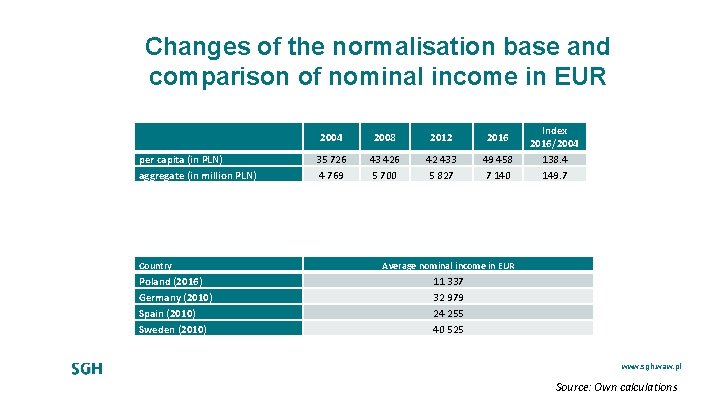
Changes of the normalisation base and comparison of nominal income in EUR per capita (in PLN) aggregate (in million PLN) Country Poland (2016) Germany (2010) Spain (2010) Sweden (2010) 2004 2008 2012 2016 35 726 4 769 43 426 5 700 42 433 5 827 49 458 7 140 Index 2016/2004 138. 4 149. 7 Average nominal income in EUR 11 337 32 979 24 255 40 525 www. sgh. waw. pl Source: Own calculations
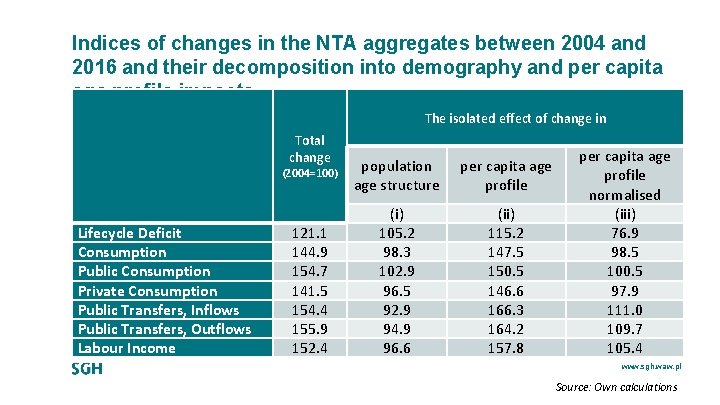
Indices of changes in the NTA aggregates between 2004 and 2016 and their decomposition into demography and per capita age profile impacts The isolated effect of change in Total change (2004=100) Lifecycle Deficit Consumption Public Consumption Private Consumption Public Transfers, Inflows Public Transfers, Outflows Labour Income 121. 1 144. 9 154. 7 141. 5 154. 4 155. 9 152. 4 population age structure per capita age profile (i) 105. 2 98. 3 102. 9 96. 5 92. 9 94. 9 96. 6 (ii) 115. 2 147. 5 150. 5 146. 6 166. 3 164. 2 157. 8 per capita age profile normalised (iii) 76. 9 98. 5 100. 5 97. 9 111. 0 109. 7 105. 4 www. sgh. waw. pl Source: Own calculations

Consumption (normalised) Consumption aggregate Consumption per capita 0. 9 0. 8 0. 7 0. 6 0. 5 0. 4 0. 3 0. 2 0. 1 0 0 3 6 9 1215182124273033363942454851545760636669727578 Consumption aggregate 2016 Consumption aggregate 2012 Consumption aggregate 2008 Consumption aggregate 2004 0 0 3 6 9 1215182124273033363942454851545760636669727578 Consumption per capita 2016 Consumption per capita 2008 Consumption per capita 2012 Consumption per capita 2004 www. sgh. waw. pl Source: Own calculations
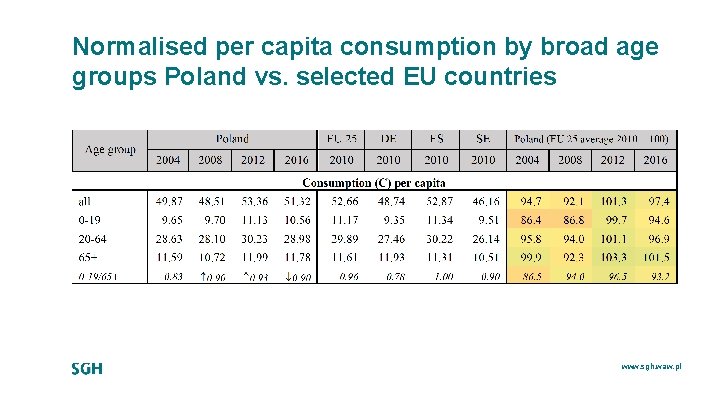
Normalised per capita consumption by broad age groups Poland vs. selected EU countries www. sgh. waw. pl

Public consumption (normalised) 0. 40 0. 35 0. 30 0. 25 0. 20 0. 15 0. 10 0. 05 0. 00 0 5 10 15 20 25 30 35 40 45 50 55 60 65 70 75 CG aggregate 2016 CG aggregate 2012 CG aggregate 2008 CG aggregate 2004 0. 00 0 5 10 15 20 25 30 35 40 45 50 55 60 65 70 75 80 CG per capita 2016 CG per capita 2012 CG per capita 2008 CG per capita 2004 www. sgh. waw. pl Source: Chłoń-Domińczak and Łątkowski (2019)
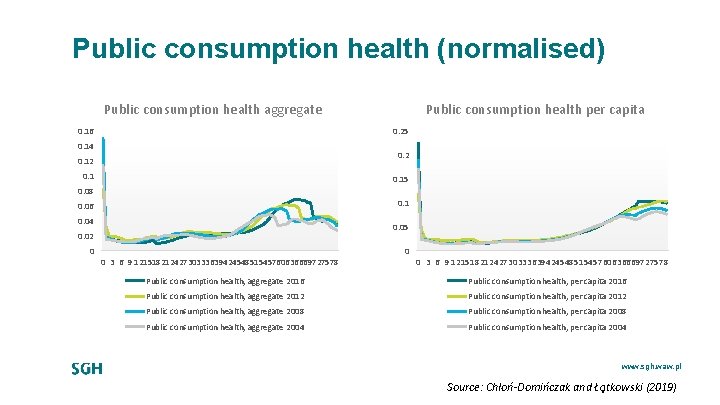
Public consumption health (normalised) Public consumption health aggregate 0. 16 Public consumption health per capita 0. 25 0. 14 0. 2 0. 15 0. 08 0. 1 0. 06 0. 04 0. 05 0. 02 0 0 3 6 9 1215182124273033363942454851545760636669727578 Public consumption health, aggregate 2016 Public consumption health, per capita 2016 Public consumption health, aggregate 2012 Public consumption health, per capita 2012 Public consumption health, aggregate 2008 Public consumption health, per capita 2008 Public consumption health, aggregate 2004 Public consumption health, per capita 2004 www. sgh. waw. pl Source: Chłoń-Domińczak and Łątkowski (2019)
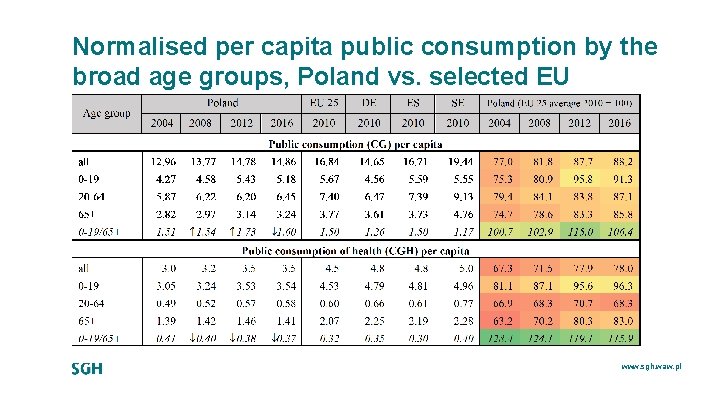
Normalised per capita public consumption by the broad age groups, Poland vs. selected EU countries www. sgh. waw. pl
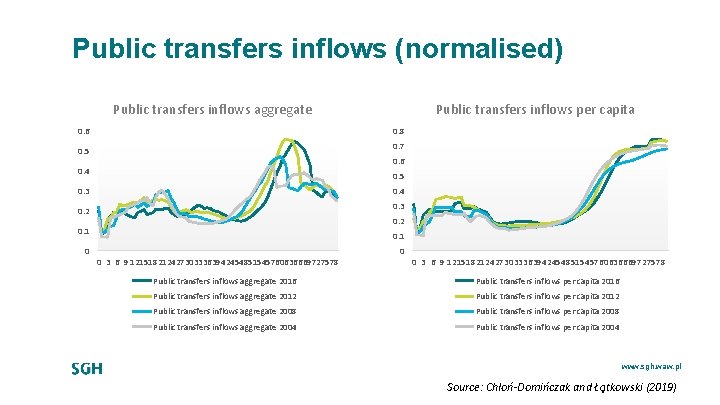
Public transfers inflows (normalised) Public transfers inflows aggregate 0. 6 0. 8 0. 7 0. 5 0. 6 0. 4 0. 5 0. 3 0. 4 0. 3 0. 2 0. 1 0 Public transfers inflows per capita 0. 1 0 3 6 9 1215182124273033363942454851545760636669727578 0 0 3 6 9 1215182124273033363942454851545760636669727578 Public transfers inflows aggregate 2016 Public transfers inflows per capita 2016 Public transfers inflows aggregate 2012 Public transfers inflows per capita 2012 Public transfers inflows aggregate 2008 Public transfers inflows per capita 2008 Public transfers inflows aggregate 2004 Public transfers inflows per capita 2004 www. sgh. waw. pl Source: Chłoń-Domińczak and Łątkowski (2019)
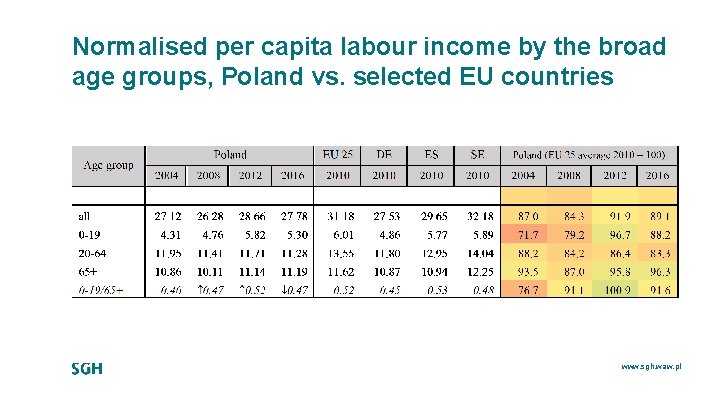
Normalised per capita labour income by the broad age groups, Poland vs. selected EU countries www. sgh. waw. pl

Labour income (normalised) Labour Income aggregate Labour income per capita 1. 4 1. 2 1 1 0. 8 0. 6 0. 4 0. 2 0 Shift of the age profile due to higher effective retirement age and increased labour market participation 0 3 6 9 1215182124273033363942454851545760636669727578 0 0 3 6 9 1215182124273033363942454851545760636669727578 Labour income aggregate 2016 Labour income per capita 2016 Labour income aggregate 2012 Labour income per capita 2012 Labour income aggregate 2008 Labour income per capita 2008 Labour income aggregate 2004 Labour income per capita 2004 www. sgh. waw. pl Source: Chłoń-Domińczak and Łątkowski (2019)

Normalised per capita labour income by the broad age groups, Poland vs. selected EU countries www. sgh. waw. pl
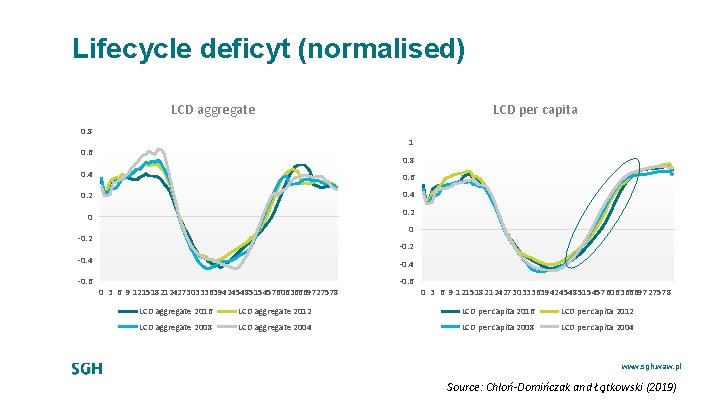
Lifecycle deficyt (normalised) LCD aggregate LCD per capita 0. 8 1 0. 6 0. 8 0. 4 0. 6 0. 2 0. 4 0. 2 0 0 -0. 2 -0. 4 -0. 6 -0. 4 0 3 6 9 1215182124273033363942454851545760636669727578 -0. 6 0 3 6 9 1215182124273033363942454851545760636669727578 LCD aggregate 2016 LCD aggregate 2012 LCD per capita 2016 LCD per capita 2012 LCD aggregate 2008 LCD aggregate 2004 LCD per capita 2008 LCD per capita 2004 www. sgh. waw. pl Source: Chłoń-Domińczak and Łątkowski (2019)
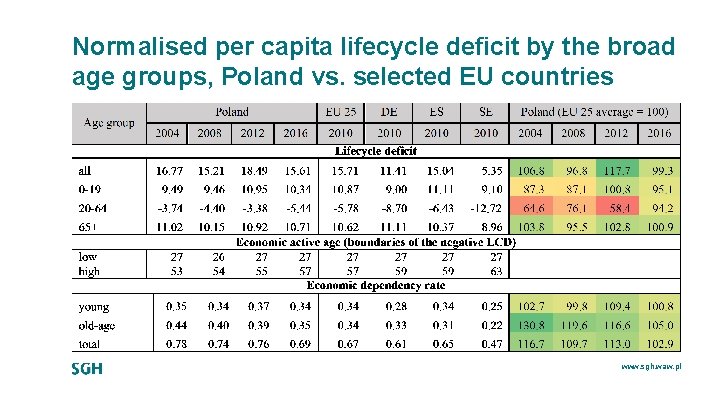
Normalised per capita lifecycle deficit by the broad age groups, Poland vs. selected EU countries www. sgh. waw. pl
Conclusions • Total changes in the aggregate consumption, labour income, and the LCD between 2004 and 2016 were affected mainly by the growth in wages and the shifts in the per capita age profiles; and, albeit to a smaller extent, by the shifts in the age structure • The changing age structure would have led to an increase in the LCD, but the age impact was reversed by growing wages and evolving age profiles. • Labour income grew faster than consumption, hence the increase in the LCD was smaller (in real terms) www. sgh. waw. pl
Conclusions • There have also been changes in the generational distribution of the consumption, labour income, and the lifecycle deficit. • The smaller per capita normalised consumption that we observed for people in the 55 -65 age group, combined with the shift in the per capita labour income, also reflect the extension of the boundaries of economically active ages. • While the lower age limit remained similar at age 27 – and is the same as the level in the European countries compared here – the upper age limit increased from 55 years in 2004 to 57 years in 2016. Despite this increase, 57 years was still below the EU average www. sgh. waw. pl
Conclusions • In the case of consumption, the age profiles in Poland became similar to the EU-25 average, but also quite similar to those in Spain • Moreover, there was a gradual reduction in the gap in public consumption between the EU average and Poland for all generations • While the per capita labour income in Poland also increased for people of working ages (20 -64 years), it remained below the values observed in the EU 25, as well as in all analysed countries • The NTA-based economic dependency of the senior generation declined, and is currently similar to the EU average and to that in Germany and Spain, but is higher than that in Sweden www. sgh. waw. pl
- Slides: 23