
Evolution of the Atmosphere Structure and Composition Yo
- Slides: 32
Evolution of the Atmosphere: Structure and Composition Yo, who turned up the Issues Composition Evolution Structure Summary © 2003, Perry Samson, University of Michigan
Evolution of the Atmosphere: Structure and Composition Today’s Issues: Issues Composition Evolution Structure Summary Driving Questions 1. The composition of the atmosphere has changed quite naturally in the past. How did THAT happen? 2. How is moisture affected by temperature and why is that important? 3. What are our dominant atmospheric gases and what are their sources? 4. The thermal characteristics of our atmosphere vary with altitude. How and Why? Last Samson, Updated: University 26 February 2021 © 2003, Perry of Michigan
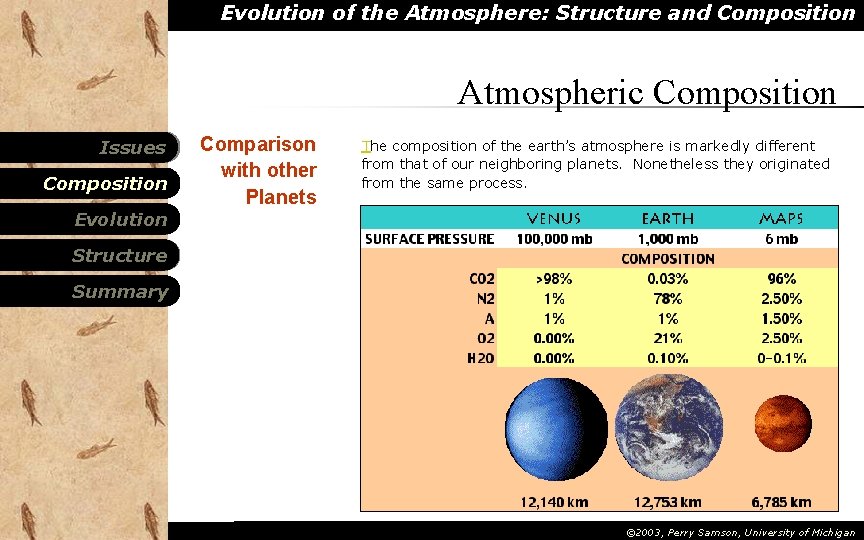
Evolution of the Atmosphere: Structure and Composition Atmospheric Composition Issues Composition Evolution Comparison with other Planets The composition of the earth’s atmosphere is markedly different from that of our neighboring planets. Nonetheless they originated from the same process. Structure Summary © 2003, Perry Samson, University of Michigan
Evolution of the Atmosphere: Structure and Composition Actual Temperatures Issues Composition Evolution Structure Summary Temperatures decreasing with distance © 2003, Perry Samson, University of Michigan
Evolution of the Atmosphere: Structure and Composition Atmospheric Composition Issues Composition Evolution Structure Summary Stages of Atmospheric Formation 1. Origin In formative years the atmosphere was composed of H and He. 2. Chemical/ pre-biological era Atmosphere formed from volcanic outgassing lead dominated by water vapor, CO 2, SO 2 and others. 3. Microbial era Initial O 2 formed through photolysis allowed ozone layer, early microbes emitted O 2 as waste product. 4. Biological era Simultaneous decrease in atmospheric CO 2 and the increase in O 2 due to life processes. © 2003, Perry Samson, University of Michigan
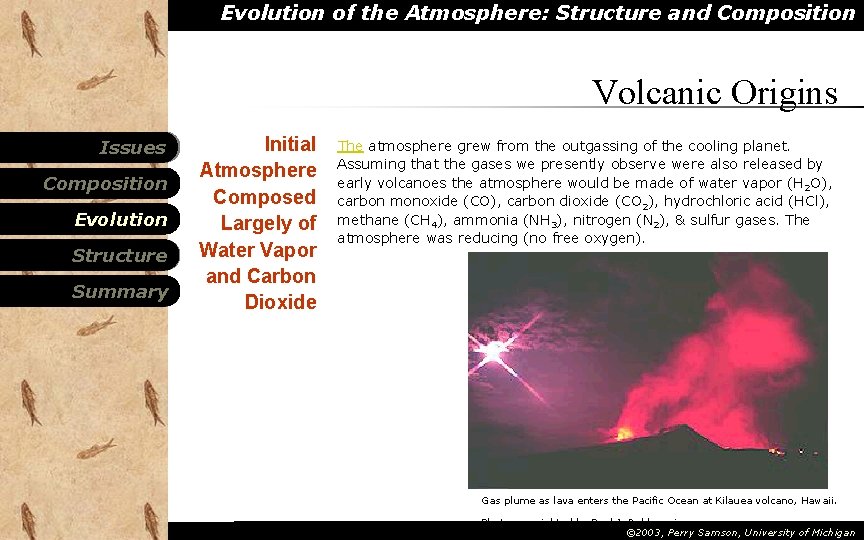
Evolution of the Atmosphere: Structure and Composition Volcanic Origins Issues Composition Evolution Structure Summary Initial Atmosphere Composed Largely of Water Vapor and Carbon Dioxide The atmosphere grew from the outgassing of the cooling planet. Assuming that the gases we presently observe were also released by early volcanoes the atmosphere would be made of water vapor (H 2 O), carbon monoxide (CO), carbon dioxide (CO 2), hydrochloric acid (HCl), methane (CH 4), ammonia (NH 3), nitrogen (N 2), & sulfur gases. The atmosphere was reducing (no free oxygen). Gas plume as lava enters the Pacific Ocean at Kilauea volcano, Hawaii. Photo copyrighted by Paul J. Buklarewicz. © 2003, Perry Samson, University of Michigan
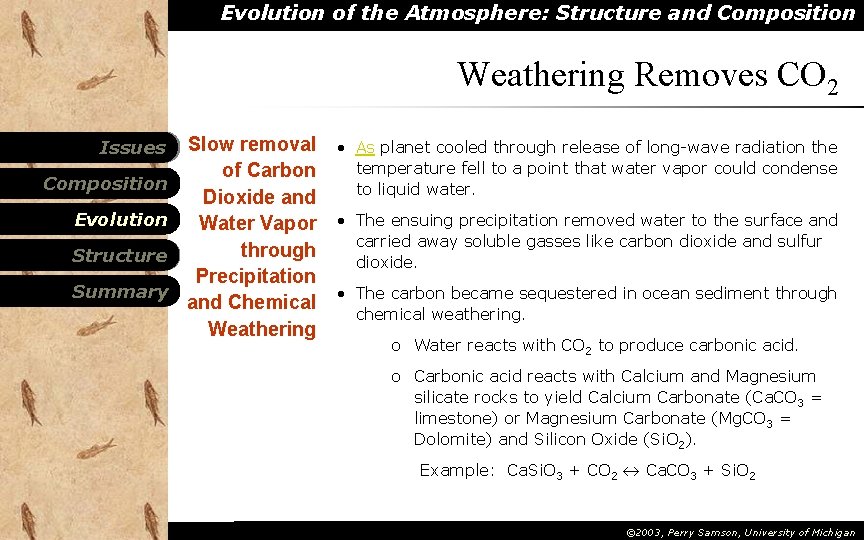
Evolution of the Atmosphere: Structure and Composition Weathering Removes CO 2 Issues Composition Evolution Structure Summary Slow removal of Carbon Dioxide and Water Vapor through Precipitation and Chemical Weathering • As planet cooled through release of long-wave radiation the temperature fell to a point that water vapor could condense to liquid water. • The ensuing precipitation removed water to the surface and carried away soluble gasses like carbon dioxide and sulfur dioxide. • The carbon became sequestered in ocean sediment through chemical weathering. o Water reacts with CO 2 to produce carbonic acid. o Carbonic acid reacts with Calcium and Magnesium silicate rocks to yield Calcium Carbonate (Ca. CO 3 = limestone) or Magnesium Carbonate (Mg. CO 3 = Dolomite) and Silicon Oxide (Si. O 2). Example: Ca. Si. O 3 + CO 2 Ca. CO 3 + Si. O 2 © 2003, Perry Samson, University of Michigan
Evolution of the Atmosphere: Structure and Composition Cooling Removes Water Vapor Issues The amount of water the atmosphere Evolution can hold is a Structure function of its temperature. Composition Summary Clausius-Clapyron Relationship © 2003, Perry Samson, University of Michigan
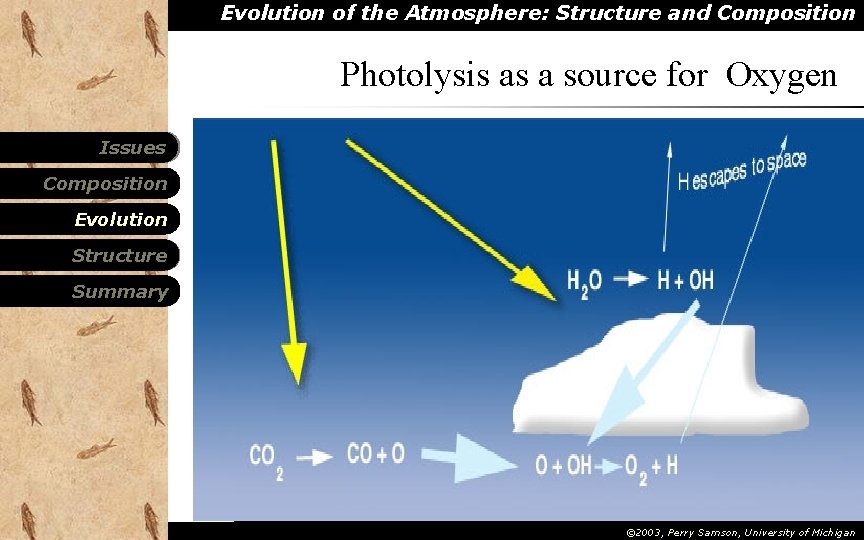
Evolution of the Atmosphere: Structure and Composition Photolysis as a source for Oxygen Issues Composition Evolution Structure Summary © 2003, Perry Samson, University of Michigan
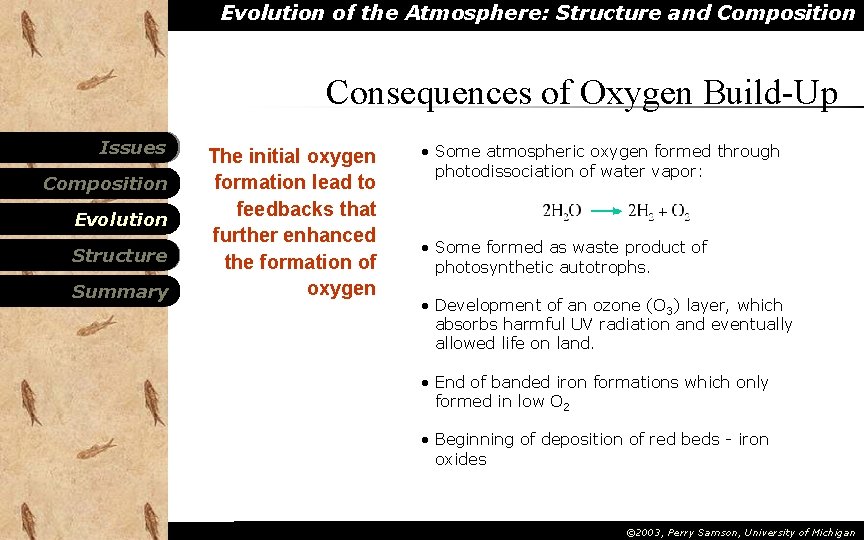
Evolution of the Atmosphere: Structure and Composition Consequences of Oxygen Build-Up Issues Composition Evolution Structure Summary The initial oxygen formation lead to feedbacks that further enhanced the formation of oxygen • Some atmospheric oxygen formed through photodissociation of water vapor: • Some formed as waste product of photosynthetic autotrophs. • Development of an ozone (O 3) layer, which absorbs harmful UV radiation and eventually allowed life on land. • End of banded iron formations which only formed in low O 2 • Beginning of deposition of red beds - iron oxides © 2003, Perry Samson, University of Michigan
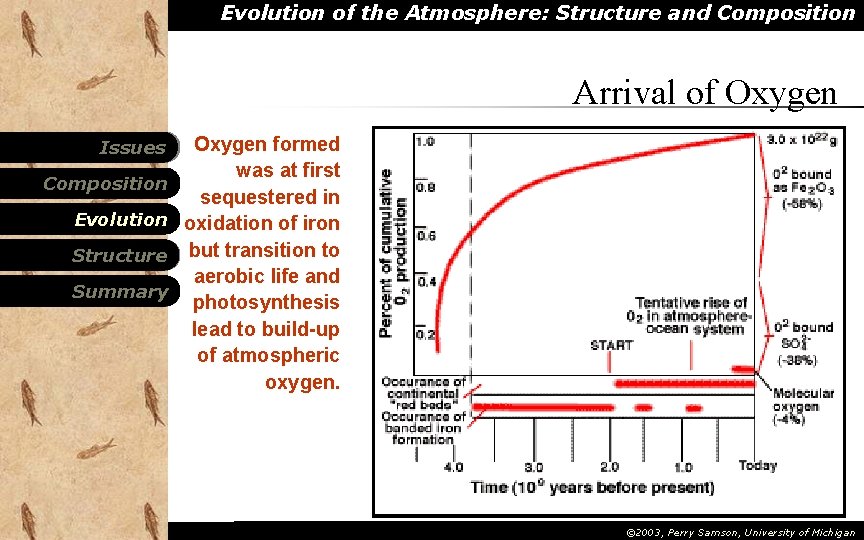
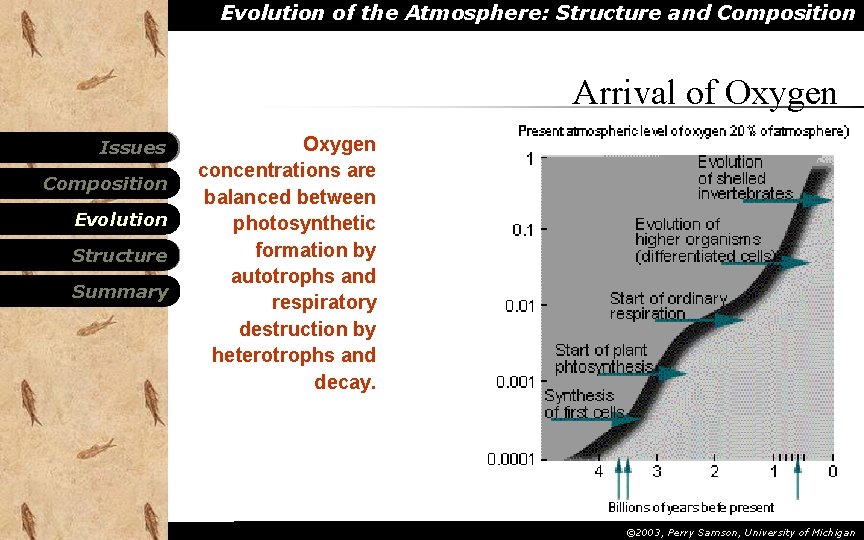
Evolution of the Atmosphere: Structure and Composition Arrival of Oxygen Issues Composition Evolution Structure Summary Oxygen formed was at first sequestered in oxidation of iron but transition to aerobic life and photosynthesis lead to build-up of atmospheric oxygen. © 2003, Perry Samson, University of Michigan
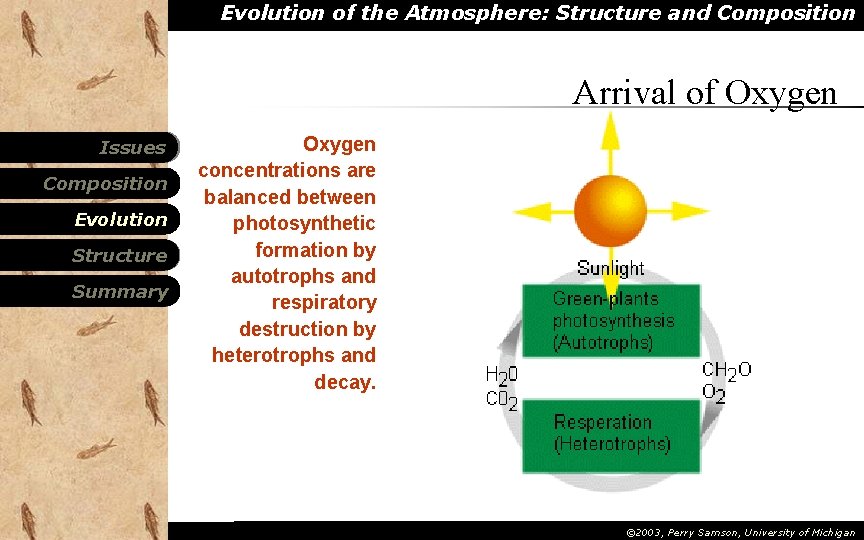
Evolution of the Atmosphere: Structure and Composition Arrival of Oxygen Issues Composition Evolution Structure Summary Oxygen concentrations are balanced between photosynthetic formation by autotrophs and respiratory destruction by heterotrophs and decay. © 2003, Perry Samson, University of Michigan
Evolution of the Atmosphere: Structure and Composition Arrival of Oxygen Issues Composition Evolution Structure Summary Oxygen concentrations are balanced between photosynthetic formation by autotrophs and respiratory destruction by heterotrophs and decay. © 2003, Perry Samson, University of Michigan
Evolution of the Atmosphere: Structure and Composition Changes in Atmospheric Composition Issues Composition Evolution Structure Changes in CO 2 We know the concentration of some gases have changed significantly over time. Geochemically inferred. Summary NOW © 2003, Perry Samson, University of Michigan
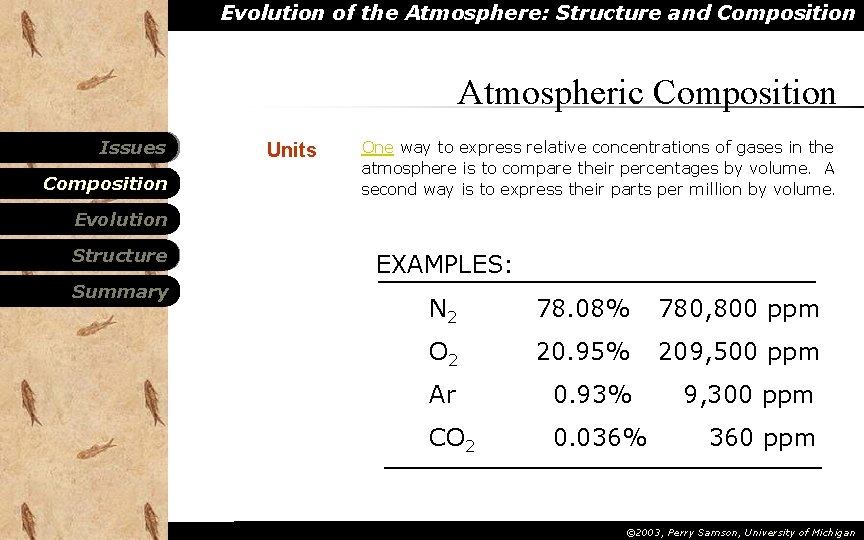
Evolution of the Atmosphere: Structure and Composition Atmospheric Composition Issues Composition Units One way to express relative concentrations of gases in the atmosphere is to compare their percentages by volume. A second way is to express their parts per million by volume. Evolution Structure Summary EXAMPLES: N 2 78. 08% 780, 800 ppm O 2 20. 95% 209, 500 ppm Ar 0. 93% 9, 300 ppm CO 2 0. 036% 360 ppm © 2003, Perry Samson, University of Michigan
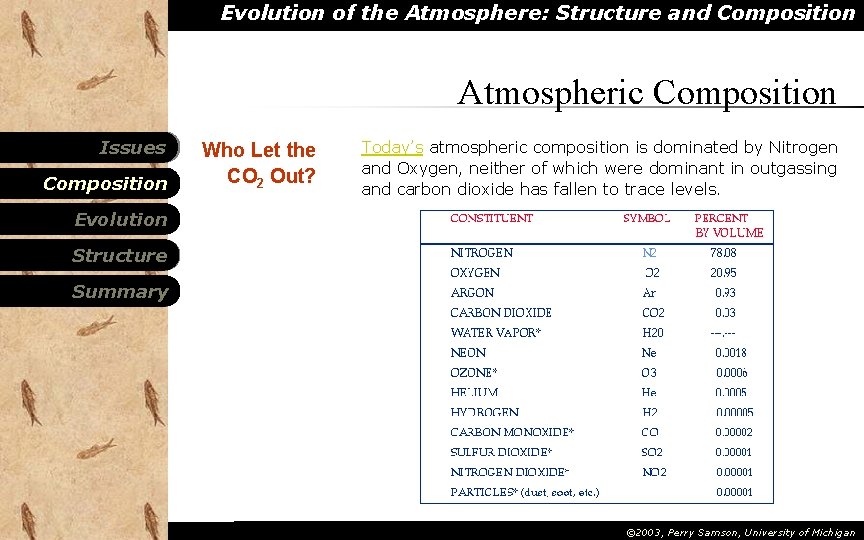
Evolution of the Atmosphere: Structure and Composition Atmospheric Composition Issues Composition Who Let the CO 2 Out? Today’s atmospheric composition is dominated by Nitrogen and Oxygen, neither of which were dominant in outgassing and carbon dioxide has fallen to trace levels. Evolution Structure Summary © 2003, Perry Samson, University of Michigan
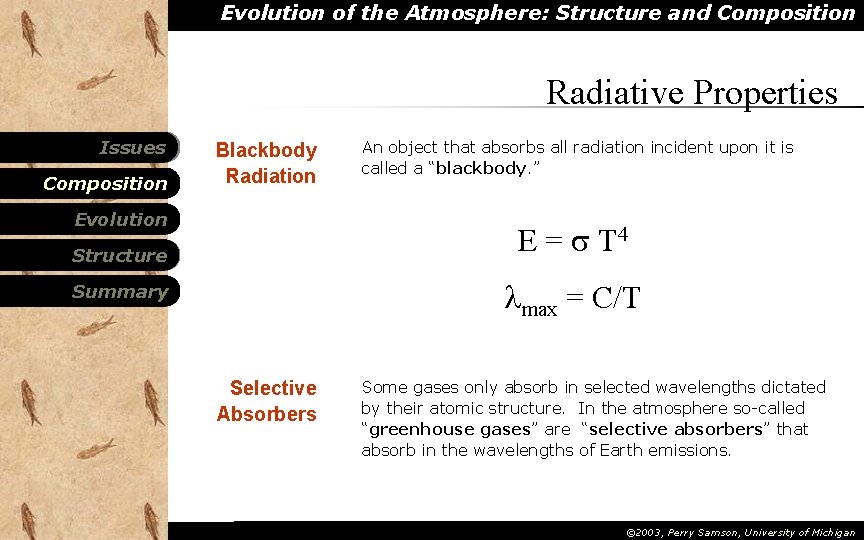
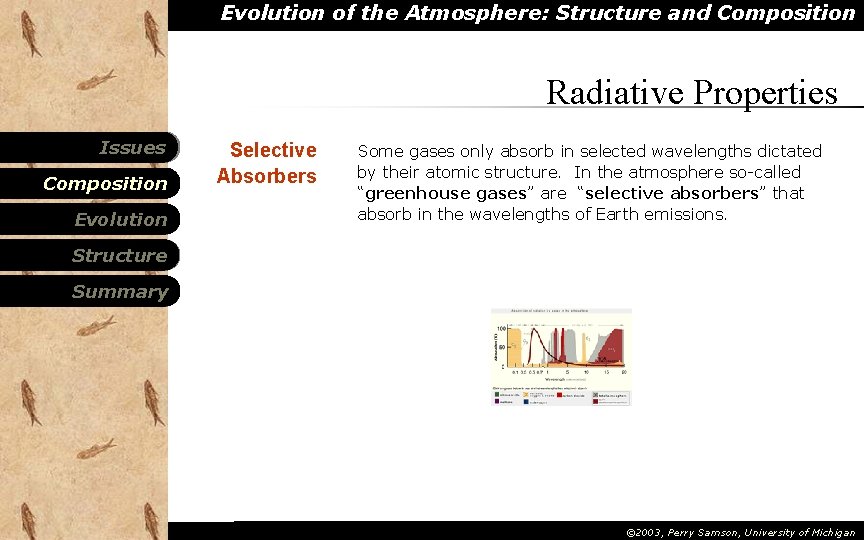
Evolution of the Atmosphere: Structure and Composition Radiative Properties Issues Composition Blackbody Radiation Evolution An object that absorbs all radiation incident upon it is called a “blackbody. ” E = T 4 Structure max = C/T Summary Selective Absorbers Some gases only absorb in selected wavelengths dictated by their atomic structure. In the atmosphere so-called “greenhouse gases” are “selective absorbers” that absorb in the wavelengths of Earth emissions. © 2003, Perry Samson, University of Michigan
Evolution of the Atmosphere: Structure and Composition Radiation Issues Composition Evolution Structure Summary Solar shortwave radiation is centered at 0. 5 µm wavelength 1 µm = 10 -6 m © 2003, Perry Samson, University of Michigan
Evolution of the Atmosphere: Structure and Composition Radiative Properties Issues Composition Evolution Selective Absorbers Some gases only absorb in selected wavelengths dictated by their atomic structure. In the atmosphere so-called “greenhouse gases” are “selective absorbers” that absorb in the wavelengths of Earth emissions. Structure Summary © 2003, Perry Samson, University of Michigan
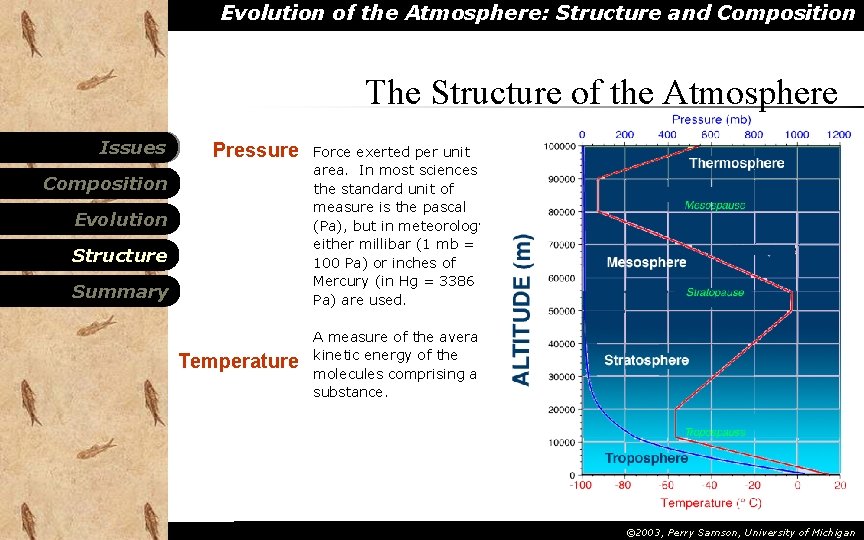
Evolution of the Atmosphere: Structure and Composition The Structure of the Atmosphere Issues Pressure Composition Evolution Structure Summary Temperature Force exerted per unit area. In most sciences the standard unit of measure is the pascal (Pa), but in meteorology either millibar (1 mb = 100 Pa) or inches of Mercury (in Hg = 3386 Pa) are used. A measure of the average kinetic energy of the molecules comprising a substance. © 2003, Perry Samson, University of Michigan
Evolution of the Atmosphere: Structure and Composition The Structure of the Atmosphere Issues Pressure Force exerted per unit area. In most sciences the standard unit of measure is the pascal (Pa), but in meteorology either millibar (1 mb = 100 Pa) or inches of Mercury (in Hg = 3386 Pa) are used. Temperature A measure of the average kinetic energy of the molecules comprising a substance. Composition Evolution Structure Summary © 2003, Perry Samson, University of Michigan
Evolution of the Atmosphere: Structure and Composition Radiation Issues Composition Evolution Structure Summary Solar shortwave radiation is centered at 0. 5 µm wavelength © 2003, Perry Samson, University of Michigan
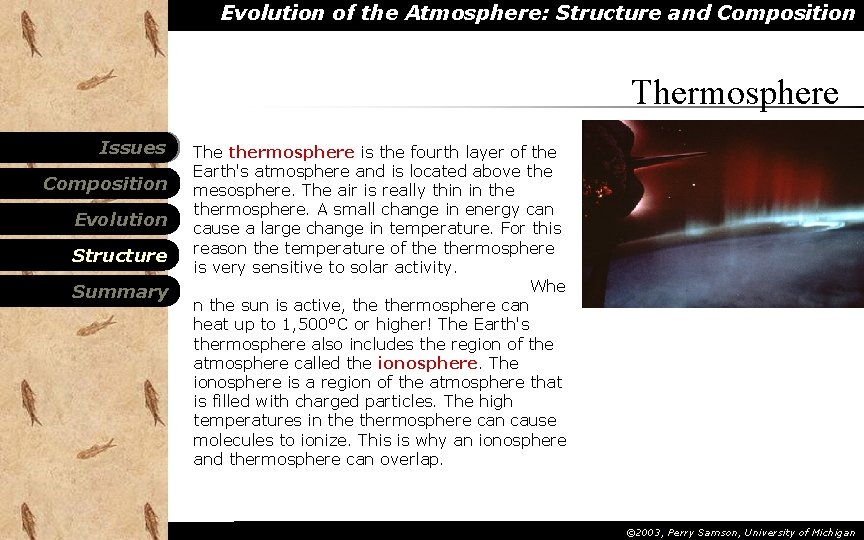
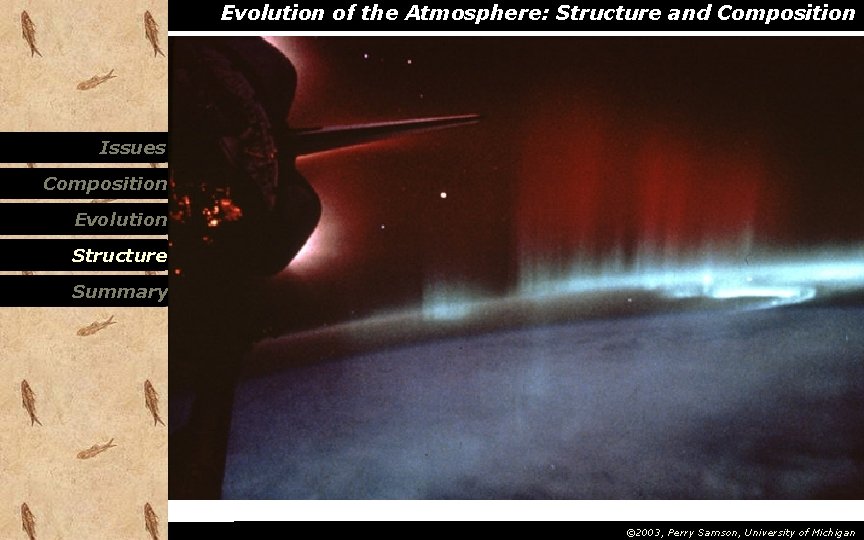
Evolution of the Atmosphere: Structure and Composition Thermosphere Issues Composition Evolution Structure Summary The thermosphere is the fourth layer of the Earth's atmosphere and is located above the mesosphere. The air is really thin in thermosphere. A small change in energy can cause a large change in temperature. For this reason the temperature of thermosphere is very sensitive to solar activity. Whe n the sun is active, thermosphere can heat up to 1, 500°C or higher! The Earth's thermosphere also includes the region of the atmosphere called the ionosphere. The ionosphere is a region of the atmosphere that is filled with charged particles. The high temperatures in thermosphere can cause molecules to ionize. This is why an ionosphere and thermosphere can overlap. © 2003, Perry Samson, University of Michigan
Evolution of the Atmosphere: Structure and Composition Thermosphere Issues Composition Evolution Structure Summary © 2003, Perry Samson, University of Michigan
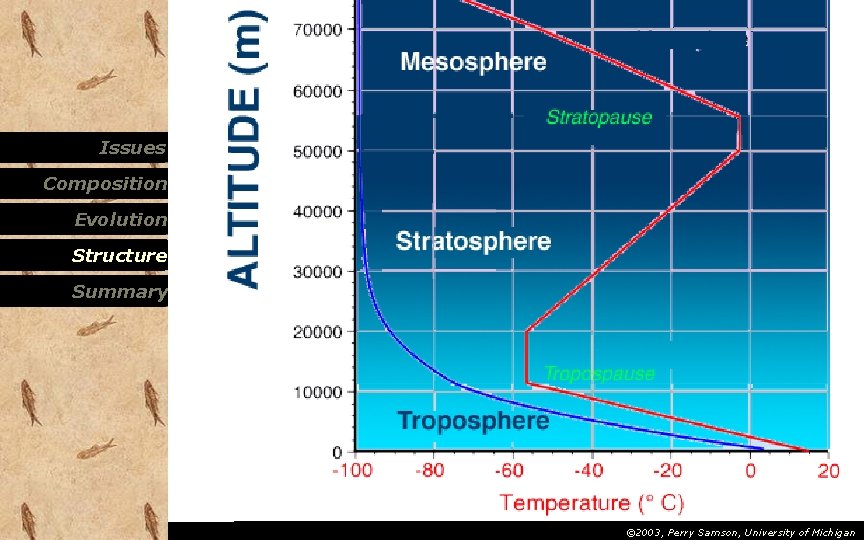
Evolution of the Atmosphere: Structure and Composition Mesosphere Issues Composition Evolution Structure In the Earth's mesosphere, the air is relatively mixed together and the temperature decreases with altitude. The atmosphere reaches its coldest temperature of around 90°C in the mesosphere. This is also the layer in which a lot of meteors burn up while entering the Earth's atmosphere. Summary © 2003, Perry Samson, University of Michigan
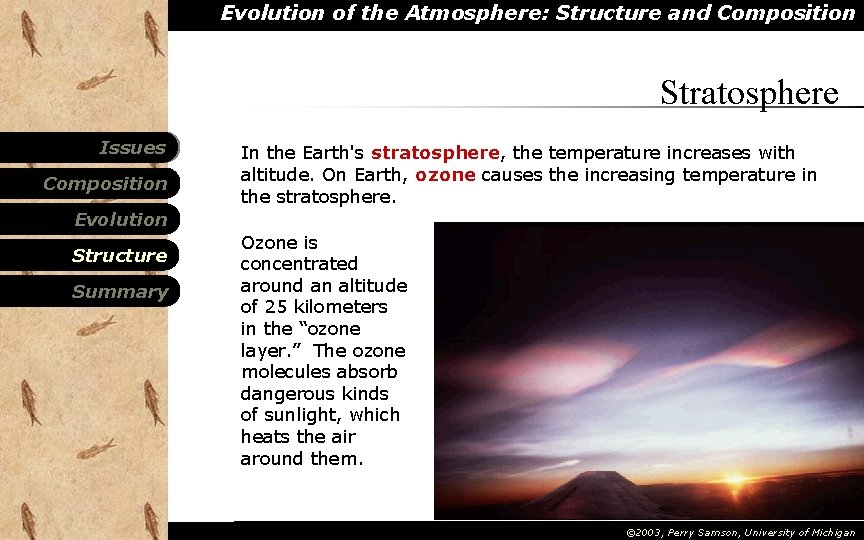
Evolution of the Atmosphere: Structure and Composition Stratosphere Issues Composition In the Earth's stratosphere, the temperature increases with altitude. On Earth, ozone causes the increasing temperature in the stratosphere. Evolution Structure Summary Ozone is concentrated around an altitude of 25 kilometers in the “ozone layer. ” The ozone molecules absorb dangerous kinds of sunlight, which heats the air around them. © 2003, Perry Samson, University of Michigan
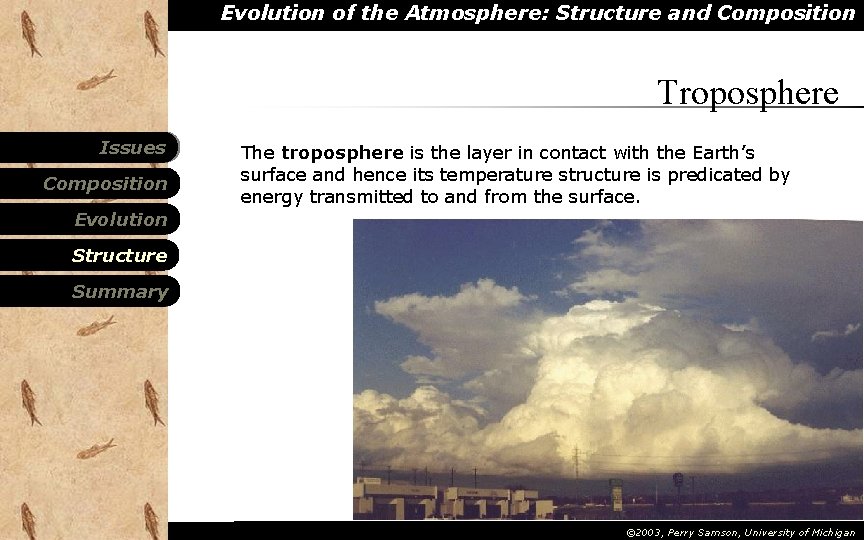
Evolution of the Atmosphere: Structure and Composition Troposphere Issues Composition The troposphere is the layer in contact with the Earth’s surface and hence its temperature structure is predicated by energy transmitted to and from the surface. Evolution Structure Summary © 2003, Perry Samson, University of Michigan
Evolution of the Atmosphere: Structure and Composition Summary Issues Composition Evolution Driving Questions 1. The composition of the atmosphere has changed quite naturally in the past. How did that happen? Structure Summary Keywords: • Outgassing • Chemical weathering • Photosynthesis • Photolysis • Oxidation © 2003, Perry Samson, University of Michigan
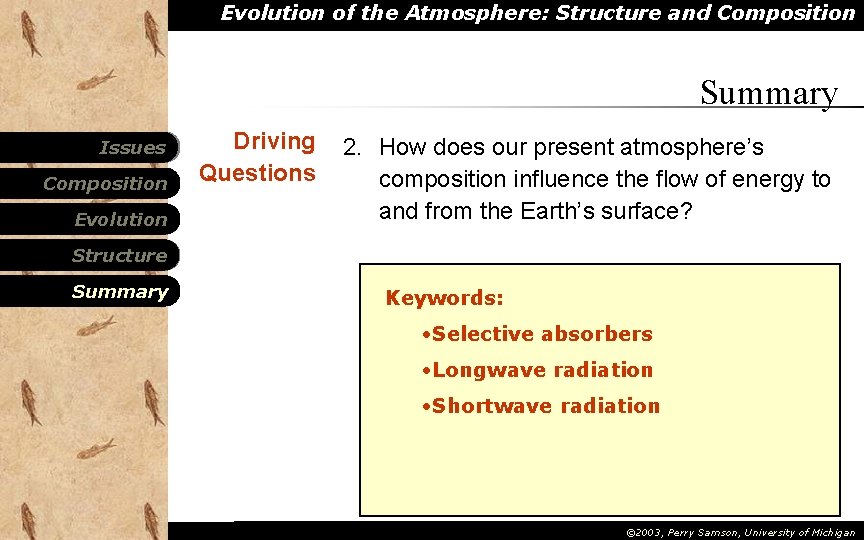
Evolution of the Atmosphere: Structure and Composition Summary Issues Composition Evolution Driving Questions 2. How does our present atmosphere’s composition influence the flow of energy to and from the Earth’s surface? Structure Summary Keywords: • Selective absorbers • Longwave radiation • Shortwave radiation © 2003, Perry Samson, University of Michigan
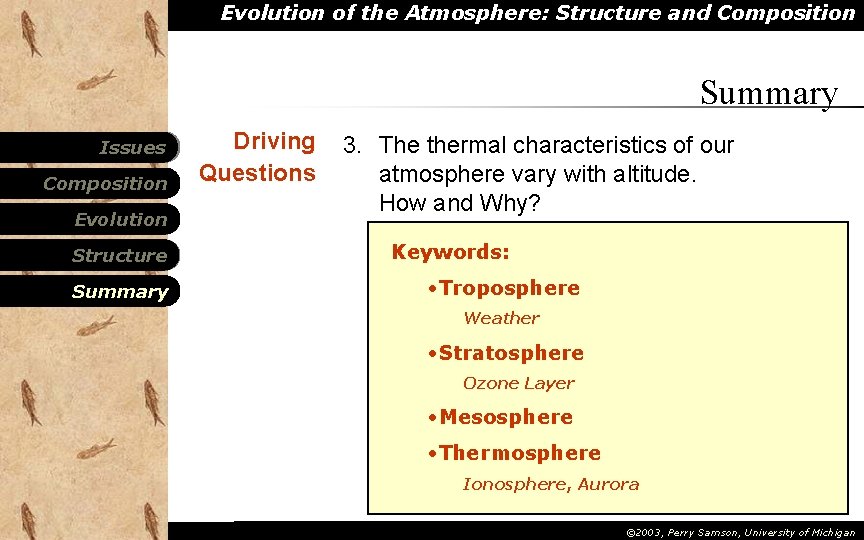
Evolution of the Atmosphere: Structure and Composition Summary Issues Composition Evolution Structure Summary Driving Questions 3. The thermal characteristics of our atmosphere vary with altitude. How and Why? Keywords: • Troposphere Weather • Stratosphere Ozone Layer • Mesosphere • Thermosphere Ionosphere, Aurora © 2003, Perry Samson, University of Michigan
Evolution of the Atmosphere: Structure and Composition Energy Balance Controls Temperature Issues Composition Energy Balance Ultimately the selective absorbers influence the flow (flux) of energy to and from the earth’s surface. Evolution Structure Summary © 2003, Perry Samson, University of Michigan
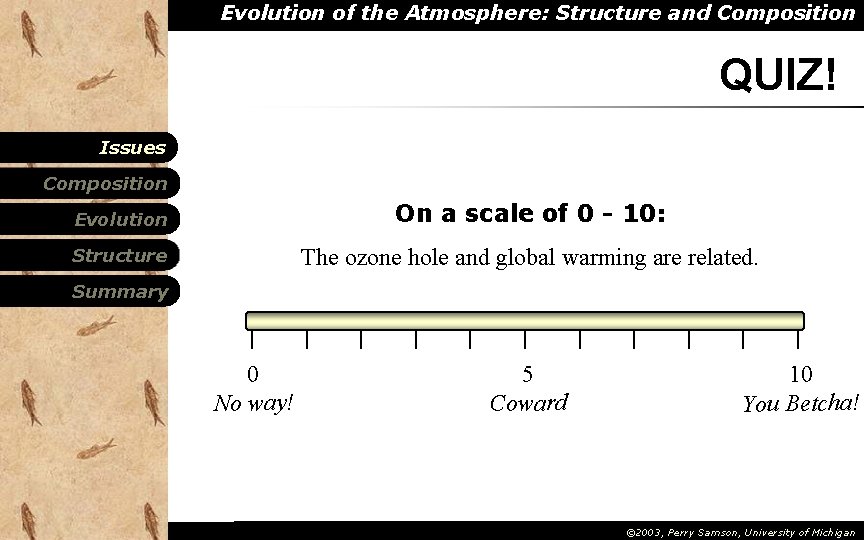
Evolution of the Atmosphere: Structure and Composition QUIZ! Issues Composition Evolution On a scale of 0 - 10: Structure The ozone hole and global warming are related. Summary 0 No way! 5 Coward 10 You Betcha! Last Samson, Updated: University 26 February 2021 © 2003, Perry of Michigan