
Evolution of the Animal Phyla Chapter 19 Copyright

- Slides: 45
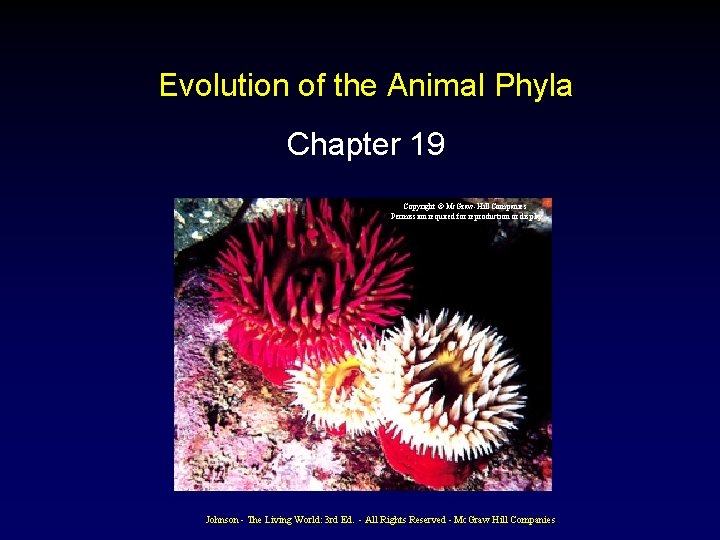
Evolution of the Animal Phyla Chapter 19 Copyright © Mc. Graw-Hill Companies Permission required for reproduction or display Johnson - The Living World: 3 rd Ed. - All Rights Reserved - Mc. Graw Hill Companies
Outline • • • Sponges Cnidarians Solid Worms Roundworms Mollusks Annelids Arthropods Echinoderms Chordates Johnson - The Living World: 3 rd Ed. - All Rights Reserved - Mc. Graw Hill Companies
General Features of Animals • • • All animals are multicellular heterotrophs. Invertebrates account for 99% of all species. Animal Kingdom includes about 36 phyla. v Most occur in the sea. v Three phyla dominate animal life on land. - Arthropoda (spiders and insects) - Mollusca (snails) - Chordata (vertebrates) Johnson - The Living World: 3 rd Ed. - All Rights Reserved - Mc. Graw Hill Companies
General Features of Animals • • • Animal cells lack rigid cell walls and are usually quite flexible. Members of the animal kingdom tend to move more rapidly and in more complex ways than members of other kingdoms. Most animals reproduce sexually. v Embryonic Development - Morula - Blastula Johnson - The Living World: 3 rd Ed. - All Rights Reserved - Mc. Graw Hill Companies
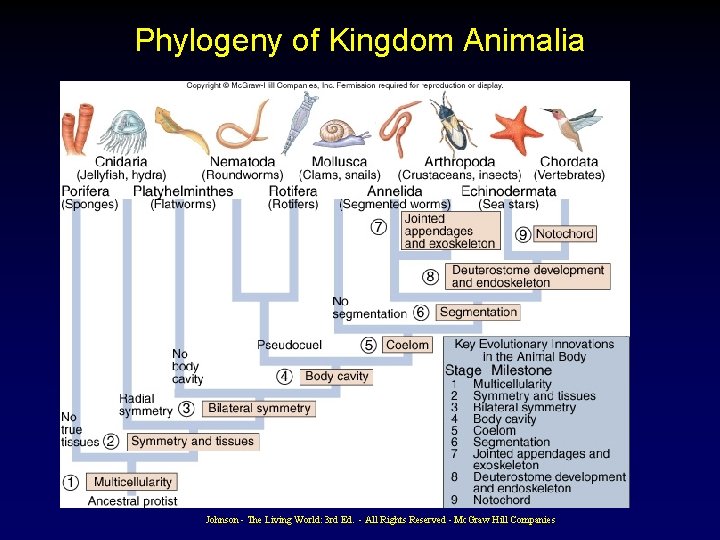
Phylogeny of Kingdom Animalia Johnson - The Living World: 3 rd Ed. - All Rights Reserved - Mc. Graw Hill Companies
Sponges • • Kingdom Animalia has two subkingdoms: v Parazoa - lack definite symmetry and tissues organized into organs. - Dominated by sponges (Porifera). v Eumetazoa - have definite shape and symmetry and highly specialized cells. Sponges are simplest animals. v Bodies consist of masses of specialized cells embedded in gel-like matrix. Johnson - The Living World: 3 rd Ed. - All Rights Reserved - Mc. Graw Hill Companies
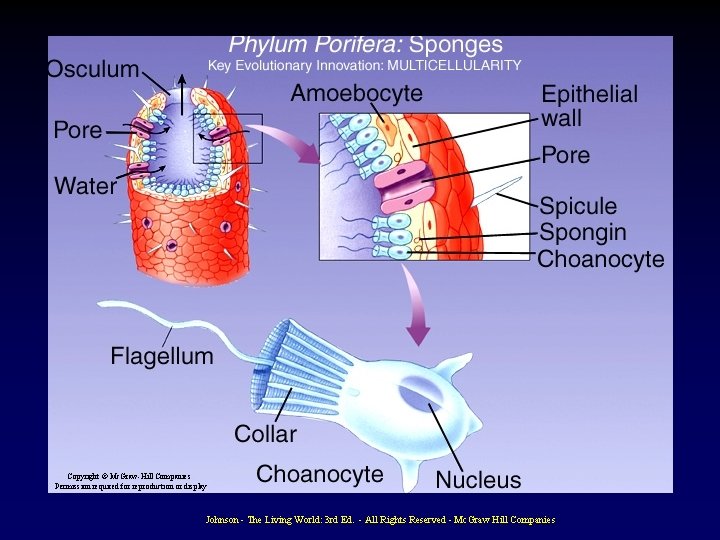
Sponges • • Phylum name, Porifera, refers to system of pores found in body of sponges. Flagellated cells, choanocytes (collar cells) line body cavity. v Draws water into body. - Filter feeders Copyright © Mc. Graw-Hill Companies Permission required for reproduction or display Johnson - The Living World: 3 rd Ed. - All Rights Reserved - Mc. Graw Hill Companies
Copyright © Mc. Graw-Hill Companies Permission required for reproduction or display Johnson - The Living World: 3 rd Ed. - All Rights Reserved - Mc. Graw Hill Companies
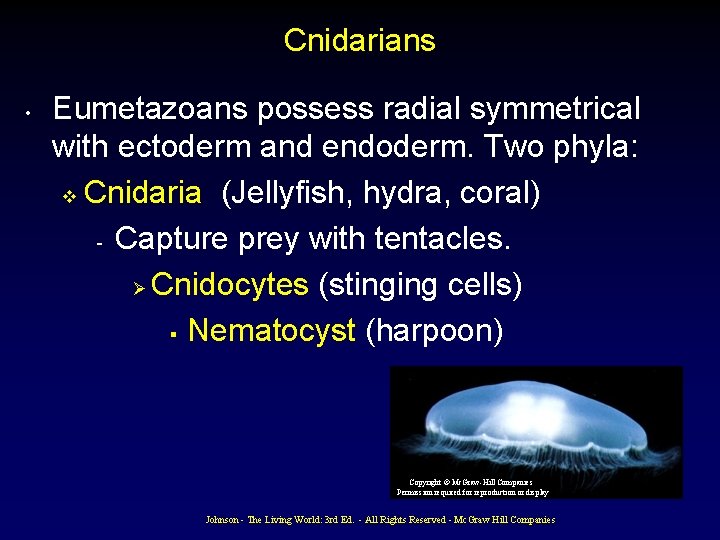
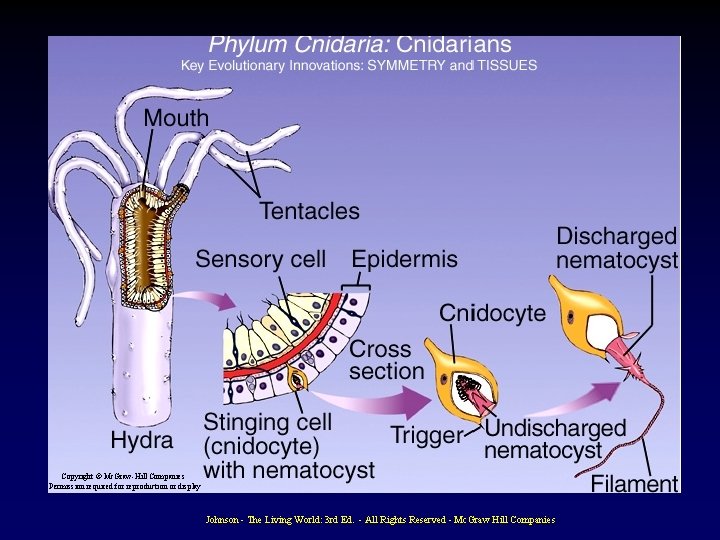
Cnidarians • Eumetazoans possess radial symmetrical with ectoderm and endoderm. Two phyla: v Cnidaria (Jellyfish, hydra, coral) - Capture prey with tentacles. Ø Cnidocytes (stinging cells) § Nematocyst (harpoon) Copyright © Mc. Graw-Hill Companies Permission required for reproduction or display Johnson - The Living World: 3 rd Ed. - All Rights Reserved - Mc. Graw Hill Companies
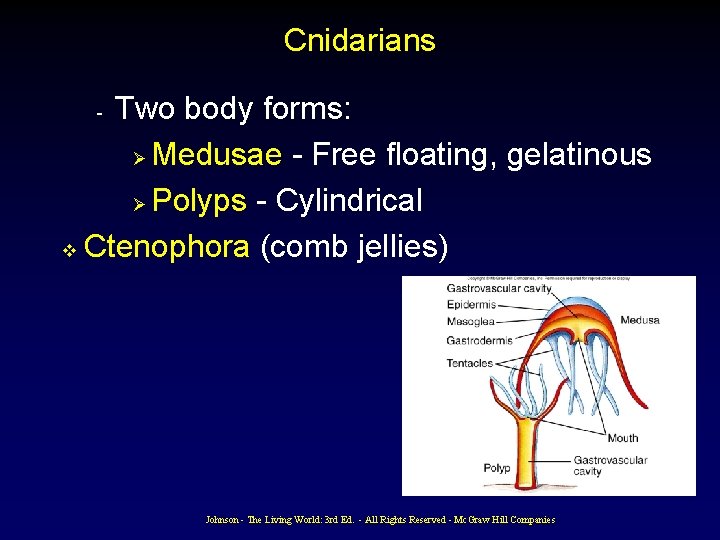
Cnidarians Two body forms: Ø Medusae - Free floating, gelatinous Ø Polyps - Cylindrical v Ctenophora (comb jellies) - Johnson - The Living World: 3 rd Ed. - All Rights Reserved - Mc. Graw Hill Companies
Copyright © Mc. Graw-Hill Companies Permission required for reproduction or display Johnson - The Living World: 3 rd Ed. - All Rights Reserved - Mc. Graw Hill Companies
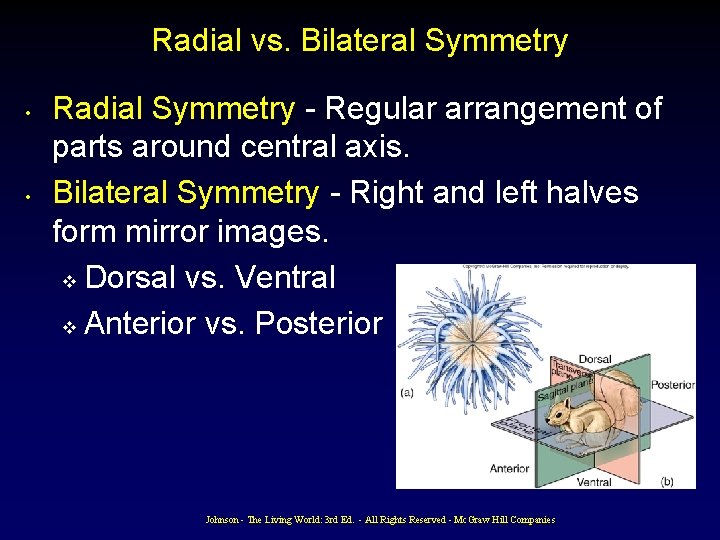
Radial vs. Bilateral Symmetry • • Radial Symmetry - Regular arrangement of parts around central axis. Bilateral Symmetry - Right and left halves form mirror images. v Dorsal vs. Ventral v Anterior vs. Posterior Johnson - The Living World: 3 rd Ed. - All Rights Reserved - Mc. Graw Hill Companies
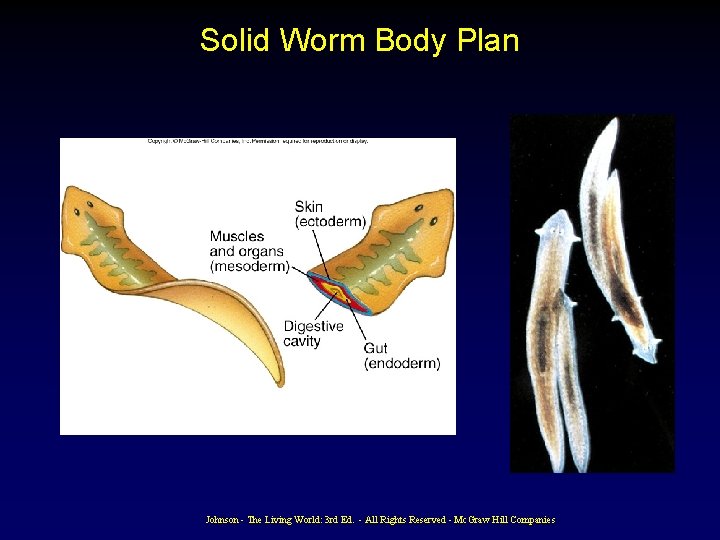
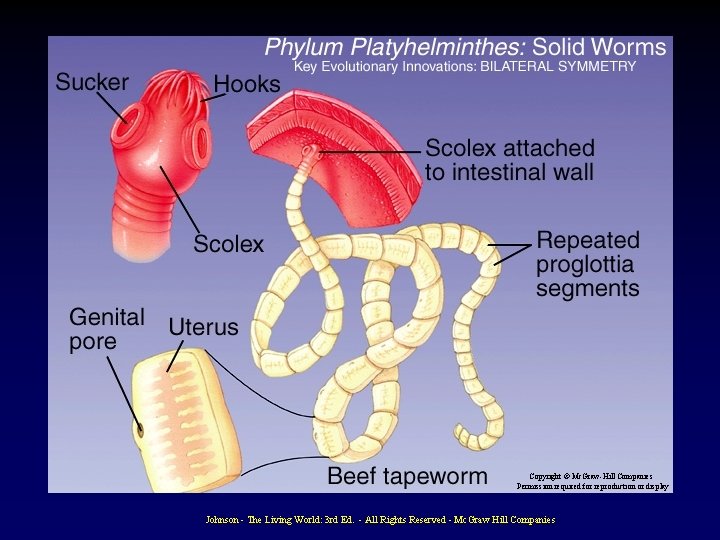
Solid Worms • • Simplest of all bilaterally-symmetrical animals. v Ectoderm - Gives rise to outer covering and nervous system. v Mesoderm - Gives rise to digestive organs and intestines. v Endoderm - Gives rise to skeleton and muscles. Lack internal cavity, except for digestive tract (acoelomate). Johnson - The Living World: 3 rd Ed. - All Rights Reserved - Mc. Graw Hill Companies
Solid Worm Body Plan Johnson - The Living World: 3 rd Ed. - All Rights Reserved - Mc. Graw Hill Companies
Copyright © Mc. Graw-Hill Companies Permission required for reproduction or display Johnson - The Living World: 3 rd Ed. - All Rights Reserved - Mc. Graw Hill Companies
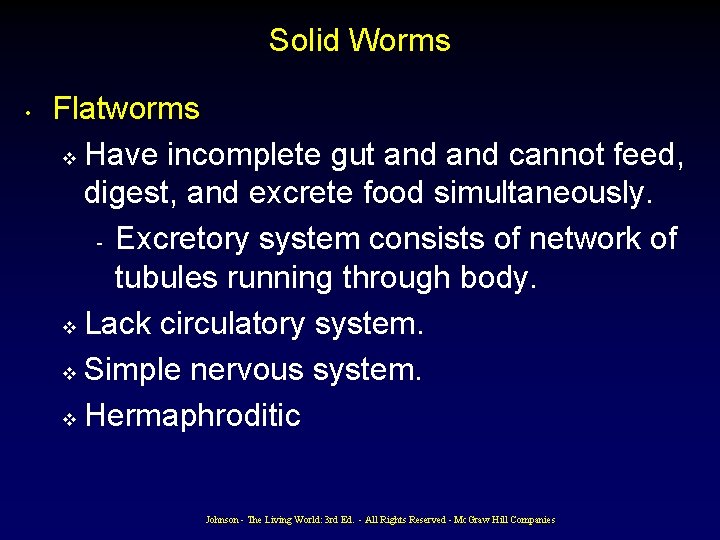
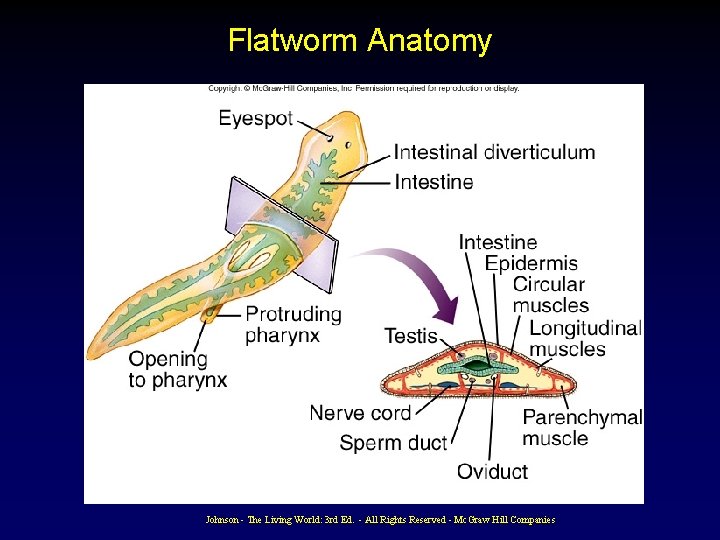
Solid Worms • Flatworms v Have incomplete gut and cannot feed, digest, and excrete food simultaneously. - Excretory system consists of network of tubules running through body. v Lack circulatory system. v Simple nervous system. v Hermaphroditic Johnson - The Living World: 3 rd Ed. - All Rights Reserved - Mc. Graw Hill Companies
Flatworm Anatomy Johnson - The Living World: 3 rd Ed. - All Rights Reserved - Mc. Graw Hill Companies
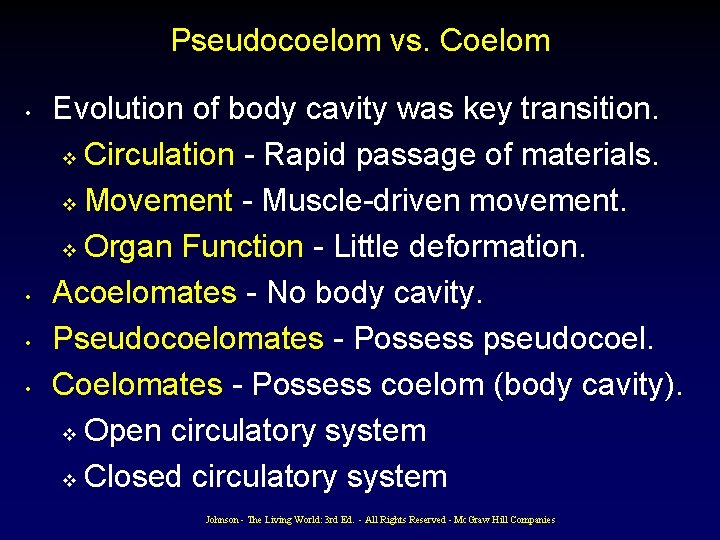
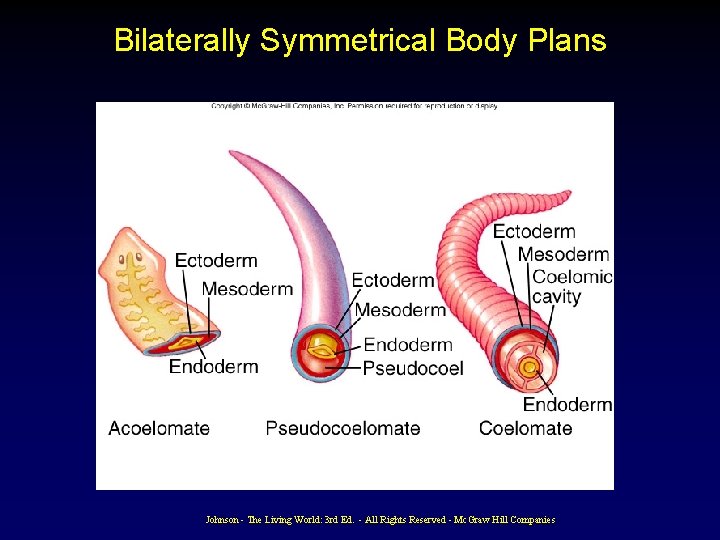
Pseudocoelom vs. Coelom • • Evolution of body cavity was key transition. v Circulation - Rapid passage of materials. v Movement - Muscle-driven movement. v Organ Function - Little deformation. Acoelomates - No body cavity. Pseudocoelomates - Possess pseudocoel. Coelomates - Possess coelom (body cavity). v Open circulatory system v Closed circulatory system Johnson - The Living World: 3 rd Ed. - All Rights Reserved - Mc. Graw Hill Companies
Bilaterally Symmetrical Body Plans Johnson - The Living World: 3 rd Ed. - All Rights Reserved - Mc. Graw Hill Companies
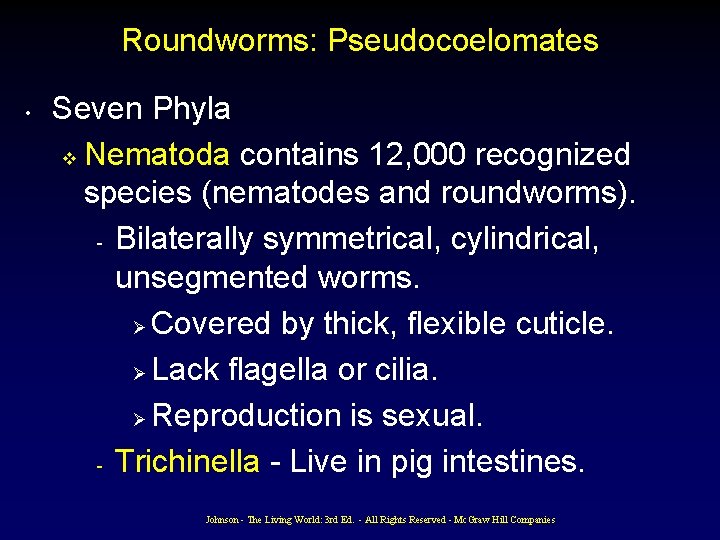
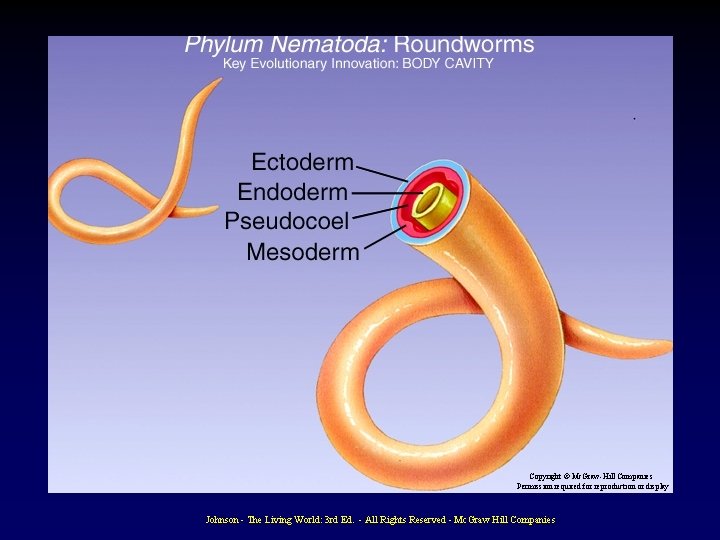
Roundworms: Pseudocoelomates • Seven Phyla v Nematoda contains 12, 000 recognized species (nematodes and roundworms). - Bilaterally symmetrical, cylindrical, unsegmented worms. Ø Covered by thick, flexible cuticle. Ø Lack flagella or cilia. Ø Reproduction is sexual. - Trichinella - Live in pig intestines. Johnson - The Living World: 3 rd Ed. - All Rights Reserved - Mc. Graw Hill Companies
Copyright © Mc. Graw-Hill Companies Permission required for reproduction or display Johnson - The Living World: 3 rd Ed. - All Rights Reserved - Mc. Graw Hill Companies
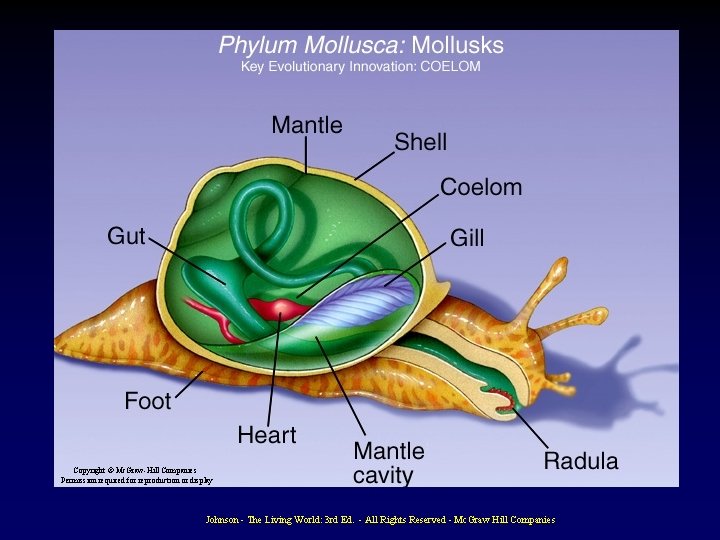
Mollusks: Coelomates • • Development of specialized tissues involved in primary induction in which one of three primary tissues interacts with one another. v Endoderm, Mesoderm, Ectoderm Mollusks v Only major phylum of coelomates without segmented bodies. v Body composed of three parts: Ø Head-Foot, Visceral Mass, Mantle Johnson - The Living World: 3 rd Ed. - All Rights Reserved - Mc. Graw Hill Companies
Mollusks: Coelomates • Mollusks v Gills capture oxygen from water and release carbon dioxide. v Radula - Rasping, tongue-like organ. v Three Major Classes - Gastropods - Bivalves - Cephalopods Johnson - The Living World: 3 rd Ed. - All Rights Reserved - Mc. Graw Hill Companies
Copyright © Mc. Graw-Hill Companies Permission required for reproduction or display Johnson - The Living World: 3 rd Ed. - All Rights Reserved - Mc. Graw Hill Companies
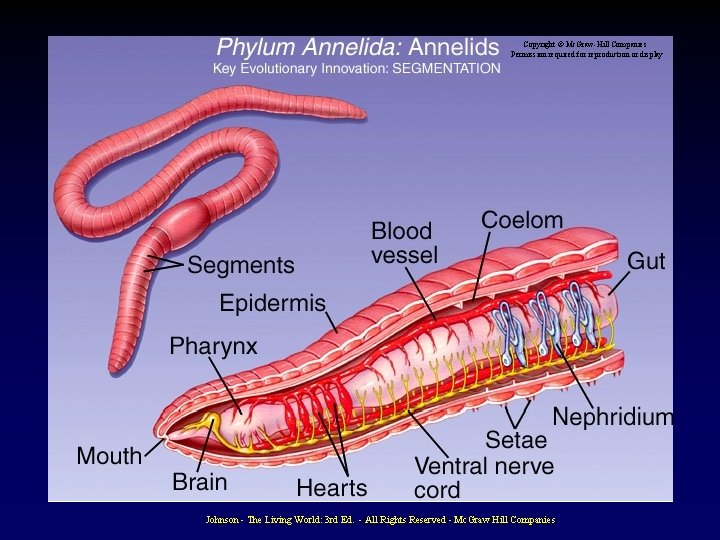
Annelids • Key innovation to arise in coelomates was segmentation. v Building of body from series of similar segments. - Small change in existing segment can produce new kind of segment with different function. Johnson - The Living World: 3 rd Ed. - All Rights Reserved - Mc. Graw Hill Companies
Annelids • Worm within a tube design. v Three characteristics: - Repeated Segments - Specialized Segments - Connections Johnson - The Living World: 3 rd Ed. - All Rights Reserved - Mc. Graw Hill Companies
Copyright © Mc. Graw-Hill Companies Permission required for reproduction or display Johnson - The Living World: 3 rd Ed. - All Rights Reserved - Mc. Graw Hill Companies
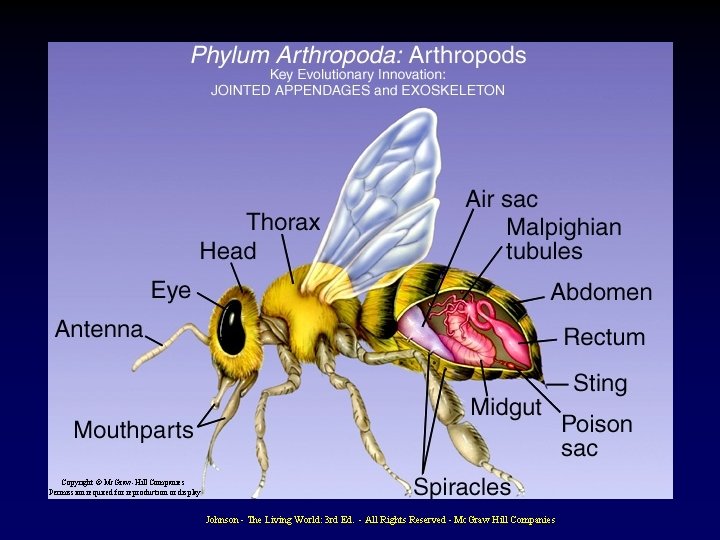
Arthropods • • All have jointed appendages. Rigid external skeleton (exoskeleton). v Protects animal and provides places for muscle attachment. - Brittle, thus there is a limit to arthropod body size due to exoskeleton thickness. v Estimates of a quintillion insects alive at any one time. Johnson - The Living World: 3 rd Ed. - All Rights Reserved - Mc. Graw Hill Companies
Copyright © Mc. Graw-Hill Companies Permission required for reproduction or display Johnson - The Living World: 3 rd Ed. - All Rights Reserved - Mc. Graw Hill Companies
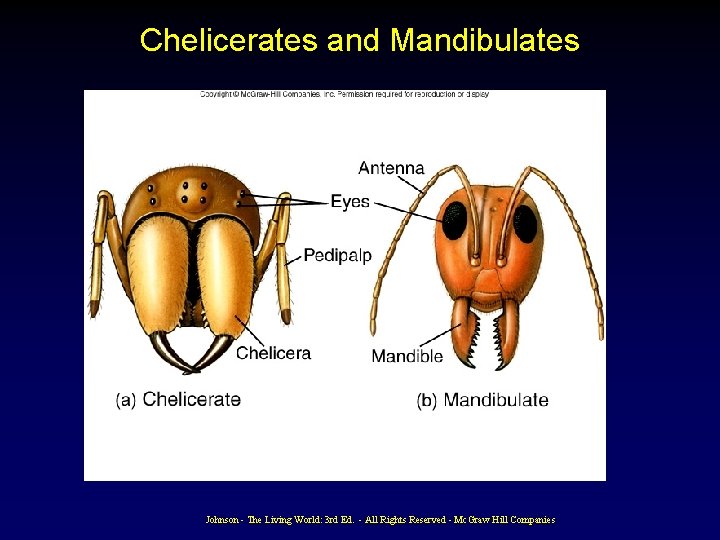
Arthropods • Chelicerates v Arthropods lacking jaws. - Mouthparts (chelicerae) evolved from appendages nearest anterior end. Ø Pediplaps v Arachnida is largest class. - 57, 000 named species including spiders, ticks, and scorpions. Johnson - The Living World: 3 rd Ed. - All Rights Reserved - Mc. Graw Hill Companies
Chelicerates and Mandibulates Johnson - The Living World: 3 rd Ed. - All Rights Reserved - Mc. Graw Hill Companies
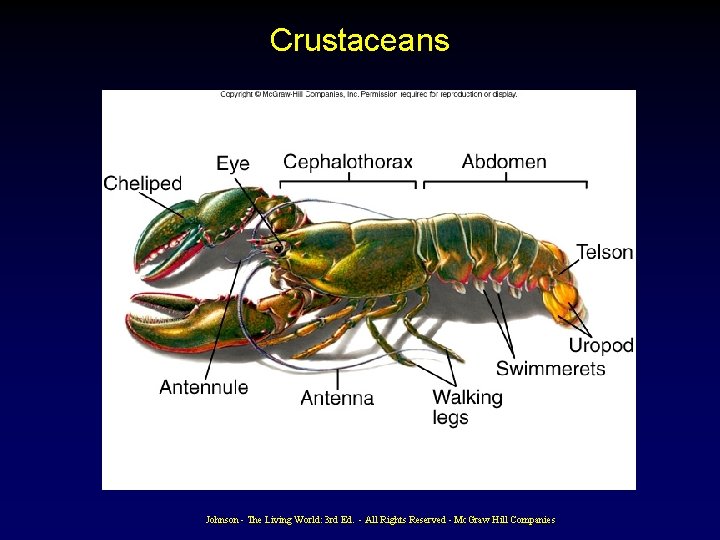
Arthropods • Mandibulates have mandibles formed by appendages formed by other anterior appendages. v Crustaceans - Differ from insects, but resemble millipedes and centipedes as they have legs on their abdomen as well as thorax. Johnson - The Living World: 3 rd Ed. - All Rights Reserved - Mc. Graw Hill Companies
Crustaceans Johnson - The Living World: 3 rd Ed. - All Rights Reserved - Mc. Graw Hill Companies
Arthropods • • Millipedes and Centipedes v Consist of head region followed by numerous similar segments. Centipedes have one pair of legs on each segment, and millipedes have two pairs of legs on each segment. Insects v Largest group of arthropods. - Head, Thorax, Abdomen Johnson - The Living World: 3 rd Ed. - All Rights Reserved - Mc. Graw Hill Companies
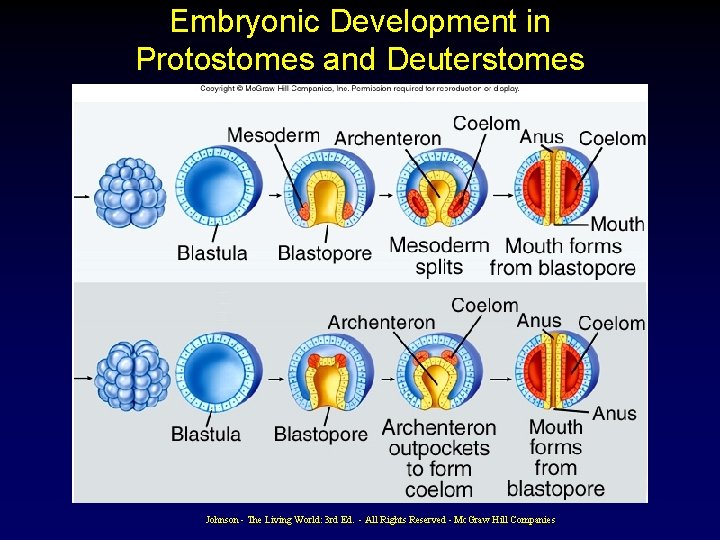
Protostomes and Deuterostomes • • Protostome v Mouth develops from or near blastopore. Anus (if present) develops from another region of embryo. Dueterstomes v Anus forms from, or near, blastopore, and mouth forms subsequently on another part of blastopore. Johnson - The Living World: 3 rd Ed. - All Rights Reserved - Mc. Graw Hill Companies
Protostomes and Deuterostomes • Deuterostomes differ from protostomes: v Cleavage Pattern - Spiral vs. Radial v Developmental fate of cells - Time of commitment v Origination of coelom - Mesoderm vs. Archenteron Johnson - The Living World: 3 rd Ed. - All Rights Reserved - Mc. Graw Hill Companies
Embryonic Development in Protostomes and Deuterstomes Johnson - The Living World: 3 rd Ed. - All Rights Reserved - Mc. Graw Hill Companies
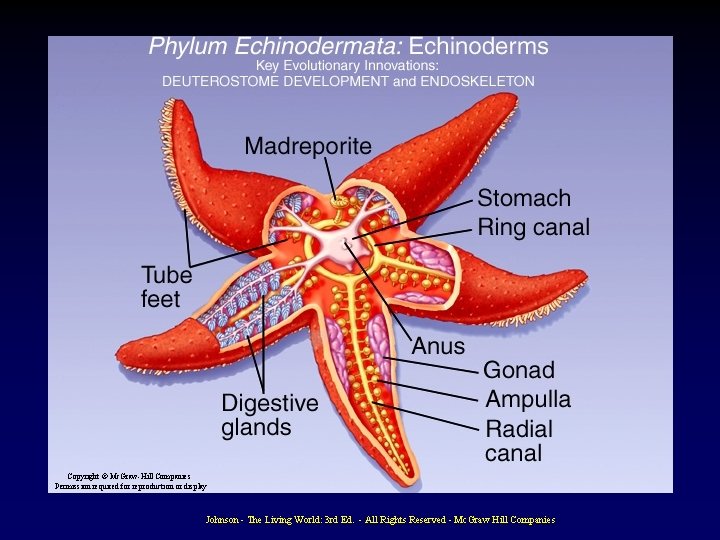
Echinoderms • First Dueterstomes v Endoskeleton composed of hard, calciumrich ossicles. v Bilaterally symmetrical as larvae, but become radially symmetrical as adults. v Key evolution innovation was water vascular system. - Tube Feet Johnson - The Living World: 3 rd Ed. - All Rights Reserved - Mc. Graw Hill Companies
Copyright © Mc. Graw-Hill Companies Permission required for reproduction or display Johnson - The Living World: 3 rd Ed. - All Rights Reserved - Mc. Graw Hill Companies
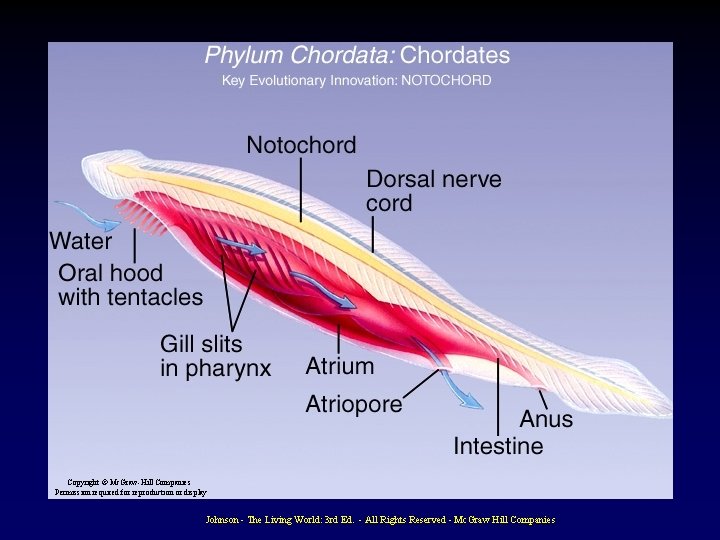
Chordates • Distinguished by four principle features: v Notochord v Nerve Cord v Pharyngeal Slits v Postnatal Tail Johnson - The Living World: 3 rd Ed. - All Rights Reserved - Mc. Graw Hill Companies
Copyright © Mc. Graw-Hill Companies Permission required for reproduction or display Johnson - The Living World: 3 rd Ed. - All Rights Reserved - Mc. Graw Hill Companies
Chordates • Vertebrates v Have internal skeleton made of bone or cartilage against which the muscles work. - Most endoskeletons made of bone. Ø Bone formed in two stages: § Matrix of collagen laid down. § Minerals impregnate fibers. Johnson - The Living World: 3 rd Ed. - All Rights Reserved - Mc. Graw Hill Companies
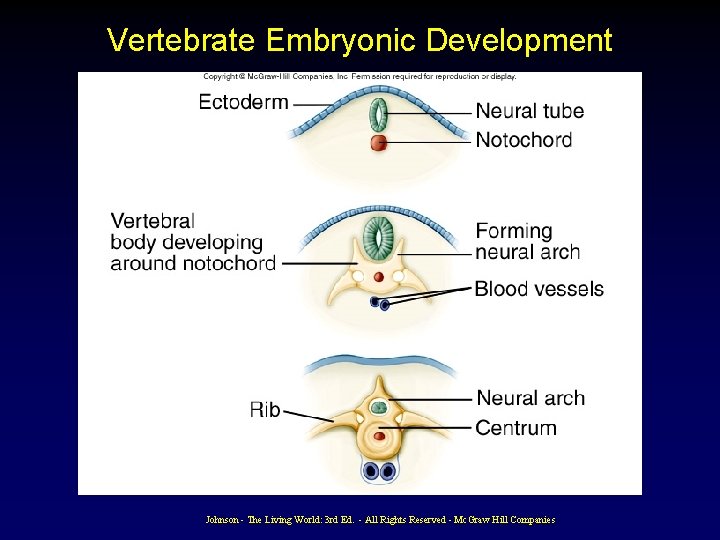
Vertebrate Embryonic Development Johnson - The Living World: 3 rd Ed. - All Rights Reserved - Mc. Graw Hill Companies
Review • • • Sponges Cnidarians Solid Worms Roundworms Mollusks Annelids Arthropods Echinoderms Chordates Johnson - The Living World: 3 rd Ed. - All Rights Reserved - Mc. Graw Hill Companies
Copyright © Mc. Graw-Hill Companies Permission required for reproduction or display Johnson - The Living World: 3 rd Ed. - All Rights Reserved - Mc. Graw Hill Companies