
Evolution of Stars How do stars form How
- Slides: 15
Evolution of Stars • How do stars form? • How does a star’s mass affect its evolution? • How is star matter recycled in space?
Life Cycle of a Star • Stars form deep inside clouds of gas and dust. • A cloud of gas and dust is a nebula.
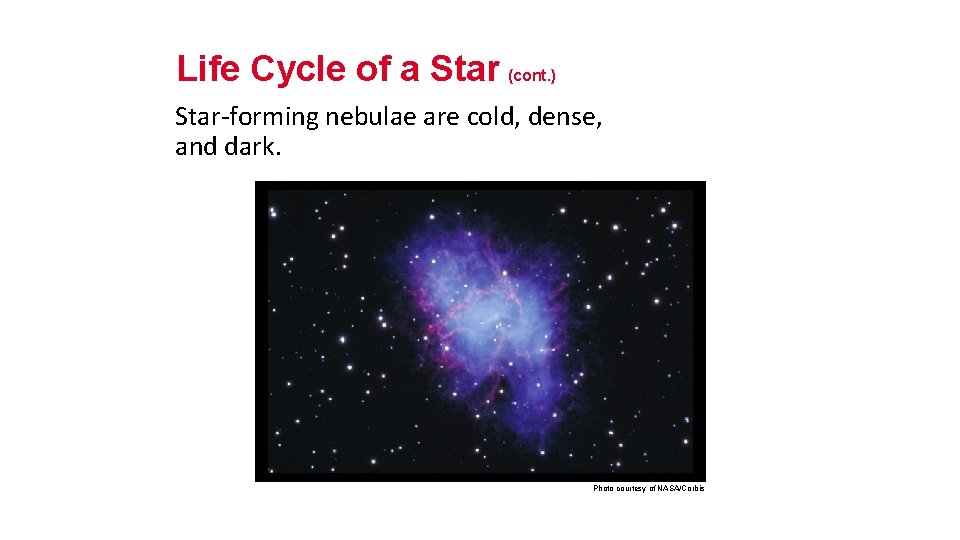
Life Cycle of a Star (cont. ) Star-forming nebulae are cold, dense, and dark. Photo courtesy of NASA/Corbis
Life Cycle of a Star (cont. ) • Gravity causes the densest parts to collapse, forming regions called protostars. • Over many thousands of years, the energy produced by protostars heats the gas and dust surrounding them.
Life Cycle of a Star (cont. ) • A star becomes a main-sequence star as soon as it begins to fuse hydrogen into helium. • Low-mass stars stay on the main sequence for billions of years, and high-mass stars are there for only a few million years.
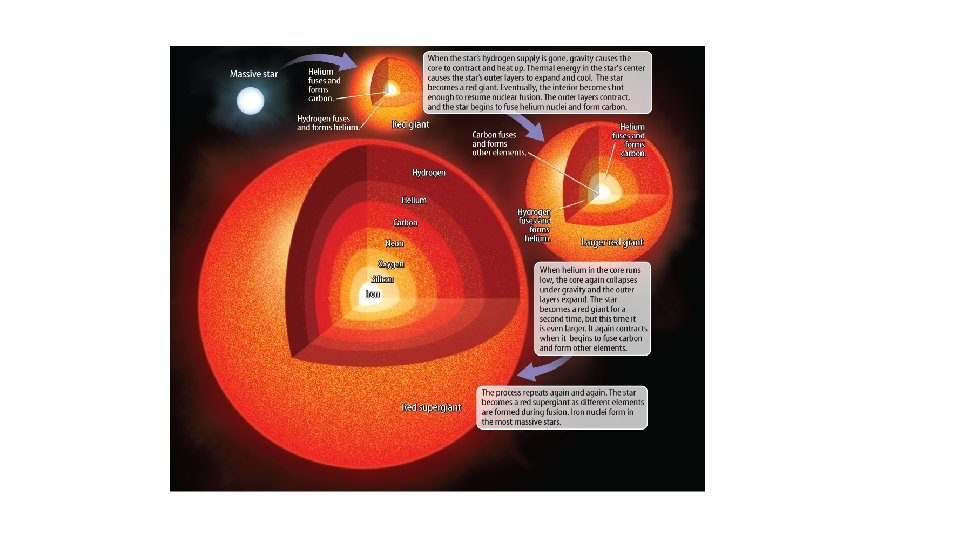
Life Cycle of a Star (cont. ) • When a star’s hydrogen supply is nearly gone, the star leaves the main sequence and begins the next stage of its life cycle. • All stars form in the same way, but stars die in different ways, depending on their masses. • Massive stars eventually become red supergiants.
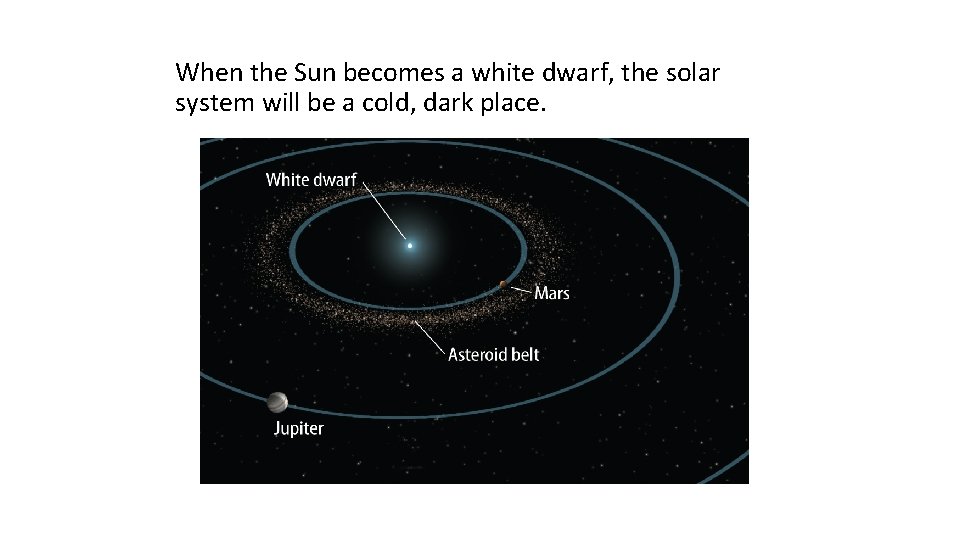
End of a Star • After helium in the cores of lower-mass stars is gone, the stars cast off their gases, exposing their cores. • The core eventually becomes a white dwarf, a hot, dense, slowly cooling sphere of carbon. • This is what is expected to happen to the Sun.
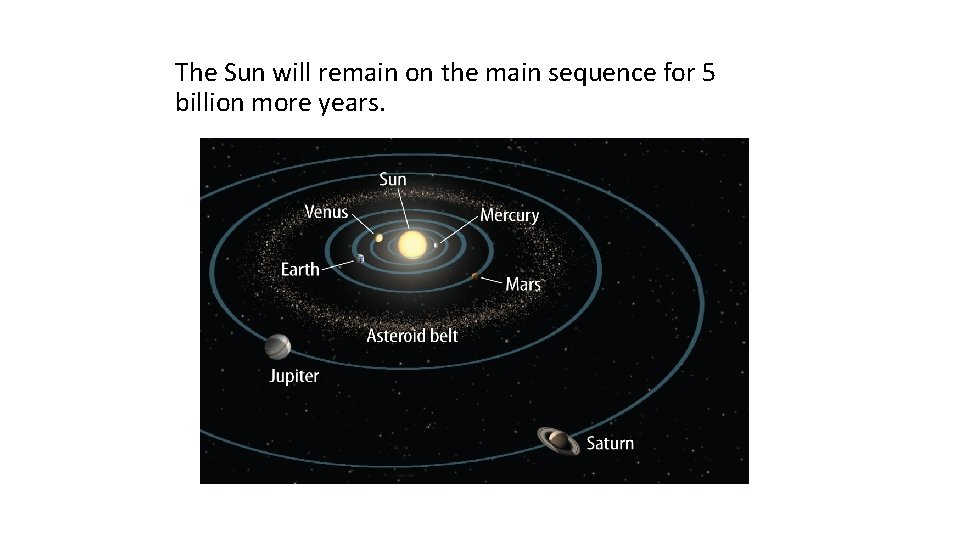
The Sun will remain on the main sequence for 5 billion more years.
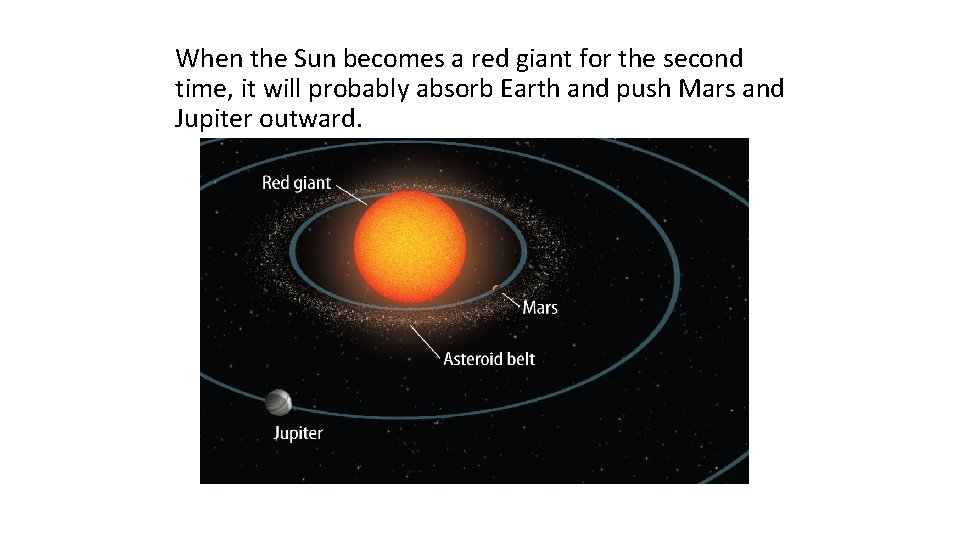
When the Sun becomes a red giant for the second time, it will probably absorb Earth and push Mars and Jupiter outward.
When the Sun becomes a white dwarf, the solar system will be a cold, dark place.
End of a Star (cont. ) • Very massive stars can explode in a supernova, which destroys the star. • Iron in the core does not fuse and the core collapses quickly under the force of gravity. • The normal space within atoms is eliminated, leaving a dense core of neutrons, or a neutron star.
End of a Star (cont. ) • For the most massive stars, atomic forces holding neutrons together are not strong enough to overcome so much mass in such a small volume. Gravity is too strong, and the matter crushes into a black hole. • A black hole is an object whose gravity is so great that no light can escape.
Recycling Matter • When a star becomes a white dwarf, it casts off hydrogen and helium gases in its outer layers. • The expanding, cast-off matter of a white dwarf is a planetary nebula. • During a supernova, a massive star comes apart sending a shock wave into space.
Recycling Matter (cont. ) • The expanding cloud of dust and gas is called a supernova remnant. • Gravity causes recycled gases and other matter to clump together in nebulae and form new stars and planets.