
Evolution of Populations Microevolution Variations in Gene Pools




- Slides: 14
Evolution of Populations Microevolution
Variations in Gene Pools • • • Microevolution: evolution on the smallest scale – generation to generation change in the frequencies of alleles in a population Gene Pool: consists of all the genes that are present in a population Relative Frequency: The number of times an allele occurs in a gene pool compared with the number of times other alleles for the same gene appear
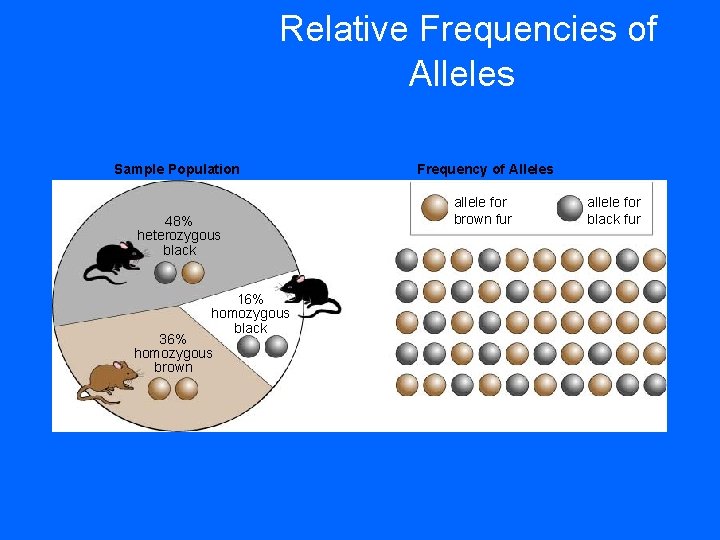
Relative Frequencies of Alleles Sample Population 48% heterozygous black 16% homozygous black 36% homozygous brown Frequency of Alleles allele for brown fur allele for black fur
Sources of Genetic Variation 1. Mutations: a change in the genetic sequence. Some may produce changes in the phenotype that result in better fitness. 2. Gene Shuffling: which results from the shuffling of gametes and sexual reproduction; produces many different combinations of genes.
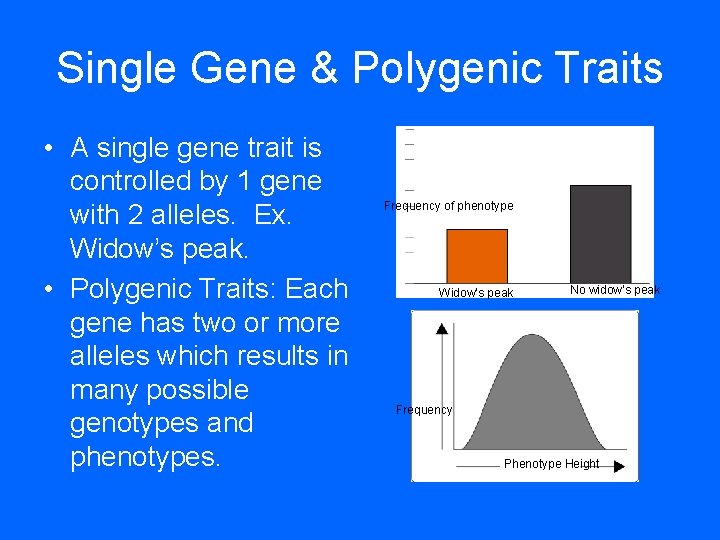
Single Gene & Polygenic Traits • A single gene trait is controlled by 1 gene with 2 alleles. Ex. Widow’s peak. • Polygenic Traits: Each gene has two or more alleles which results in many possible genotypes and phenotypes. Frequency of phenotype Widow’s peak No widow’s peak Frequency Phenotype Height
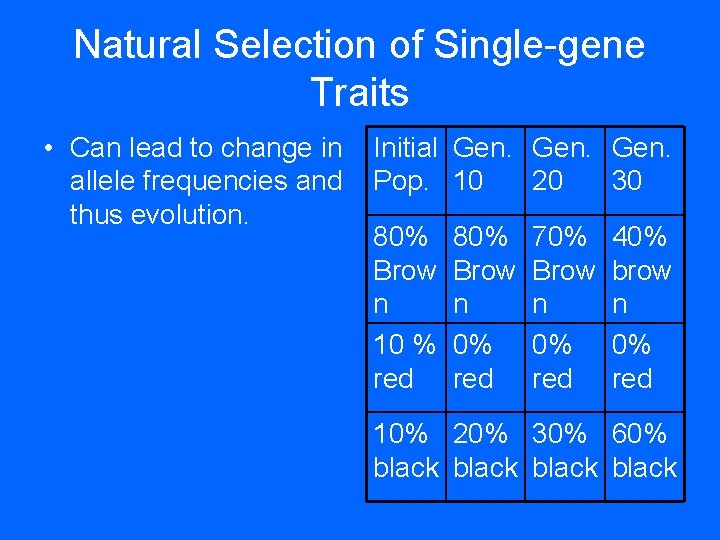
Natural Selection of Single-gene Traits • Can lead to change in allele frequencies and thus evolution. Initial Gen. Pop. 10 20 30 80% Brow n 10 % red 80% Brow n 0% red 70% Brow n 0% red 40% brow n 0% red 10% 20% 30% 60% black
Genetic Drift • The random change in allele frequency. • In a small population, individuals that carry a particular allele may leave more descendants than other individuals, just by chance. Over time, a series of chance occurrences of this type can cause an allele to become more common.
Genetic Drift Sample of Original Population Descendants Founding Population A Founding Population B Founder’s Effect: Allele frequencies change as a result of the migration of a small subgroup.
Evolution Versus Genetic Equilibrium • Hardy-Weinberg Principle (1908) states that allele frequency in a population will remain constant unless one or more factors cause those frequencies to change. • Genetic Equilibrium: allele frequencies remain the same.
Five Conditions of Hardy-Weinberg • • • Random mating – no sexual selection Large population – no genetic drift No migrations – immigration or emigration No mutations No natural selection • STOP
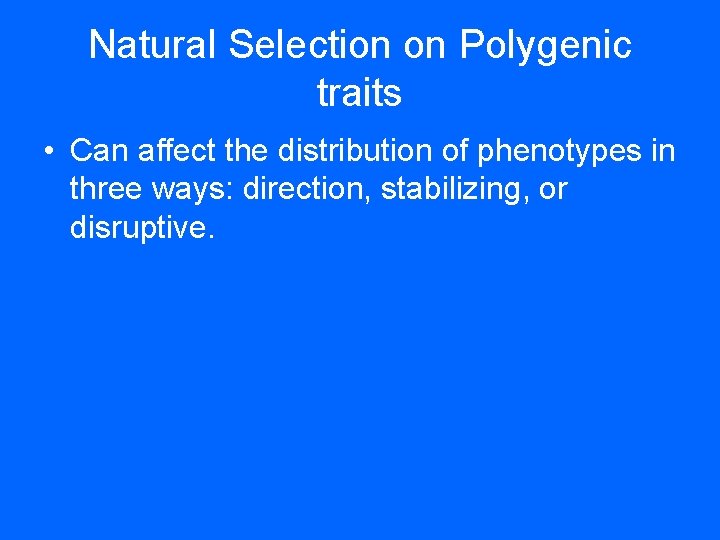
Natural Selection on Polygenic traits • Can affect the distribution of phenotypes in three ways: direction, stabilizing, or disruptive.
Graph of Directional Selection Key Directional Selection Food becomes scarce. Low mortality, high fitness High mortality, low fitness The environment favors one extreme
Graph of Stabilizing Selection Key Low mortality, high fitness High mortality, low fitness Percentage of Population The average Organism is More fit Birth Weight Selection against both extremes keep curve narrow and in same place.
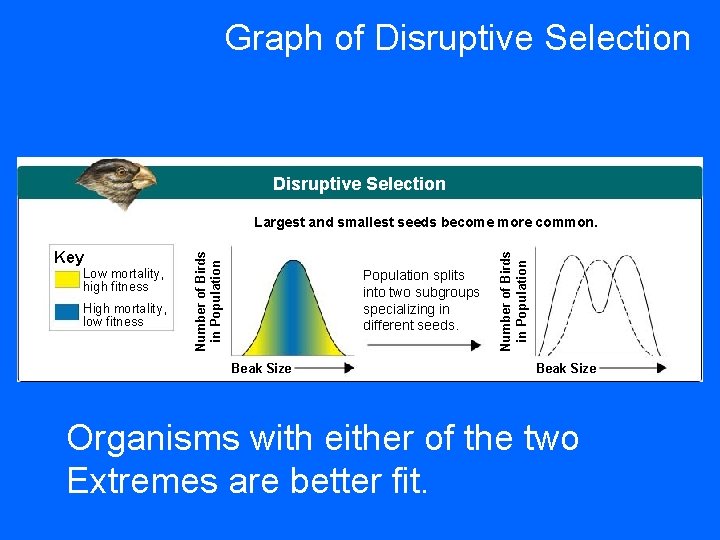
Graph of Disruptive Selection Low mortality, high fitness High mortality, low fitness Population splits into two subgroups specializing in different seeds. Beak Size Number of Birds in Population Key Number of Birds in Population Largest and smallest seeds become more common. Beak Size Organisms with either of the two Extremes are better fit.