
Evolution of Populations Chapter 23 Macroevolution n Evolution

- Slides: 63
Evolution of Populations Chapter 23
Macroevolution n Evolution on a large scale n Changes in plants & animals n Where new forms replace old n Major episodes of extinction
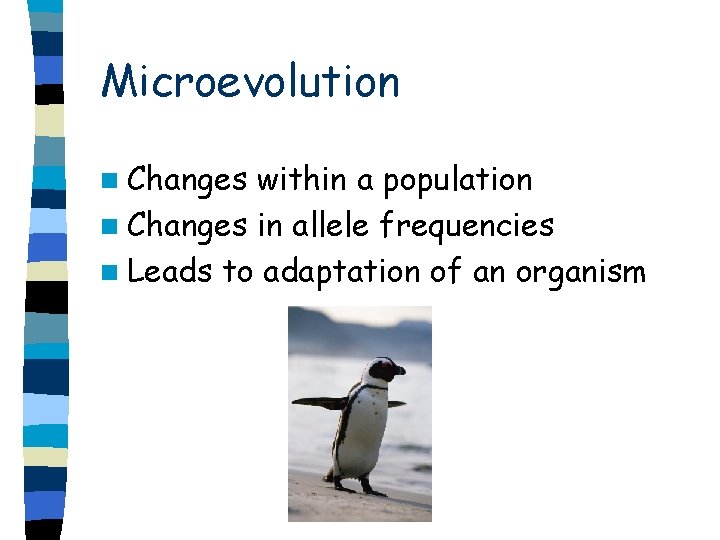
Microevolution n Changes within a population n Changes in allele frequencies n Leads to adaptation of an organism
Variation n Individual variation n Chance of survival n Reproduce n Success of offspring
Variation n Gene variation is the driving force behind evolution n Factors that caused a change in allele frequency G: Chapter_23A_Power. Point_Lectures23 _Lecture_Presentation2304 Sexual. Recombi nation. A. html
Population genetics n Study of the properties of genes in populations
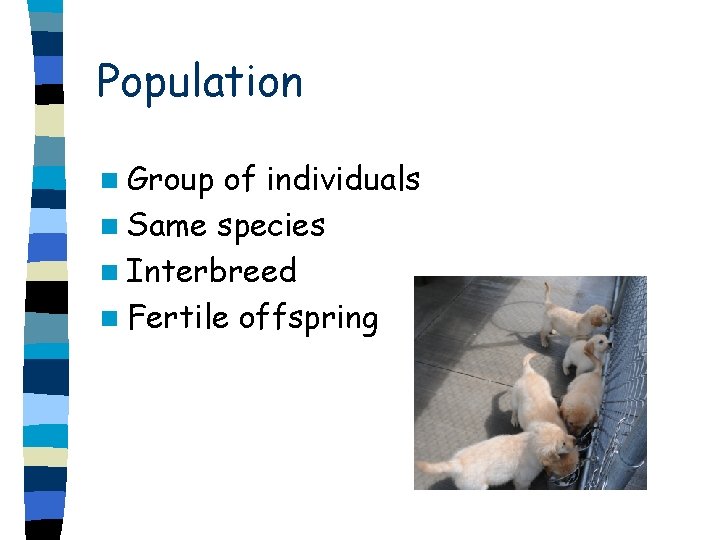
Population n Group of individuals n Same species n Interbreed n Fertile offspring
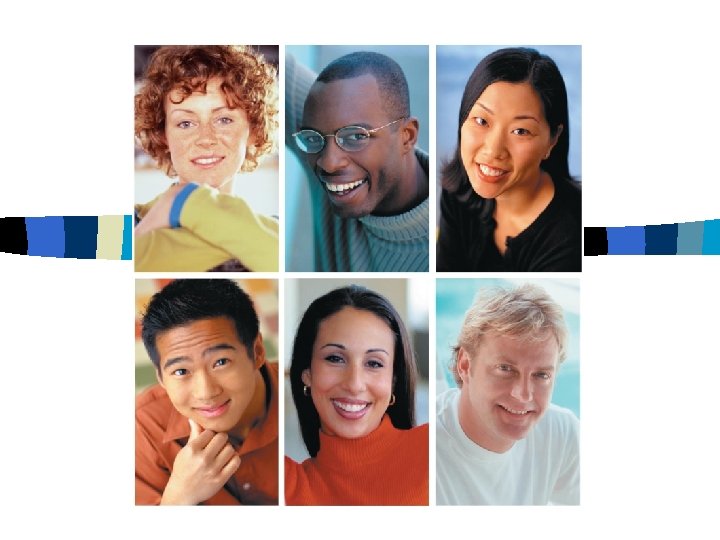
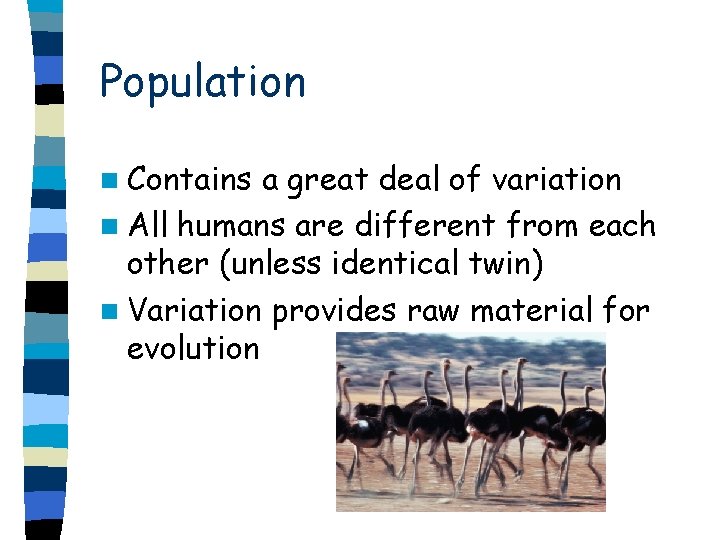
Population n Contains a great deal of variation n All humans are different from each other (unless identical twin) n Variation provides raw material for evolution
Gene pool n All the alleles n Of all individuals within a population
Hardy-Weinberg Principle n Determines if population is evolving n Frequencies of alleles in population n Used for baseline of genes in a population
Hardy-Weinberg n Equilibrium n When proportions of genotypes remain the same n Generation to generation
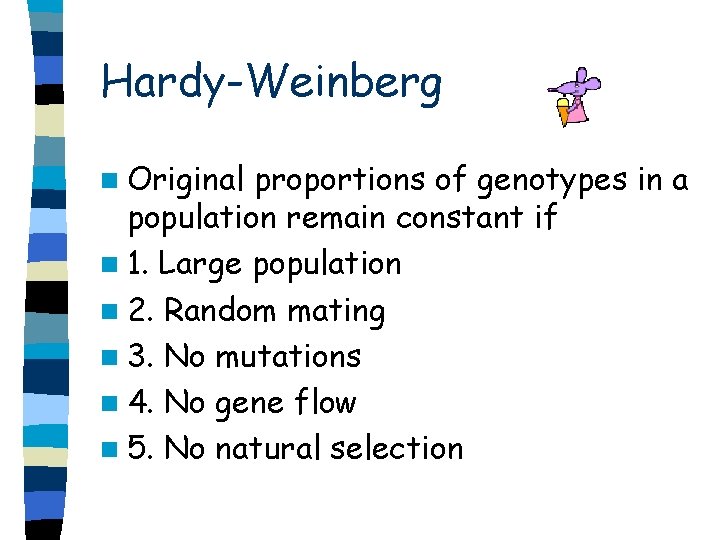
Hardy-Weinberg n Original proportions of genotypes in a population remain constant if n 1. Large population n 2. Random mating n 3. No mutations n 4. No gene flow n 5. No natural selection
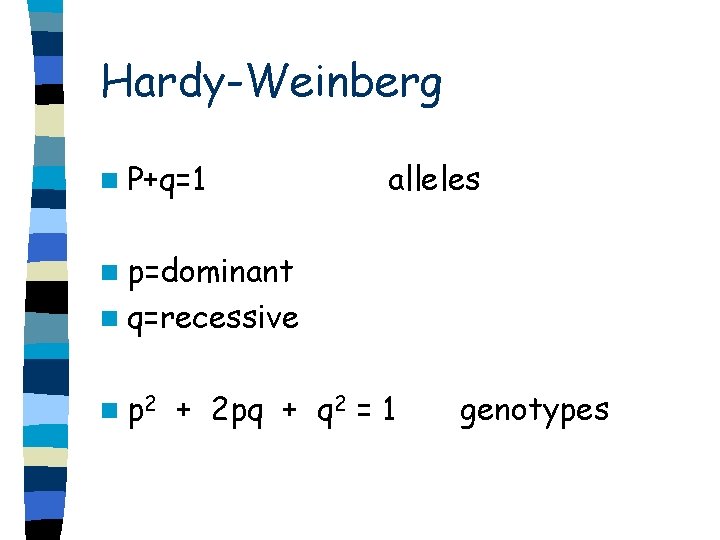
Hardy-Weinberg n P+q=1 alleles n p=dominant n q=recessive n p 2 + 2 pq + q 2 = 1 genotypes
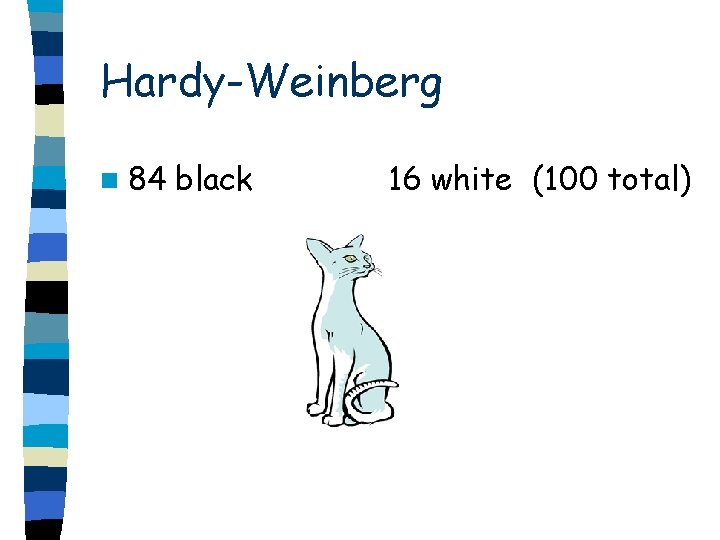
Hardy-Weinberg n 84 black 16 white (100 total)
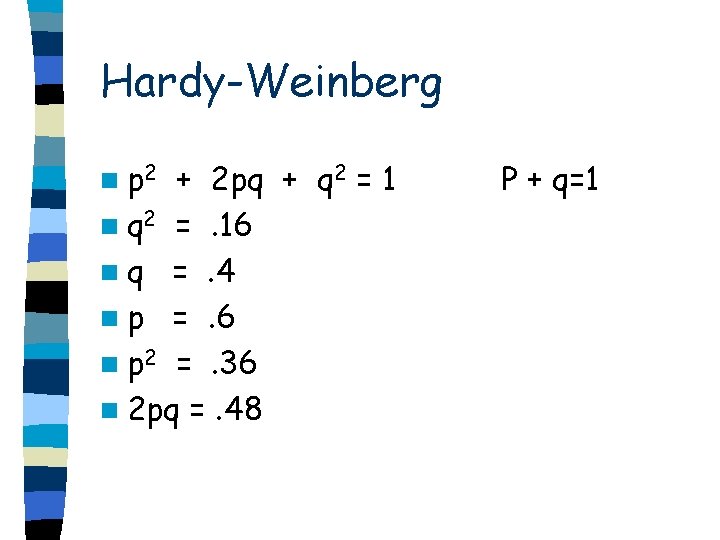
Hardy-Weinberg n p 2 + 2 pq + q 2 = 1 n q 2 =. 16 n q =. 4 n p =. 6 n p 2 =. 36 n 2 pq =. 48 P + q=1
Hardy-Weinberg n If the dominant allele is 30% of the gene pool n What is n % dominant phenotype n % recessive phenotype n % hybrid
Hardy-Weinberg n Factors that affect evolutionary change n 1. Mutations n 2. Nonrandom mating n 3. Gene flow n 4. Genetic drift n 5. Natural selection
Hardy-Weinberg D: Chapter_23A_Power. Point_Lecture s23_Lecture_Presentation2308 Evol utionary. Changes. A. html
Mutation n Occurs at a low rate n Not a strong influence on evolutionary change
Nonrandom mating n Individuals with one genotype mate with another at a greater rate n Not a strong influence on allele frequency
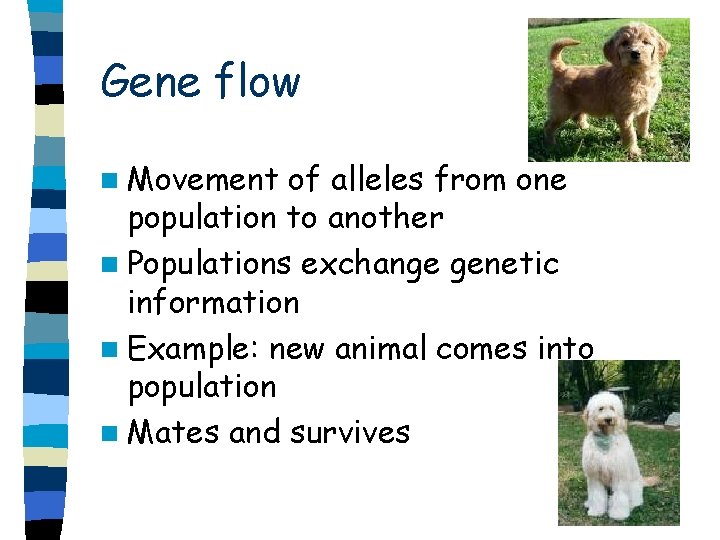
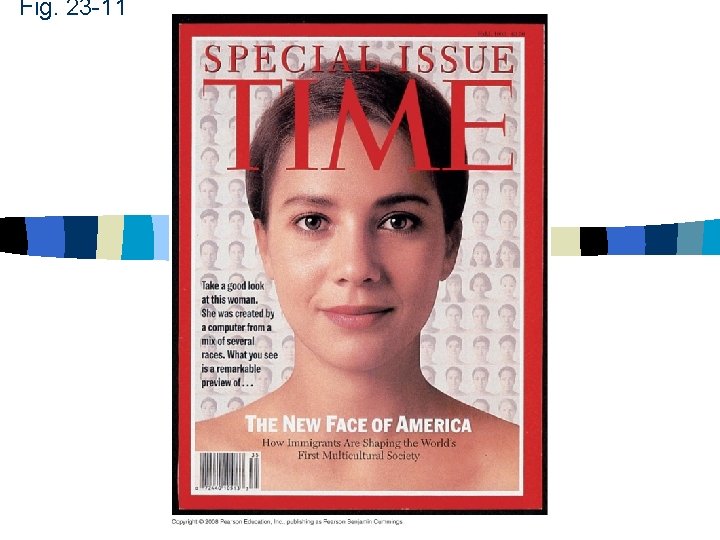
Gene flow n Movement of alleles from one population to another n Populations exchange genetic information n Example: new animal comes into population n Mates and survives
Fig. 23 -11
Gene flow n Bees and pollen n Seeds n Reduces genetic differences between populations
Gene flow n Example: Great Britain n Bent grass vs mines (heavy metals) n Grass dies in area of metals (Cu) n Resistance to metals survives-thrives n If resistant gene flows into an area of no metals grows very slowly
Gene flow n Insecticide resistant alleles n Mosquito West Nile & Malaria n Spreading the allele
Gene flow n Advantage when a beneficial mutation enters a population n Select for the allele n Disadvantage when an inferior allele enters the population n Select against the allele
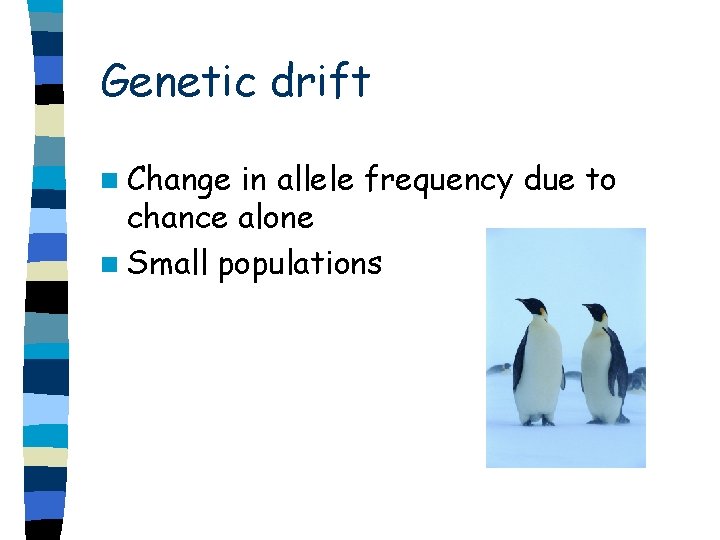
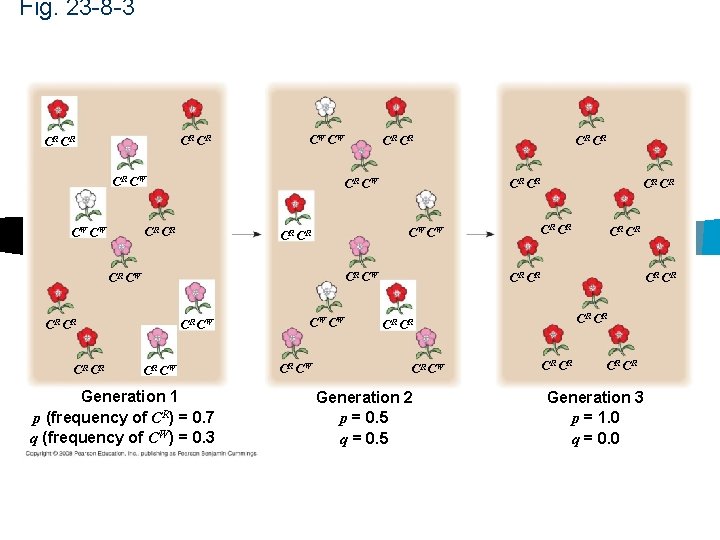
Genetic drift n Change in allele frequency due to chance alone n Small populations
Genetic drift n Only a few possible alleles are present n Example: n Red, blue, yellow seeds n If blue & yellow are isolated from red n Eventually the population will only have blue or yellow and no red
Genetic drift n May see a rise in harmful alleles n Lose alleles
Fig. 23 -8 -3 CR CR CW CW CR CR CW CW CR CR CR CW Generation 1 p (frequency of CR) = 0. 7 q (frequency of CW ) = 0. 3 CW CW CR CR CR CR CR CR CR CW Generation 2 p = 0. 5 q = 0. 5 CR CR Generation 3 p = 1. 0 q = 0. 0
Genetic drift n 1. Founders effects n Few individuals leave a population n New isolated population n Few alleles present n Island populations n Amish (polydactyly)
n. . Desktoppolydactyl. jpg
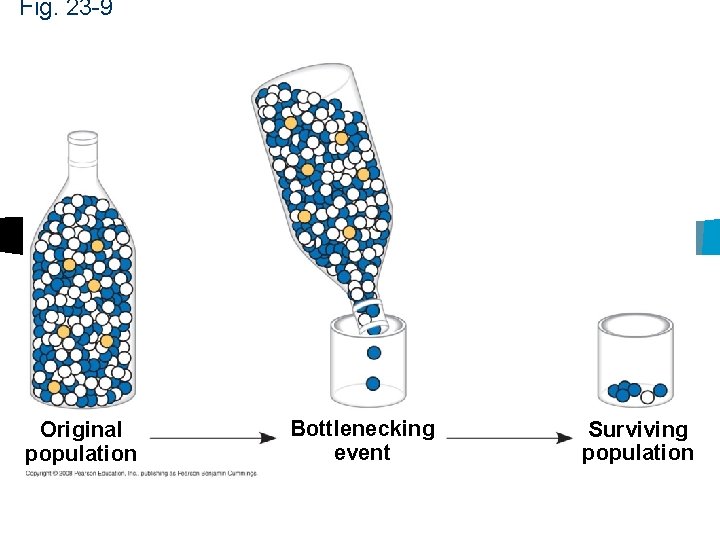
Genetic drift n 2. Bottleneck n Occurs when a few surviving individuals have only a few genes n Loss of genetic variability n Occurs when a natural event happens – Flood, drought, disease etc.
Fig. 23 -9 Original population Bottlenecking event Surviving population
Genetic drift n Northern elephant seal n California n Reduced to few seals in a population due to hunting n Has rebounded in numbers n Organisms with limited genetic variation
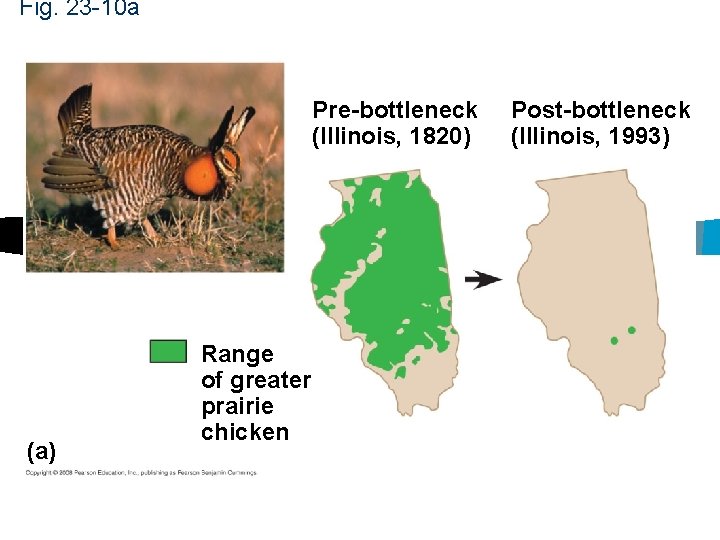
Fig. 23 -10 a Pre-bottleneck (Illinois, 1820) (a) Range of greater prairie chicken Post-bottleneck (Illinois, 1993)
Selection n Natural selection the process that causes evolutionary change n Adaptive evolution
Selection n Natural selection to happen & cause evolutionary change n 1. Must have variation in individuals among population n Enables choice of traits that are better able to survive
Selection n 2. Variation causes different number of offspring surviving n 3. Variation must be genetically inherited
Selection n Individuals with a certain phenotype n Leave more surviving offspring than other phenotypes
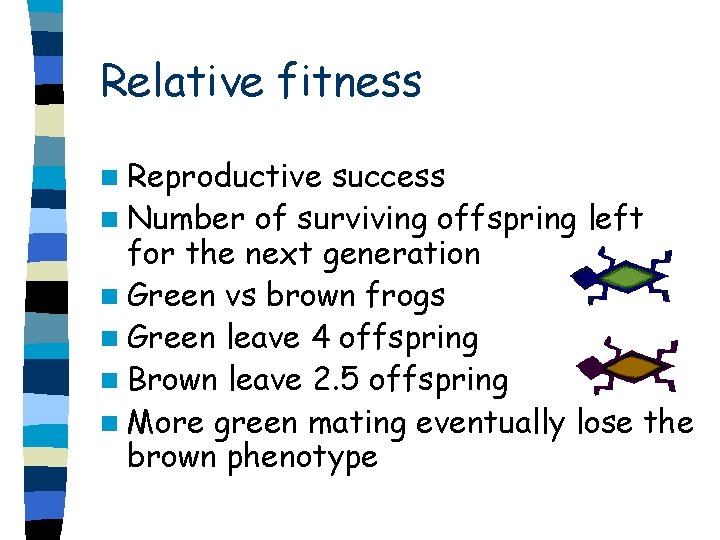
Relative fitness n Reproductive success n Number of surviving offspring left for the next generation n Green vs brown frogs n Green leave 4 offspring n Brown leave 2. 5 offspring n More green mating eventually lose the brown phenotype
Relative fitness n 1. Survival (how long) n 2. Mating success n 3. Number of offspring n Examples: larger organisms mate more n Larger fish or frogs leave more offspring
Forms of selection n 1. Disruptive selection n 2. Directional selection n 3. Stabilizing selection
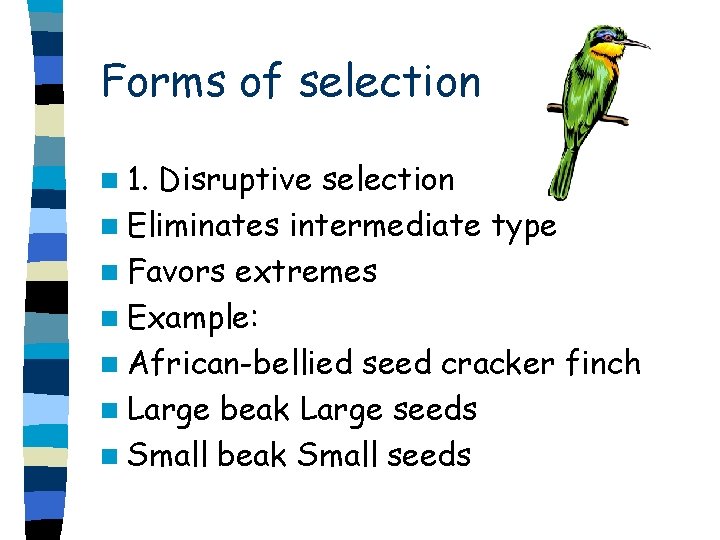
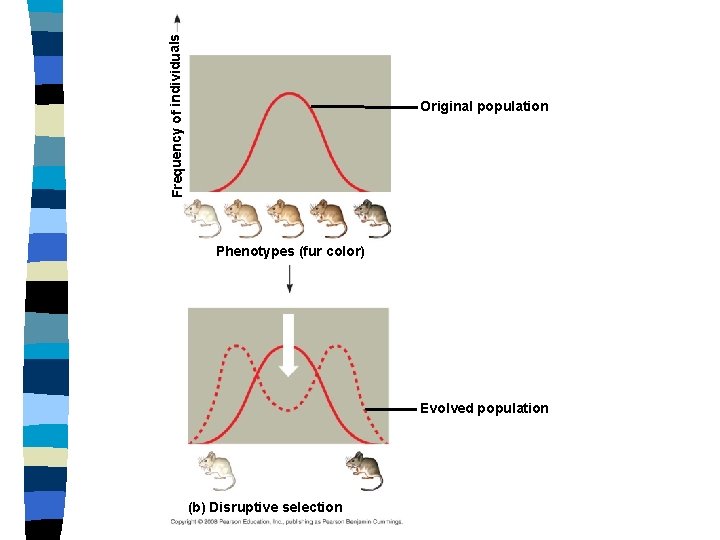
Forms of selection n 1. Disruptive selection n Eliminates intermediate type n Favors extremes n Example: n African-bellied seed cracker finch n Large beak Large seeds n Small beak Small seeds
Frequency of individuals Original population Phenotypes (fur color) Evolved population (b) Disruptive selection
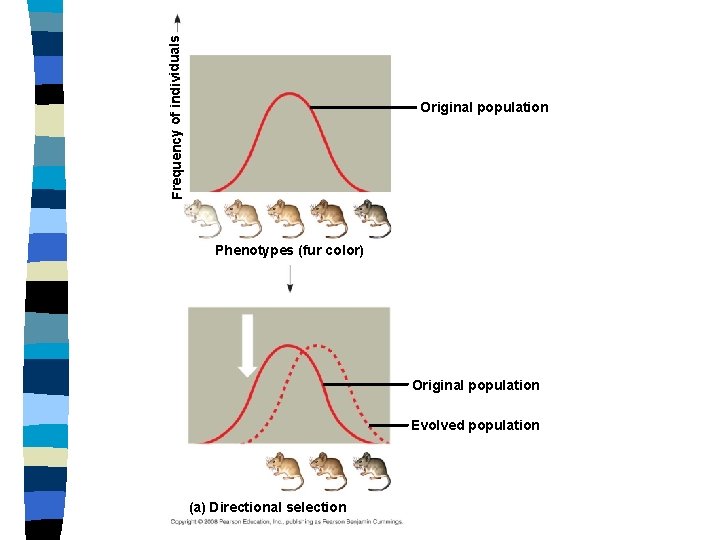
Forms of selection n 2. Directional selection n Favors one extreme
Frequency of individuals Original population Phenotypes (fur color) Original population Evolved population (a) Directional selection
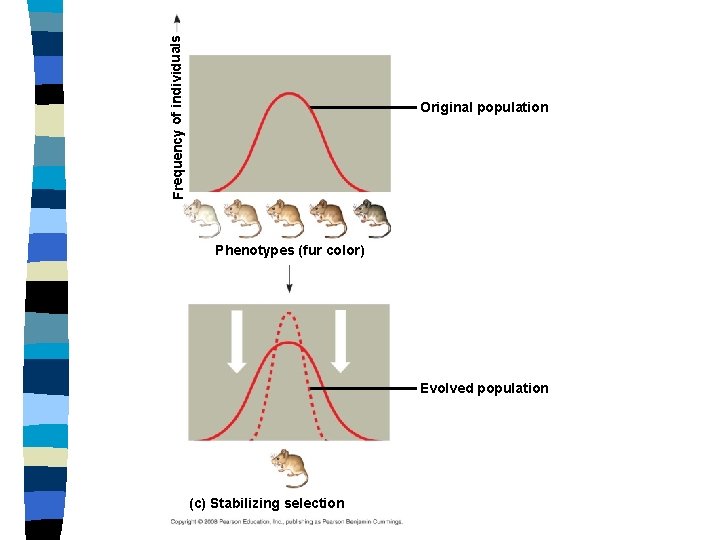
Forms of selection n 3. Stabilizing selection n Eliminates both extremes n Example: birth weight of newborns n Small & large newborns can be harmful n Increased death rate n Intermediate BW best survival
Frequency of individuals Original population Phenotypes (fur color) Evolved population (c) Stabilizing selection
Selection n Environment imposes conditions n Determines selection n Cause evolutionary change.
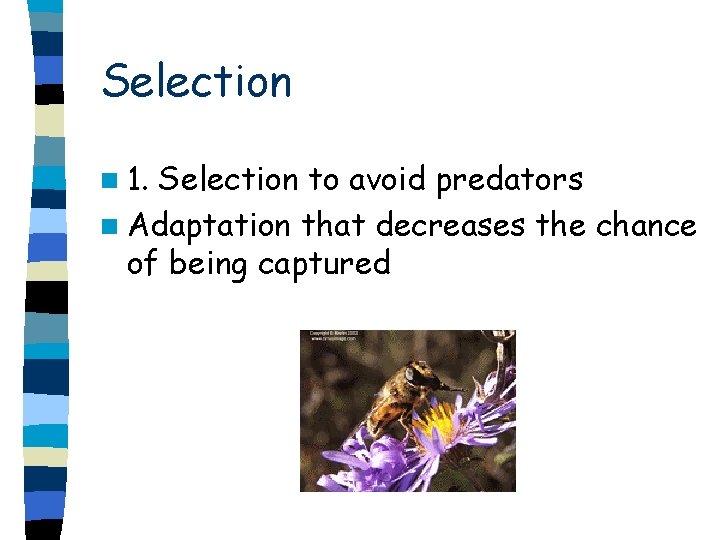
Selection n 1. Selection to avoid predators n Adaptation that decreases the chance of being captured
Selection n n n 2. Selection to match climatic condition Enzyme alleles Vary depending on geographic location Fish enzyme for LDH Coverts pyruvate to lactate Works better in colder weather Fish swim faster
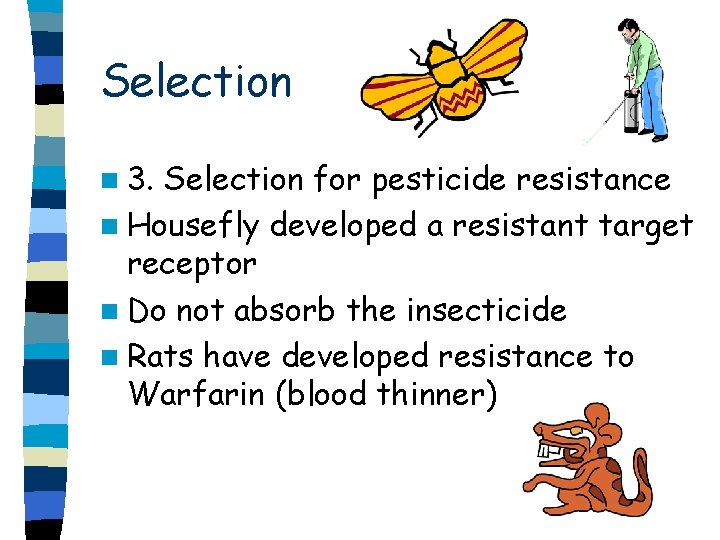
Selection n 3. Selection for pesticide resistance n Housefly developed a resistant target receptor n Do not absorb the insecticide n Rats have developed resistance to Warfarin (blood thinner)
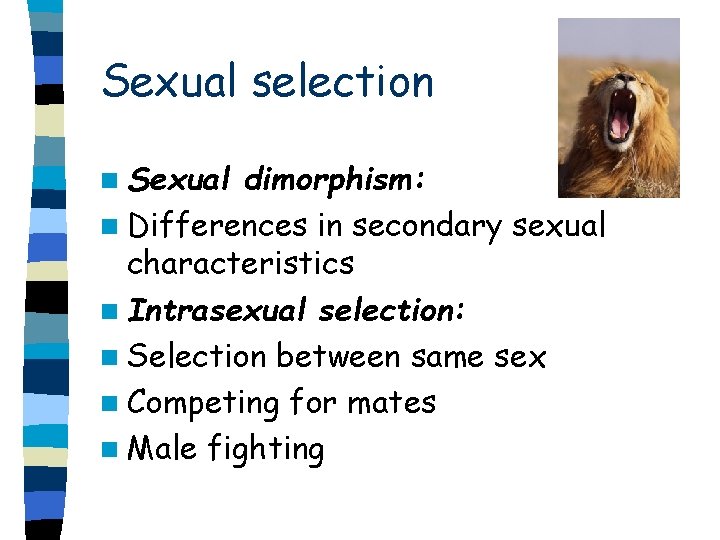
Sexual selection n Sexual dimorphism: n Differences in secondary sexual characteristics n Intrasexual selection: n Selection between same sex n Competing for mates n Male fighting
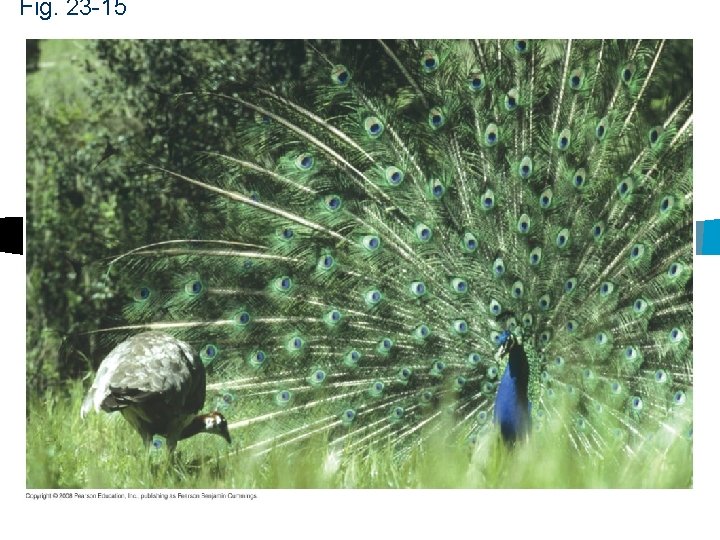
Sexual selection n Intersexual selection: n Selection of mate n Females choosing male mate n “good genes”
Fig. 23 -15
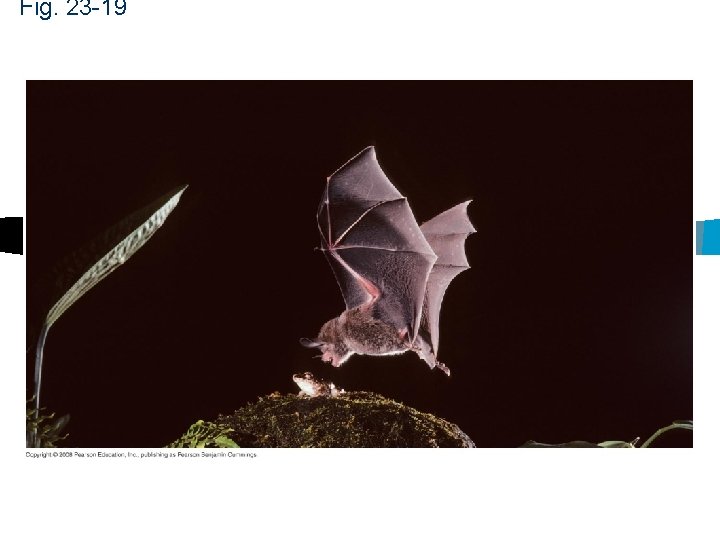
Fig. 23 -19
Maintaining variation n 1. Frequency-dependent selection n 2. Oscillating selection n 3. Heterozgote advantage
Frequency-dependent selection n n Fitness of a phenotype depends on frequency within population Negative frequency-dependent selection Rare phenotypes favored Predator preys on the more common phenotype Allowing less common phenotype to thrive
Frequency-dependent selection n Positive frequency-dependent selection n Predator feeds on rare phenotype n Favoring common phenotype
Oscillating selection n When one phenotype is favored at one time n Another phenotype is favored at a different time n Birds beak size and drought
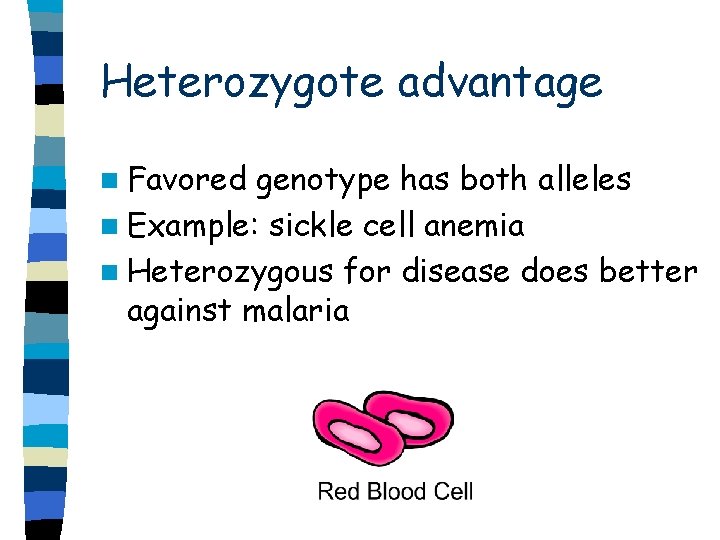
Heterozygote advantage n Favored genotype has both alleles n Example: sickle cell anemia n Heterozygous for disease does better against malaria