
Evolution of Nuclear Structure with the Increase of
- Slides: 19
Evolution of Nuclear Structure with the Increase of Neutron Richness – Orbital Crossing in Potassium Isotopes W. Królas, R. Broda, B. Fornal, T. Pawłat, J. Wrzesiński Department of the Structure of Atomic Nucleus (NZ 22/NO 2)
Evolution of Nuclear Structure with the Increase of Neutron Richness n Changes in shell structure – rearrangements of orbitals n Vanishing of shell gaps, appearance of new „magic numbers” n Experimental evidence needed n Experimental challenge – nuclei not easily accessible
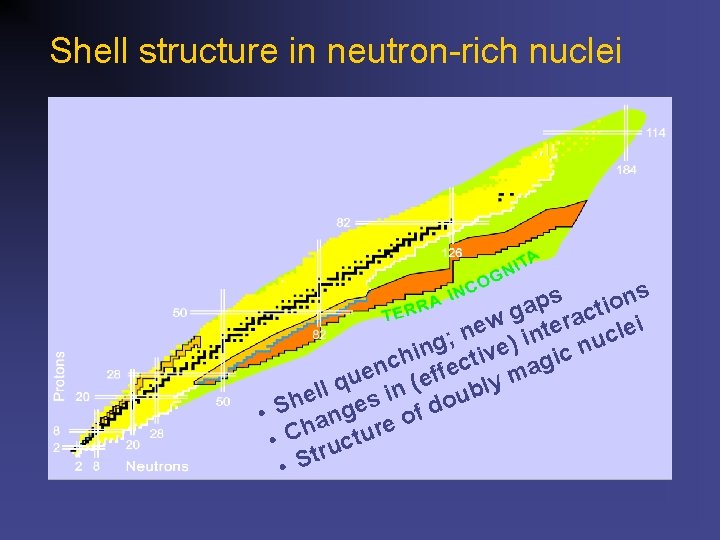
Shell structure in neutron-rich nuclei s s n p o i a g ct i a w r e te ucle n n ; i g ) n e n i v c i h i t c g c n a e f m y qu in (e l l l b e s f dou h e S g • n o a e h r • C ructu t • S
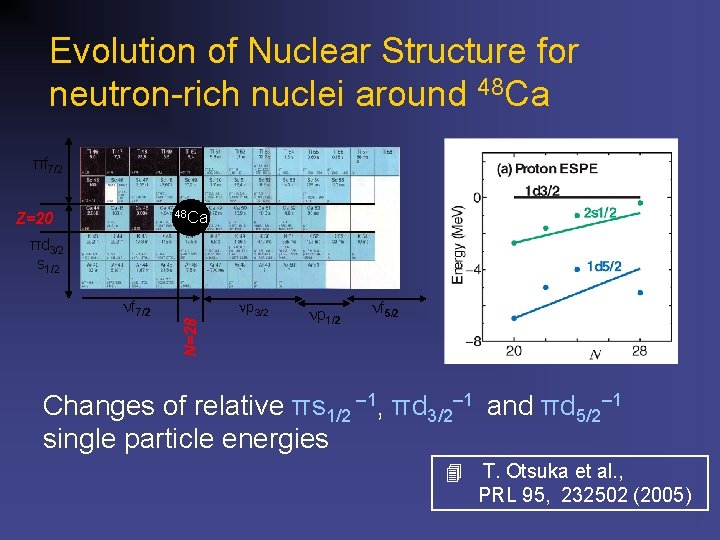
Evolution of Nuclear Structure for neutron-rich nuclei around 48 Ca πf 7/2 48 Ca Z=20 nf 7/2 N=28 πd 3/2 s 1/2 np 3/2 np 1/2 nf 5/2 Changes of relative πs 1/2 – 1, πd 3/2– 1 and πd 5/2– 1 single particle energies 4 T. Otsuka et al. , PRL 95, 232502 (2005)
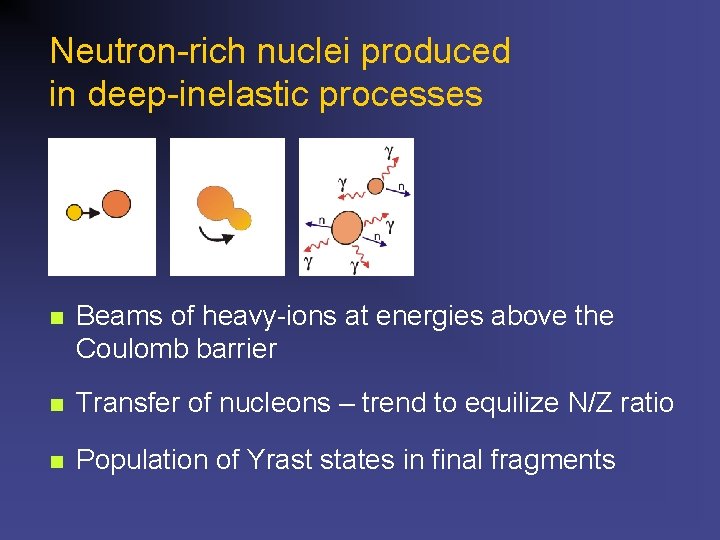
Neutron-rich nuclei produced in deep-inelastic processes n Beams of heavy-ions at energies above the Coulomb barrier n Transfer of nucleons – trend to equilize N/Z ratio n Population of Yrast states in final fragments
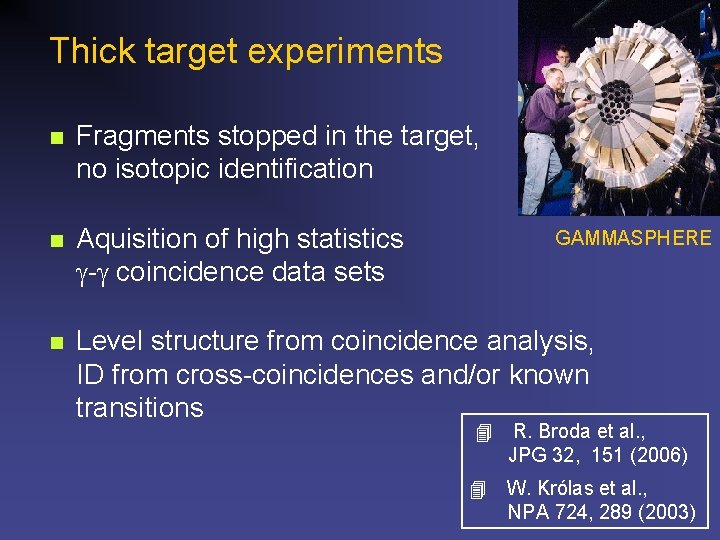
Thick target experiments n Fragments stopped in the target, no isotopic identification n Aquisition of high statistics g-g coincidence data sets n Level structure from coincidence analysis, ID from cross-coincidences and/or known transitions GAMMASPHERE 4 R. Broda et al. , JPG 32, 151 (2006) 4 W. Królas et al. , NPA 724, 289 (2003)
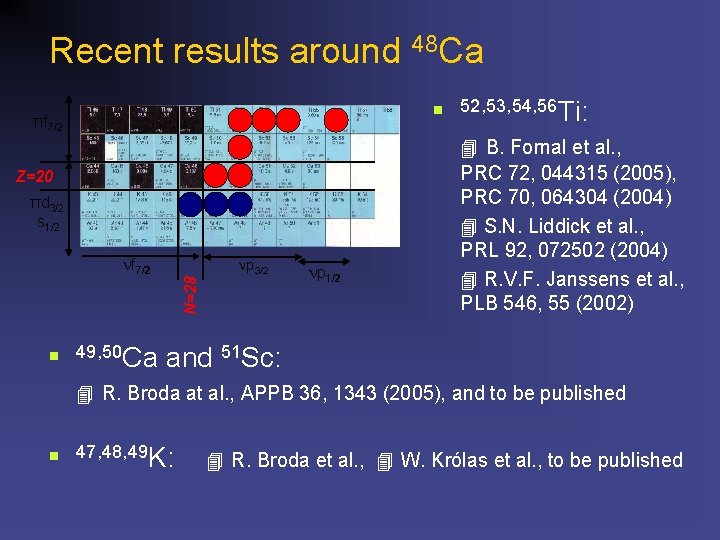
Recent results around 48 Ca n πf 7/2 Z=20 πd 3/2 s 1/2 n 49, 50 Ca N=28 nf 7/2 np 3/2 np 1/2 52, 53, 54, 56 Ti: 4 B. Fornal et al. , PRC 72, 044315 (2005), PRC 70, 064304 (2004) 4 S. N. Liddick et al. , PRL 92, 072502 (2004) 4 R. V. F. Janssens et al. , PLB 546, 55 (2002) and 51 Sc: 4 R. Broda at al. , APPB 36, 1343 (2005), and to be published n 47, 48, 49 K: 4 R. Broda et al. , 4 W. Królas et al. , to be published
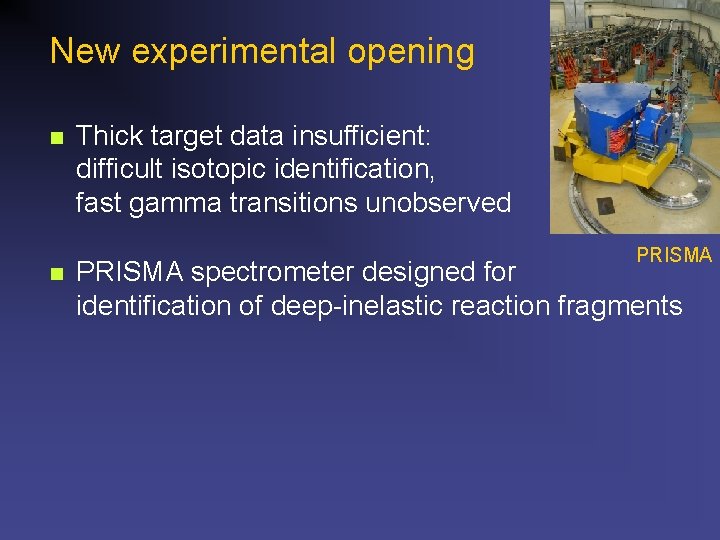
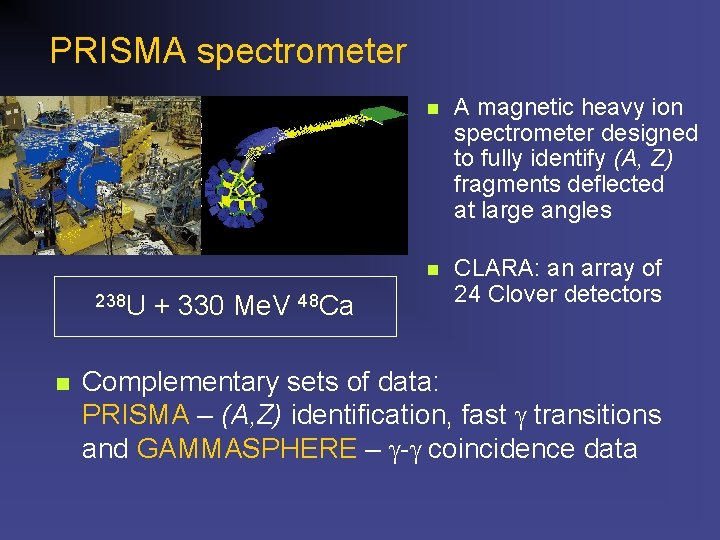
New experimental opening n n Thick target data insufficient: difficult isotopic identification, fast gamma transitions unobserved PRISMA spectrometer designed for identification of deep-inelastic reaction fragments
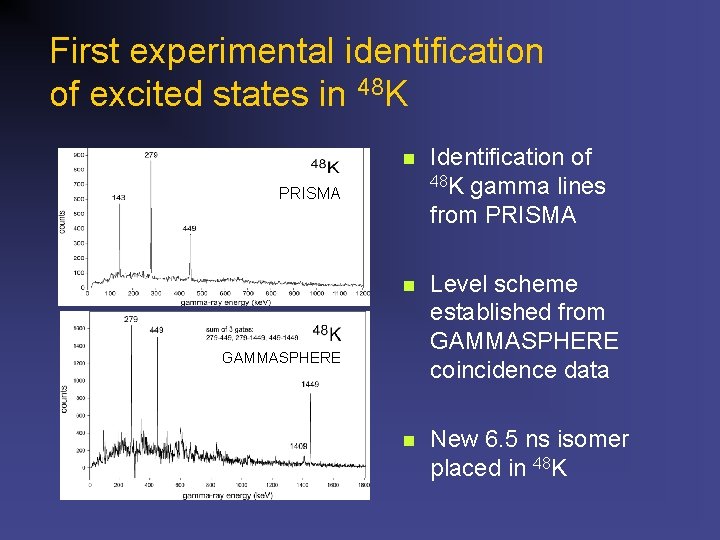
PRISMA spectrometer 238 U n + 330 Me. V 48 Ca n A magnetic heavy ion spectrometer designed to fully identify (A, Z) fragments deflected at large angles n CLARA: an array of 24 Clover detectors Complementary sets of data: PRISMA – (A, Z) identification, fast g transitions and GAMMASPHERE – g-g coincidence data
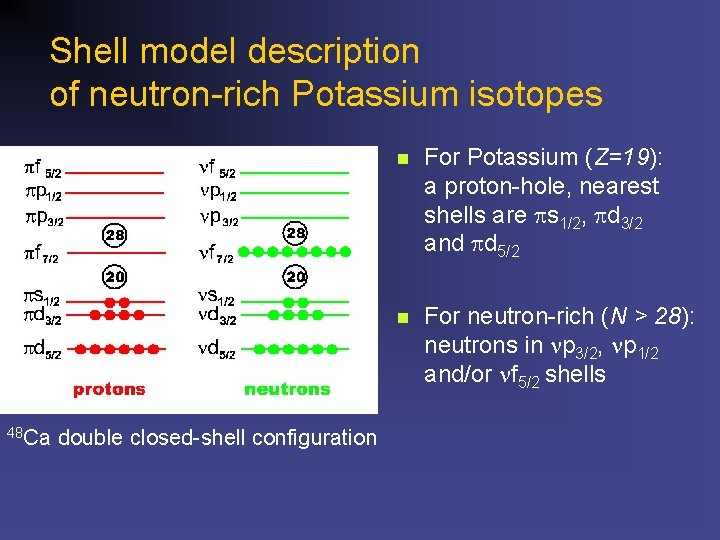
Shell model description of neutron-rich Potassium isotopes 48 Ca double closed-shell configuration n For Potassium (Z=19): a proton-hole, nearest shells are ps 1/2, pd 3/2 and pd 5/2 n For neutron-rich (N > 28): neutrons in np 3/2, np 1/2 and/or nf 5/2 shells
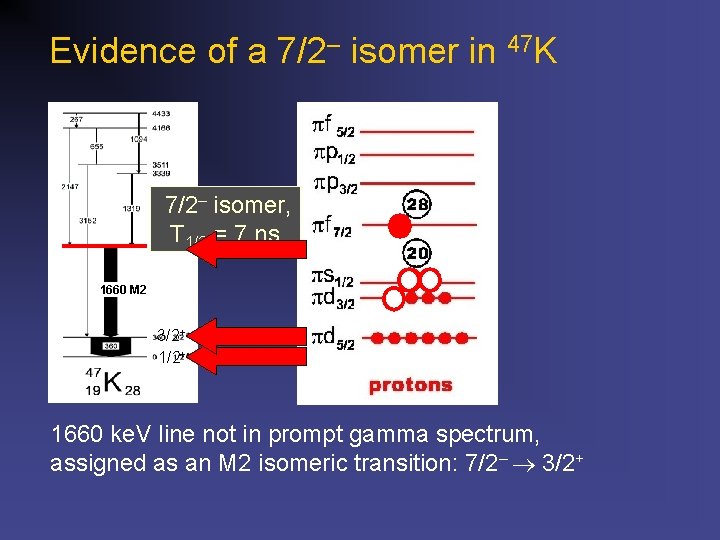
Evidence of a 7/2– isomer in 47 K 7/2– isomer, T 1/2 = 7 ns 1660 M 2 3/2+ 1660 ke. V line not in prompt gamma spectrum, assigned as an M 2 isomeric transition: 7/2– 3/2+
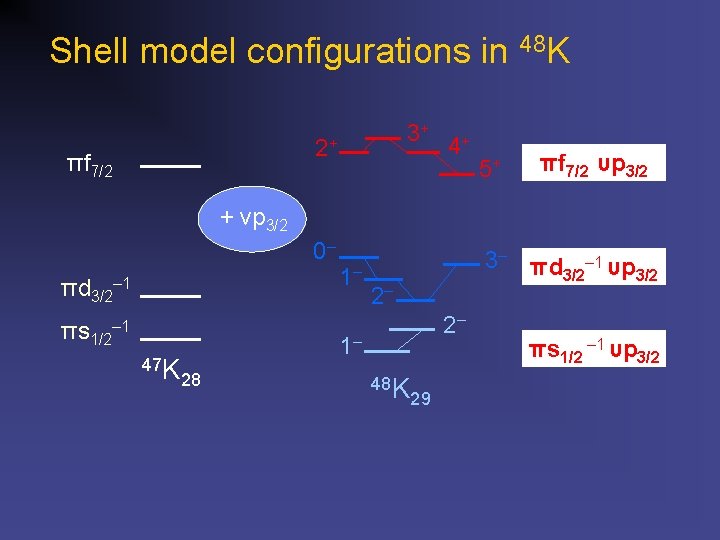
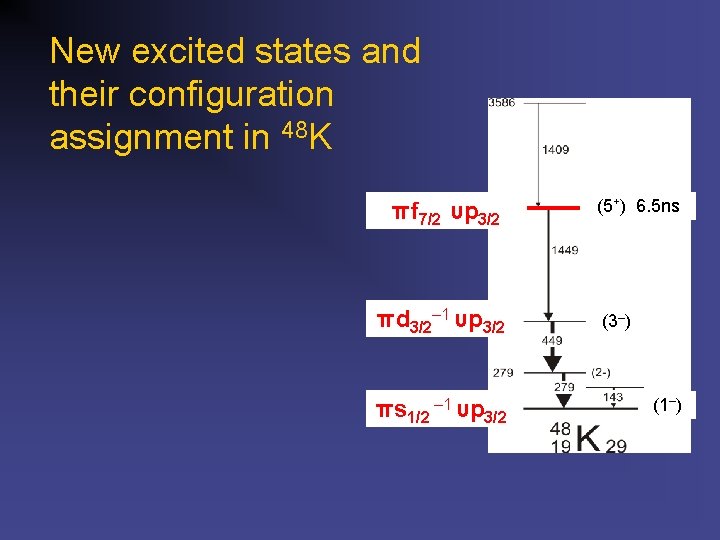
Shell model configurations in 48 K 3+ 2+ πf 7/2 4+ 5+ πf 7/2 υp 3/2 + νp 3/2 0– πd 3/2 – 1 πs 1/2– 1 47 K 1– 3– πd – 1 υp 3/2 2– 2– 1– 28 48 K 29 πs 1/2 – 1 υp 3/2
First experimental identification of excited states in 48 K n Identification of 48 K gamma lines from PRISMA n Level scheme established from GAMMASPHERE coincidence data n New 6. 5 ns isomer placed in 48 K PRISMA GAMMASPHERE
New excited states and their configuration assignment in 48 K πf 7/2 υp 3/2 πd 3/2– 1 υp 3/2 πs 1/2 – 1 υp 3/2 (5+) 6. 5 ns (3–) (1–)
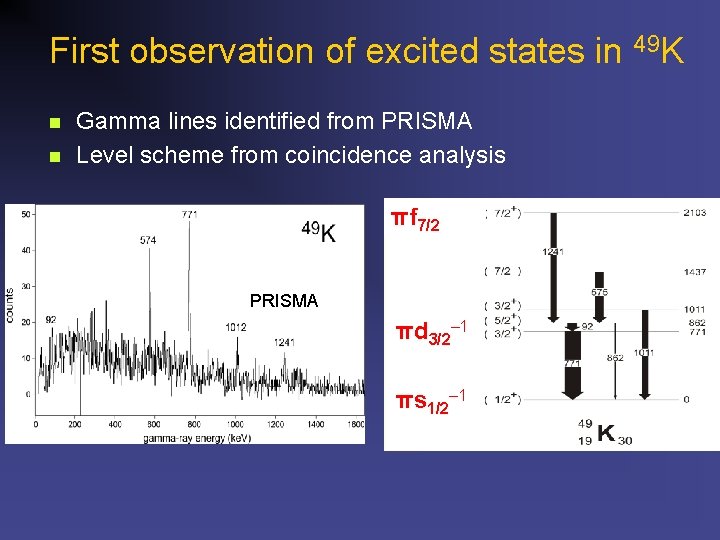
First observation of excited states in 49 K n n Gamma lines identified from PRISMA Level scheme from coincidence analysis πf 7/2 PRISMA πd 3/2– 1 πs 1/2– 1
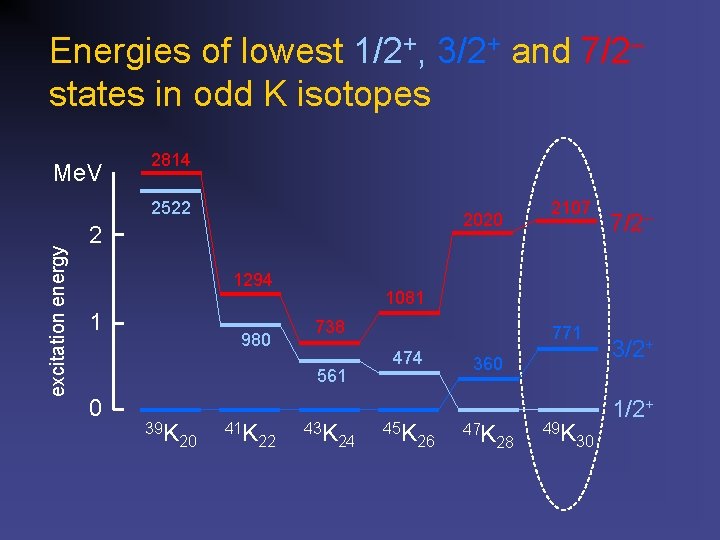
Energies of lowest 1/2+, 3/2+ and 7/2– states in odd K isotopes Me. V 2814 excitation energy 2522 2020 2 1294 1 980 39 K 20 41 K 22 7/2– 1081 738 561 0 2107 43 K 24 771 474 45 K 26 360 47 K 28 49 K 3/2+ 1/2+ 30
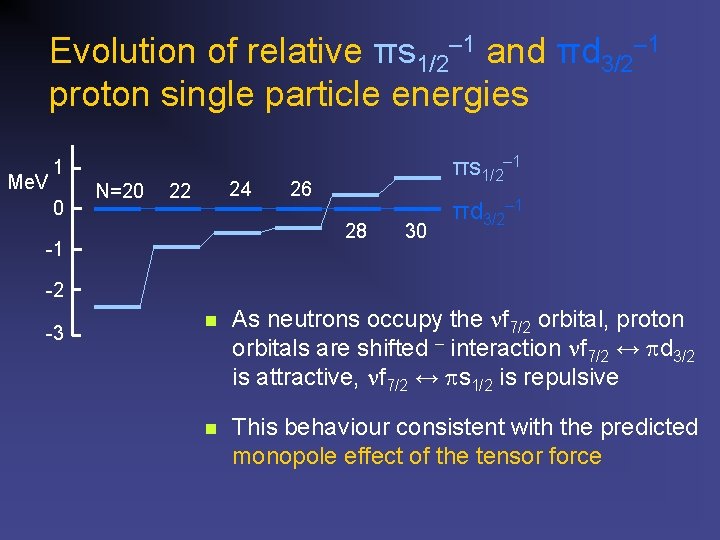
Evolution of relative πs 1/2– 1 and πd 3/2– 1 proton single particle energies Me. V 1 0 N=20 24 22 πs 1/2– 1 26 28 -1 30 πd 3/2– 1 -2 -3 n As neutrons occupy the nf 7/2 orbital, proton orbitals are shifted – interaction nf 7/2 ↔ pd 3/2 is attractive, nf 7/2 ↔ ps 1/2 is repulsive n This behaviour consistent with the predicted monopole effect of the tensor force
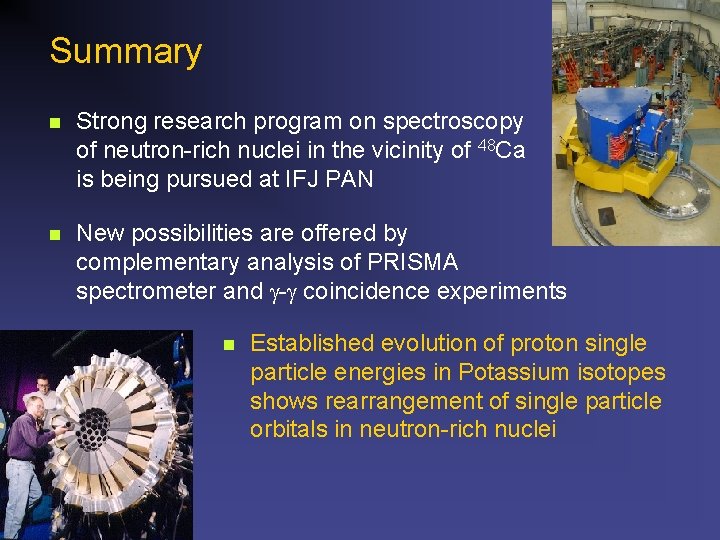
Summary n Strong research program on spectroscopy of neutron-rich nuclei in the vicinity of 48 Ca is being pursued at IFJ PAN n New possibilities are offered by complementary analysis of PRISMA spectrometer and g-g coincidence experiments n Established evolution of proton single particle energies in Potassium isotopes shows rearrangement of single particle orbitals in neutron-rich nuclei
Kraków group and collaborators R. Broda, B. Fornal, W. Królas, T. Pawłat, J. Wrzesiński IFJ PAN Kraków S. Lunardi, A. Gadea, N. Marginean, L. Corradi, A. M. Stefanini, F. Scarlassara, G. Montagnoli, M. Trotta, D. Napoli, E. Farnea Laboratori Nazionali di Legnaro and INFN Padova R. V. F. Janssens, M. P. Carpenter, T. Lauritsen, D. Seweryniak, S. Zhu Argonne National Laboratory