
Evolution of Multicellular Life Chapter 15 Copyright Mc
- Slides: 22
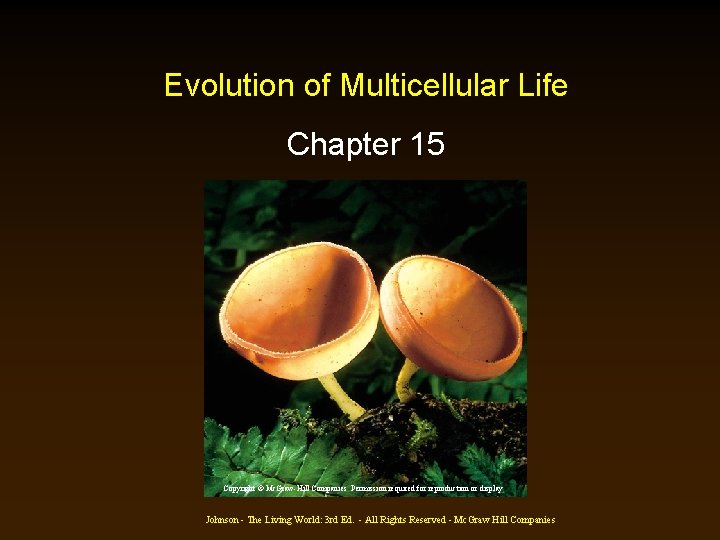
Evolution of Multicellular Life Chapter 15 Copyright © Mc. Graw-Hill Companies Permission required for reproduction or display Johnson - The Living World: 3 rd Ed. - All Rights Reserved - Mc. Graw Hill Companies
Outline • • • Complex Multicellularity Fungus vs. Plants Fungal Reproduction and Nutrition Fungi Ecology Kinds of Fungi v Zygomycetes v Ascomycetes v Basidomycetes Lichens and Mycorrhizae Johnson - The Living World: 3 rd Ed. - All Rights Reserved - Mc. Graw Hill Companies
Complex Multicellularity • Individuals are composed of many highly specialized kinds of cells that coordinate their activities. Three Kingdoms: v Plants v Animals v Fungi Johnson - The Living World: 3 rd Ed. - All Rights Reserved - Mc. Graw Hill Companies
Complex Multicellularity • Two key characteristics separate complex multicellular organisms from simple multicellular organisms. v Cell Specialization - Different cells using different genes - Cell Development v Intercell Coordination - Cell activity adjusts based on response to functions of other cells. Johnson - The Living World: 3 rd Ed. - All Rights Reserved - Mc. Graw Hill Companies
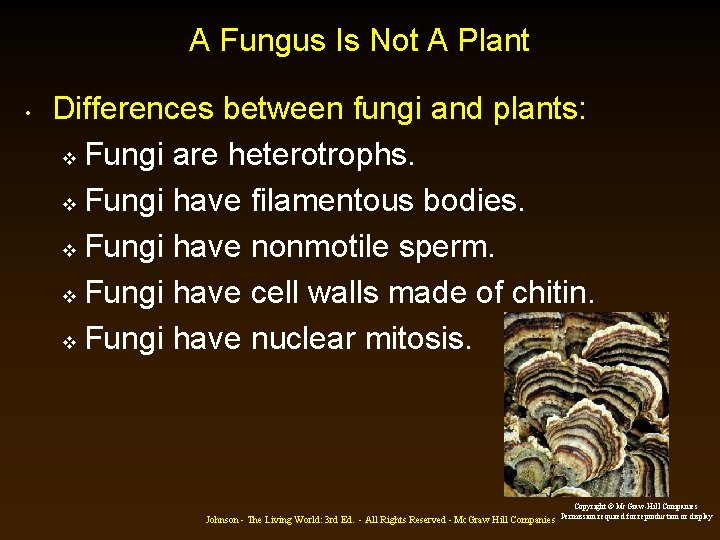
A Fungus Is Not A Plant • Differences between fungi and plants: v Fungi are heterotrophs. v Fungi have filamentous bodies. v Fungi have nonmotile sperm. v Fungi have cell walls made of chitin. v Fungi have nuclear mitosis. Johnson - The Living World: 3 rd Ed. - All Rights Reserved - Mc. Graw Hill Companies Copyright © Mc. Graw-Hill Companies Permission required for reproduction or display
A Fungus Is Not A Plant • Body of a Fungus v Fungi exist mainly in the form of slender filaments (hyphae). - Walls (septa) divide cells in filament. v Main body is network of hyphae (mycelium). - All parts of body are metabolically active. - Because of cytoplasmic streaming, many nuclei may be connected by shared cytoplasm. Johnson - The Living World: 3 rd Ed. - All Rights Reserved - Mc. Graw Hill Companies
Fungal Reproduction and Nutrition • Fungi reproduce both asexually and sexually. v Sexual reproduction initiated when hyphae of genetically different mating types come in contact and fuse. - Heterokaryon - nuclei derived from genetically different individuals. - Homokaryon - nuclei derived from genetically similar individuals. Johnson - The Living World: 3 rd Ed. - All Rights Reserved - Mc. Graw Hill Companies
Fungal Reproduction and Nutrition • • Three kinds of reproductive structures: v Gametangia - Gametes form within v Sporangia - Spores form within v Conidia - Asexual spore Fungi obtain food by secreting digestive enzymes into their surroundings and absorb organic molecules produced by external digestion. v Some act as active predators. Johnson - The Living World: 3 rd Ed. - All Rights Reserved - Mc. Graw Hill Companies
Fungi Ecology • Fungi and bacteria are principle decomposers in biosphere. v Fungi virtually only organism capable of breaking down lignin. v Often act as disease-causing organisms for plants and animals. v Multiple commercial products depend on biochemical activities of fungi. - Cheese, Penicillin Johnson - The Living World: 3 rd Ed. - All Rights Reserved - Mc. Graw Hill Companies
Kinds of Fungi • • Nearly 73, 000 described species. Three fungal phyla are distinguished from one another primarily by mode of sexual reproduction. v Zygomycetes v Ascomycetes v Basidiomycetes Johnson - The Living World: 3 rd Ed. - All Rights Reserved - Mc. Graw Hill Companies
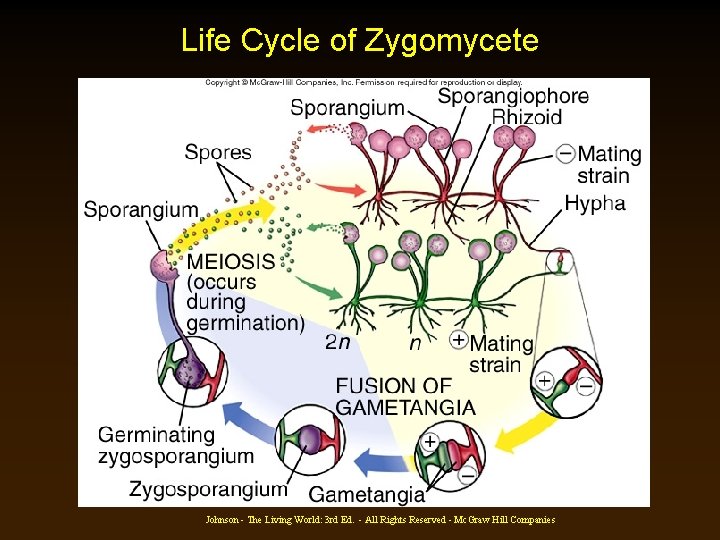
Zygomycetes • Zygomycetes are unique among fungi because fusion of hyphae does not produce heterokaryon. v Two nuclei fuse and form diploid nucleus. v Make up only about 1% of named fungi. v Reproduction typically asexual. Johnson - The Living World: 3 rd Ed. - All Rights Reserved - Mc. Graw Hill Companies
Life Cycle of Zygomycete Johnson - The Living World: 3 rd Ed. - All Rights Reserved - Mc. Graw Hill Companies
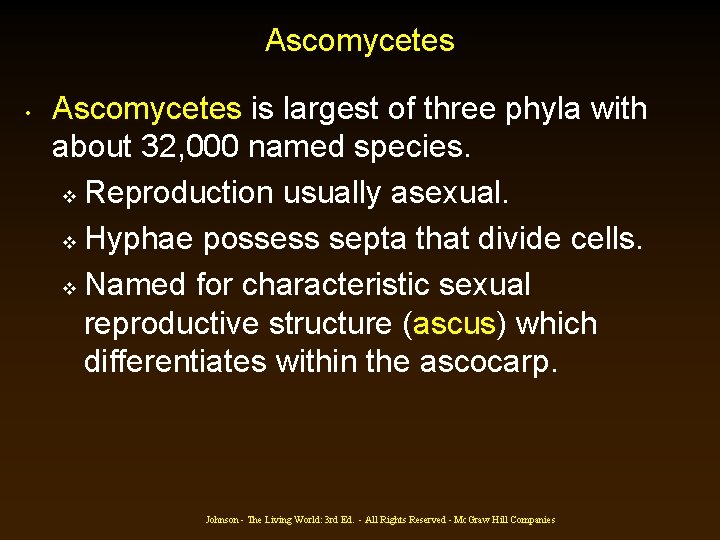
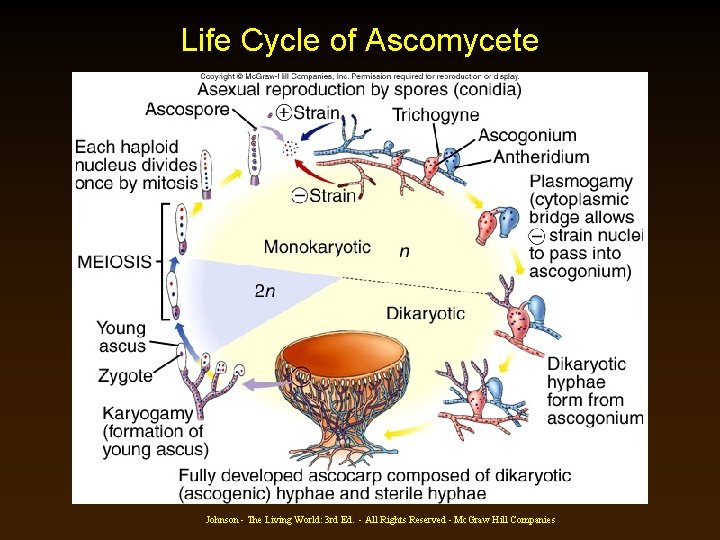
Ascomycetes • Ascomycetes is largest of three phyla with about 32, 000 named species. v Reproduction usually asexual. v Hyphae possess septa that divide cells. v Named for characteristic sexual reproductive structure (ascus) which differentiates within the ascocarp. Johnson - The Living World: 3 rd Ed. - All Rights Reserved - Mc. Graw Hill Companies
Life Cycle of Ascomycete Johnson - The Living World: 3 rd Ed. - All Rights Reserved - Mc. Graw Hill Companies
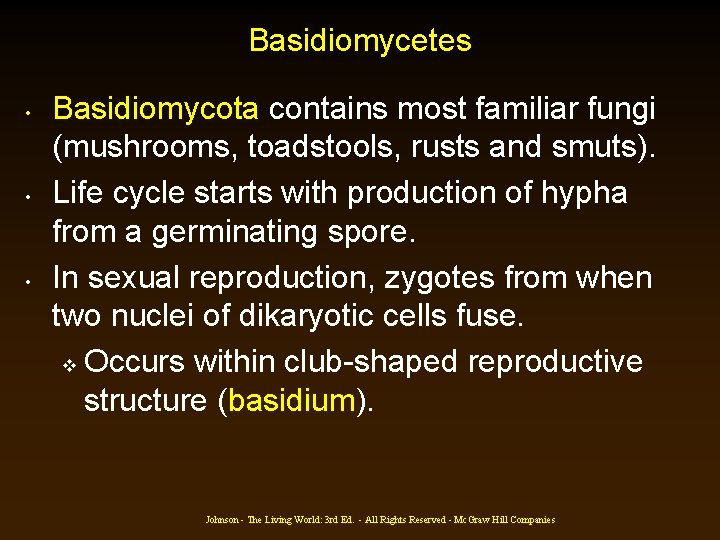
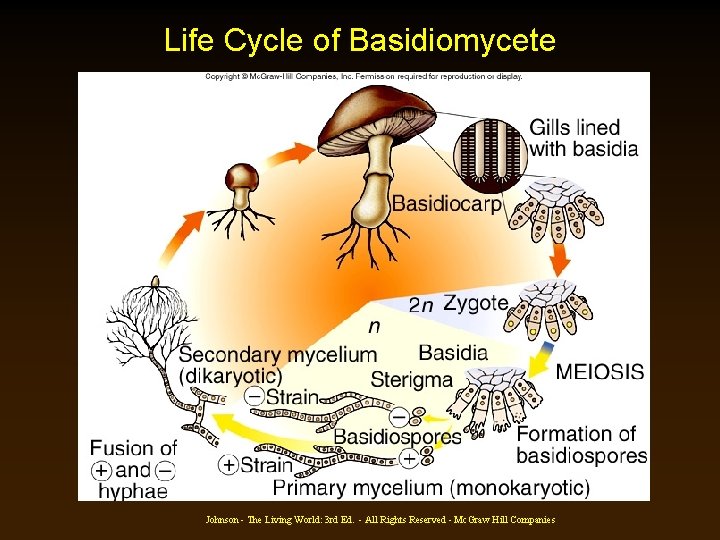
Basidiomycetes • • • Basidiomycota contains most familiar fungi (mushrooms, toadstools, rusts and smuts). Life cycle starts with production of hypha from a germinating spore. In sexual reproduction, zygotes from when two nuclei of dikaryotic cells fuse. v Occurs within club-shaped reproductive structure (basidium). Johnson - The Living World: 3 rd Ed. - All Rights Reserved - Mc. Graw Hill Companies
Life Cycle of Basidiomycete Johnson - The Living World: 3 rd Ed. - All Rights Reserved - Mc. Graw Hill Companies
Unicellular and Asexual Fungi • • Yeasts v Generic name given to unicellular fungi. - About 250 named species. v Most yeast reproduction is asexual and takes place by cell fission or budding. Imperfect Fungi v Sexual reproduction never observed. - Cannot formally be assigned to one of sexually reproducing phyla. Johnson - The Living World: 3 rd Ed. - All Rights Reserved - Mc. Graw Hill Companies
Lichens • Symbiotic association between fungus and photosynthetic partner. v Most of visible body consists of fungus, with interwoven cyanobacteria or green algae. - Fungus transmits biochemical signals to partner directing production of metabolic substances. Ø Key component of primary succession. § Can resist drying or freezing. § Pollution indicators. Johnson - The Living World: 3 rd Ed. - All Rights Reserved - Mc. Graw Hill Companies
Mycorrhizae • Mycorrhizae are associations between fungi and plant roots. v Fungus filaments act as efficient root hairs, and aid in direct transfer of minerals while plant supplies organic carbon to the symbiotic fungus. Johnson - The Living World: 3 rd Ed. - All Rights Reserved - Mc. Graw Hill Companies
Mycorrhizae • • Endomycorrhizae - Fungal hyphae of mycelium penetrate outer cells of the plant root, as well as far into the soil. Ectomycorrhizae - Mycorrhizae surround but do not physically penetrate plant root cells. v Highly specialized relationships in which a particular plant species has become associated with particular fungus. Johnson - The Living World: 3 rd Ed. - All Rights Reserved - Mc. Graw Hill Companies
Review • • • Complex Multicellularity Fungus vs. Plants Fungal Reproduction and Nutrition Fungi Ecology Kinds of Fungi v Zygomycetes v Ascomycetes v Basidomycetes Lichens and Mycorrhizae Johnson - The Living World: 3 rd Ed. - All Rights Reserved - Mc. Graw Hill Companies
Copyright © Mc. Graw-Hill Companies Permission required for reproduction or display Johnson - The Living World: 3 rd Ed. - All Rights Reserved - Mc. Graw Hill Companies