
EVOLUTION OF MODERN LIBERALISM Chapter 8 Positive vs
EVOLUTION OF MODERN LIBERALISM Chapter 8

Positive vs. Negative Freedoms � Classical liberalism believes in the freedom of individual choice � Often referred to as negative freedom or “freedom from. ” � Eg. freedom from tyranny, freedom from fear, freedom from hunger � Often amounted to little more than freedom from government intervention

Positive vs. Negative Freedoms � Modern Liberals tend to believe more in positive freedoms or “freedoms to” � How does this terminology help explain some of the differences between Classical and Modern Liberalism?

Positive or Negative Freedoms? “Everyone has the right to a standard of living adequate for the health and well-being of himself and of his family, including food, clothing, housing and medical care and necessary social services, and the right to security in the event of unemployment, sickness, disability, widowhood, old age or other lack of livelihood in circumstances beyond his control. ” Article 25. 1 The Universal Declaration of Human Rights
� Modern liberals believe that you cannot be truly free if basic needs are not met. � To ensure this freedom, modern liberals urge government social and economic intervention. � Modern liberals balance this increase in government power with guarantees of civil liberties

Consider the following scenarios. How would a classical and a modern liberal respond differently to each scenario? � A family loses its home in a hurricane � A young person from a low-income household cannot afford to go to university � A corporation’s “glass ceiling” prevents women and visible minorities from reaching the highest levels of management.
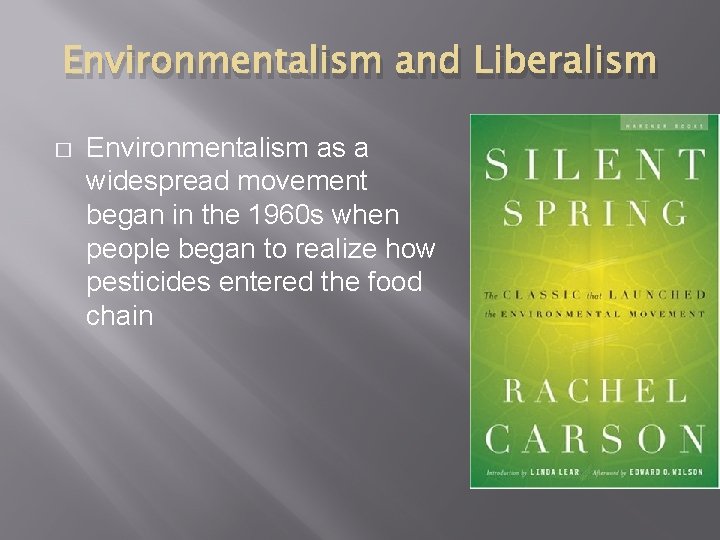
Environmentalism and Liberalism � Environmentalism as a widespread movement began in the 1960 s when people began to realize how pesticides entered the food chain

Environmentalism � During the 1970 s organizations like Green Peace and Friends of the Earth began to put pressure on the government to enact laws to protect the environment
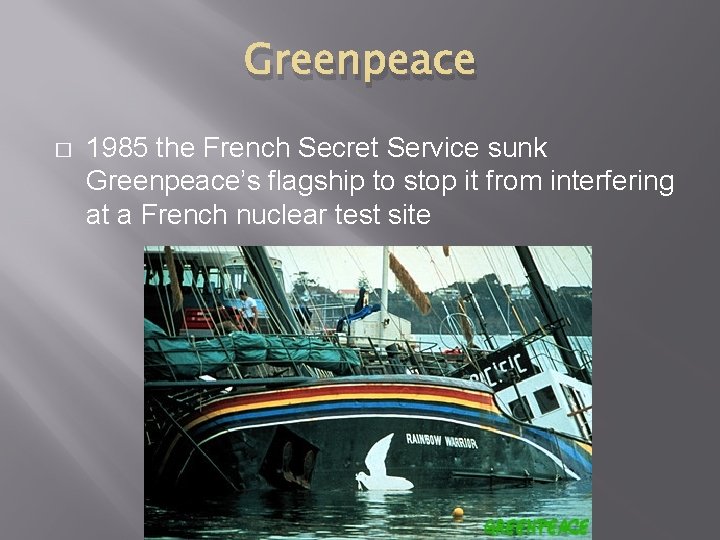
Greenpeace � 1985 the French Secret Service sunk Greenpeace’s flagship to stop it from interfering at a French nuclear test site
Free-market skeptics of environmental reform � Many free market economists and supporters look to the great improvements in modern living conditions that are the result of industrial and technical growth made possible by the free market � Many indicators such as health, mortality, disease control, smog reduction have shown massive improvements in many parts of the world
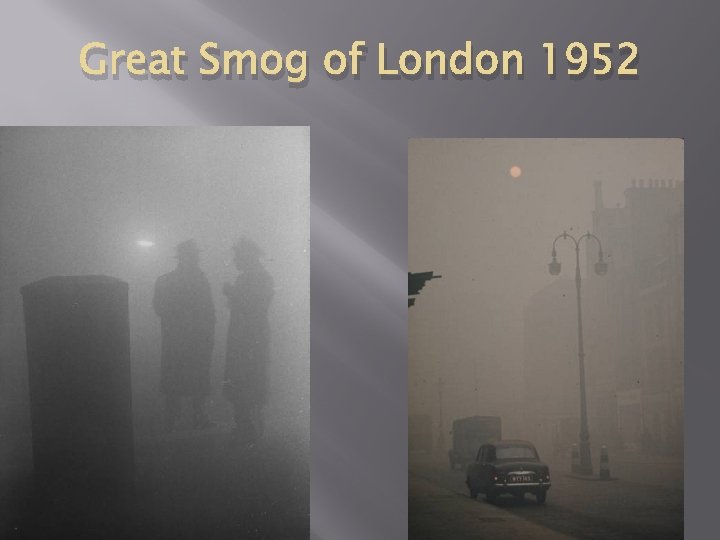
Great Smog of London 1952
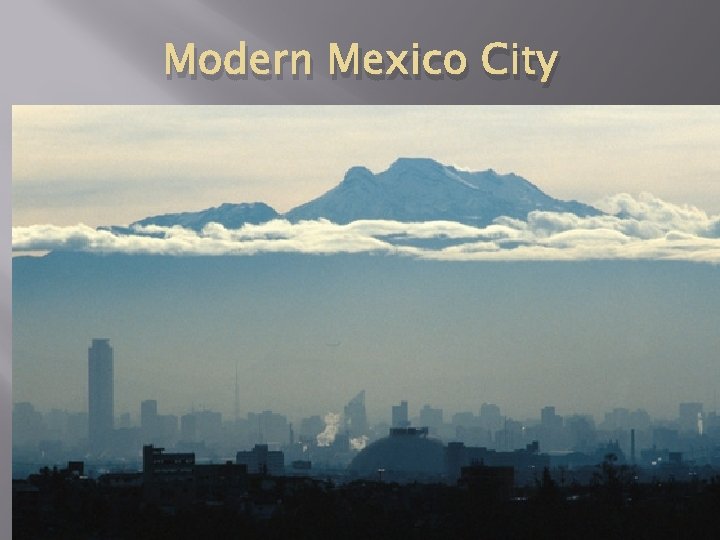
Modern Mexico City
Organic Foods � Initially, organic foods were sought by a small group of people � It was expensive and hard to find, often confined to specialty stores � Today, every major grocery store has its own line of organic products that are very similar in price

Modern Liberalism and the Neo. Conservative Challenge � Neo-conservatism is hard to define “When two neo-conservatives meet they are more likely to argue with one another than to confer or conspire” – Irving Kristol Some neo-conservatives are former liberals who believe liberal policies failed Some are favour return to the principles of classical liberalism Some challenge both modern and classical liberalism
Neo-conservatism: a brief history � Developed during the 1950 s and 1960 s as a reaction modern liberal principles that were “taken too far” � Civil rights movement led to affirmative action, a policy that gave minorities and women greater educational and employment opportunities
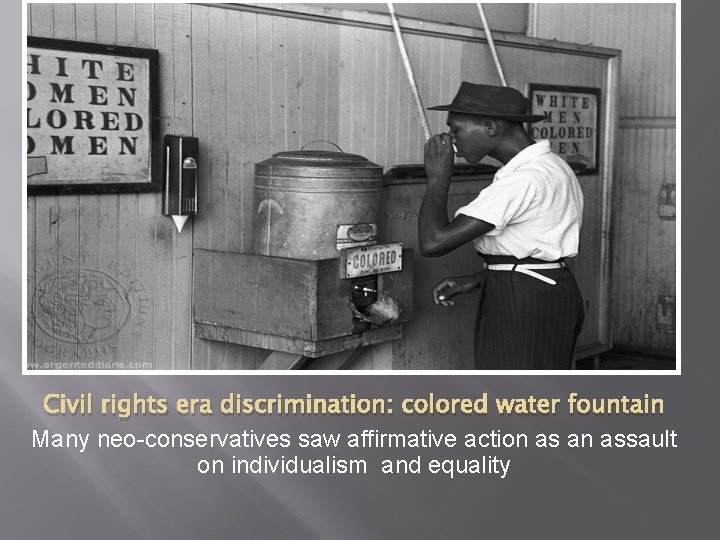
Civil rights era discrimination: colored water fountain Many neo-conservatives saw affirmative action as an assault on individualism and equality
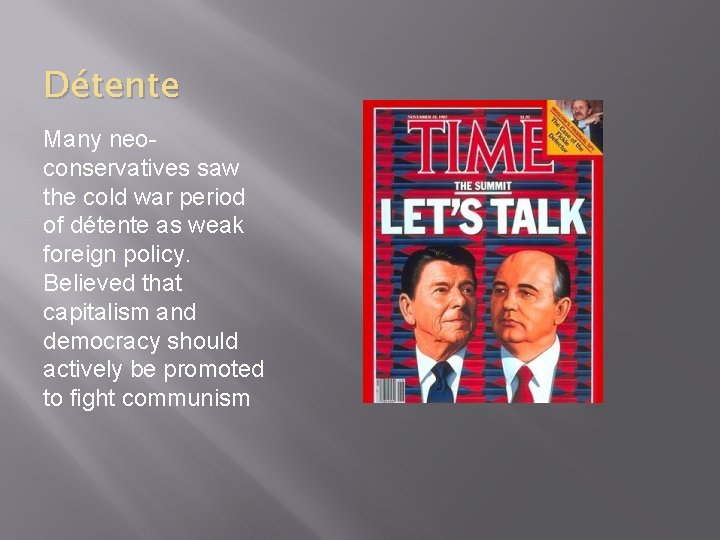
Détente Many neoconservatives saw the cold war period of détente as weak foreign policy. Believed that capitalism and democracy should actively be promoted to fight communism
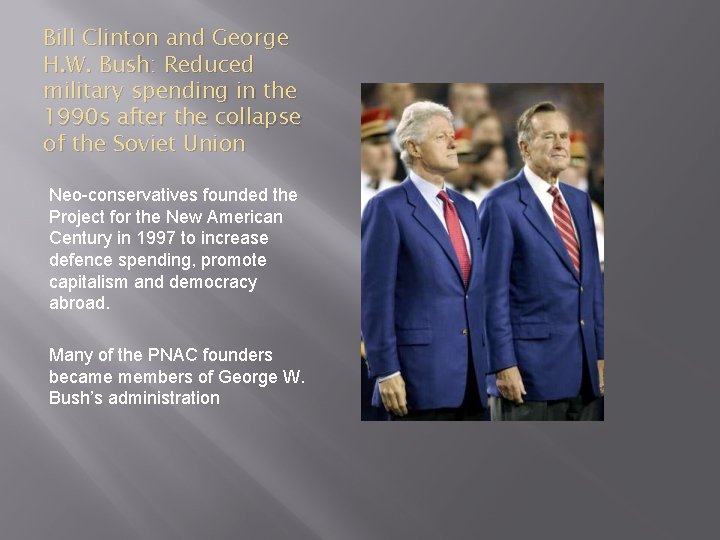
Bill Clinton and George H. W. Bush: Reduced military spending in the 1990 s after the collapse of the Soviet Union Neo-conservatives founded the Project for the New American Century in 1997 to increase defence spending, promote capitalism and democracy abroad. Many of the PNAC founders became members of George W. Bush’s administration
Neo – Conservative Beliefs Political Economic Social
Neo-Conservative Economic Policy � � � Believe that economic growth can be stimulated by cutting taxes Government involvement in economic markets should be limited The World Trade Organization (WTO) and the International Monetary Fund (IMF) � Both organizations promote free trade with little government involvement � Leaders associated with neo-conservative economics?
Economic neo-conservatives � � � President Ronald Reagan – U. S. A Prime Minister Margaret Thatcher – U. K. Milton Friedman
Neo-Conservatives and the Role of Government � � Not comfortable with the large amount of services provided by modern government To some extent, this challenges modern and classical liberalism For example, both believe that government should be responsible for education Neo-conservatives have influenced the establishment of private schools – free from rules, regulations and government controls of public schools

Private Schools � � � 24% in United States 4% in Alberta 10% in Quebec
Thatcher � In the 1980 s Thatcher supported privatization of state owned industries, decreased taxes, reduced government programs related to health, employment, education, and social security
Neo-conservatives and Social/Moral beliefs � � � Generally have traditional views about social issues Concerned about the demise of traditional moral culture and tend to be suspicious of the counter culture Influenced by the Christian Right many neoconservatives seek to curtail abortion rights, allow prayer in schools, urge teaching about creationism in science class
Religion and government � What should the relationship between government and religion be? � What do classical and modern liberals believe about this question? � Circumstances where these two would conflict?
Christian Right � Term used to describe a coalition of conservative groups in the United States and other liberal democracies that focuses on applying specific Christian beliefs to public policy � Members often see modern liberal society as straying from religious values and principles they believe society should follow
Government Limitations on Religious Right � Freedom of religion is an important right of liberalism but governments often place restrictions on religious practices to prevent them from conflicting with the rights of the individual members of a religious community � Although preventing some religious groups from practicing their interpretation of religious traditions restricts them, it ensures equality before the law.
Case Studies � Marriage/ divorce laws � Health Examine the table on page 290. Where do you place yourself? Read page 292 – 293 and answer questions 1 -3
- Slides: 29