
EVOLUTION OF METABOLISM PHOTOSYNTHESIS IMSS BIOLOGY SUMMER 2012
EVOLUTION OF METABOLISM: PHOTOSYNTHESIS IMSS BIOLOGY ~ SUMMER 2012
LEARNING TARGETS • To be able to define metabolism. • To understand the evidence for the evolutionary origin of photosynthesis. • To understand the impact of oxygenic photosynthesis on the evolution of life on Earth. • To understand the importance of photosynthesis at the cellular, organismal, and ecological levels.
DEFINING METABOLISM • Sum of all chemical reactions occurring in a living organism • Includes • Catabolism – breaking down large molecules into smaller molecules; releases energy (exergonic reactions) • Anabolism – synthesis of large molecules from smaller molecules; requires energy (endergonic reactions) • Photosynthesis and cellular respiration both involve metabolic processes that • Occur on a molecular level inside cells • Produce energy-yielding molecules that sustain life
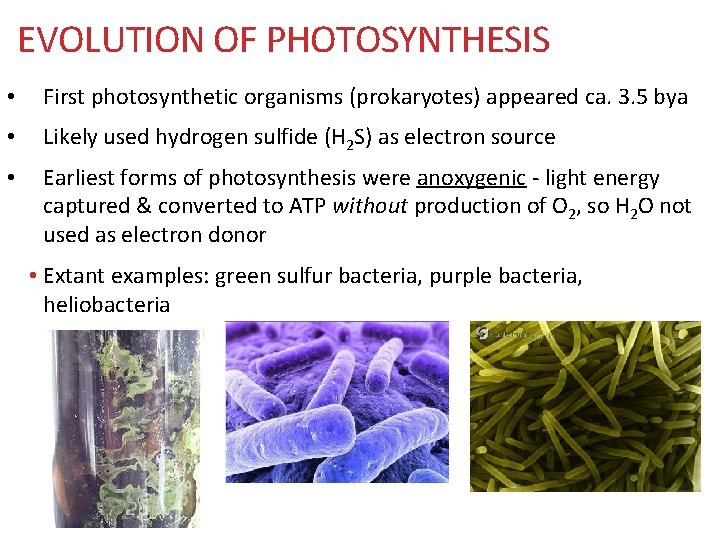
EVOLUTION OF PHOTOSYNTHESIS • First photosynthetic organisms (prokaryotes) appeared ca. 3. 5 bya • Likely used hydrogen sulfide (H 2 S) as electron source • Earliest forms of photosynthesis were anoxygenic - light energy captured & converted to ATP without production of O 2, so H 2 O not used as electron donor • Extant examples: green sulfur bacteria, purple bacteria, heliobacteria
EVOLUTIONARY TRANSITION TO OXYGENIC PHOTOSYNTHESIS • Single most important point in evolution of life on Earth: evolution of oxygenic photosynthesis - ability of photosynthetic organisms to use water as electron donor, thereby producing O 2 as waste product. • O 2 production and its subsequent accumulation in atmosphere forever changed life on Earth! • Several lines of geochemical evidence suggest free O 2 began to accumulate in atmosphere by 2. 4 bya • Cyanobacteria first evolved ability to use H 2 O as electron source for oxygenic photosynthesis • H 2 O molecule split to make reducing agents for fixing CO 2
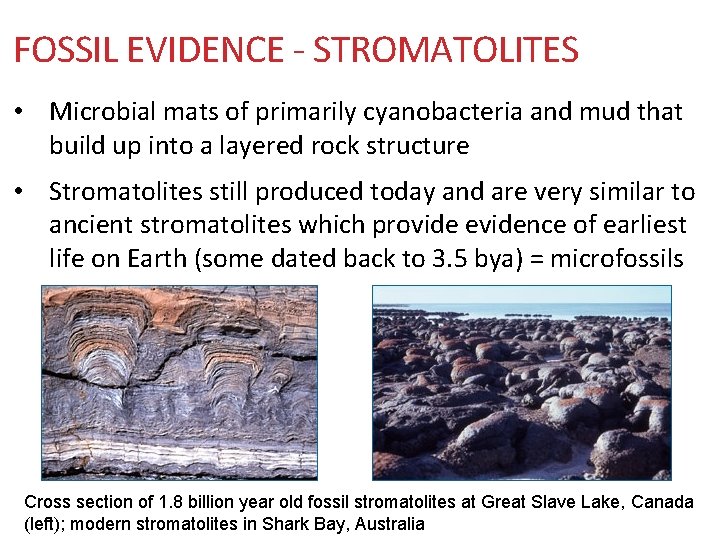
FOSSIL EVIDENCE - STROMATOLITES • Microbial mats of primarily cyanobacteria and mud that build up into a layered rock structure • Stromatolites still produced today and are very similar to ancient stromatolites which provide evidence of earliest life on Earth (some dated back to 3. 5 bya) = microfossils Cross section of 1. 8 billion year old fossil stromatolites at Great Slave Lake, Canada (left); modern stromatolites in Shark Bay, Australia
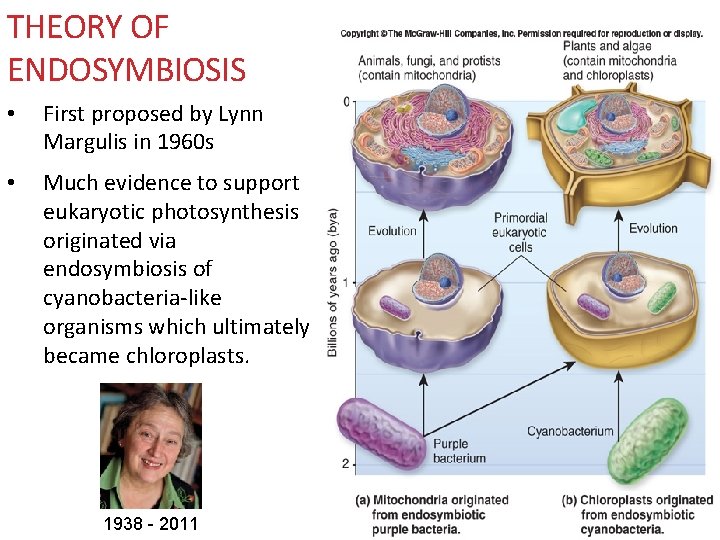
THEORY OF ENDOSYMBIOSIS • First proposed by Lynn Margulis in 1960 s • Much evidence to support eukaryotic photosynthesis originated via endosymbiosis of cyanobacteria-like organisms which ultimately became chloroplasts. 1938 - 2011
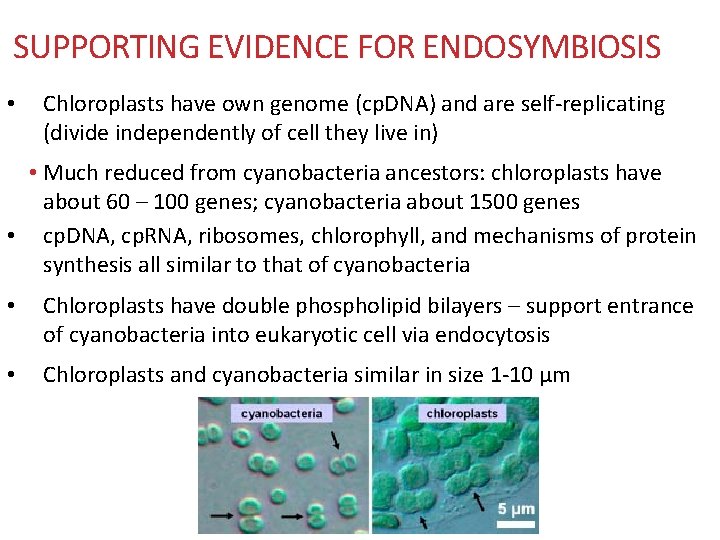
SUPPORTING EVIDENCE FOR ENDOSYMBIOSIS • Chloroplasts have own genome (cp. DNA) and are self-replicating (divide independently of cell they live in) • Much reduced from cyanobacteria ancestors: chloroplasts have about 60 – 100 genes; cyanobacteria about 1500 genes • cp. DNA, cp. RNA, ribosomes, chlorophyll, and mechanisms of protein synthesis all similar to that of cyanobacteria • Chloroplasts have double phospholipid bilayers – support entrance of cyanobacteria into eukaryotic cell via endocytosis • Chloroplasts and cyanobacteria similar in size 1 -10 μm

TAKE TWO MINUTES • To reflect on what you’ve learned thus far.
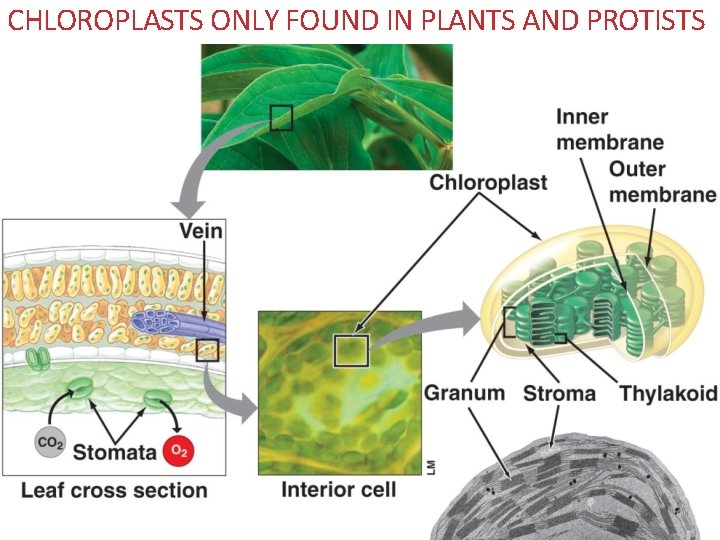
CHLOROPLASTS ONLY FOUND IN PLANTS AND PROTISTS
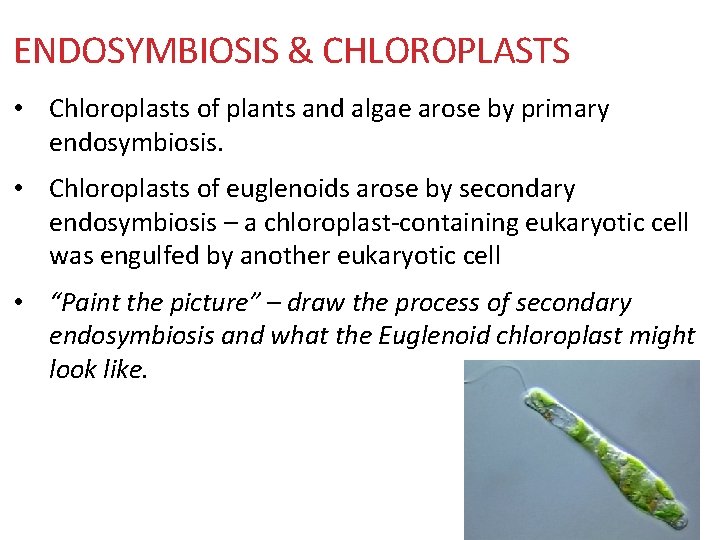
ENDOSYMBIOSIS & CHLOROPLASTS • Chloroplasts of plants and algae arose by primary endosymbiosis. • Chloroplasts of euglenoids arose by secondary endosymbiosis – a chloroplast-containing eukaryotic cell was engulfed by another eukaryotic cell • “Paint the picture” – draw the process of secondary endosymbiosis and what the Euglenoid chloroplast might look like.
ENDOSYMBIOSIS & CHLOROPLASTS • View animation: http: //bcs. whfreeman. com/thelifewire/content/chp 28/2 802 s. swf
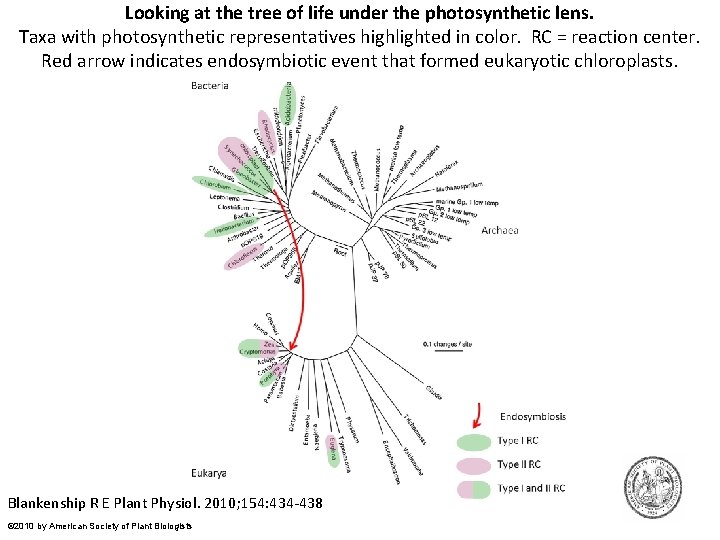
Looking at the tree of life under the photosynthetic lens. Taxa with photosynthetic representatives highlighted in color. RC = reaction center. Red arrow indicates endosymbiotic event that formed eukaryotic chloroplasts. Blankenship R E Plant Physiol. 2010; 154: 434 -438 © 2010 by American Society of Plant Biologists
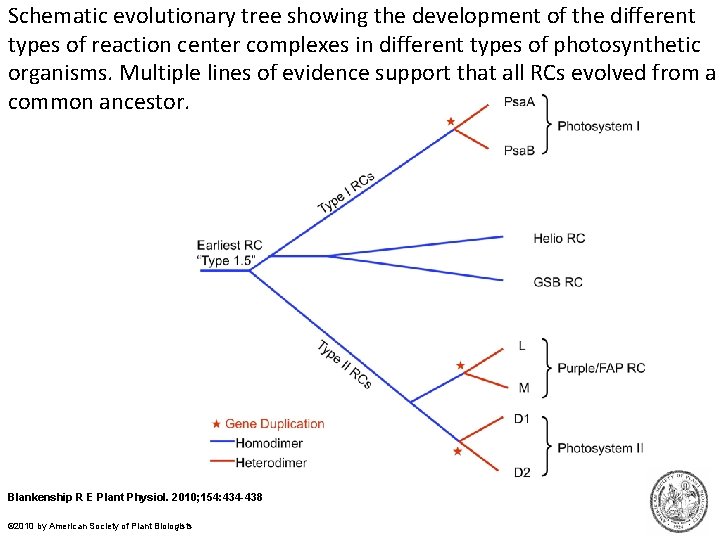
Schematic evolutionary tree showing the development of the different types of reaction center complexes in different types of photosynthetic organisms. Multiple lines of evidence support that all RCs evolved from a common ancestor. Blankenship R E Plant Physiol. 2010; 154: 434 -438 © 2010 by American Society of Plant Biologists
Reaction centers in photosynthetic organisms are examples of (A) homologies (B) analogies
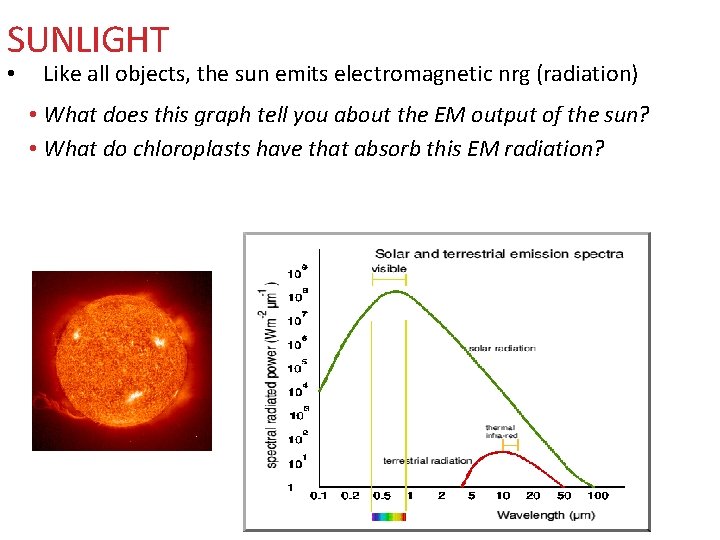
SUNLIGHT • Like all objects, the sun emits electromagnetic nrg (radiation) • What does this graph tell you about the EM output of the sun? • What do chloroplasts have that absorb this EM radiation?
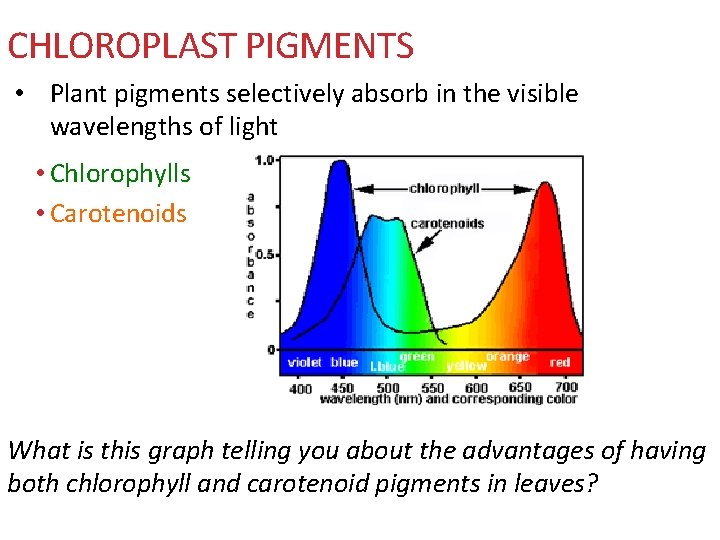
CHLOROPLAST PIGMENTS • Plant pigments selectively absorb in the visible wavelengths of light • Chlorophylls • Carotenoids What is this graph telling you about the advantages of having both chlorophyll and carotenoid pigments in leaves?
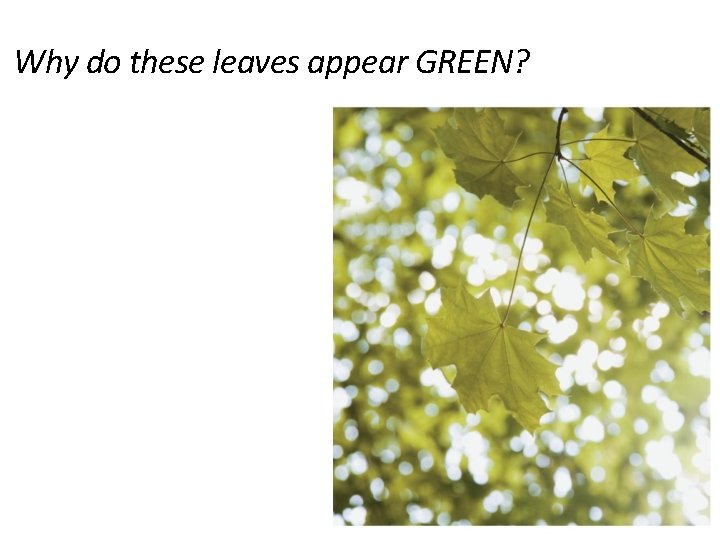
Why do these leaves appear GREEN?
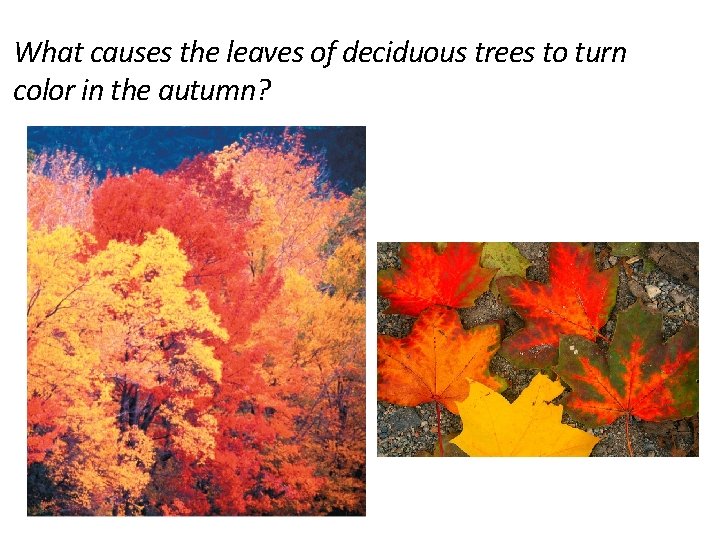
What causes the leaves of deciduous trees to turn color in the autumn?
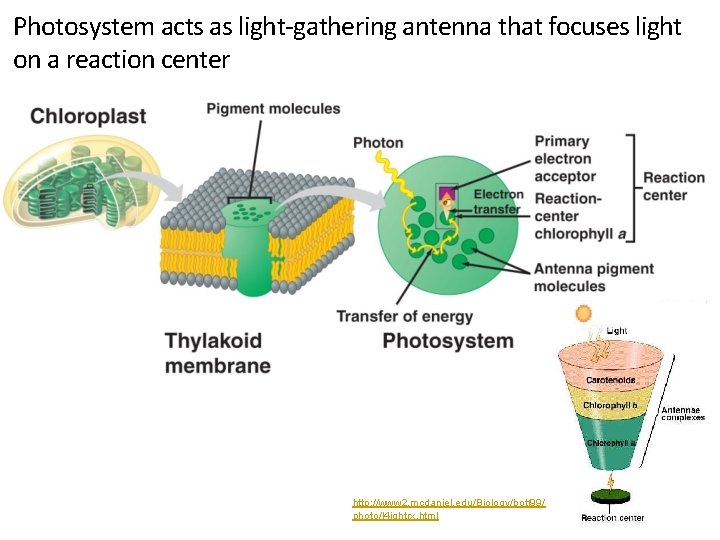
Photosystem acts as light-gathering antenna that focuses light on a reaction center http: //www 2. mcdaniel. edu/Biology/botf 99/ photo/l 4 ightrx. html
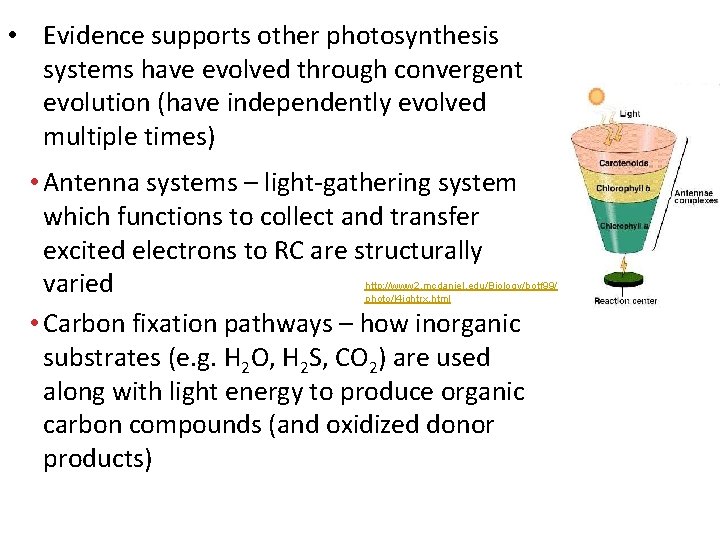
• Evidence supports other photosynthesis systems have evolved through convergent evolution (have independently evolved multiple times) • Antenna systems – light-gathering system which functions to collect and transfer excited electrons to RC are structurally varied • Carbon fixation pathways – how inorganic substrates (e. g. H 2 O, H 2 S, CO 2) are used along with light energy to produce organic carbon compounds (and oxidized donor products) http: //www 2. mcdaniel. edu/Biology/botf 99/ photo/l 4 ightrx. html
Antenna systems (and modes of carbon fixation) in photosynthetic organisms are examples of (A) homologies (B) analogies
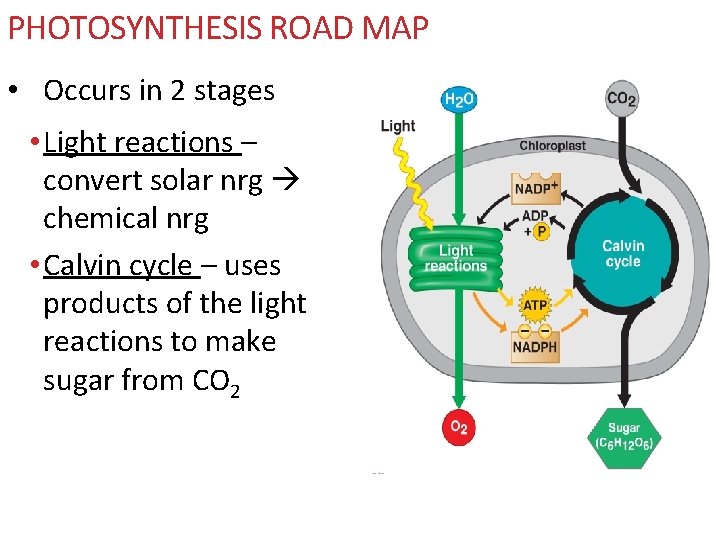
PHOTOSYNTHESIS ROAD MAP • Occurs in 2 stages • Light reactions – convert solar nrg chemical nrg • Calvin cycle – uses products of the light reactions to make sugar from CO 2
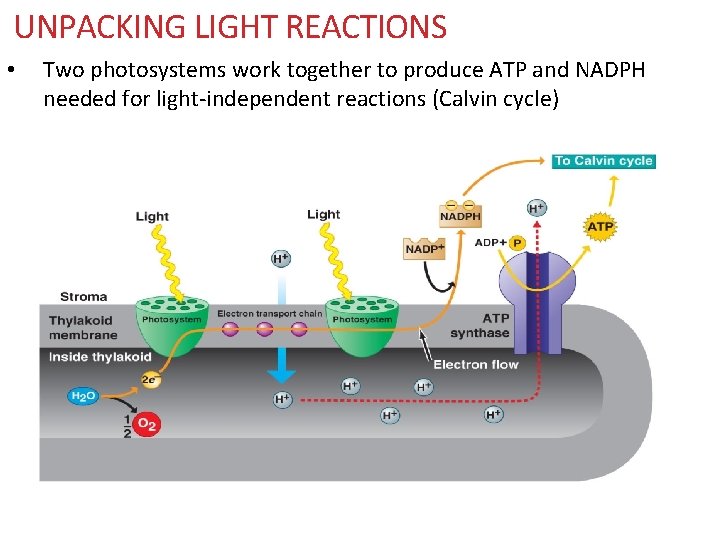
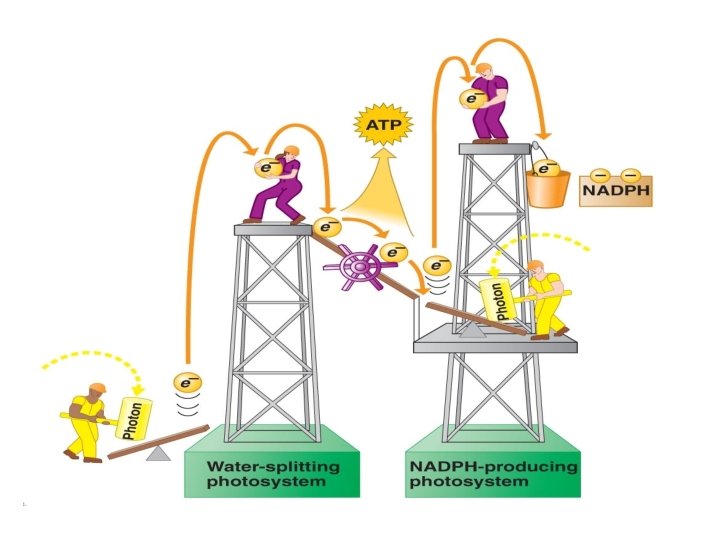
UNPACKING LIGHT REACTIONS • Two photosystems work together to produce ATP and NADPH needed for light-independent reactions (Calvin cycle)
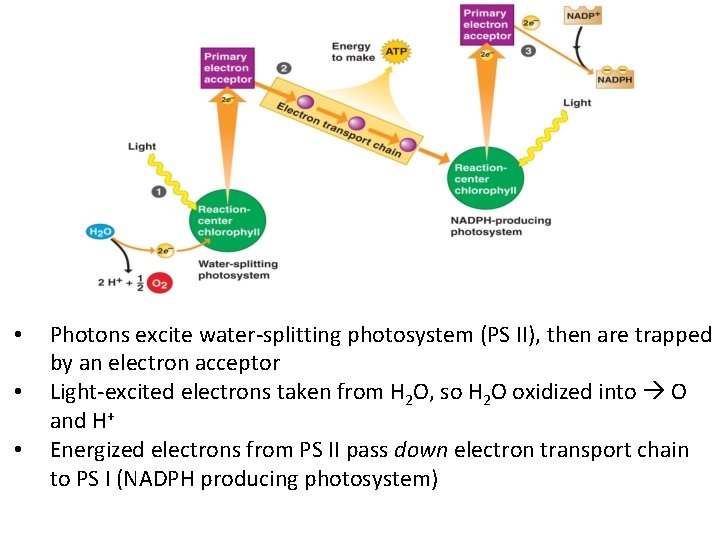
• • • Photons excite water-splitting photosystem (PS II), then are trapped by an electron acceptor Light-excited electrons taken from H 2 O, so H 2 O oxidized into O and H+ Energized electrons from PS II pass down electron transport chain to PS I (NADPH producing photosystem)
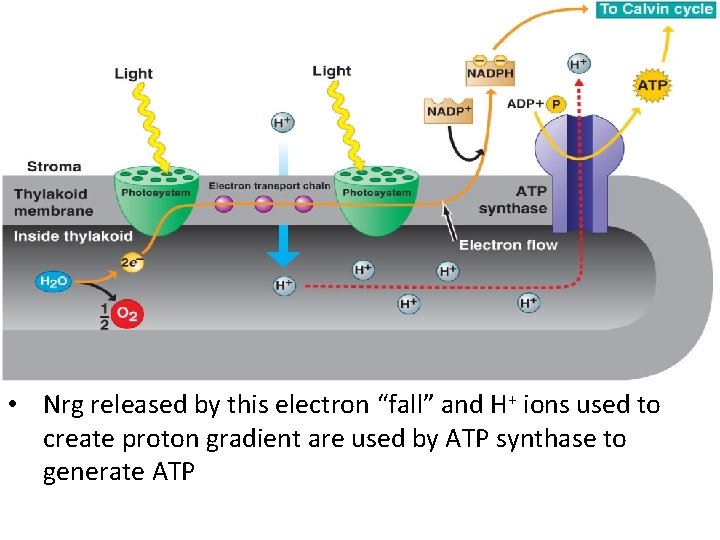
• Nrg released by this electron “fall” and H+ ions used to create proton gradient are used by ATP synthase to generate ATP
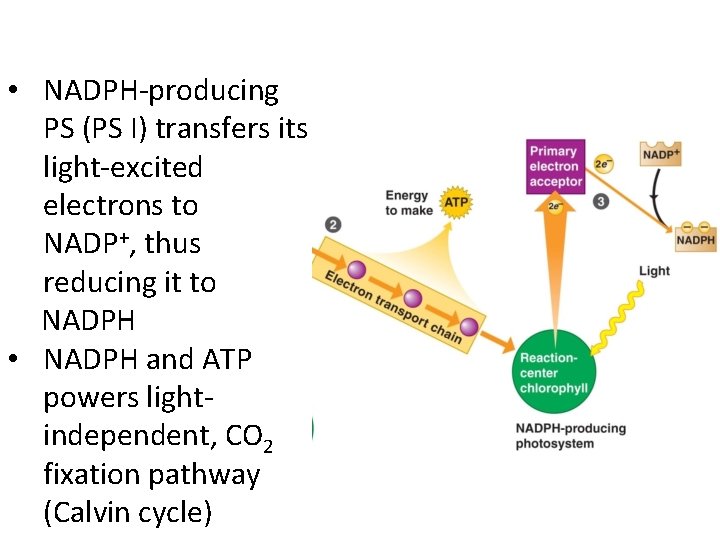
• NADPH-producing PS (PS I) transfers its light-excited electrons to NADP+, thus reducing it to NADPH • NADPH and ATP powers lightindependent, CO 2 fixation pathway (Calvin cycle)
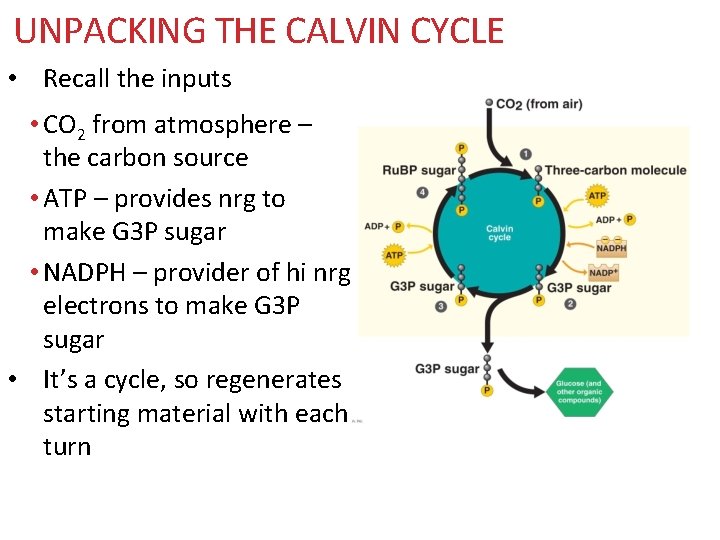
UNPACKING THE CALVIN CYCLE • Recall the inputs • CO 2 from atmosphere – the carbon source • ATP – provides nrg to make G 3 P sugar • NADPH – provider of hi nrg electrons to make G 3 P sugar • It’s a cycle, so regenerates starting material with each turn
MISCONCEPTION • Glucose is the direct product of the Calvin cycle • G 3 P is the direct product. G 3 P will be made into glucose, sucrose, or carbohydrates for the plant, e. g. starch, cellulose
PHOTOSYNTHETIC STRATEGIES IN PLANTS • Three modes of photosynthesis in plants – these reflect climate adaptations • C 3 plants • C 4 plants • CAM plants
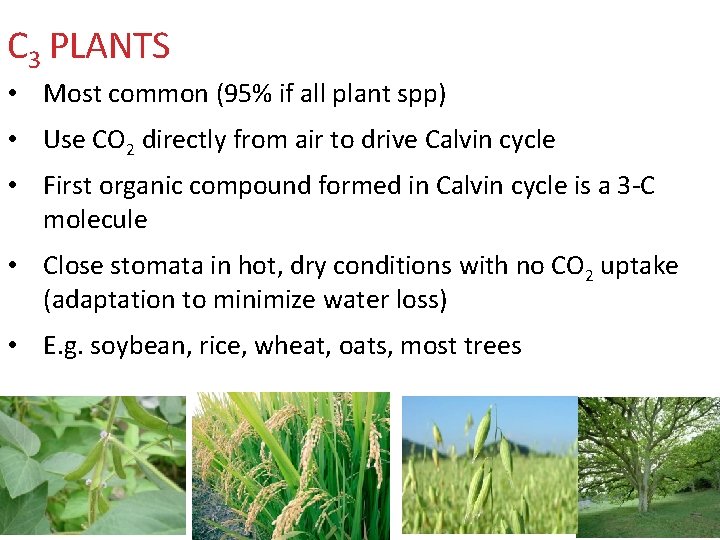
C 3 PLANTS • Most common (95% if all plant spp) • Use CO 2 directly from air to drive Calvin cycle • First organic compound formed in Calvin cycle is a 3 -C molecule • Close stomata in hot, dry conditions with no CO 2 uptake (adaptation to minimize water loss) • E. g. soybean, rice, wheat, oats, most trees
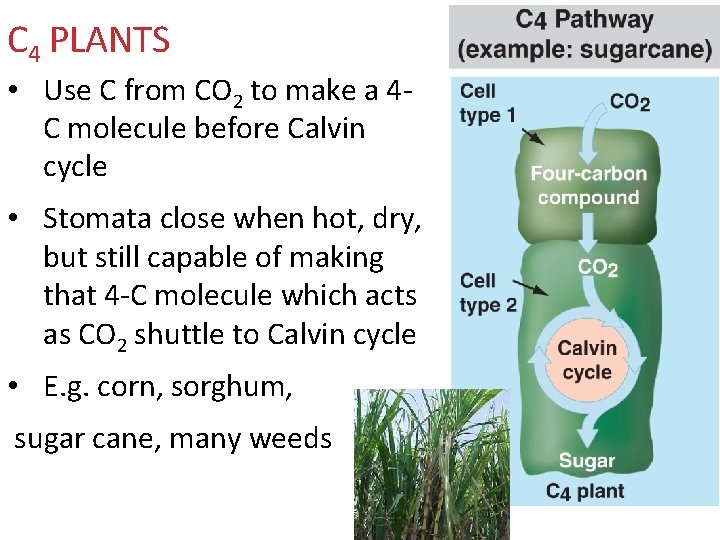
C 4 PLANTS • Use C from CO 2 to make a 4 C molecule before Calvin cycle • Stomata close when hot, dry, but still capable of making that 4 -C molecule which acts as CO 2 shuttle to Calvin cycle • E. g. corn, sorghum, sugar cane, many weeds
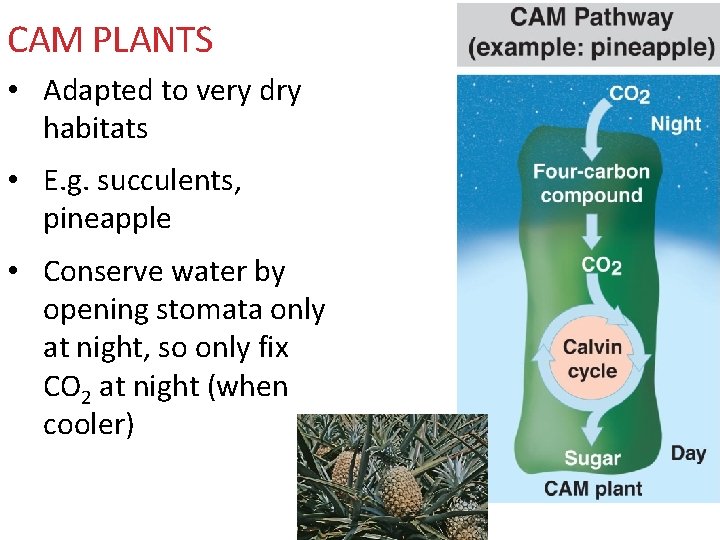
CAM PLANTS • Adapted to very dry habitats • E. g. succulents, pineapple • Conserve water by opening stomata only at night, so only fix CO 2 at night (when cooler)
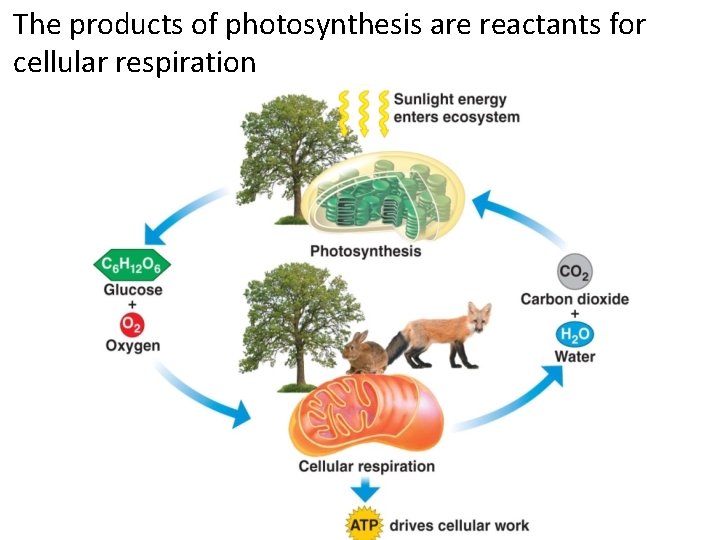
The products of photosynthesis are reactants for cellular respiration FIG. 6. 2: NRG FLOW & CHEMICAL CYCLING IN ECOSYSTEMS
PLANTS ALSO RESPIRE! • All eukaryotes (including plants) evolved from a common ancestor with mitochondria • Endosymbiotic origin of mitochondria • All eukaryotes have mitochondria (or once did, and later lost them) • Origin of mitochondria and eukaryotic cell plausibly the same event • Land Martin (2011) ask, “why did only mitochondrionbearing cells evolve true complexity? ”
RESOURCES • Great overviews on key biology concepts http: //www. shmoop. com/biology/ • Advanced tutorial on photosynthesis http: //highered. mcgrawhill. com/olcweb/cgi/pluginpop. cgi? it=swf: : 535: : /sites/dl/free/0072437316/120072/b io 13. swf: : Photosynthetic%20 Electron%20 Transport%20 and%20 ATP%20 Synthesis • Early evolution of photosynthesis http: //www. plantphysiol. org/content/154/2/434. full

MUDDIEST POINT • Take a few moments to jot down what was the most difficult or confusing part of today’s presentation.
ACTIVITY Leaf Disk Assay 45 min.
- Slides: 39