
Evolution of Legacy Systems Strategic and managerial issues
- Slides: 28
Evolution of Legacy Systems Strategic and managerial issues based on a case Herman Tromp, Ghislain Hoffman ELISA workshop, Amsterdam, Sep. 23, 2003 INTEC Department of Information Technology http: //www. intec. rug. ac. be
What is legacy n Legacy : n n Money, etc. (to be) received by a person by the will of and at the death of another person Something handed down from ancestors or predecessors (source : dictionary) Legacy has a n n Positive connotation : value Negative connotation : old, out-of-date, inappropriate for current use INTEC - Department of Information Technology
What is a legacy system? A legacy system is an operational system that has been designed, implemented and installed in a radically different environment than imposed by the current ICT strategy. It is also a system that still contains considerable business value and is critical for operations. (Note : other definitions are available) INTEC - Department of Information Technology
Context The ARRIBA project (see companion paper) n Migration at LCM (this paper) n n n Largest organisation in Belgium, responsible for health care allowances (interfaces with government agencies, hospitals and indivual citizens in a variety of ways) Large scale systems, parts of it about 30 years old “home developed” (no commercial software was available then) Urgent need to migrate (hardware is becoming obsolete) Objective of this paper : to discuss the strategic and managerial issues of legacy migration INTEC - Department of Information Technology
A few position statements. . . from the lessons learned n Large scale systems can only be succesfully migrated through evolution n Evolution implies more than code refactoring (it can hardly be refactored) n Evolution must also consider architecture, information models, persistency techniques, business culture, . . . n. . . and thus has severe implications on strategy and management. . . n. . . and is seriously impacted by these. INTEC - Department of Information Technology
As is – What is “large scale” INTEC - Department of Information Technology
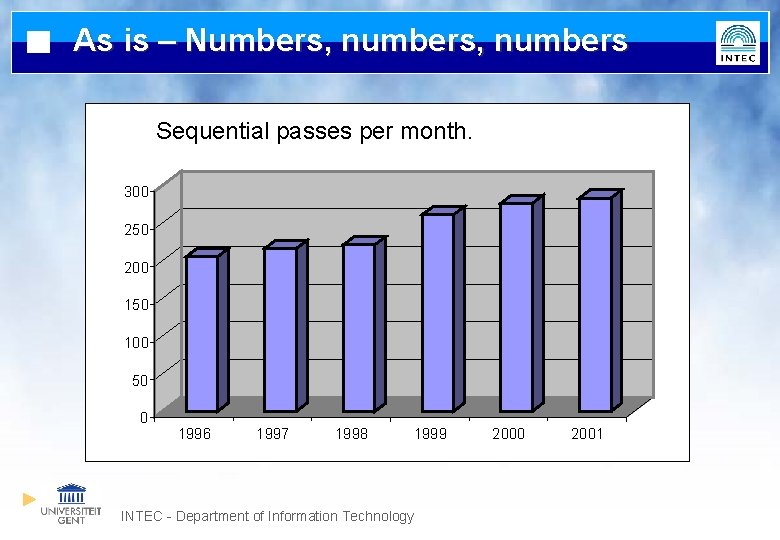
As is – Numbers, numbers Sequential passes per month. 300 250 200 150 100 50 0 1996 1997 1998 1999 INTEC - Department of Information Technology 2000 2001
As is – Numbers, numbers INTEC - Department of Information Technology
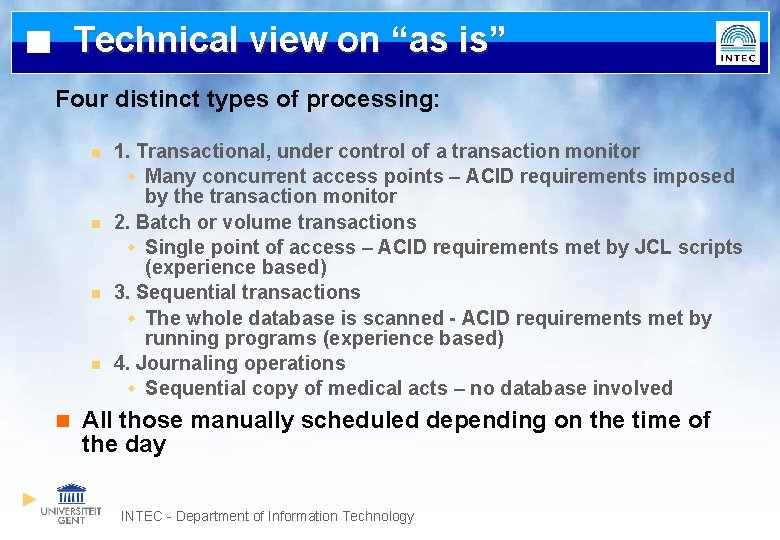
Technical view on “as is” Four distinct types of processing: n n n 1. Transactional, under control of a transaction monitor w Many concurrent access points – ACID requirements imposed by the transaction monitor 2. Batch or volume transactions w Single point of access – ACID requirements met by JCL scripts (experience based) 3. Sequential transactions w The whole database is scanned - ACID requirements met by running programs (experience based) 4. Journaling operations w Sequential copy of medical acts – no database involved All those manually scheduled depending on the time of the day INTEC - Department of Information Technology
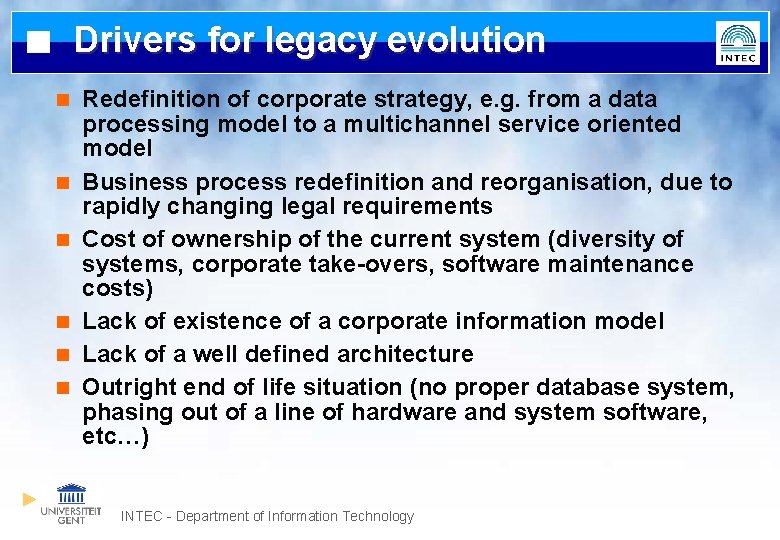
Drivers for legacy evolution n n n Redefinition of corporate strategy, e. g. from a data processing model to a multichannel service oriented model Business process redefinition and reorganisation, due to rapidly changing legal requirements Cost of ownership of the current system (diversity of systems, corporate take-overs, software maintenance costs) Lack of existence of a corporate information model Lack of a well defined architecture Outright end of life situation (no proper database system, phasing out of a line of hardware and system software, etc…) INTEC - Department of Information Technology
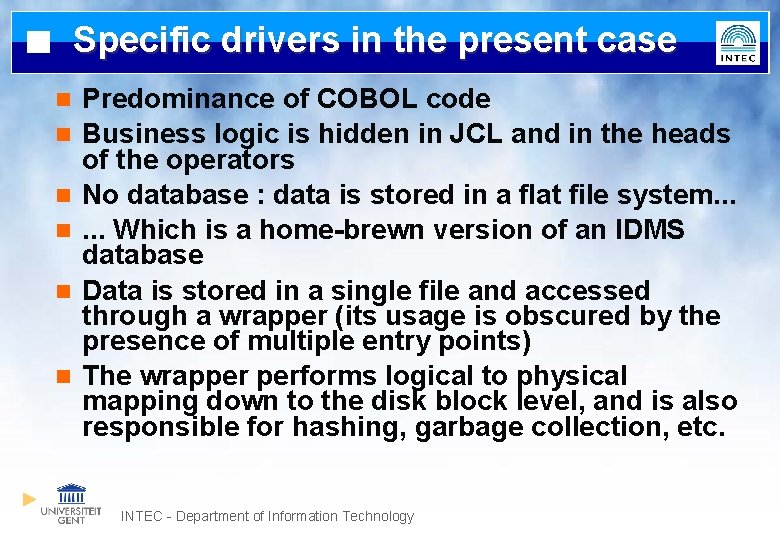
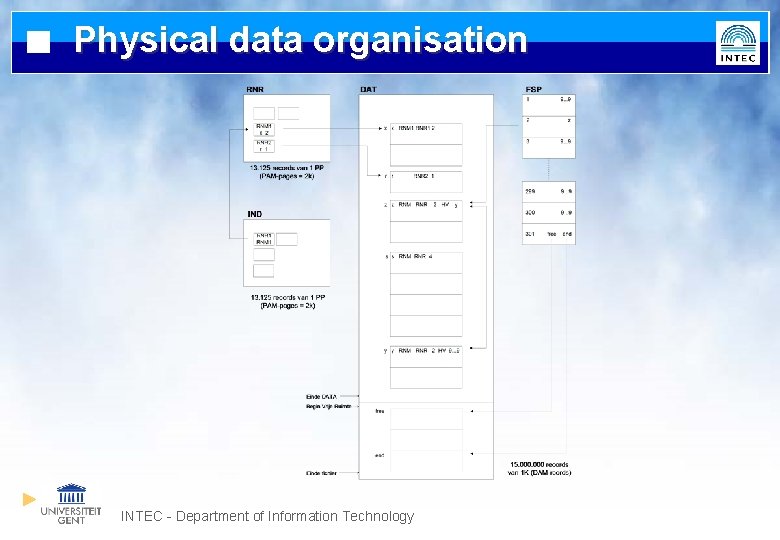
Specific drivers in the present case n n n Predominance of COBOL code Business logic is hidden in JCL and in the heads of the operators No database : data is stored in a flat file system. . . Which is a home-brewn version of an IDMS database Data is stored in a single file and accessed through a wrapper (its usage is obscured by the presence of multiple entry points) The wrapper performs logical to physical mapping down to the disk block level, and is also responsible for hashing, garbage collection, etc. INTEC - Department of Information Technology
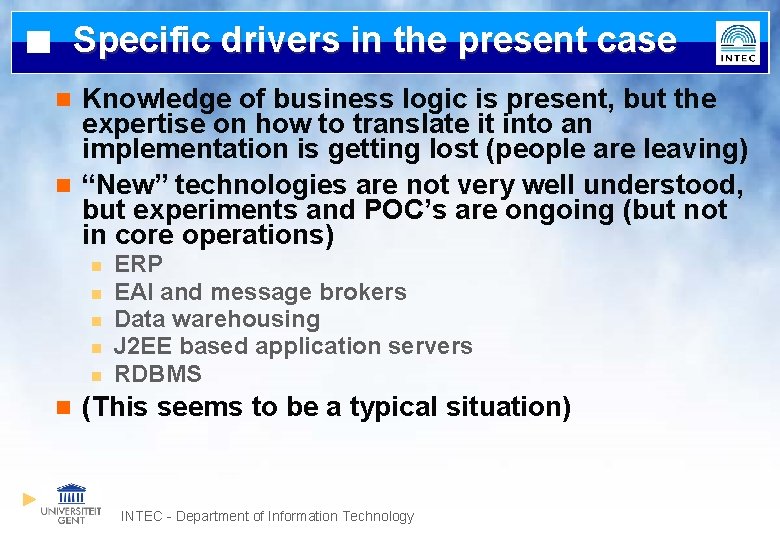
Specific drivers in the present case Knowledge of business logic is present, but the expertise on how to translate it into an implementation is getting lost (people are leaving) n “New” technologies are not very well understood, but experiments and POC’s are ongoing (but not in core operations) n n n n ERP EAI and message brokers Data warehousing J 2 EE based application servers RDBMS (This seems to be a typical situation) INTEC - Department of Information Technology
Evolving legacy systems n n n First option: rewrite from scratch (Big Bang) Second option: refactor (rewrite in new context) Third option: migrate (geriatric operation) Fourth option: reuse by trying to define components Fifth option: a mix of the first four options Evolution is the way to go. . . INTEC - Department of Information Technology
A management view n n n Motivation (why ? ) Objectives (where ? ) Basic postulates and constraints (environment) Critical success factors (how to measure success) Risk assessment Methodology (how) INTEC - Department of Information Technology
Motivation LCM needs to make sure that it develops and maintains a strategic technology direction, keeps current with industry development, and employs the selected technologies appropriate to reach its long-term objectives: to be the leader in the healthcare and related social services. The strategic decision to start the REFAC project (Reorganisation of the Financial, Administrative and Control circuits) implies a complete revision of the “Health Care” information system. This revision is minimally based on the installation of a relational database. The IT Management considers this project to be an excellent opportunity to carry out the first steps in leaving the current platform BS 2000. However involving some risks, this migration operation appears to be essential and inevitable for the future. Movement to a new environment will reduce support requirements, enable faster responses to development needs, and permit staff to be reassigned to support emerging new technologies. Viewing data as an institutional asset will improve the quality of reports, allow LCM staff to respond easily to rapidly expanding requests for information, and provide a service oriented users environment. INTEC - Department of Information Technology
Objectives n n n Set up a evolution plan from the BS 2000 towards a new platform Define a new technical infrastructure to be developed and installed Create an efficient and flexible application and data architecture. Accompany this with a budgetary, HRM and business reengineering plan. Make the necessary budgets available INTEC - Department of Information Technology
Postulates and constraints n n n n Migration by stages (no big bang) evolution Stage by stage synchronisation of data Definition of a corporate information model accessible through a relational data base (Oracle 9 x) Business Process Reengineering Real time system with availability 24 x 7 J 2 EE based thin client architecture via portal and application servers No data replication (? ) Interface with existing CRM and financial systems INTEC - Department of Information Technology
Critical success factors n n n Affordable but significant proof of concept Quick win definitions Succesful implementation of a strategic application suite within 2 years Management and stakeholder support Support of users (business and regular) INTEC - Department of Information Technology
Risk assesment n n n n Unfeasibility (technology mix, integration of COBOL/Java) Complexity Performance (is already a problem) Obsolescence of techniques Lack of pragmatism Unmanageable systems (related to complexity) Cost control (hard. . . ) Lack of (human) resources INTEC - Department of Information Technology
Methodolody and planning Evaluation of the “as-is” situation (investigation of COBOL code, underlying data structures, . . . ) n Determine a “to-be” business and application architecture n Determine a “to-be” technical and deployment architecture n Evaluate evolution scenario’s between the “as-is” and “to-be” situation n Any methodology should reflect the structure of the organisation. INTEC - Department of Information Technology
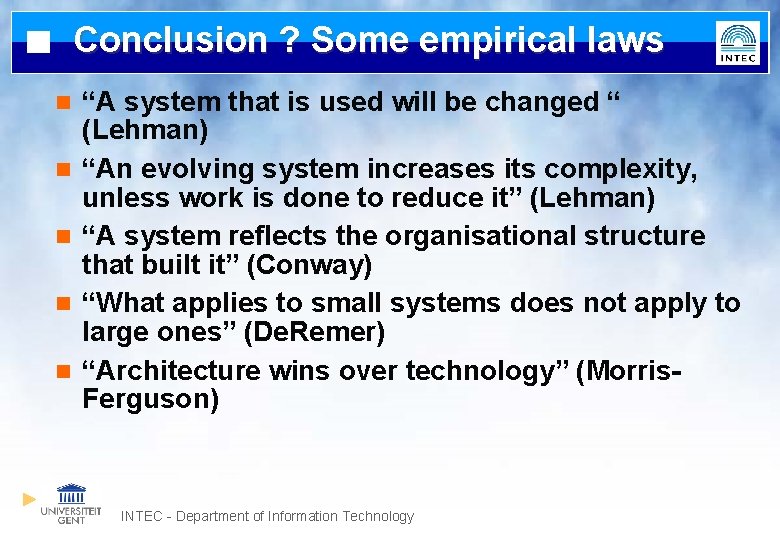
Conclusion ? Some empirical laws n n n “A system that is used will be changed “ (Lehman) “An evolving system increases its complexity, unless work is done to reduce it” (Lehman) “A system reflects the organisational structure that built it” (Conway) “What applies to small systems does not apply to large ones” (De. Remer) “Architecture wins over technology” (Morris. Ferguson) INTEC - Department of Information Technology
Appendix – accessing information n Some extra information. . . INTEC - Department of Information Technology
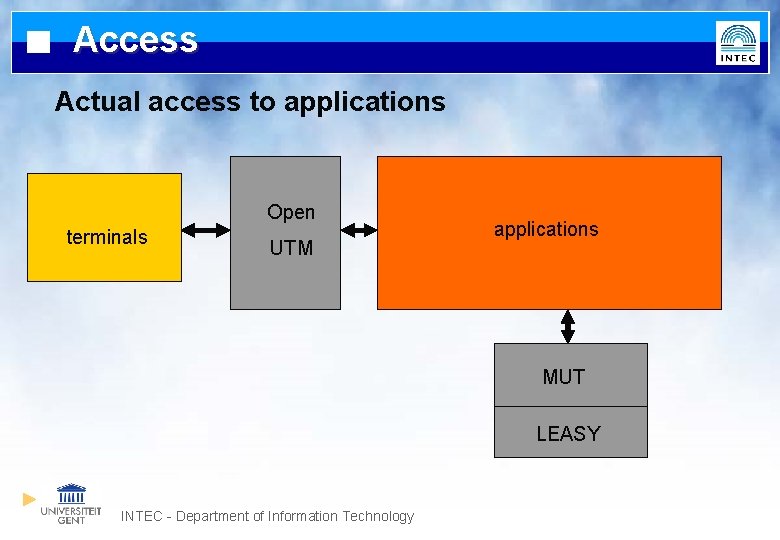
Access Actual access to applications Open terminals UTM applications MUT LEASY INTEC - Department of Information Technology
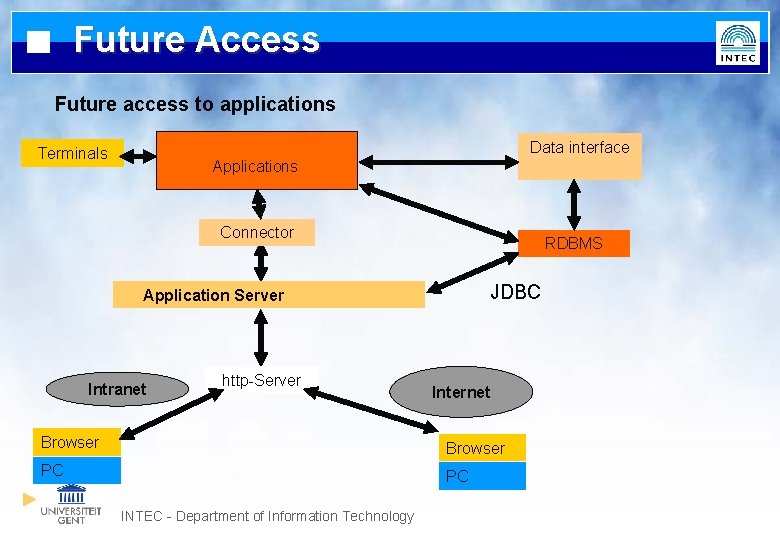
Future Access Future access to applications Data interface Terminals Applications Connector RDBMS JDBC Application Server Intranet http-Server Internet Browser PC PC INTEC - Department of Information Technology
Handling data in COBOL INTEC - Department of Information Technology
Data streams INTEC - Department of Information Technology
Physical data organisation INTEC - Department of Information Technology
Example of a data structure INTEC - Department of Information Technology