
Evolution of Ionic Exchange Resins A morphological study
- Slides: 22
Evolution of Ionic Exchange Resins A morphological study of ageing CAST Symposium – Lyon 16 -18 January 2017 Antonietta Rizzo Working Team : Alfredo Luce, Alessandro Gessi, Stefania Bruni, Giuseppe Marghella, Lorenzo Moretti, Antonietta Rizzo, Chiara Telloli
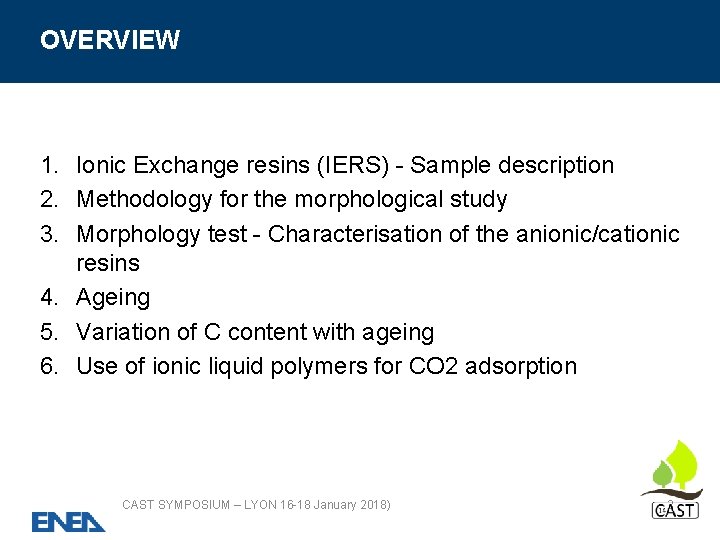
OVERVIEW 1. Ionic Exchange resins (IERS) - Sample description 2. Methodology for the morphological study 3. Morphology test - Characterisation of the anionic/cationic resins 4. Ageing 5. Variation of C content with ageing 6. Use of ionic liquid polymers for CO 2 adsorption CAST SYMPOSIUM – LYON 16 -18 January 2018) 2
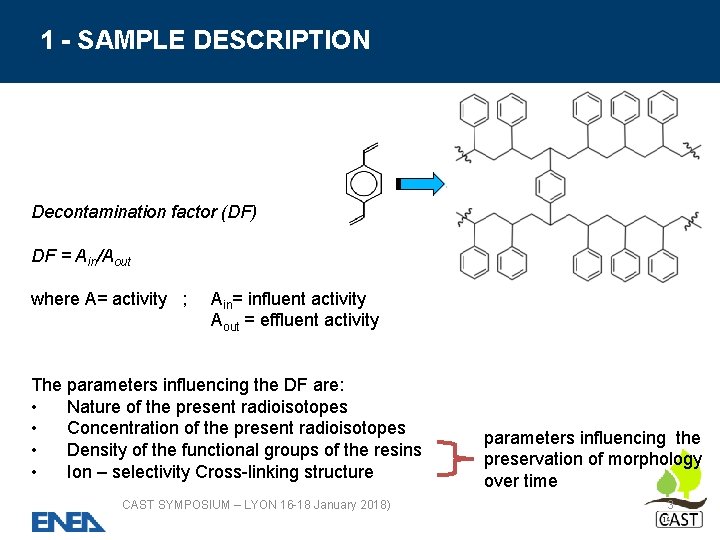
1 - SAMPLE DESCRIPTION Decontamination factor (DF) DF = Ain/Aout where A= activity ; Ain= influent activity Aout = effluent activity The parameters influencing the DF are: • Nature of the present radioisotopes • Concentration of the present radioisotopes • Density of the functional groups of the resins • Ion – selectivity Cross-linking structure CAST SYMPOSIUM – LYON 16 -18 January 2018) parameters influencing the preservation of morphology over time 3
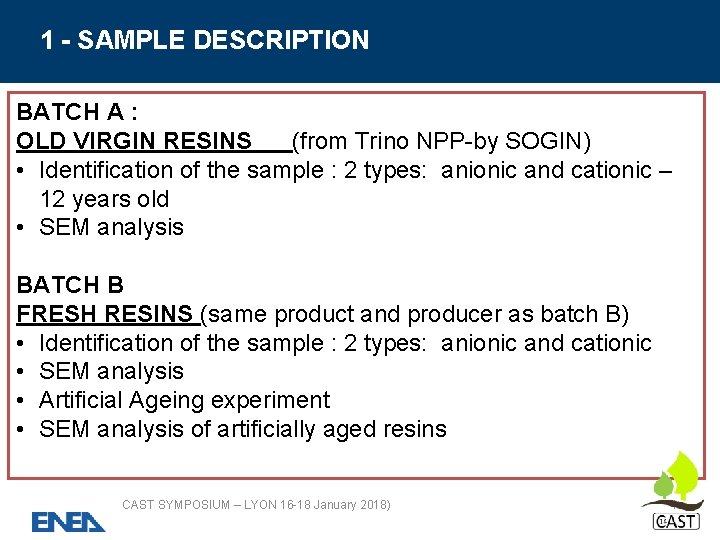
1 - SAMPLE DESCRIPTION BATCH A : Eventuale titolo secondario OLD VIRGIN RESINS (from Trino NPP-by SOGIN) • Identification of the sample : 2 types: anionic and cationic – 12 years old • SEM analysis BATCH B FRESH RESINS (same product and producer as batch B) • Identification of the sample : 2 types: anionic and cationic • SEM analysis • Artificial Ageing experiment • SEM analysis of artificially aged resins CAST SYMPOSIUM – LYON 16 -18 January 2018) 4
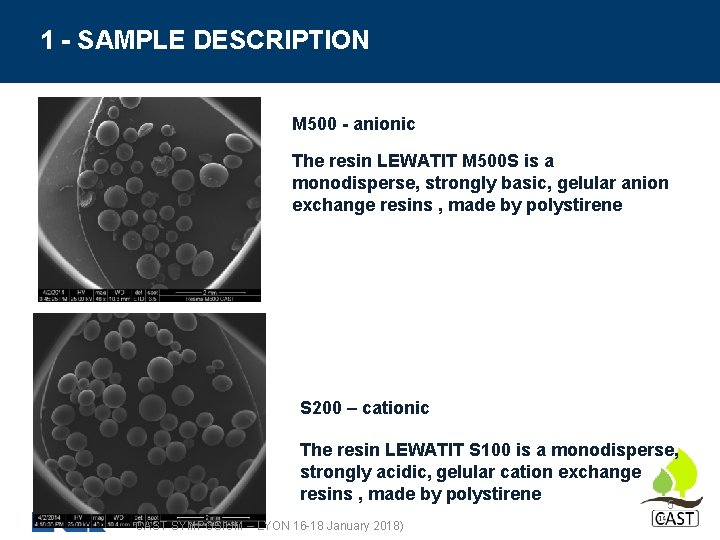
1 - SAMPLE DESCRIPTION M 500 - anionic The resin LEWATIT M 500 S is a monodisperse, strongly basic, gelular anion exchange resins , made by polystirene S 200 – cationic The resin LEWATIT S 100 is a monodisperse, strongly acidic, gelular cation exchange resins , made by polystirene 5 CAST SYMPOSIUM – LYON 16 -18 January 2018)
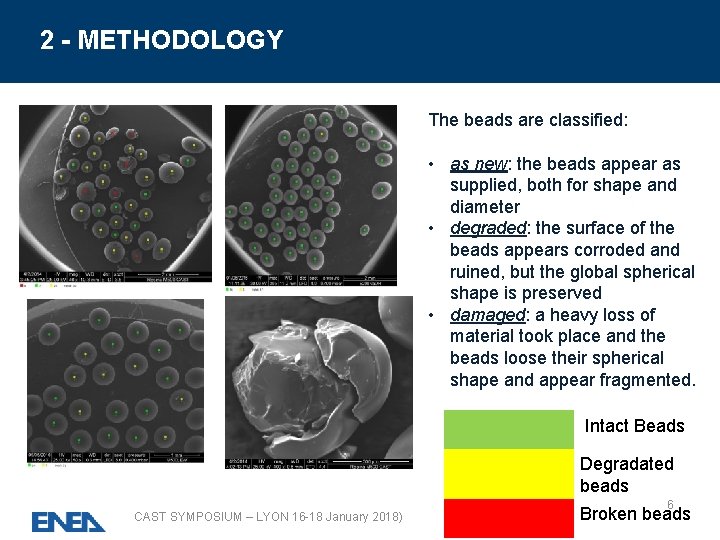
2 - METHODOLOGY The beads are classified: • as new: the beads appear as supplied, both for shape and diameter • degraded: the surface of the beads appears corroded and ruined, but the global spherical shape is preserved • damaged: a heavy loss of material took place and the beads loose their spherical shape and appear fragmented. Intact Beads Degradated beads CAST SYMPOSIUM – LYON 16 -18 January 2018) 6 Broken beads
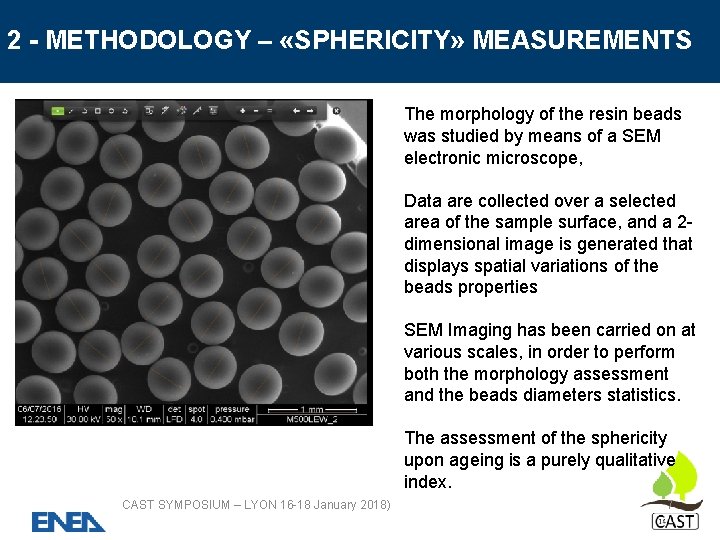
2 - METHODOLOGY – «SPHERICITY» MEASUREMENTS The morphology of the resin beads was studied by means of a SEM electronic microscope, Data are collected over a selected area of the sample surface, and a 2 dimensional image is generated that displays spatial variations of the beads properties SEM Imaging has been carried on at various scales, in order to perform both the morphology assessment and the beads diameters statistics. The assessment of the sphericity upon ageing is a purely qualitative index. CAST SYMPOSIUM – LYON 16 -18 January 2018) 7
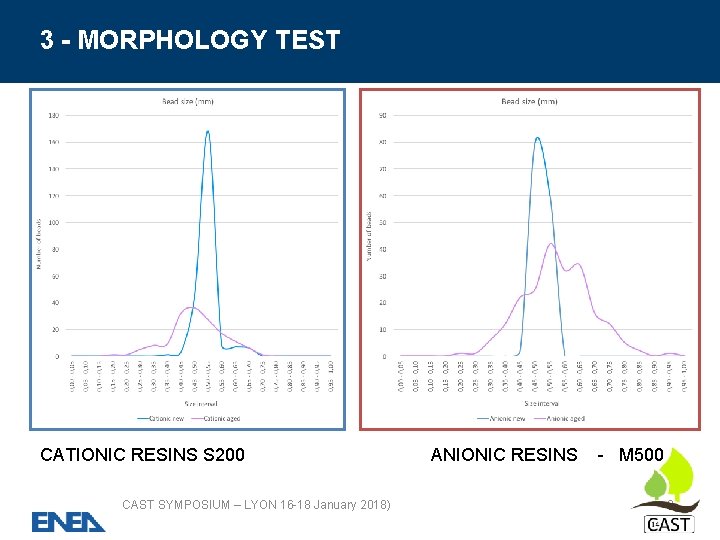
3 - MORPHOLOGY TEST CATIONIC RESINS S 200 CAST SYMPOSIUM – LYON 16 -18 January 2018) ANIONIC RESINS - M 500 8
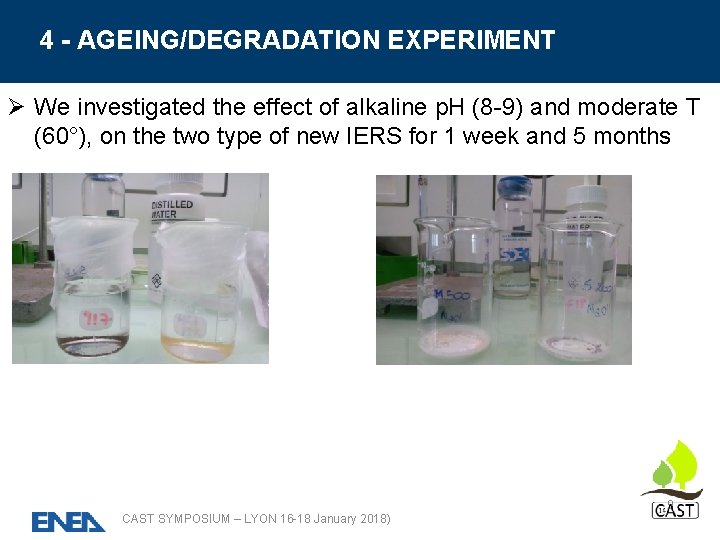
4 - AGEING/DEGRADATION EXPERIMENT Ø We investigated the effect of alkaline p. H (8 -9) and moderate T (60°), on the two type of new IERS for 1 week and 5 months 9 CAST SYMPOSIUM – LYON 16 -18 January 2018)
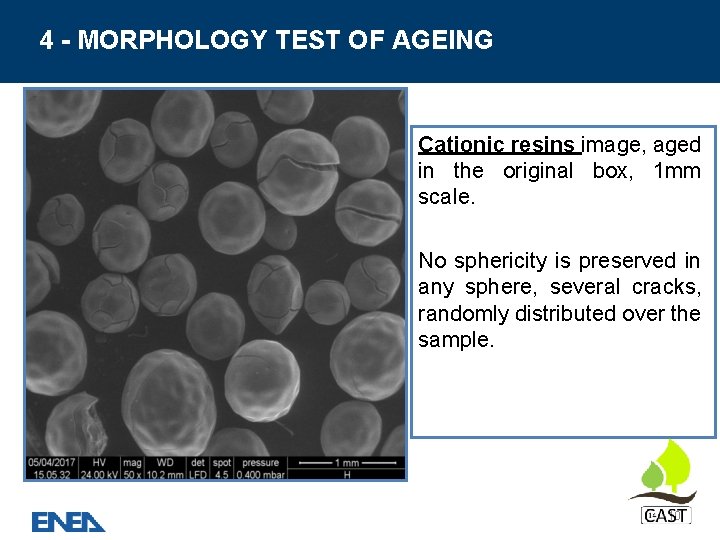
4 - MORPHOLOGY TEST OF AGEING Cationic resins image, aged in the original box, 1 mm scale. No sphericity is preserved in any sphere, several cracks, randomly distributed over the sample. 10
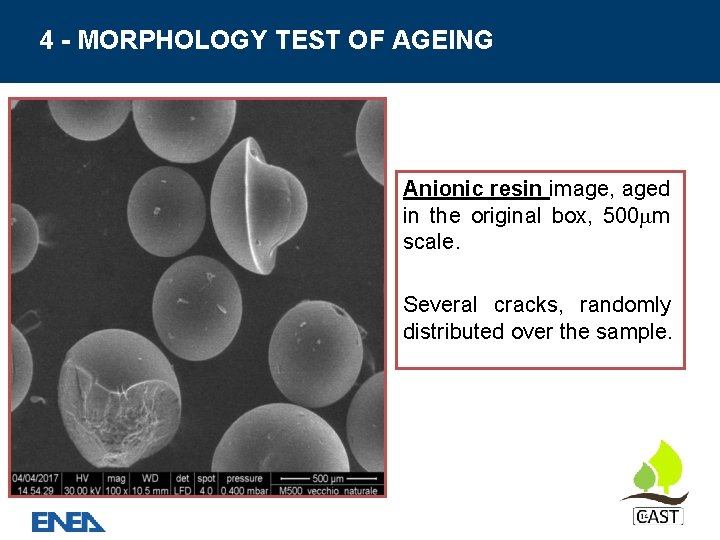
4 - MORPHOLOGY TEST OF AGEING Anionic resin image, aged in the original box, 500 mm scale. Several cracks, randomly distributed over the sample. 11
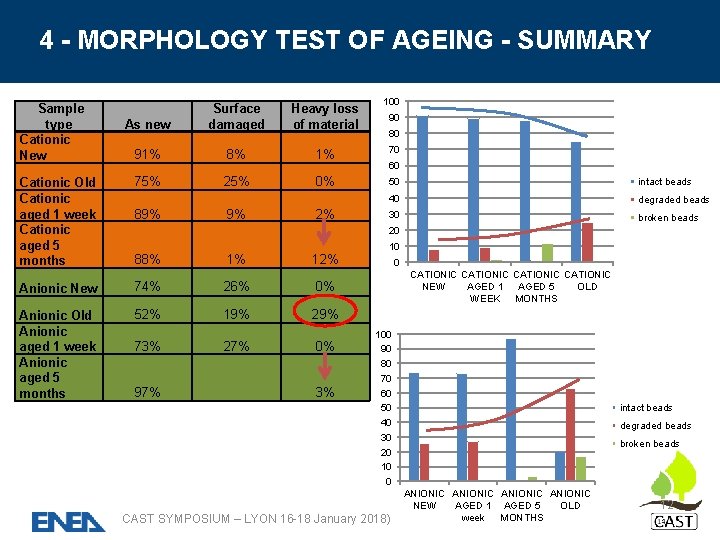
4 - MORPHOLOGY TEST OF AGEING - SUMMARY Sample type Cationic New 100 As new Surface damaged Heavy loss of material 91% 8% 1% 70 Cationic Old Cationic aged 1 week Cationic aged 5 months 75% 25% 0% 50 intact beads 40 degraded beads 30 broken beads 88% 1% 12% Anionic New 74% 26% 0% Anionic Old Anionic aged 1 week Anionic aged 5 months 52% 19% 29% 73% 27% 0% 89% 9% 2% 90 80 60 20 10 97% 3% 0 CATIONIC NEW AGED 1 AGED 5 OLD WEEK MONTHS 100 90 80 70 60 50 40 30 20 10 0 CAST SYMPOSIUM – LYON 16 -18 January 2018) intact beads degraded beads broken beads ANIONIC NEW AGED 1 AGED 5 OLD week MONTHS 12
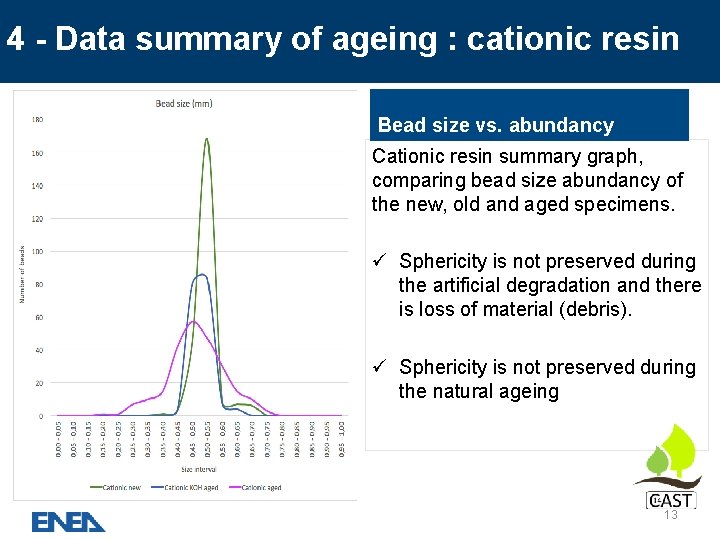
4 - Data summary of ageing : cationic resin Bead size vs. abundancy Cationic resin summary graph, comparing bead size abundancy of the new, old and aged specimens. ü Sphericity is not preserved during the artificial degradation and there is loss of material (debris). ü Sphericity is not preserved during the natural ageing 13
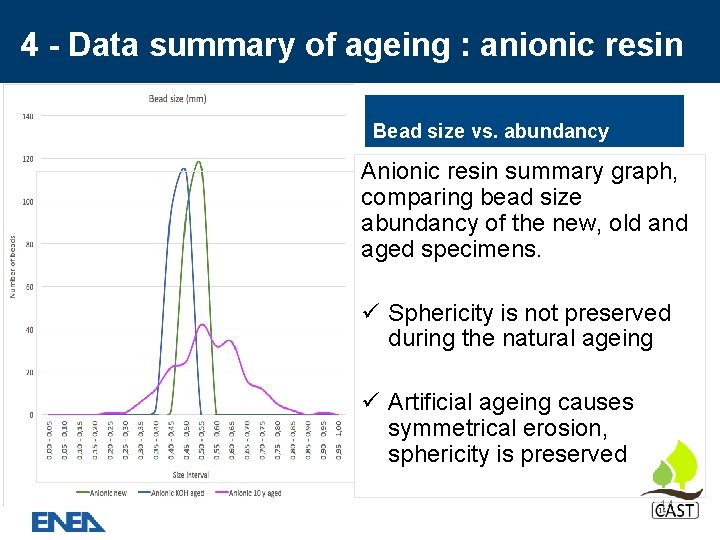
4 - Data summary of ageing : anionic resin Bead size vs. abundancy Anionic resin summary graph, comparing bead size abundancy of the new, old and aged specimens. ü Sphericity is not preserved during the natural ageing ü Artificial ageing causes symmetrical erosion, sphericity is preserved 14
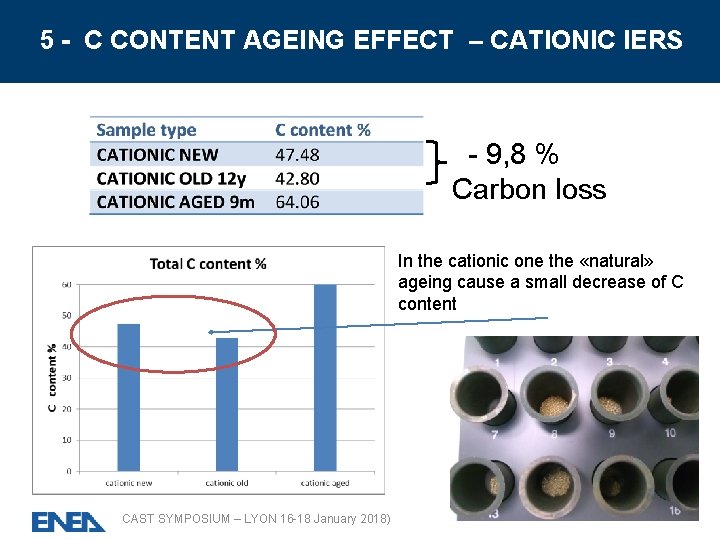
5 - C CONTENT AGEING EFFECT – CATIONIC IERS - 9, 8 % Carbon loss In the cationic one the «natural» ageing cause a small decrease of C content 15 CAST SYMPOSIUM – LYON 16 -18 January 2018)
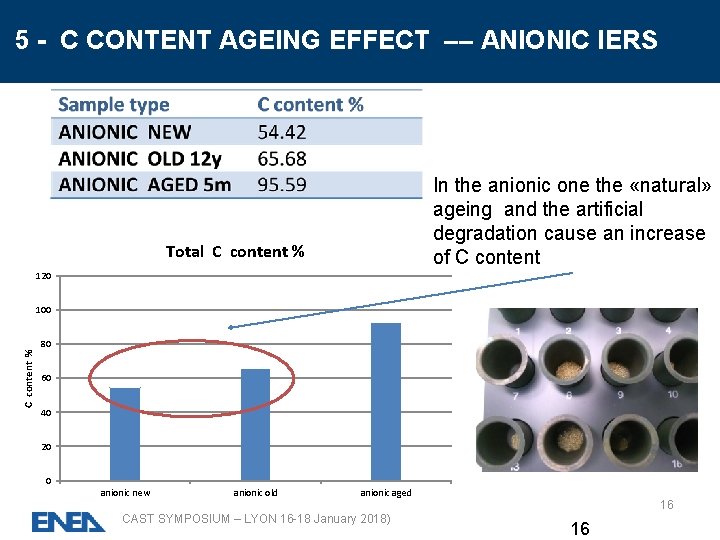
5 - C CONTENT AGEING EFFECT –– ANIONIC IERS In the anionic one the «natural» ageing and the artificial degradation cause an increase of C content Total C content % 120 C content % 100 80 60 40 20 0 anionic new anionic old anionic aged CAST SYMPOSIUM – LYON 16 -18 January 2018) 16 16
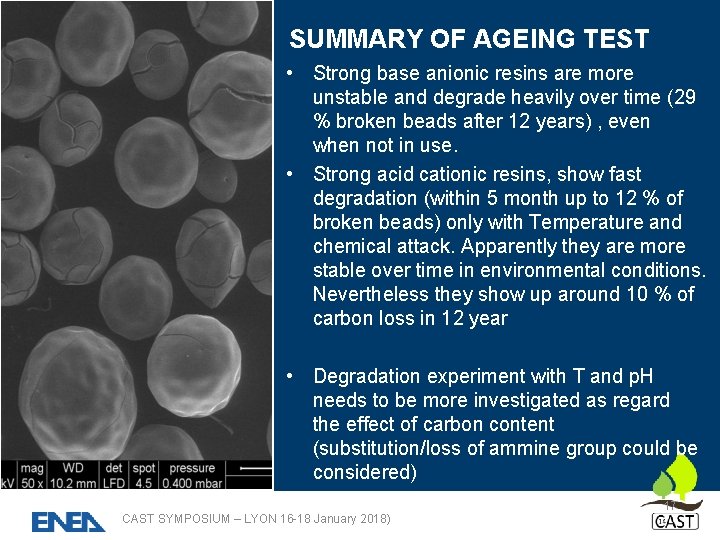
SUMMARY OF AGEING TEST • Strong base anionic resins are more unstable and degrade heavily over time (29 % broken beads after 12 years) , even when not in use. • Strong acid cationic resins, show fast degradation (within 5 month up to 12 % of broken beads) only with Temperature and chemical attack. Apparently they are more stable over time in environmental conditions. Nevertheless they show up around 10 % of carbon loss in 12 year • Degradation experiment with T and p. H needs to be more investigated as regard the effect of carbon content (substitution/loss of ammine group could be considered) 17 CAST SYMPOSIUM – LYON 16 -18 January 2018)
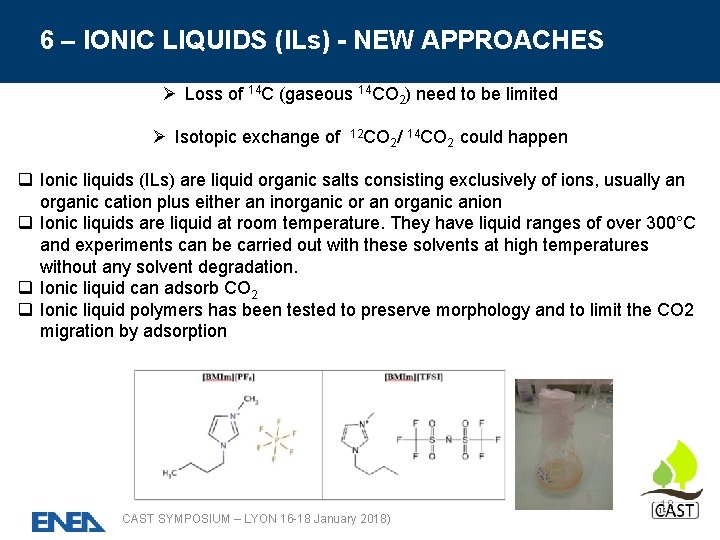
6 – IONIC LIQUIDS (ILs) - NEW APPROACHES Ø Loss of 14 C (gaseous 14 CO 2) need to be limited Ø Isotopic exchange of 12 CO 2/ 14 CO 2 could happen q Ionic liquids (ILs) are liquid organic salts consisting exclusively of ions, usually an organic cation plus either an inorganic or an organic anion q Ionic liquids are liquid at room temperature. They have liquid ranges of over 300°C and experiments can be carried out with these solvents at high temperatures without any solvent degradation. q Ionic liquid can adsorb CO 2 q Ionic liquid polymers has been tested to preserve morphology and to limit the CO 2 migration by adsorption 18 CAST SYMPOSIUM – LYON 16 -18 January 2018)
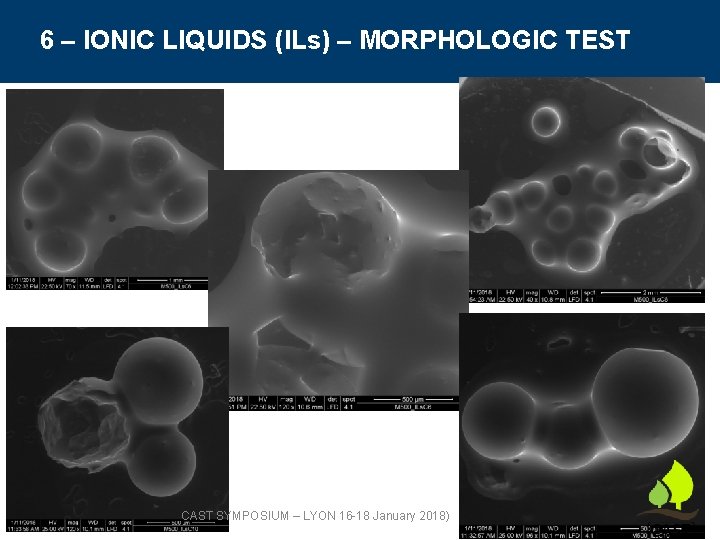
6 – IONIC LIQUIDS (ILs) – MORPHOLOGIC TEST CAST SYMPOSIUM – LYON 16 -18 January 2018) 19
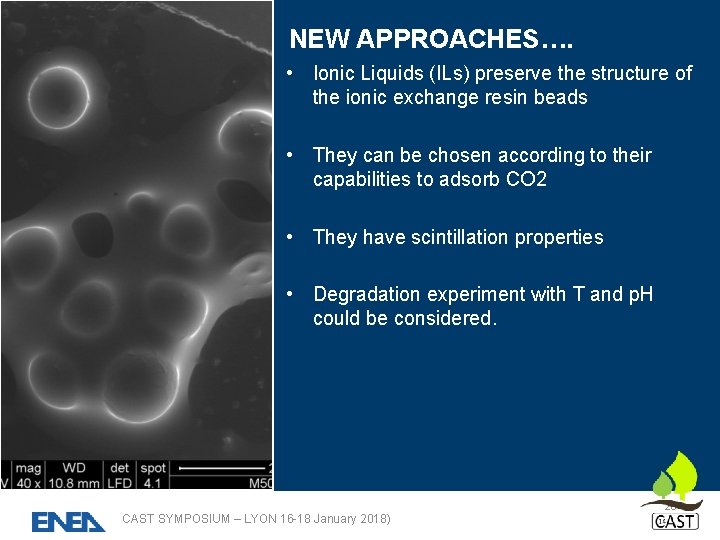
NEW APPROACHES…. • Ionic Liquids (ILs) preserve the structure of the ionic exchange resin beads • They can be chosen according to their capabilities to adsorb CO 2 • They have scintillation properties • Degradation experiment with T and p. H could be considered. 20 CAST SYMPOSIUM – LYON 16 -18 January 2018)
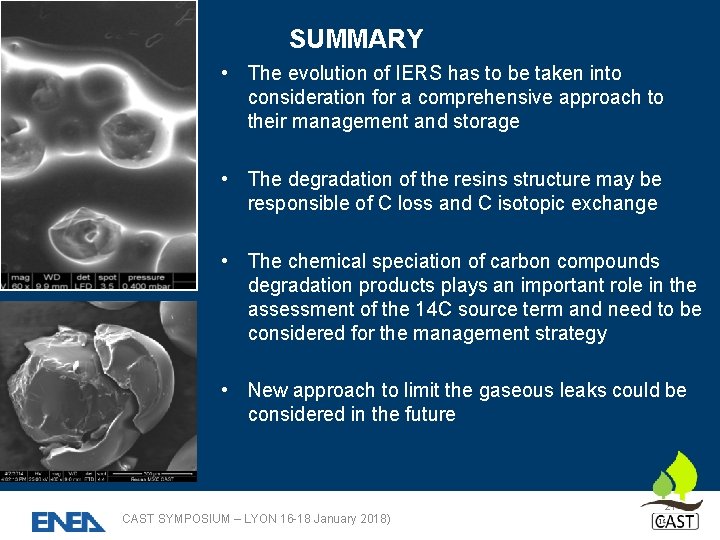
SUMMARY • The evolution of IERS has to be taken into consideration for a comprehensive approach to their management and storage • The degradation of the resins structure may be responsible of C loss and C isotopic exchange • The chemical speciation of carbon compounds degradation products plays an important role in the assessment of the 14 C source term and need to be considered for the management strategy • New approach to limit the gaseous leaks could be considered in the future 21 CAST SYMPOSIUM – LYON 16 -18 January 2018)
Antonietta Rizzo antonietta. rizzo@enea. it CAST SYMPOSIUM – LYON 16 -18 January 2018)