
Evolution of Instructional Media Timeline 1905 1908 School
- Slides: 8
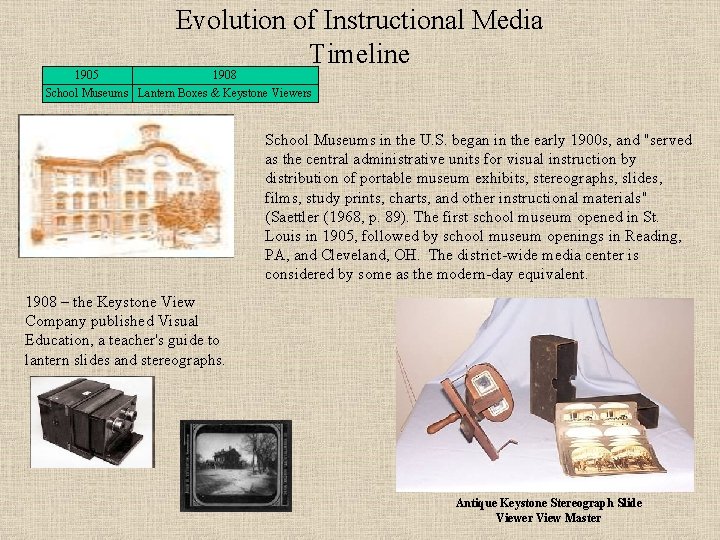
Evolution of Instructional Media Timeline 1905 1908 School Museums Lantern Boxes & Keystone Viewers School Museums in the U. S. began in the early 1900 s, and "served as the central administrative units for visual instruction by distribution of portable museum exhibits, stereographs, slides, films, study prints, charts, and other instructional materials" (Saettler (1968, p. 89). The first school museum opened in St. Louis in 1905, followed by school museum openings in Reading, PA, and Cleveland, OH. The district-wide media center is considered by some as the modern-day equivalent. 1908 – the Keystone View Company published Visual Education, a teacher's guide to lantern slides and stereographs. Antique Keystone Stereograph Slide Viewer View Master
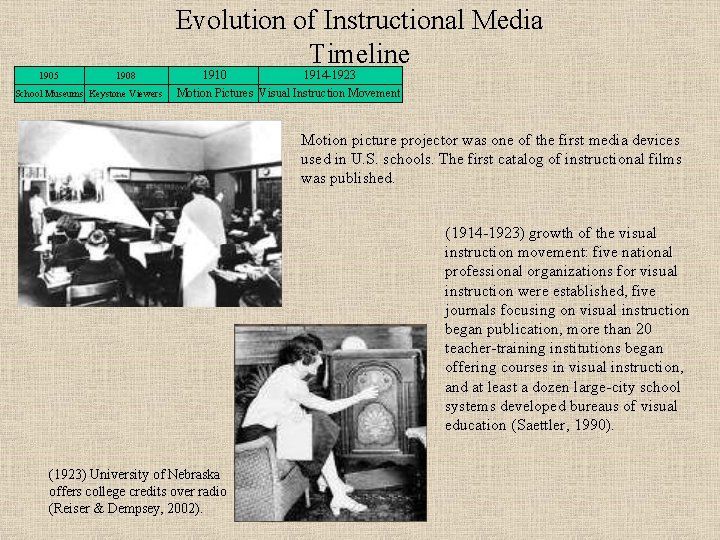
Evolution of Instructional Media Timeline 1905 1908 School Museums Keystone Viewers 1910 1914 -1923 Motion Pictures Visual Instruction Movement Motion picture projector was one of the first media devices used in U. S. schools. The first catalog of instructional films was published. (1914 -1923) growth of the visual instruction movement: five national professional organizations for visual instruction were established, five journals focusing on visual instruction began publication, more than 20 teacher-training institutions began offering courses in visual instruction, and at least a dozen large-city school systems developed bureaus of visual education (Saettler, 1990). (1923) University of Nebraska offers college credits over radio (Reiser & Dempsey, 2002).
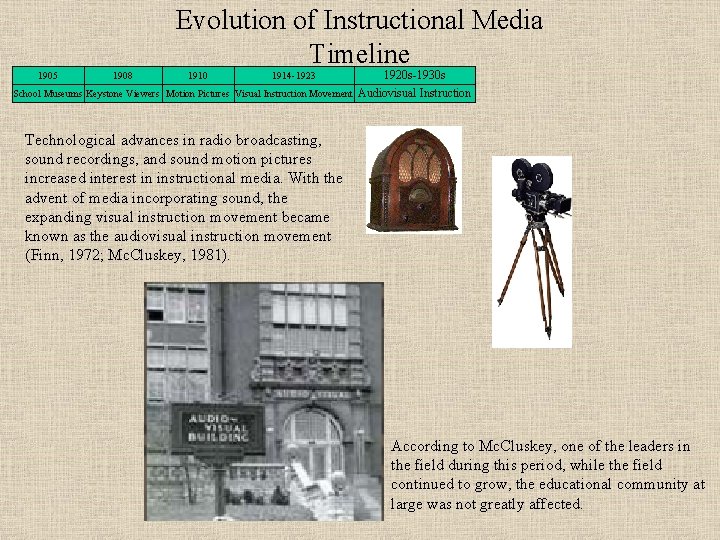
Evolution of Instructional Media Timeline 1920 s-1930 s School Museums Keystone Viewers Motion Pictures Visual Instruction Movement Audiovisual Instruction 1905 1908 1910 1914 -1923 Technological advances in radio broadcasting, sound recordings, and sound motion pictures increased interest in instructional media. With the advent of media incorporating sound, the expanding visual instruction movement became known as the audiovisual instruction movement (Finn, 1972; Mc. Cluskey, 1981). According to Mc. Cluskey, one of the leaders in the field during this period, while the field continued to grow, the educational community at large was not greatly affected.
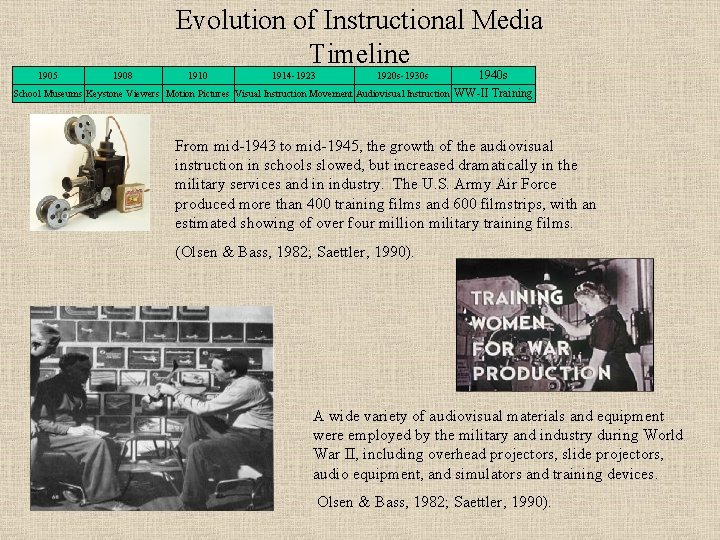
Evolution of Instructional Media Timeline 1940 s School Museums Keystone Viewers Motion Pictures Visual Instruction Movement Audiovisual Instruction WW-II Training 1905 1908 1910 1914 -1923 1920 s-1930 s From mid-1943 to mid-1945, the growth of the audiovisual instruction in schools slowed, but increased dramatically in the military services and in industry. The U. S. Army Air Force produced more than 400 training films and 600 filmstrips, with an estimated showing of over four million military training films. (Olsen & Bass, 1982; Saettler, 1990). A wide variety of audiovisual materials and equipment were employed by the military and industry during World War II, including overhead projectors, slide projectors, audio equipment, and simulators and training devices. Olsen & Bass, 1982; Saettler, 1990).
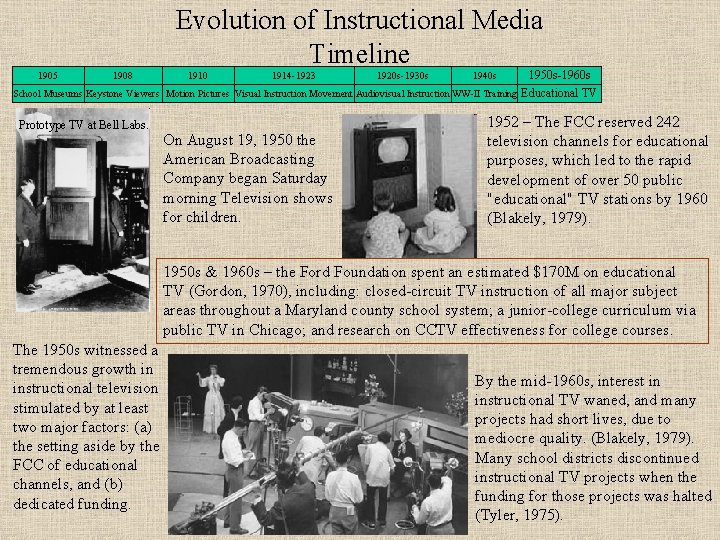
Evolution of Instructional Media Timeline 1950 s-1960 s School Museums Keystone Viewers Motion Pictures Visual Instruction Movement Audiovisual Instruction WW-II Training Educational TV 1905 1908 Prototype TV at Bell Labs. 1910 1914 -1923 On August 19, 1950 the American Broadcasting Company began Saturday morning Television shows for children. 1920 s-1930 s 1940 s 1952 – The FCC reserved 242 television channels for educational purposes, which led to the rapid development of over 50 public "educational" TV stations by 1960 (Blakely, 1979). 1950 s & 1960 s – the Ford Foundation spent an estimated $170 M on educational TV (Gordon, 1970), including: closed-circuit TV instruction of all major subject areas throughout a Maryland county school system; a junior-college curriculum via public TV in Chicago; and research on CCTV effectiveness for college courses. The 1950 s witnessed a tremendous growth in instructional television stimulated by at least two major factors: (a) the setting aside by the FCC of educational channels, and (b) dedicated funding. By the mid-1960 s, interest in instructional TV waned, and many projects had short lives, due to mediocre quality. (Blakely, 1979). Many school districts discontinued instructional TV projects when the funding for those projects was halted (Tyler, 1975).
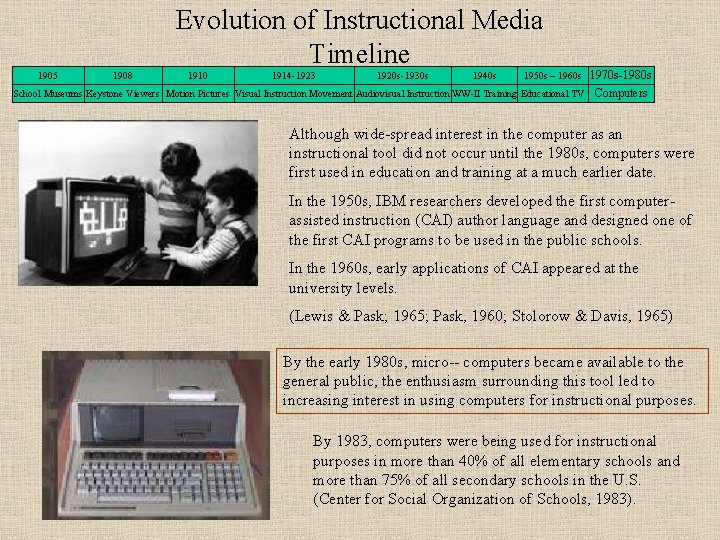
Evolution of Instructional Media Timeline 1970 s-1980 s School Museums Keystone Viewers Motion Pictures Visual Instruction Movement Audiovisual Instruction WW-II Training Educational TV Computers 1905 1908 1910 1914 -1923 1920 s-1930 s 1940 s 1950 s – 1960 s Although wide-spread interest in the computer as an instructional tool did not occur until the 1980 s, computers were first used in education and training at a much earlier date. In the 1950 s, IBM researchers developed the first computerassisted instruction (CAI) author language and designed one of the first CAI programs to be used in the public schools. In the 1960 s, early applications of CAI appeared at the university levels. (Lewis & Pask; 1965; Pask, 1960; Stolorow & Davis, 1965) By the early 1980 s, micro-- computers became available to the general public, the enthusiasm surrounding this tool led to increasing interest in using computers for instructional purposes. By 1983, computers were being used for instructional purposes in more than 40% of all elementary schools and more than 75% of all secondary schools in the U. S. (Center for Social Organization of Schools, 1983).
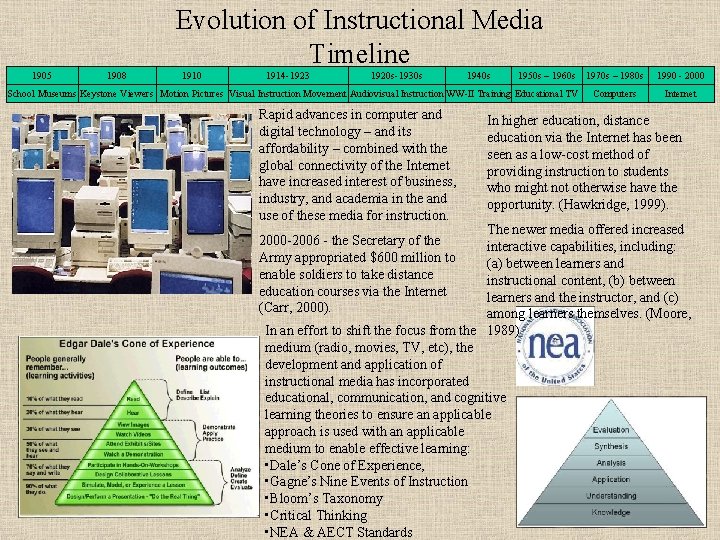
Evolution of Instructional Media Timeline 1905 1908 1910 1914 -1923 1920 s-1930 s 1940 s 1950 s – 1960 s School Museums Keystone Viewers Motion Pictures Visual Instruction Movement Audiovisual Instruction WW-II Training Educational TV Rapid advances in computer and digital technology – and its affordability – combined with the global connectivity of the Internet have increased interest of business, industry, and academia in the and use of these media for instruction. 1970 s – 1980 s 1990 - 2000 Computers Internet In higher education, distance education via the Internet has been seen as a low-cost method of providing instruction to students who might not otherwise have the opportunity. (Hawkridge, 1999). The newer media offered increased interactive capabilities, including: (a) between learners and instructional content, (b) between learners and the instructor, and (c) among learners themselves. (Moore, In an effort to shift the focus from the 1989) medium (radio, movies, TV, etc), the development and application of instructional media has incorporated educational, communication, and cognitive learning theories to ensure an applicable approach is used with an applicable medium to enable effective learning: • Dale’s Cone of Experience, • Gagne’s Nine Events of Instruction • Bloom’s Taxonomy • Critical Thinking • NEA & AECT Standards 2000 -2006 - the Secretary of the Army appropriated $600 million to enable soldiers to take distance education courses via the Internet (Carr, 2000).
References Primary Reference Robert A Reiser. (2001). A history of instructional design and technology: Part I: A history of instructional media. Educational Technology, Research and Development, 49(1), 53. Retrieved October 13, 2010, from Pro. Quest Psychology Journals. (Document ID: 71395499). Secondary References Atkinson, R. C. , & Hansen, D. N. (1966). Computer-assisted instruction in initial reading: The Stanford project. Reading Research Quarterly, 2, 5 -25. Anderson, C. (1962). Technology in American education: 1650 -1900 (Report No. OE-34018). Washington, DC: Office of Education, U. S. Department of Health, Education, and Welfare. Anderson, R. E. , & Ronnkvist, A. (1999). The presence of computers in American schools: Teaching, learning and computing: 1998 national survey (Report #2). Irvine, CA: Center for Research on Information Technology and Organizations. (ERIC Document Reproduction Service No. ED 430 548). Blakely, R. J. (1979). To serve the public interest: Educational broadcasting in the United States. Syracuse, NY: Syracuse University Press. Cuban, L. (1986). Teachers and machines: The classroom use of technology since 1920. New York: Teachers College Press. Dale, E. (1946). Audio-visual methods in teaching (Ist ed. ). New York: Holt, Rinehart and Winston. Mc. Cluskey, F. D. (1981). DVI, DAVI, AECT: A long view. In J. W. Brown & S. N. Brown (Eds. ), Educational media yearbook: 1981. Littleton, CO: Libraries Unlimited. Pask, G. (1960). Electronic keyboard teaching machines. In A. A. Lumsdaine & R. Glaser (Eds. ), Teaching machines and programmed learning: A source book. Washington, DC: National Education Association. Reiser, R. A. (1987). Instructional technology: A history. In R. M. Gagne (Ed. ), Instructional technology: Foundations. Hillsdale, NJ: Erlbaum. Reiser, R. A. , & Dempsey, J. V. (in press). Trends and issues in instructional design and technology. Upper Saddle River, NJ: Merrill/Prentice Hall. Saettler, P. (1990). The evolution of American educational technology. Englewood, CO: Libraries Unlimited.