
Evolution of Homo sapiens How toolusing apes came

- Slides: 35
Evolution of Homo sapiens ▬ How tool-using apes came to dominate the world William P. Hall President Kororoit Institute Proponents and Supporters Assoc. , Inc. - http: //kororoit. org william-hall@bigpond. com http: //www. orgs-evolution-knowledge. net U 3 A – Gisborne, 26 Aug. 2019
Extract from an unfinished project on the coevolution of humans and our technologies Career threads in evolutionary biology and organizational knowledge management – – Interested to understand how our primitive common ancestors with chimpanzees and bonobos came to develop the technologies to control matter and dominate the entire planetary resources of the Earth And, to show our domination of these technologies has enabled this story to be unraveled and documented Book: Application Holy Wars or a New Reformation – A Fugue on theory of Knowledge. – – Won’t be finished because the conclusion is so dismal 25 Meetup presentations given in 2015: 2 – Human Origins, Cognitive Technologies, and Futures Today extracts highlights and updates of the 5 -million year story of human evolution
Introduction Goal: explore and understand how our chimpanzee-like ancestors living in East African forests so completely dominated the biosphere of our entire planet that we are destroying it Overwhelmed since 2010 with new and sometimes revolutionary information revealed with new technolgies – Impact of Moore’s Law on scientific research & publishing – Exploding volume of paleo and population genomic information 3 New technologies for anthropology, archaeology, cognitive science, genomics Ever-increasing scope and pace of research & electronic publication Recent siblings in our family tree (Neanderthals, Denisovans, & other kissing cousins identified in our genomes) Revealing the epic migrations of our ancestors – Revolutionary science may be stabilizing into “normal” science – Positive feedback between technological and cognitive evolution Impacts of technological revolutions on our biology Individual selection vs group selection in the evolution of human social systems and organizations
Four major sections of the story Material evidence – what we think we know – Reconstruction of the last 5 million years of human history An evolutionary hypothesis – how did we get to where we are now? – – Working to understand what circumstances shaped our evolution to result in the observed history Role natural selection and coevolutionary feedback among – – 4 Ecology Climate change Tool use Cognition Cooperation is innate Emergence of human social organizations as higher order living systems Moore’s Law (exponential growth of computer power) and the rise and rise of socio-technical organizations – Where is evolution taking us?
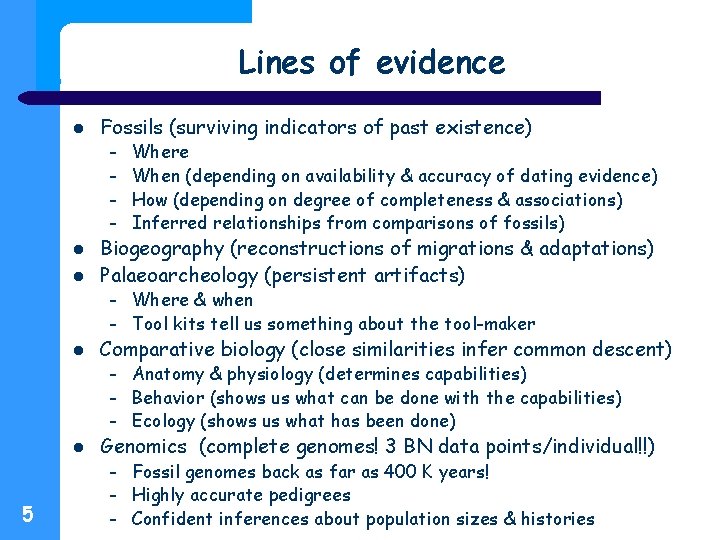
Lines of evidence Fossils (surviving indicators of past existence) - Where When (depending on availability & accuracy of dating evidence) How (depending on degree of completeness & associations) Inferred relationships from comparisons of fossils) Biogeography (reconstructions of migrations & adaptations) Palaeoarcheology (persistent artifacts) - Where & when - Tool kits tell us something about the tool-maker Comparative biology (close similarities infer common descent) - Anatomy & physiology (determines capabilities) - Behavior (shows us what can be done with the capabilities) - Ecology (shows us what has been done) 5 Genomics (complete genomes! 3 BN data points/individual!!) - Fossil genomes back as far as 400 K years! - Highly accurate pedigrees - Confident inferences about population sizes & histories
Our deep ancestry 6
Our ancestors were socially foraging, tool-using forest apes in East African Rift Valley 5 mya Adaptive plateaus achieved in the Pliocene as our ancestors became more bipedal and better adapted to open and arid environments (White et al. 2009) (click pictures below to view videos) 7 Chimps using probes to collect ants. Probe is inserted almost to full length into earth. Child watching mother crack otherwise inedible palm nuts using stone hammer & anvil.
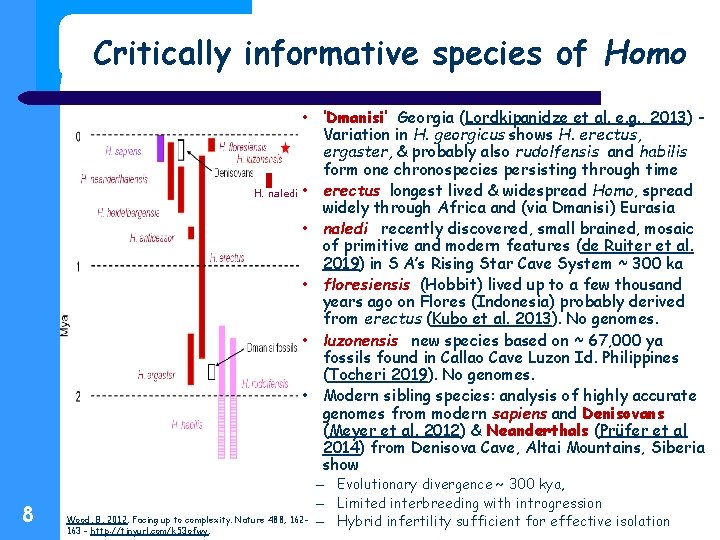
Critically informative species of Homo • ‘Dmanisi’ Georgia (Lordkipanidze et al. e. g. , 2013) Variation in H. georgicus shows H. erectus, ergaster, & probably also rudolfensis and habilis form one chronospecies persisting through time H. naledi • erectus longest lived & widespread Homo, spread widely through Africa and (via Dmanisi) Eurasia • naledi recently discovered, small brained, mosaic of primitive and modern features (de Ruiter et al. 2019) in S A’s Rising Star Cave System ~ 300 ka • floresiensis (Hobbit) lived up to a few thousand years ago on Flores (Indonesia) probably derived from erectus (Kubo et al. 2013). No genomes. • luzonensis new species based on ~ 67, 000 ya fossils found in Callao Cave Luzon Id. Philippines (Tocheri 2019). No genomes. • Modern sibling species: analysis of highly accurate genomes from modern sapiens and Denisovans (Meyer et al. 2012) & Neanderthals (Prüfer et al 2014) from Denisova Cave, Altai Mountains, Siberia show 8 Wood, B. 2012. Facing up to complexity. Nature 488, 162163 - http: //tinyurl. com/k 53 ofwy. – Evolutionary divergence ~ 300 kya, – Limited interbreeding with introgression – Hybrid infertility sufficient for effective isolation
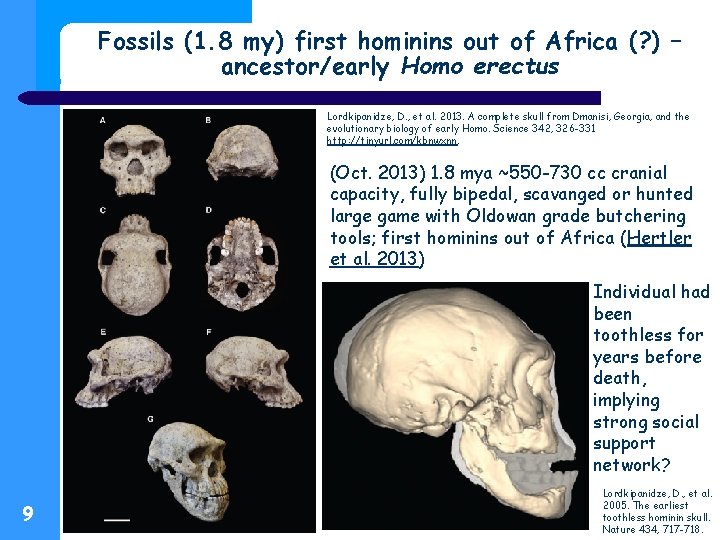
Fossils (1. 8 my) first hominins out of Africa (? ) – ancestor/early Homo erectus Lordkipanidze, D. , et al. 2013. A complete skull from Dmanisi, Georgia, and the evolutionary biology of early Homo. Science 342, 326 -331 http: //tinyurl. com/kbnwxnn. (Oct. 2013) 1. 8 mya ~550 -730 cc cranial capacity, fully bipedal, scavanged or hunted large game with Oldowan grade butchering tools; first hominins out of Africa (Hertler et al. 2013) Individual had been toothless for years before death, implying strong social support network? 9 Lordkipanidze, D. , et al. 2005. The earliest toothless hominin skull. Nature 434, 717 -718.
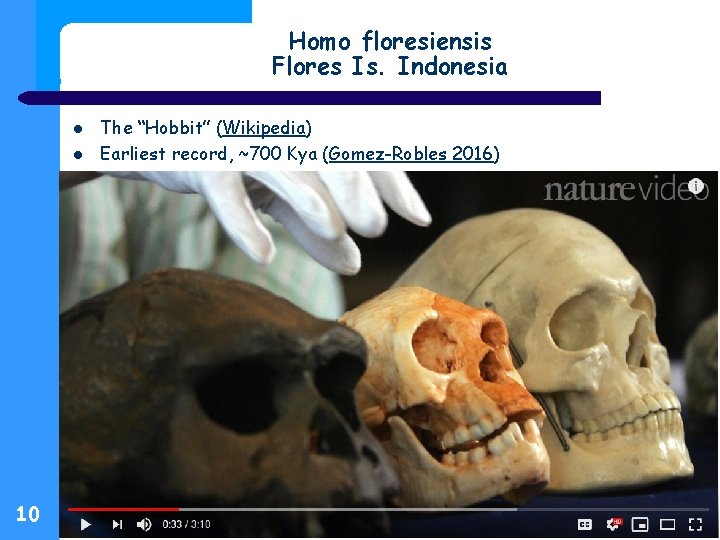
Homo floresiensis Flores Is. Indonesia 10 The “Hobbit” (Wikipedia) Earliest record, ~700 Kya (Gomez-Robles 2016)
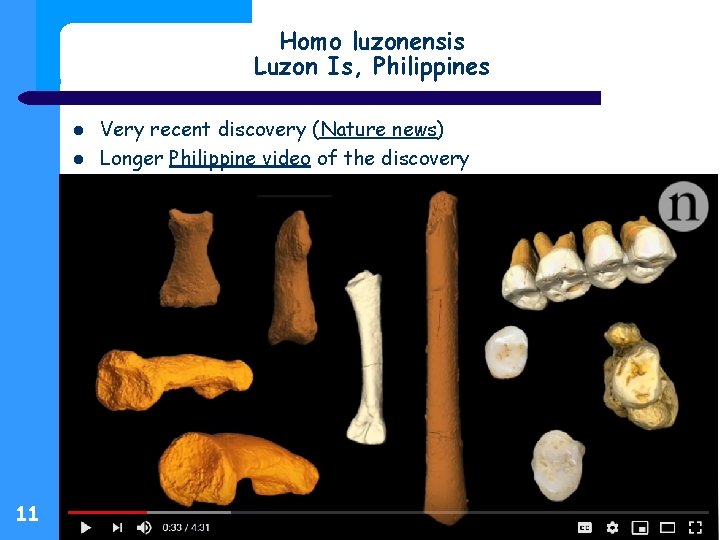
Homo luzonensis Luzon Is, Philippines 11 Very recent discovery (Nature news) Longer Philippine video of the discovery
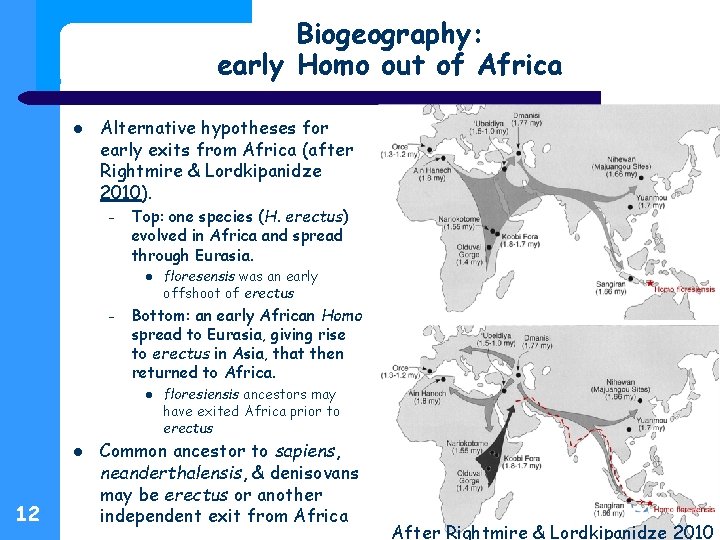
Biogeography: early Homo out of Africa Alternative hypotheses for early exits from Africa (after Rightmire & Lordkipanidze 2010). – Top: one species (H. erectus) evolved in Africa and spread through Eurasia. – Bottom: an early African Homo spread to Eurasia, giving rise to erectus in Asia, that then returned to Africa. 12 floresensis was an early offshoot of erectus floresiensis ancestors may have exited Africa prior to erectus Common ancestor to sapiens, neanderthalensis, & denisovans may be erectus or another independent exit from Africa After Rightmire & Lordkipanidze 2010
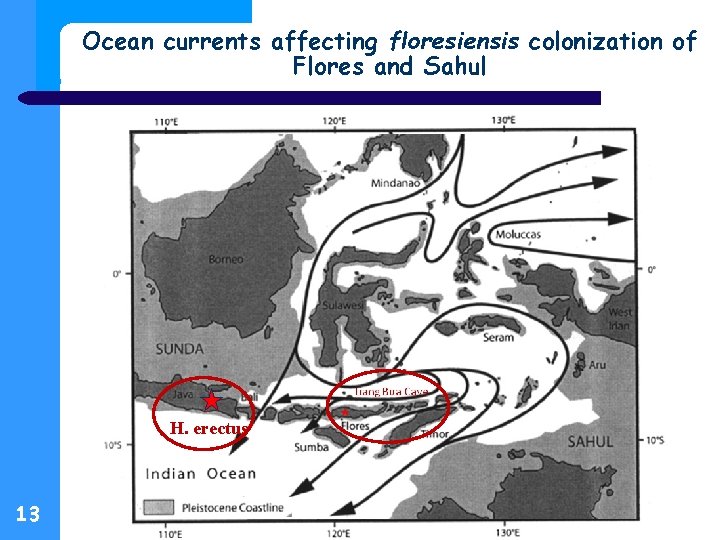
Ocean currents affecting floresiensis colonization of Flores and Sahul H. erectus 13
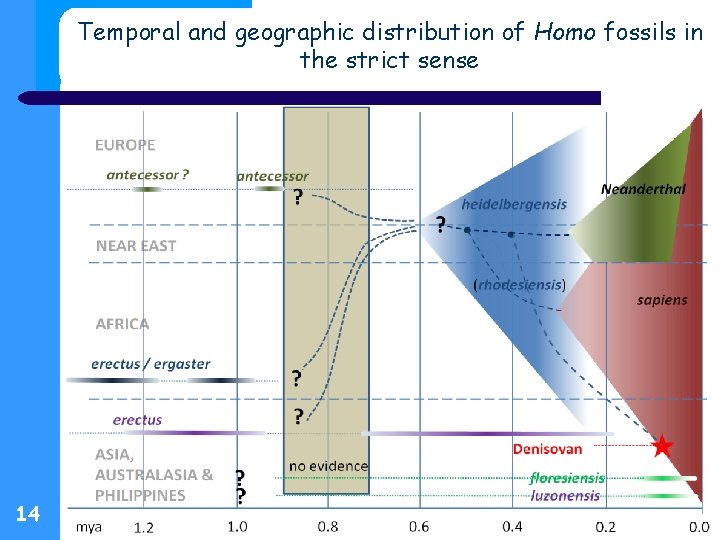
Temporal and geographic distribution of Homo fossils in the strict sense 14
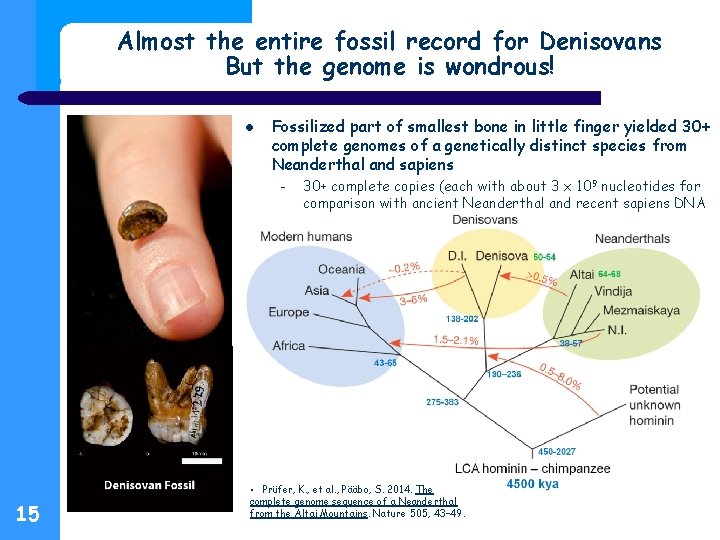
Almost the entire fossil record for Denisovans But the genome is wondrous! Fossilized part of smallest bone in little finger yielded 30+ complete genomes of a genetically distinct species from Neanderthal and sapiens – 15 30+ complete copies (each with about 3 x 10⁹ nucleotides for comparison with ancient Neanderthal and recent sapiens DNA • Prüfer, K. , et al. , Pääbo, S. 2014. The complete genome sequence of a Neanderthal from the Altai Mountains. Nature 505, 43– 49.
Genomics – 3 bn data points per individual: — detailed pedigrees, migrations, population biology, adaptations 16
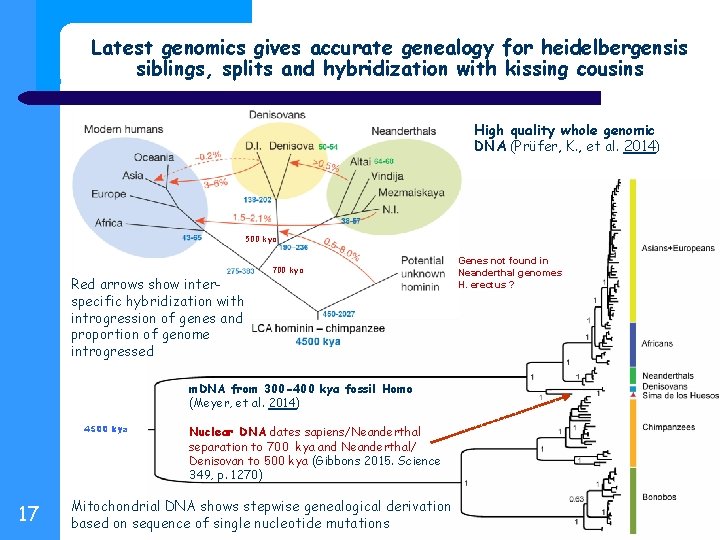
Latest genomics gives accurate genealogy for heidelbergensis siblings, splits and hybridization with kissing cousins High quality whole genomic DNA (Prüfer, K. , et al. 2014) 500 kya Red arrows show interspecific hybridization with introgression of genes and proportion of genome introgressed 700 kya m. DNA from 300 -400 kya fossil Homo (Meyer, et al. 2014) 4500 kya 17 Nuclear DNA dates sapiens/Neanderthal separation to 700 kya and Neanderthal/ Denisovan to 500 kya (Gibbons 2015. Science 349, p. 1270) Mitochondrial DNA shows stepwise genealogical derivation based on sequence of single nucleotide mutations Genes not found in Neanderthal genomes H. erectus ?
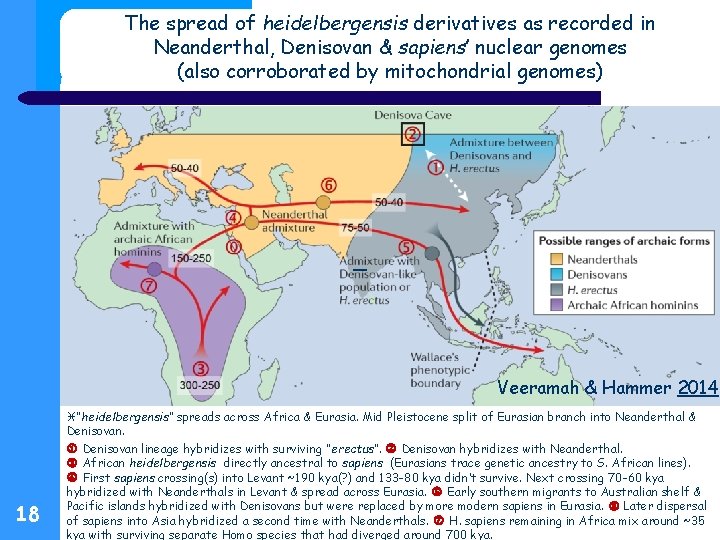
The spread of heidelbergensis derivatives as recorded in Neanderthal, Denisovan & sapiens’ nuclear genomes (also corroborated by mitochondrial genomes) — Veeramah & Hammer 2014 18 i“heidelbergensis” spreads across Africa & Eurasia. Mid Pleistocene split of Eurasian branch into Neanderthal & Denisovan lineage hybridizes with surviving “erectus”. Denisovan hybridizes with Neanderthal. African heidelbergensis directly ancestral to sapiens (Eurasians trace genetic ancestry to S. African lines). First sapiens crossing(s) into Levant ~190 kya(? ) and 133 -80 kya didn’t survive. Next crossing 70 -60 kya hybridized with Neanderthals in Levant & spread across Eurasia. Early southern migrants to Australian shelf & Pacific islands hybridized with Denisovans but were replaced by more modern sapiens in Eurasia. Later dispersal of sapiens into Asia hybridized a second time with Neanderthals. H. sapiens remaining in Africa mix around ~35 kya with surviving separate Homo species that had diverged around 700 kya.
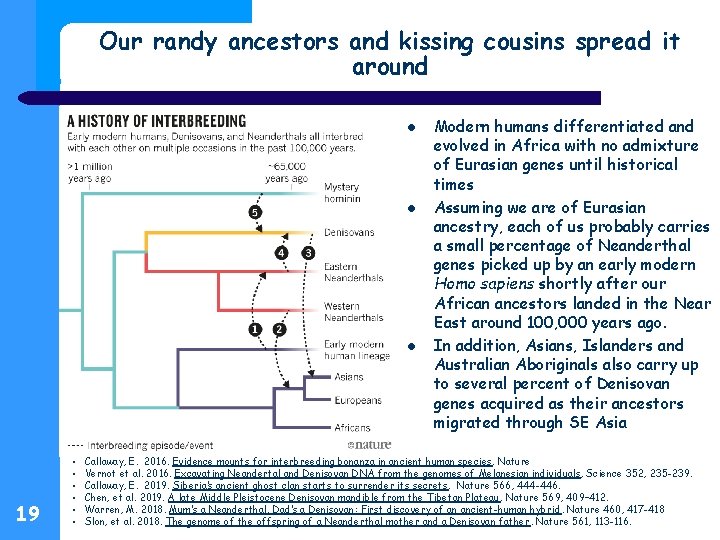
Our randy ancestors and kissing cousins spread it around 19 • • • Modern humans differentiated and evolved in Africa with no admixture of Eurasian genes until historical times Assuming we are of Eurasian ancestry, each of us probably carries a small percentage of Neanderthal genes picked up by an early modern Homo sapiens shortly after our African ancestors landed in the Near East around 100, 000 years ago. In addition, Asians, Islanders and Australian Aboriginals also carry up to several percent of Denisovan genes acquired as their ancestors migrated through SE Asia Callaway, E. 2016. Evidence mounts for interbreeding bonanza in ancient human species. Nature Vernot et al. 2016. Excavating Neandertal and Denisovan DNA from the genomes of Melanesian individuals, Science 352, 235 -239. Callaway, E. 2019. Siberia’s ancient ghost clan starts to surrender its secrets. Nature 566, 444 -446. Chen, et al. 2019. A late Middle Pleistocene Denisovan mandible from the Tibetan Plateau. Nature 569, 409– 412. Warren, M. 2018. Mum’s a Neanderthal, Dad’s a Denisovan: First discovery of an ancient-human hybrid. Nature 460, 417 -418 Slon, et al. 2018. The genome of the offspring of a Neanderthal mother and a Denisovan father. Nature 561, 113 -116.
Mechanics of human evolution Brief review of some generalities Selection for tool-making & use Selection for knowledge & control 20
Genes & memes – genetic vs cultural adaptation Genes – – Determine individual anatomical, physiological and neurological capacities of the organism’s physical fabric Mutation: physical change to one or more DNA nucleotides on a chromosome 21 Change is slow multi-generational process depending on natural selection Movement on the adaptive landscape rather than increased versatility Memes = units of culture (ideas or values or knowledge or patterns of behavior) that may be passed between individuals or from one generation to another by non-genetic means – Change often takes place within generations depending on innovation, social relationships and processes – Transmission limited by genetic capacity to communicate information – Essential information easily lost or corrupted over generations. – Rate and extent of cultural accumulation depend on genetic capacity, group size, (culturally transmitted) cultural practices Major evolutionary trend in hominids is the growing importance of memetic evolution
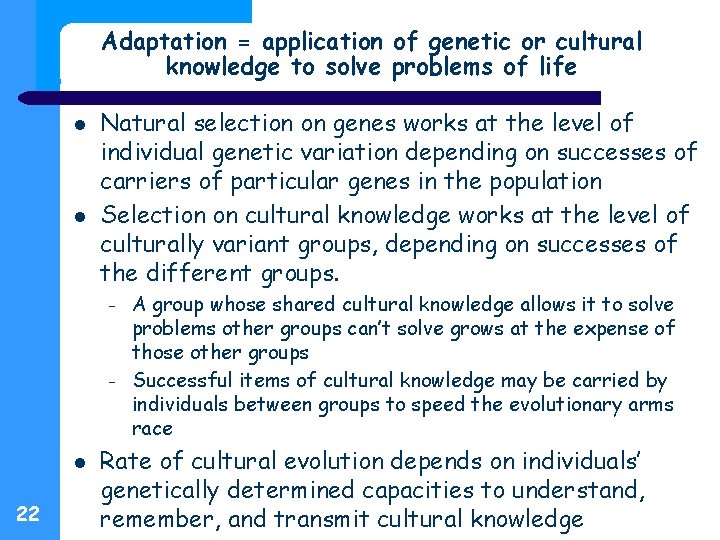
Adaptation = application of genetic or cultural knowledge to solve problems of life Natural selection on genes works at the level of individual genetic variation depending on successes of carriers of particular genes in the population Selection on cultural knowledge works at the level of culturally variant groups, depending on successes of the different groups. – – 22 A group whose shared cultural knowledge allows it to solve problems other groups can’t solve grows at the expense of those other groups Successful items of cultural knowledge may be carried by individuals between groups to speed the evolutionary arms race Rate of cultural evolution depends on individuals’ genetically determined capacities to understand, remember, and transmit cultural knowledge
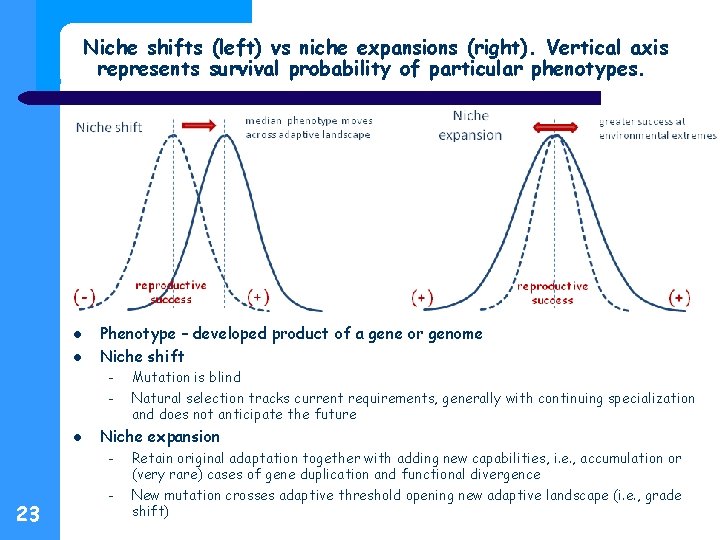
Niche shifts (left) vs niche expansions (right). Vertical axis represents survival probability of particular phenotypes. Phenotype – developed product of a gene or genome Niche shift – – Niche expansion – 23 Mutation is blind Natural selection tracks current requirements, generally with continuing specialization and does not anticipate the future – Retain original adaptation together with adding new capabilities, i. e. , accumulation or (very rare) cases of gene duplication and functional divergence New mutation crosses adaptive threshold opening new adaptive landscape (i. e. , grade shift)
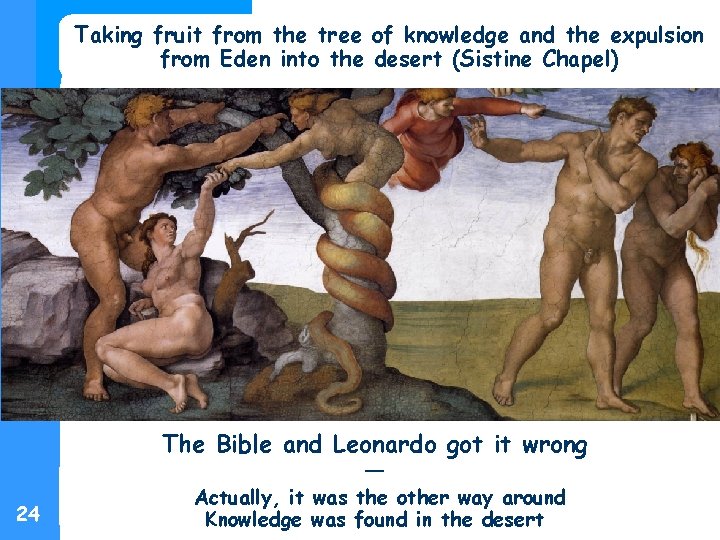
Taking fruit from the tree of knowledge and the expulsion from Eden into the desert (Sistine Chapel) The Bible and Leonardo got it wrong — 24 Actually, it was the other way around 24 Knowledge was found in the desert
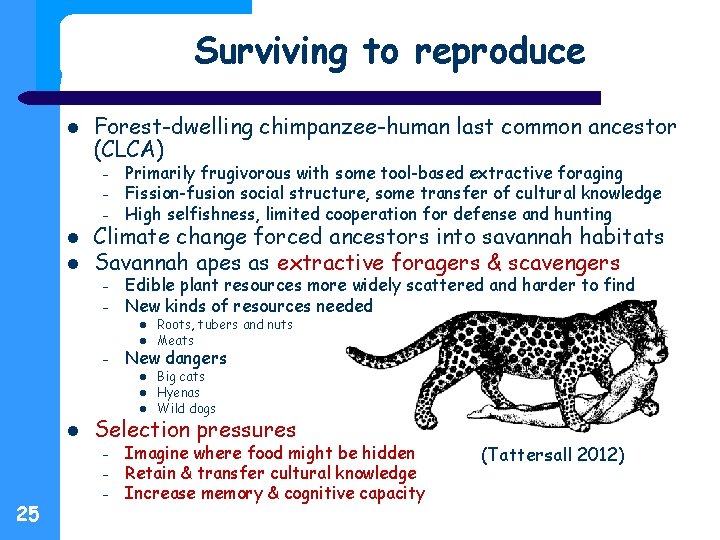
Surviving to reproduce Forest-dwelling chimpanzee-human last common ancestor (CLCA) – – – Primarily frugivorous with some tool-based extractive foraging Fission-fusion social structure, some transfer of cultural knowledge High selfishness, limited cooperation for defense and hunting Climate change forced ancestors into savannah habitats Savannah apes as extractive foragers & scavengers – – Edible plant resources more widely scattered and harder to find New kinds of resources needed – New dangers Big cats Hyenas Wild dogs Selection pressures – – 25 Roots, tubers and nuts Meats – Imagine where food might be hidden Retain & transfer cultural knowledge Increase memory & cognitive capacity (Tattersall 2012) 25
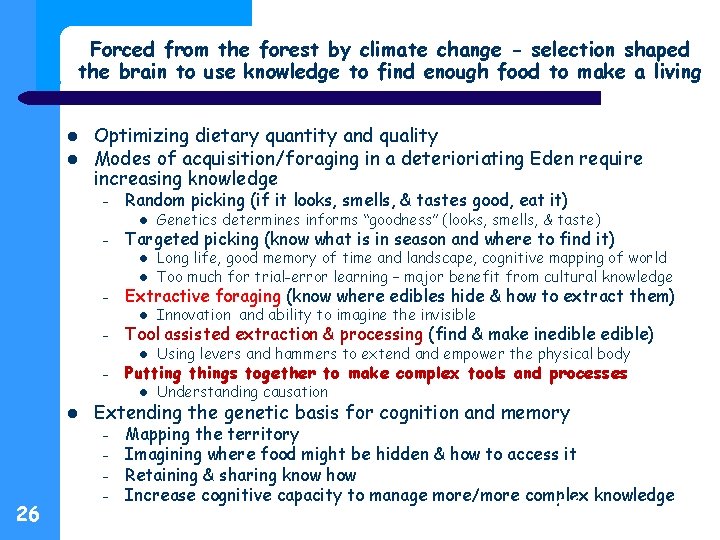
Forced from the forest by climate change - selection shaped the brain to use knowledge to find enough food to make a living Optimizing dietary quantity and quality Modes of acquisition/foraging in a deterioriating Eden require increasing knowledge – Random picking (if it looks, smells, & tastes good, eat it) – Targeted picking (know what is in season and where to find it) Long life, good memory of time and landscape, cognitive mapping of world Too much for trial-error learning – major benefit from cultural knowledge Innovation and ability to imagine the invisible Using levers and hammers to extend and empower the physical body Understanding causation – – – Extractive foraging (know where edibles hide & how to extract them) Tool assisted extraction & processing (find & make inedible) Putting things together to make complex tools and processes Extending the genetic basis for cognition and memory – – – 26 Genetics determines informs “goodness” (looks, smells, & taste) – Mapping the territory Imagining where food might be hidden & how to access it Retaining & sharing know how Increase cognitive capacity to manage more/more complex knowledge 26
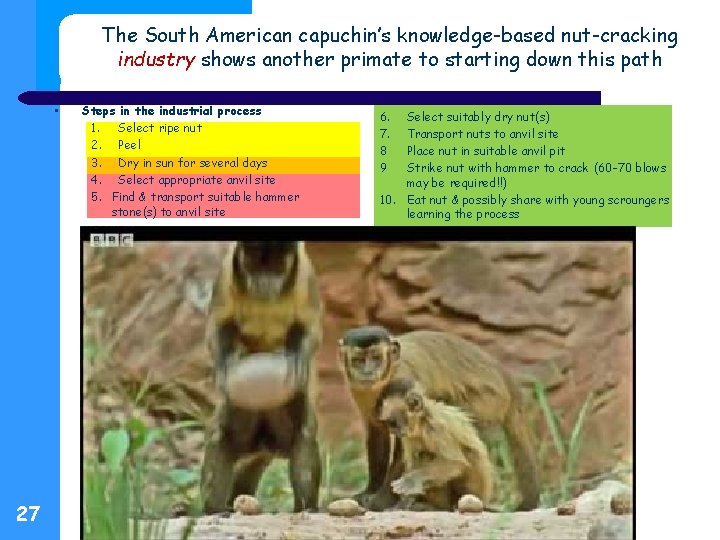
The South American capuchin’s knowledge-based nut-cracking industry shows another primate to starting down this path • 27 Steps in the industrial process 1. Select ripe nut 2. Peel 3. Dry in sun for several days 4. Select appropriate anvil site 5. Find & transport suitable hammer stone(s) to anvil site 6. 7. 8 9 Select suitably dry nut(s) Transport nuts to anvil site Place nut in suitable anvil pit Strike nut with hammer to crack (60 -70 blows may be required!!) 10. Eat nut & possibly share with young scroungers learning the process
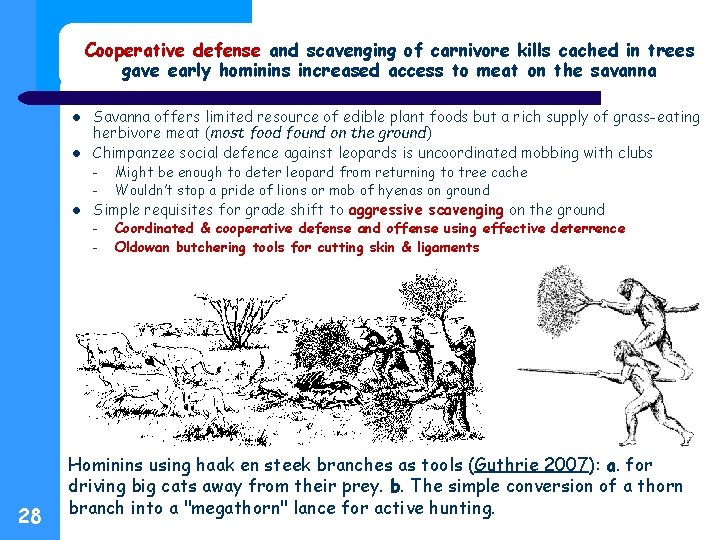
Cooperative defense and scavenging of carnivore kills cached in trees gave early hominins increased access to meat on the savanna Savanna offers limited resource of edible plant foods but a rich supply of grass-eating herbivore meat (most food found on the ground) Chimpanzee social defence against leopards is uncoordinated mobbing with clubs - Might be enough to deter leopard from returning to tree cache - Wouldn’t stop a pride of lions or mob of hyenas on ground Simple requisites for grade shift to aggressive scavenging on the ground – – 28 Coordinated & cooperative defense and offense using effective deterrence Oldowan butchering tools for cutting skin & ligaments Hominins using haak en steek branches as tools (Guthrie 2007): a. for driving big cats away from their prey. b. The simple conversion of a thorn branch into a "megathorn" lance for active hunting.
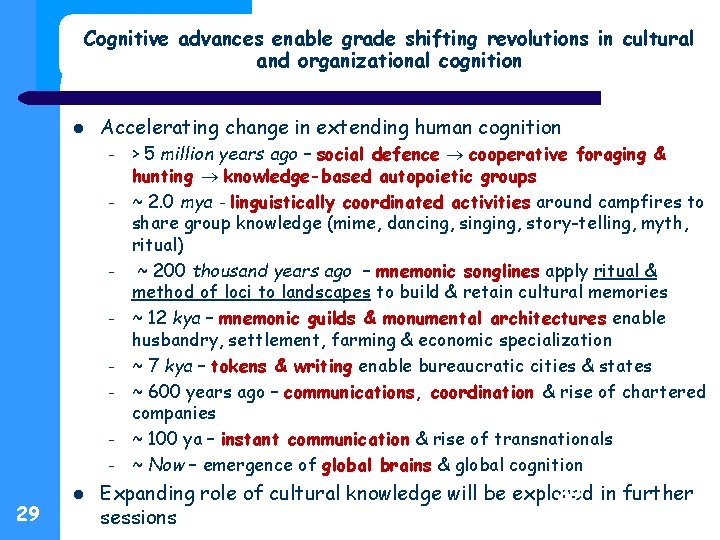
Cognitive advances enable grade shifting revolutions in cultural and organizational cognition Accelerating change in extending human cognition – – – – 29 > 5 million years ago – social defence cooperative foraging & hunting knowledge-based autopoietic groups ~ 2. 0 mya - linguistically coordinated activities around campfires to share group knowledge (mime, dancing, singing, story-telling, myth, ritual) ~ 200 thousand years ago – mnemonic songlines apply ritual & method of loci to landscapes to build & retain cultural memories ~ 12 kya – mnemonic guilds & monumental architectures enable husbandry, settlement, farming & economic specialization ~ 7 kya – tokens & writing enable bureaucratic cities & states ~ 600 years ago – communications, coordination & rise of chartered companies ~ 100 ya – instant communication & rise of transnationals ~ Now – emergence of global brains & global cognition Expanding role of cultural knowledge will be explored 29 in further sessions
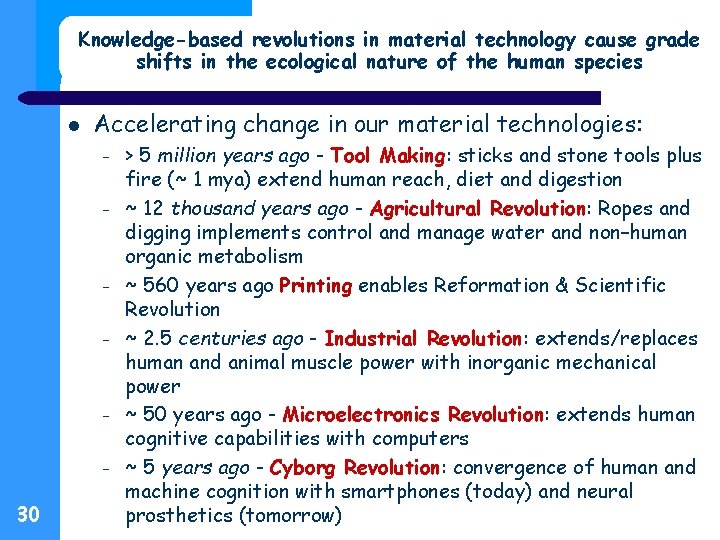
Knowledge-based revolutions in material technology cause grade shifts in the ecological nature of the human species Accelerating change in our material technologies: – – – 30 > 5 million years ago - Tool Making: sticks and stone tools plus fire (~ 1 mya) extend human reach, diet and digestion ~ 12 thousand years ago - Agricultural Revolution: Ropes and digging implements control and manage water and non–human organic metabolism ~ 560 years ago Printing enables Reformation & Scientific Revolution ~ 2. 5 centuries ago - Industrial Revolution: extends/replaces human and animal muscle power with inorganic mechanical power ~ 50 years ago - Microelectronics Revolution: extends human cognitive capabilities with computers ~ 5 years ago - Cyborg Revolution: convergence of human and machine cognition with smartphones (today) and neural 30 prosthetics (tomorrow)
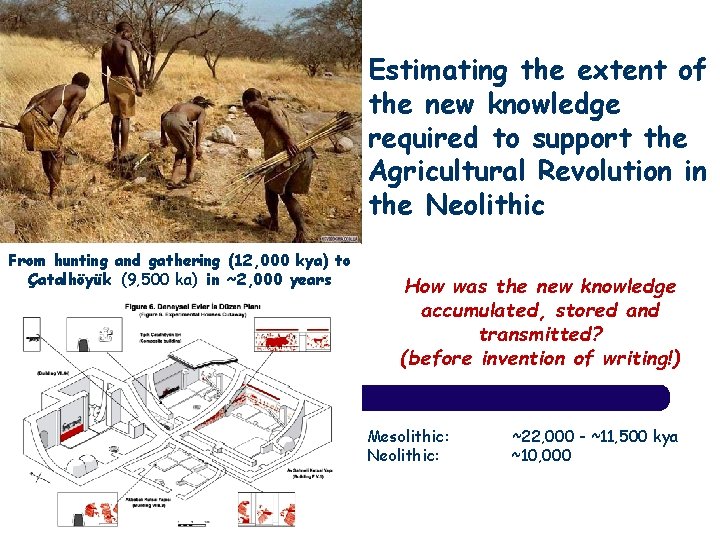
Estimating the extent of the new knowledge required to support the Agricultural Revolution in the Neolithic From hunting and gathering (12, 000 kya) to Çatalhöyük (9, 500 ka) in ~2, 000 years How was the new knowledge accumulated, stored and transmitted? (before invention of writing!) Mesolithic: Neolithic: ~22, 000 - ~11, 500 kya ~10, 000
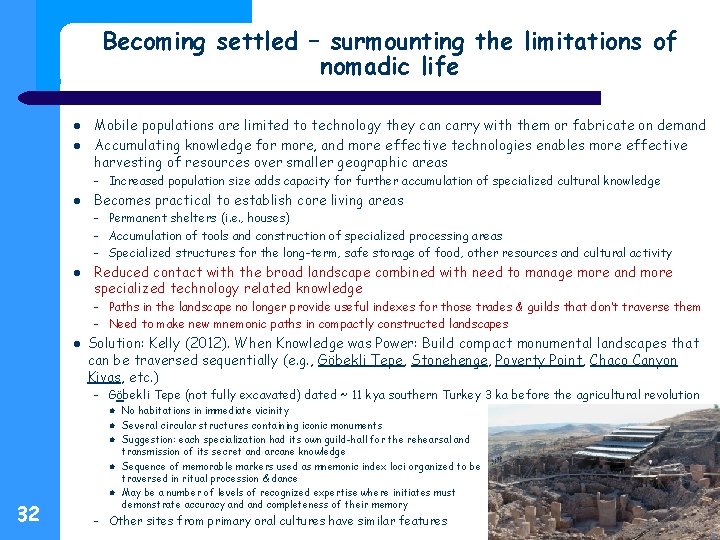
Becoming settled – surmounting the limitations of nomadic life Mobile populations are limited to technology they can carry with them or fabricate on demand Accumulating knowledge for more, and more effective technologies enables more effective harvesting of resources over smaller geographic areas – Becomes practical to establish core living areas – – – Permanent shelters (i. e. , houses) Accumulation of tools and construction of specialized processing areas Specialized structures for the long-term, safe storage of food, other resources and cultural activity Reduced contact with the broad landscape combined with need to manage more and more specialized technology related knowledge – – Increased population size adds capacity for further accumulation of specialized cultural knowledge Paths in the landscape no longer provide useful indexes for those trades & guilds that don’t traverse them Need to make new mnemonic paths in compactly constructed landscapes Solution: Kelly (2012). When Knowledge was Power: Build compact monumental landscapes that can be traversed sequentially (e. g. , Göbekli Tepe, Stonehenge, Poverty Point, Chaco Canyon Kivas, etc. ) – Göbekli Tepe (not fully excavated) dated ~ 11 kya southern Turkey 3 ka before the agricultural revolution 32 – No habitations in immediate vicinity Several circular structures containing iconic monuments Suggestion: each specialization had its own guild-hall for the rehearsal and transmission of its secret and arcane knowledge Sequence of memorable markers used as mnemonic index loci organized to be traversed in ritual procession & dance May be a number of levels of recognized expertise where initiates must demonstrate accuracy and completeness of their memory Other sites from primary oral cultures have similar features
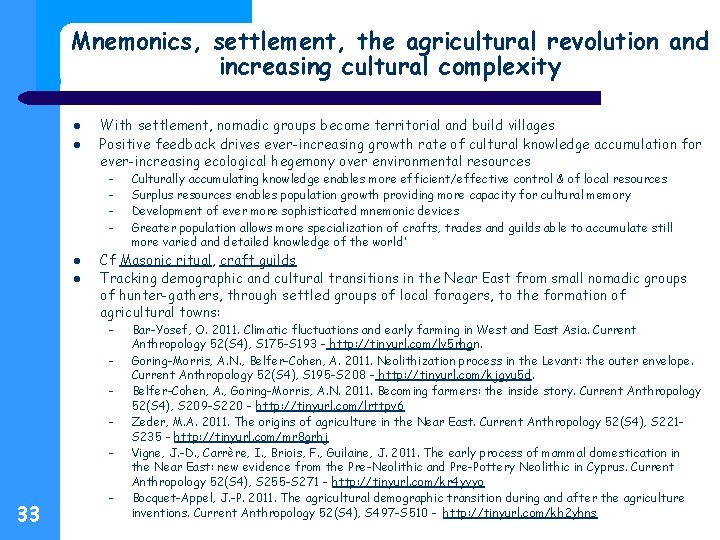
Mnemonics, settlement, the agricultural revolution and increasing cultural complexity With settlement, nomadic groups become territorial and build villages Positive feedback drives ever-increasing growth rate of cultural knowledge accumulation for ever-increasing ecological hegemony over environmental resources – – Cf Masonic ritual, craft guilds Tracking demographic and cultural transitions in the Near East from small nomadic groups of hunter-gathers, through settled groups of local foragers, to the formation of agricultural towns: – – – 33 Culturally accumulating knowledge enables more efficient/effective control & of local resources Surplus resources enables population growth providing more capacity for cultural memory Development of ever more sophisticated mnemonic devices Greater population allows more specialization of crafts, trades and guilds able to accumulate still more varied and detailed knowledge of the world’ – Bar-Yosef, O. 2011. Climatic fluctuations and early farming in West and East Asia. Current Anthropology 52(S 4), S 175 -S 193 - http: //tinyurl. com/lv 5 rhgn. Goring-Morris, A. N. , Belfer-Cohen, A. 2011. Neolithization process in the Levant: the outer envelope. Current Anthropology 52(S 4), S 195 -S 208 - http: //tinyurl. com/kjgyu 5 d. Belfer-Cohen, A. , Goring-Morris, A. N. 2011. Becoming farmers: the inside story. Current Anthropology 52(S 4), S 209 -S 220 - http: //tinyurl. com/lrttpv 6 Zeder, M. A. 2011. The origins of agriculture in the Near East. Current Anthropology 52(S 4), S 221 S 235 - http: //tinyurl. com/mr 8 grhj Vigne, J. -D. , Carrère, I. , Briois, F. , Guilaine, J. 2011. The early process of mammal domestication in the Near East: new evidence from the Pre-Neolithic and Pre-Pottery Neolithic in Cyprus. Current Anthropology 52(S 4), S 255 -S 271 - http: //tinyurl. com/kr 4 yvyo Bocquet-Appel, J. -P. 2011. The agricultural demographic transition during and after the agriculture inventions. Current Anthropology 52(S 4), S 497 -S 510 - http: //tinyurl. com/kh 2 yhns
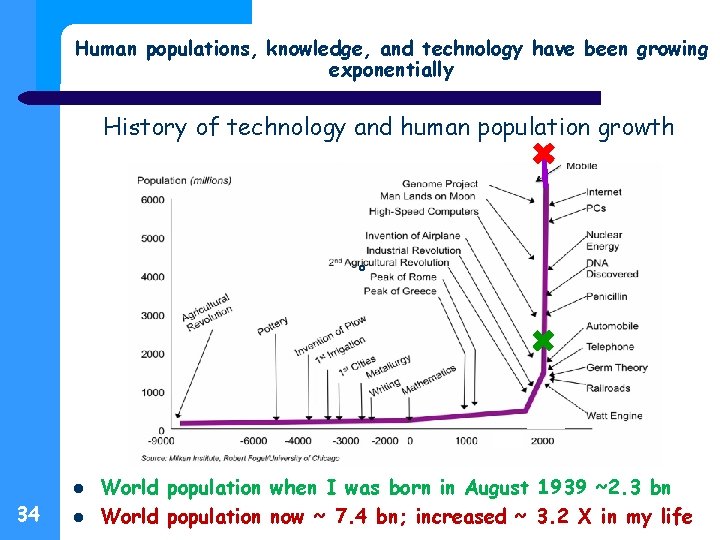
Human populations, knowledge, and technology have been growing exponentially History of technology and human population growth ° 34 World population when I was born in August 1939 ~2. 3 bn World population now ~ 7. 4 bn; increased ~ 3. 2 X in my life
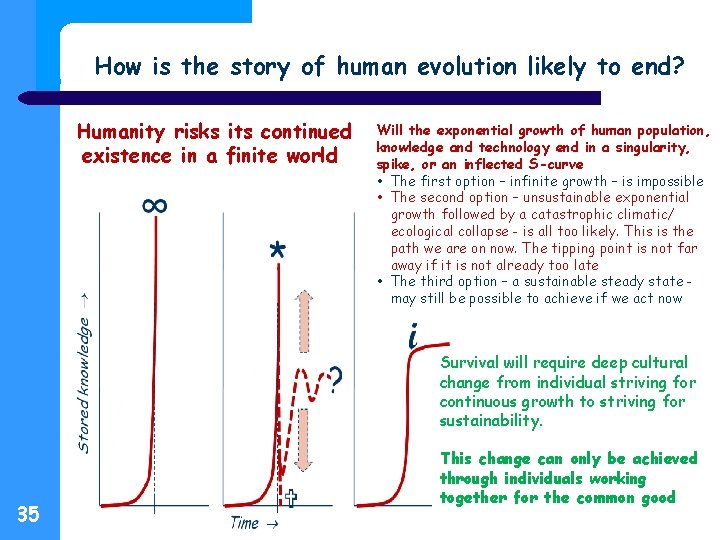
How is the story of human evolution likely to end? Humanity risks its continued existence in a finite world Will the exponential growth of human population, knowledge and technology end in a singularity, spike, or an inflected S-curve The first option – infinite growth – is impossible The second option – unsustainable exponential growth followed by a catastrophic climatic/ ecological collapse - is all too likely. This is the path we are on now. The tipping point is not far away if it is not already too late The third option – a sustainable steady state may still be possible to achieve if we act now Survival will require deep cultural change from individual striving for continuous growth to striving for sustainability. 35 This change can only be achieved through individuals working together for the common good