
Evolution of film animation by Dylan Pombo Animation
Evolution of film animation by Dylan Pombo
Animation is the art of bringing drawn characters of any style, who can’t move, to life. Technology on how this is achieved has greatly changed these past few decades. The Phi Phenomenon This was first pioneered by spinning a disc with pictures of some kind of figure patterned in different positions to create an illusion of perpetual movement.
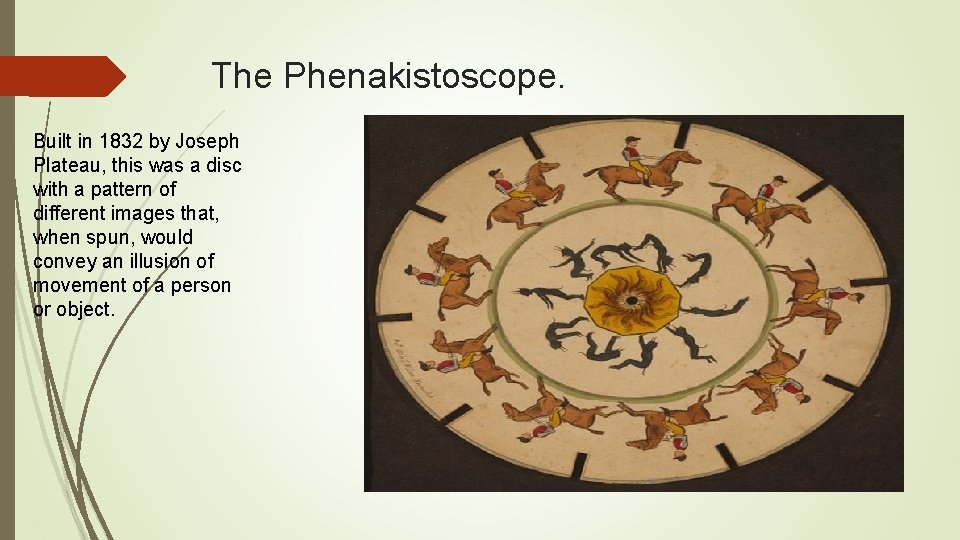
The Phenakistoscope. Built in 1832 by Joseph Plateau, this was a disc with a pattern of different images that, when spun, would convey an illusion of movement of a person or object.

Zoetrope Two years after the invention of the phenakistoscope, came the zoetrope by William Horner. The original design consisted of a cylinder with slits cut outside it to view images inside with the help of a light in the center. This further created an illusion of motion. Some time later, 3 D zoetropes were invented, which made images even more authentic as actual sculptures were used.
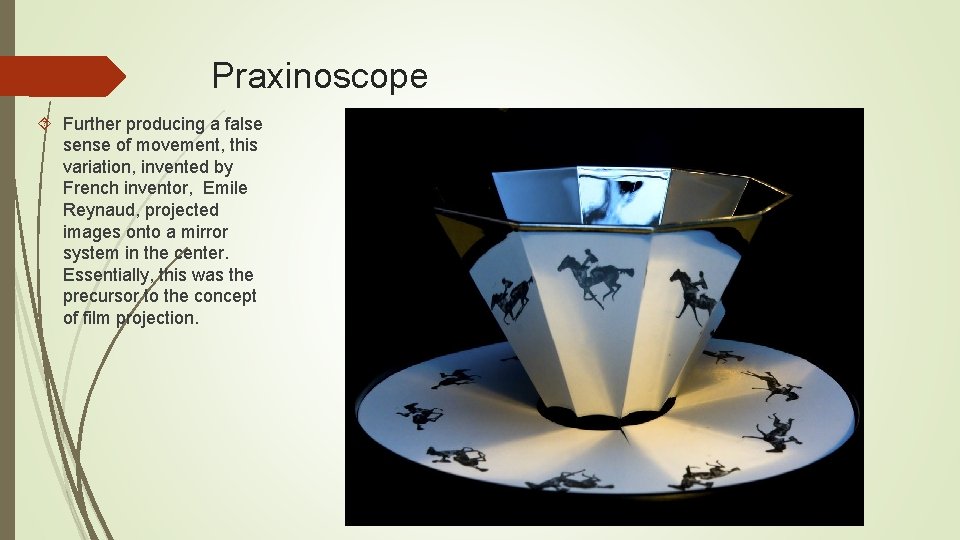
Praxinoscope Further producing a false sense of movement, this variation, invented by French inventor, Emile Reynaud, projected images onto a mirror system in the center. Essentially, this was the precursor to the concept of film projection.
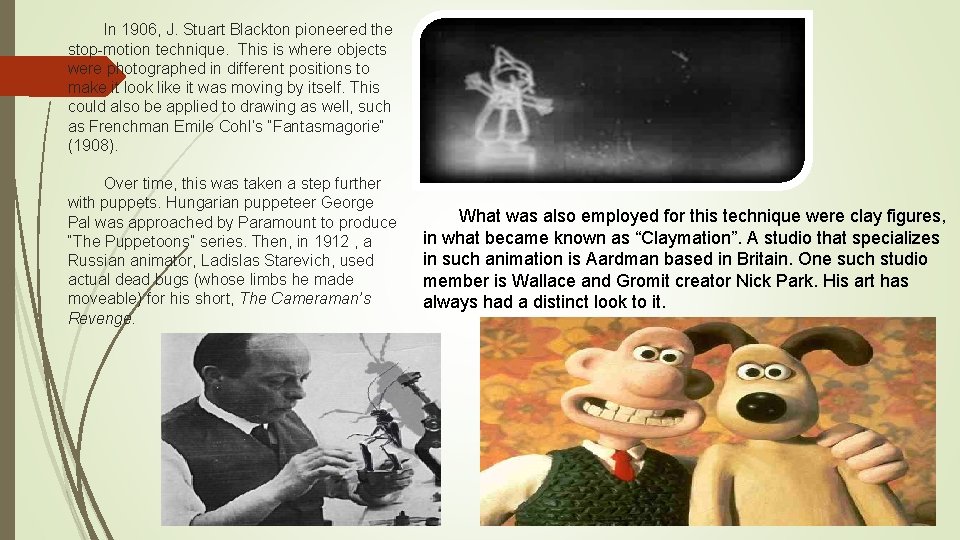
In 1906, J. Stuart Blackton pioneered the stop-motion technique. This is where objects were photographed in different positions to make it look like it was moving by itself. This could also be applied to drawing as well, such as Frenchman Emile Cohl’s “Fantasmagorie” (1908). Over time, this was taken a step further with puppets. Hungarian puppeteer George Pal was approached by Paramount to produce “The Puppetoons” series. Then, in 1912 , a Russian animator, Ladislas Starevich, used actual dead bugs (whose limbs he made moveable) for his short, The Cameraman’s Revenge. What was also employed for this technique were clay figures, in what became known as “Claymation”. A studio that specializes in such animation is Aardman based in Britain. One such studio member is Wallace and Gromit creator Nick Park. His art has always had a distinct look to it.
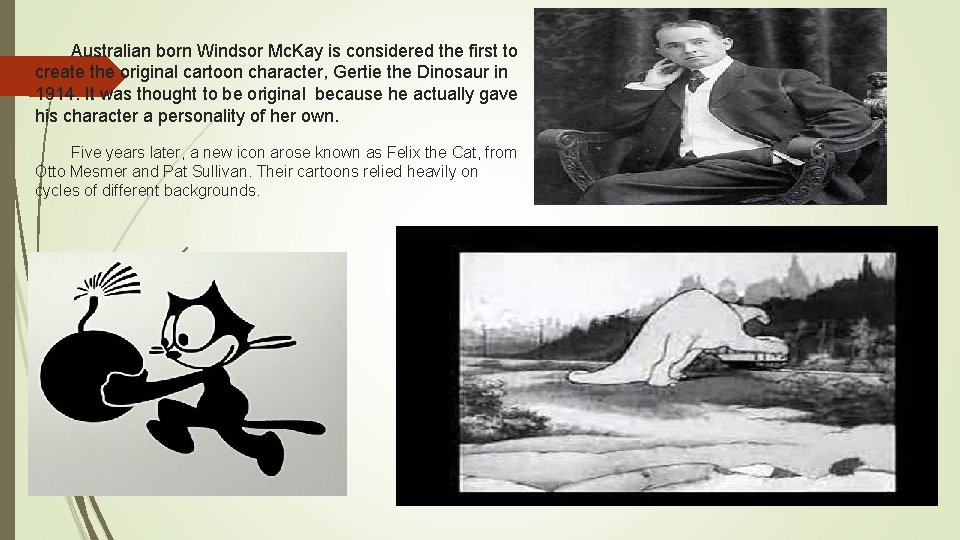
Australian born Windsor Mc. Kay is considered the first to create the original cartoon character, Gertie the Dinosaur in 1914. It was thought to be original because he actually gave his character a personality of her own. Five years later, a new icon arose known as Felix the Cat, from Otto Mesmer and Pat Sullivan. Their cartoons relied heavily on cycles of different backgrounds.

WALT DISNEY is perhaps regarded as the greatest animator of all time, who truly left his mark on the face of animation and creativity, giving rise to all the famous characters we all know. Perhaps the most famous being Mickey Mouse, whose prototype was actually Oswald the Lucky Rabbit, who, in turn, was inspired by Felix the Cat. Disney was forced to change Oswald’s appearance due to copyright issues with Felix’s creator. What really was Mickey’s big break was his 1928 film, “Steamboat Willie”. This is considered his first film because it is the first cartoon to use synchronized sound. Oswald the Lucky Rabbit

Fleishcher brothers Max and Dave are not only best known for the creations of Betty Boop and Popeye, whose content was distinctly different from any previous animation. Their work dealt with topics like sexuality, booze and more modern subjects. More importantly, the Fleishchers devised the revolutionary Rotoscoping method. This allowed one to trace over something live-action, so it could then be animated.
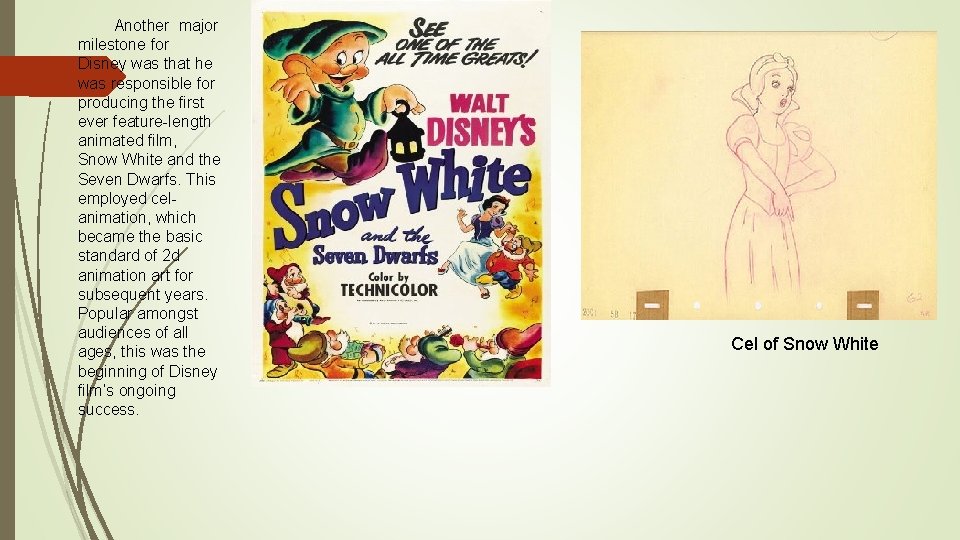
Another major milestone for Disney was that he was responsible for producing the first ever feature-length animated film, Snow White and the Seven Dwarfs. This employed celanimation, which became the basic standard of 2 d animation art for subsequent years. Popular amongst audiences of all ages, this was the beginning of Disney film’s ongoing success. Cel of Snow White
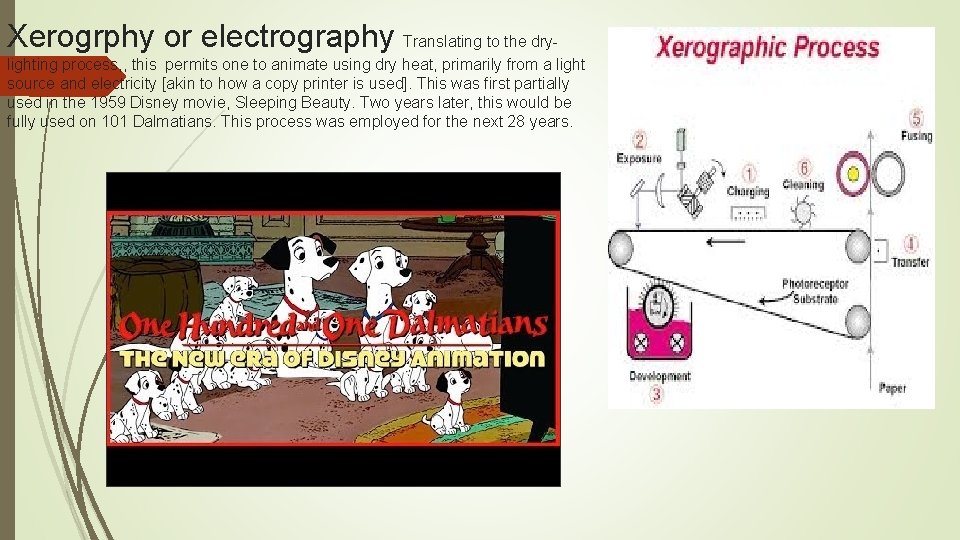
Xerogrphy or electrography Translating to the drylighting process, , this permits one to animate using dry heat, primarily from a light source and electricity [akin to how a copy printer is used]. This was first partially used in the 1959 Disney movie, Sleeping Beauty. Two years later, this would be fully used on 101 Dalmatians. This process was employed for the next 28 years.
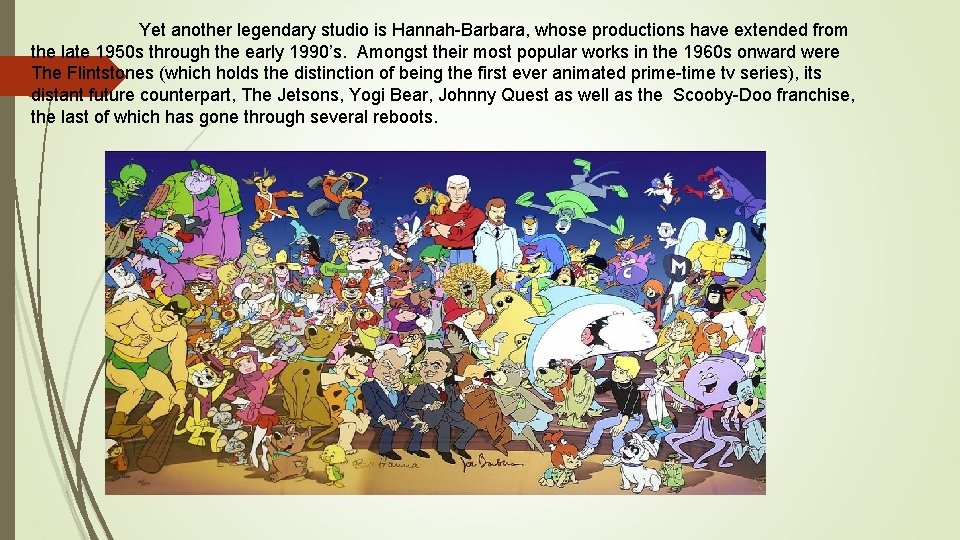
Yet another legendary studio is Hannah-Barbara, whose productions have extended from the late 1950 s through the early 1990’s. Amongst their most popular works in the 1960 s onward were The Flintstones (which holds the distinction of being the first ever animated prime-time tv series), its distant future counterpart, The Jetsons, Yogi Bear, Johnny Quest as well as the Scooby-Doo franchise, the last of which has gone through several reboots.
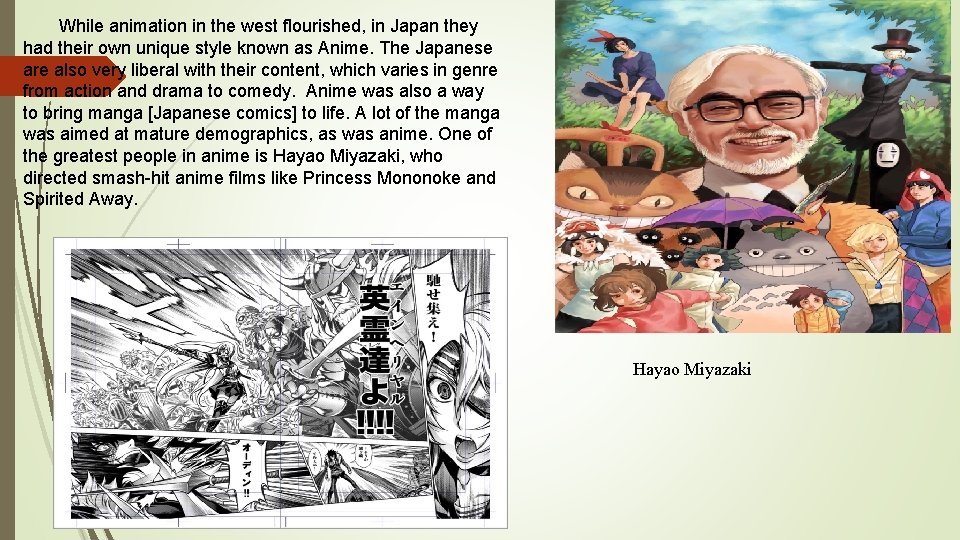
While animation in the west flourished, in Japan they had their own unique style known as Anime. The Japanese are also very liberal with their content, which varies in genre from action and drama to comedy. Anime was also a way to bring manga [Japanese comics] to life. A lot of the manga was aimed at mature demographics, as was anime. One of the greatest people in anime is Hayao Miyazaki, who directed smash-hit anime films like Princess Mononoke and Spirited Away. Hayao Miyazaki
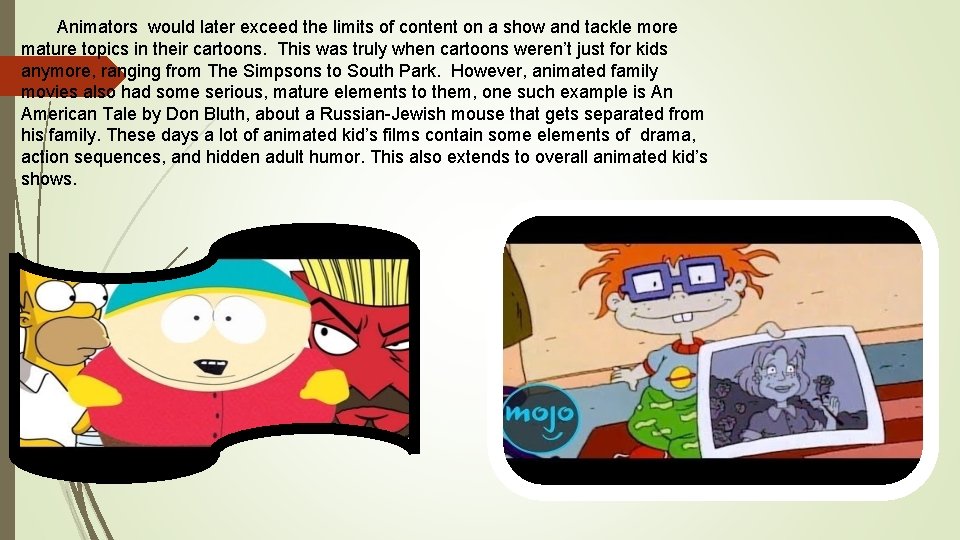
Animators would later exceed the limits of content on a show and tackle more mature topics in their cartoons. This was truly when cartoons weren’t just for kids anymore, ranging from The Simpsons to South Park. However, animated family movies also had some serious, mature elements to them, one such example is An American Tale by Don Bluth, about a Russian-Jewish mouse that gets separated from his family. These days a lot of animated kid’s films contain some elements of drama, action sequences, and hidden adult humor. This also extends to overall animated kid’s shows.
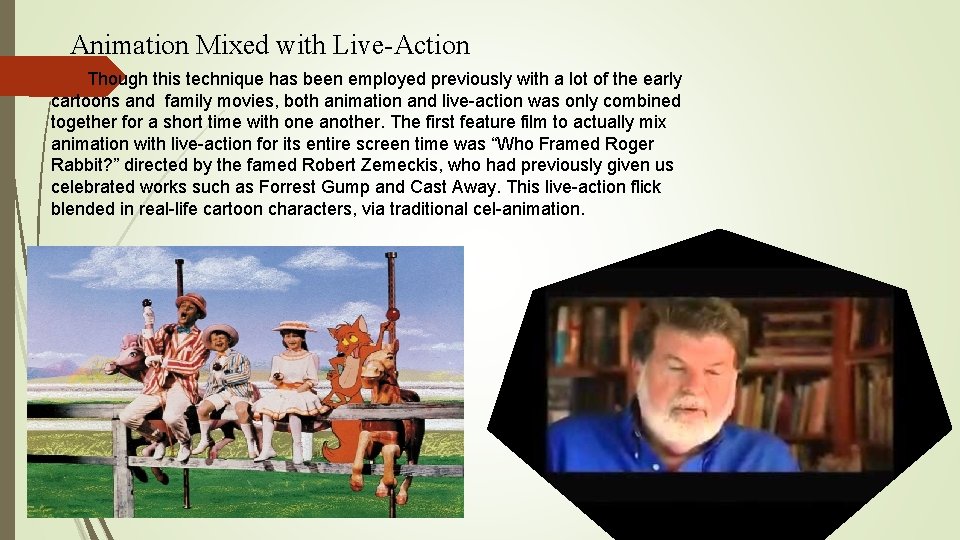
Animation Mixed with Live-Action Though this technique has been employed previously with a lot of the early cartoons and family movies, both animation and live-action was only combined together for a short time with one another. The first feature film to actually mix animation with live-action for its entire screen time was “Who Framed Roger Rabbit? ” directed by the famed Robert Zemeckis, who had previously given us celebrated works such as Forrest Gump and Cast Away. This live-action flick blended in real-life cartoon characters, via traditional cel-animation.
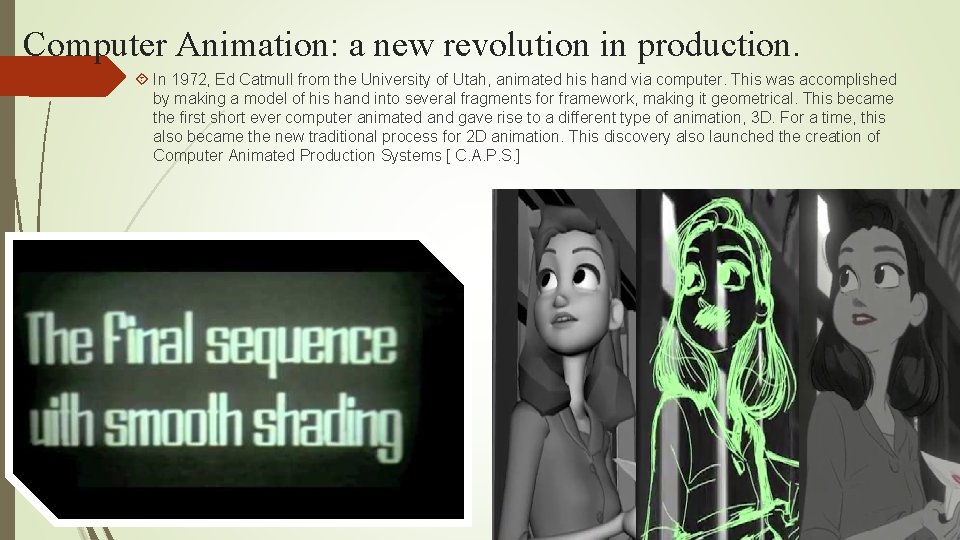
Computer Animation: a new revolution in production. In 1972, Ed Catmull from the University of Utah, animated his hand via computer. This was accomplished by making a model of his hand into several fragments for framework, making it geometrical. This became the first short ever computer animated and gave rise to a different type of animation, 3 D. For a time, this also became the new traditional process for 2 D animation. This discovery also launched the creation of Computer Animated Production Systems [ C. A. P. S. ]
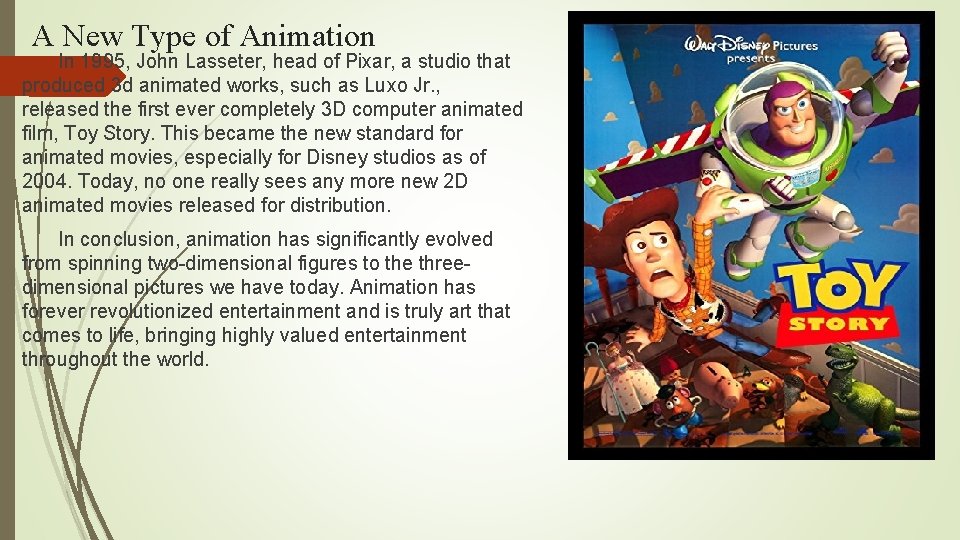
A New Type of Animation In 1995, John Lasseter, head of Pixar, a studio that produced 3 d animated works, such as Luxo Jr. , released the first ever completely 3 D computer animated film, Toy Story. This became the new standard for animated movies, especially for Disney studios as of 2004. Today, no one really sees any more new 2 D animated movies released for distribution. In conclusion, animation has significantly evolved from spinning two-dimensional figures to the threedimensional pictures we have today. Animation has forever revolutionized entertainment and is truly art that comes to life, bringing highly valued entertainment throughout the world.
- Slides: 17