
Evolution of Engines With Innovative Designs and Components
- Slides: 3
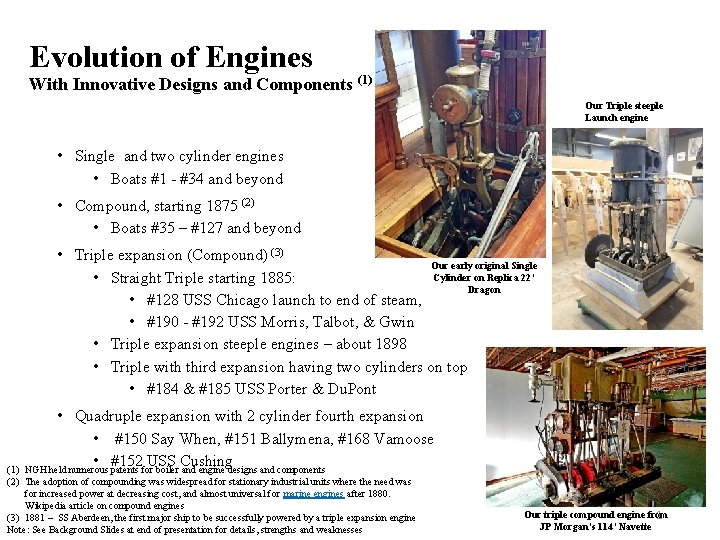
Evolution of Engines With Innovative Designs and Components (1) Our Triple steeple Launch engine • Single and two cylinder engines • Boats #1 - #34 and beyond • Compound, starting 1875 (2) • Boats #35 – #127 and beyond • Triple expansion (Compound) (3) Our early original Single Cylinder on Replica 22’ • Straight Triple starting 1885: Dragon • #128 USS Chicago launch to end of steam, • #190 - #192 USS Morris, Talbot, & Gwin • Triple expansion steeple engines – about 1898 • Triple with third expansion having two cylinders on top • #184 & #185 USS Porter & Du. Pont • Quadruple expansion with 2 cylinder fourth expansion • #150 Say When, #151 Ballymena, #168 Vamoose • #152 USS Cushing NGH held numerous patents for boiler and engine designs and components (1) (2) The adoption of compounding was widespread for stationary industrial units where the need was for increased power at decreasing cost, and almost universal for marine engines after 1880. Wikipedia article on compound engines (3) 1881 – SS Aberdeen, the first major ship to be successfully powered by a triple expansion engine Note: See Background Slides at end of presentation for details, strengths and weaknesses Our triple compound engine from 1 JP Morgan’s 114’ Navette
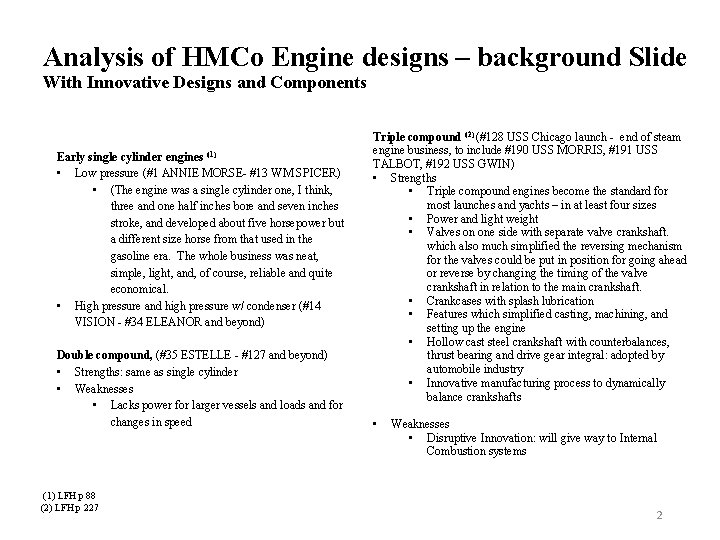
Analysis of HMCo Engine designs – background Slide With Innovative Designs and Components Early single cylinder engines (1) • Low pressure (#1 ANNIE MORSE- #13 WM SPICER) • (The engine was a single cylinder one, I think, three and one half inches bore and seven inches stroke, and developed about five horsepower but a different size horse from that used in the gasoline era. The whole business was neat, simple, light, and, of course, reliable and quite economical. • High pressure and high pressure w/ condenser (#14 VISION - #34 ELEANOR and beyond) Double compound, (#35 ESTELLE - #127 and beyond) • Strengths: same as single cylinder • Weaknesses • Lacks power for larger vessels and loads and for changes in speed (1) LFH p 88 (2) LFH p 227 Triple compound (2) (#128 USS Chicago launch - end of steam engine business, to include #190 USS MORRIS, #191 USS TALBOT, #192 USS GWIN) • Strengths • Triple compound engines become the standard for most launches and yachts – in at least four sizes • Power and light weight • Valves on one side with separate valve crankshaft. which also much simplified the reversing mechanism for the valves could be put in position for going ahead or reverse by changing the timing of the valve crankshaft in relation to the main crankshaft. • Crankcases with splash lubrication • Features which simplified casting, machining, and setting up the engine • Hollow cast steel crankshaft with counterbalances, thrust bearing and drive gear integral: adopted by automobile industry • Innovative manufacturing process to dynamically balance crankshafts • Weaknesses • Disruptive Innovation: will give way to Internal Combustion systems 2
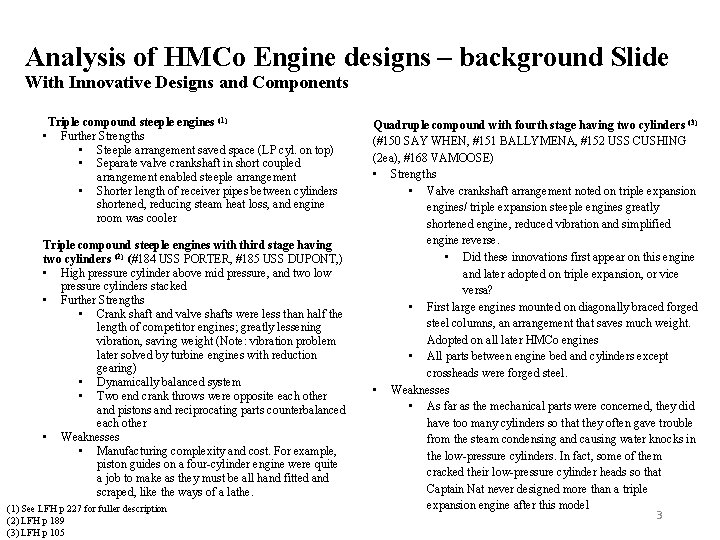
Analysis of HMCo Engine designs – background Slide With Innovative Designs and Components Triple compound steeple engines (1) • Further Strengths • Steeple arrangement saved space (LP cyl. on top) • Separate valve crankshaft in short coupled arrangement enabled steeple arrangement • Shorter length of receiver pipes between cylinders shortened, reducing steam heat loss, and engine room was cooler Triple compound steeple engines with third stage having two cylinders (2) (#184 USS PORTER, #185 USS DUPONT, ) • High pressure cylinder above mid pressure, and two low pressure cylinders stacked • Further Strengths • Crank shaft and valve shafts were less than half the length of competitor engines; greatly lessening vibration, saving weight (Note: vibration problem later solved by turbine engines with reduction gearing) • Dynamically balanced system • Two end crank throws were opposite each other and pistons and reciprocating parts counterbalanced each other • Weaknesses • Manufacturing complexity and cost. For example, piston guides on a four-cylinder engine were quite a job to make as they must be all hand fitted and scraped, like the ways of a lathe. (1) See LFH p 227 for fuller description (2) LFH p 189 (3) LFH p 105 Quadruple compound with fourth stage having two cylinders (3) (#150 SAY WHEN, #151 BALLYMENA, #152 USS CUSHING (2 ea), #168 VAMOOSE) • Strengths • Valve crankshaft arrangement noted on triple expansion engines/ triple expansion steeple engines greatly shortened engine, reduced vibration and simplified engine reverse. • Did these innovations first appear on this engine and later adopted on triple expansion, or vice versa? • First large engines mounted on diagonally braced forged steel columns, an arrangement that saves much weight. Adopted on all later HMCo engines • All parts between engine bed and cylinders except crossheads were forged steel. • Weaknesses • As far as the mechanical parts were concerned, they did have too many cylinders so that they often gave trouble from the steam condensing and causing water knocks in the low-pressure cylinders. In fact, some of them cracked their low-pressure cylinder heads so that Captain Nat never designed more than a triple expansion engine after this model 3