
Evolution of COREP and FINREP Presented at the

- Slides: 16
Evolution of COREP and FINREP Presented at the: IX European Banking Supervisors XBRL Workshop & Tutorial In: Paris On: 30 th September 2008 By: Wolfgang Strohbach Member of CEBS XBRL Network 1
Outline 1. CEBS? ? ? 2. FINREP vs. COREP 3. EU-wide reporting formats 4. Streamlining & Harmonization project 5. One-entry point 2
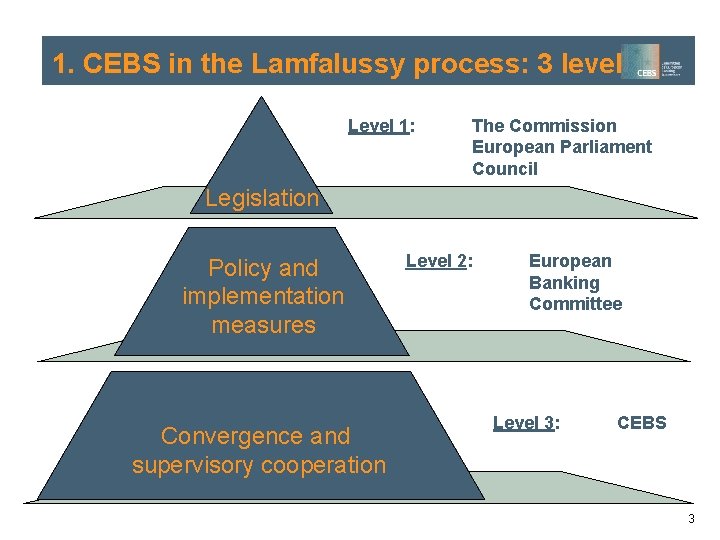
1. CEBS in the Lamfalussy process: 3 levels Level 1: The Commission European Parliament Council Legislation Policy and implementation measures Convergence and supervisory cooperation Level 2: European Banking Committee Level 3: CEBS 3
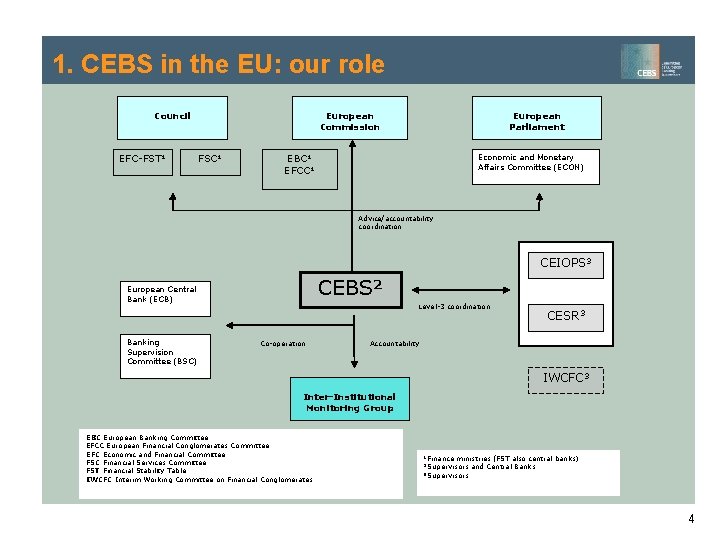
1. CEBS in the EU: our role Council EFC-FST¹ European Commission FSC¹ European Parliament EBC¹ EFCC¹ Economic and Monetary Affairs Committee (ECON) Advice/accountability coordination CEIOPS 3 CEBS² European Central Bank (ECB) Banking Supervision Committee (BSC) Level-3 coordination Co-operation CESR 3 Accountability IWCFC 3 Inter-Institutional Monitoring Group EBC European Banking Committee EFCC European Financial Conglomerates Committee EFC Economic and Financial Committee FSC Financial Services Committee FST Financial Stability Table IWCFC Interim Working Committee on Financial Conglomerates ¹Finance ministries (FST also central banks) ²Supervisors and Central Banks ³Supervisors 4
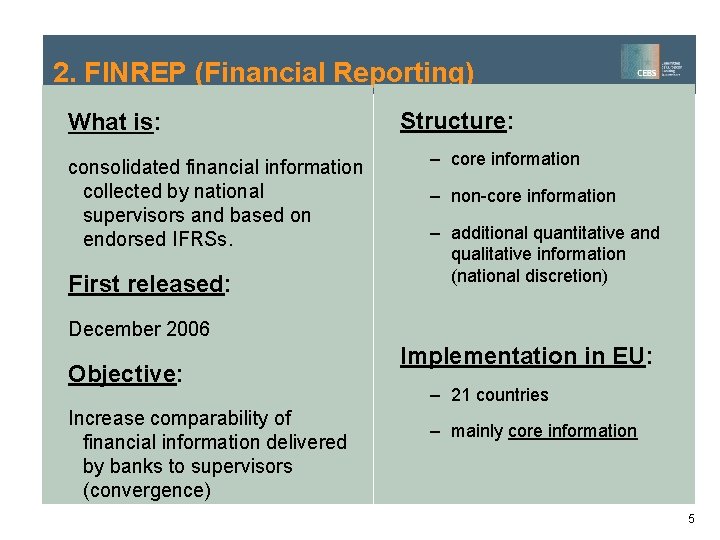
2. FINREP (Financial Reporting) What is: consolidated financial information collected by national supervisors and based on endorsed IFRSs. First released: Structure: – core information – non-core information – additional quantitative and qualitative information (national discretion) December 2006 Objective: Increase comparability of financial information delivered by banks to supervisors (convergence) Implementation in EU: – 21 countries – mainly core information 5
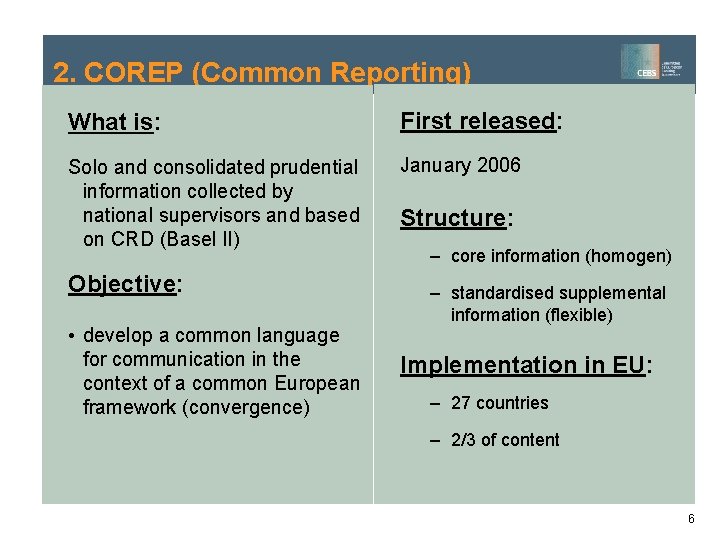
2. COREP (Common Reporting) What is: First released: Solo and consolidated prudential information collected by national supervisors and based on CRD (Basel II) January 2006 Objective: • develop a common language for communication in the context of a common European framework (convergence) Structure: – core information (homogen) – standardised supplemental information (flexible) Implementation in EU: – 27 countries – 2/3 of content 6
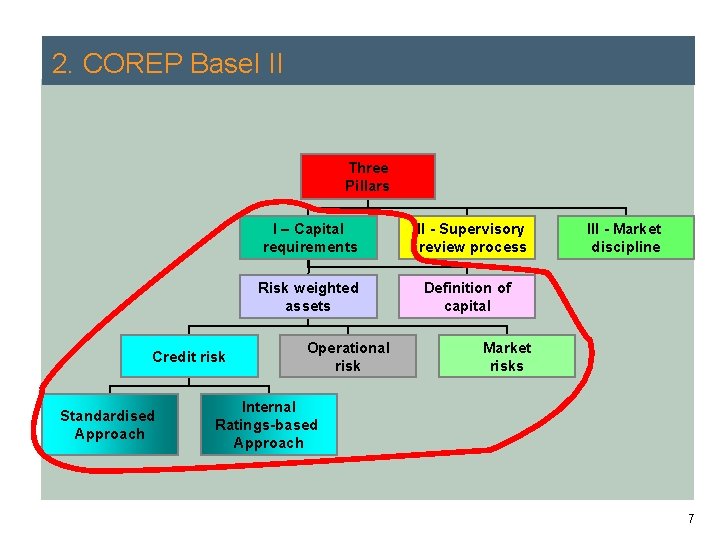
2. COREP Basel II Three Pillars I – Capital requirements Risk weighted assets Credit risk Standardised Approach Operational risk II - Supervisory review process III - Market discipline Definition of capital Market risks Internal Ratings-based Approach 7
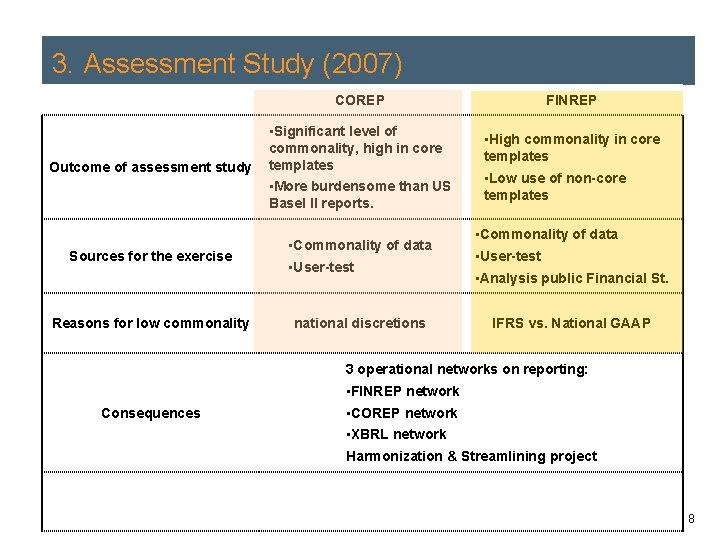
3. Assessment Study (2007) COREP Outcome of assessment study • Significant level of commonality, high in core templates • More burdensome than US Basel II reports. Sources for the exercise Reasons for low commonality • Commonality of data • User-test national discretions FINREP • High commonality in core templates • Low use of non-core templates • Commonality of data • User-test • Analysis public Financial St. IFRS vs. National GAAP 3 operational networks on reporting: • FINREP network Consequences • COREP network • XBRL network Harmonization & Streamlining project 8
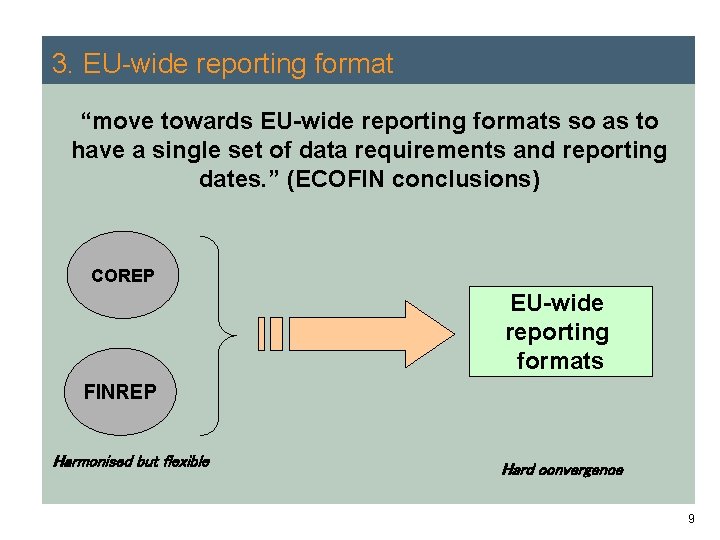
3. EU-wide reporting format “move towards EU-wide reporting formats so as to have a single set of data requirements and reporting dates. ” (ECOFIN conclusions) COREP EU-wide reporting formats FINREP Harmonised but flexible Hard convergence 9
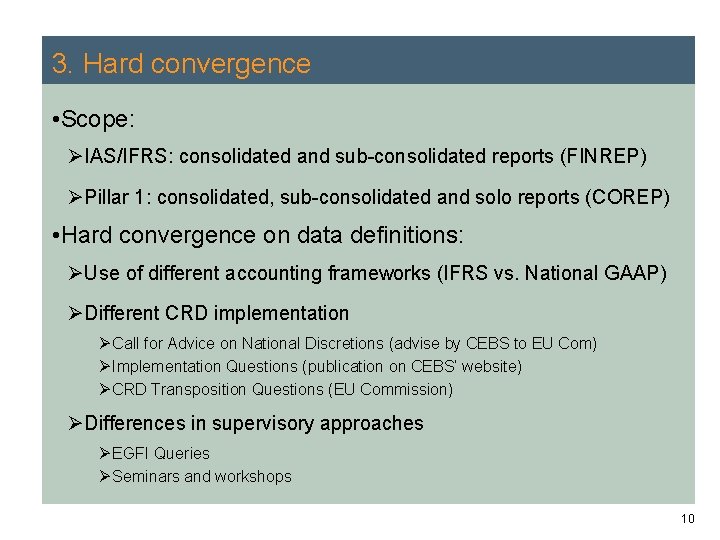
3. Hard convergence • Scope: ØIAS/IFRS: consolidated and sub-consolidated reports (FINREP) ØPillar 1: consolidated, sub-consolidated and solo reports (COREP) • Hard convergence on data definitions: ØUse of different accounting frameworks (IFRS vs. National GAAP) ØDifferent CRD implementation Ø Call for Advice on National Discretions (advise by CEBS to EU Com) Ø Implementation Questions (publication on CEBS’ website) Ø CRD Transposition Questions (EU Commission) ØDifferences in supervisory approaches Ø EGFI Queries Ø Seminars and workshops 10
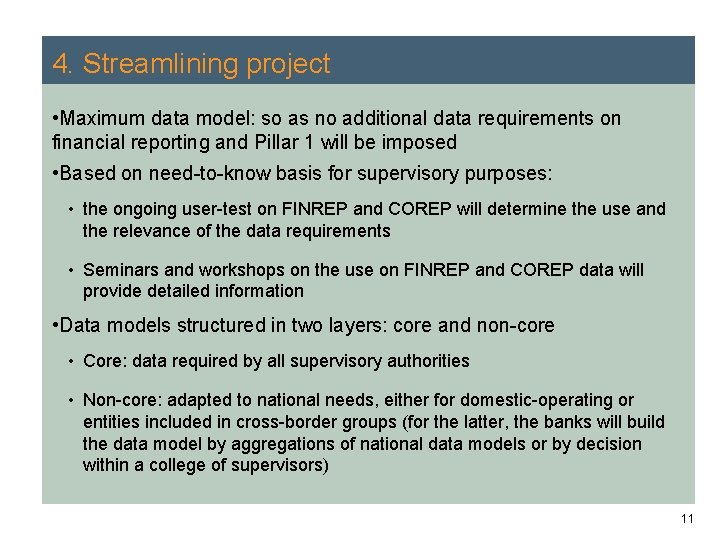
4. Streamlining project • Maximum data model: so as no additional data requirements on financial reporting and Pillar 1 will be imposed • Based on need-to-know basis for supervisory purposes: • the ongoing user-test on FINREP and COREP will determine the use and the relevance of the data requirements • Seminars and workshops on the use on FINREP and COREP data will provide detailed information • Data models structured in two layers: core and non-core • Core: data required by all supervisory authorities • Non-core: adapted to national needs, either for domestic-operating or entities included in cross-border groups (for the latter, the banks will build the data model by aggregations of national data models or by decision within a college of supervisors) 11
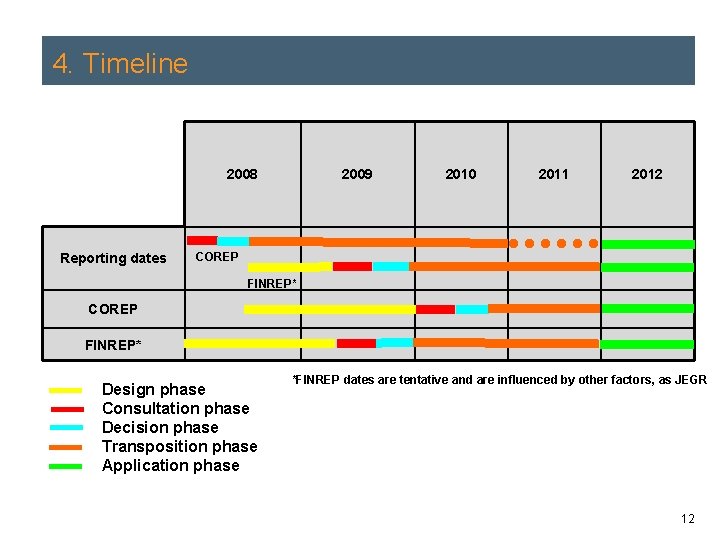
4. Timeline 2008 Reporting dates 2009 2010 2011 2012 COREP FINREP* Design phase Consultation phase Decision phase Transposition phase Application phase *FINREP dates are tentative and are influenced by other factors, as JEGR 12
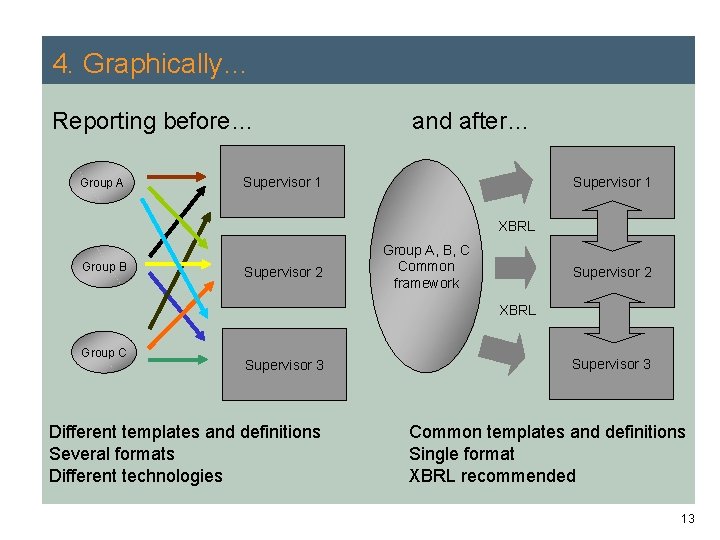
4. Graphically… Reporting before… Group A and after… Supervisor 1 XBRL Group B Supervisor 2 Group A, B, C Common framework Supervisor 2 XBRL Group C Supervisor 3 Different templates and definitions Several formats Different technologies Supervisor 3 Common templates and definitions Single format XBRL recommended 13
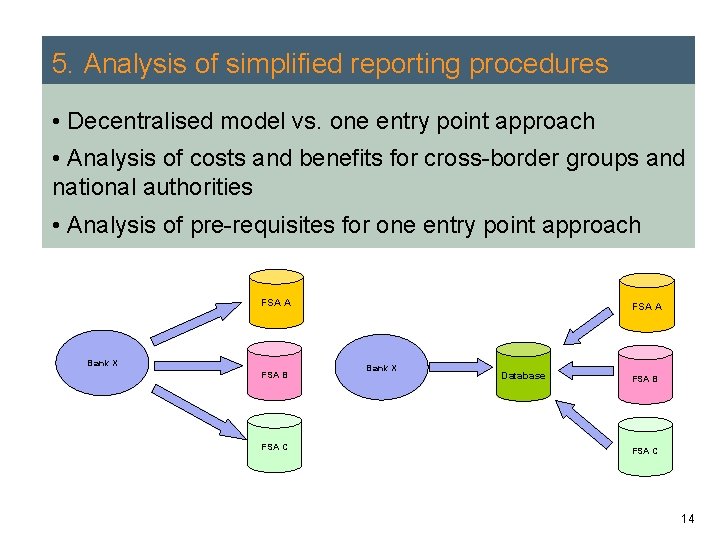
5. Analysis of simplified reporting procedures • Decentralised model vs. one entry point approach • Analysis of costs and benefits for cross-border groups and national authorities • Analysis of pre-requisites for one entry point approach FSA A Bank X FSA B FSA C FSA A Bank X Database FSA B FSA C 14
Questions? Thank you! 15
www. corep. info www. finrep. info Wolfgang Strohbach: wolfgang. strohbach@c-ebs. org