
Evolution Of Broadcastin g The term broadcast was
Evolution Of Broadcastin g
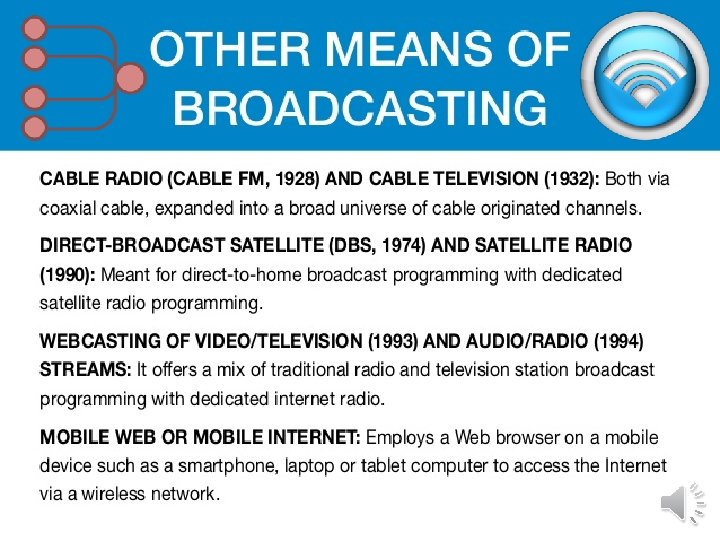
The term broadcast was coined by early radio engineers from the mid-western United States to distinguish electronic transmissions that are intended for general public reception, as distinguished from private signals that are directed to specific receivers. Broadcasting forms a very large segment of the mass media. Television and radio programs are distributed through radio broadcasting or cable, often both simultaneously. By coding signals and having decoding equipment in homes, cable also enables subscription-based channels and pay-perview services. A broadcasting organization may broadcast several programs at the same time, through several channels (frequencies); for example, the BBC broadcasts BBC One and BBC Two. On the other hand, two or more organizations may share a channel and each use it during a fixed part of the day. Digital radio and digital television may also transmit multiplexed programming, with several channels compressed into one ensemble. When broadcasting is done via the Internet, the term "webcasting" is often used
Broadcasting is the distribution of audio and/or video signals (programs) to a number of recipients ("listeners" or "viewers") that belong to a large group. This group may be the public in general, or a relatively large audience within the public. Thus, an Internet channel may distribute text or music worldwide, while a public address system in a workplace may broadcast very limited ad hoc "sound bites" to a small population within its range. Broadcasting may involve auditory information only, as in radio, or visual, or a combination, as in television. As technology has advanced, so too have the forms of broadcasting. Historically, the term broadcasting usually has referred to the radio and television industries. Broadcasting was previously synonymous with "over the air" broadcasts, where the radio frequency spectrum is limited and thus regulated; but with the advent of direct (satellite) radio broadcasting and especially cable television, channels (and programming variety) are far more numerous (digital cable television can support hundreds of different channels) and are subscriber-based. The concept and ability of broadcasting to convey the same information, whether
Broadcasting Jhon Elmer Dequilla Evolution Camille Espedillon Mary Ann De Chavez Abigail Mojana Reynalene Aco Dimple Ira Librea Lindsay Inciong Julie Ann Galupo
- Slides: 10