
Evolution of beam energy distribution as a diagnostics
Evolution of beam energy distribution as a diagnostics tool Alexey Burov, Bill Ng and Sergei Nagaitsev November 13, 2003 Beam energy distribution - Nagaitsev
What affects coasting-beam energy distribution? § IBS: changes the energy spread, does not change the average energy. § Broad-band impedance: does not change the energy spread, changes the average energy. § Ionization losses and coulomb scattering with electrons: changes both the energy spread and the average energy. Beam energy distribution - Nagaitsev 2
Short history § In August, 2003 at the Recycler Shutdown Work Review, I have presented a beam-based “average” vacuum model. This model uses the measured transverse emittance growth rate and the energy loss data to derive the partial pressures. The model neglected the IBS and the impedance. § I have then asked Bill Ng to estimate the contribution of the impedance to the energy loss. § I have also asked Alexey Burov to include the IBS in the model and then extract the impedance from the measured energy distribution. § All Recycler measurements were performed by Martin Hu, the Accumulator data were obtained by Paul Derwent. Beam energy distribution - Nagaitsev 3
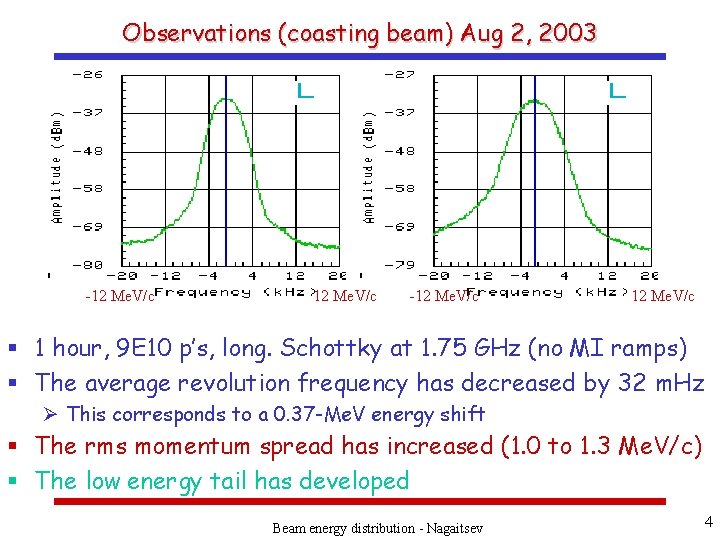
Observations (coasting beam) Aug 2, 2003 -12 Me. V/c § 1 hour, 9 E 10 p’s, long. Schottky at 1. 75 GHz (no MI ramps) § The average revolution frequency has decreased by 32 m. Hz Ø This corresponds to a 0. 37 -Me. V energy shift § The rms momentum spread has increased (1. 0 to 1. 3 Me. V/c) § The low energy tail has developed Beam energy distribution - Nagaitsev 4
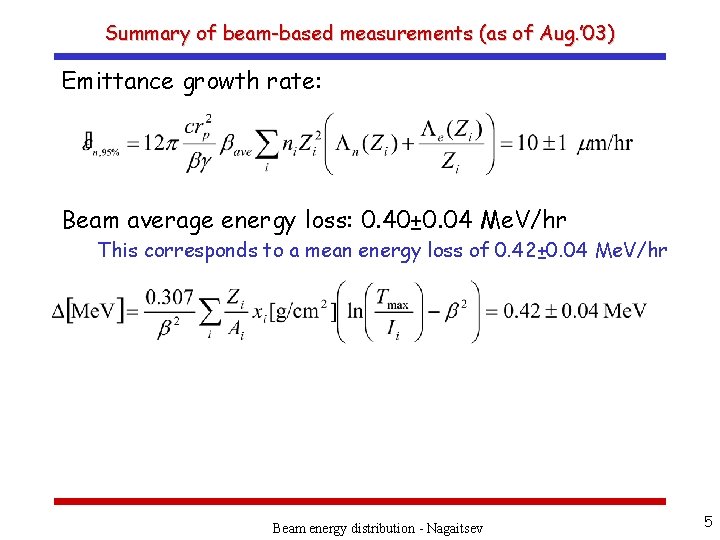
Summary of beam-based measurements (as of Aug. ’ 03) Emittance growth rate: Beam average energy loss: 0. 40± 0. 04 Me. V/hr This corresponds to a mean energy loss of 0. 42± 0. 04 Me. V/hr Beam energy distribution - Nagaitsev 5
Partial pressures model § Assume that the residual gas consists only of Z=1 and Z=8 atoms (H 2 and H 2 O) § Solving equations for 10± 1 μm/hr and 0. 42± 0. 04 Me. V results in: Ø p. H = 3. 3± 1. 7 x 10 -9 Torr Ø p. W = 1. 0± 0. 2 x 10 -9 Torr Beam energy distribution - Nagaitsev 6
Partial pressures model § Assume that the residual gas consists only of Z=1 and Z=8 atoms (H 2 and H 2 O) § Solving equations for 10± 1 μm/hr and 0. 42± 0. 04 Me. V results in: Ø p. H = 3. 3± 1. 7 x 10 -9 Torr Ø p. W = 1. 0± 0. 2 x 10 -9 Torr § If I assume that one of the gases is hydrogen with a know concentration n. H, and then try looking for another gas with a new Z (A = 2 Z), n. Z ≤ n. H, I am unable to find any solution unless p. H > 1. 5 x 10 -9 Torr and Z ~ 5. Beam energy distribution - Nagaitsev 7
Partial pressures model § Assume that the residual gas consists only of Z=1 and Z=8 atoms (H 2 and H 2 O) § Solving equations for 10± 1 μm/hr and 0. 42± 0. 04 Me. V results in: Ø p. H = 3. 3± 1. 7 x 10 -9 Torr Ø p. W = 1. 0± 0. 2 x 10 -9 Torr § “Water” alone contributes 8. 3 μm/hr to the emittance growth Beam energy distribution - Nagaitsev 8
Partial pressures model § Assume that the residual gas consists only of Z=1 and Z=8 atoms (H 2 and H 2 O) § Solving equations for 10± 1 μm/hr and 0. 42± 0. 04 Me. V results in: Ø p. H = 3. 3± 1. 7 x 10 -9 Torr Ø p. W = 1. 0± 0. 2 x 10 -9 Torr § “Water” alone contributes 8. 3 μm/hr to the emittance growth § Before Jan 2003 shutdown the measured emittance growth rate was 5 μm/hr. There were no beam energy loss measurements. § Present measurements are consistent with the “water” content doubled after the shutdown. Beam energy distribution - Nagaitsev 9
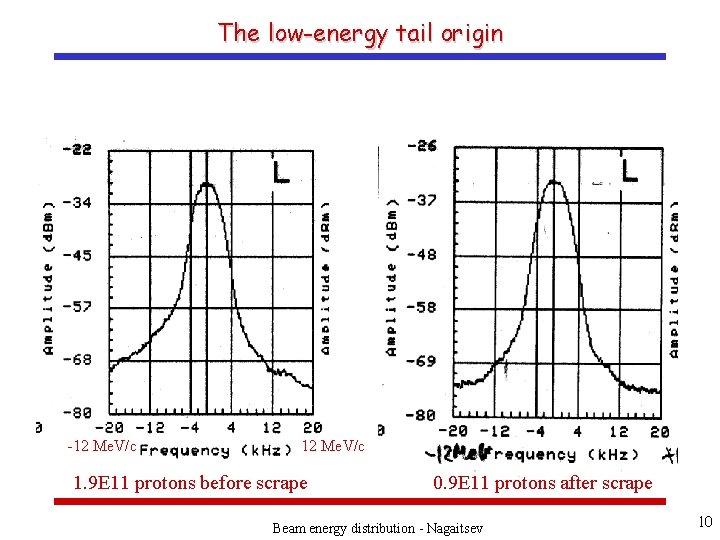
The low-energy tail origin -12 Me. V/c 1. 9 E 11 protons before scrape 0. 9 E 11 protons after scrape Beam energy distribution - Nagaitsev 10
The low-energy tail § The scrape was done with a horizontal scraper at a location with a horizontal beta-function of 52 m, zero dispersion (~20 cm) and with equal tunes. § The scraper was stopped 6. 2 mm away from the beam center, which corresponds to a 7 -μm acceptance, and then withdrawn. § How can one scrape the low energy tail at zerodispersion location? Beam energy distribution - Nagaitsev 11
The low-energy tail § The scrape was done with a horizontal scraper at a location with a horizontal beta-function of 52 m, zero dispersion (~20 cm) and with equal tunes. § The scraper was stopped 6. 2 mm away from the beam center, which corresponds to a 7 -μm acceptance, and then withdrawn. § How can one scrape the low energy tail at zerodispersion location? § The answer is: proton-electron collisions. Beam energy distribution - Nagaitsev 12
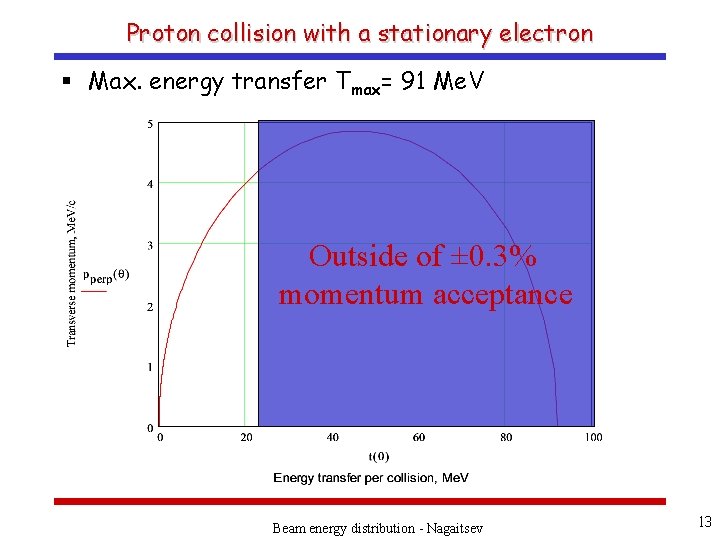
Proton collision with a stationary electron § Max. energy transfer Tmax= 91 Me. V Outside of ± 0. 3% momentum acceptance Beam energy distribution - Nagaitsev 13
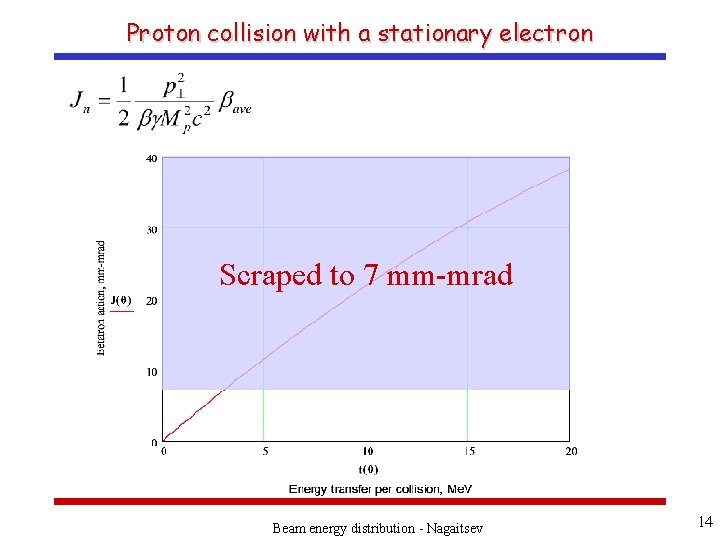
Proton collision with a stationary electron Scraped to 7 mm-mrad Beam energy distribution - Nagaitsev 14
- Slides: 14