
Evolution of adaptation mechanisms adaptation energy stress and

- Slides: 48
Evolution of adaptation mechanisms: adaptation “energy”, stress, and oscillating death Alexander Gorban University of Leicester
Plan • Selye’s “Adaptation energy” – the universal currency for adaptation; • Goldstone’s critics and development of Selye’s concept; • Factor-resource models; • Resource, reserve and oscillating death; • Adaptation of adaptation to many stressors: - under stress, both correlations and variance increase, - Liebig’s and anti-Liebig’s systems of factors, - Anticipating critical transition.
Selye’s “Adaptation energy” – the universal currency for adaptation (and the term was a political mistake of Selye because everybody asked him to demonstrate the physical nature of this “energy”; an abstract “adaptation resource” may be better)
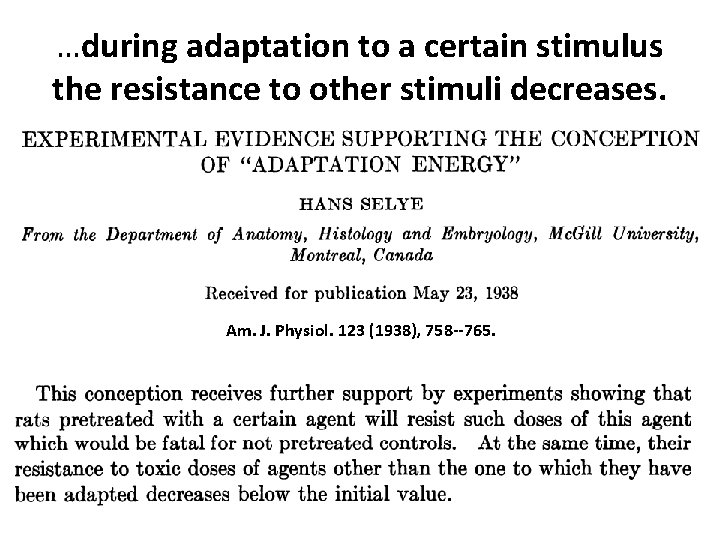
…during adaptation to a certain stimulus the resistance to other stimuli decreases. Am. J. Physiol. 123 (1938), 758 --765.
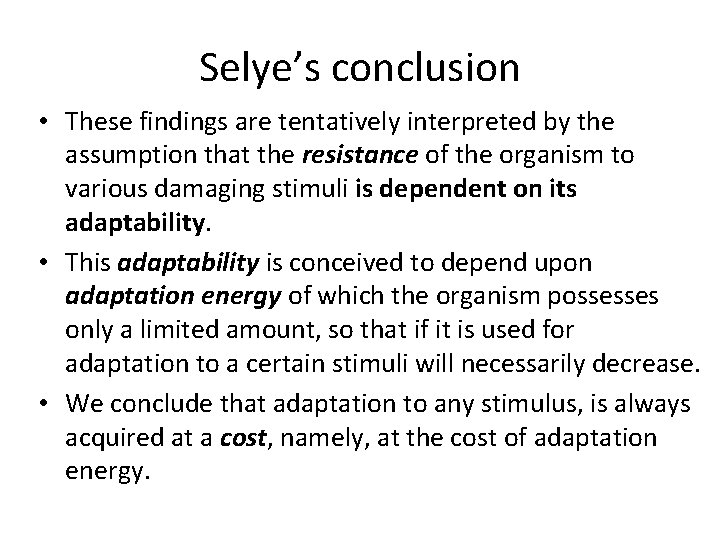
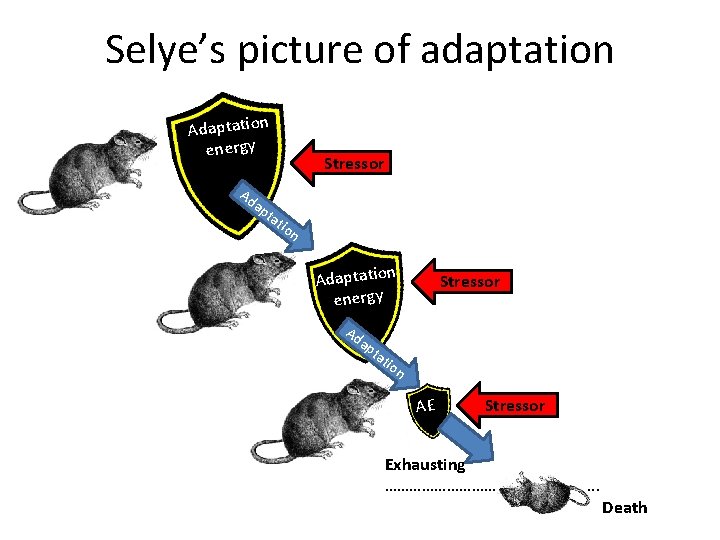
Selye’s conclusion • These findings are tentatively interpreted by the assumption that the resistance of the organism to various damaging stimuli is dependent on its adaptability. • This adaptability is conceived to depend upon adaptation energy of which the organism possesses only a limited amount, so that if it is used for adaptation to a certain stimuli will necessarily decrease. • We conclude that adaptation to any stimulus, is always acquired at a cost, namely, at the cost of adaptation energy.
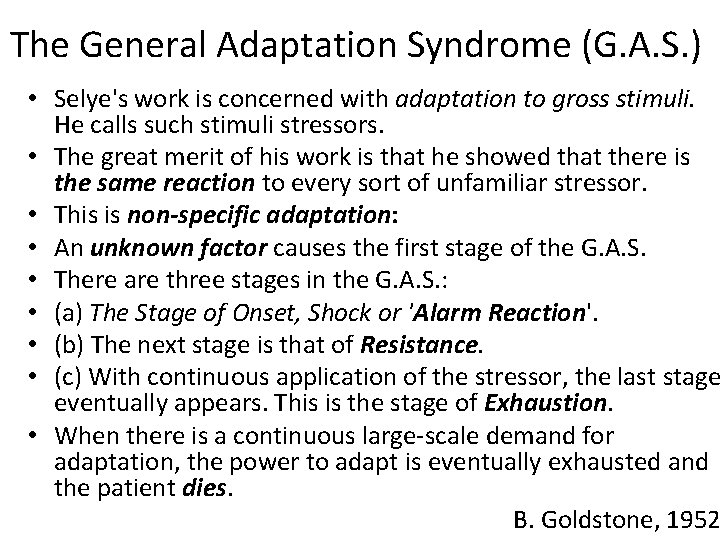
The General Adaptation Syndrome (G. A. S. ) • Selye's work is concerned with adaptation to gross stimuli. He calls such stimuli stressors. • The great merit of his work is that he showed that there is the same reaction to every sort of unfamiliar stressor. • This is non-specific adaptation: • An unknown factor causes the first stage of the G. A. S. • There are three stages in the G. A. S. : • (a) The Stage of Onset, Shock or 'Alarm Reaction'. • (b) The next stage is that of Resistance. • (c) With continuous application of the stressor, the last stage eventually appears. This is the stage of Exhaustion. • When there is a continuous large-scale demand for adaptation, the power to adapt is eventually exhausted and the patient dies. B. Goldstone, 1952
Goldstone’s critics and development of Selye’s concept
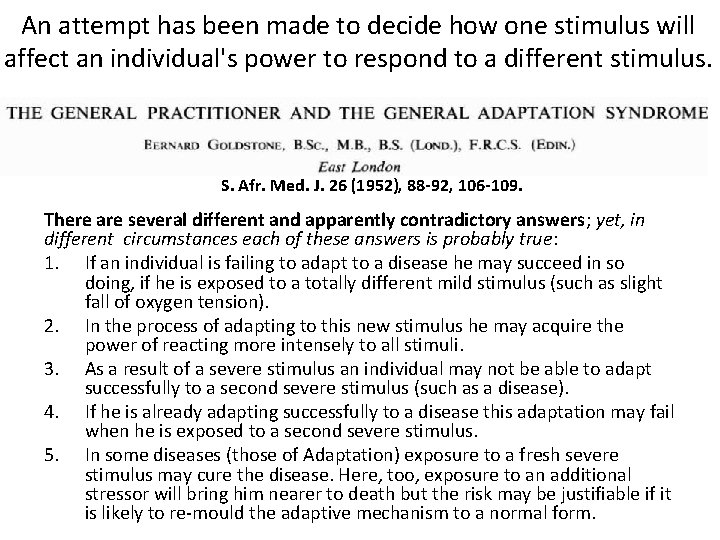
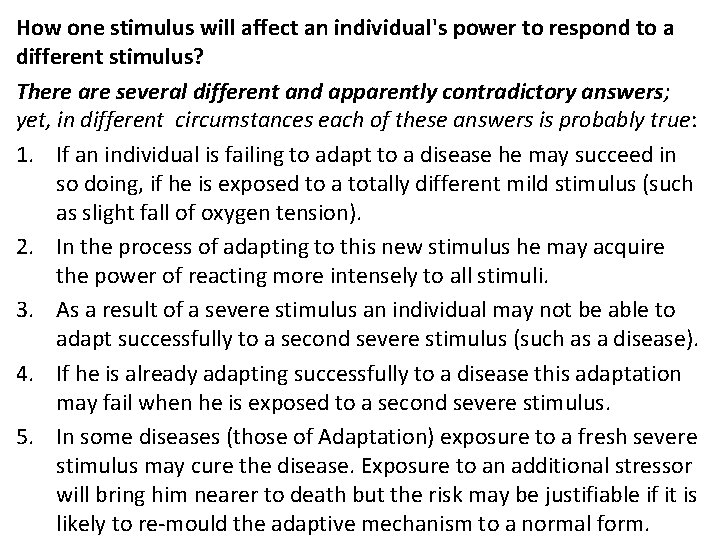
An attempt has been made to decide how one stimulus will affect an individual's power to respond to a different stimulus. S. Afr. Med. J. 26 (1952), 88 -92, 106 -109. There are several different and apparently contradictory answers; yet, in different circumstances each of these answers is probably true: 1. If an individual is failing to adapt to a disease he may succeed in so doing, if he is exposed to a totally different mild stimulus (such as slight fall of oxygen tension). 2. In the process of adapting to this new stimulus he may acquire the power of reacting more intensely to all stimuli. 3. As a result of a severe stimulus an individual may not be able to adapt successfully to a second severe stimulus (such as a disease). 4. If he is already adapting successfully to a disease this adaptation may fail when he is exposed to a second severe stimulus. 5. In some diseases (those of Adaptation) exposure to a fresh severe stimulus may cure the disease. Here, too, exposure to an additional stressor will bring him nearer to death but the risk may be justifiable if it is likely to re-mould the adaptive mechanism to a normal form.
How one stimulus will affect an individual's power to respond to a different stimulus? There are several different and apparently contradictory answers; yet, in different circumstances each of these answers is probably true: 1. If an individual is failing to adapt to a disease he may succeed in so doing, if he is exposed to a totally different mild stimulus (such as slight fall of oxygen tension). 2. In the process of adapting to this new stimulus he may acquire the power of reacting more intensely to all stimuli. 3. As a result of a severe stimulus an individual may not be able to adapt successfully to a second severe stimulus (such as a disease). 4. If he is already adapting successfully to a disease this adaptation may fail when he is exposed to a second severe stimulus. 5. In some diseases (those of Adaptation) exposure to a fresh severe stimulus may cure the disease. Exposure to an additional stressor will bring him nearer to death but the risk may be justifiable if it is likely to re-mould the adaptive mechanism to a normal form.
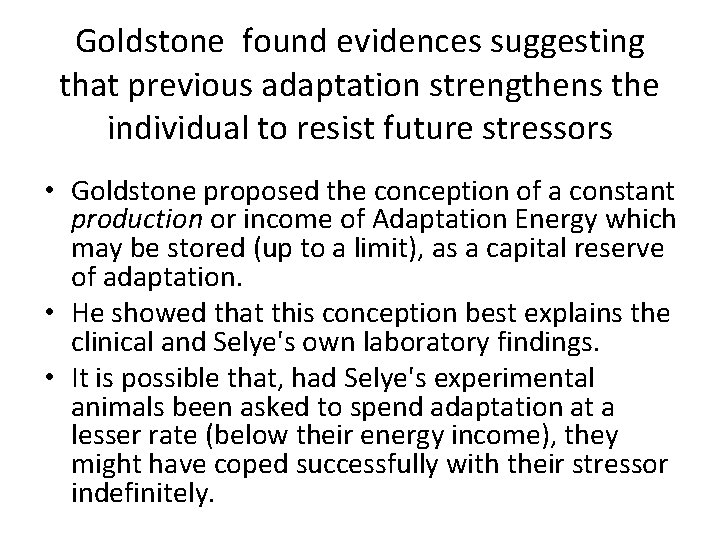
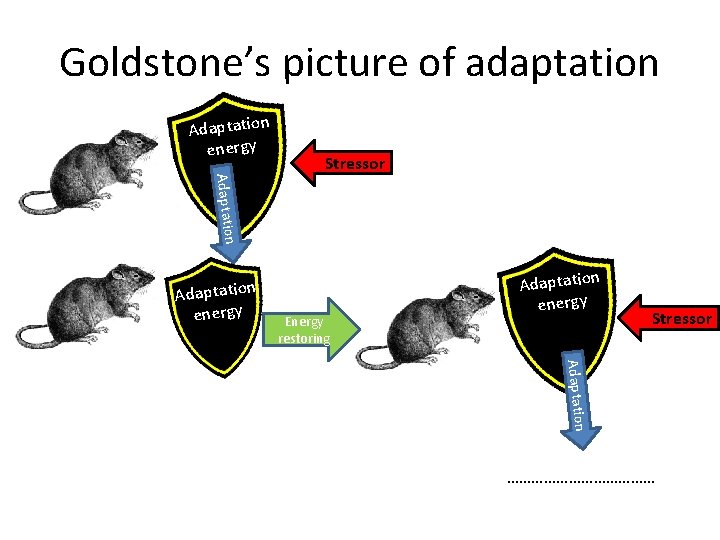
Goldstone found evidences suggesting that previous adaptation strengthens the individual to resist future stressors • Goldstone proposed the conception of a constant production or income of Adaptation Energy which may be stored (up to a limit), as a capital reserve of adaptation. • He showed that this conception best explains the clinical and Selye's own laboratory findings. • It is possible that, had Selye's experimental animals been asked to spend adaptation at a lesser rate (below their energy income), they might have coped successfully with their stressor indefinitely.
Selye’s picture of adaptation Adaptation energy Ad ap ta Stressor tio n AE Stressor Exhausting ………………………. Death
Goldstone’s picture of adaptation Adaptation energy Stressor n Adaptation energy Energy restoring Adaptation energy Stressor Adaptation ………………
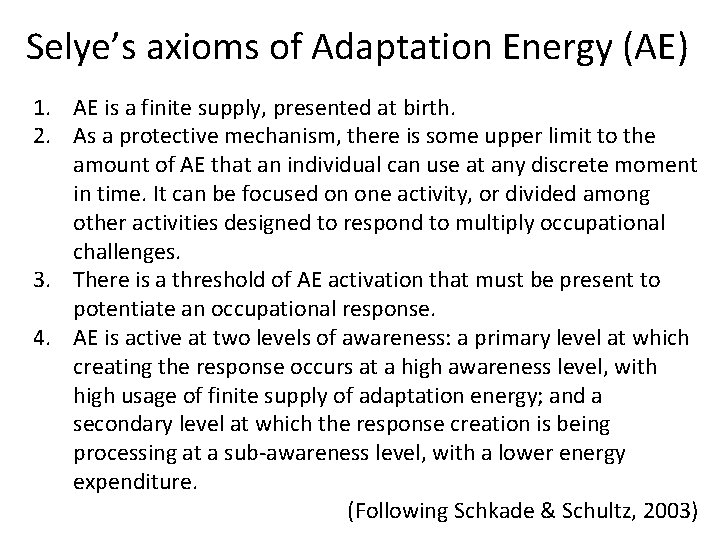
Selye’s axioms of Adaptation Energy (AE) 1. AE is a finite supply, presented at birth. 2. As a protective mechanism, there is some upper limit to the amount of AE that an individual can use at any discrete moment in time. It can be focused on one activity, or divided among other activities designed to respond to multiply occupational challenges. 3. There is a threshold of AE activation that must be present to potentiate an occupational response. 4. AE is active at two levels of awareness: a primary level at which creating the response occurs at a high awareness level, with high usage of finite supply of adaptation energy; and a secondary level at which the response creation is being processing at a sub-awareness level, with a lower energy expenditure. (Following Schkade & Schultz, 2003)
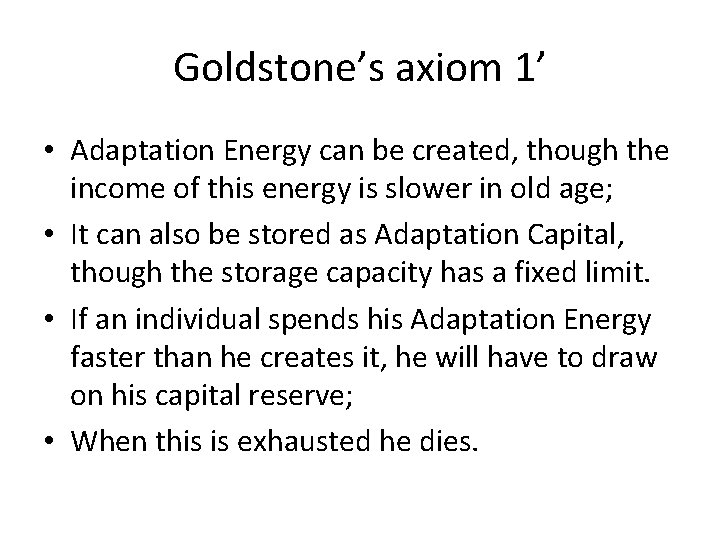
Goldstone’s axiom 1’ • Adaptation Energy can be created, though the income of this energy is slower in old age; • It can also be stored as Adaptation Capital, though the storage capacity has a fixed limit. • If an individual spends his Adaptation Energy faster than he creates it, he will have to draw on his capital reserve; • When this is exhausted he dies.
Factor-resource models We try to formalize the findings of physiologists in simple models
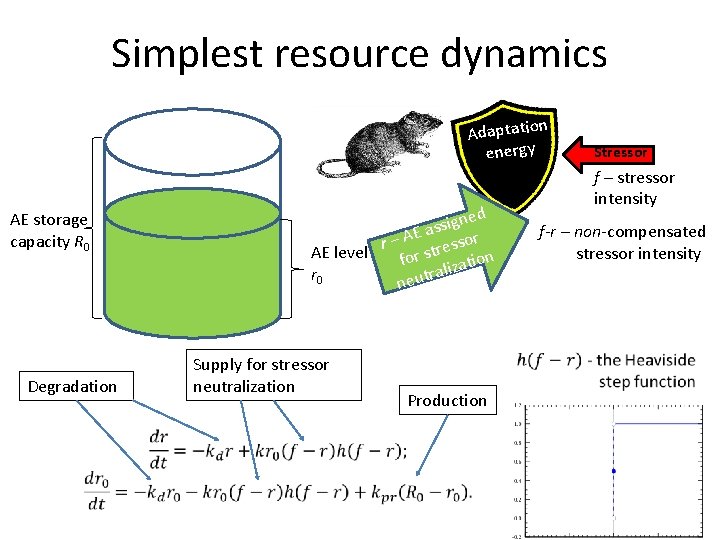
Simplest resource dynamics Adaptation energy AE storage capacity R 0 Degradation f – stressor intensity ed n g i s E as or A – r ress n t AE level s r fo atio z i l a r r 0 neut Supply for stressor neutralization f-r – non-compensated stressor intensity Production Stressor
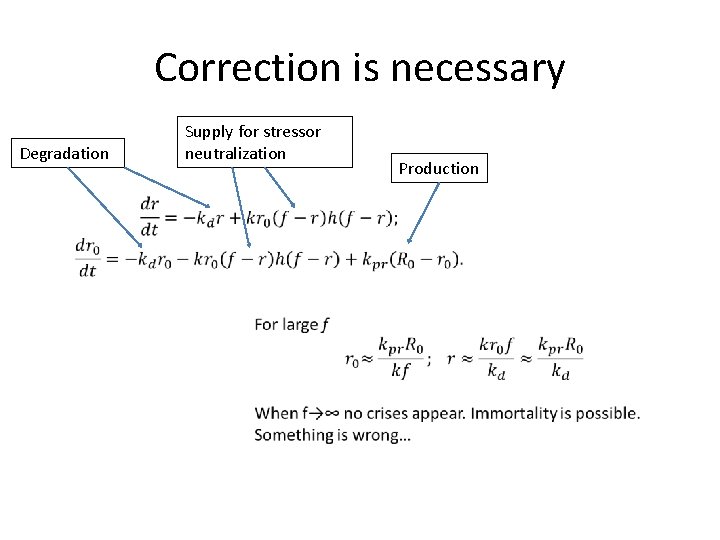
Correction is necessary Degradation Supply for stressor neutralization Production
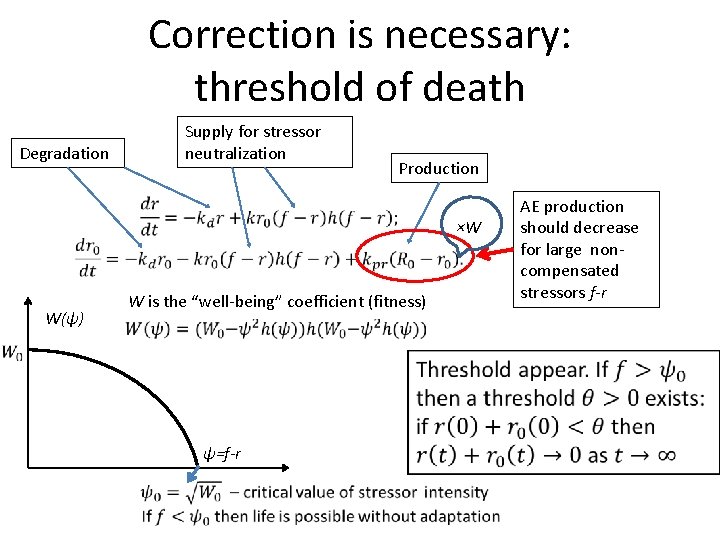
Correction is necessary: threshold of death Supply for stressor neutralization Degradation Production W(ψ) ×W W is the “well-being” coefficient (fitness) ψ=f-r AE production should decrease for large noncompensated stressors f-r
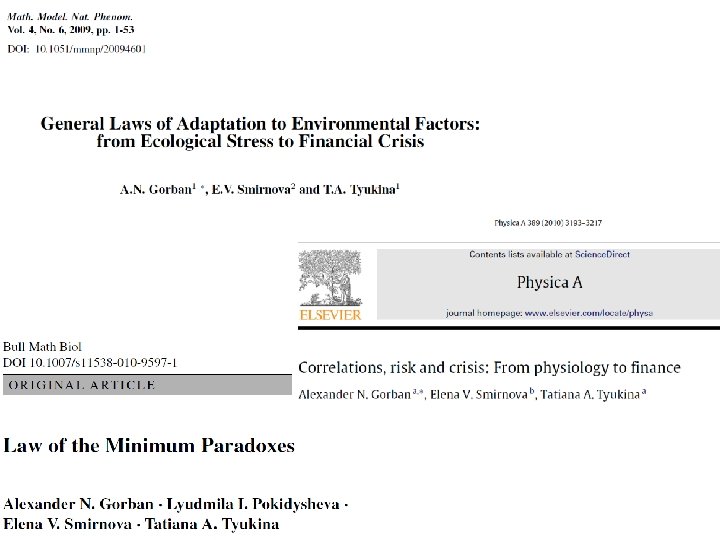
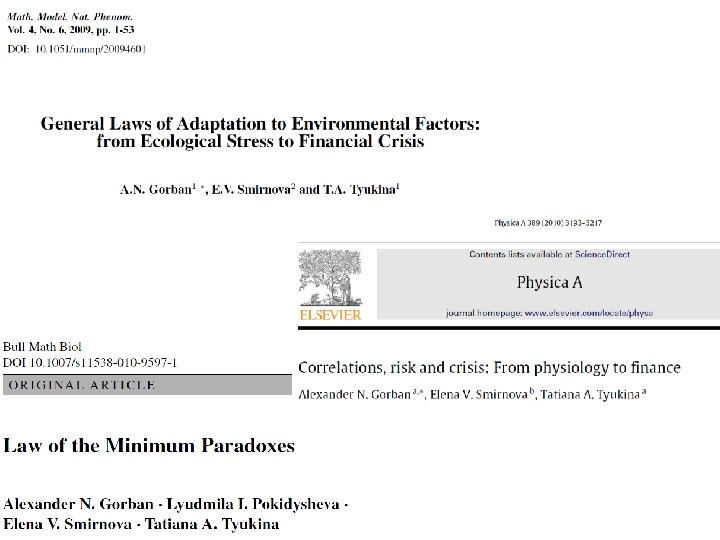
Some generalizations are published in • A. N. Gorban, E. V. Smirnova, T. A. Tyukina, General Laws of Adaptation to Environmental Factors: from Ecological Stress to Financial Crisis. Math. Model. Nat. Phenom. Vol. 4, No. 6, 2009, pp. 1 -53. • A. N. Gorban, E. V. Smirnova, T. A. Tyukina, Correlations, risk and crisis: From physiology to finance, Physica A, Vol. 389, Issue 16, 2010, 3193 -3217. • A. N. Gorban, L. I. Pokidysheva, ·E, V. Smirnova, T. A. Tyukina. Law of the Minimum Paradoxes, Bull Math Biol 73(9) (2011), 2013 -2044.
Resource & reserve
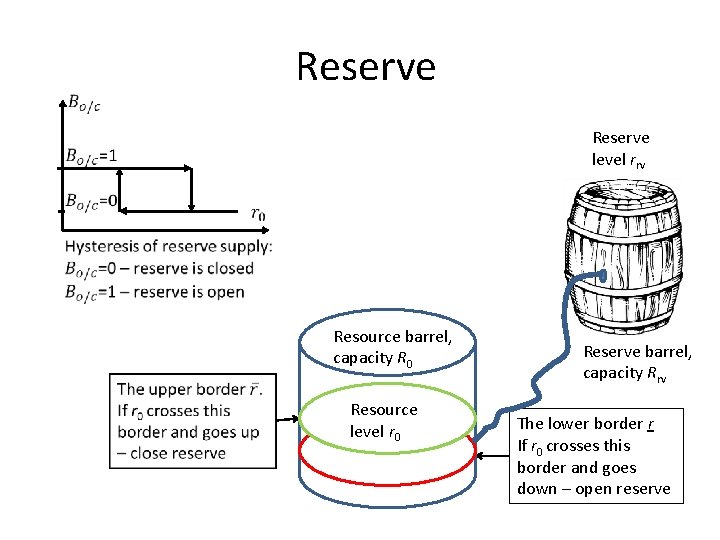
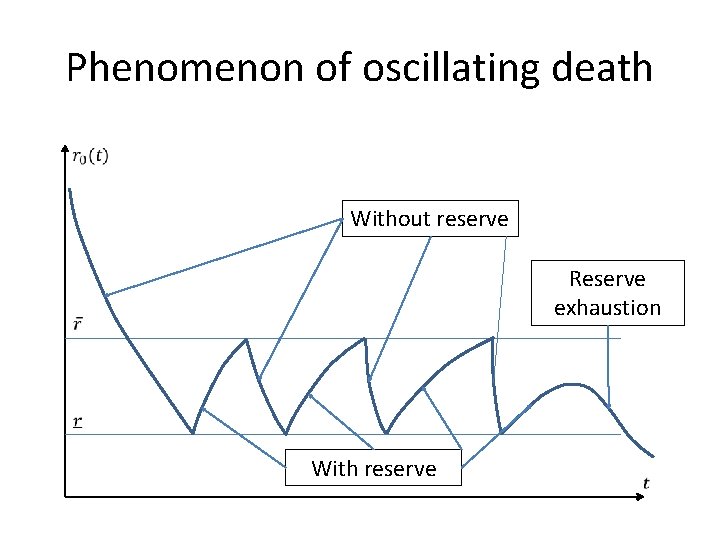
Reserve level rrv Resource barrel, capacity R 0 Resource level r 0 Reserve barrel, capacity Rrv The lower border r If r 0 crosses this border and goes down – open reserve
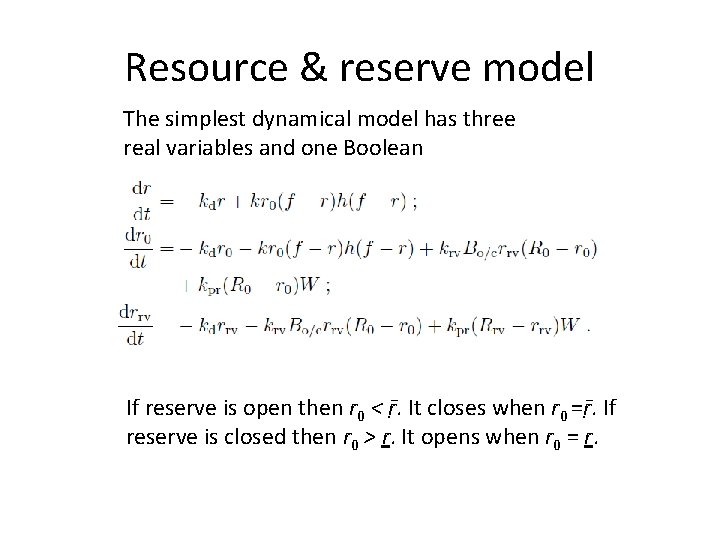
Resource & reserve model The simplest dynamical model has three real variables and one Boolean If reserve is open then r 0 < ṝ. It closes when r 0 =ṝ. If reserve is closed then r 0 > r. It opens when r 0 = r.
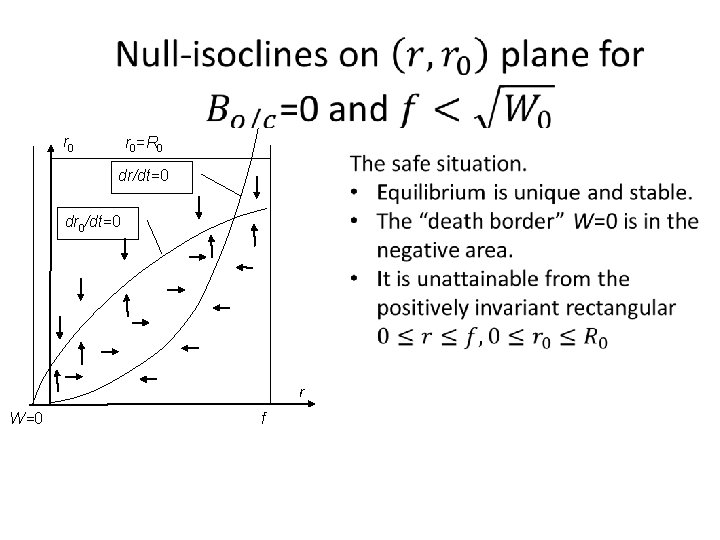
r 0=R 0 dr/dt=0 dr 0/dt=0 r W=0 f
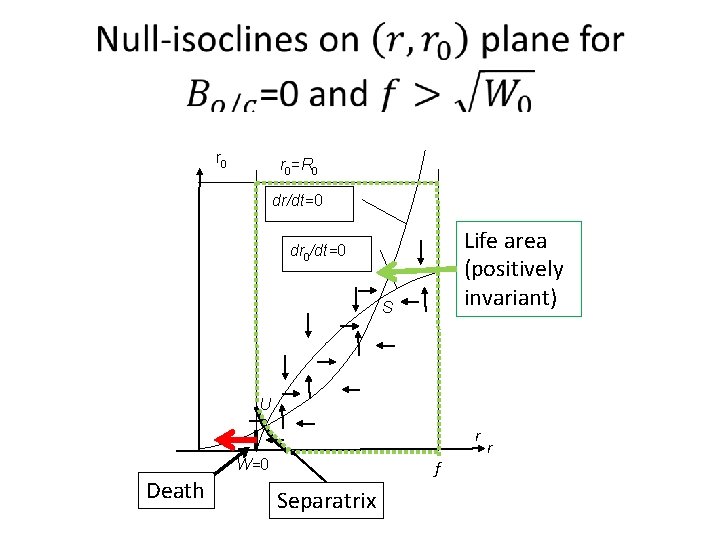
r 0=R 0 dr/dt=0 Life area (positively invariant) dr 0/dt=0 S U r W=0 Death f Separatrix r
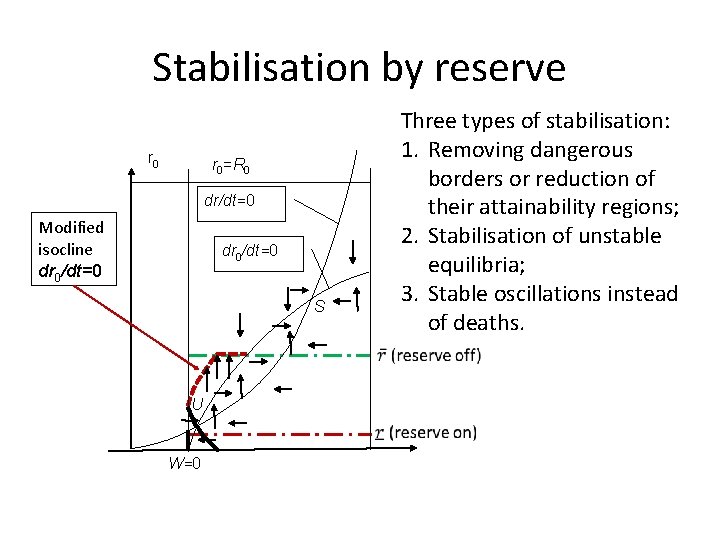
Stabilisation by reserve r 0 Three types of stabilisation: 1. Removing dangerous borders or reduction of their attainability regions; 2. Stabilisation of unstable equilibria; 3. Stable oscillations instead of deaths. r 0=R 0 dr/dt=0 Modified isocline dr 0/dt=0 S U W=0
Oscillating death
Phenomenon of oscillating death Without reserve Reserve exhaustion With reserve
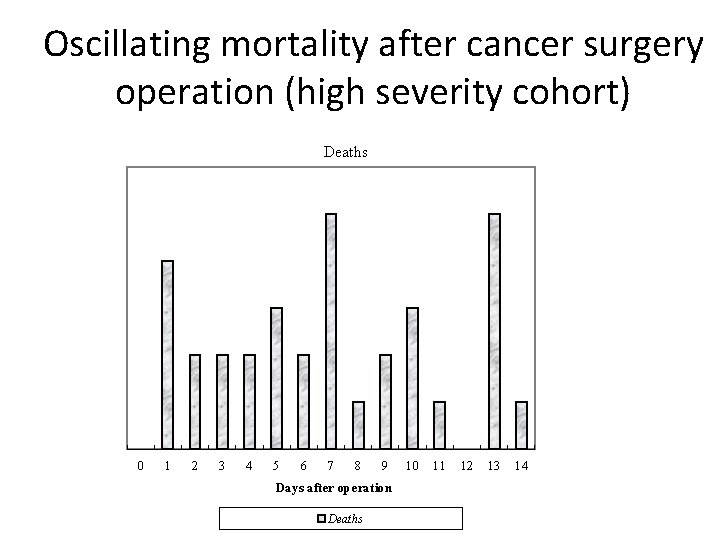
Oscillating mortality after cancer surgery operation (high severity cohort) Deaths 0 1 2 3 4 5 6 7 8 9 Days after operation Deaths 10 11 12 13 14
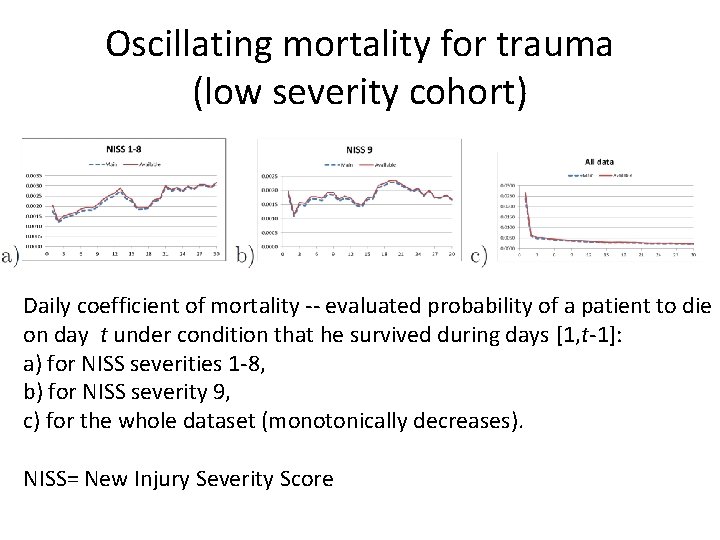
Oscillating mortality for trauma (low severity cohort) Daily coefficient of mortality -- evaluated probability of a patient to die on day t under condition that he survived during days [1, t-1]: a) for NISS severities 1 -8, b) for NISS severity 9, c) for the whole dataset (monotonically decreases). NISS= New Injury Severity Score
Distribution of adaptation resource for neutralization of several factors (Adaptation of adaptation to many stressors)
Definition of deep questions: A question is deep if it allows at least two answers which are true but contradict each other. (Scientific folklore)
Multidimensional adaptive systems under load of many factors: do they become more or less similar under stress? Both answers are correct simultaneously: 1. They become more similar because stress! 2. They become less similar because stress! This is a deep question. How it may occur? See the next slide
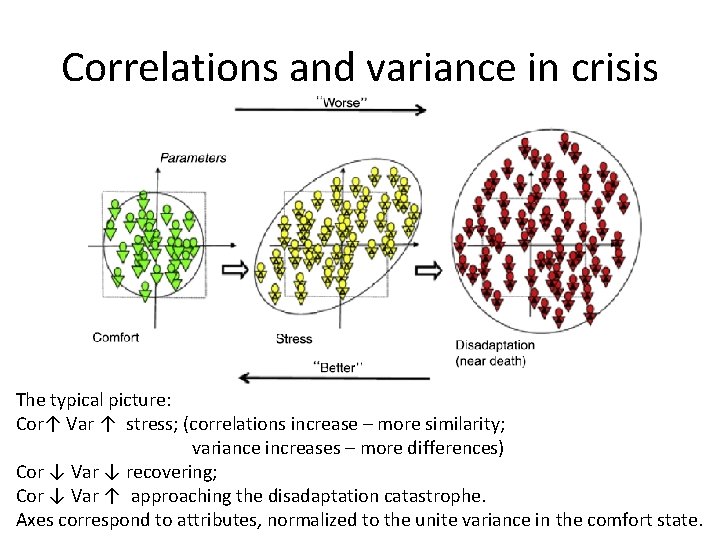
Correlations and variance in crisis The typical picture: Cor↑ Var ↑ stress; (correlations increase – more similarity; variance increases – more differences) Cor ↓ Var ↓ recovering; Cor ↓ Var ↑ approaching the disadaptation catastrophe. Axes correspond to attributes, normalized to the unite variance in the comfort state.
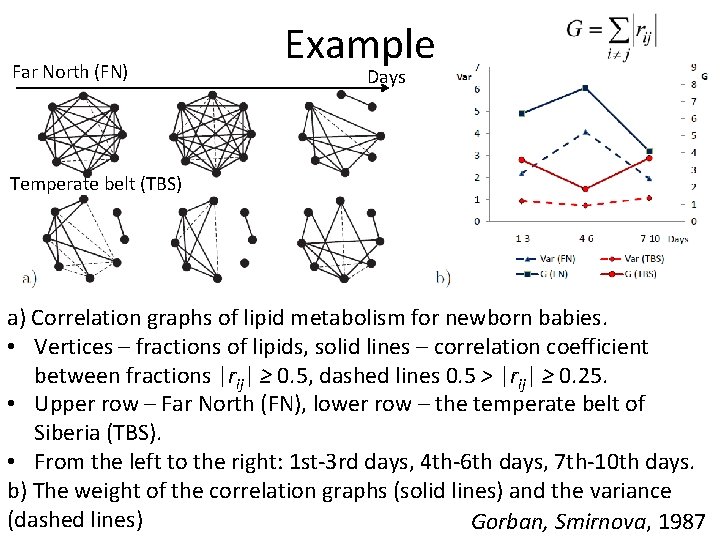
Far North (FN) Example Days Temperate belt (TBS) a) Correlation graphs of lipid metabolism for newborn babies. • Vertices – fractions of lipids, solid lines – correlation coefficient between fractions |rij| ≥ 0. 5, dashed lines 0. 5 > |rij| ≥ 0. 25. • Upper row – Far North (FN), lower row – the temperate belt of Siberia (TBS). • From the left to the right: 1 st-3 rd days, 4 th-6 th days, 7 th-10 th days. b) The weight of the correlation graphs (solid lines) and the variance (dashed lines) Gorban, Smirnova, 1987
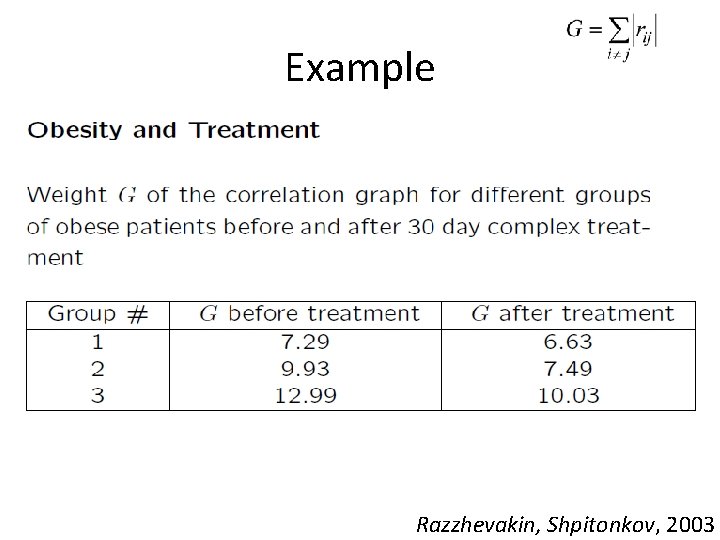
Example Razzhevakin, Shpitonkov, 2003
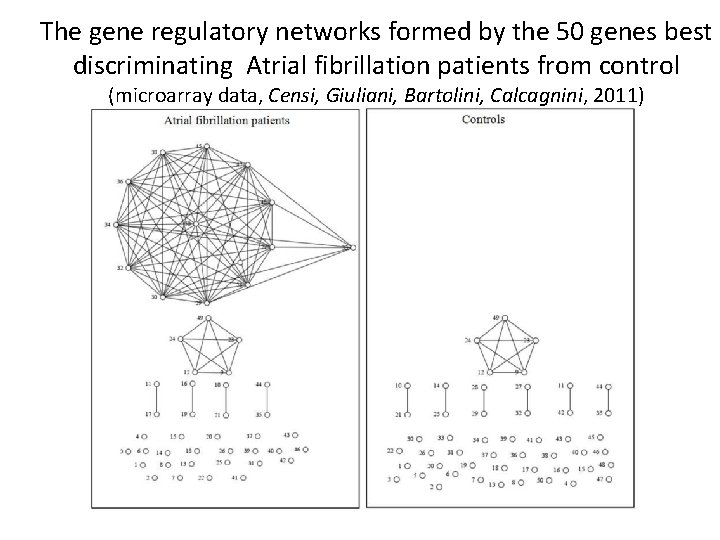
The gene regulatory networks formed by the 50 genes best discriminating Atrial fibrillation patients from control (microarray data, Censi, Giuliani, Bartolini, Calcagnini, 2011)
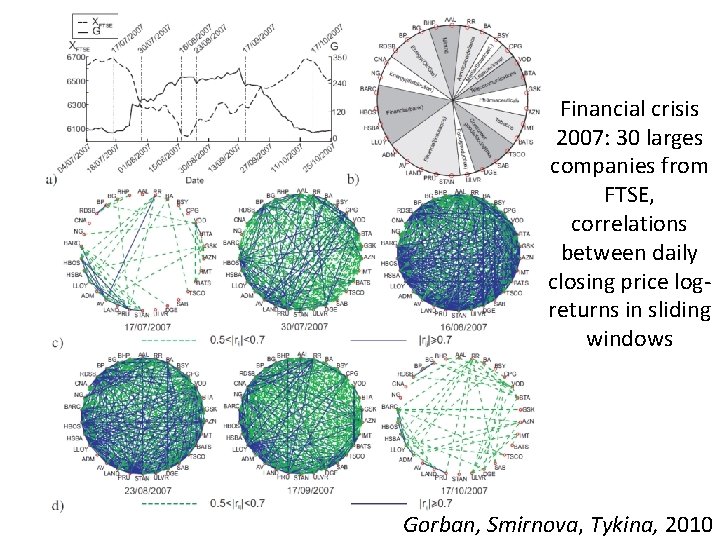
Financial crisis 2007: 30 larges companies from FTSE, correlations between daily closing price logreturns in sliding windows Gorban, Smirnova, Tykina, 2010
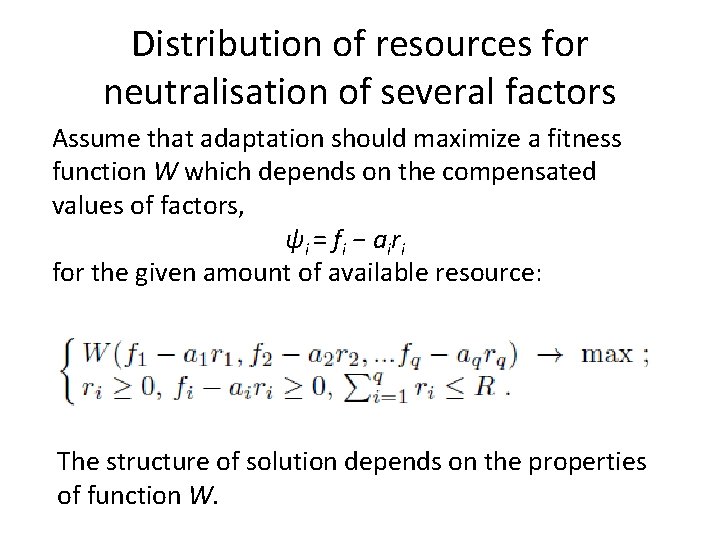
Distribution of resources for neutralisation of several factors Assume that adaptation should maximize a fitness function W which depends on the compensated values of factors, ψi = fi − airi for the given amount of available resource: The structure of solution depends on the properties of function W.
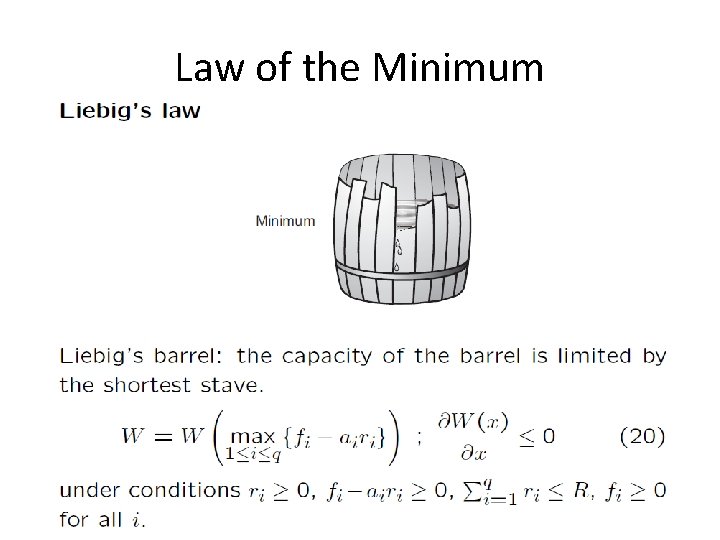
Law of the Minimum
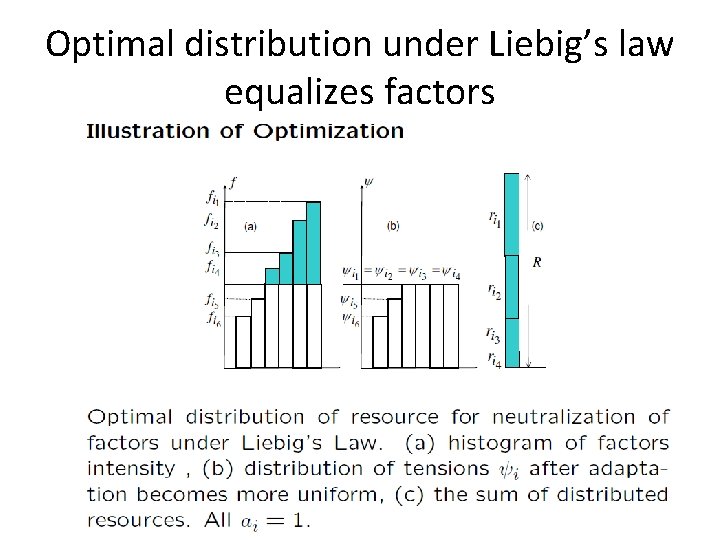
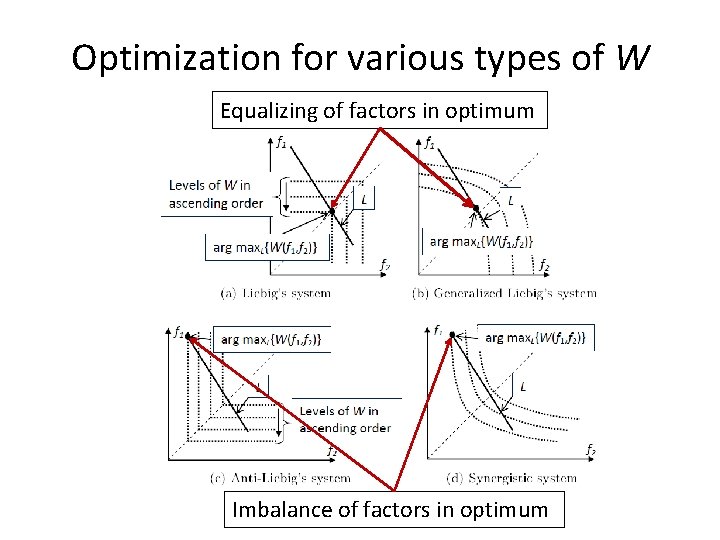
Optimal distribution under Liebig’s law equalizes factors
Thus, • If the system satisfies the Law of the Minimum, then the adaptation process makes the tension produced by different factors more uniform. • Adaptation decreases the effect from the limiting factor and hides manifestations of the Law of the Minimum. • The Law of the Minimum paradox is a theorem: if the Law of the Minimum is true then microevolution, ecological succession, phenotype modifications, and adaptation decrease the role of the limiting factors and bring the tension produced by different factors together. • The cooper starts to repair Liebig’s barrel from the shortest stave and after reparation the staves are more uniform than they were before. • After adaptation, the factors become equally important and the dimension of the “data cloud” increases but its variance decreases.
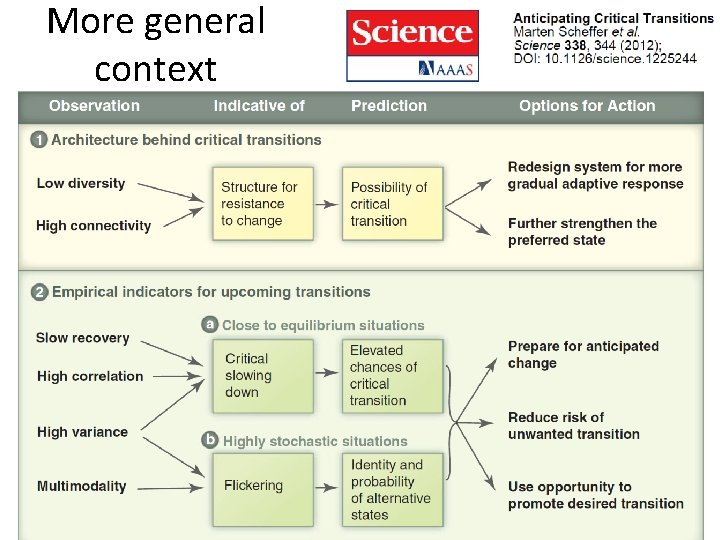
Supported by thousands of observations • In crisis, typically, even before obvious symptoms of crisis appear, the correlations increase, and, at the same time, variance (volatility) increases too. • After the crisis achieves its bottom, it can develop into two directions: recovering (both correlations and variance decrease) or fatal catastrophe (correlations decrease, but variance continue to increase). We should guess that the real organisation of the systems of factors is not very far from Liebig’s law. But other types of functions are also possible – next slide.
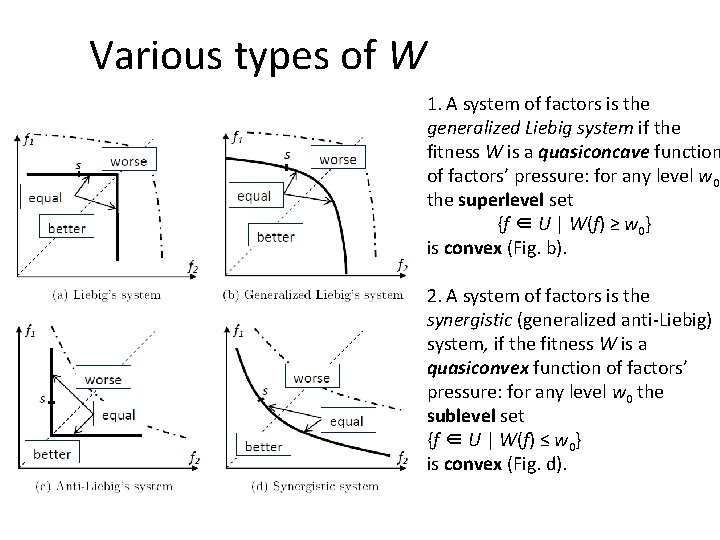
Various types of W 1. A system of factors is the generalized Liebig system if the fitness W is a quasiconcave function of factors’ pressure: for any level w 0 the superlevel set {f ∈ U | W(f) ≥ w 0} is convex (Fig. b). 2. A system of factors is the synergistic (generalized anti-Liebig) system, if the fitness W is a quasiconvex function of factors’ pressure: for any level w 0 the sublevel set {f ∈ U | W(f) ≤ w 0} is convex (Fig. d).
Optimization for various types of W Equalizing of factors in optimum Imbalance of factors in optimum
More general context
Several references • A. N. Gorban, V. T. Manchuk, E. V. Smirnova. Dynamics of physiological parameters correlations and the ecological-evolutionary principle of polyfactoriality. The Problems of Ecological Monitoring and Ecosystem Modelling, V. 10 (1987), 187– 198. • K. R. Sedov, A. N. Gorban, E. V. Smirnova, V. T. Manchuk, E. N. Shalamova. Correlation adaptometry as a method of screening of the population. Vestn. Akad Med Nauk SSSR, 10 (1988), 69– 75. • F. Longin, B. Solnik. Is the correlation in international equity returns constant: 1960 -1990? J. Internat. Money and Finance, 14, No. 1 (1995), 3– 26. • R. N. Mantegna, H. E. Stanley. An introduction to econophysics: correlations and complexity in finance. Cambridge University Press, Cambridge, 1999. • M. Scheffer, et al. Anticipating critical transitions. Science 338, no. 6105 (2012), 344 -348.