
Evolution n Is fundamentally a genetic process n

- Slides: 22
Evolution n Is fundamentally, a genetic process n Written in the genetic code of species alive today n Story of life on earth is the story of the molecule of life---DNA---and the various ways in which it manifests itself, in the form of living species in order to survive
Processes that produce, maintain or redistribute variation in a population 1. Recombination (sexual reproduction) 2. Natural selection 3. Mutation 4. Gene Flow 5. Genetic Drift
Natural Selection n Sorts out certain variations n Favorable traits increase while unfavorable traits decrease in the population n The environment (nature) determines which traits are favorable Example: Peppered Moths of England
Important Points of Moth Example n Trait must be inheritable (passed on to succeeding generations) n Through sexual reproduction n Variation must already exist n Two varieties of moths (spotted & dark gray) n Importance of reproductive success (“survival of the fittest”) n Moths w/advantageous coloring survived predation, reproduced & passed on their genes for coloring, which affected the composition of the population n Adaptation = resulting from natural selection; ability of a population to survive & reproduce w/in their environment
Natural Selection n Selection is a process by which genes that produce better adaptations become more frequent over time n Does NOT always lead to production of new species
What is a species? n A group of interbreeding populations that is reproductively isolated from other such groups n Speciation = the production of new species
What causes speciation? n Reproductive isolating mechanisms = barriers that prevent interbreeding Can be physical or behavioral (example: Galapagos finches) n http: //media. pearsoncmg. com/ph/hss/shared_ hss_assets/anthropology/mal_animations/new/ animations/05_02 t. html n Can be pre-mating or post-mating barrier n n Continued adaptation to specific environmental conditions
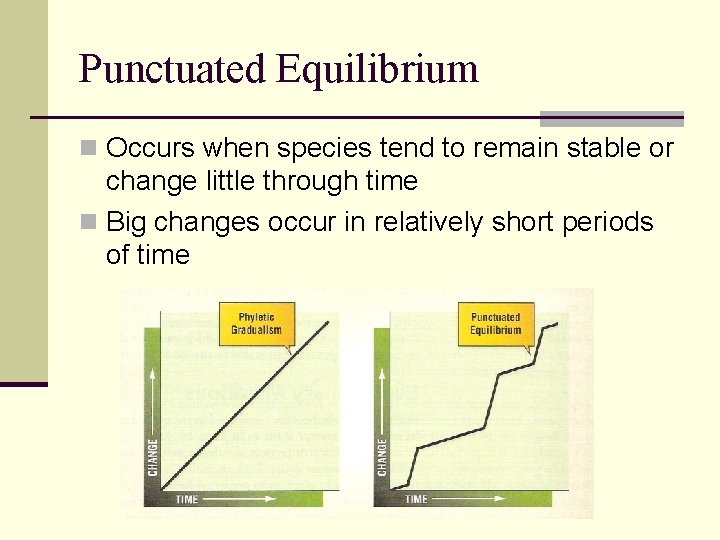
The Pace of Evolution n Natural Selection is a gradual process n Different characteristics evolve at different rates (mosaic evolution); produces transitional forms
Punctuated Equilibrium n Occurs when species tend to remain stable or change little through time n Big changes occur in relatively short periods of time
Evolutionary Radiation n Many distinct lineages diverge from a common ancestor within a short time n Occur w/evolution of a new adaptation that provides access to new resources or a new way of life, or when other species become extinct; occupation of new ecological niches
Mutation n A mistake or error in the copying process during cell division and DNA replication n Not always harmful; may be neutral or beneficial (ex: Lactase persistence) n Is the only source of NEW variation
Importance of Mutations, cont. n Different types of genes that control phenotype: Structural and Control Genes n Control genes – act as “master switches” that turn strings of structural genes on and off Can radically alter body plan/function n Can show up in a single generation n Coupled w/environmental change (epigenetic), can lead to dramatic evolutionary changes Evolving switches n
Definition of Evolution n A change in gene frequency (or the frequency of alleles) in a population over time
How do allele frequencies change? n Sexual selection n Gene flow n Genetic drift
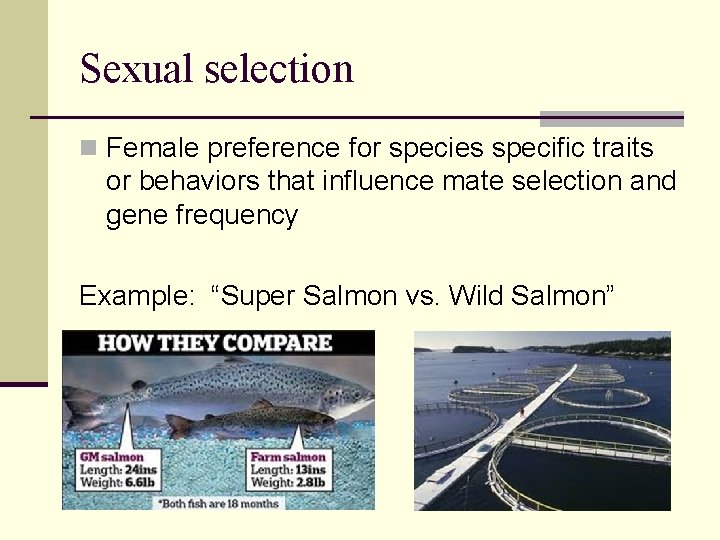
Sexual selection n Female preference for species specific traits or behaviors that influence mate selection and gene frequency Example: “Super Salmon vs. Wild Salmon”
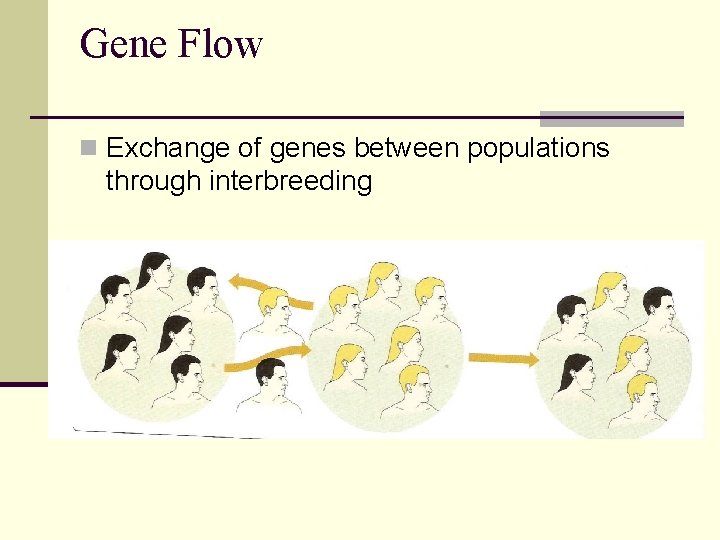
Gene Flow n Exchange of genes between populations through interbreeding
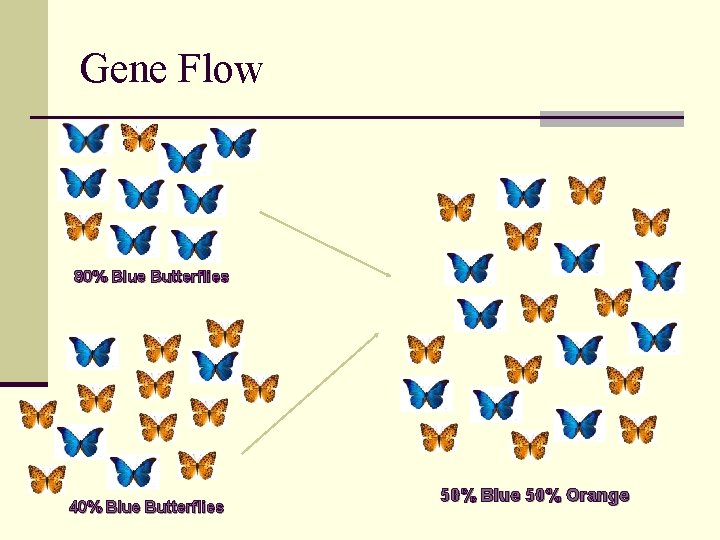
Gene Flow 80% Blue Butterflies 40% Blue Butterflies 50% Blue 50% Orange
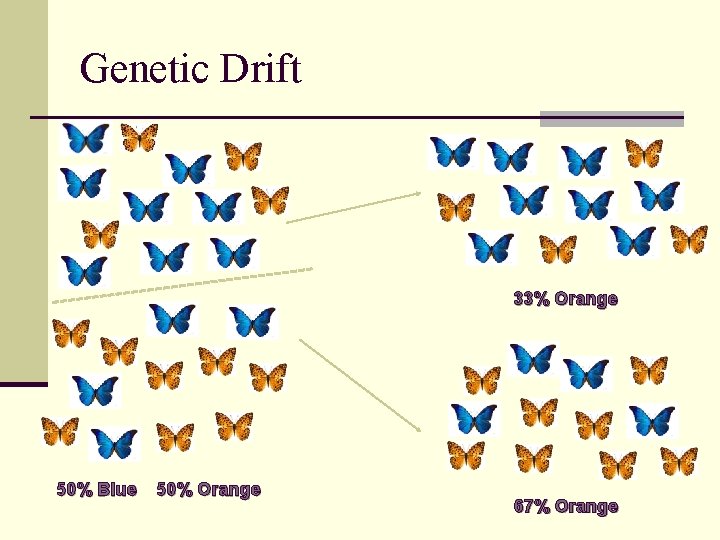
Genetic drift n Random splitting of a population (Fission) n New population has different allele frequencies from that of the original population n Founder Effect – creates concentration of alleles (genetic bottleneck) n http: //media. pearsoncmg. com/ph/hss/shared_ hss_assets/anthropology/mal_animations/ne w/animations/05_05. html
Genetic Drift 33% Orange 50% Blue 50% Orange 67% Orange
In Sum n Evolution is a process 1. 2. 3. 4. The production and redistribution of variation (inherited differences between individuals) Recombination, gene flow and genetic drift “reshuffle” the genetic variation Mutations create new genotypes & phenotypes Natural selection acts on these sources of variation (differences between individuals)
Cancer’s Wandering Gene: Examples of Gene Flow, Genetic Drift & Mutation n How did the BRCA-1 gene arrive in the New World? Mutation originated 2, 500 years ago. “Founder” came from a population of Sephardic Jews in Spain who converted to Catholicism & migrated to New World, linking Hispanic population in New Mexico & Colorado to Jewish ancestry What does the BRCA-1 gene ordinarily do? n It is a tumor suppressor gene What was the mutation that happened? n A missing A & G (chemical bases of DNA molecule) on ONE copy of the chromosome Why did the “founder” who had the mutation survive? n Founder was protected by the working copy of the gene Why is the BRCA-1 gene so deadly? n It is a dominant allele n The dominant copy will override the healthy allele at some point n Most common & deadly single-gene disease identified in any population n n
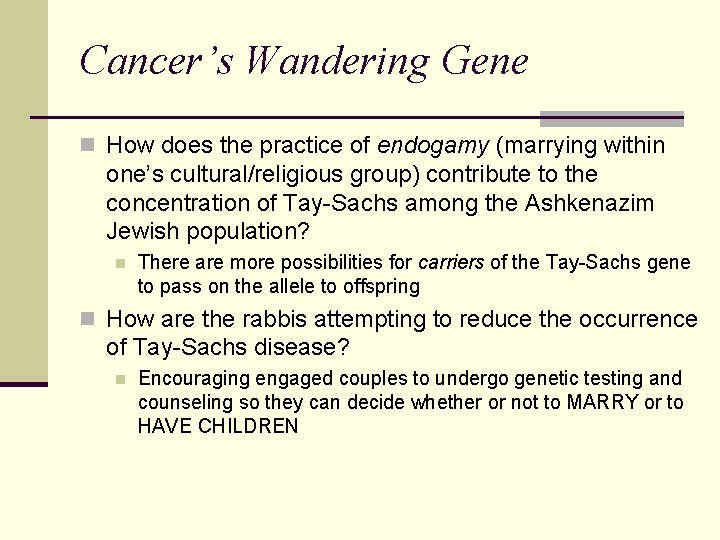
Cancer’s Wandering Gene n How does the practice of endogamy (marrying within one’s cultural/religious group) contribute to the concentration of Tay-Sachs among the Ashkenazim Jewish population? n There are more possibilities for carriers of the Tay-Sachs gene to pass on the allele to offspring n How are the rabbis attempting to reduce the occurrence of Tay-Sachs disease? n Encouraging engaged couples to undergo genetic testing and counseling so they can decide whether or not to MARRY or to HAVE CHILDREN