
Evolution Mechanisms of Animal Behavior Week 2 Foundations
Evolution & Mechanisms of Animal Behavior Week 2 Foundations of Animal Behavior Emily Levy Some slides adapted from Susan Alberts
Evolution & Natural Selection: Mechanisms Evolution & Natural Selection: Evolutionary thinking Outline Discussion: the Adaptationist programme Case study: Infanticide & feticide in baboons Mechanisms of animal behavior Putting it all together: Maternal density and offspring growth & hormones
Understand how natural selection works Understand evolutionary thinking and articulate evolutionary theories about behavior (ie, how natural selection can shape behavior) Outcomes Be able to explain why not all behaviors evolved via natural selection (adaptationist programme) Understand, on a basic level, the mechanisms that can drive behaviors Give some examples Generate a hypothesis about underlying mechanisms
https: //www. youtube. com/watch? v=PQb. Scg 3 r 1 o. Q
‘Nothing in biology makes sense except in the light of evolution’ Dobzhansky, 1973 Why do we need evolution to study animal behavior?
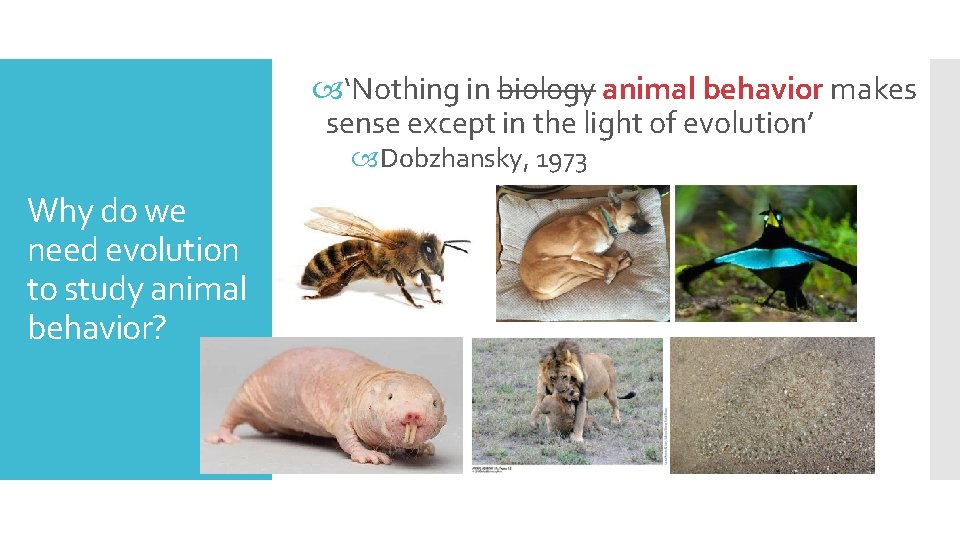
‘Nothing in biology animal behavior makes sense except in the light of evolution’ Dobzhansky, 1973 Why do we need evolution to study animal behavior?
Evolution & Natural Selection: Mechanisms How does natural selection actually happen, and how do behaviors evolve?
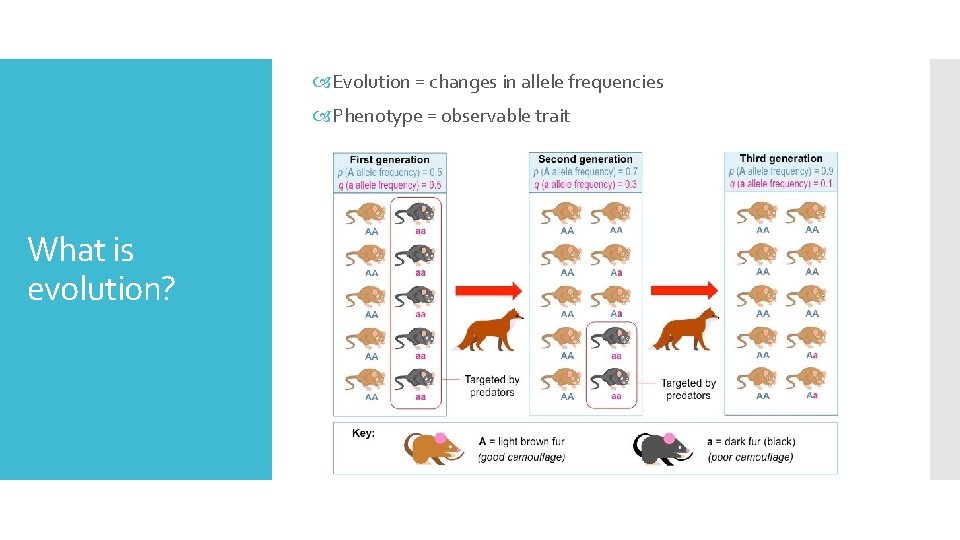
Evolution = changes in allele frequencies Phenotype = observable trait What is evolution?
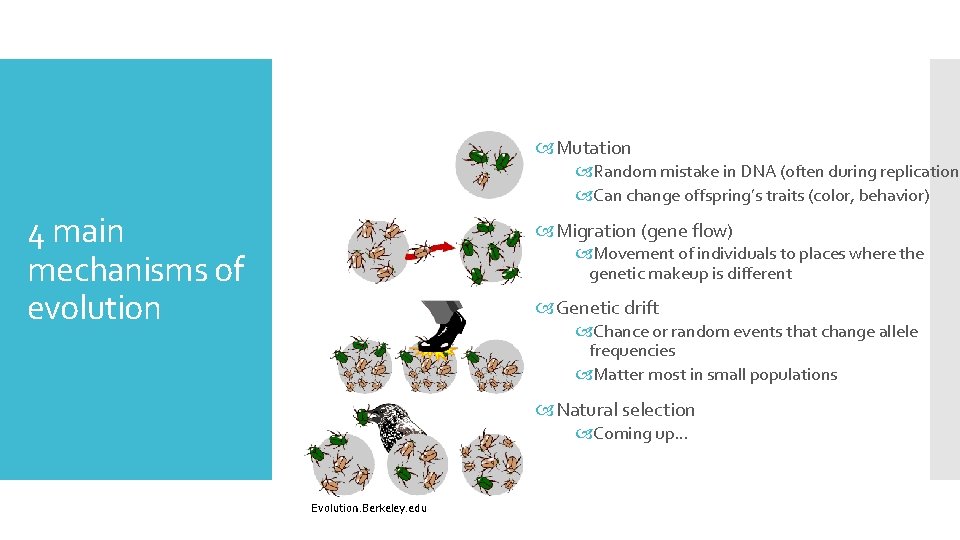
Mutation Random mistake in DNA (often during replication) Can change offspring’s traits (color, behavior) 4 main mechanisms of evolution Migration (gene flow) Movement of individuals to places where the genetic makeup is different Genetic drift Chance or random events that change allele frequencies Matter most in small populations Natural selection Coming up… Evolution. Berkeley. edu
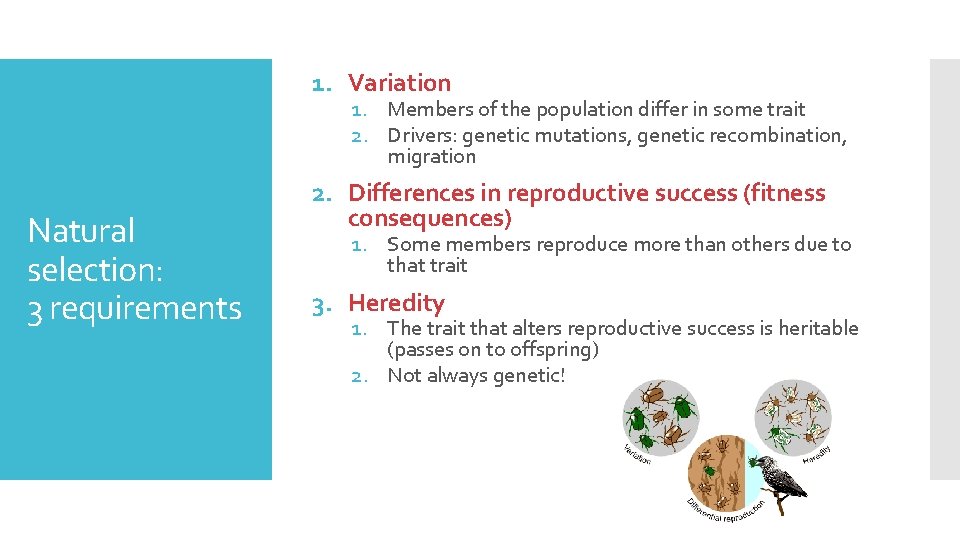
1. Variation 1. Members of the population differ in some trait 2. Drivers: genetic mutations, genetic recombination, migration Natural selection: 3 requirements 2. Differences in reproductive success (fitness consequences) 1. Some members reproduce more than others due to that trait 3. Heredity 1. The trait that alters reproductive success is heritable (passes on to offspring) 2. Not always genetic!

Natural selection: 3 requirements 1. Variation 2. Differences in reproductive success 3. Heredity Natural selection is unguided and unconscious No master plan Organisms don’t will themselves to evolve
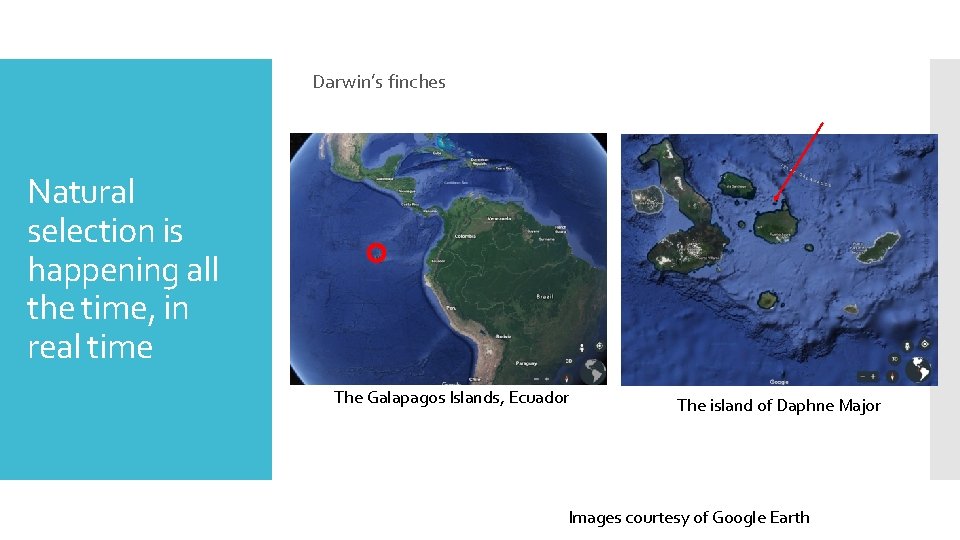
Darwin’s finches Natural selection is happening all the time, in real time The Galapagos Islands, Ecuador The island of Daphne Major Images courtesy of Google Earth
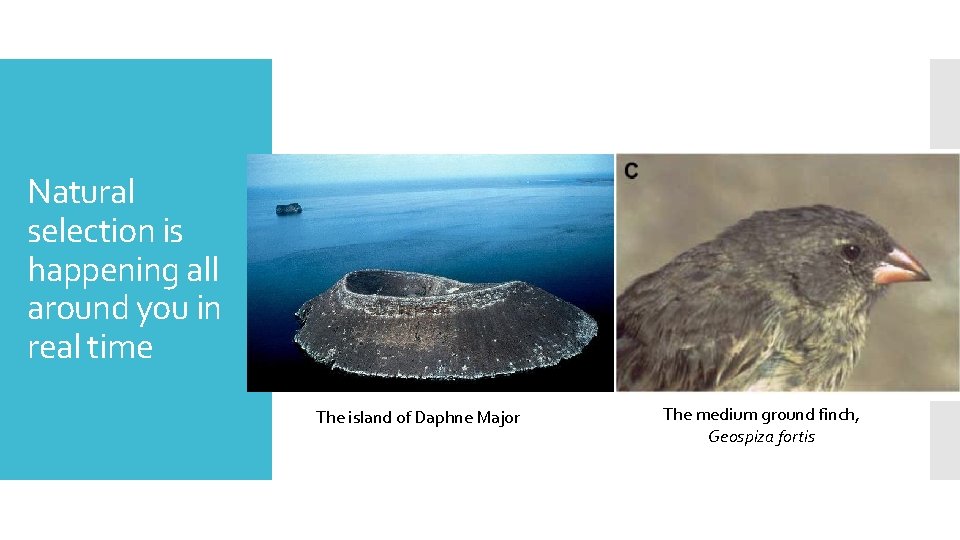
Natural selection is happening all around you in real time The island of Daphne Major The medium ground finch, Geospiza fortis
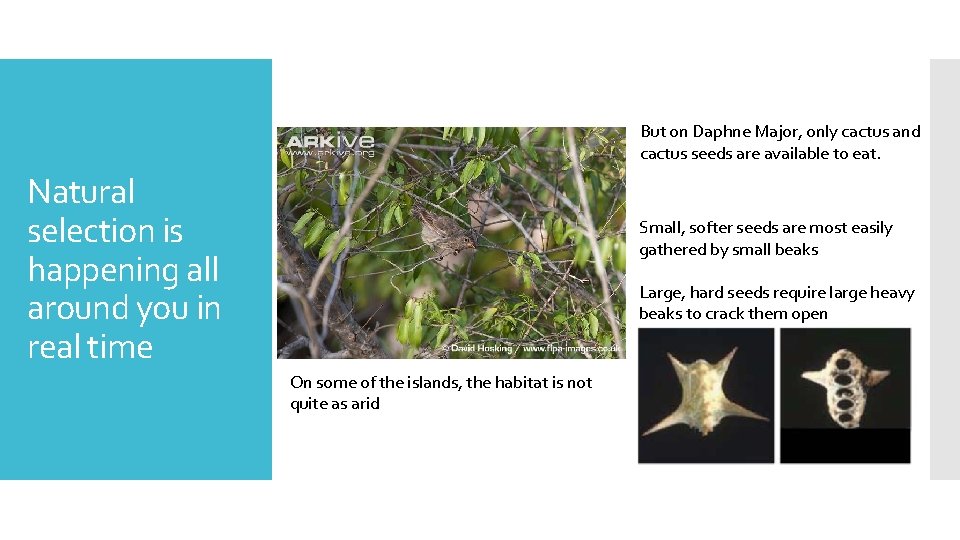
But on Daphne Major, only cactus and cactus seeds are available to eat. Natural selection is happening all around you in real time Small, softer seeds are most easily gathered by small beaks Large, hard seeds require large heavy beaks to crack them open On some of the islands, the habitat is not quite as arid
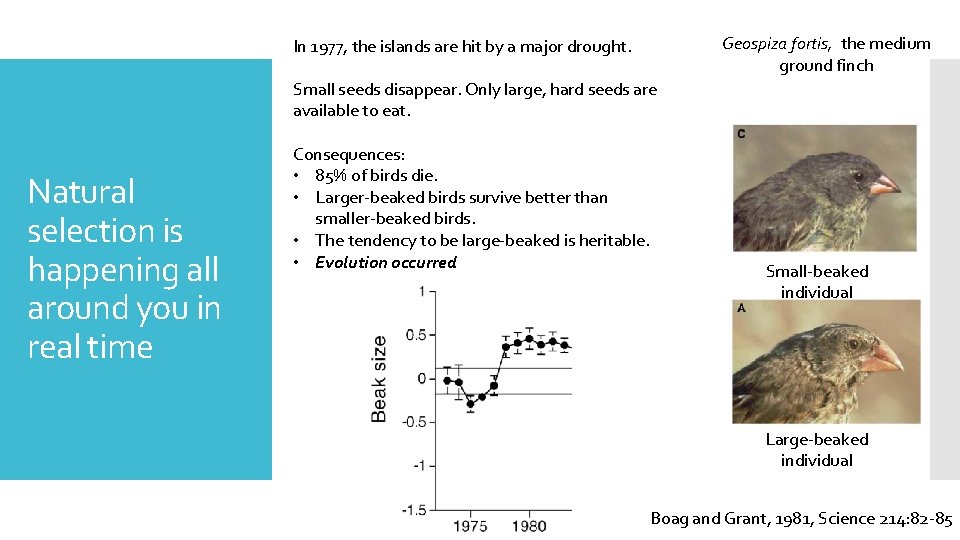
Geospiza fortis, the medium ground finch In 1977, the islands are hit by a major drought. Small seeds disappear. Only large, hard seeds are available to eat. Natural selection is happening all around you in real time Consequences: • 85% of birds die. • Larger-beaked birds survive better than smaller-beaked birds. • The tendency to be large-beaked is heritable. • Evolution occurred Small-beaked individual Large-beaked individual Boag and Grant, 1981, Science 214: 82 -85
Evolution & Natural Selection: Evolutionary Thinking Ie, the bigger picture
- Slides: 16