
Evolution Lesson 3 Evolution Project Recap In two





- Slides: 20
Evolution Lesson 3
Evolution Project Recap • In two hours, you and your group members constructed evolutionary tress that previously would have taken years • The resources available to you today would have been unimaginable to the “naturalists” living in earlier times who characterized relationships between organisms
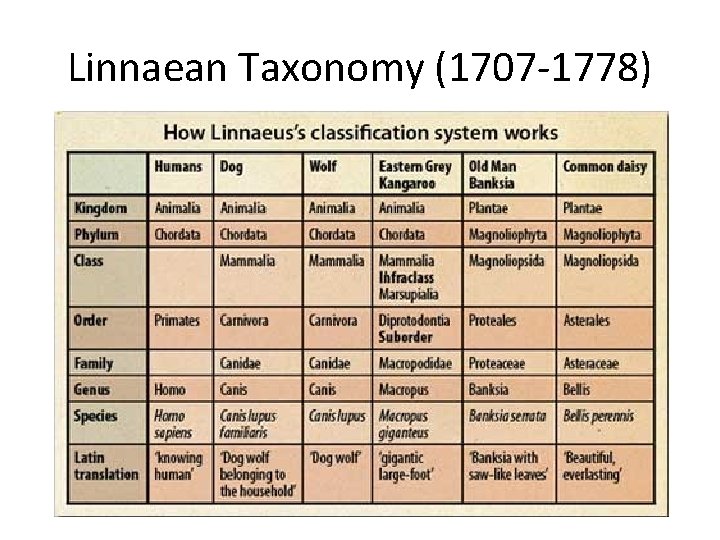
Linnaean Taxonomy (1707 -1778)
Lamarckian (1744 -1829) • Jean-Baptiste Lamarck was a naturalist who believed that traits acquired by an organism after birth were passed along to offspring. – Example: a giraffe stretches its neck reaching for high leaves and passes the trait for stretched out neck to offspring • Theory largely abandoned, although recently the study of epigenetics has rekindled interest
Darwin (1809 -1882) • Charles Darwin was a naturalist who believed that traits were inherited through the process of natural selection • During his 5 year voyage on the HMS Beagle, he made extensively detailed observations of plants, animals, and geological formations • He theorized that organisms evolved to fill specific niches
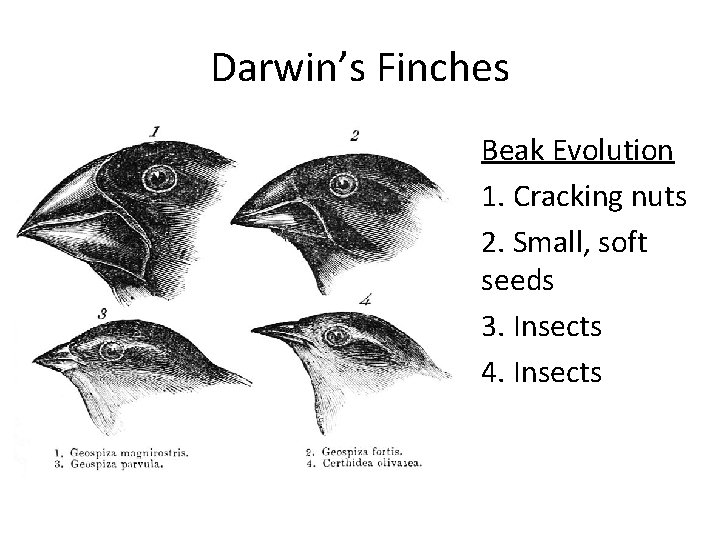
Darwin’s Finches Beak Evolution 1. Cracking nuts 2. Small, soft seeds 3. Insects 4. Insects
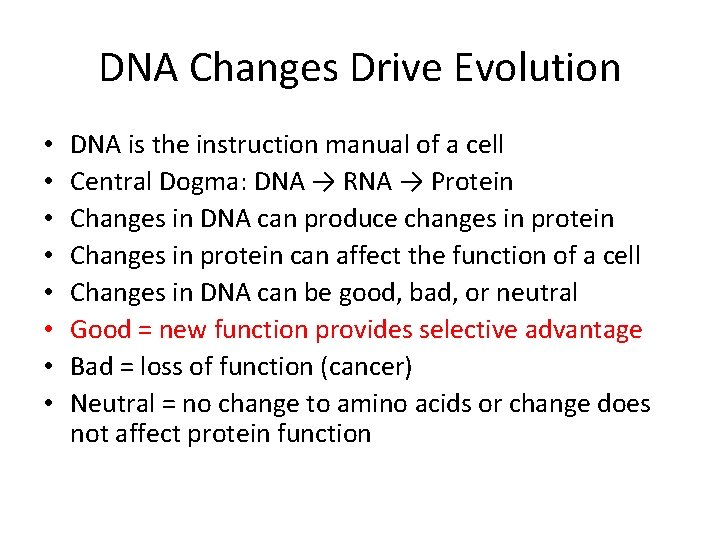
DNA Changes Drive Evolution • • DNA is the instruction manual of a cell Central Dogma: DNA → RNA → Protein Changes in DNA can produce changes in protein Changes in protein can affect the function of a cell Changes in DNA can be good, bad, or neutral Good = new function provides selective advantage Bad = loss of function (cancer) Neutral = no change to amino acids or change does not affect protein function
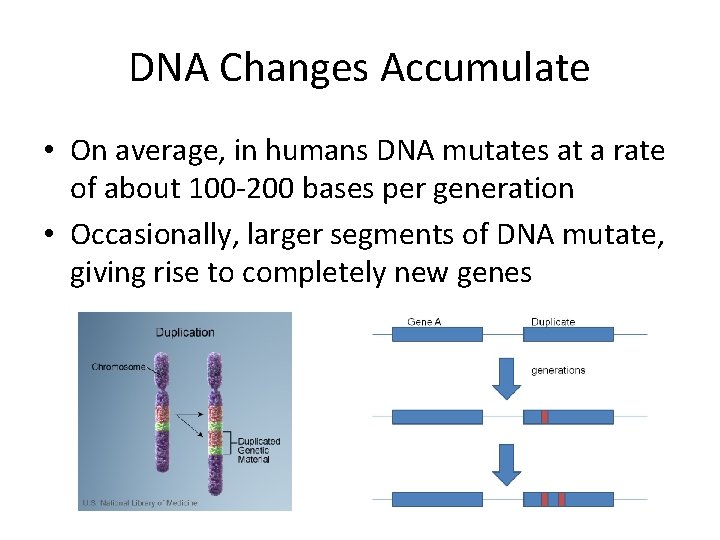
DNA Changes Accumulate • On average, in humans DNA mutates at a rate of about 100 -200 bases per generation • Occasionally, larger segments of DNA mutate, giving rise to completely new genes
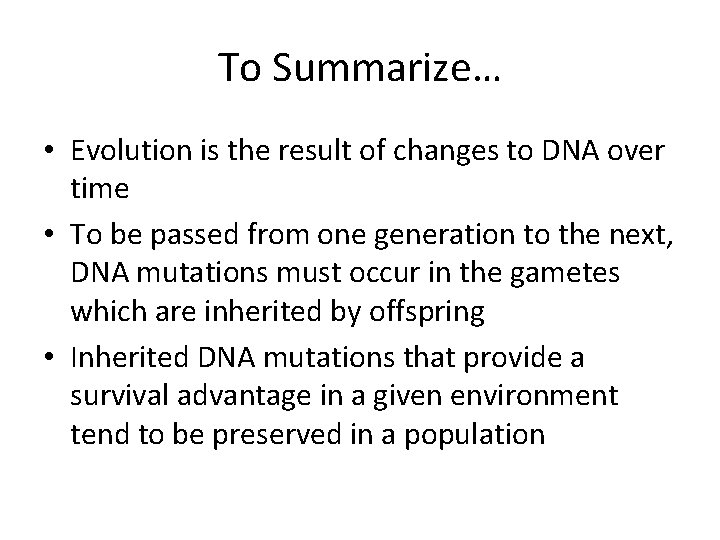
To Summarize… • Evolution is the result of changes to DNA over time • To be passed from one generation to the next, DNA mutations must occur in the gametes which are inherited by offspring • Inherited DNA mutations that provide a survival advantage in a given environment tend to be preserved in a population
DNA Changes Everything • We can compare the DNA from different species to determine genetic similarity • Species with similar DNA are more closely related than species with dissimilar DNA • If DNA mutates at a constant rate, it can be used to determine the time it has taken two species to diverge (constant rate of mutation)
Punctuated Equilibrium • There are gaps in the fossil record which have led to the concept of “punctuated equilibrium” • The idea is that there are evolutionary “jumps” that seem to come out of nowhere
Viruses Facilitate Evolution • Punctuated equilibrium may be partially explained by: – An incomplete fossil record – The transfer of genetic material (DNA) between species by retroviruses • Retroviruses contain RNA, which they insert into a host cell. The host cell reverse transcribes the retrovirus RNA to DNA, and the new DNA is inserted into the host’s DNA
Retroviruses Add DNA Retroviruses include: HIV (human immunodeficiency virus), the Herpesvirus family, HTLV (human T cell leukemia virus)
Retrovirus DNA can be Inherited • If a retrovirus inserts its DNA into a meiotic host cell (egg or sperm), it can be passed along to offspring • However, the DNA may not produce an active gene product if it is inserted into a region of host DNA that lacks a promoter region • In that case, the DNA may continue to evolve as a non-conserved region (mutating more quickly than an important gene)
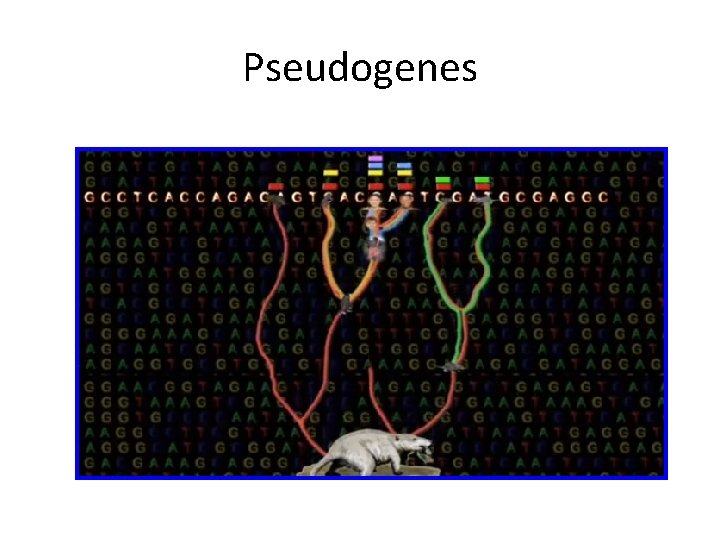
Pseudogenes
Pseudogenes have many sources • Inactive retroviral DNA insertion • Gene duplication • Mutations in the promoter sequence of an existing gene • Pseudogenes can be reactivated if… – Promoter sequence mutation results in re-activation – Transposons “jump” into a position to activate genes
Transposons (Jumping Genes) Dr. Barbara Mc. Clintock was awarded the Nobel Prize in 1983 (Physiology or Medicine category) for her discovery that gene regulation can change based on DNA segments moving around an organism’s genome.
Last Universal Common Ancestor