
Evolution l Evolution is change Galaxies languages and

- Slides: 20
Evolution! l Evolution is change. Galaxies, languages, and political systems all evolve. l Biological evolution- change in the properties of populations of organisms that transcend (are bigger than) the lifetime of a single individual. l Individual organisms do not evolve…they can change…that’s different. Species evolve.
Evolutionary Changes are…changes in populations that are inheritable through passing of genetic material from one generation to the next. l Can be minor or BIG. l Everything from slight changes in the amounts of different alleles within a population, all the way up to… l …changes that led from the earliest life forms to worms, fish, lions, and tulips. l
Evolution is simply species changing. l Sometimes it’s gradual (GRADUALISM). l Sometimes it’s fast (PUNCTUATED EQUILIBRIUM). l One mechanism of evolution is natural selection (cause and effect. . . right? ). Natural selection causes species to evolve (just like tectonic activity causes continental drift). l
Applying Natural Selection 1. 2. Discuss the relationship among genetics, natural selection, and evolution. Construct a scenario wherein a population of organisms (any type you want) is acted upon by natural selection. Be sure to discuss all four mechanisms. Yeah…I know it’s hard; you are going to have to actually think.
Who was Charles Darwin? Well, he was a naturalist who made some cool observations (remember those) in 1835 while visiting the Galapagos Islands (off the western coast of South America…Ecuador to be specific). l He saw that certain flora (plants) and fauna (animals) in the islands were slightly different than those on the mainland. l Examples: Finch beaks, Tortoise shell shapes, l
l l He hypothesized that geographic separation had prompted these organisms to change over time as a response to the environment in which they lived. He didn’t know about genetics…Mendel took care of that piece of information in the 1840’s. How? Well…Natural Selection…which we’ve discussed (Overproduction, Variation, Competition, & Selection-(Successful Reproduction). We now have modern evolution.
What is Natural Selection? Ok…we have this concept called NATURAL SELECTION…right? l That states that organisms that are better equipped for survival have a better chance of…(you tell me)? l
l That’s pretty straight forward isn’t it? I mean, imagine you’re in a soup eating contest. You have a fork and your buddy has a spoon…you ain’t gonna win that contest. l Natural selection works in the same way only the winner lives, and the loser…well…I don’t wanna talk about it. l Let’s look at what affects this process.
1. Overproduction: This refers to the way many organisms produce way more offspring than can survive. 2. Competition: Food and other resources are limited, right? Offspring compete for this stuff to survive. Competition is usually indirect and only a few offspring survive long enough to reproduce.
3. Variation: members of a species differ from one another with regard to certain traits. Differences between individuals of the same species is called VARIATION. 4. Selection: Some variations make certain individuals better adapted to their environment. Those individuals are more likely to survive and reproduce.
Ok, so its like this…When the individuals that are better adapted reproduce, their offsprings may inherit the allele for the helpful trait. l The offsprings, will be more likely to survive and reproduce… they got the good genes (alleles) for the good traits right? l The offsprings (kids) can pass on the allele to their kids. l
l After a bunch of generations, more organisms within the species will have the helpful trait. Over a long period of time, natural selection can lead to evolution. l How? Beneficial variations gradually build up within a species, while unfavorable ones disappear. l This lab we do on Monday will demonstrate how this happens. l
Darwin …did he act alone? Well…. he did but there was another guy acting alone at the same time…. Wallace! He figured out the Natural Selection idea as well. l l So anyways…Darwin and Wallace presented their findings on the same day at the same meeting. Darwin wrote a book though (1859): On the Origin of the Species by Means of Natural Selection…so he got the cred.
Darwin’s Galapagos Vacation l The Galapagos Islands. It was a balmy Friday afternoon on September the twentysomethingteenth, 1835…ok…I have no idea what day it was or whether it was balmy or if porcupines were falling from the sky…although that would’ve been pretty cool IMHO. l l Anyway…October 1835…Darwin lands on the Galapagos Islands (which are where…? ). He spends five weeks there. Nice! So, besides windsurfing, parasailing, and shopping…he’s doing the naturalist thing. You know…one of those eco-tour things. Not nearly as trendy in 1835.
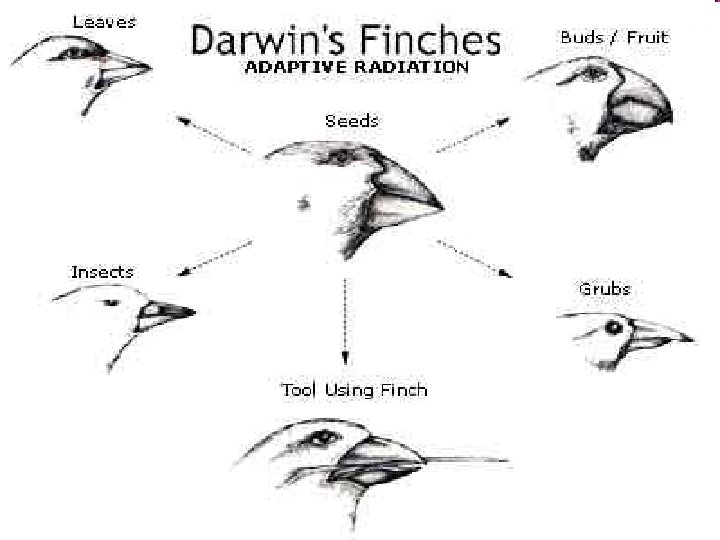
Darwin’s Finches The Galapagos Islands –Charles Darwin, collected some birds (called finches). He thought that they were the same, but although they were closely related, they were actually different. This catalyzed his development of the principle of natural selection. l What Darwin had observed was… l
Speciation l l Changes in closely related organisms that result in enough of a difference to be classified as a separate species. This happens when populations of one species are geographically isolated and each must adapt to its new environment. Speciation that occurs in this way is called ADAPTIVE RADIATION. In the case of the finches, their beaks developed differently depending upon the food sources available in their specific geographic location.
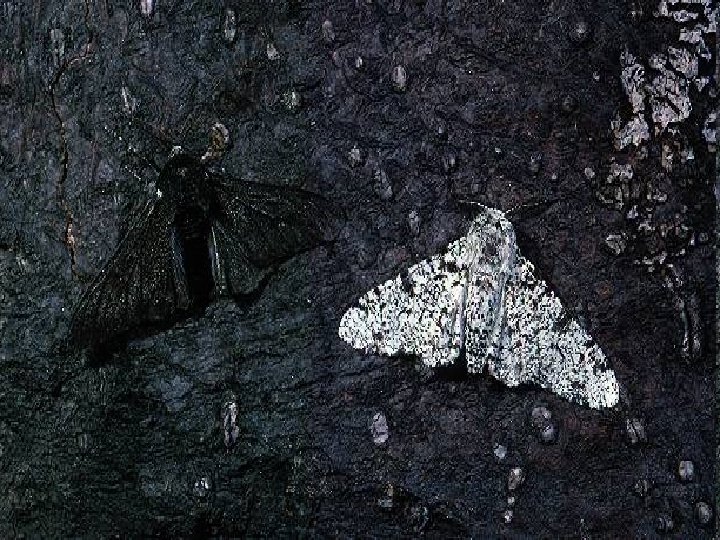
Peppered Moths l l First you’ll need 3 lbs of moths with wings 2 Tbs Olive Oil ¼ cup lemon or lime juice 4 Tbs coarsely ground black pepper …but seriously folks…we’re now discussing INDUSTRIAL MELANISM l This is an example of Polymorphism…It’s a big word that means many forms. So…when a species is found in two distinctly different groups (but is still the same species), that’s polymorphism. l
The peppered moth has changed its appearance since the beginning of the industrial age. l In the 1800's, soot would collect on the sides of buildings from chimneys and factories and make the buildings darker in color. l The moths were originally light colored and were pretty easy to see…happy, happy birds (if you like to eat moths)! l A mutation which caused darker coloration occurred and it was beneficial…if you blend in, you’re tougher to find and eat. l