
Evolution Evolution An organisms characteristics are determined by
Evolution: Evolution An organisms characteristics are determined by the genes inherited from their parents. Most animals get some genes from the mother and some from the father. This combining of genes causes genetic variation. Some characteristics are determined only by genes (genetic variation). The environment also causes differences (environmental variation). Most characteristics are due to genes and the environment. Mutations introduce variation. These are changes to the sequence of bases in DNA which leads to changes in the protein that a gene codes for. Most mutations have no effect, some have a very small influence on phenotype and in very rare cases a new phenotype can be caused. If the environment changes, and the new phenotype makes an individual more suited to the environment, it can become more common throughout the species relatively quickly by natural selection. Evolution and Darwin Organisms in a species show wide variation in their characteristics and have to compete for limited resources in an ecosystem. • Those with the most suitable characteristics are more likely to survive. • They breed and pass on the genes for the characteristic to their offspring. • The organisms that are less well adapted and are less likely to survive and reproduce. • Over time, the beneficial characteristics become more common in the population and the species changes – it evolves. Lots of people didn’t believe Darwin. This was due to a lack of evidence, a lack of understanding (there was no knowledge of genes or mutations) and religious beliefs. Speciation The development of a new species. This happens when a species is separated from others and changes so much is becomes reproductively isolated (can’t interbreed to produce fertile offspring). Extinction When no individuals of a species remain. This may be due to: 1. A new predator 2. A new disease 3. Quick environmental change 4. Competition for food 5. A catastrophic event (e. g. volcano eruption)
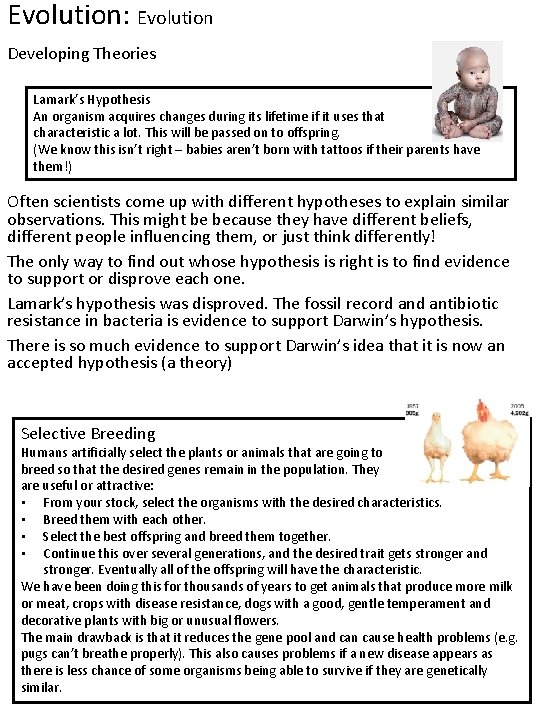
Evolution: Evolution Developing Theories Lamark’s Hypothesis An organism acquires changes during its lifetime if it uses that characteristic a lot. This will be passed on to offspring. (We know this isn’t right – babies aren’t born with tattoos if their parents have them!) Often scientists come up with different hypotheses to explain similar observations. This might be because they have different beliefs, different people influencing them, or just think differently! The only way to find out whose hypothesis is right is to find evidence to support or disprove each one. Lamark’s hypothesis was disproved. The fossil record antibiotic resistance in bacteria is evidence to support Darwin’s hypothesis. There is so much evidence to support Darwin’s idea that it is now an accepted hypothesis (a theory) Selective Breeding Humans artificially select the plants or animals that are going to breed so that the desired genes remain in the population. They are useful or attractive: • From your stock, select the organisms with the desired characteristics. • Breed them with each other. • Select the best offspring and breed them together. • Continue this over several generations, and the desired trait gets stronger and stronger. Eventually all of the offspring will have the characteristic. We have been doing this for thousands of years to get animals that produce more milk or meat, crops with disease resistance, dogs with a good, gentle temperament and decorative plants with big or unusual flowers. The main drawback is that it reduces the gene pool and can cause health problems (e. g. pugs can’t breathe properly). This also causes problems if a new disease appears as there is less chance of some organisms being able to survive if they are genetically similar.
Evolution: Cloning Types of cloning Plant Cloning Tissue culture – a few plant cells are put in a growth medium with hormones (auxins). They grow into clones of the parent plant. This is used to preserve rare plants and grow plants for nurseries. Cuttings – a small part of the parent plant is cut off and planted to produce new plants. This is quick and cheap and an older method. Embryo Transplants Sperm cells are taken from the best male. Egg cells are taken from the best female. The egg is artificially fertilised with the sperm. The embryo that develops is split to form many clones. These cloned embryos are implanted into lots of females to grow into young. Hundreds of ‘ideal’ offspring can be produced every year in this way. Adult Cell Cloning Take an unfertilised egg and remove its nucleus. Take the nucleus out of an adult body cell. Insert the nucleus into the empty egg. Stimulate it to divide with an electric shock. When it becomes an embryo, implant it into the womb of an adult female. This technique was used to make Dolly the Sheep and CC the cat. Issues Reduced gene pool so less variation, making the population more susceptible to disease. Could be used to better understand the process of aging. Could be used to preserve endangered species. We don’t know if there are health side effects. Some people worry that humans might be cloned in the future. If it was allowed, how many people would be born with severe disabilities before we got the process right? Fossils These are the remains of organisms from thousands of years ago. They can tell us a lot about how much or how little organisms have changed over time. They form in three different ways: Gradual replacement by minerals Things like teeth, shells, bones, etc. , which don’t’ decay easily are eventually replaced by minerals, forming a rock-like substance shaped like the original part. Eventually someone digs it up. From casts and impressions Organisms are buried in a soft material like clay. The clay hardens around it. The organism decays, leaving a cast of itself. Footprints can be pressed into the material when soft, leaving an impression when it hardens. Preservations in places where no decay happens In amber and tar pits there’s no oxygen or moisture so decay microbes can’t survive. In glaciers it’s too cold for the decay microbes to work. Peat bogs are too acidic for decay microbes. Fossils tell us how life has changed but not how it started. Was it brought here on comets, or formed in a swamp or under the sea? We don’t know as there is no valid evidence.
Evolution: Bacteria can evolve and become antibiotic-resistant. They develop random mutations in their DNA which can lead to changes in the bacteria’s characteristics, e. g. being less affected by a particular antibiotic. This can lead to antibiotic-resistant strains forming as the gene for antibiotic resistance becomes more common in the population. Bacteria divide quickly by binary fission, so they can evolve quickly too. Being antibiotic-resistant is a big advantage to bacteria as they can survive and reproduce. This is a problem for those who become infected as there is no treatment. So it easily spreads between people. ‘Superbugs’ are resistant to most known antibiotics. MRSA is an example, it often affects people in hospitals and can be fatal if it enters their bloodstream. Antibiotic resistance is becoming more common. Because of overuse of antibiotics and inappropriate use (e. g. being used to attempt to treat viruses). The more often antibiotics are used, the bigger the problem. Taking the full course makes sure that all bacteria are destroyed, which means that there are none left to mutate and develop into antibiotic-resistant strains. We are producing new antibiotics, but not quickly enough to keep up with the demand. In farming: Antibiotics are given to animals to prevent them becoming ill and to grow faster. This can lead to the development of antibiotic-resistant bacteria in the animals that can then spread to humans. Some countries restrict their use.

Evolution: Classification puts organisms into groups according to their characteristics and the structures that make them up. The five kingdoms system (Linnaean system) was first created in the 1700 s by Carl Linnaeus. We can remember it using the pneumonic Kindly Put Candy Out For Good Students. Kindly Put Candy Out For Once we knew more about the biochemical processes taking place inside organisms and the internal structures, Scientists knew this kingdoms system was too basic. Good Students In 1990 Carl Woese proposed the three-domain system after carrying out RNA analysis. Organisms are first split into one of three large groups called domains, and are then split into kingdoms, phylums, classes…. Organisms are named using the binomial system. This uses a two-part Latin name coming from the genus name and the species name. Humans are Homo sapiens, chimpanzees are Pan troglodytes, horses are Equus caballus. Evolutionary trees show evolutionary relationships. The more recent the common ancestor, the more closely related the two species are. Scientists analyse DNA and structural similarities to work out evolutionary relationships. For extinct species they use the fossil record.
- Slides: 5