
Evolution Definition Evolution Changes in one species over
- Slides: 34
Evolution
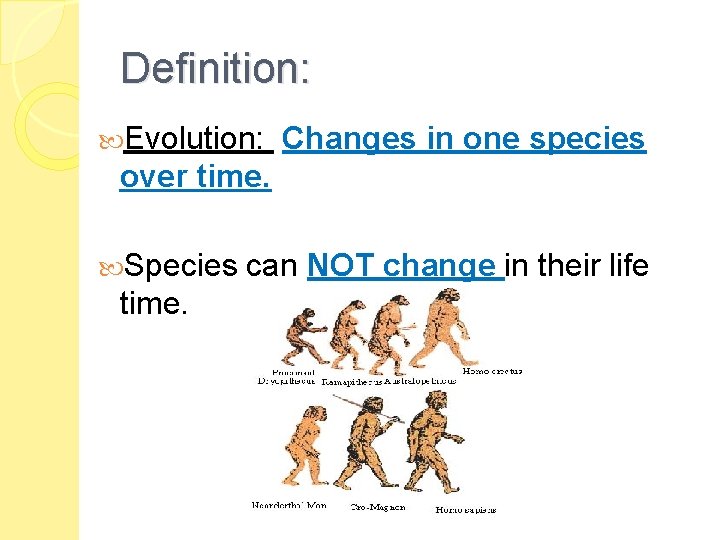
Definition: Evolution: Changes in one species over time. Species time. can NOT change in their life
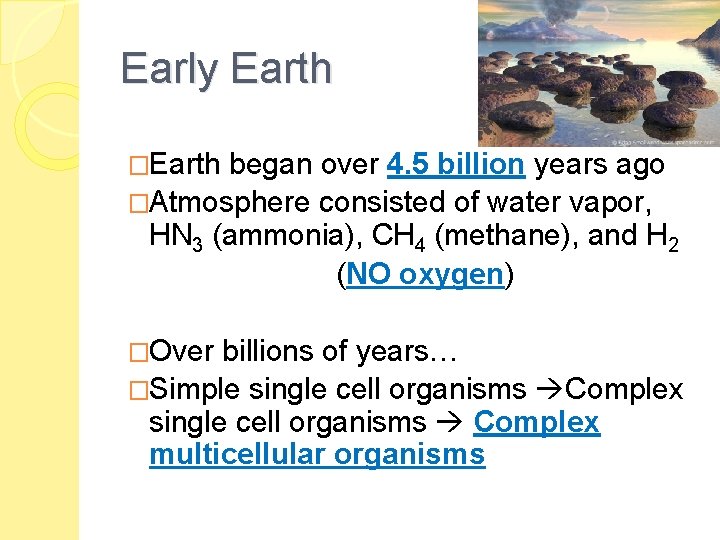
Early Earth �Earth began over 4. 5 billion years ago �Atmosphere consisted of water vapor, HN 3 (ammonia), CH 4 (methane), and H 2 (NO oxygen) �Over billions of years… �Simple single cell organisms Complex single cell organisms Complex multicellular organisms
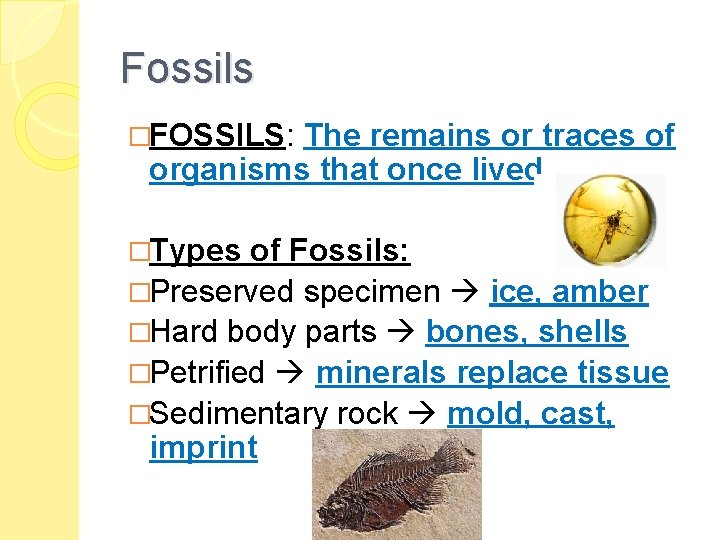
Fossils �FOSSILS: The remains or traces of organisms that once lived �Types of Fossils: �Preserved specimen ice, amber �Hard body parts bones, shells �Petrified minerals replace tissue �Sedimentary rock mold, cast, imprint
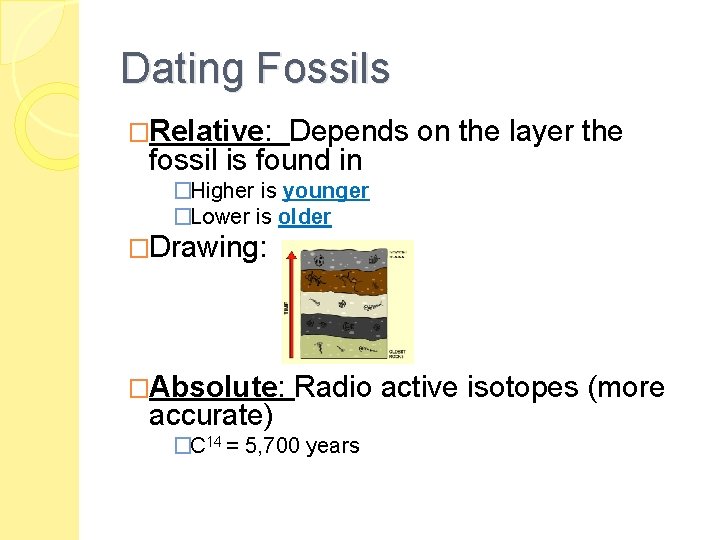
Dating Fossils �Relative: Depends on the layer the fossil is found in �Higher is younger �Lower is older �Drawing: �Absolute: accurate) Radio active isotopes (more �C 14 = 5, 700 years
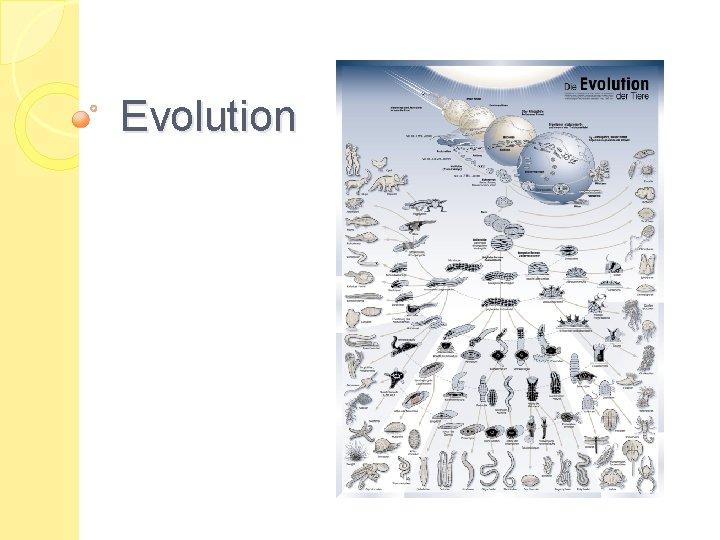
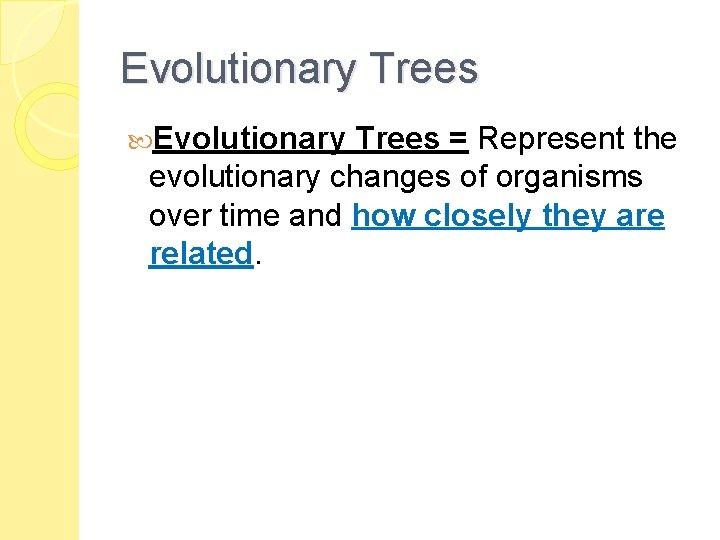
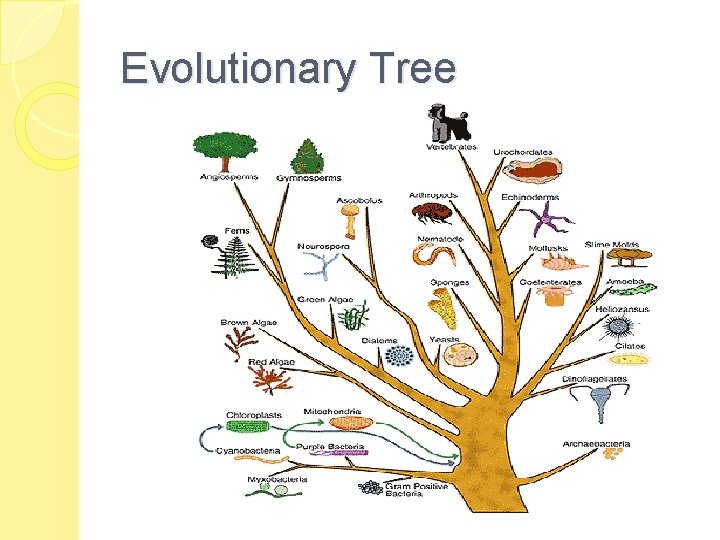
Evolutionary Trees = Represent the evolutionary changes of organisms over time and how closely they are related.
Evolutionary Tree
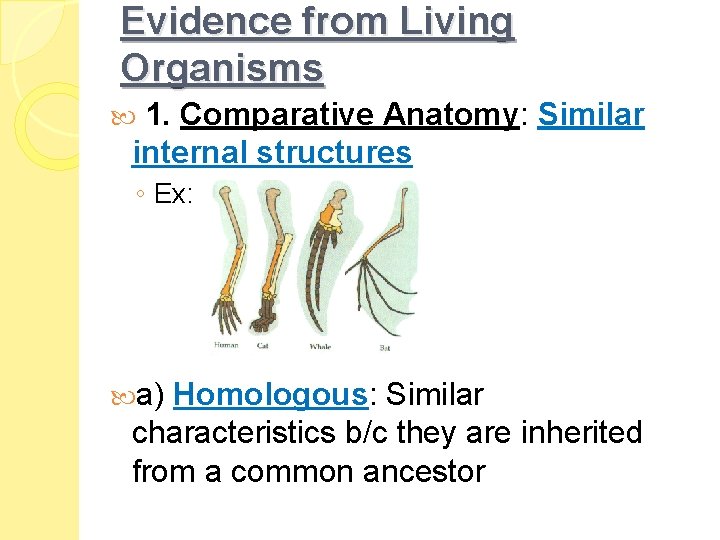
Evidence from Living Organisms 1. Comparative Anatomy: Similar internal structures ◦ Ex: a) Homologous: Similar characteristics b/c they are inherited from a common ancestor
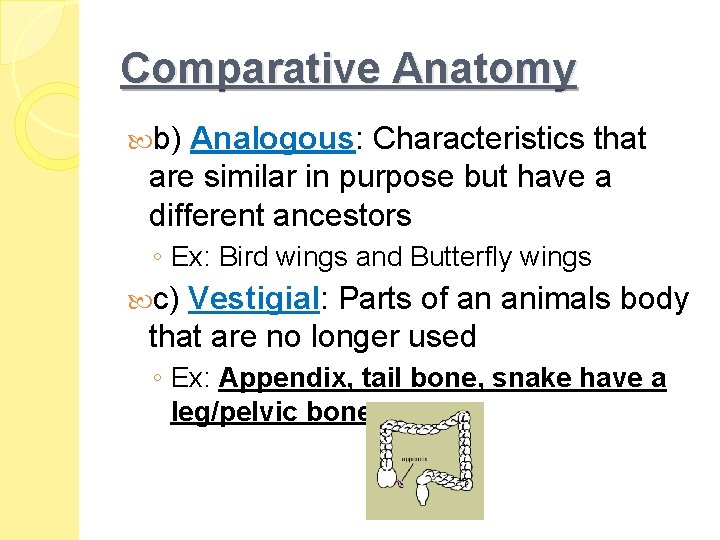
Comparative Anatomy b) Analogous: Characteristics that are similar in purpose but have a different ancestors ◦ Ex: Bird wings and Butterfly wings c) Vestigial: Parts of an animals body that are no longer used ◦ Ex: Appendix, tail bone, snake have a leg/pelvic bone
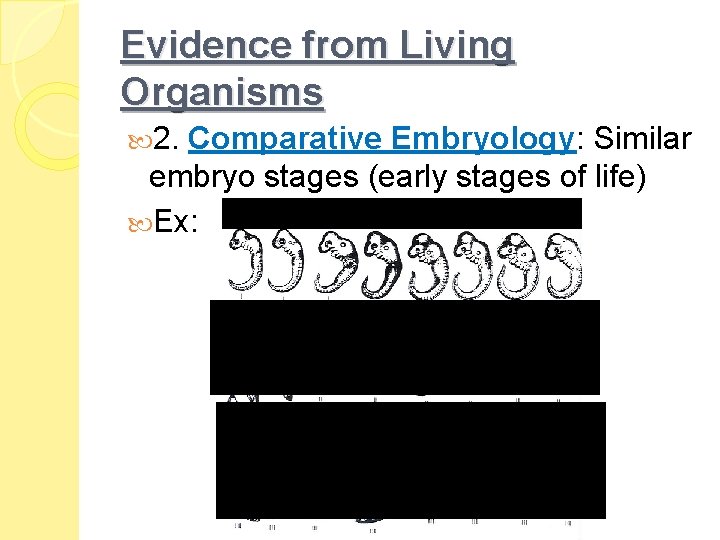
Evidence from Living Organisms 2. Comparative Embryology: Similar embryo stages (early stages of life) Ex:
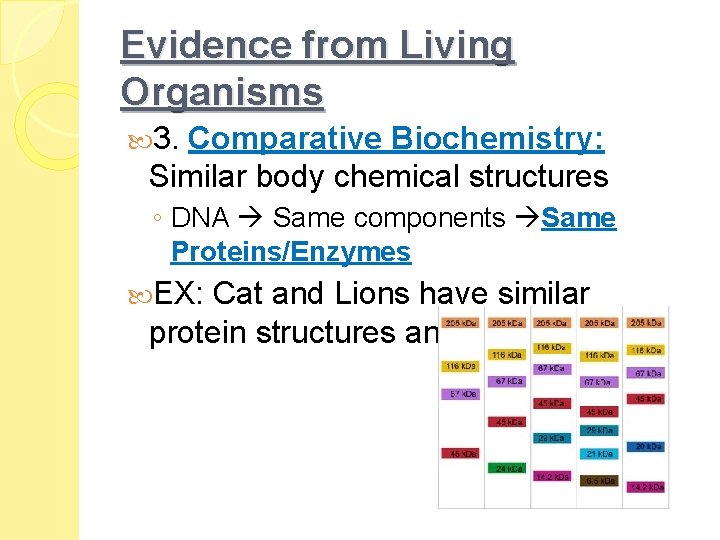
Evidence from Living Organisms 3. Comparative Biochemistry: Similar body chemical structures ◦ DNA Same components Same Proteins/Enzymes EX: Cat and Lions have similar protein structures and DNA
Theory vs. Law Theory = an explanation that is supported by experimental data Law = statement that is always true Which is evolution? ◦ THEORY
Jean Baptiste de Lamarck (1744 -1829) 1. Organisms strive to improve themselves 2. Law of Use and Disuse = Useful characteristics are acquired during a lifetime and the not useful characteristics waste away. 3. Inheritance of Acquired Traits = The structure changed through use and disuse is inherited into the next generation
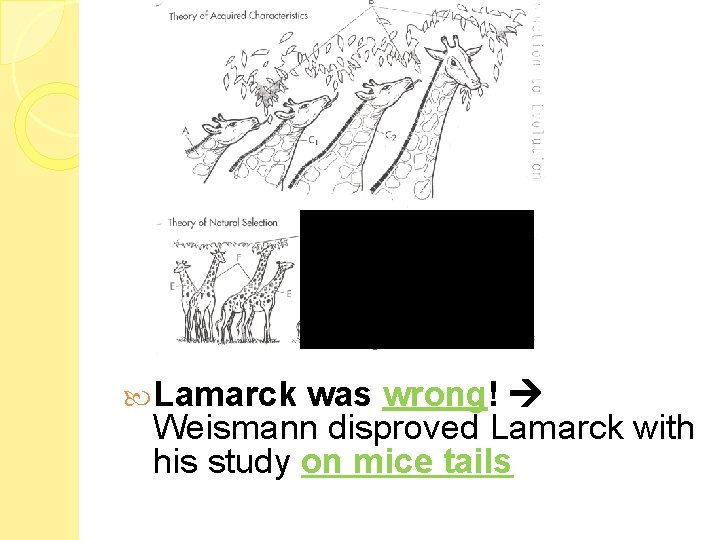
Lamarck was wrong! Weismann disproved Lamarck with his study on mice tails
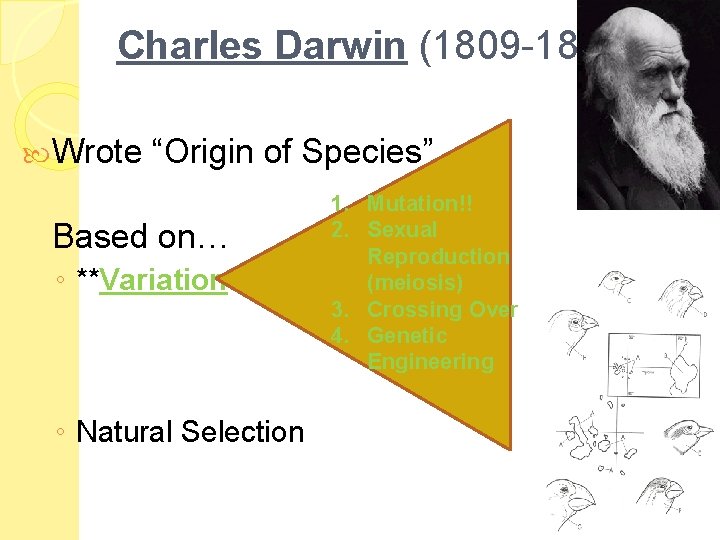
Charles Darwin (1809 -1882) Wrote “Origin of Species” Based on… ◦ **Variation ◦ Natural Selection 1. Mutation!! 2. Sexual Reproduction (meiosis) 3. Crossing Over 4. Genetic Engineering
NATURAL SELECTION 1. Overpopulation: More offspring are born than can possibly survive. 2. Competition: Struggle for survival and resources. 3. Survival of the Fittest: Those whom survive are best adapted to survive (Variation different and better). Adaptation: an inherited trait that improves chances of survival CAN NOT BE AQUIRED IN A LIFETIME!
NATURAL SELECTION ◦ 4. Reproduction: Those whom survive will reproduce and transmit those variations to the offspring. ◦ 5. Speciation: the formation of a new species due to the build up of changes
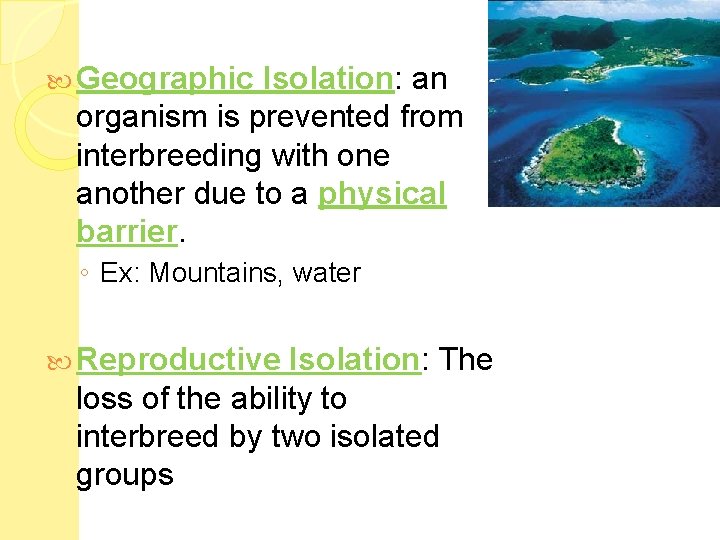
Geographic Isolation: an organism is prevented from interbreeding with one another due to a physical barrier. ◦ Ex: Mountains, water Reproductive Isolation: The loss of the ability to interbreed by two isolated groups
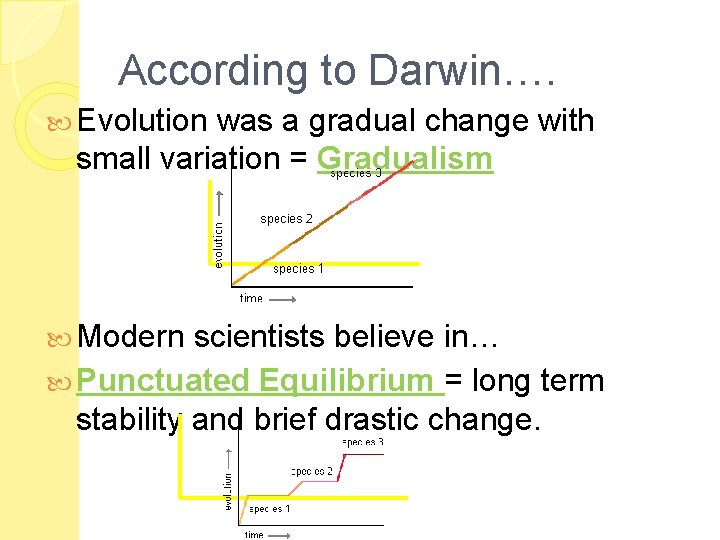
According to Darwin…. Evolution was a gradual change with small variation = Gradualism Modern scientists believe in… Punctuated Equilibrium = long term stability and brief drastic change.
Modern Evolution Old definition Evolution: gradual change of one species over time Modern definition Evolution: a change in the allele frequency within a population overtime As the genetic make up changes population changes
Modern Evolution Gene Frequency: how often the gene is seen in a population Gene Pool: all the possible alleles present in a population Genetic Drift: The change in the gene pool by chance. Therefore, decreases genetic variation. Stable Population: No change in gene frequency
Hardy Weinberg Theory A population will not evolve if these conditions exists: 1. Large population 2. No migration 3. No mutations (no new variations) 4. Random mating (not selective breeding) Conclusion: The conditions are not likely, therefore evolution will progress
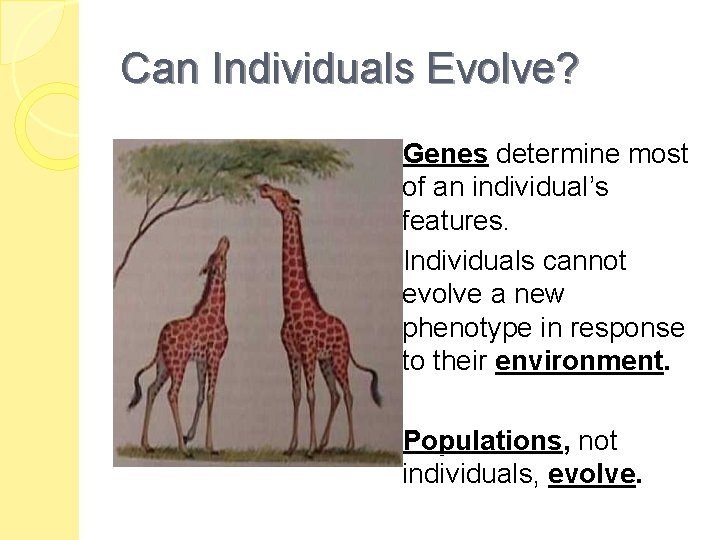
Can Individuals Evolve? Genes determine most of an individual’s features. Individuals cannot evolve a new phenotype in response to their environment. Populations, not individuals, evolve.
Evolution of a Population Natural selection acts on the range of phenotypes in a population. Evolution occurs as a population’s genes and their frequencies change over time.
How can a population’s genes change over time? All of the alleles of a population’s genes together make up a gene pool. Allelic frequency - % of any specific allele in the gene pool. Genetic equilibrium – a population in which the frequency of alleles remains the same over generations.
Changes in Genetic Equilibrium A population in genetic equilibrium is not evolving. Mutations are one cause of genetic change. Lethal mutations disappear quickly, but mutations that cause a useful variation become part of the gene pool
Natural Selection Acts on Variation Some variations increase or decrease an organism’s chance of survival in an environment. Variations are controlled by alleles. Allelic frequencies in a gene pool will change due to natural selection of variations.
Evolution of Species Speciation – occurs when members of a similar population no longer interbreed to produce fertile offspring.
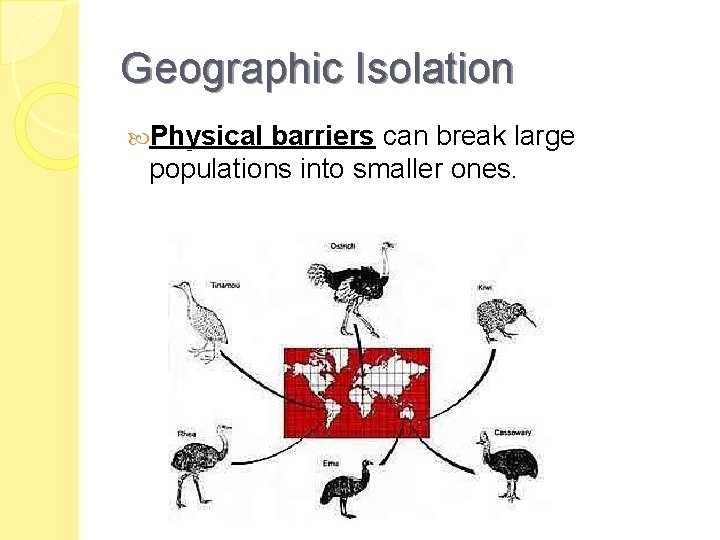
Geographic Isolation Physical barriers can break large populations into smaller ones.
Reproductive Isolation Occurs when formerly interbreeding organisms can no longer mate and produce fertile offspring. May occur because genetic material becomes so different that fertilization cannot occur. May be isolated by behavior, such as mating at different times.
Rate of Speciation – Two Hypotheses Gradualism – species originate through a gradual change of adaptations. Punctuated Equilibrium – speciation occurs relatively quickly with long periods of genetic equilibrium in between.
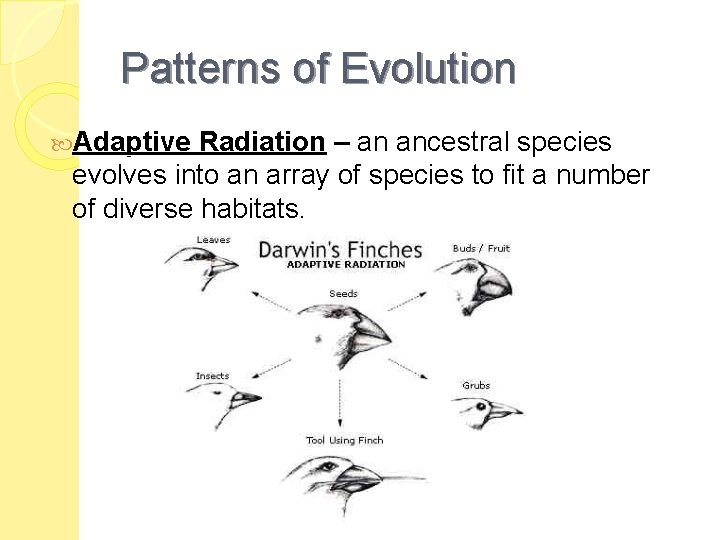
Patterns of Evolution Adaptive Radiation – an ancestral species evolves into an array of species to fit a number of diverse habitats.
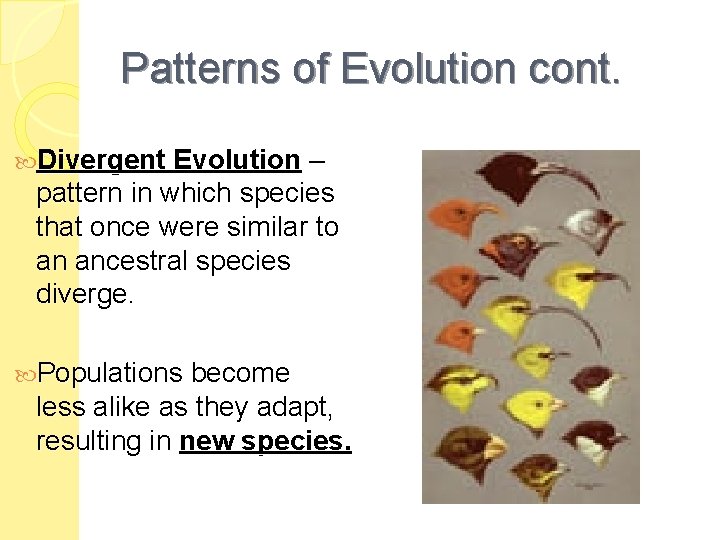
Patterns of Evolution cont. Divergent Evolution – pattern in which species that once were similar to an ancestral species diverge. Populations become less alike as they adapt, resulting in new species.
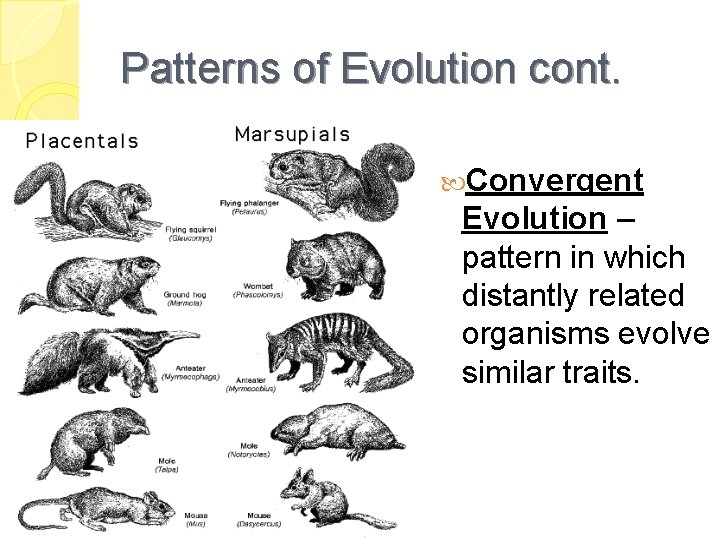
Patterns of Evolution cont. Convergent Evolution – pattern in which distantly related organisms evolve similar traits.