
Evolution Darwins Ideas HardyWeinberg Evidence for Evolution Speciation
Evolution Darwin’s Ideas Hardy-Weinberg Evidence for Evolution Speciation and Mechanisms Origins AP Biology
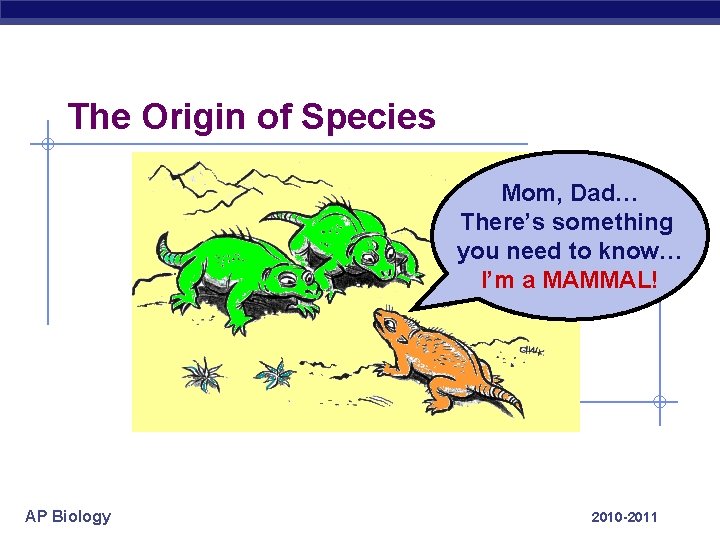
The Origin of Species Mom, Dad… There’s something you need to know… I’m a MAMMAL! AP Biology 2010 -2011
Origin of the Earth What must Earth have been like before living things took over? AP Biology
The Primitive Earth § Atmosphere: All chemicals/compounds necessary are thought to have originated on earth u Inorganic precursors: § Water vapor § Nitrogen § Carbon dioxide § Small amounts of hydrogen and carbon monoxide These were the monomers forming more complex molecules. Experiments have shown that it is possible to form organic from inorganic. u § § AP Biology
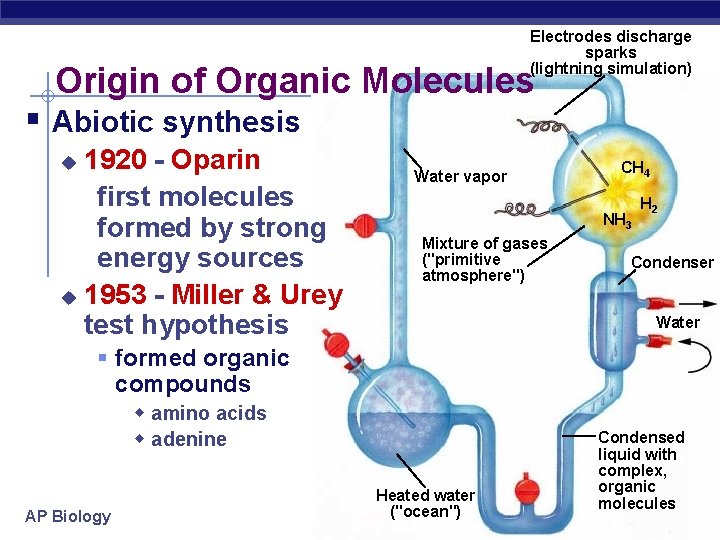
Electrodes discharge sparks (lightning simulation) Origin of Organic Molecules § Abiotic synthesis 1920 - Oparin first molecules formed by strong energy sources u 1953 - Miller & Urey test hypothesis u Water vapor NH 3 Mixture of gases ("primitive atmosphere") H 2 Condenser Water § formed organic compounds w amino acids w adenine AP Biology CH 4 Heated water ("ocean") Condensed liquid with complex, organic molecules
Key Events in Origin of Life § Origin of Cells (Protobionts) u lipid bubbles separate inside from outside metabolism & reproduction § Origin of Genetics u u RNA is likely first genetic material multiple functions: encodes information (selfreplicating), enzyme, regulatory molecule, transport molecule (t. RNA, m. RNA) § makes inheritance possible § makes natural selection & evolution possible § Origin of Eukaryotes u AP Biology endosymbiosis
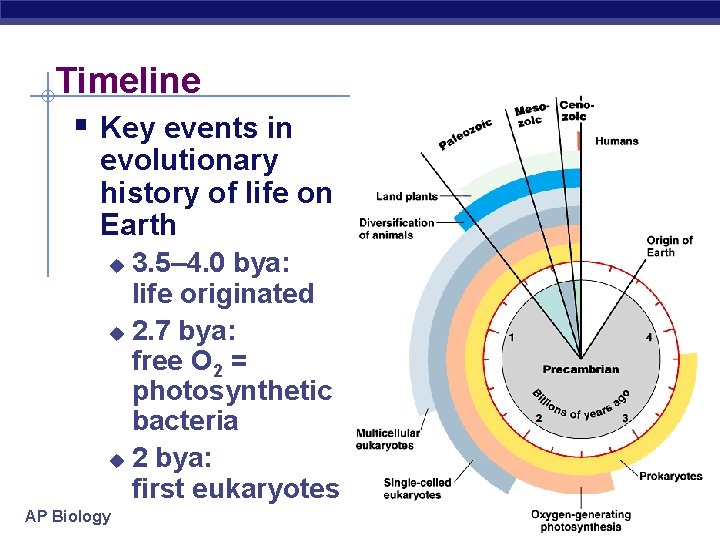
Timeline § Key events in evolutionary history of life on Earth 3. 5– 4. 0 bya: life originated u 2. 7 bya: free O 2 = photosynthetic bacteria u 2 bya: first eukaryotes u AP Biology
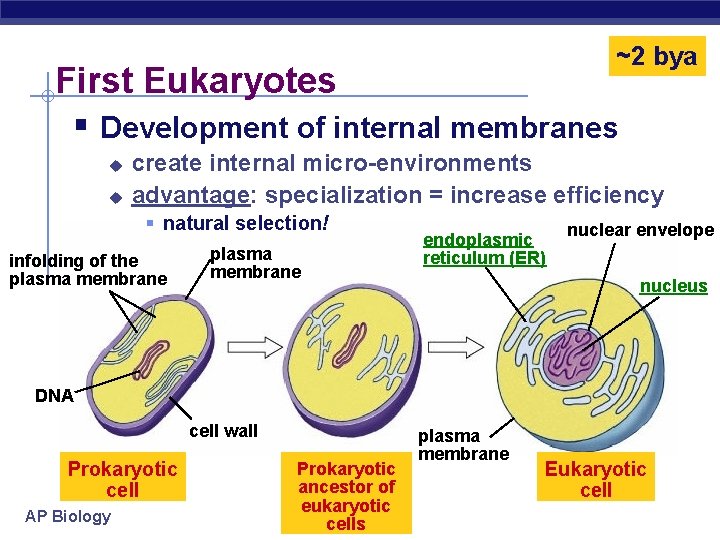
~2 bya First Eukaryotes § Development of internal membranes u u create internal micro-environments advantage: specialization = increase efficiency § natural selection! infolding of the plasma membrane endoplasmic reticulum (ER) nuclear envelope nucleus DNA cell wall Prokaryotic cell AP Biology Prokaryotic ancestor of eukaryotic cells plasma membrane Eukaryotic cell
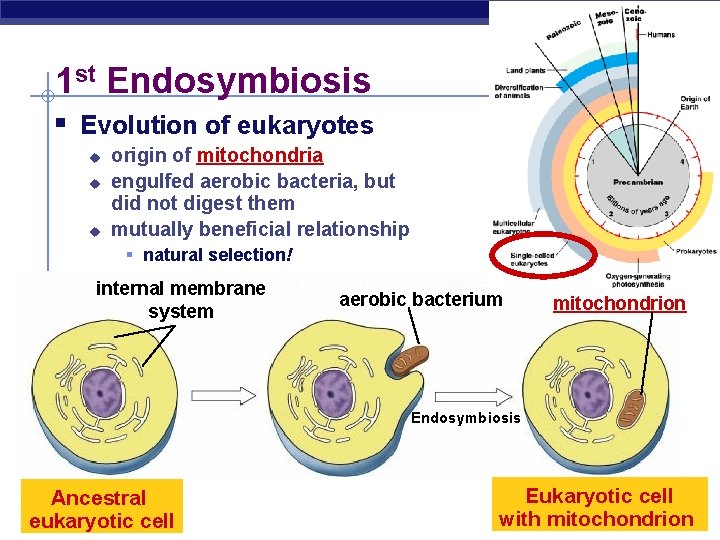
1 st Endosymbiosis § Evolution of eukaryotes u u u origin of mitochondria engulfed aerobic bacteria, but did not digest them mutually beneficial relationship § natural selection! internal membrane system aerobic bacterium mitochondrion Endosymbiosis Ancestral AP Biology eukaryotic cell Eukaryotic cell with mitochondrion
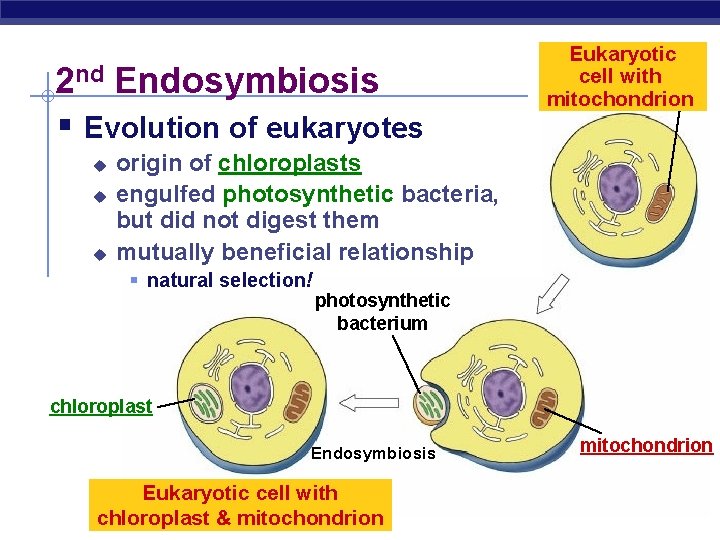
2 nd Endosymbiosis § Evolution of eukaryotes u u u Eukaryotic cell with mitochondrion origin of chloroplasts engulfed photosynthetic bacteria, but did not digest them mutually beneficial relationship § natural selection! photosynthetic bacterium chloroplast Endosymbiosis Eukaryotic cell with AP Biology chloroplast & mitochondrion
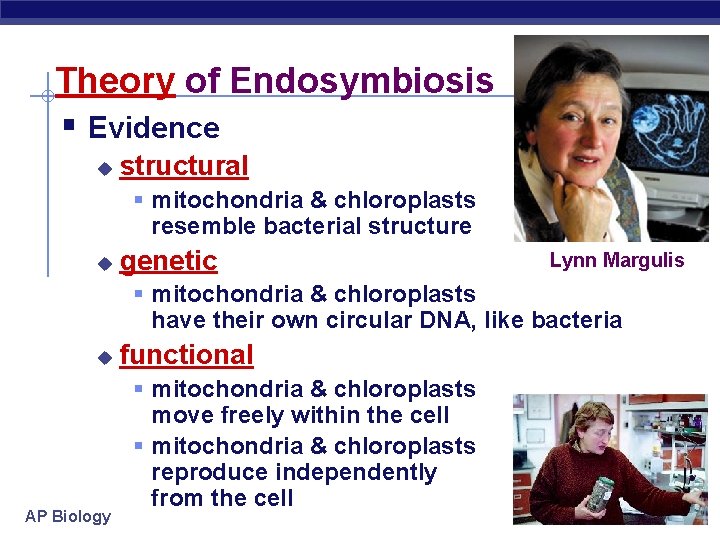
Theory of Endosymbiosis § Evidence u structural § mitochondria & chloroplasts resemble bacterial structure u genetic Lynn Margulis § mitochondria & chloroplasts have their own circular DNA, like bacteria u AP Biology functional § mitochondria & chloroplasts move freely within the cell § mitochondria & chloroplasts reproduce independently from the cell
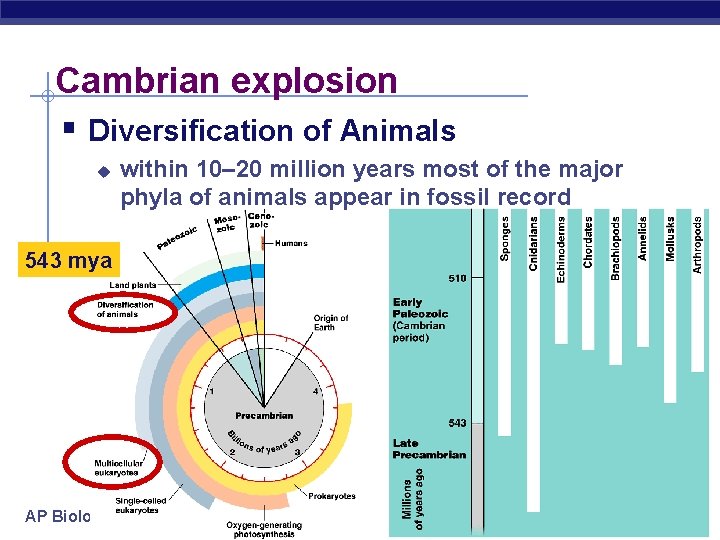
Cambrian explosion § Diversification of Animals u 543 mya AP Biology within 10– 20 million years most of the major phyla of animals appear in fossil record
- Slides: 12