
Evolution Charles Darwin Evolution change over time Process






- Slides: 45
Evolution & Charles Darwin
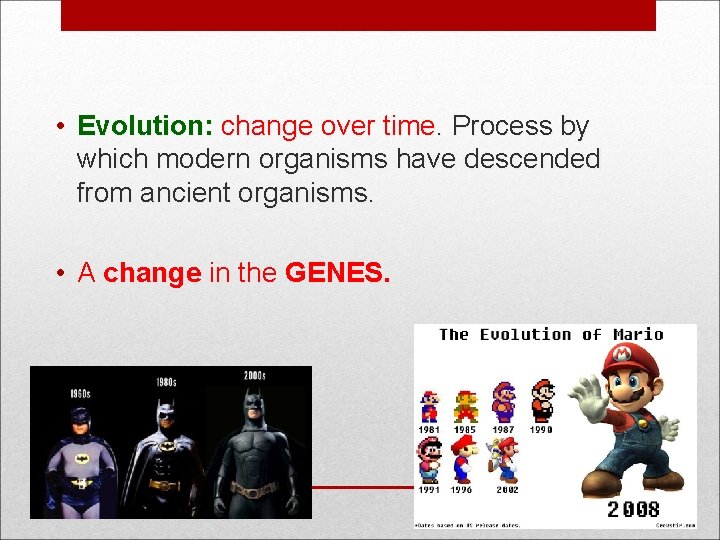
• Evolution: change over time. Process by which modern organisms have descended from ancient organisms. • A change in the GENES. Evolution
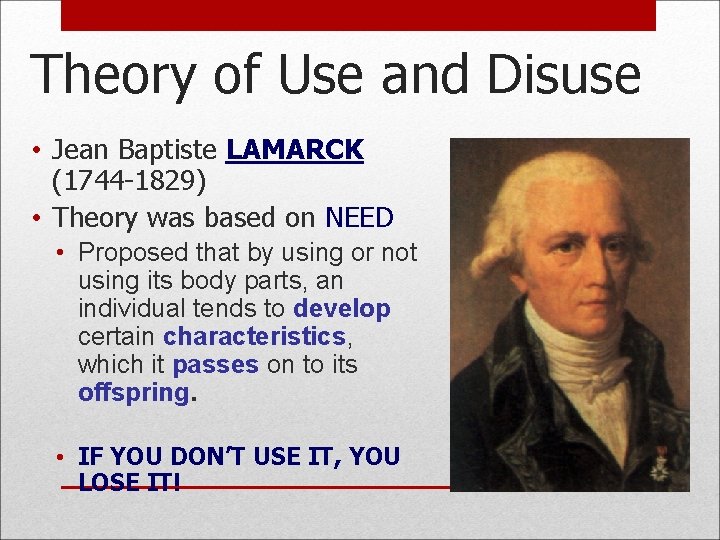
Theory of Use and Disuse • Jean Baptiste LAMARCK (1744 -1829) • Theory was based on NEED • Proposed that by using or not using its body parts, an individual tends to develop certain characteristics, characteristics which it passes on to its offspring • IF YOU DON’T USE IT, YOU LOSE IT!
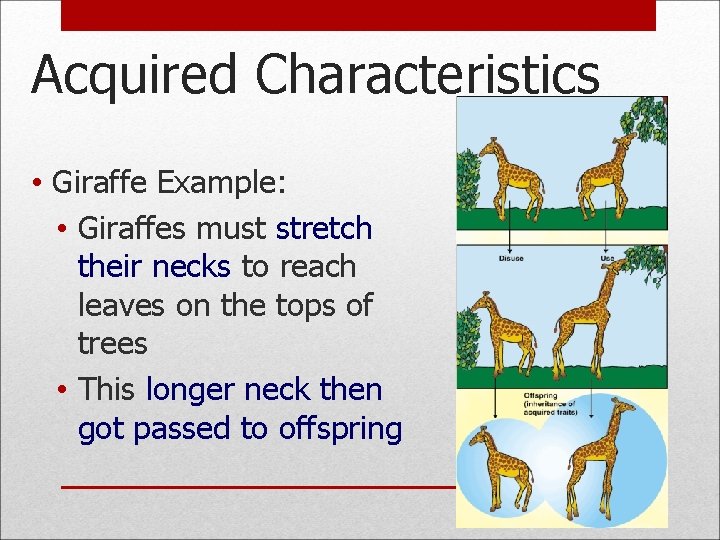
Acquired Characteristics • Giraffe Example: • Giraffes must stretch their necks to reach leaves on the tops of trees • This longer neck then got passed to offspring
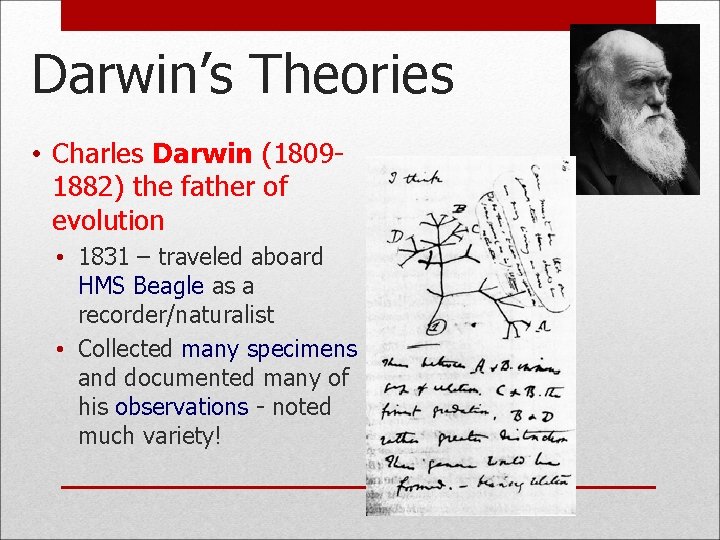
Darwin’s Theories • Charles Darwin (18091882) the father of evolution • 1831 – traveled aboard HMS Beagle as a recorder/naturalist • Collected many specimens and documented many of his observations - noted much variety!
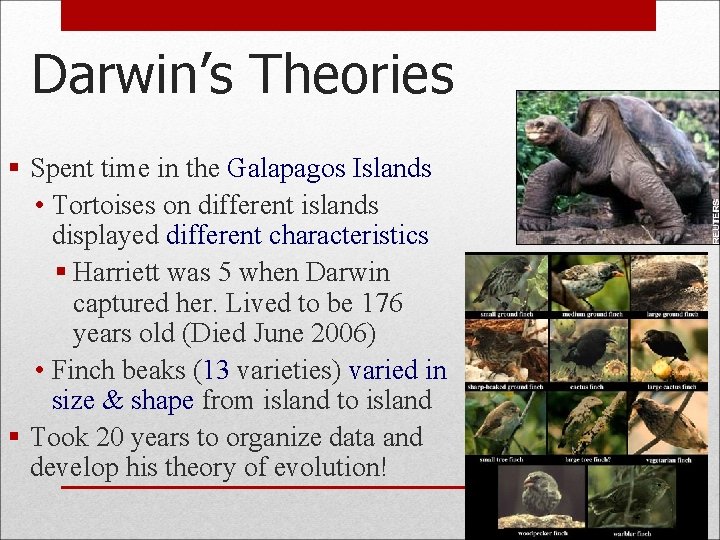
Darwin’s Theories § Spent time in the Galapagos Islands • Tortoises on different islands displayed different characteristics § Harriett was 5 when Darwin captured her. Lived to be 176 years old (Died June 2006) • Finch beaks (13 varieties) varied in size & shape from island to island § Took 20 years to organize data and develop his theory of evolution!
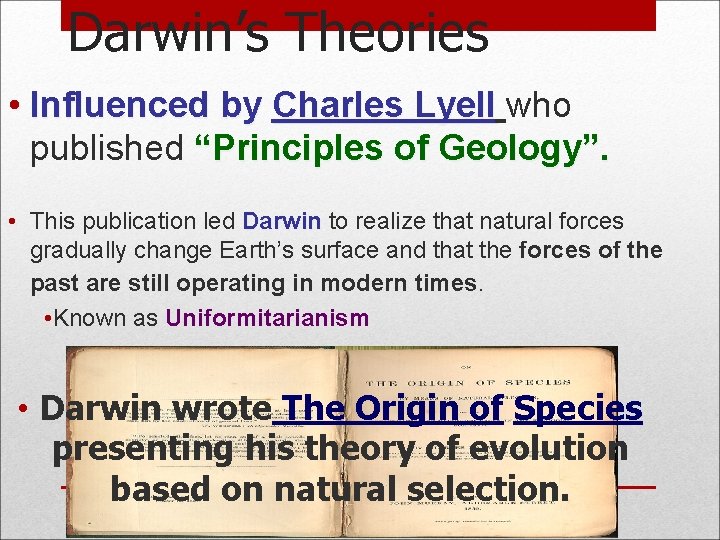
Darwin’s Theories • Influenced by Charles Lyell who published “Principles of Geology”. • This publication led Darwin to realize that natural forces gradually change Earth’s surface and that the forces of the past are still operating in modern times. • Known as Uniformitarianism • Darwin wrote The Origin of Species presenting his theory of evolution based on natural selection.
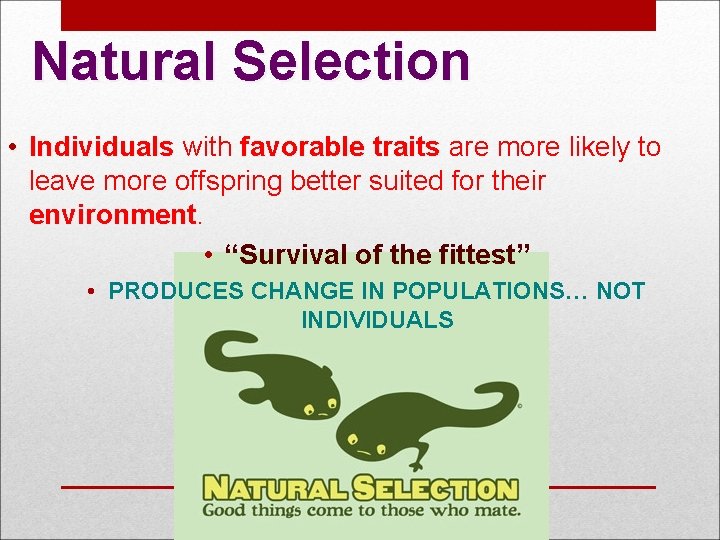
Natural Selection • Individuals with favorable traits are more likely to leave more offspring better suited for their environment • “Survival of the fittest” • PRODUCES CHANGE IN POPULATIONS… NOT INDIVIDUALS
Darwin’s 5 points 1. Populations have variation. 2. Some variations are favorable. 3. More offspring are produced than survive 4. Those that survive have favorable traits. 5. A population will change over time.
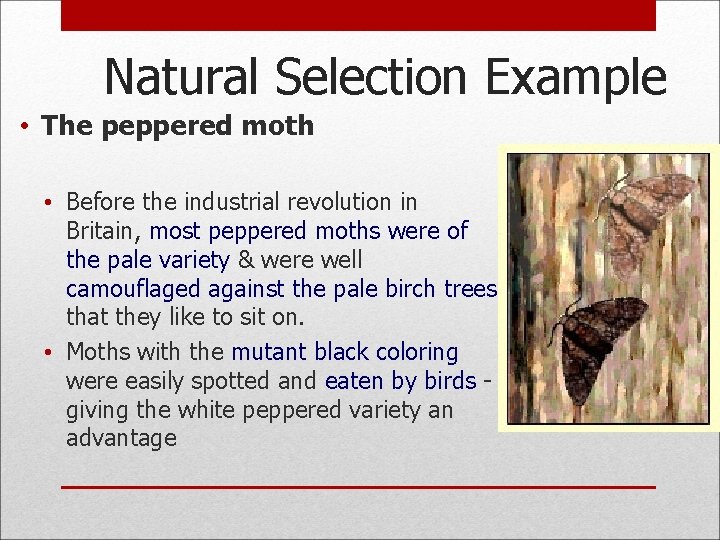
Natural Selection Example • The peppered moth • Before the industrial revolution in Britain, most peppered moths were of the pale variety & were well camouflaged against the pale birch trees that they like to sit on. • Moths with the mutant black coloring were easily spotted and eaten by birds giving the white peppered variety an advantage
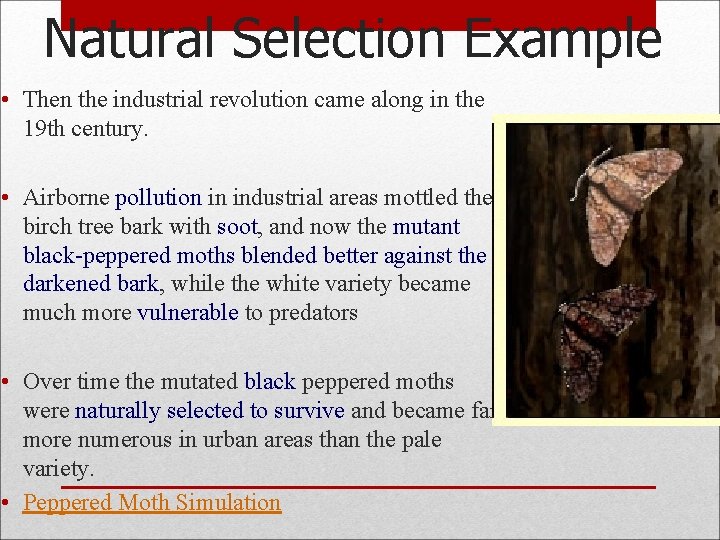
Natural Selection Example • Then the industrial revolution came along in the 19 th century. • Airborne pollution in industrial areas mottled the birch tree bark with soot, and now the mutant black-peppered moths blended better against the darkened bark, while the white variety became much more vulnerable to predators • Over time the mutated black peppered moths were naturally selected to survive and became far more numerous in urban areas than the pale variety. • Peppered Moth Simulation
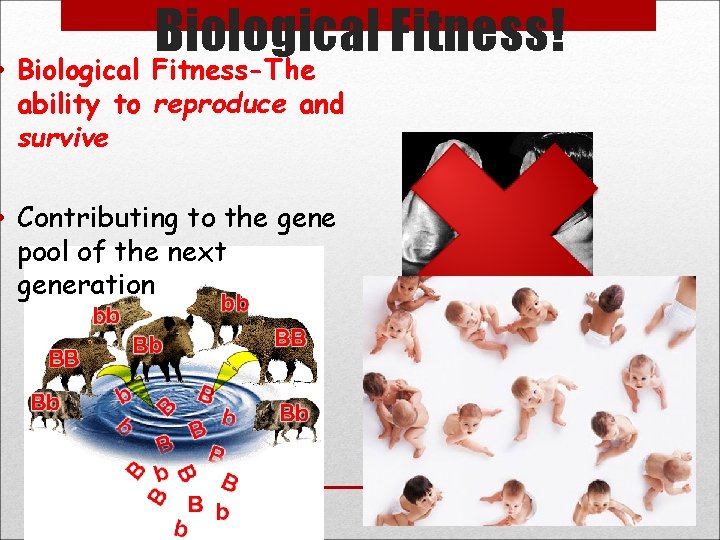
Biological Fitness! • Biological Fitness-The ability to reproduce and survive • Contributing to the gene pool of the next generation
In what ways have humans adapted in order for us to be “fit”?
Evidence of Evolution 1. Biogeography: Geographical distribution of species. 2. Fossil Record: Fossils and the order in which they appear in layers of sedimentary rock (strongest evidence). 3. Taxonomy: Classification of life forms. 4. Homologous structures: Structures that are similar because of common ancestry (comparative anatomy)
5. Comparative embryology: Study of structures that appear during embryonic development. 6. Molecular biology: DNA and proteins (amino acids) Evidence of Evolution
• A localized group of individuals belonging to the same species Population
• A group of populations whose individuals have the potential to interbreed and produce viable offspring. Species
• The total collection of genes in a population at any one time. Gene Pool
• The concept that the shuffling of genes that occur during sexual reproduction, by itself, cannot change the overall genetic makeup of a population. Hardy-Weinberg Principle
• This principle will be maintained in nature only if all five of the following conditions are met: 1. 2. 3. 4. 5. Very large population Isolation from other populations No net mutations Random mating No natural selection Hardy-Weinberg Principle
• Remember: If these conditions are met, the population is at equilibrium • This means “No Change” or “No Evolution”. Hardy-Weinberg Principle
• The origin of taxonomic groups higher than the species level Macroevolution
• A change in a population’s gene pool over a secession of generations. • Evolutionary changes in species over relatively brief periods of geological time Microevolution
1. Genetic drift: Change in the gene pool of a small population due to chance. • Two examples: a. Bottleneck effect b. Founder effect Five Mechanisms of Microevolution
• Genetic drift (reduction of alleles in a population) resulting from a disaster that drastically reduces population size • Examples: 1. Earthquakes 2. Volcano’s a. Bottleneck Effect
• Genetic drift resulting from the colonization of a new location by a small number of individuals. • Results in random change of the gene pool. • Example: 1. Islands (first Darwin finch) b. Founder Effect
2. Gene Flow: The gain or loss of alleles from a population by the movement of individuals or gametes. • Immigration or emigration Five Mechanisms of Microevolution
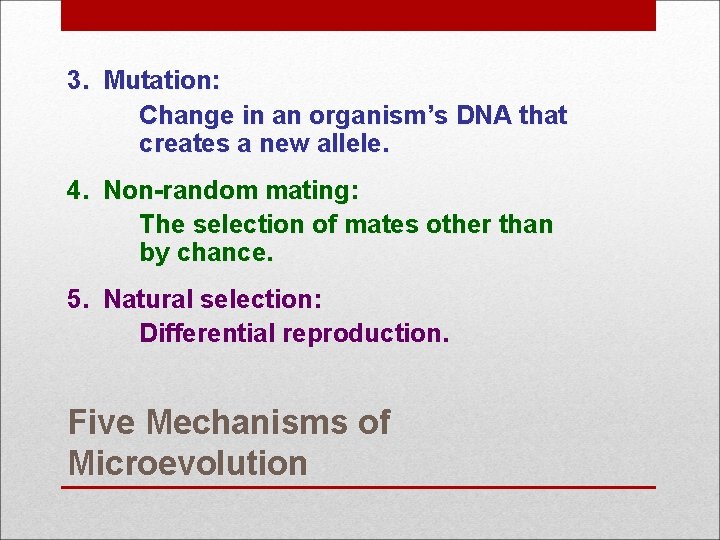
3. Mutation: Change in an organism’s DNA that creates a new allele. 4. Non-random mating: The selection of mates other than by chance. 5. Natural selection: Differential reproduction. Five Mechanisms of Microevolution
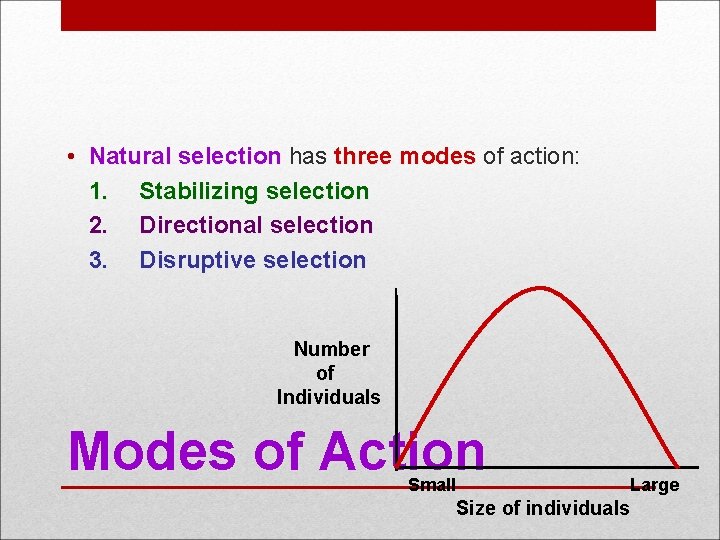
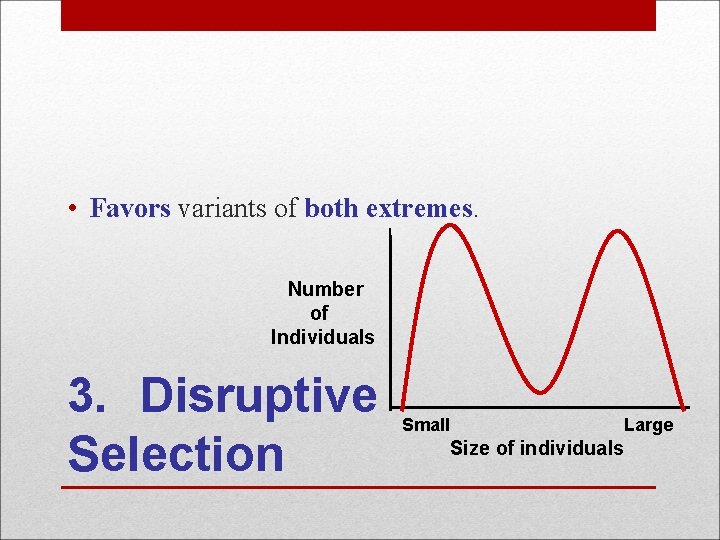
• Natural selection has three modes of action: 1. Stabilizing selection 2. Directional selection 3. Disruptive selection Number of Individuals Modes of Action Small Size of individuals Large
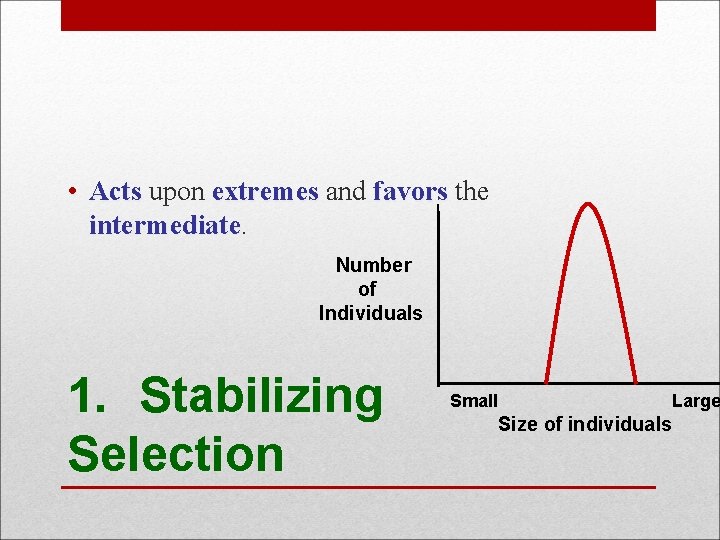
• Acts upon extremes and favors the intermediate Number of Individuals 1. Stabilizing Selection Small Large Size of individuals
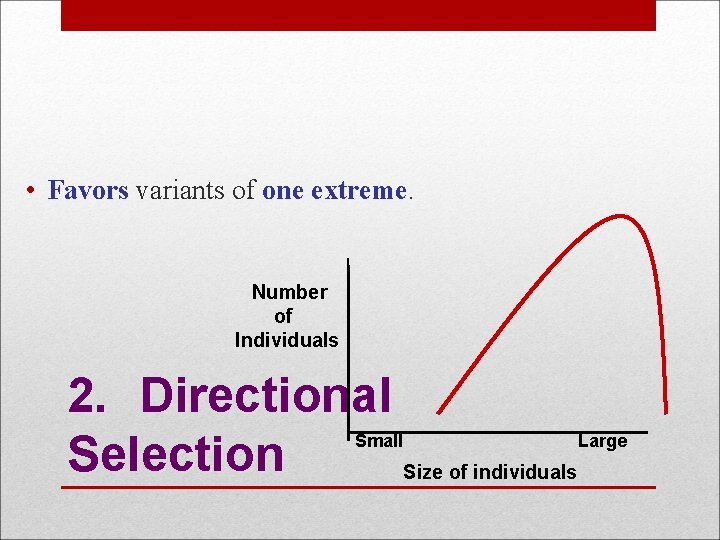
• Favors variants of one extreme Number of Individuals 2. Directional Selection Size of individuals Small Large
• Favors variants of both extremes Number of Individuals 3. Disruptive Selection Small Large Size of individuals
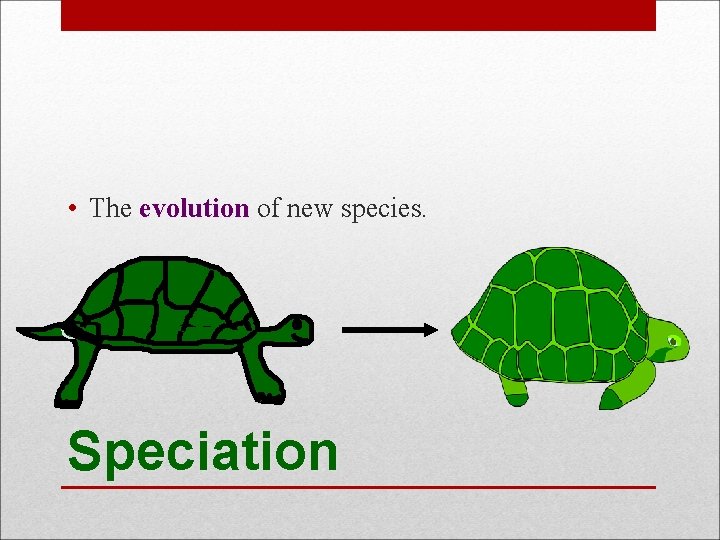
• The evolution of new species. Speciation
• Any mechanism that impedes two species from producing fertile and/or viable hybrid offspring • Two barriers: 1. Pre-zygotic barriers 2. Post-zygotic barriers Reproductive Barriers
a. Temporal isolation: Breeding occurs at different times for different species. b. Habitat isolation: Species breed in different habitats. c. Behavioral isolation: Little or no sexual attraction between species. 1. Pre-zygotic Barriers
d. Mechanical isolation: Structural differences prevent gamete exchange. e. Gametic isolation: Gametes die before uniting with gametes of other species, or gametes fail to unite. 1. Pre-zygotic Barriers
a. Hybrid inviability: Hybrid zygotes fail to develop or fail to reach sexual maturity. b. Hybrid sterility: Hybrid fails to produce functional gametes. 2. Post-zygotic Barriers c. Hybrid breakdown: Offspring of hybrids are weak or infertile.
• Induced when the ancestral population becomes separated by a geographical barrier. • Example: Grand Canyon and ground squirrels Allopatric Speciation
• Emergence of numerous species from a common ancestor introduced to new and diverse environments. • Example: Darwin’s Finches Adaptive Radiation
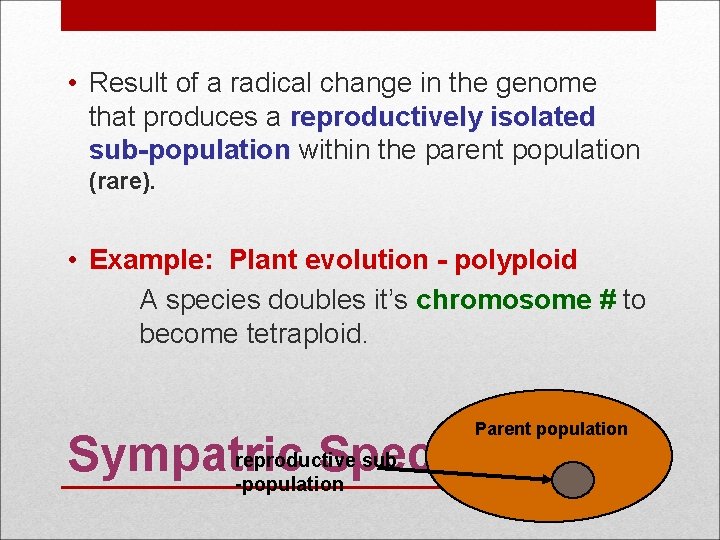
• Result of a radical change in the genome that produces a reproductively isolated sub-population within the parent population (rare). • Example: Plant evolution - polyploid A species doubles it’s chromosome # to become tetraploid. Parent population reproductive sub Sympatric Speciation -population
• Two theories: 1. Gradualist Model (Neo-Darwinian): Slow changes in species overtime. 2. Punctuated Equilibrium: Evolution occurs in spurts of rapid change. Interpretations of Speciation relatively
• Species from different evolutionary branches may come to resemble one another if they live in very similar environments. • Example: 1. Ostrich (Africa) and Emu (Australia). 2. Sidewinder (Mojave Desert) and Horned Viper (Middle East Desert) Convergent Evolution
• Evolutionary change, change in which one species act as a selective force on a second species, inducing adaptations that in turn act as selective force on the first species. • Example: 1. Acacia ants and acacia trees 2. Humming birds and plants with flowers with long tubes Coevolution
This powerpoint was kindly donated to www. worldofteaching. com http: //www. worldofteaching. com is home to over a thousand powerpoints submitted by teachers. This is a completely free site and requires no registration. Please visit and I hope it will help in your teaching.
• • • Create a fictional animal Describe where your animal lives What does your animal eat? What eats your animal? Describe the adaptions your animal has that help it to survive. • Pick a trait that helps it survive and describe what type of natural selection it is and draw a graph representing this type of natural selection