
EVOLUTION change over time Charles Darwin The main
- Slides: 23
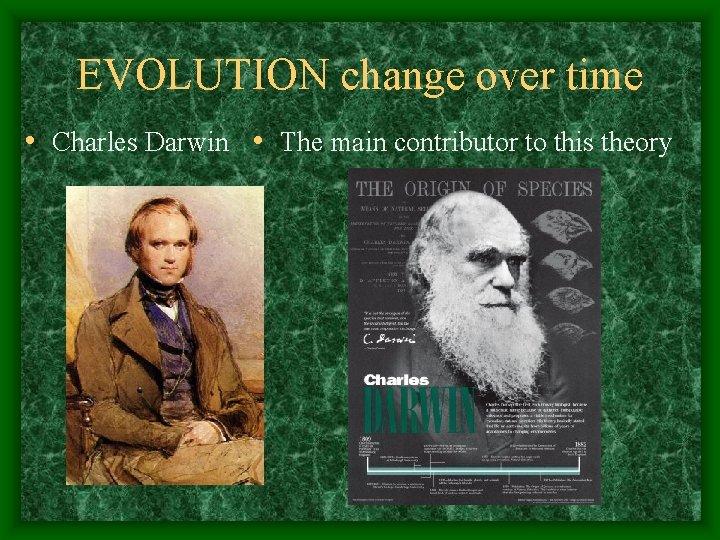
EVOLUTION change over time • Charles Darwin • The main contributor to this theory
EVOLUTION change over time • Charles Darwin • The main contributor to this theory • Principle points • Individuals within a species vary ex: larger fruit, more milk, taller, etc
EVOLUTION change over time • Charles Darwin • The main contributor to this theory • Principle points • Individuals within a species vary ex: larger fruit, more milk, taller, etc • These variations are inheritable and can be selected for (artificial selection)
Natural Selection • Natural selection • “survival of the fittest”
Natural Selection • Natural selection • “survival of the fittest” • Individuals with the most ability to survive and reproduce will increase, over time, the prevalence of those characteristics in the population
Natural Selection • Natural • “survival of the fittest” selection • Individuals with the most ability to survive and reproduce will increase, over time, the prevalence of those characteristics in the population • Over long periods of time NS produces organisms with different structures and/or live in different niches or habitats. They change from their ancestors so…….
Natural Selection • This implies a single “tree of life”
Natural Selection • This implies a single “tree of life” • This is now supported by DNA evidence as well
Populations • populations • A group of individuals of the same species that interbreed
Populations • Populations • A group of individuals of the same • Gene pool species that interbreed • All the genes present in a population
Population Terms • Populations • A group of individuals of the same • Gene pool • Relative species that interbreed • All the genes present in a population • The # of times an allele occurs in a gene pool frequency
Population Terms • Populations • A group of individuals of the same • Gene pool • Relative species that interbreed • All the genes present in a population • The # of times an allele occurs in a gene pool frequency • Sources of genetic variation • Sexual reproduction shuffles genes • mutaions
Genetic View of Evolution • Evolutionary fitness is an organisms success in passing genes to the next generation
Genetic View of Evolution • Evolutionary fitness is an organisms success in passing genes to the next generation • Any adaptation that physiologically, anatomically, or behaviorally increases the ability to pass genes on is an evolutionary adaptation
Genetic View of Evolution • Evolutionary fitness is an organisms success in passing genes to the next generation • Any adaptation that physiologically, anatomically, or behaviorally increases the ability to pass genes on is an evolutionary adaptation • Evolution never acts directly on genes
Speciation speciation • Formation of a new species
Speciation speciation • Formation of a new species • Gene pools must separate from original pool
Speciation speciation • Formation of a new species • Gene pools must separate from original pool • Caused by isolation
Three Types of Isolation • Behavioral • Different strategies to mate, court, etc
Three Types of Isolation • Behavioral • Different strategies to mate, court, etc • Geographic • Physical separation ex: river, mtn
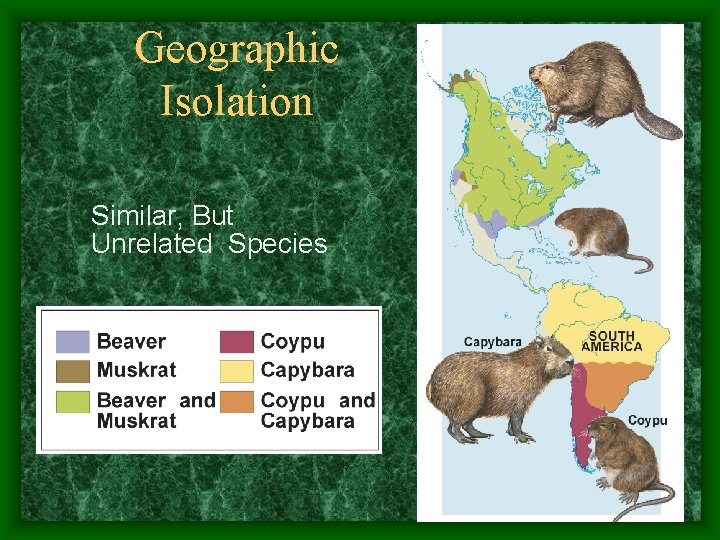
Geographic Isolation Similar, But Unrelated Species
Three Types of Isolation • Behavioral • Different strategies to mate, court, etc • Geographic • Physical separation ex: river, mtn • temporal • Different reproductive timing
Three Types of Isolation • Behavioral • Different strategies to mate, court, etc • Geographic • Physical separation ex: river, mtn • temporal • Different reproductive timing *Is a new species when the populations can no longer interbreed