
Evolution Change in populations over time HISTORY ideas

- Slides: 44
Evolution Change in populations over time
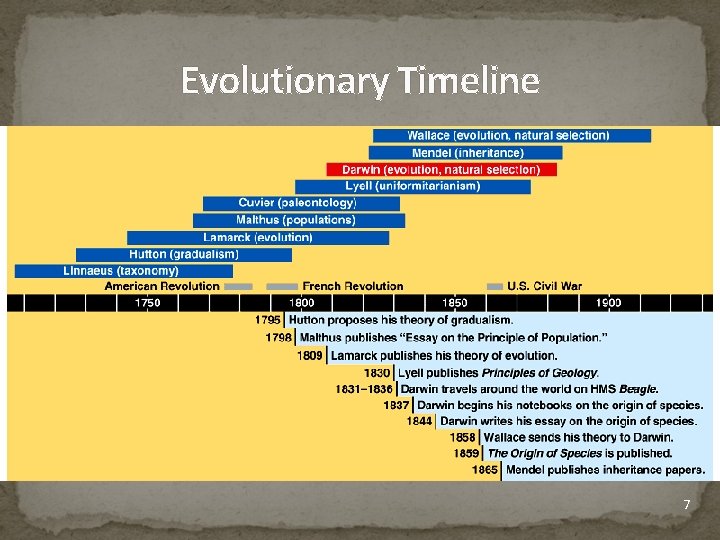
HISTORY – ideas that shaped the current theory �James Hutton (1785) – proposes that Earth is shaped by geological forces that took place over extremely long periods of time --estimates earth to be millions of years old. �Scientist now believe Earth is 4. 6 billion years old! �Thomas Malthus (1798) – predicts that human populations outgrow food supply. Death and famine were inevitable. �Organisms struggle to exist! 2
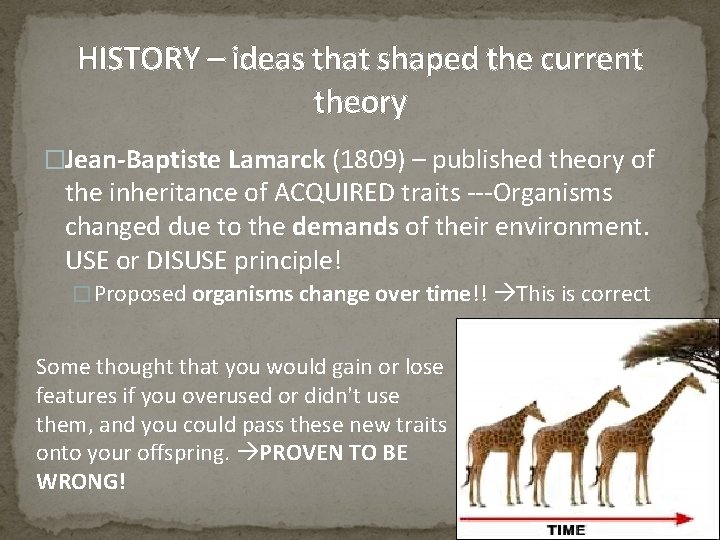
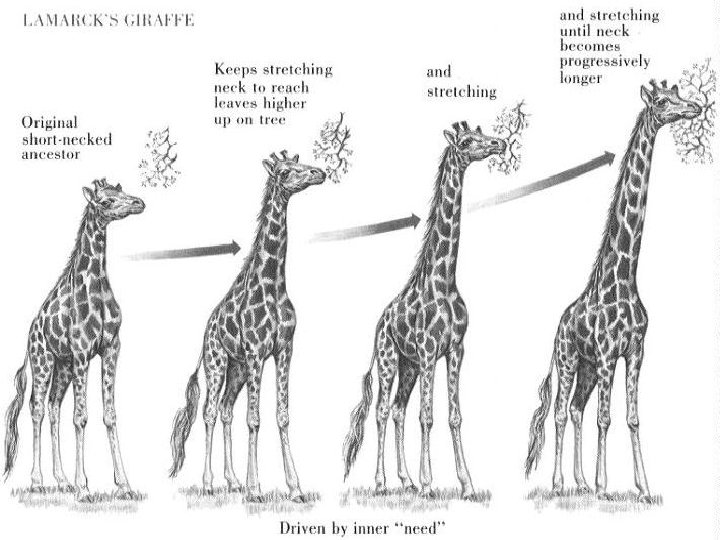
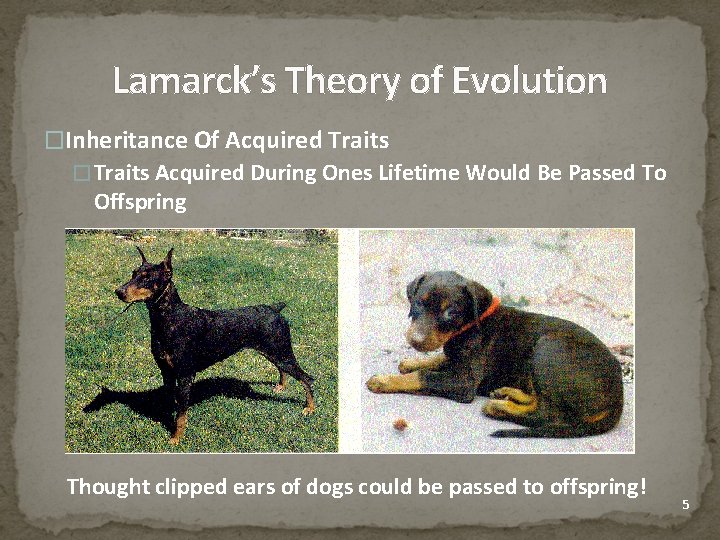
HISTORY – ideas that shaped the current theory �Jean-Baptiste Lamarck (1809) – published theory of the inheritance of ACQUIRED traits ---Organisms changed due to the demands of their environment. USE or DISUSE principle! � Proposed organisms change over time!! This is correct Some thought that you would gain or lose features if you overused or didn't use them, and you could pass these new traits onto your offspring. PROVEN TO BE WRONG! 3
copyright cmassengale 4
Lamarck’s Theory of Evolution �Inheritance Of Acquired Traits �Traits Acquired During Ones Lifetime Would Be Passed To Offspring Thought clipped ears of dogs could be passed to offspring! 5
HISTORY – ideas that shaped the current theory �Charles Lyell (1833) – processes occurring now has shaped Earth’s geological features over long periods of time. �Alfred Wallace (1858) – speculates on evolution by natural selection with emphasis on idea of competition for resources as a main force of natural selection. 6
Evolutionary Timeline 7
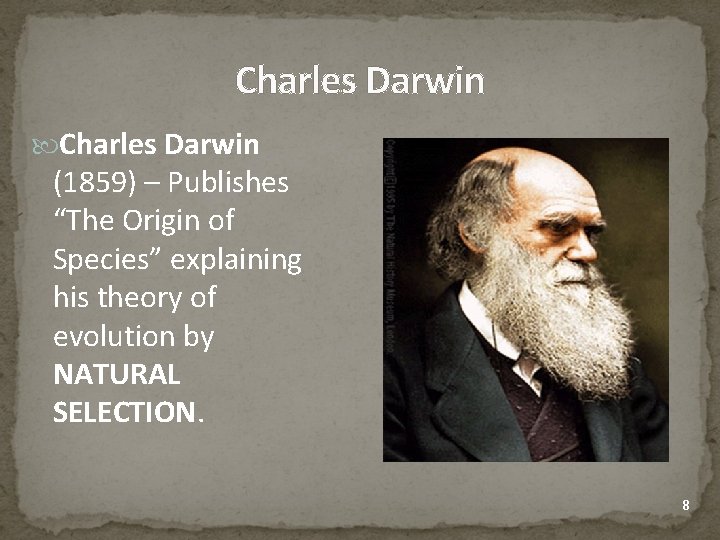
Charles Darwin (1859) – Publishes “The Origin of Species” explaining his theory of evolution by NATURAL SELECTION. 8
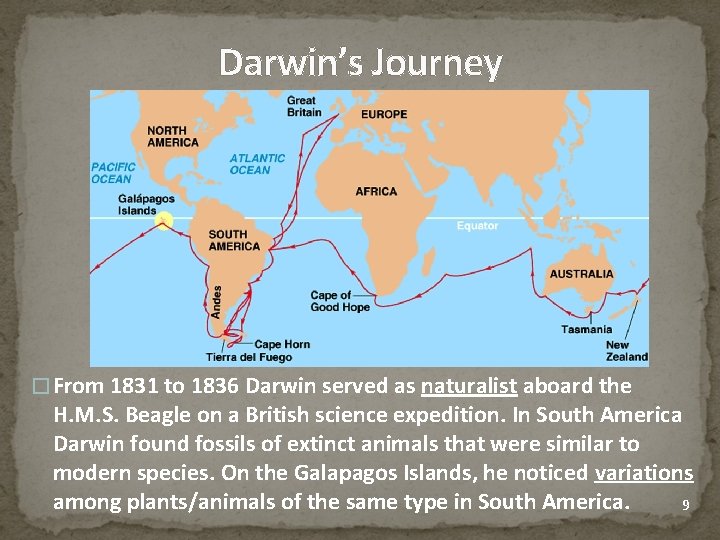
Darwin’s Journey � From 1831 to 1836 Darwin served as naturalist aboard the H. M. S. Beagle on a British science expedition. In South America Darwin found fossils of extinct animals that were similar to modern species. On the Galapagos Islands, he noticed variations among plants/animals of the same type in South America. 9
NATURAL SELECTION: mechanism for evolution �Natural Variations (differences among individuals) exist in all organisms. These variations are inherited and are called adaptations. �ADAPTATIONS that are more favorable become more prevalent within the population. These traits will be passed onto the next generation. The GENE POOL of a population changes in favor of the “FITTEST” phenotype and genotype. �Adaptations Can Be: �Physical-Speed, Camouflage, Claws, Quills, etc. �Behavioral-Solitary, Herds, Packs, Activity, etc. 10
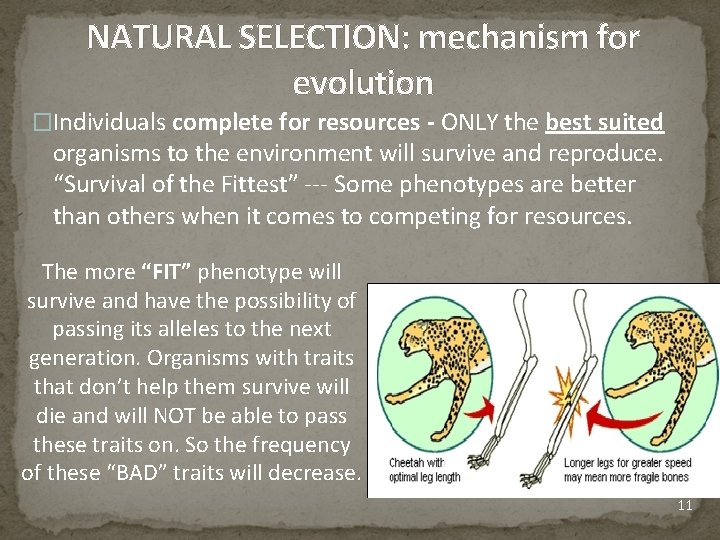
NATURAL SELECTION: mechanism for evolution �Individuals complete for resources - ONLY the best suited organisms to the environment will survive and reproduce. “Survival of the Fittest” --- Some phenotypes are better than others when it comes to competing for resources. The more “FIT” phenotype will survive and have the possibility of passing its alleles to the next generation. Organisms with traits that don’t help them survive will die and will NOT be able to pass these traits on. So the frequency of these “BAD” traits will decrease. 11
NATURAL SELECTION: mechanism for evolution �The Struggle for Existence - Darwin realized that high birth rates and a shortage of life's basic needs would force organisms to compete for resources like food, living space, etc…. Therefore, organisms will produce more offspring than can survive, and many that do survive will NOT reproduce. 12
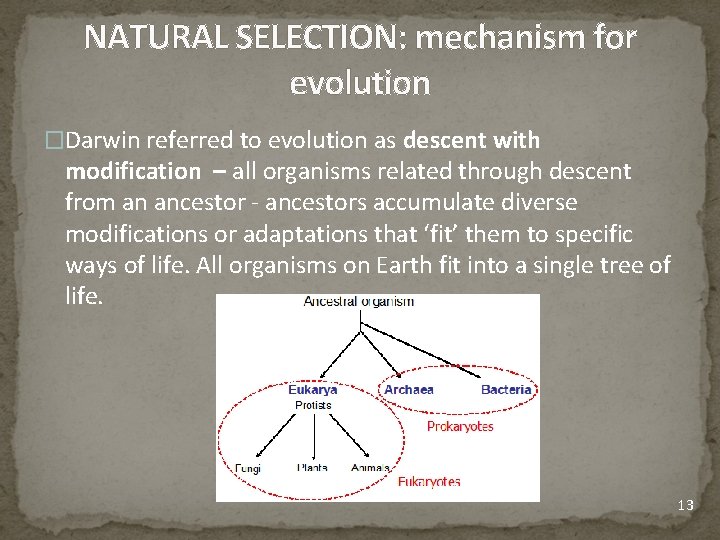
NATURAL SELECTION: mechanism for evolution �Darwin referred to evolution as descent with modification – all organisms related through descent from an ancestor - ancestors accumulate diverse modifications or adaptations that ‘fit’ them to specific ways of life. All organisms on Earth fit into a single tree of life. 13
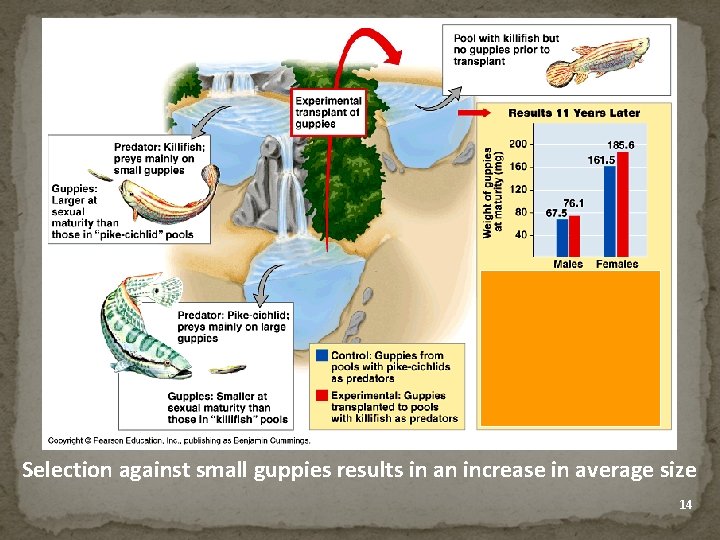
Evidence for Evolution – Evolution Observed Selection against small guppies results in an increase in average size 14
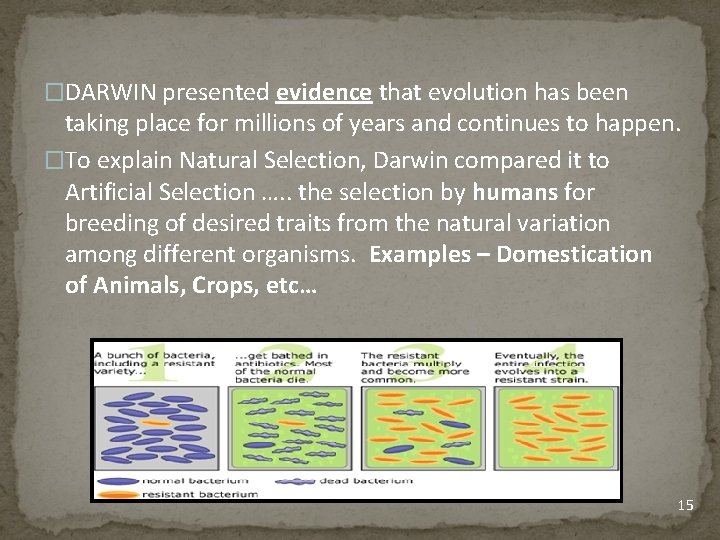
�DARWIN presented evidence that evolution has been taking place for millions of years and continues to happen. �To explain Natural Selection, Darwin compared it to Artificial Selection …. . the selection by humans for breeding of desired traits from the natural variation among different organisms. Examples – Domestication of Animals, Crops, etc… 15
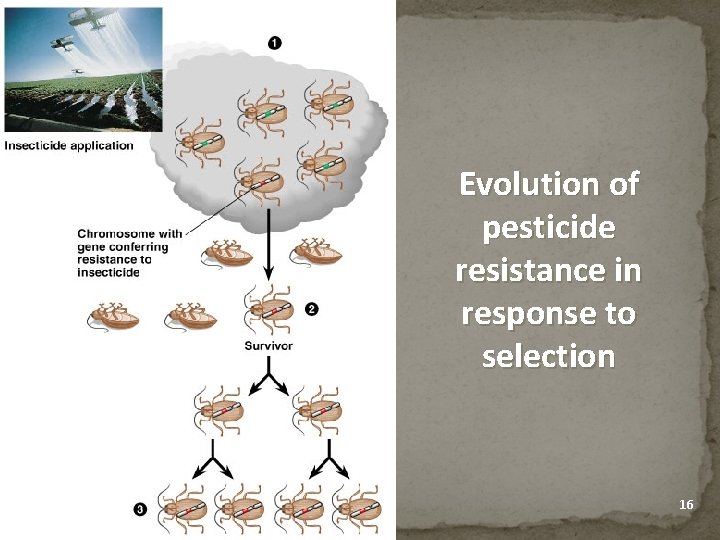
Evolution of pesticide resistance in response to selection 16
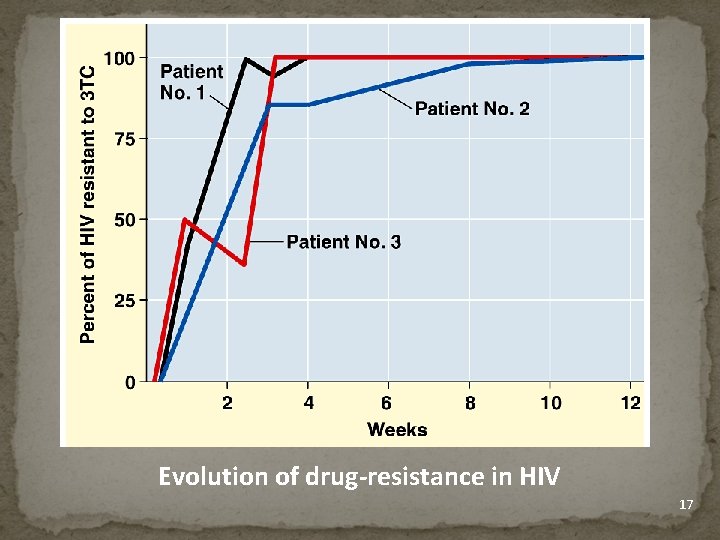
Evidence for Evolution – Evolution Observed Evolution of drug-resistance in HIV 17
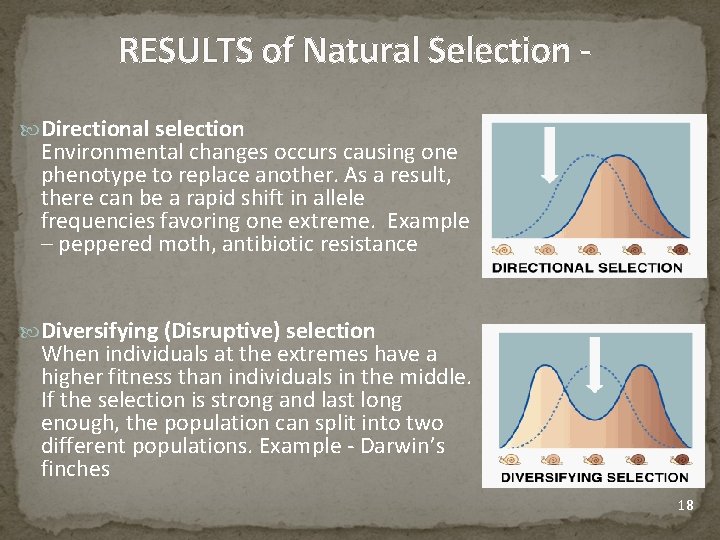
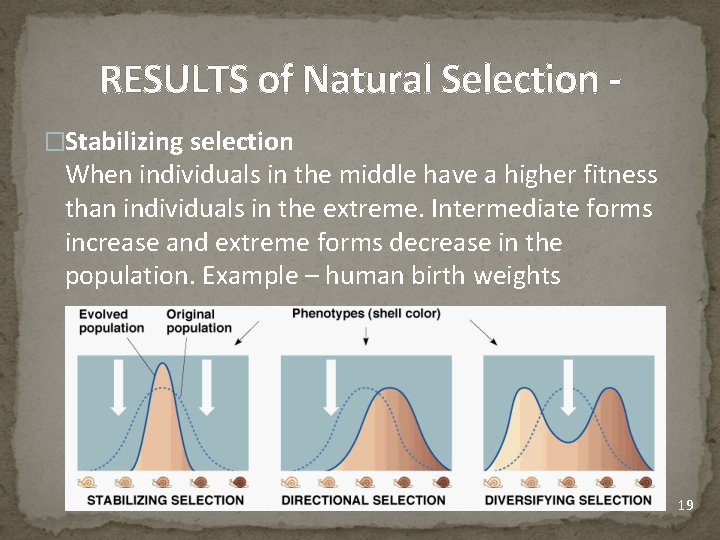
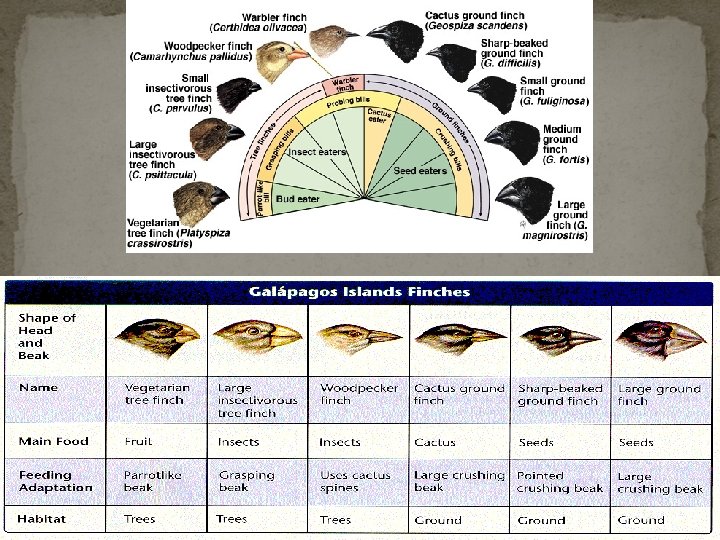
RESULTS of Natural Selection Directional selection Environmental changes occurs causing one phenotype to replace another. As a result, there can be a rapid shift in allele frequencies favoring one extreme. Example – peppered moth, antibiotic resistance Diversifying (Disruptive) selection When individuals at the extremes have a higher fitness than individuals in the middle. If the selection is strong and last long enough, the population can split into two different populations. Example - Darwin’s finches 18
RESULTS of Natural Selection �Stabilizing selection When individuals in the middle have a higher fitness than individuals in the extreme. Intermediate forms increase and extreme forms decrease in the population. Example – human birth weights 19
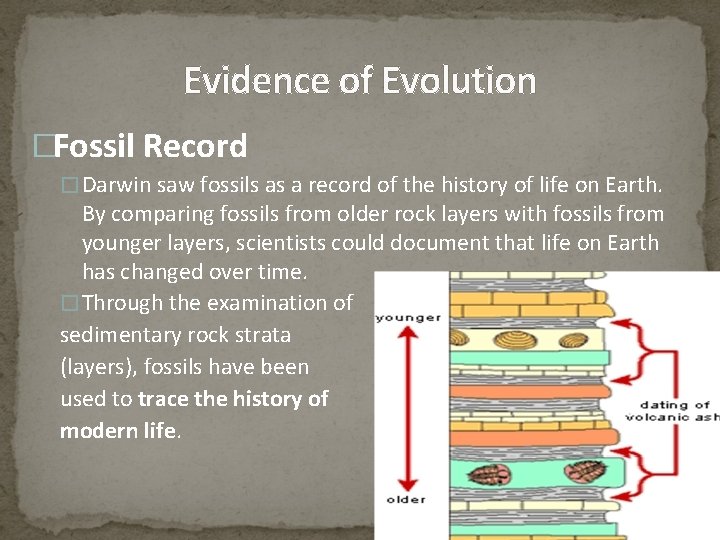
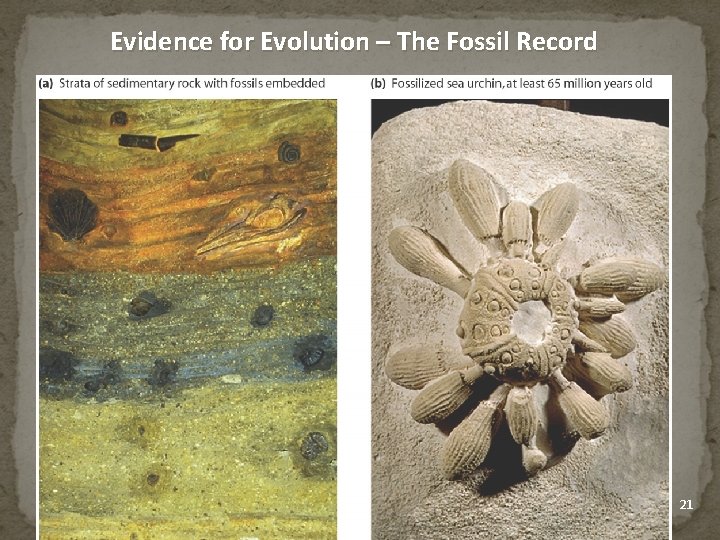
Evidence of Evolution �Fossil Record � Darwin saw fossils as a record of the history of life on Earth. By comparing fossils from older rock layers with fossils from younger layers, scientists could document that life on Earth has changed over time. � Through the examination of sedimentary rock strata (layers), fossils have been used to trace the history of modern life. 20
Evidence for Evolution – The Fossil Record copyright cmassengale 21
Evidence of Evolution �Geographic distribution �Darwin’s theory was that many species now living had each descended from a common ancestor. While many of these newer species shared similarities, they had each adapted to their new environments. This results in Adaptive Radiation. 22
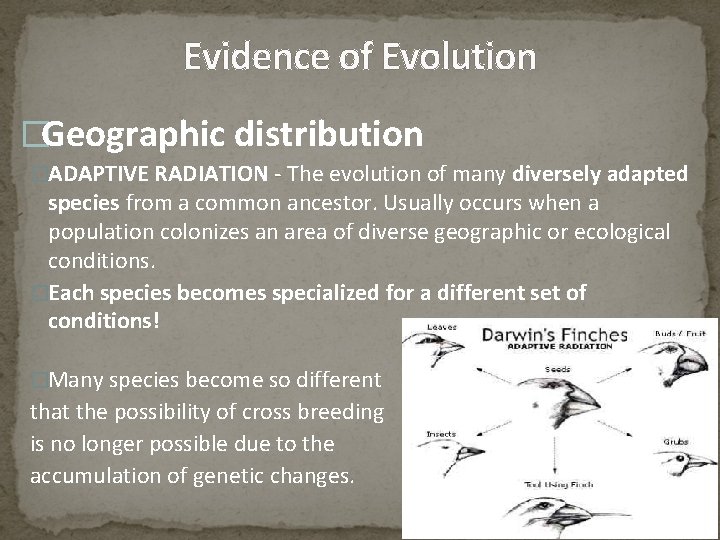
Evidence of Evolution �Geographic distribution �ADAPTIVE RADIATION - The evolution of many diversely adapted species from a common ancestor. Usually occurs when a population colonizes an area of diverse geographic or ecological conditions. �Each species becomes specialized for a different set of conditions! �Many species become so different that the possibility of cross breeding is no longer possible due to the accumulation of genetic changes. 23
24
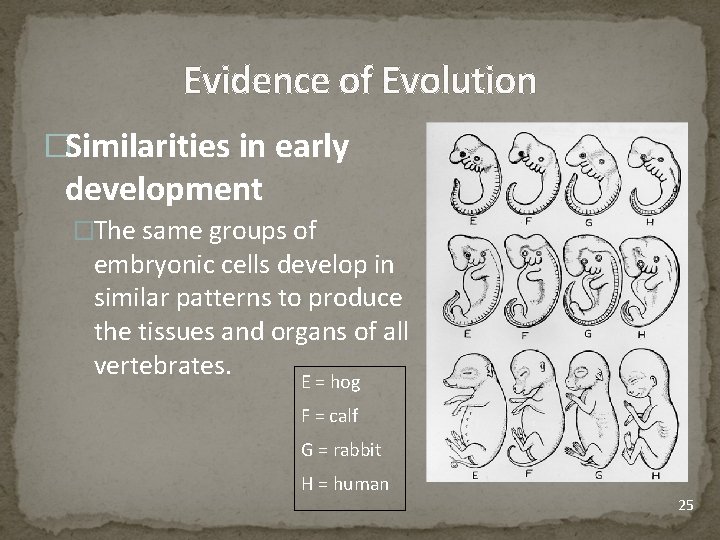
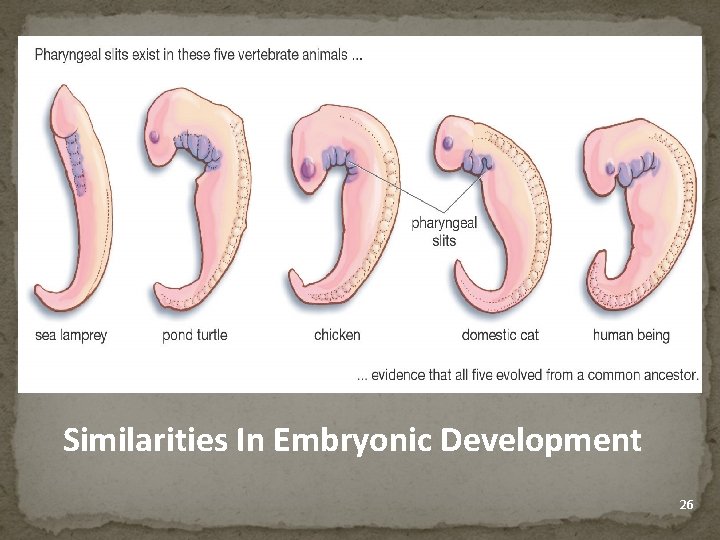
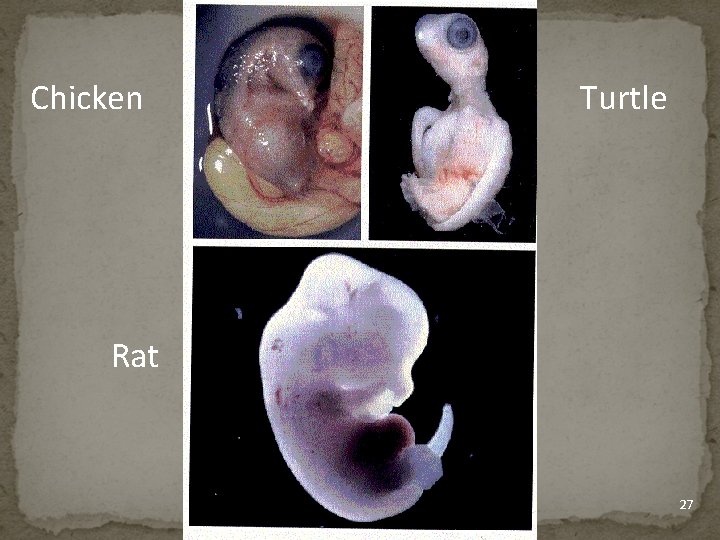
Evidence of Evolution �Similarities in early development �The same groups of embryonic cells develop in similar patterns to produce the tissues and organs of all vertebrates. E = hog F = calf G = rabbit H = human 25
Evidence for Evolution - Comparative Embryology Similarities In Embryonic Development 26
Chicken Turtle Rat copyright cmassengale 27
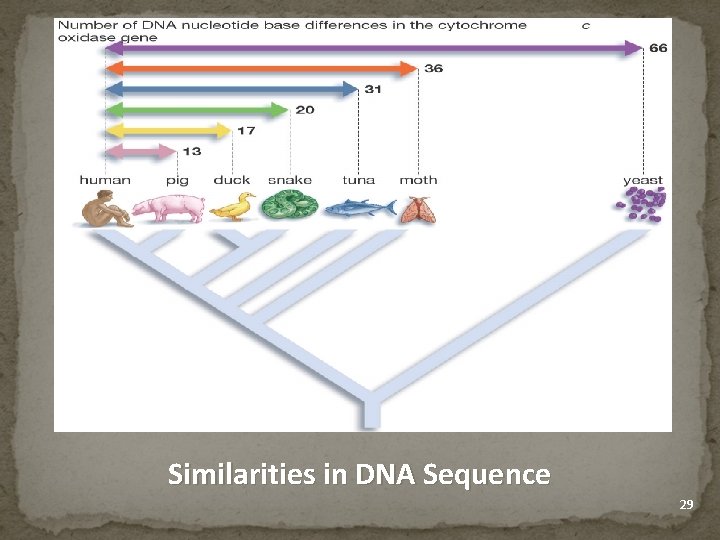
Evidence of Evolution �Genetic Evidence � All species of life have the same basic genetic machinery of RNA and DNA and the genetic code is essentially universal. � Sources of genetic variation in species: �Mutations �Independent Assortment �Crossing over �Sexual Reproduction 28
Similarities in DNA Sequence 29
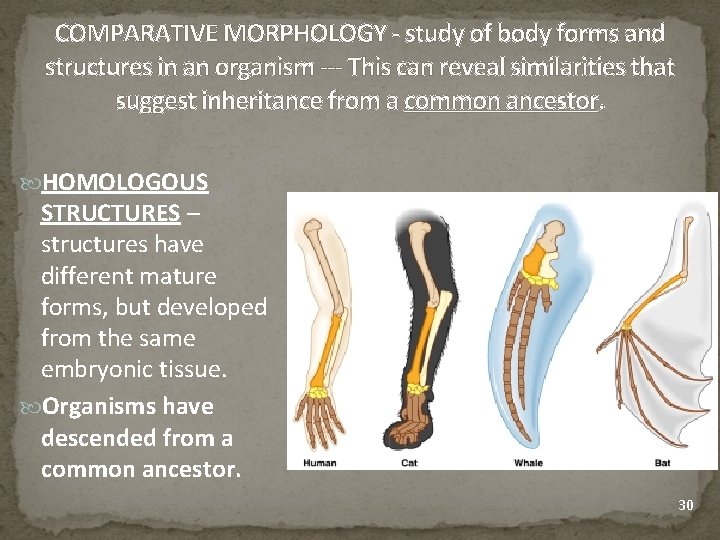
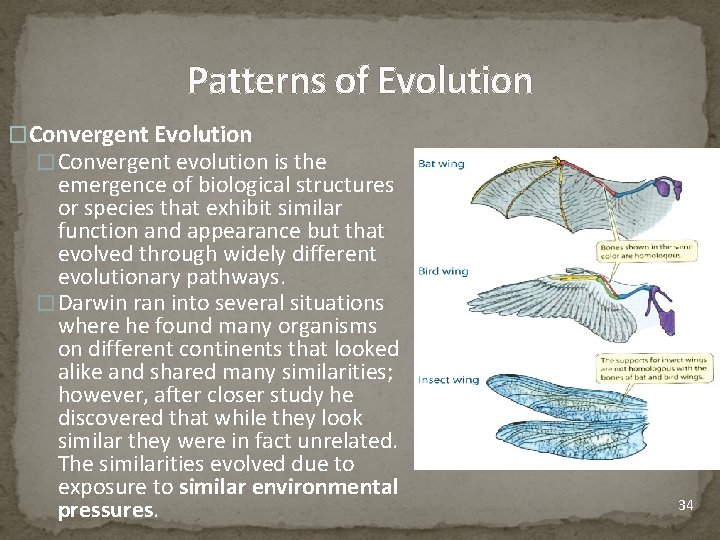
COMPARATIVE MORPHOLOGY - study of body forms and structures in an organism --- This can reveal similarities that suggest inheritance from a common ancestor. HOMOLOGOUS STRUCTURES – structures have different mature forms, but developed from the same embryonic tissue. Organisms have descended from a common ancestor. 30
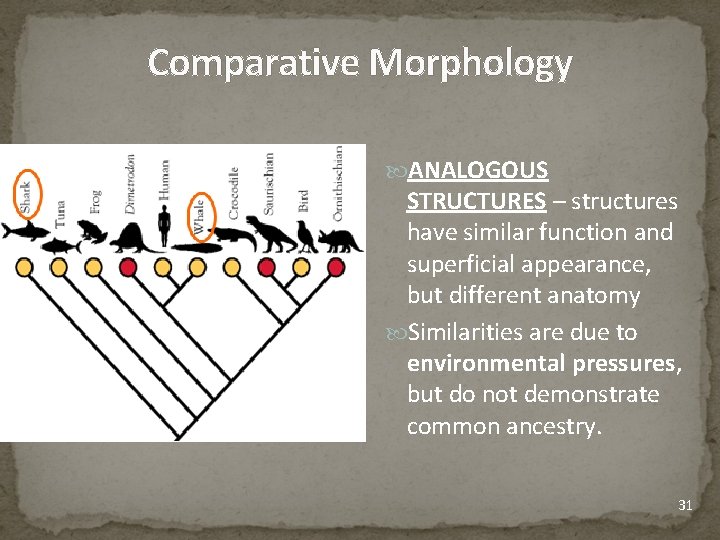
Comparative Morphology ANALOGOUS STRUCTURES – structures have similar function and superficial appearance, but different anatomy Similarities are due to environmental pressures, but do not demonstrate common ancestry. 31
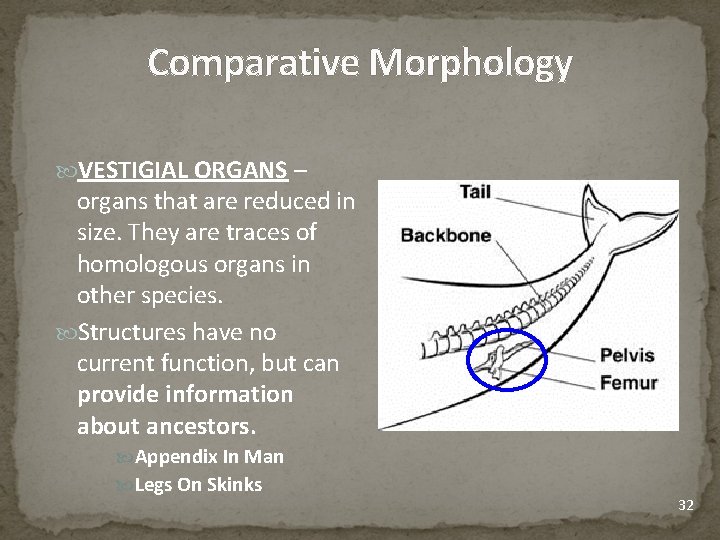
Comparative Morphology VESTIGIAL ORGANS – organs that are reduced in size. They are traces of homologous organs in other species. Structures have no current function, but can provide information about ancestors. Appendix In Man Legs On Skinks 32
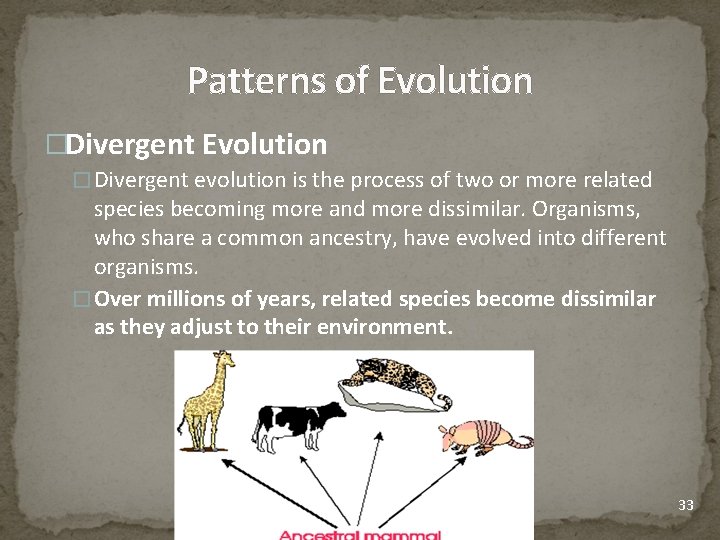
Patterns of Evolution �Divergent evolution is the process of two or more related species becoming more and more dissimilar. Organisms, who share a common ancestry, have evolved into different organisms. �Over millions of years, related species become dissimilar as they adjust to their environment. 33
Patterns of Evolution �Convergent Evolution � Convergent evolution is the emergence of biological structures or species that exhibit similar function and appearance but that evolved through widely different evolutionary pathways. � Darwin ran into several situations where he found many organisms on different continents that looked alike and shared many similarities; however, after closer study he discovered that while they look similar they were in fact unrelated. The similarities evolved due to exposure to similar environmental pressures. 34
Patterns of Evolution �Coevolution �Co. Evolution is the joint change of two or more species in close interaction. Example - Bumblebees & the flowers they pollinate have coevolved so that both have become dependent on each other for survival. 35
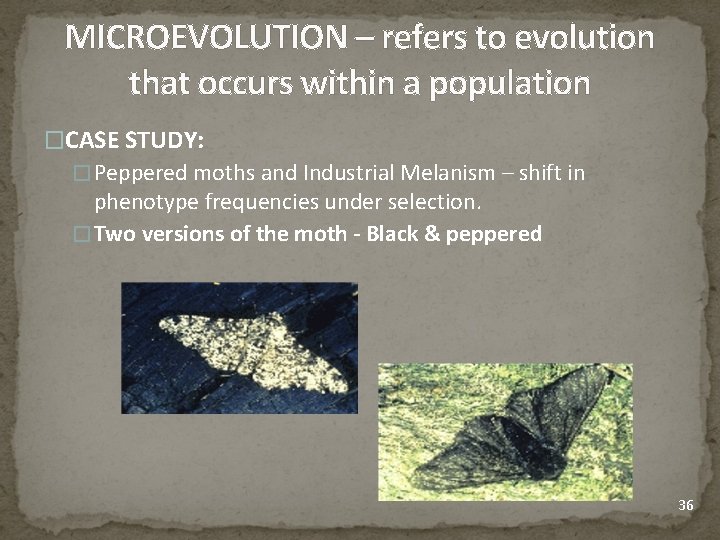
MICROEVOLUTION – refers to evolution that occurs within a population �CASE STUDY: � Peppered moths and Industrial Melanism – shift in phenotype frequencies under selection. � Two versions of the moth - Black & peppered 36
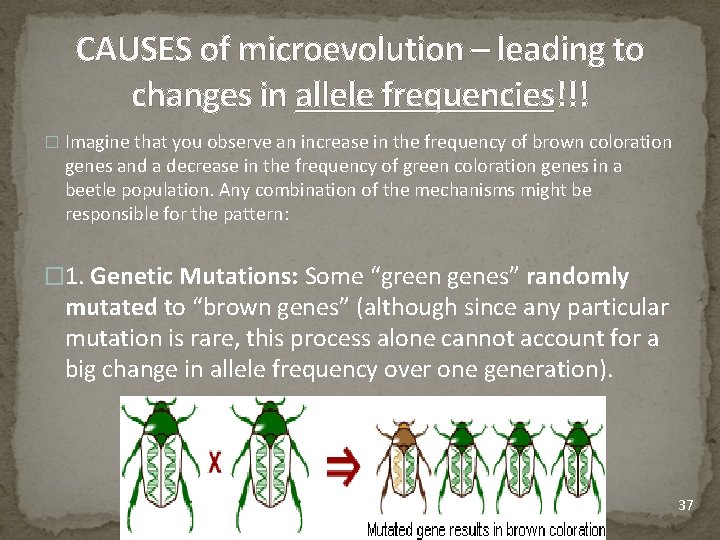
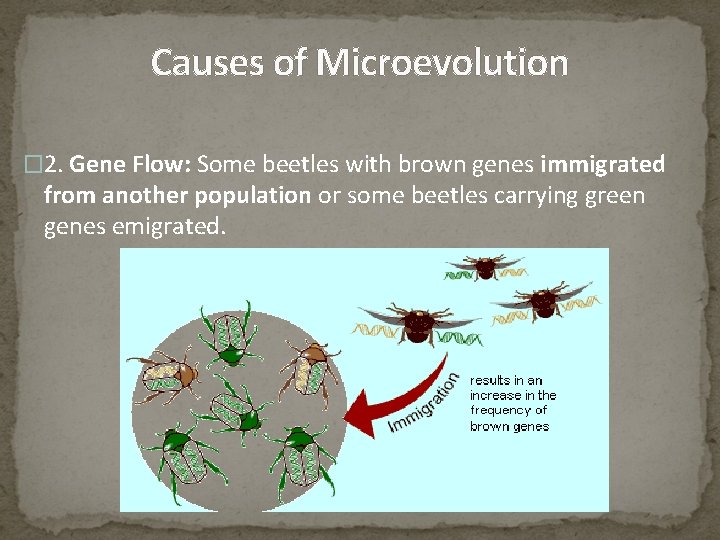
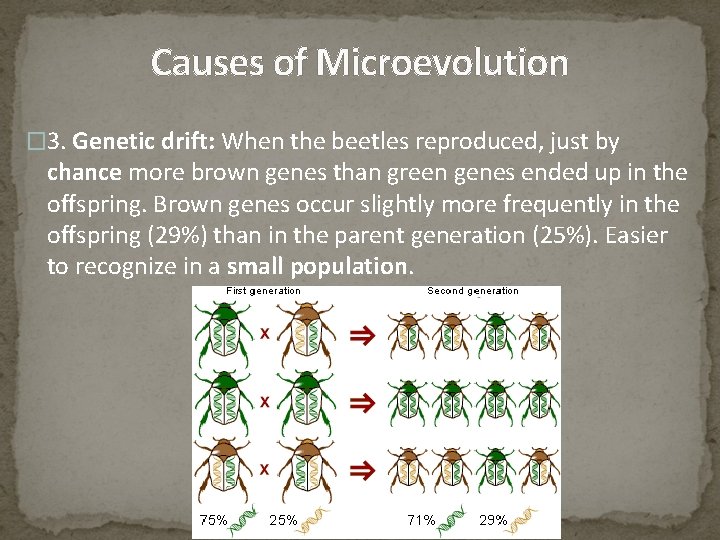
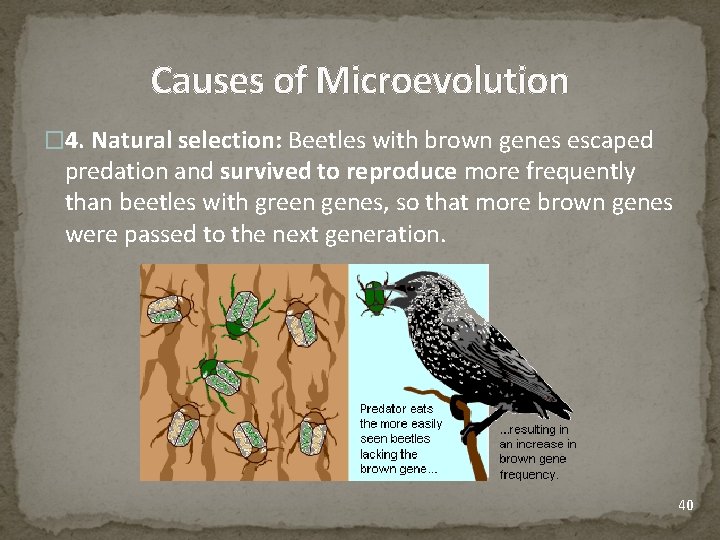
CAUSES of microevolution – leading to changes in allele frequencies!!! � Imagine that you observe an increase in the frequency of brown coloration genes and a decrease in the frequency of green coloration genes in a beetle population. Any combination of the mechanisms might be responsible for the pattern: � 1. Genetic Mutations: Some “green genes” randomly mutated to “brown genes” (although since any particular mutation is rare, this process alone cannot account for a big change in allele frequency over one generation). 37
Causes of Microevolution � 2. Gene Flow: Some beetles with brown genes immigrated from another population or some beetles carrying green genes emigrated.
Causes of Microevolution � 3. Genetic drift: When the beetles reproduced, just by chance more brown genes than green genes ended up in the offspring. Brown genes occur slightly more frequently in the offspring (29%) than in the parent generation (25%). Easier to recognize in a small population.
Causes of Microevolution � 4. Natural selection: Beetles with brown genes escaped predation and survived to reproduce more frequently than beetles with green genes, so that more brown genes were passed to the next generation. 40
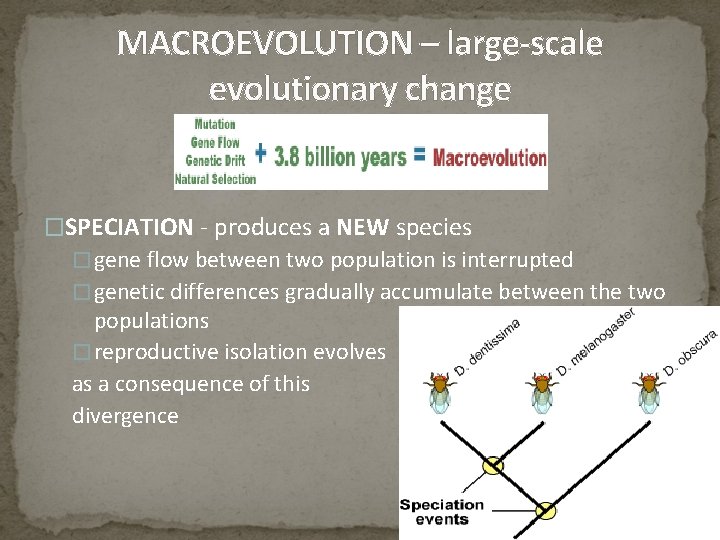
MACROEVOLUTION – large-scale evolutionary change �SPECIATION - produces a NEW species � gene flow between two population is interrupted � genetic differences gradually accumulate between the two populations � reproductive isolation evolves as a consequence of this divergence 41
MECHANISMS leading to speciation: �Geographic Isolation �Separated by bodies of water or mountains. �Temporal Isolation �Reproduction takes place at different times of the year �Behavioral Isolation �Populations are capable of interbreeding, but have different courtship rituals or other type of behavior. 42
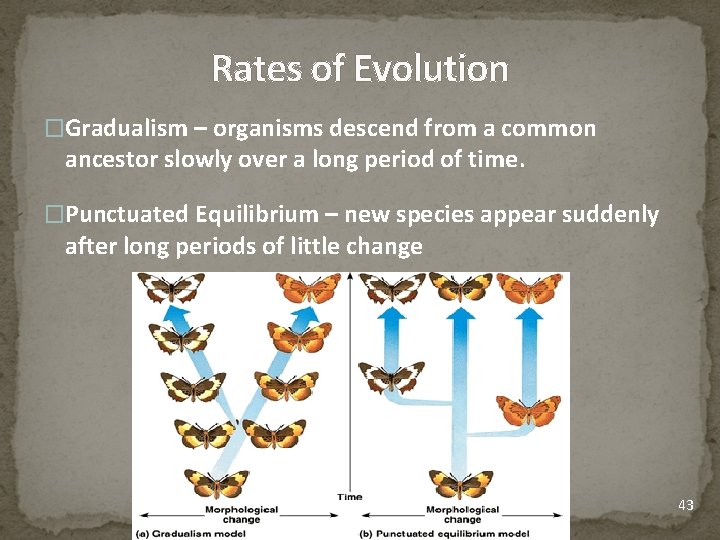
Rates of Evolution �Gradualism – organisms descend from a common ancestor slowly over a long period of time. �Punctuated Equilibrium – new species appear suddenly after long periods of little change 43
Quick Review � Natural Variation-Differences Among Individuals Of A Species � Artificial Selection-Selective Breeding To Enhance Desired Traits Among Stock or Crops � Natural Selection: � The Struggle for Existence (compete for food, mates, space, water, etc. ) � Survival of the Fittest (strongest able to survive and reproduce) � Fitness-Ability of an Individual To Survive & Reproduce � Adaptation-Inherited Characteristic That Increases an Organisms Chance for Survival � Descent with Modification (new species over time arise from common ancestor replacing less fit species) � Evidence for Natural Selection: Fossil record, geographic distribution, similarities in early development, homologous structures 44