
Evolution CHANGE Essential Questions 1 Who is Charles
- Slides: 45
Evolution CHANGE
Essential Questions ■ ■ 1. Who is Charles Darwin? 2. What was his contribution to science? 3. What is Natural Selection? 4. How does natural selection shape a species?
Early Thinking on the Origin of Life ■ Spontaneous generation (abiogenesis) Non-living objects can give rise to living organisms ❑ A stick falls into a stream and turns into a fish ❑ ■ ■ ■ Early Thoughts Observation: Every year in the spring, the Nile River flooded areas of Egypt along the river, leaving behind nutrient-rich mud that enabled the people to grow that year’s crop of food. However, along with the muddy soil, large numbers of frogs appeared that weren’t around in drier times. Conclusion: It was perfectly obvious to people back then that the muddy soil gave rise to the frogs.
Spontaneous Generation Disproved ■ Three experiments disproved spontaneous generation and proved biogenesis (living organisms are descended from other living organisms) ❑ ❑ ❑ Redi, 1688 Spallanzani, late 1700’s Pasteur, 1860
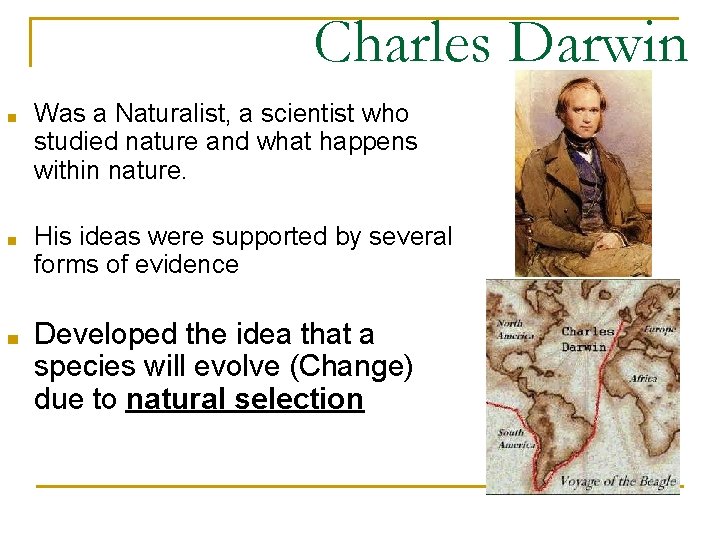
Charles Darwin ■ Was a Naturalist, a scientist who studied nature and what happens within nature. ■ His ideas were supported by several forms of evidence ■ Developed the idea that a species will evolve (Change) due to natural selection
Darwin’s Theory of Natural Selection ■ ■ Natural selection is the gradual, non-random process by which traits become either more or less common in a population due to mate selection. Reproductive mate selection takes place and the best traits for survival are chosen for. ❑ Takes thousands of years to affect a population of animals
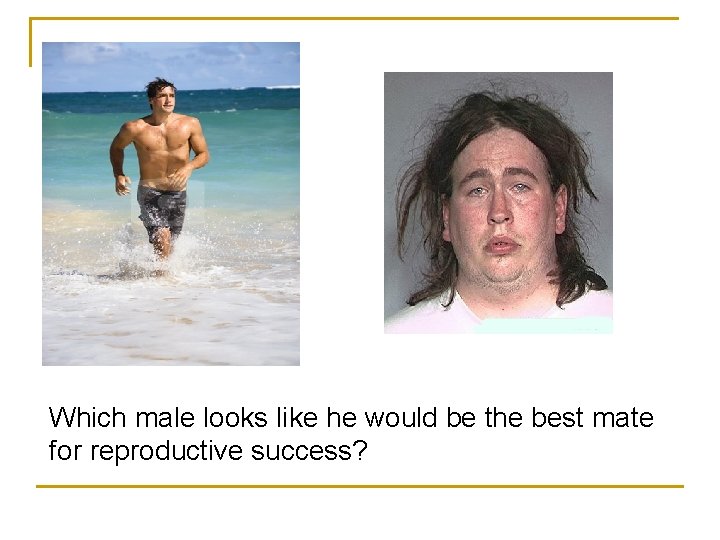
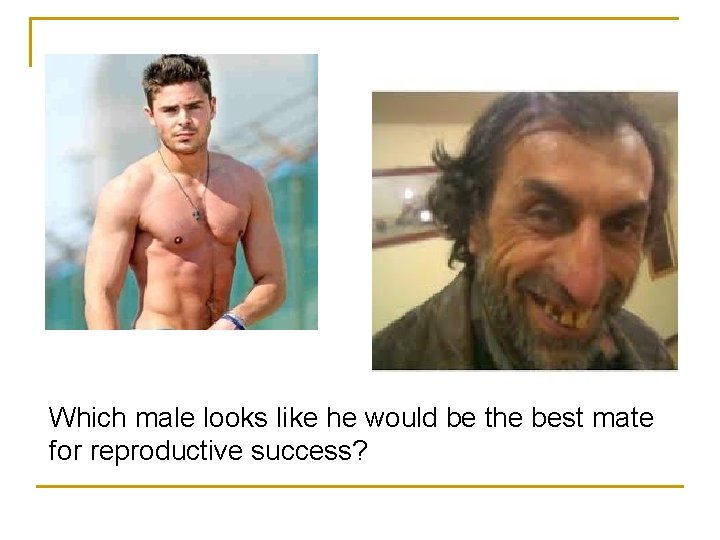
Which male looks like he would be the best mate for reproductive success?
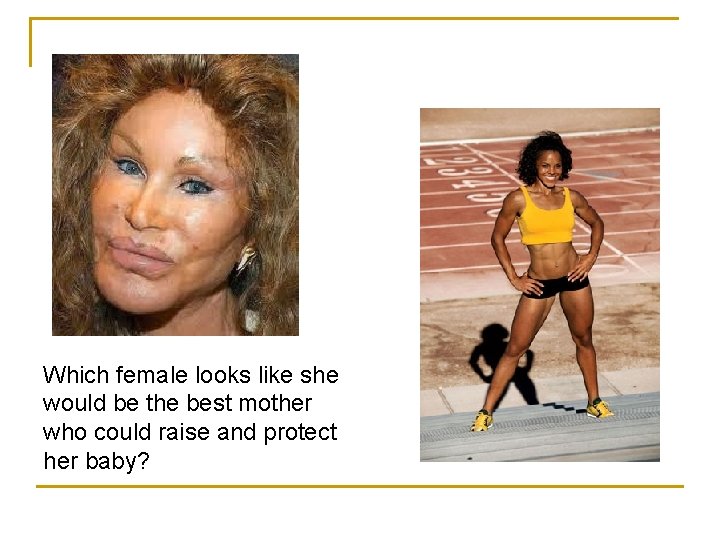
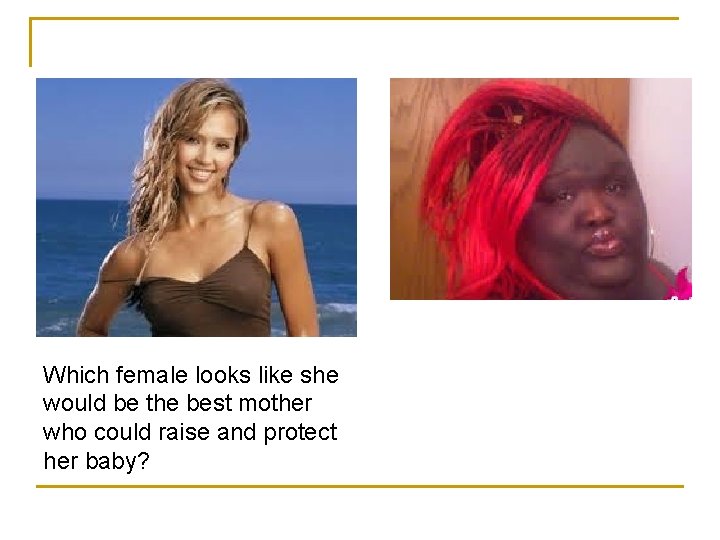
Which female looks like she would be the best mother who could raise and protect her baby?
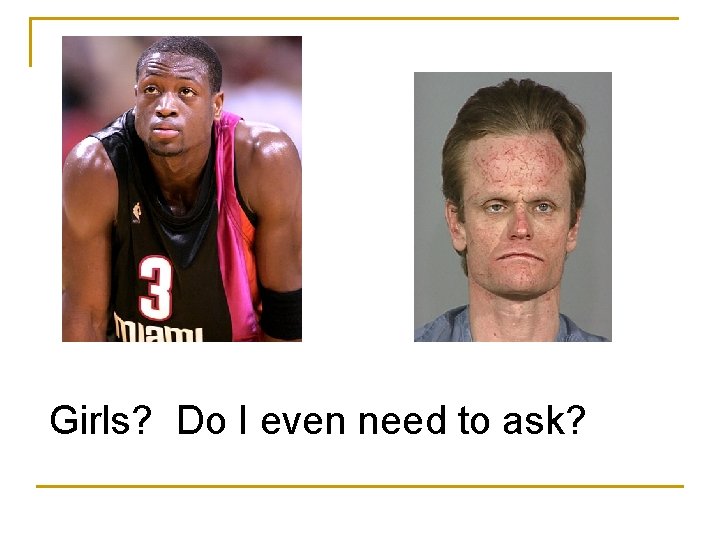
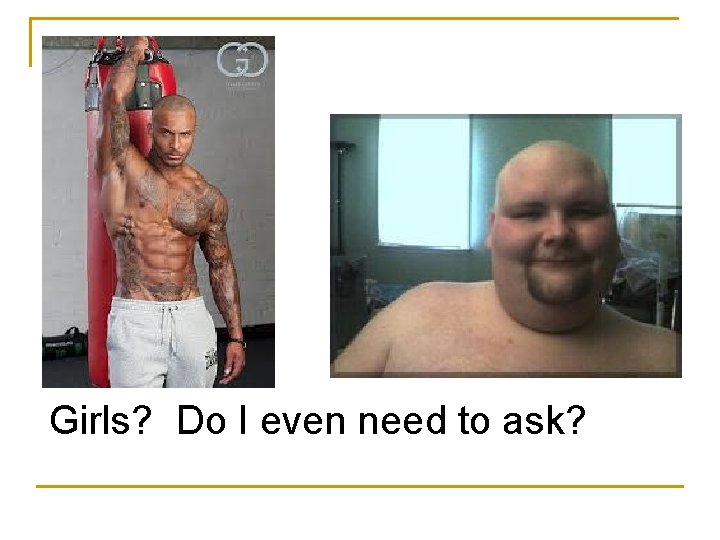
Girls? Do I even need to ask?
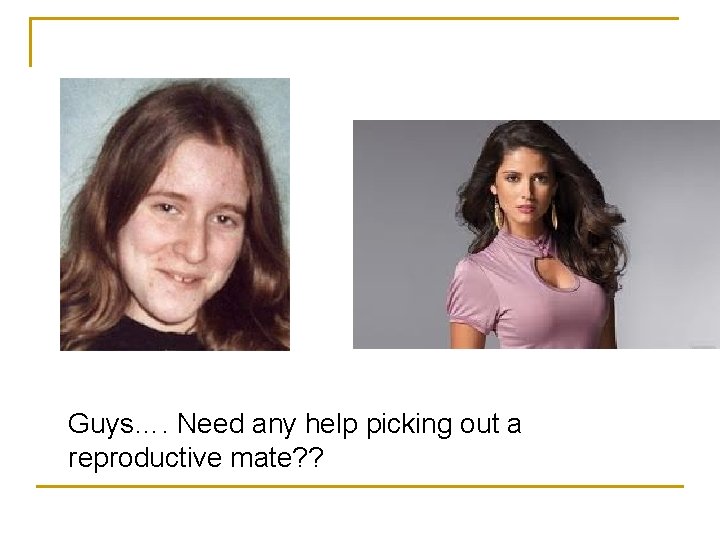
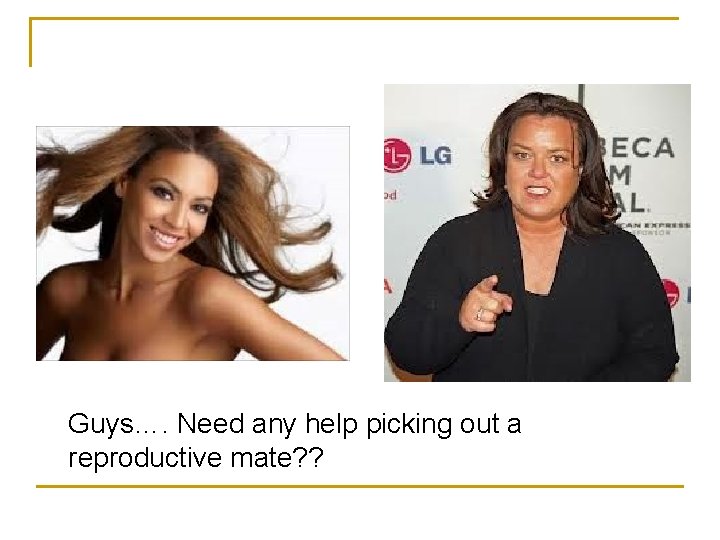
Guys…. Need any help picking out a reproductive mate? ?
Natural Selection How are mates selected for in nature? Who has the best traits for survival? Is it in our DNA who we are attracted to?
Which male looks like he would be the best mate for reproductive success?
Which female looks like she would be the best mother who could raise and protect her baby?
Girls? Do I even need to ask?
Guys…. Need any help picking out a reproductive mate? ?
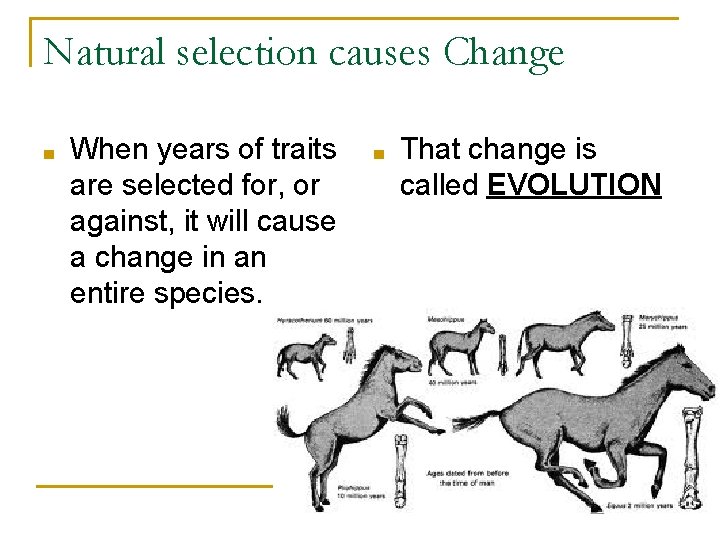
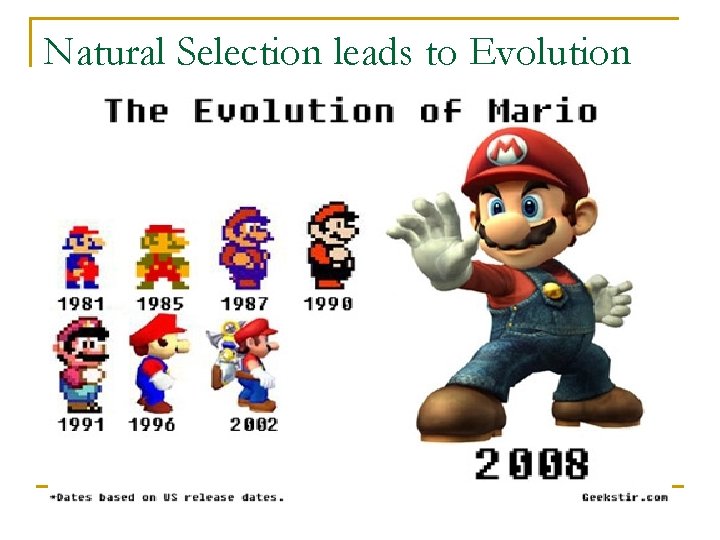
Natural selection causes Change ■ When years of traits are selected for, or against, it will cause a change in an entire species. ■ That change is called EVOLUTION
Natural Selection leads to Evolution
Survival of the fittest ONLY THE STRONG WILL SURVIVE!!
Essential Questions: ■ ■ 1. What causes evolution? 2. What evidence is there that evolution exists? 3. What is fitness? 4. What happens when an organism is “un-fit” for a particular area?
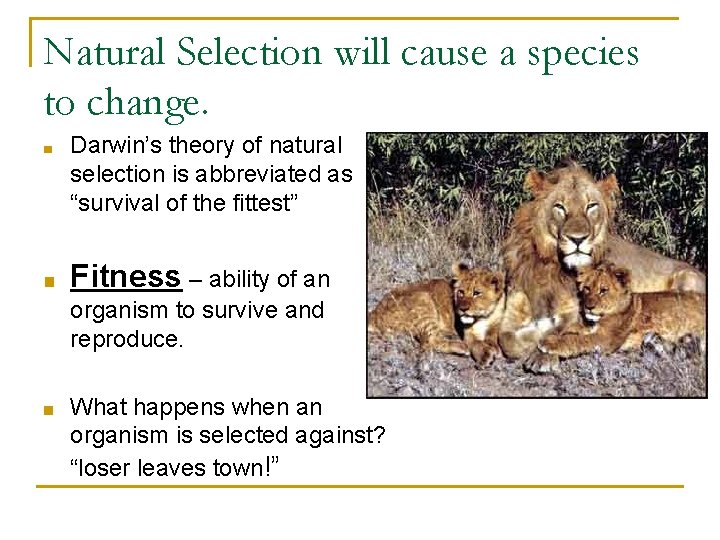
Natural Selection will cause a species to change. ■ ■ Darwin’s theory of natural selection is abbreviated as “survival of the fittest” Fitness – ability of an organism to survive and reproduce. ■ What happens when an organism is selected against? “loser leaves town!”
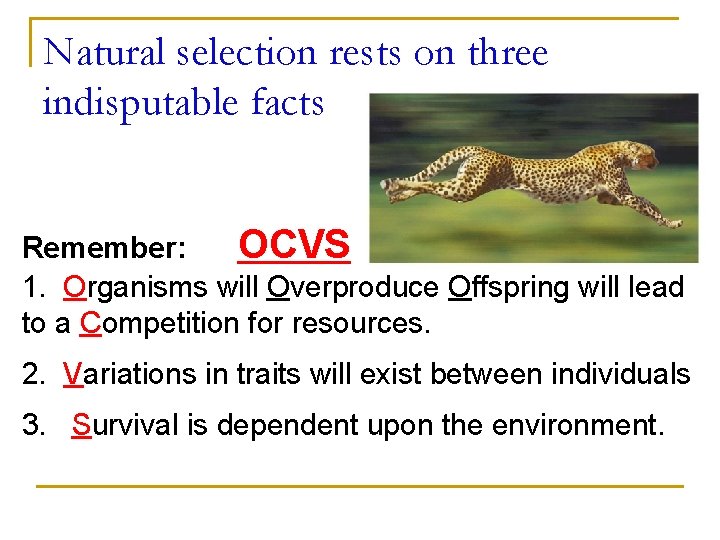
Natural selection rests on three indisputable facts Remember: OCVS 1. Organisms will Overproduce Offspring will lead to a Competition for resources. 2. Variations in traits will exist between individuals 3. Survival is dependent upon the environment.
Results of Natural Selection Adaptive Radiation When one species evolves into many different species in order to adapt to the environment This is called speciation
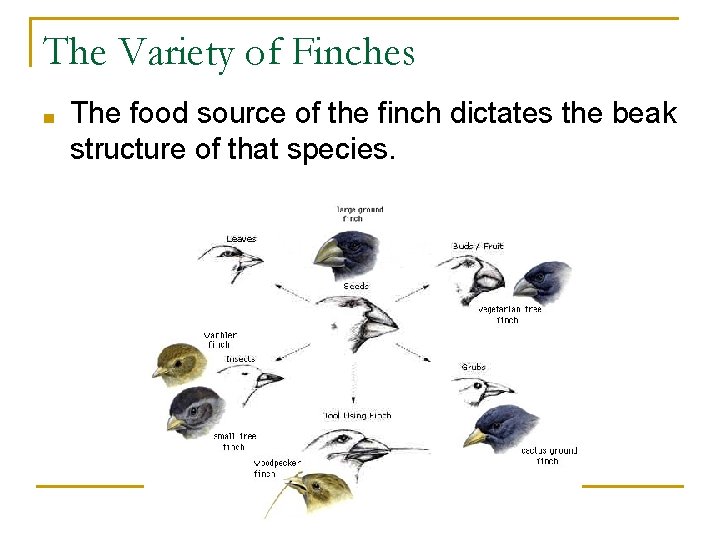
The Variety of Finches ■ The food source of the finch dictates the beak structure of that species.
Evidence of evolution Science always asks for PROOF that an event occurs…how do we know evolution occurs if we can’t see the old species? ?
Evolution of a Species ■ ■ ■ ■ What evidence is there that a species has evolved? 1. Fossils 2. Vestigial structures 3. Embryology 4. Biochemical similarities 5. Homologous Structures 6. Reproductive Isolation 7. Geographic Isolation
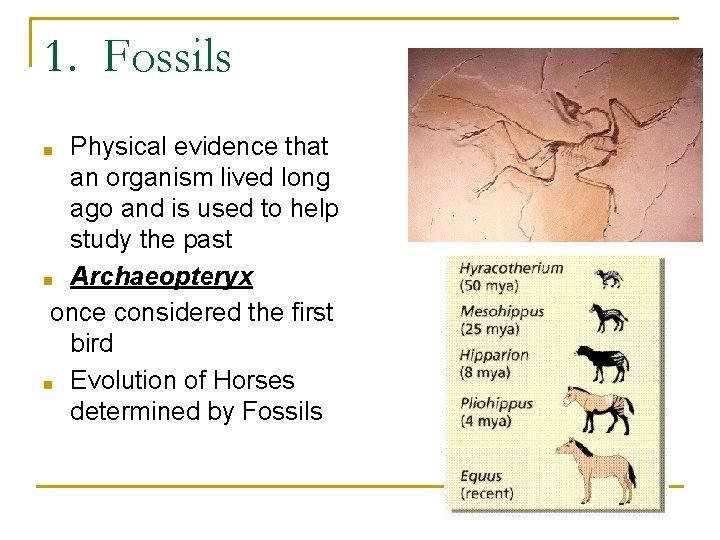
1. Fossils Physical evidence that an organism lived long ago and is used to help study the past ■ Archaeopteryx once considered the first bird ■ Evolution of Horses determined by Fossils ■
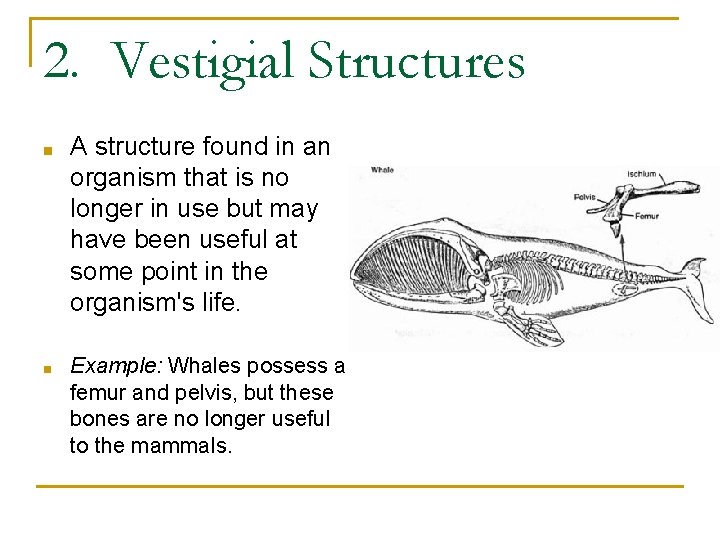
2. Vestigial Structures ■ A structure found in an organism that is no longer in use but may have been useful at some point in the organism's life. ■ Example: Whales possess a femur and pelvis, but these bones are no longer useful to the mammals.
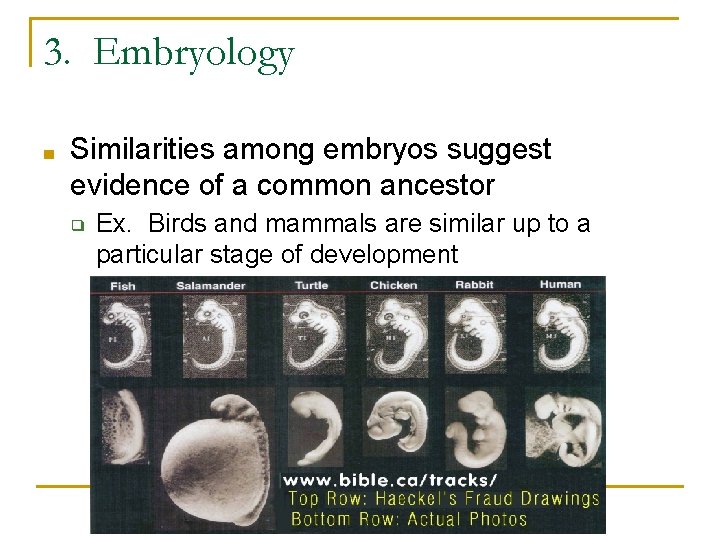
3. Embryology ■ Similarities among embryos suggest evidence of a common ancestor ❑ Ex. Birds and mammals are similar up to a particular stage of development
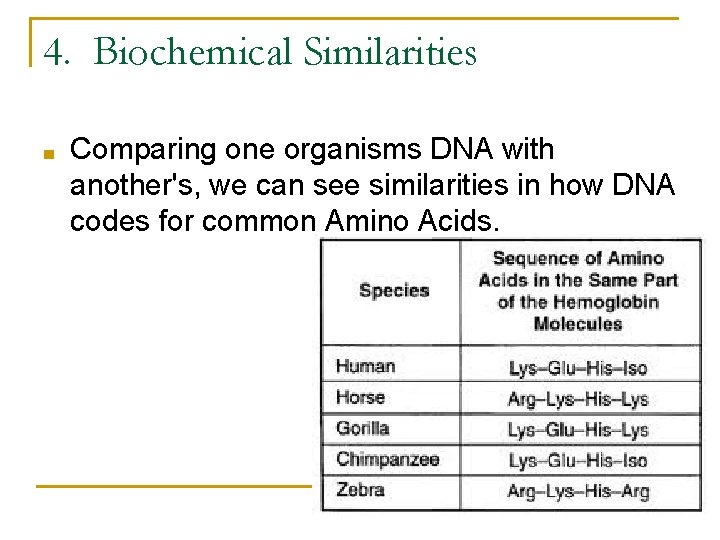
4. Biochemical Similarities ■ Comparing one organisms DNA with another's, we can see similarities in how DNA codes for common Amino Acids.
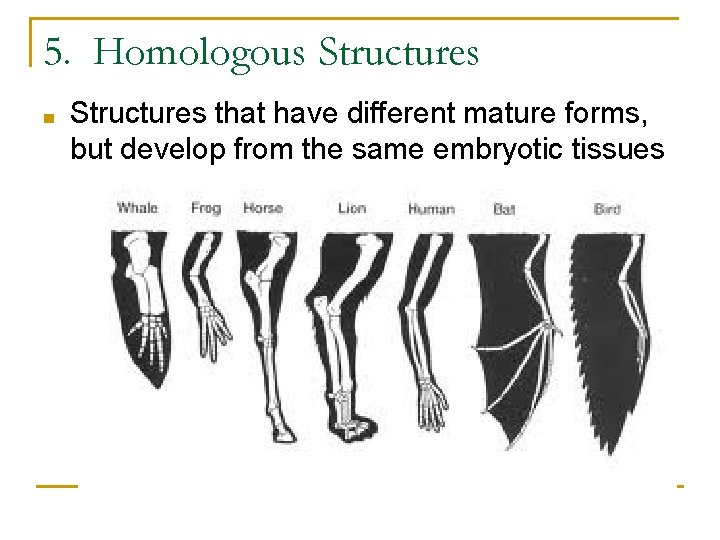
5. Homologous Structures ■ Structures that have different mature forms, but develop from the same embryotic tissues
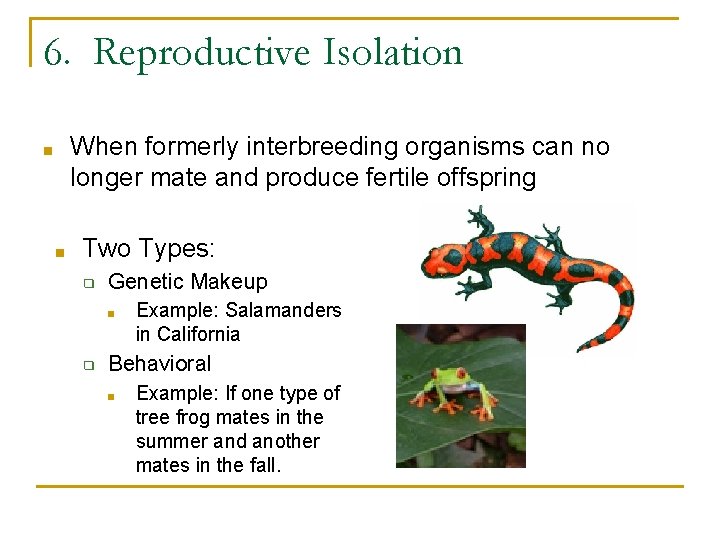
6. Reproductive Isolation When formerly interbreeding organisms can no longer mate and produce fertile offspring ■ ■ Two Types: ❑ Genetic Makeup ■ ❑ Example: Salamanders in California Behavioral ■ Example: If one type of tree frog mates in the summer and another mates in the fall.
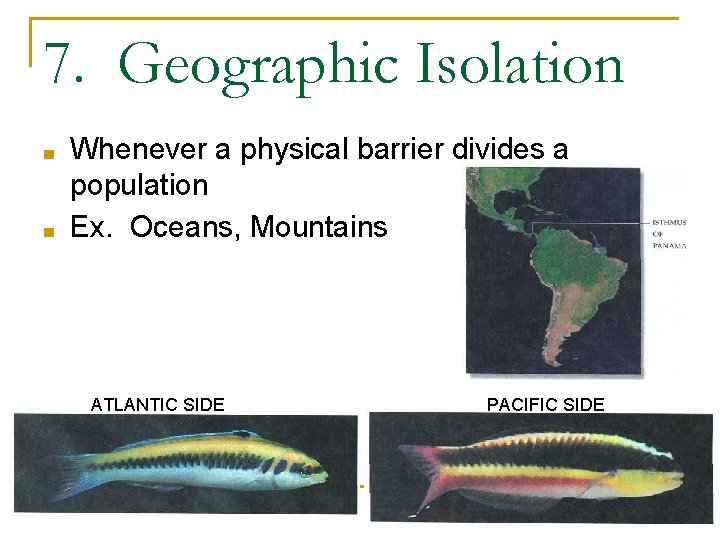
7. Geographic Isolation ■ ■ Whenever a physical barrier divides a population Ex. Oceans, Mountains ATLANTIC SIDE PACIFIC SIDE
Origins of Life on Earth and future impacts of evolution 1. How did life on Earth 2. What are some Evolve into what we benefits and potential currently have? dangers to a species evolving?
Origins of Life Where did the first life on Earth come from? ?
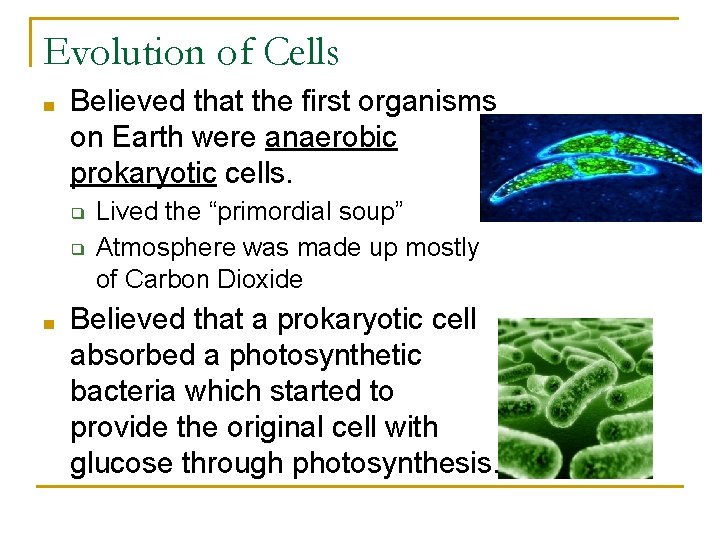
Evolution of Cells ■ Believed that the first organisms on Earth were anaerobic prokaryotic cells. ❑ ❑ ■ Lived the “primordial soup” Atmosphere was made up mostly of Carbon Dioxide Believed that a prokaryotic cell absorbed a photosynthetic bacteria which started to provide the original cell with glucose through photosynthesis.
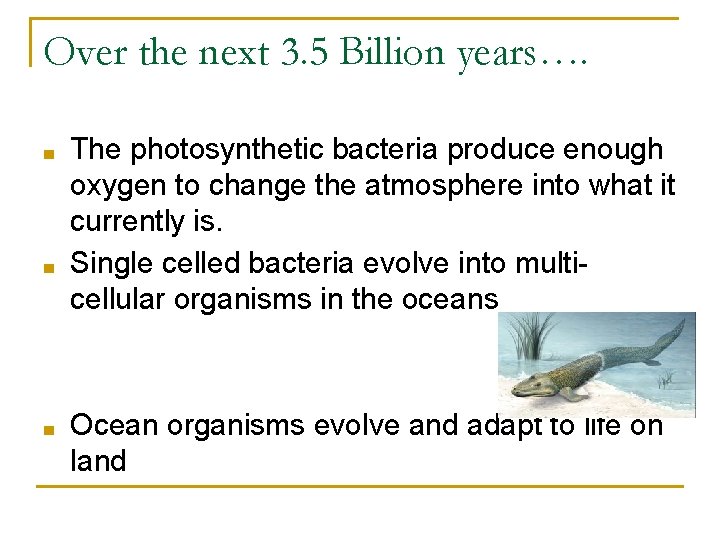
Over the next 3. 5 Billion years…. ■ ■ ■ The photosynthetic bacteria produce enough oxygen to change the atmosphere into what it currently is. Single celled bacteria evolve into multicellular organisms in the oceans Ocean organisms evolve and adapt to life on land
Evolution happening TODAY How does evolution of a species affect your lives today?
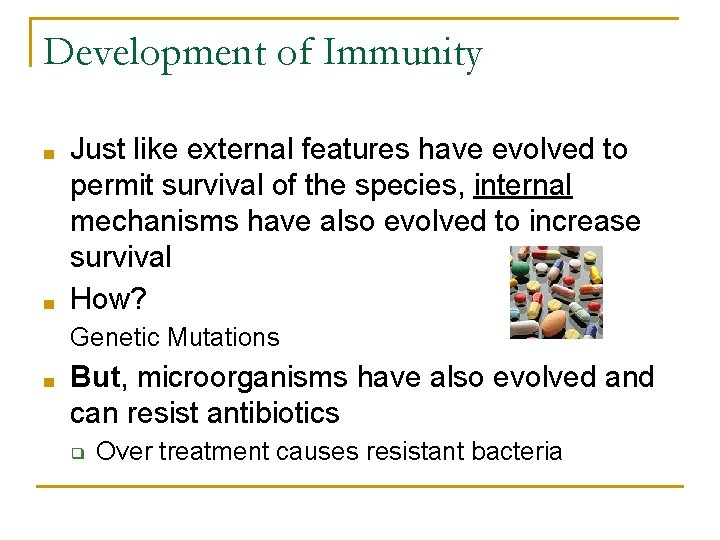
Development of Immunity ■ ■ Just like external features have evolved to permit survival of the species, internal mechanisms have also evolved to increase survival How? Genetic Mutations ■ But, microorganisms have also evolved and can resist antibiotics ❑ Over treatment causes resistant bacteria
Antibiotics ■ Antibiotics are ■ There are many types of substances that slows bacteria, some beneficial, or stops the growth of some harmful bacteria. ❑ Good: ■ ■ Most widely known antibiotic - penicillin ❑ Bacteria in our intestines which aid in digestion. Bad: ■ Bacteria which cause pneumonia or Strep.
Antibiotic resistance ■ The over prescription of antibiotics can cause only the “super bugs” to remain. ❑ ■ Example: MRSA Antibiotics basically stop working against these bacteria since they have now evolved a resistance to their effects.
Pesticide resistance ■ Similar to antibiotic resistance in bacteria, Insects can become pesticide resistant ■ Pesticides are chemicals designed to kill insects (pests).
Types of Natural Selection ■Stabilizing ■Directional ■Disruptive
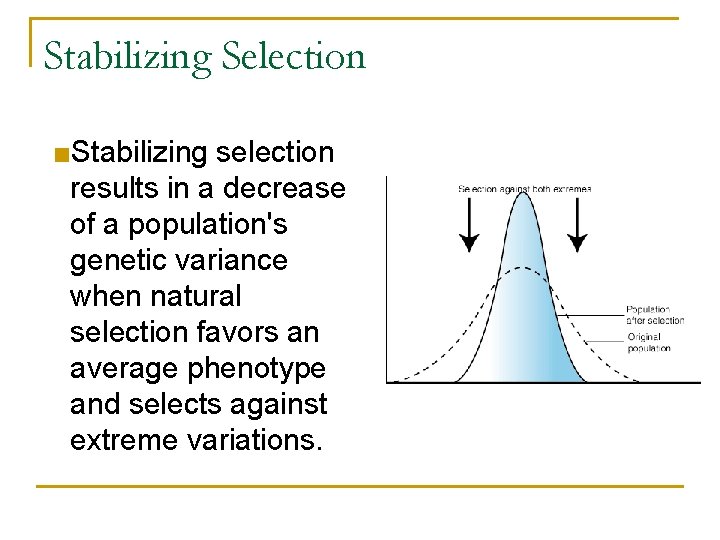
Stabilizing Selection ■Stabilizing selection results in a decrease of a population's genetic variance when natural selection favors an average phenotype and selects against extreme variations.
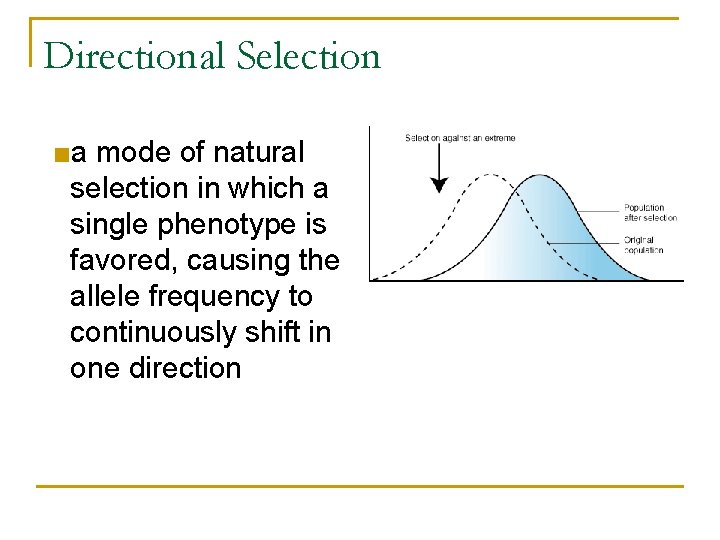
Directional Selection ■a mode of natural selection in which a single phenotype is favored, causing the allele frequency to continuously shift in one direction
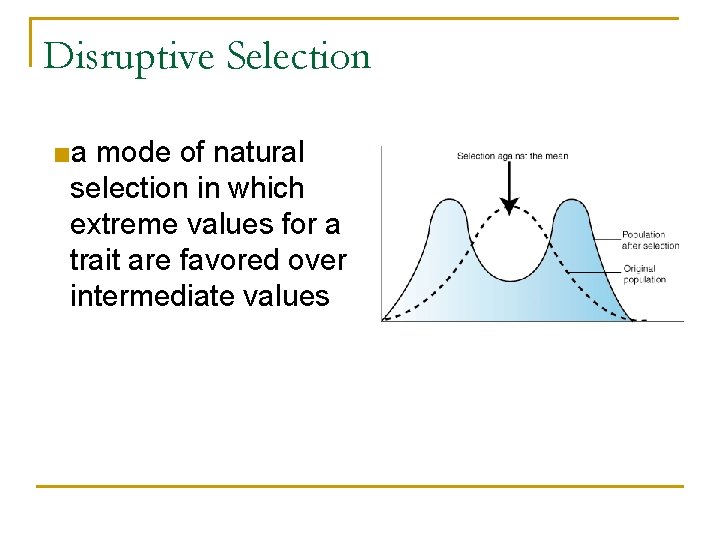
Disruptive Selection ■a mode of natural selection in which extreme values for a trait are favored over intermediate values