
Evolution Biodiversity Laboratory BIL 161 Project I Collection
Evolution & Biodiversity Laboratory BIL 161 Project I: Collection Techniques

Collection Techniques Near the end of today’s lab, your team will design a pilot research survey. The goal: to discover whethere are differences in biodiversity between two local ecosystems.

Collection Techniques You will not manipulate the systems. Instead, you will examine the results of natural and anthropogenic forces on existing biodiversity in two different habitats. To this end, you will record as much data about your two habitats as possible when you sample them.

Sampling Techniques & Tools A transect is a straight line or narrow section through an object or natural feature or across the earth's surface, along which observations are made or measurements taken. Origin - mid 17 th century verb trans, meaning “through” and the Latin verb secare, “to cut. ”

Sampling Techniques & Tools

Sampling Techniques & Tools Transects can be used to sample almost any type of habitat.
Sampling Techniques & Tools Your team will use the following protocol to collect random samples from your two chosen habitats. Take a sampling kit with you at the end of lab It contains supplies you will need to collect your samples
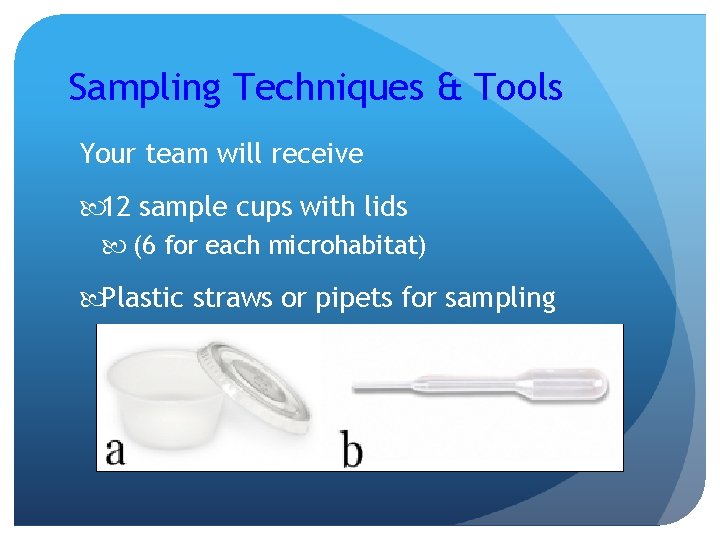
Sampling Techniques & Tools Your team will receive 12 sample cups with lids (6 for each microhabitat) Plastic straws or pipets for sampling
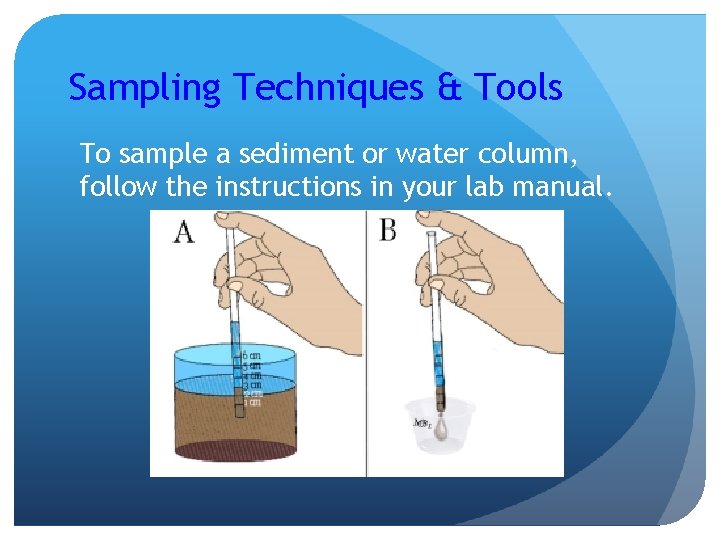
Sampling Techniques & Tools To sample a sediment or water column, follow the instructions in your lab manual.
Sampling Techniques & Tools Do not cross-contaminate samples! Pipets are disposable for a reason. Your team will also take a onemeter transect cord. Mark every 20 cm with a Sharpie or a knot.
Sampling Techniques & Tools Shortly before lab, your team will visit each of its two habitats. Week 1: Three samples per habitat Week 2: Three samples per habitat
Sampling Techniques & Tools To sample a habitat: 1. Choose a site that is relatively uniform and representative of the locality. 2. Lay your transect line in a chosen spot and pull it straight.
Sampling Techniques & Tools 1. Aquatic samples: 2. Collect ~6 m. L at each of five marks along the transect line. 3. Place all samples from the transect line in one cup. 4. At the end of one transect, you will have ~30 m. L. 5. This is your first sample.
Sampling Techniques & Tools Repeat these steps twice more in your first habitat. Each time, try to select a site that is comparable to your first site in terms of abiotic conditions. This will reduce unwanted variability.
Sampling Techniques & Tools 1. Terrestrial samples: 2. Collect ~1 cc at each of five marks along the transect line. 3. Place all samples from the transect line in one cup. 4. At the end of one transect, you will have ~5 cc of soil for suspension. 5. This is your first sample.
Sampling Techniques & Tools Use the same protocol for your second habitat. Keep sampling techniques as constant as possible. Record all environmental conditions at each site.
Sampling Techniques and Tools For each site and sample, record Locality (use GPS Logger for global coordinates) Time of day collected Type of habitat Sample type (water column? Sediment? ) Other relevant info (air temperature, water temperature, light conditions, weather, etc. )
Sampling Techniques & Tools Samples must be fresh! Decide on your localities well in advance Sample each habitat as close to lab time as possible Keep samples in a cool, aerated location, with lid loosely attached. Tighten the lid on the sample cup only when transporting it to lab for analysis.

Sampling Techniques and Tools LABEL EVERYTHING CLEARLY. Keep meticulous, detailed notes. Make sure every team member has a copy of all data.

Questions?
- Slides: 20