
Evolution Biodiversity Chapter 5 Origins of life Chemical
Evolution & Biodiversity Chapter 5
Origins of life • Chemical analysis and • Life evolved over the measurement of past 4. 7 - 4. 8 billion radioactive elements in years rocks & fossils are • Chemical evolution studied came first • Evolution of life is • Biological evolution linked to evolution of about 2. 3 - 2. 5 billion earth years ago
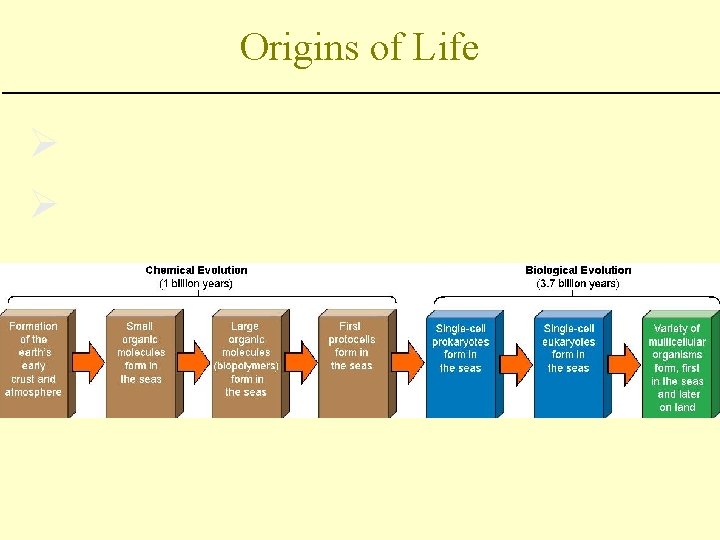
Origins of Life Ø Chemical evolution Ø Biological evolution
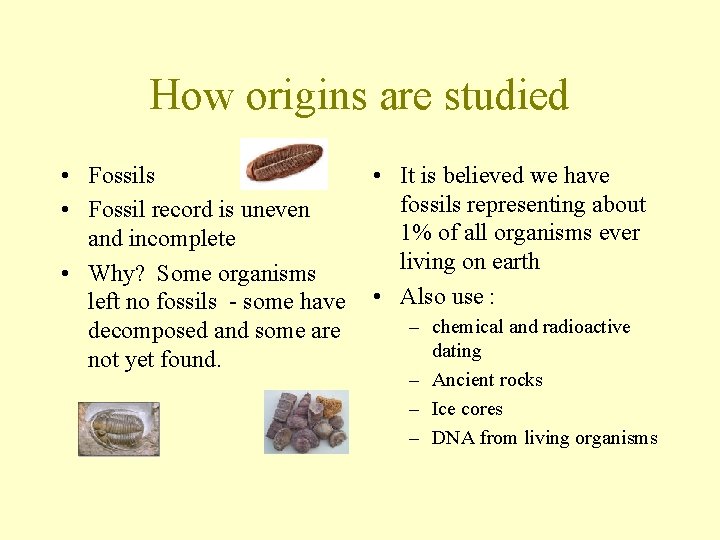
How origins are studied • Fossils • Fossil record is uneven and incomplete • Why? Some organisms left no fossils - some have decomposed and some are not yet found. • It is believed we have fossils representing about 1% of all organisms ever living on earth • Also use : – chemical and radioactive dating – Ancient rocks – Ice cores – DNA from living organisms
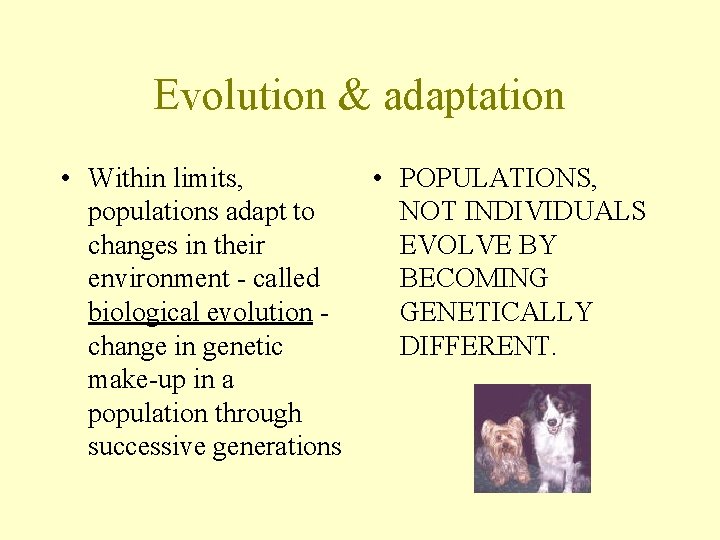
Evolution & adaptation • Within limits, populations adapt to changes in their environment - called biological evolution change in genetic make-up in a population through successive generations • POPULATIONS, NOT INDIVIDUALS EVOLVE BY BECOMING GENETICALLY DIFFERENT.
• THEORY OF EVOLUTION - all species descended from earlier, ancestral species • Microevolution – Small genetic changes that occur in a population • Macroevolution – Long-term, large-scale evolutionary changes among groups of species - new species are formed from ancestral species and other species are lost through extinction.
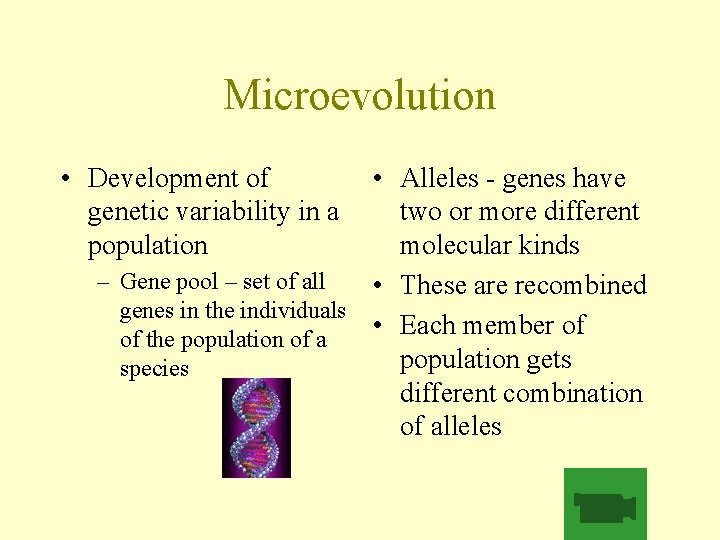
Microevolution • Development of genetic variability in a population • Alleles - genes have two or more different molecular kinds – Gene pool – set of all • These are recombined genes in the individuals • Each member of of the population of a population gets species different combination of alleles
Mutation • Random change in structure of number of DNA molecules in a cell • Can occur in two ways: – Exposure to external agents such as radioactivity, xrays, natural and man-made chemicals – Random changes in coded genetic instructions. Sometimes are beneficial and make survival easier under existing or changing conditions. Some are harmless and some are lethal.
• Mutations are: – Random and unpredictable – Only new source of genetic material – Rare events

Mutation • Random changes in structure or number of DNA molecules in a cell • Can be caused by radiation and chemicals mutagens • Random mistakes • Can occur in any cell but only passed on in reproductive cells.
• Natural selection occurs when some individuals have genetically based traits that cause them to better survive and produce offspring • Idea developed by Charles Darwin in “On the origin of the species by means of natural selection”
More… • Must be natural variability for a trait in a population • Trait must have a genetic bases that can be passed from one generation to another – be heritable • Must lead to differential reproduction enable individuals with the trait to leave more offspring than other members of the population.
Adaptations or adaptive traits • A heritable trait that enables organisms to better survive and reproduce under a given set of environmental conditions • Selective pressure - a factor in a population’s environment that causes natural selection to occur. • Environmental conditions do not create favorable characteristics
To summarize • • Genes mutate Individuals are selected Populations evolve Can also change populations by artificial selection (see p. 100) • Peppered moth - an example
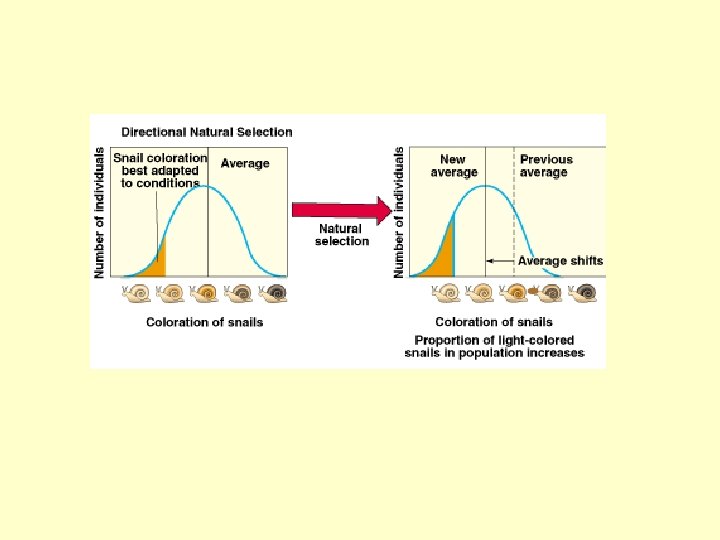
Types of natural selection • Directional natural selection - conditions shift so that individuals at one end of the normal range become more common than midrange forms “it pays to be different” • Most common during periods of environmental change or when members of a population migrate to a new habitat with different environmental conditions.
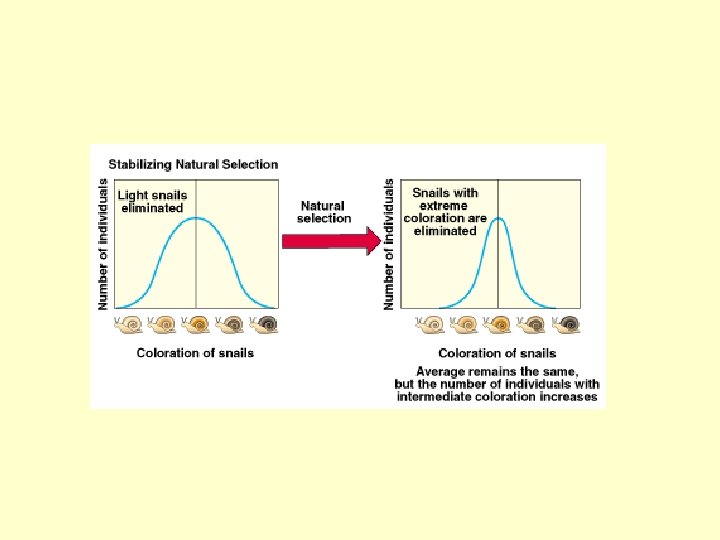
Second type: • Stabilizing natural selection - eliminates individuals at both ends of the genetic spectrum and favors average genetic makeup • “it pays to be average” • Occurs when an environment changes little and members are well adapted to that environment. • Individuals with unusual alleles tend to be eliminated
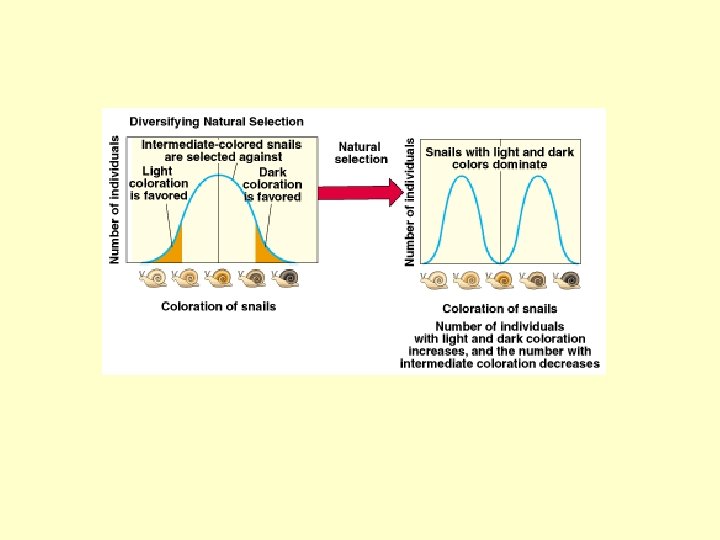
Third type: • Diversifying natural • “It doesn’t pay to be selection - disruptive normal” natural selection • Population is split into individuals at both two groups extremes of the genetic • Occurs when there is a spectrum are favored shift in food supply and individuals with selected against normal traits are average individuals eliminated.
Coevolution • Populations of two • Owls become better at different species hunting mice; certain interact over a long prey have traits that time and changes in allow them to escape one gene pool lead to • Some of the predators changes in the gene have better eyesight pool of another species and are more successful hunters and they pass this trait to their offspring.
Ecological niche • Way of life or role in the ecosystem • Involves everything that affects survival and reproduction • Includes: range of tolerance for chemical and physical requirements • Important because: – Can prevent extinction – Can help assess environmental changes. • Types of resources used food or nutrients • How it interacts with biotic and abiotic factors • Role in the flow of energy and matter cycling • Represents adaptive traits that organisms have acquired through evolution that allow for better survival.
Fundamental niche • The full potential range of physical, chemical, and biological conditions and resources an organism could theoretically use if there was no competition with other species. – Niches however, often overlab
Realized niche • In order for an organism to survive and avoid competition for resources it will use only part of its fundamental niche – this is the realized niche.
Generalist species • • Occupy broad niches Can live many places Eat many types of food Tolerate a wide range of environmental conditions • Flies, cockroaches, mice, etc
Specialist species • • Have narrow niches Live in only one type of habitat Eat only one or a few types of food Tolerate only a narrow range of climactic and environmental conditions • More prone to extinction during changes in environmental conditions • Examples: tiger salamander, red-cockaded woodpecker, spotted owls, giant panda
Limits to adaptation • Changes in environmental conditions can lead to adaptation only if the traits are already present in the gene pool • Because each organism must do many things • Adaptations are usually compromise • Even if a beneficial trait is present, the population’s ability to adapt is limited by its reproductive capacity • Adapt, migrate or die
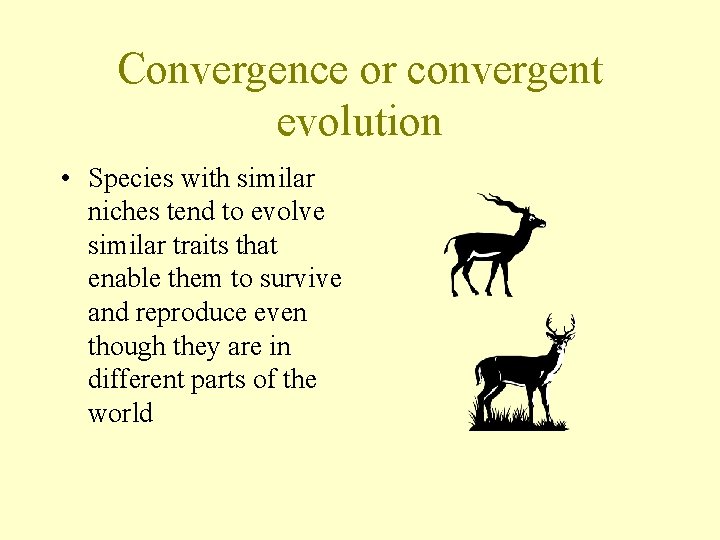
Convergence or convergent evolution • Species with similar niches tend to evolve similar traits that enable them to survive and reproduce even though they are in different parts of the world
macroevolution • Evolution that takes place above the level of species and over much longer periods • Patterns include: – Genetic persistence inheritance of DNA molecule through all subsequent lines of descent – Genetic divergence long term changes in lineages of species – Genetic losses - steady loss (background extinction) or abrupt, catastrophic loss (mass extinction) of lineages – Example: the horse
How do new species evolve? • Speciation - two species arise from one • Usually takes place in two phases: – Geographic isolation • Populations become separated for long periods of time • Migration to new area • Physical barrier such as a road • Earthquake – Reproductive isolation • Mutation & natural selection act on isolated populations - called divergence - eventually cannot interbreed – Divergent evolution arises from speciation – Usually takes tens of thousands of years
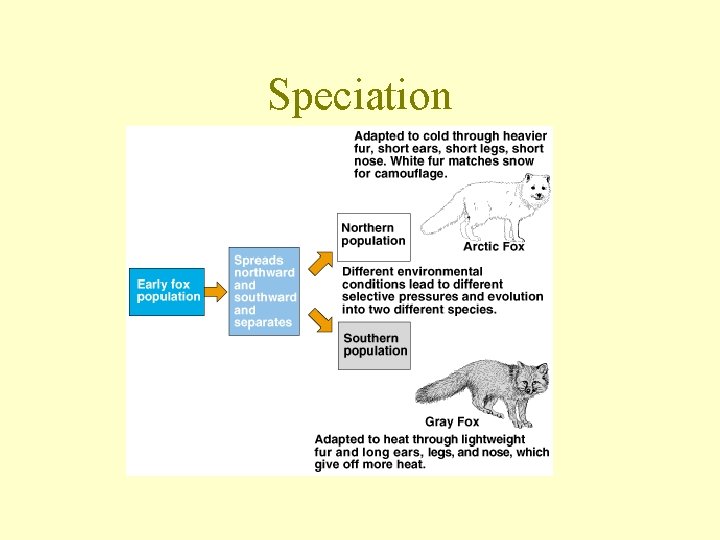
Speciation
Extinction • Can be caused by large • Extinction is the scale movement of the ultimate fate of all continents (continental organisms drift) • Biologists estimate • Gradual climate that 99. 9% of all change species that have ever lived are now extinct. • Rapid climate change volcanic eruption, etc.
Types of extinction • Background extinction • Generally believed to - species disappear at a be the result of climate low rate as local change. conditions change • Five mass extinction s • Mass extinction - 20 - 40 million years abrupt rise in apart extinction rates – Last one took place about 65 million years catastrophic, often ago - wiped out the global-wipes out large dinasaurs groups of species
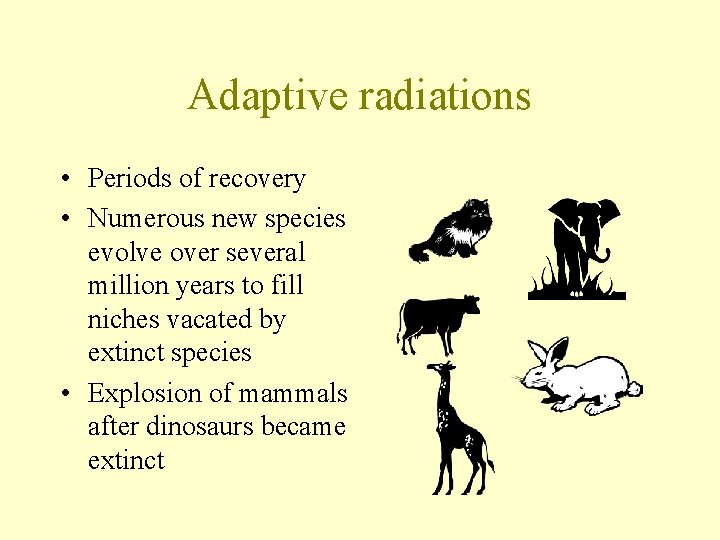
Adaptive radiations • Periods of recovery • Numerous new species evolve over several million years to fill niches vacated by extinct species • Explosion of mammals after dinosaurs became extinct
Biodiversity = • Speciation minus extinction • Humans have become a major force in the premature extinction of species. • We may cause extinction of up to a quarter of the earth’s current species • On short time scale, new species cannot form rapidly enough • We are impacting the earth
- Slides: 35