
Evolution and Genetics Is there a mathematical model
- Slides: 15
Evolution and Genetics Is there a mathematical model that can show that evolution occurs in a population? Why does Bob have to show off so much? I’m different from the others! My alleles are so special. I am special!
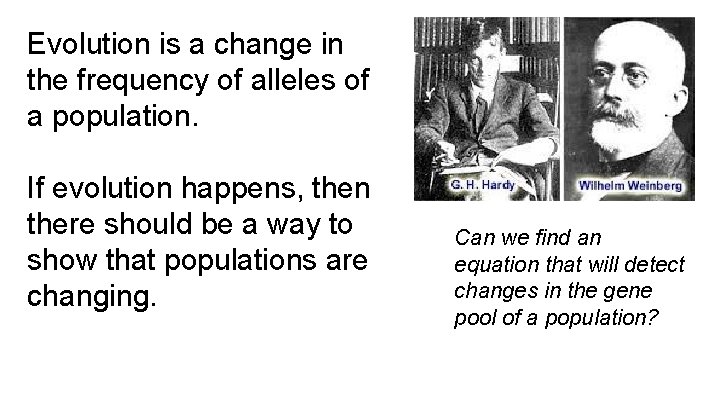
Evolution is a change in the frequency of alleles of a population. If evolution happens, then there should be a way to show that populations are changing. Can we find an equation that will detect changes in the gene pool of a population?
The Null Hypothesis If populations do not change, then the allele frequencies will remain constant; there will always be an equal amount of each allele in the population. 50 % A and 50 % a Individuals will be: AA or Aa or aa
Hardy and Weinberg also suggested that some populations might not change at all if certain criteria were met. These include: 1. 2. 3. 4. 5. large population random mating no mutation no migration no selection That makes no sense! What population would meet all those criteria? Oh right. . . this is the null hypothesis. These populations would not evolve at all.
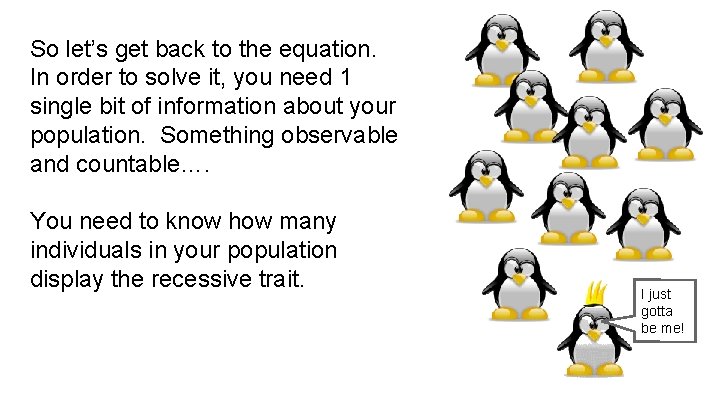
So let’s get back to the equation. In order to solve it, you need 1 single bit of information about your population. Something observable and countable…. You need to know how many individuals in your population display the recessive trait. I just gotta be me!
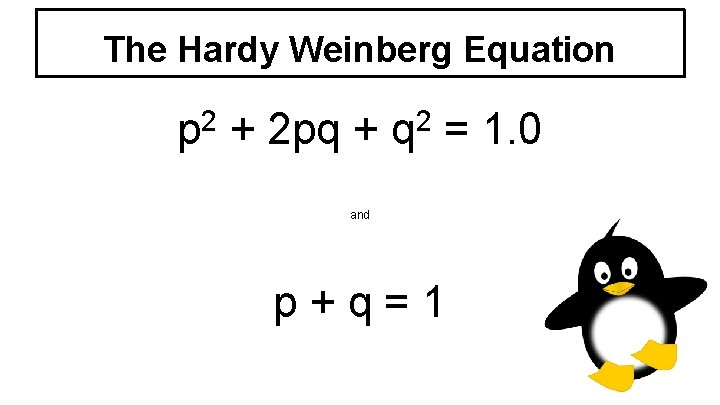
The Hardy Weinberg Equation 2 p + 2 pq + 2 q = 1. 0 and p+q=1
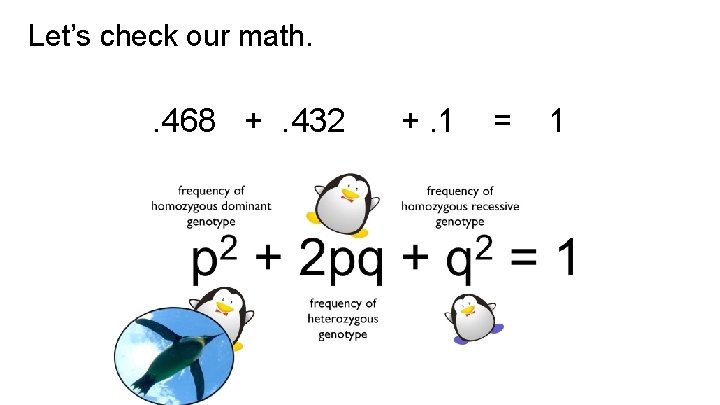
Another way to look at the equation.
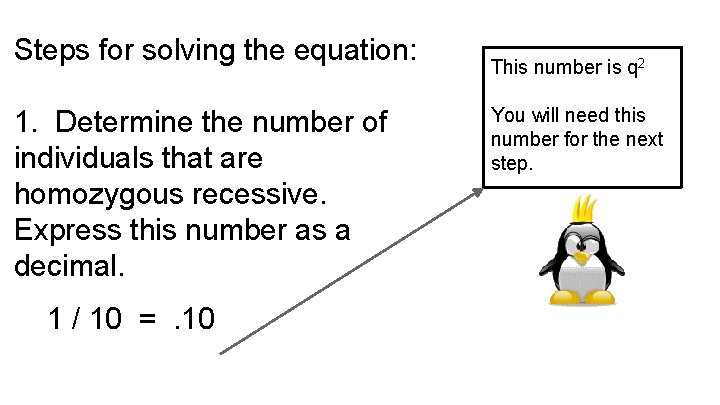
Steps for solving the equation: 1. Determine the number of individuals that are homozygous recessive. Express this number as a decimal. 1 / 10 =. 10 This number is q 2 You will need this number for the next step.
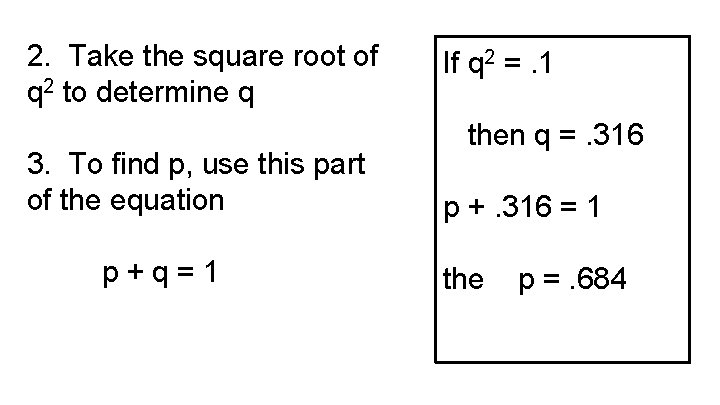
2. Take the square root of q 2 to determine q 3. To find p, use this part of the equation p+q=1 If q 2 =. 1 then q =. 316 p +. 316 = 1 the p =. 684
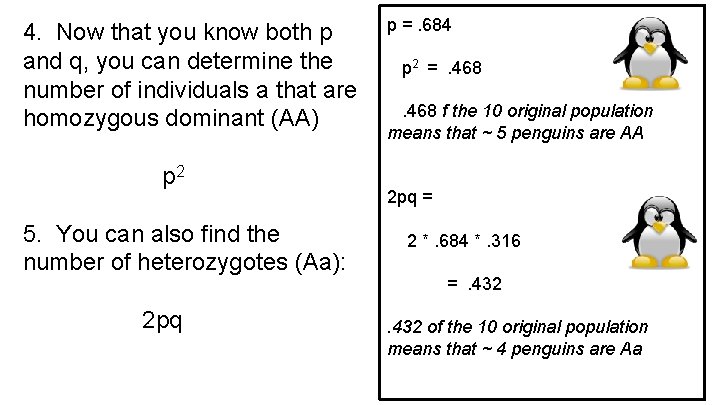
4. Now that you know both p and q, you can determine the number of individuals a that are homozygous dominant (AA) p 2 5. You can also find the number of heterozygotes (Aa): 2 pq p =. 684 p 2 =. 468 f the 10 original population means that ~ 5 penguins are AA 2 pq = 2 *. 684 *. 316 =. 432 of the 10 original population means that ~ 4 penguins are Aa
Let’s check our math. . 468 +. 432 +. 1 = 1
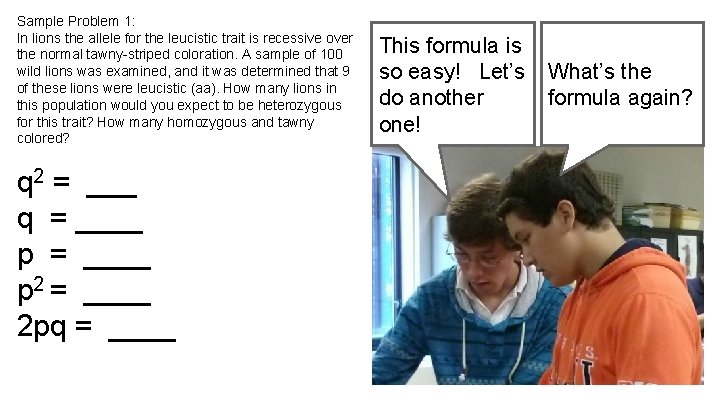
Sample Problem 1: In lions the allele for the leucistic trait is recessive over the normal tawny-striped coloration. A sample of 100 wild lions was examined, and it was determined that 9 of these lions were leucistic (aa). How many lions in this population would you expect to be heterozygous for this trait? How many homozygous and tawny colored? q 2 = ___ q = ____ p 2 = ____ 2 pq = ____ This formula is so easy! Let’s do another one! What’s the formula again?
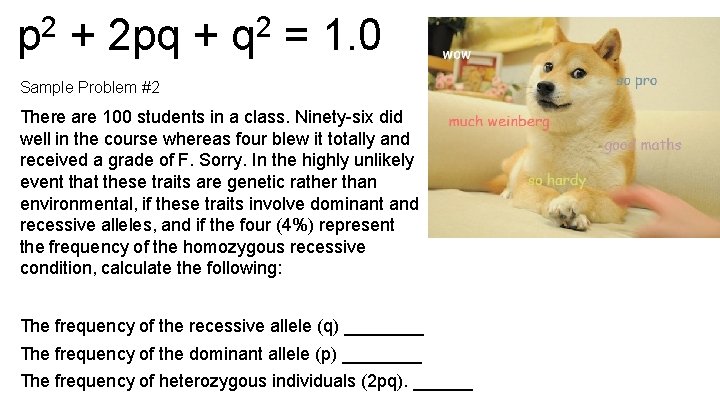
p 2 + 2 pq + q 2 = 1. 0 Sample Problem #2 There are 100 students in a class. Ninety-six did well in the course whereas four blew it totally and received a grade of F. Sorry. In the highly unlikely event that these traits are genetic rather than environmental, if these traits involve dominant and recessive alleles, and if the four (4%) represent the frequency of the homozygous recessive condition, calculate the following: The frequency of the recessive allele (q) ____ The frequency of the dominant allele (p) ____ The frequency of heterozygous individuals (2 pq). ______
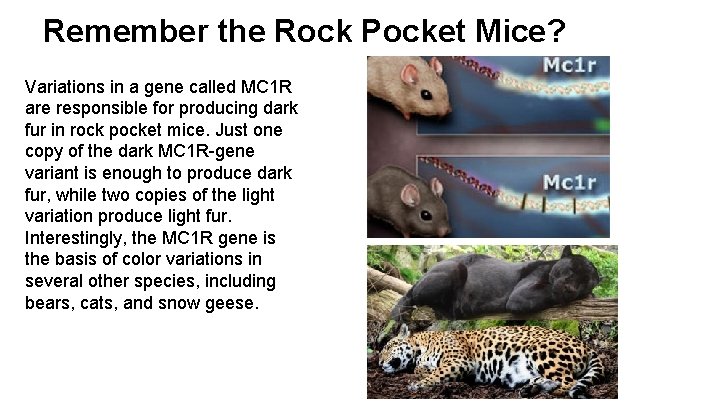
Remember the Rock Pocket Mice? Variations in a gene called MC 1 R are responsible for producing dark fur in rock pocket mice. Just one copy of the dark MC 1 R-gene variant is enough to produce dark fur, while two copies of the light variation produce light fur. Interestingly, the MC 1 R gene is the basis of color variations in several other species, including bears, cats, and snow geese.
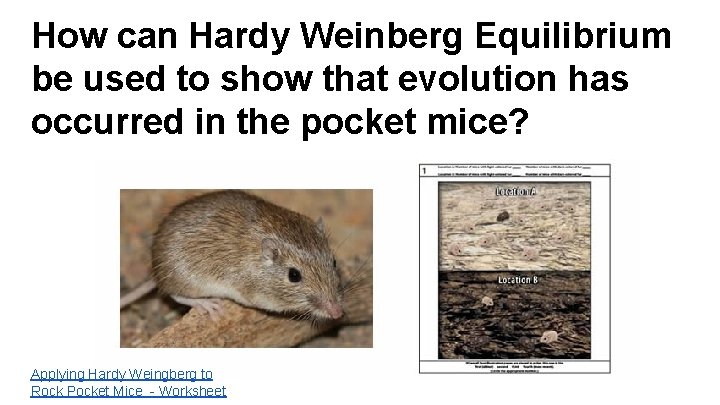
How can Hardy Weinberg Equilibrium be used to show that evolution has occurred in the pocket mice? Applying Hardy Weingberg to Rock Pocket Mice - Worksheet