
Evolution and classification L O look at how
- Slides: 17
Evolution and classification L. O: look at how evidence shows evolution Describe biodiversity, classification and sustainability
• Legumes – plants that improve soil fertility • Root nodules – lumps on roots that contain bacteria that fix nitrogen
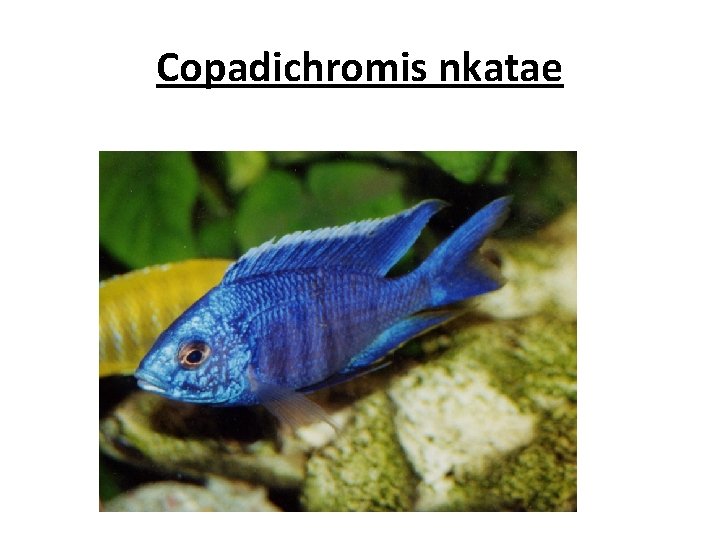
Copadichromis nkatae
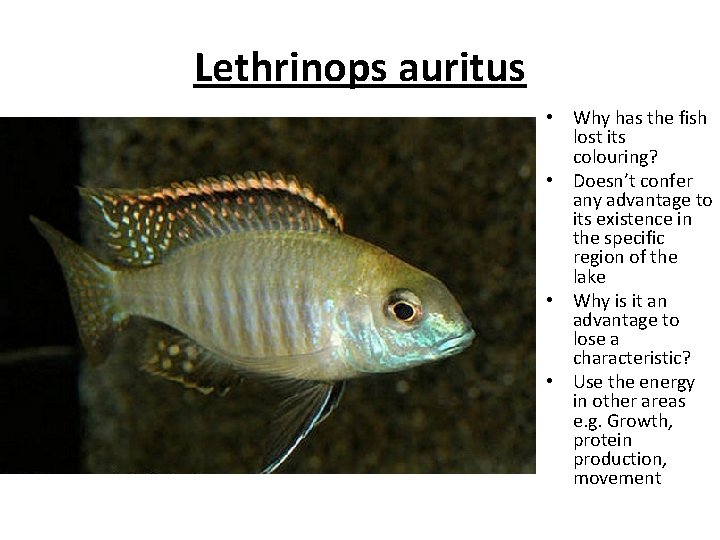
Lethrinops auritus • Why has the fish lost its colouring? • Doesn’t confer any advantage to its existence in the specific region of the lake • Why is it an advantage to lose a characteristic? • Use the energy in other areas e. g. Growth, protein production, movement
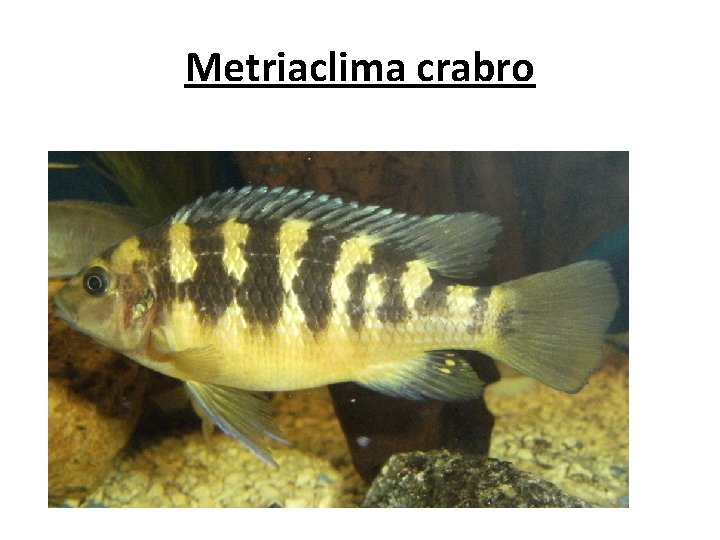
Metriaclima crabro
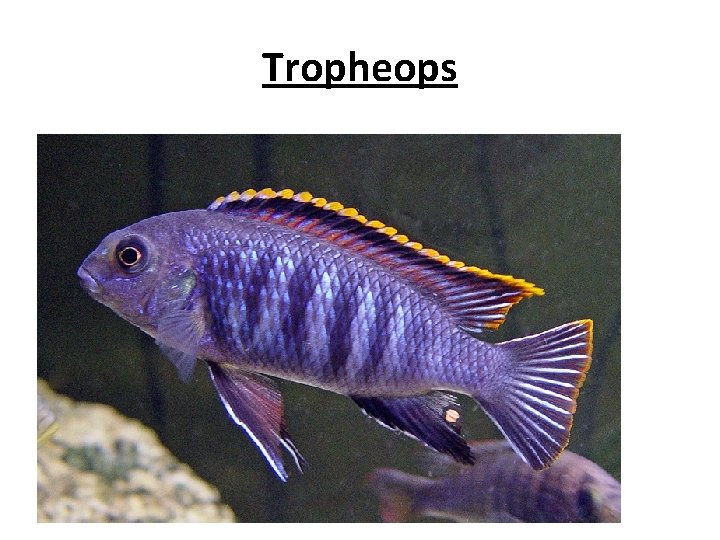
Tropheops
6 mark question • The Mexican tetra is a species of fish. It lives in rivers and is a silver colour. • Some of this fish have become trapped in caves where there is no light. • Over time the population of fish living in caves have lost their ability to produce the protein that gives them their body colour. They now appear colourless. • The cave fish are also blind because they do not have developed eyes. • Suggest and explain the evolutionary processes through which these changes could have occurred.
• mutations cause fish to not make pigment and/or not develop eyes • In caves there is no (or little) light, so fish would not be able to see, would not be able to be seen, and would not need protection from (strong) sunlight • Therefore lack of eyes and pigment give no disadvantage • Can save resources by not producing pigment / eyes • These resources can be used for growth/movement etc • This is an advantage • Idea that advantage = fitness • Fitness allows each form to survive / breed more successfully / increase in number • This is natural selection • Over time, blind form only in caves / normal form only in rivers
Biodiversity • The variety of life on Earth, including: • The number of different species • The range of different types of organisms, eg plants, animals and microorganisms • The genetic variation between organisms within the same species
Classification • So how do we group something as diverse as all the living organisms on Earth? • Group according to similarities and differences: • Physical features (flowers in plants/skeletons in vertebrates) • DNA
Order of classification Species all grouped into five KINGDOMS: Bacteria, fungi, algae, plants, animals Each kingdom is divided into more groups: Animals grouped into: mammals, birds, reptiles, amphibians, fish • These groups are further divided until you get down to a species • As you go down these groups, the number of type of organism in each group DECREASES, but the number of characteristics that the organisms have in common INCREASES • •
How can classification help? • The classification of living and fossil organisms can help to: a. Make sense of the enormous diversity of organisms on Earth b. Show the evolutionary relationships between organisms
Why is it important to maintain biodiversity? • Stops species from becoming extinct • More plants we have the more resources there are • More plants we have the more medicines can be discovered • More species there are more food in food webs for other species
Sustainability • Sustainability means meeting the needs of today’s population without harming the environment so that future generations can still meet their own needs • Examples that are not sustainable: • Burning fossil fuels, non-biodegradable materials (plastics), using limited resources that are nonrecyclable (metals), pollution, de-forestation • Maintaining biodiversity to ensure the conservation of different species is one of the keys to sustainability • Loss of biodiversity means that future generations won’t be able to get the things from the environment that we can today
Farming – monoculture crop production • Monoculture – growing one type of crop in large fields • Doesn’t maintain biodiversity • Fewer species can survive from the crop • Certain types of nutrients are stripped from the soil, preventing growth of other crops
Making more sustainable packaging • Why is packaging seen as non-sustainable? • Resources that have gone into making packaging cannot be re-used (no longer available for future use) • Lots of energy has been used to make packaging material e. g. Burning fossil fuels • Packaging waste is thrown into landfill sites, using up space, giving off toxic fumes
• How can we make packaging more sustainable? • Use renewable materials (paper, card-plant more trees) • Use less energy (recycling uses less energy than producing new material) • Creating less pollution (make packaging biodegradable so packaging thrown away will biodegrade, returning nutrients to the soil) • It is preferable to decrease the use of some materials, including packaging materials, even when they are biodegradable, because of: • Use of energy in their production and transport • Slow decomposition in oxygen deficient landfill sites.