
Evolution and Biodiversity Origins Niches and Adaptations What
Evolution and Biodiversity: Origins, Niches, and Adaptations What is Evolution? Chapter 5
Key Concepts Ø Origins of life Ø Evolutionary processes Ø Ecological niches Ø Species formation Ø Species extinction
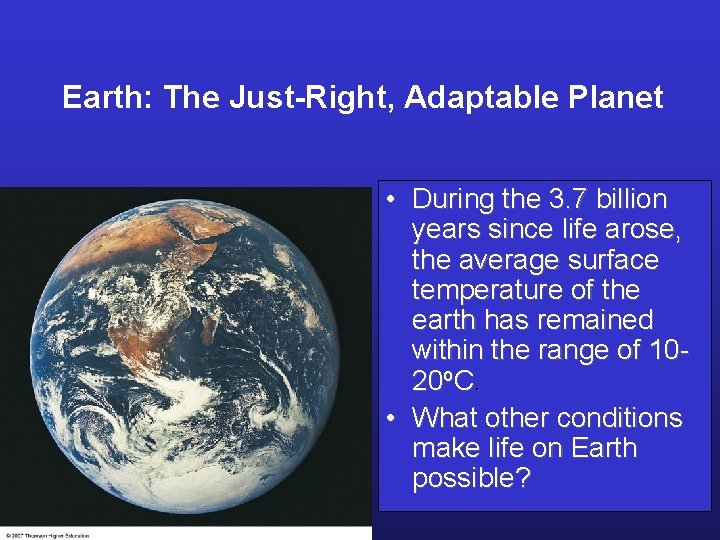
Earth: The Just-Right, Adaptable Planet • During the 3. 7 billion years since life arose, the average surface temperature of the earth has remained within the range of 1020 o. C. • What other conditions make life on Earth possible?
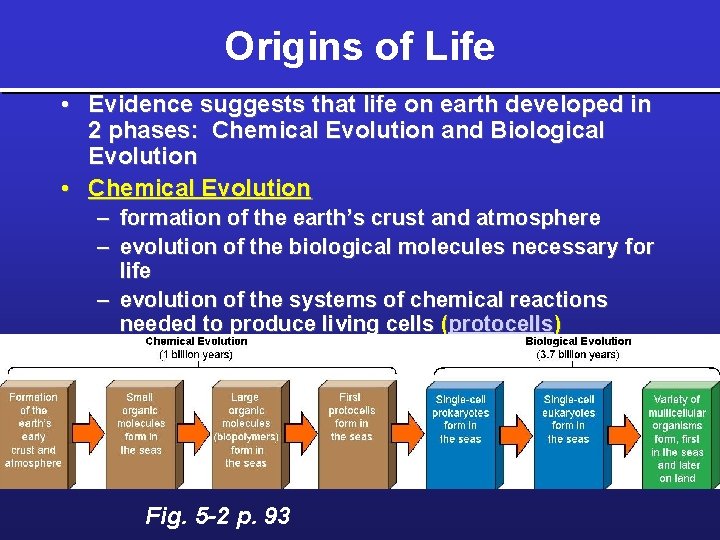
Origins of Life • Evidence suggests that life on earth developed in 2 phases: Chemical Evolution and Biological Evolution • Chemical Evolution – formation of the earth’s crust and atmosphere – evolution of the biological molecules necessary for life – evolution of the systems of chemical reactions needed to produce living cells (protocells) Fig. 5 -2 p. 93
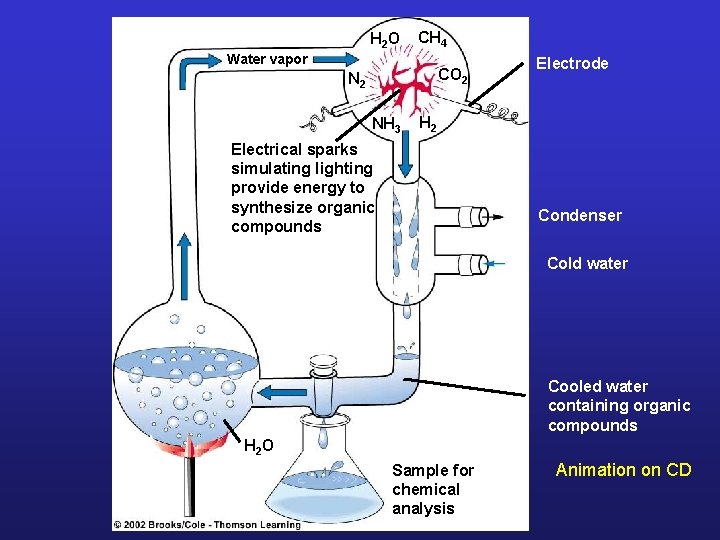
H 2 O CH 4 Water vapor CO 2 NH 3 Electrode H 2 Electrical sparks simulating lighting provide energy to synthesize organic compounds Condenser Cold water Cooled water containing organic compounds H 2 O Sample for chemical analysis Animation on CD
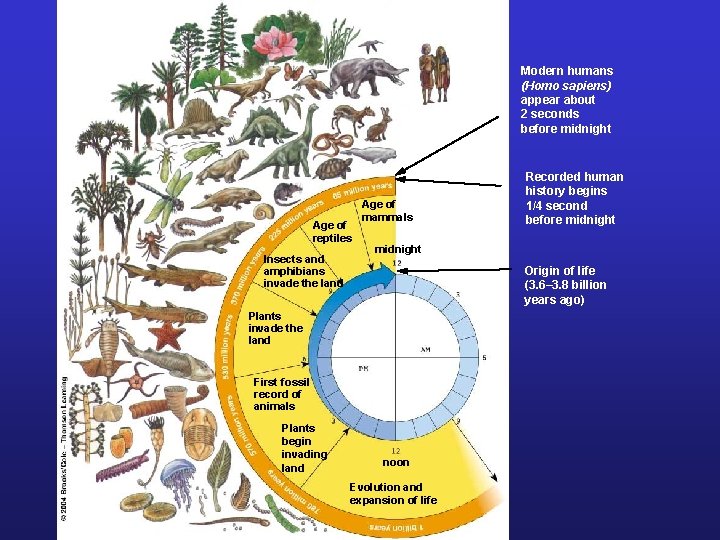
Modern humans (Homo sapiens) appear about 2 seconds before midnight Age of reptiles Insects and amphibians invade the land Age of mammals midnight Origin of life (3. 6– 3. 8 billion years ago) Plants invade the land First fossil record of animals Plants begin invading land Recorded human history begins 1/4 second before midnight noon Evolution and expansion of life
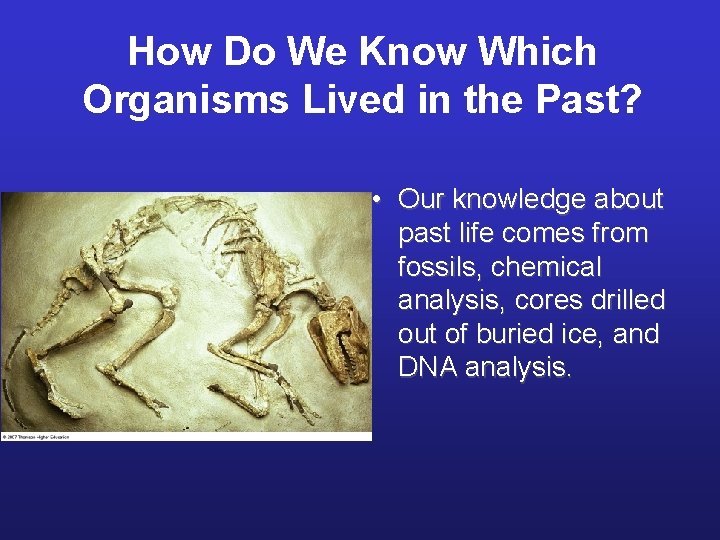
How Do We Know Which Organisms Lived in the Past? • Our knowledge about past life comes from fossils, chemical analysis, cores drilled out of buried ice, and DNA analysis.
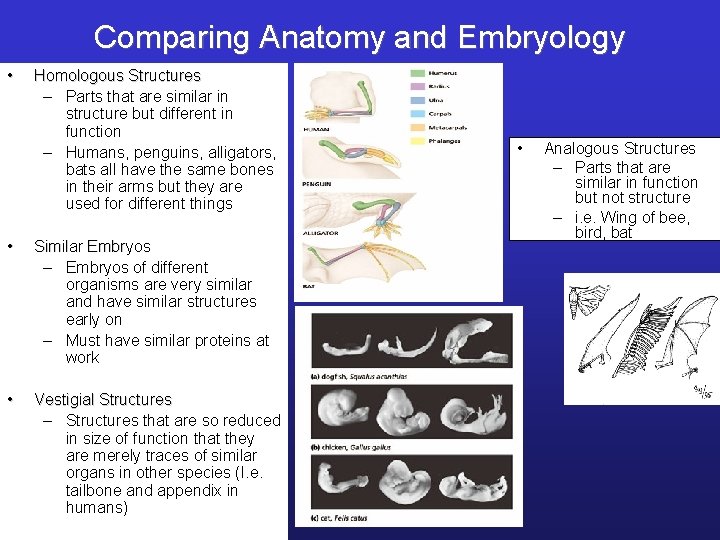
Comparing Anatomy and Embryology • Homologous Structures – Parts that are similar in structure but different in function – Humans, penguins, alligators, bats all have the same bones in their arms but they are used for different things • Similar Embryos – Embryos of different organisms are very similar and have similar structures early on – Must have similar proteins at work • Vestigial Structures – Structures that are so reduced in size of function that they are merely traces of similar organs in other species (I. e. tailbone and appendix in humans) • Analogous Structures – Parts that are similar in function but not structure – i. e. Wing of bee, bird, bat
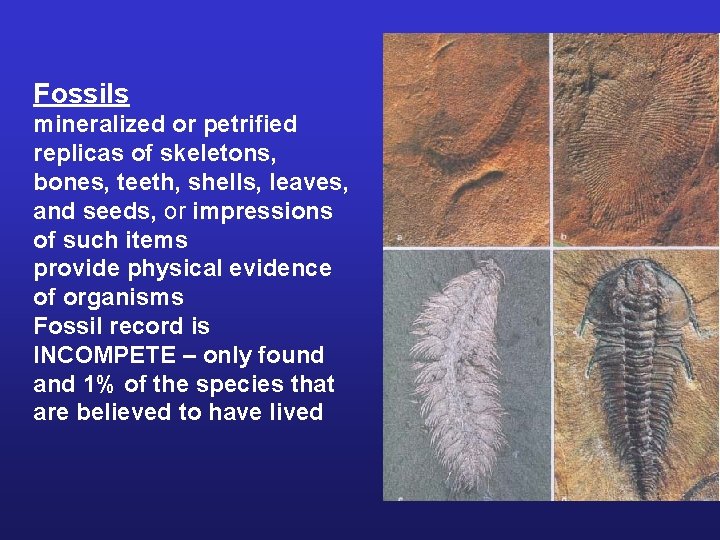
Fossils mineralized or petrified replicas of skeletons, bones, teeth, shells, leaves, and seeds, or impressions of such items provide physical evidence of organisms Fossil record is INCOMPETE – only found and 1% of the species that are believed to have lived
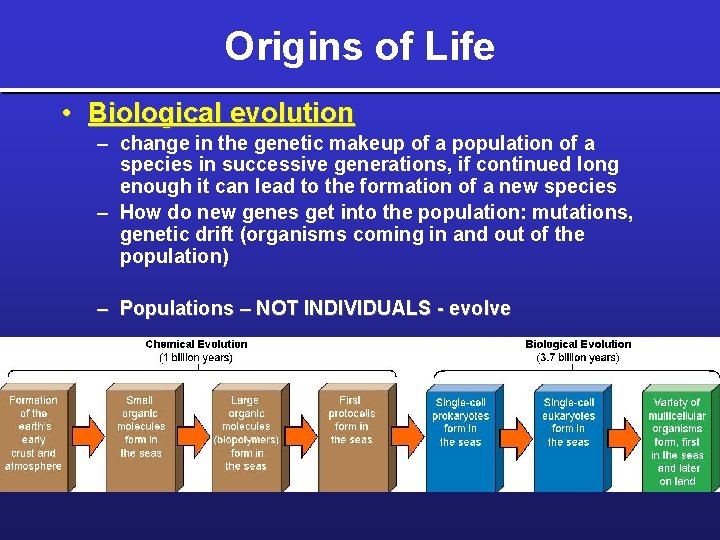
Origins of Life • Biological evolution – change in the genetic makeup of a population of a species in successive generations, if continued long enough it can lead to the formation of a new species – How do new genes get into the population: mutations, genetic drift (organisms coming in and out of the population) – Populations – NOT INDIVIDUALS - evolve
Evolution and Adaptation Theory of Evolution – all species descended from earlier, ancestral species. HOMER • Macroevolution - long-term, large-scale evolutionary changes through which • new species are formed from ancestral species and • other species are lost through extinction.
Evolution and Adaptation • Microevolution - small genetic changes that occur in a population. Genes mutate, individuals are selected and populations evolve. • Gene pool – set of all genes in the individuals of the population of a species • Mutation – changes in the structure or number of DNA molecules in a cell – Mutations are random, rare, only source of totally new alleles » Exposure to mutagens » Mistakes during replication
Evolution and Adaptation Natural selection • Process in by which individuals of a population acquire genetically based traits that increase their chances of survival and their ability to produce offspring. üAdaptation (n. ) – A heritable trait that enables an organism to better survive and reproduce under a given set of environmental conditions Artificial selection • Humans select one or more desirable genetic traits in the population of a plant or animal.
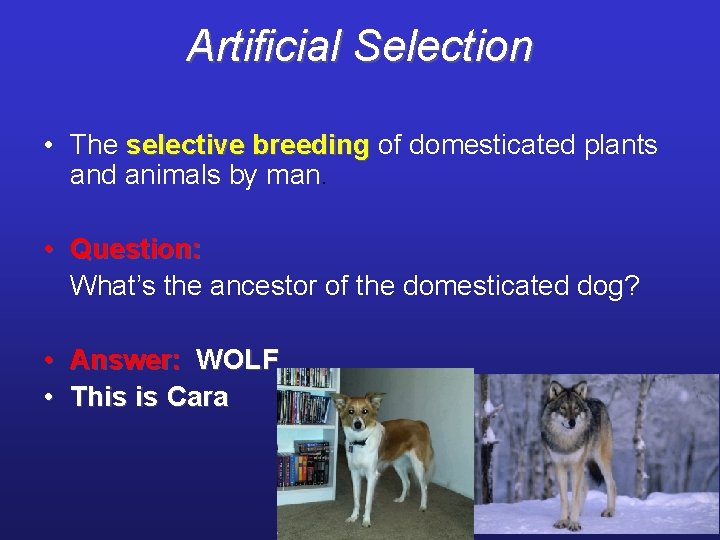
Artificial Selection • The selective breeding of domesticated plants and animals by man. • Question: What’s the ancestor of the domesticated dog? • Answer: WOLF • This is Cara
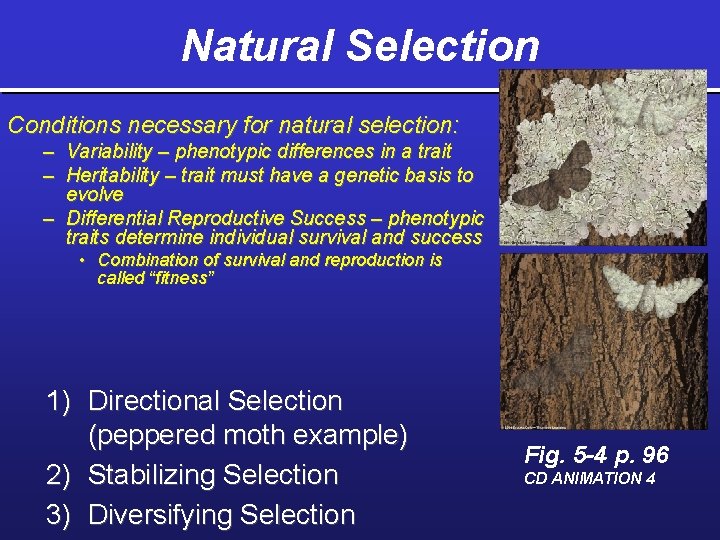
Natural Selection Conditions necessary for natural selection: – Variability – phenotypic differences in a trait – Heritability – trait must have a genetic basis to evolve – Differential Reproductive Success – phenotypic traits determine individual survival and success • Combination of survival and reproduction is called “fitness” 1) Directional Selection (peppered moth example) 2) Stabilizing Selection 3) Diversifying Selection Fig. 5 -4 p. 96 CD ANIMATION 4
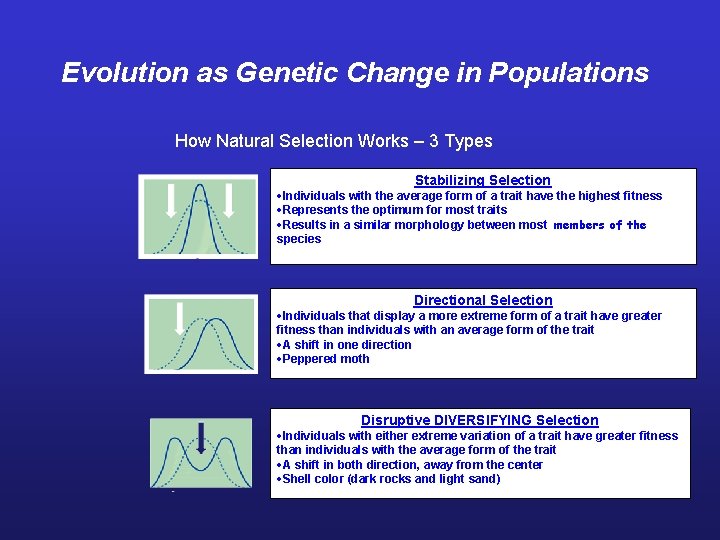
Evolution as Genetic Change in Populations How Natural Selection Works – 3 Types Stabilizing Selection ·Individuals with the average form of a trait have the highest fitness ·Represents the optimum for most traits ·Results in a similar morphology between most members of the species Directional Selection ·Individuals that display a more extreme form of a trait have greater fitness than individuals with an average form of the trait ·A shift in one direction ·Peppered moth Disruptive DIVERSIFYING Selection ·Individuals with either extreme variation of a trait have greater fitness than individuals with the average form of the trait ·A shift in both direction, away from the center ·Shell color (dark rocks and light sand)
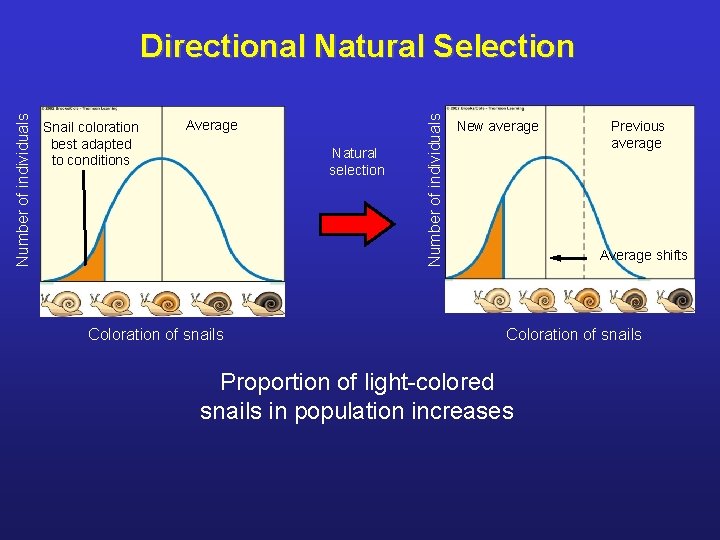
Snail coloration best adapted to conditions Average Natural selection Coloration of snails Number of individuals Directional Natural Selection New average Previous average Average shifts Coloration of snails Proportion of light-colored snails in population increases
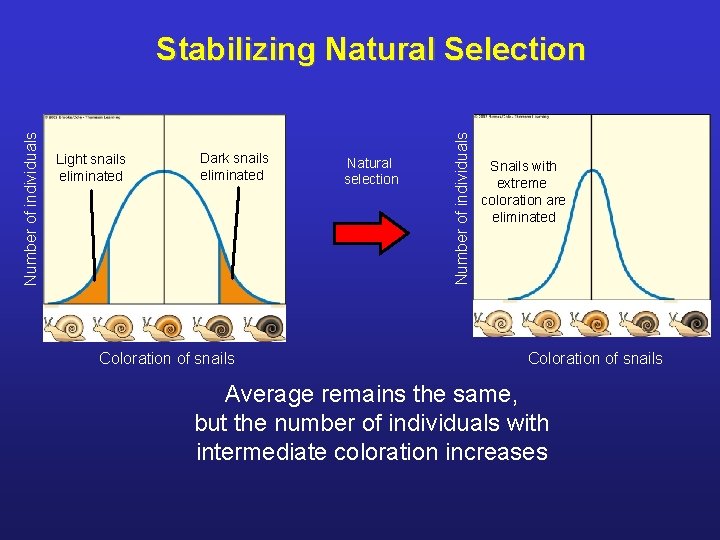
Light snails eliminated Dark snails eliminated Coloration of snails Natural selection Number of individuals Stabilizing Natural Selection Snails with extreme coloration are eliminated Coloration of snails Average remains the same, but the number of individuals with intermediate coloration increases
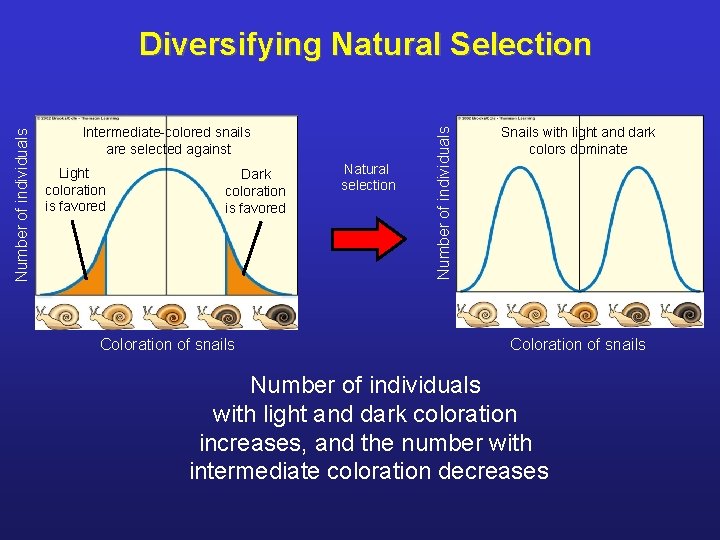
Intermediate-colored snails are selected against Light coloration is favored Dark coloration is favored Coloration of snails Natural selection Number of individuals Diversifying Natural Selection Snails with light and dark colors dominate Coloration of snails Number of individuals with light and dark coloration increases, and the number with intermediate coloration decreases
Evolution Primers • Isn't Evolution Just a Theory? ? ? • How Does Evolution Really Work? • How Do We Know Evolution Happens?
Limits on Adaptation through Natural Selection • A population’s ability to adapt to new environmental conditions through natural selection is limited by its gene pool and how fast it can reproduce. – Humans have a relatively slow generation time (decades) and output (# of young) versus some other species.
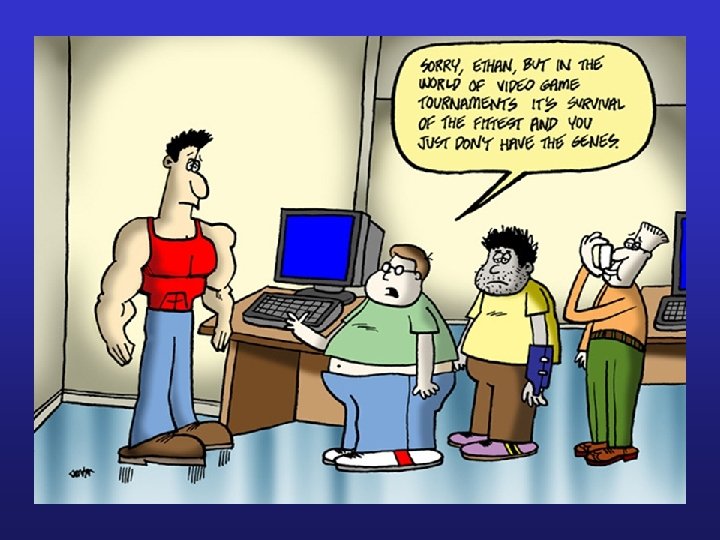
Common Myths about Evolution through Natural Selection • Evolution through natural selection is about the most descendants. • Misconception 1: survival of the fittest does not mean survival of the strongest – it is referring to REPRODUCTIVE SUCCESS • Misconception 2: Evolution involves some grand plan of nature in which species become progressively more perfect – Organisms do not develop certain traits because they need them. – There is no such thing as genetic perfection.
Evolution and Adaptation • Co-Evolution – Populations of two different species interacting over a long period of time – Changes in the gene pool of one species can lead to changes the gene pool of another species • Predator-Prey Relationships (salamander and snake – the coffee pot incident) • Plant defense mechanisms (mistletoe plant)
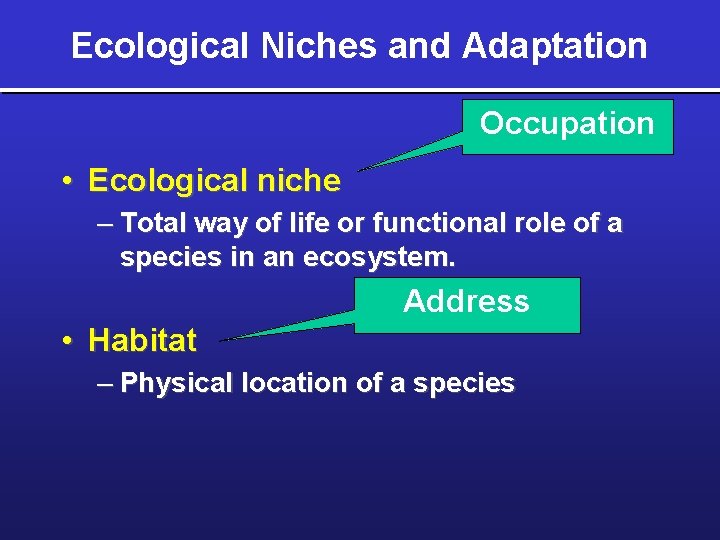
Ecological Niches and Adaptation Occupation • Ecological niche – Total way of life or functional role of a species in an ecosystem. Address • Habitat – Physical location of a species
Ecological Niches and Adaptation • Fundamental niche – Full potential range of the physical, chemical, and biological factors a species can use if there were no direct competition from other species. • Realized niche – Part of a species fundamental niche that are actually used.
Broad and Narrow Niches • Generalist species – Species with a broad ecological niche. • • • Live in many different places. Eat a variety of food. Tolerate a wide range of environmental conditions. (flies, mice, deer, catfish, humans) • Specialist species – Species with a narrow ecological niche. • • • Live only in one type of habitat Use only a few types of food Tolerate only a narrow range of climatic and other environmental conditions. (tiger salamander, red-cockaded woodpecker, spotted owls, pandas)
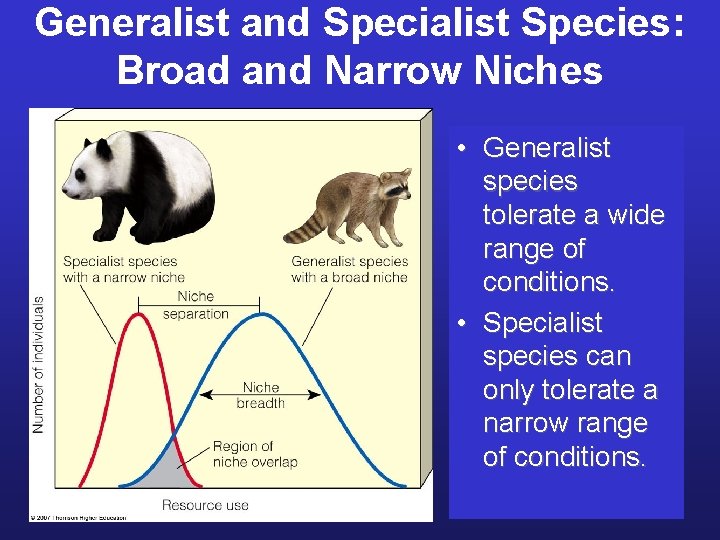
Generalist and Specialist Species: Broad and Narrow Niches • Generalist species tolerate a wide range of conditions. • Specialist species can only tolerate a narrow range of conditions.
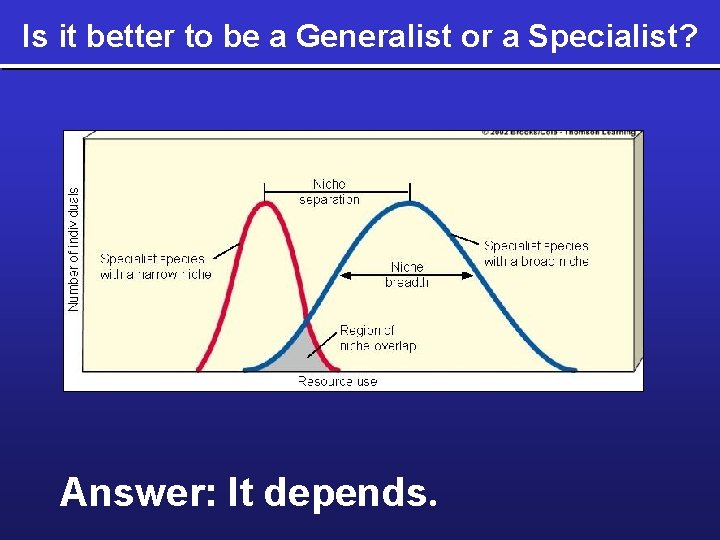
Is it better to be a Generalist or a Specialist? Answer: It depends.
Speciation, Extinction, and Biodiversity Speciation - formation of two species from one species because of divergent natural selection 1) Geographic isolation – groups of the same species become physically separated
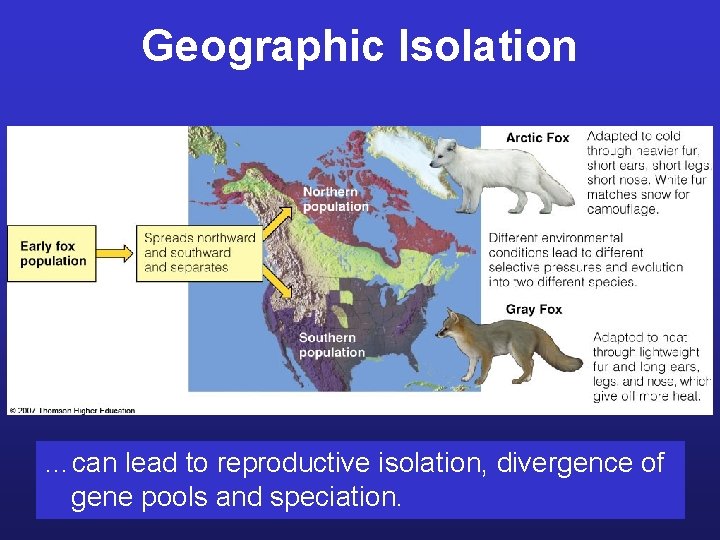
Geographic Isolation …can lead to reproductive isolation, divergence of gene pools and speciation.
Speciation, Extinction, and Biodiversity 2) Reproductive Isolation – isolated populations become so genetically different they cannot. . . ØInterbreed, or Øproduce live, fertile offspring
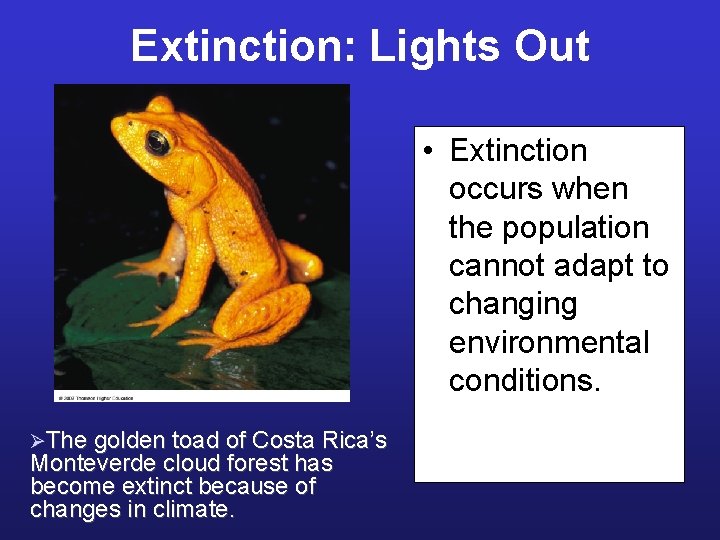
Extinction: Lights Out • Extinction occurs when the population cannot adapt to changing environmental conditions. ØThe golden toad of Costa Rica’s Monteverde cloud forest has become extinct because of changes in climate.
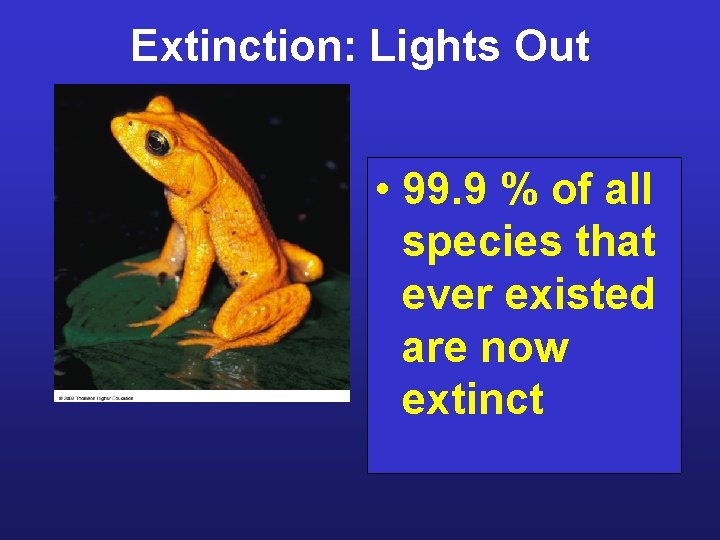
Extinction: Lights Out • 99. 9 % of all species that ever existed are now extinct
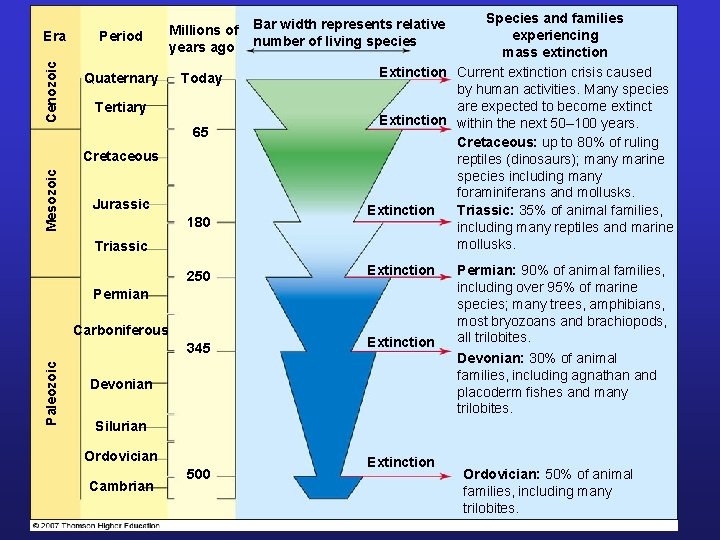
Cenozoic Era Period Millions of years ago Quaternary Today Tertiary 65 Mesozoic Cretaceous Jurassic 180 Triassic Species and families experiencing mass extinction Extinction Current extinction crisis caused by human activities. Many species are expected to become extinct Extinction within the next 50– 100 years. Cretaceous: up to 80% of ruling reptiles (dinosaurs); many marine species including many foraminiferans and mollusks. Extinction Triassic: 35% of animal families, including many reptiles and marine mollusks. Bar width represents relative number of living species 250 Extinction 345 Extinction Permian Paleozoic Carboniferous Devonian Permian: 90% of animal families, including over 95% of marine species; many trees, amphibians, most bryozoans and brachiopods, all trilobites. Devonian: 30% of animal families, including agnathan and placoderm fishes and many trilobites. Silurian Ordovician Cambrian 500 Extinction Ordovician: 50% of animal families, including many trilobites.
Extinction • Background extinction – Normal extinction of various species as a result of changes in local environmental conditions • Mass extinction – extinction resulting from catastrophic, widespread event in which large groups of existing species are wiped out • Adaptive radiation – Process in which numerous new species evolve to fill vacant and new ecological niches in changed environments
Period of Recovery Following Extinction Adaptive radiation Process in which numerous new species evolve to fill vacant and new ecological niches in changed environments
How do speciation and extinction affect biodiversity? Speciation – Extinction = Biodiversity Extinctions and depletions temporarily reduce biodiversity YET create evolutionary opportunities for surviving species to undergo adaptive radiations to fill unoccupied and new biological niches
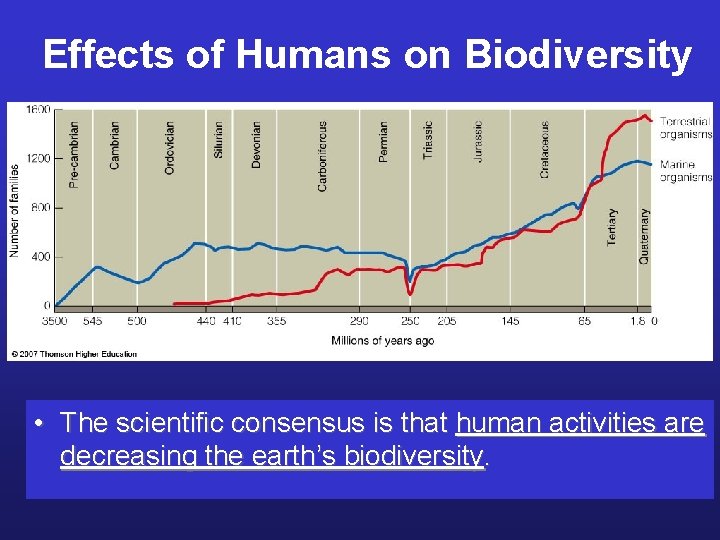
Effects of Humans on Biodiversity • The scientific consensus is that human activities are decreasing the earth’s biodiversity.
- Slides: 40