
Evolution and Biodiversity Essential Questions n n Be
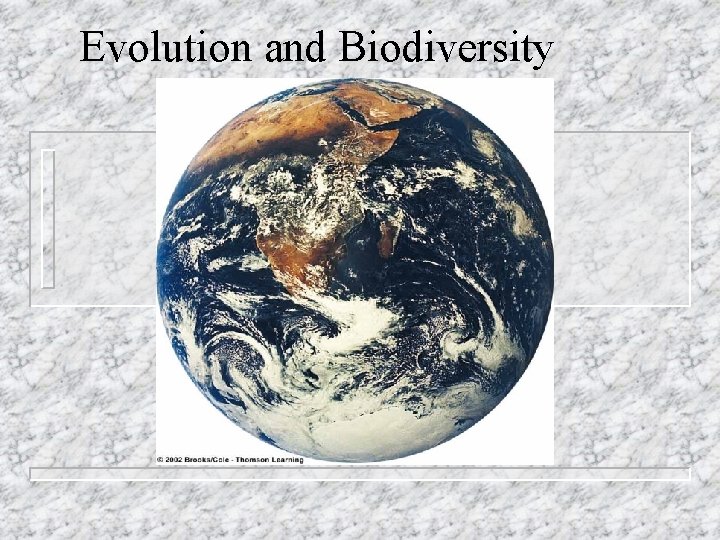
Evolution and Biodiversity
Essential Questions n n Be able to describe how the earth is “just right” for life What is evolution? How has evolution lead to the current diversity of organisms? What is an ecological niche? How does it relate to adaptation to changing environmental conditions? How do extinction of species and formation of new species affect biodiversity?
Earth: The Just Right Planet n Temperature – – – n n Distance from Sun Geothermal energy from core Temperature fluctuated only 10 -20 o. C over 3. 7 billion years despite 30 -40% increase in solar output Water exists in 3 phases Right size (=gravitational mass to keep atmosphere) Resilient and adaptive Each species here today represents a long chain of evolution and each plays a role in its respective ecosystem
Origins of Life on Earth 4. 7 -4. 8 Billion Year History n n Evidence from chemical analysis and measurements of radioactive elements in primitive rocks and fossils. Life developed over two main phases: – Chemical evolution (took about 1 billion years) n – Organic molecules, proteins, polymers, and chemical reactions to form first “protocells” Biological evolution (3. 7 billion years) n From single celled prokaryotic bacteria to eukaryotic creatures to eukaryotic multicellular organisms (diversification of species)
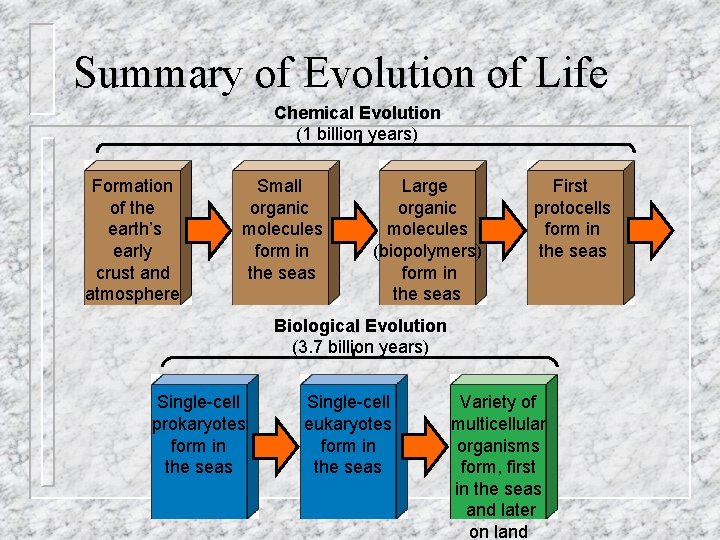
Summary of Evolution of Life Chemical Evolution (1 billion years) Formation of the earth’s early crust and atmosphere Small organic molecules form in the seas Large organic molecules (biopolymers) form in the seas First protocells form in the seas Biological Evolution (3. 7 billion years) Single-cell prokaryotes form in the seas Single-cell eukaryotes form in the seas Variety of multicellular organisms form, first in the seas and later on land
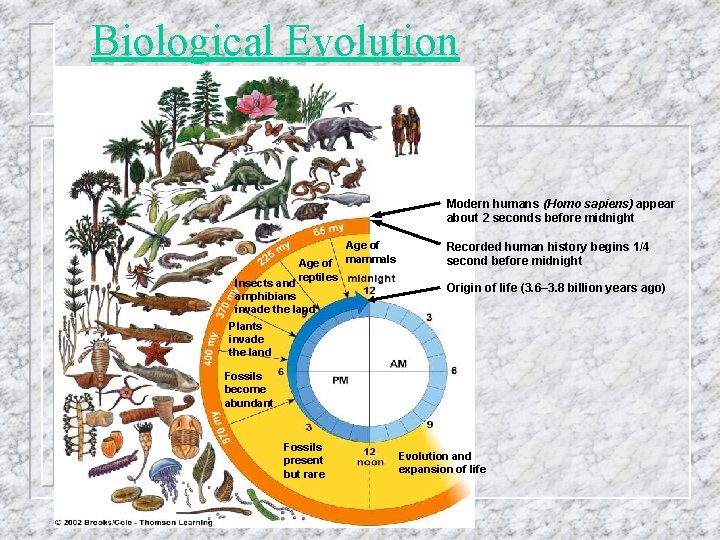
Biological Evolution Modern humans (Homo sapiens) appear about 2 seconds before midnight Age of reptiles Insects and amphibians invade the land Plants invade the land Age of mammals Recorded human history begins 1/4 second before midnight Origin of life (3. 6– 3. 8 billion years ago) Fossils become abundant Fossils present but rare Evolution and expansion of life
Fossil Record n n Most of what we know of the history of life on earth comes from fossils (SJ Gould) Give us physical evidence of organisms – n Uneven and incomplete record of species – – n n Show us internal structure We have fossils for 1% of species believed to have lived on earth Some organisms left no fossils, others decomposed, others have yet to be found. Other info from ancient rocks, ice core, DNA The whale as an example Other evidence here
Evolution n The change in a POPULATION’S genetic makeup (gene pool) over time (successive generations) – – n Microevolution – – n Those with the best phenotype and genotype survive to reproduce and pass on traits All species descended from earlier ancestor species Small genetic changes in a population such as the spread of a mutation or the change in the frequency of a single allele due to selection (changes to gene pool) Not possible without genetic variability in a pop… Macroevolution – Long term large scale evolutionary changes through which new species are formed and others are lost through extinction
Microevolution n Changes in a population’s gene pool over time. – n Genetic variability within a population is the catalyst Four Processes cause Microevolution – Mutation (random changes in DNA—ultimate source of new alleles) [stop little] n n – – – n Exposure to mutagens or random mistakes in copying Random/unpredictable relatively rare Natural Selection (best produce most offspring) Gene flow (movement of genes between pop’s) Genetic drift (change in gene pool due to random/chance events) Peppered moth of England; El Nino Galapagos
Darwinian Natural Selection n Three conditions necessary for evolution by natural selection to occur: – – n Natural variability for a trait in a population Trait must be heritable (has a genetic basis so that it can be passed onto offspring) Trait must lead to differential reproduction Must allow some members of the population to leave more offspring than other members of the population w/o trait) A heritable trait that enables organisms to survive is called an adaptation (Lamark is wrong…)
Why won’t our lungs evolve to deal with air pollution? n Limits to adaptation: – – A change in the environment can only lead to adaptation for traits already present in the gene pool Reproductive capacity may limit a population’s ability to adapt n n – If you reproduce quickly (insects, bacteria) then you can adapt to changes in a short time If you reproduce slowly (elephants, tigers, corals) then it takes thousands or millions of years to adapt through natural selection Most individuals without trait would have to die in order for the trait to predominate and be passed on
Take Home #1 n When faced with a change in environmental condition, a population of a species can: – – – n n Adapt via natural selection Migrate (if possible) to an area with more favorable conditions (Mars & Atlantis? ) Become extinct Natural selection can only act on inherited alleles already present in the population The environment DOES NOT creates favorable heritable characteristics!
Steps of Evolution n n n n Genetic variation is added to genotype by mutation Mutations lead to changes in the phenotype Phenotype is acted upon by nat’l selection Individuals more suited to environment produce more offspring (contribute more to total gene pool of population) Population’s gene pool changes over time Speciation may occur if geographic and reproductive isolating mechanisms exist… Natural Selection in action. . . A demonstration. . .
Three types of Natural Selection n Directional – Allele frequencies shift to favor individuals at one extreme of the normal range n n Only one side of the distribution reproduce Population looks different over time – n Stabilizing – Favors individuals with an average genetic makeup n n n Peppered moths and genetic resistance to pesticides among insects and antibiotics in bacteria Only the middle reproduce Population looks more similar over time (elim. extremes) Diversifying – Environmental conditions favor individuals at both ends of the genetic spectrum n Population split into two groups
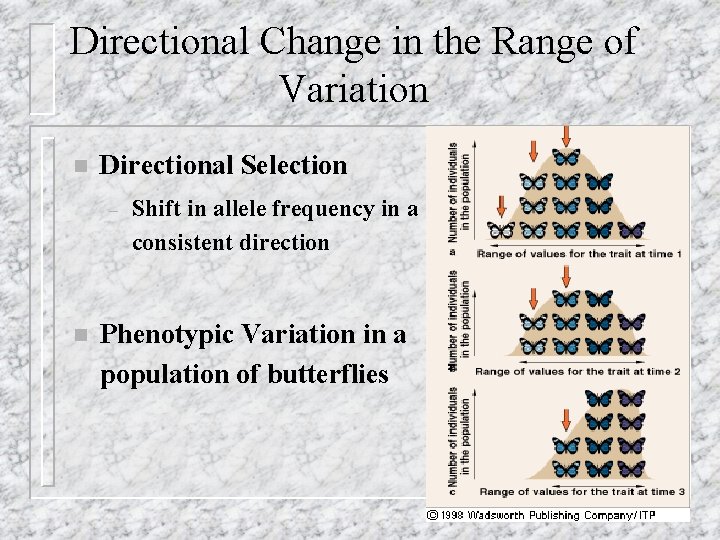
Directional Change in the Range of Variation n Directional Selection – n Shift in allele frequency in a consistent direction Phenotypic Variation in a population of butterflies
The Case of the Peppered Moths n Industrial revolution – Pollution darkened tree trunks n Camouflage of moths increases survival from predators n Directional selection caused a shift away from light-gray towards dark-gray moths
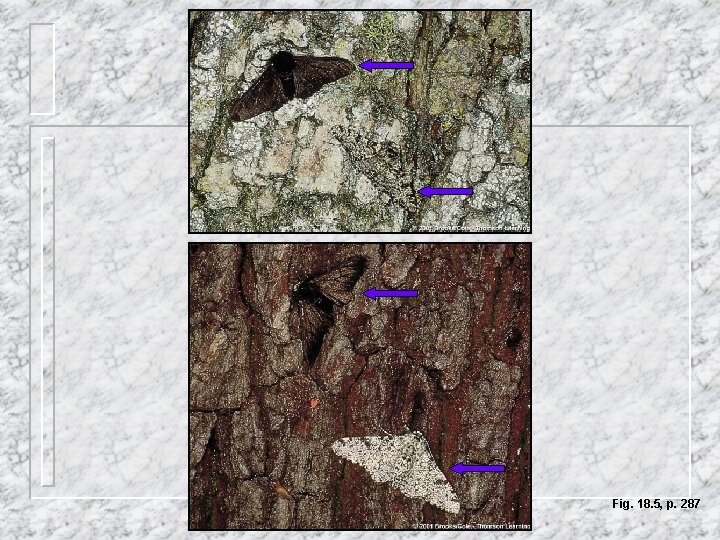
Fig. 18. 5, p. 287
Directional Selection n Pesticide Resistance – Pest resurgence n Antibiotic Resistance n Grant’s Finch Beak Data With directional selection, allele frequencies tend to shift in response to directional changes in the environment n
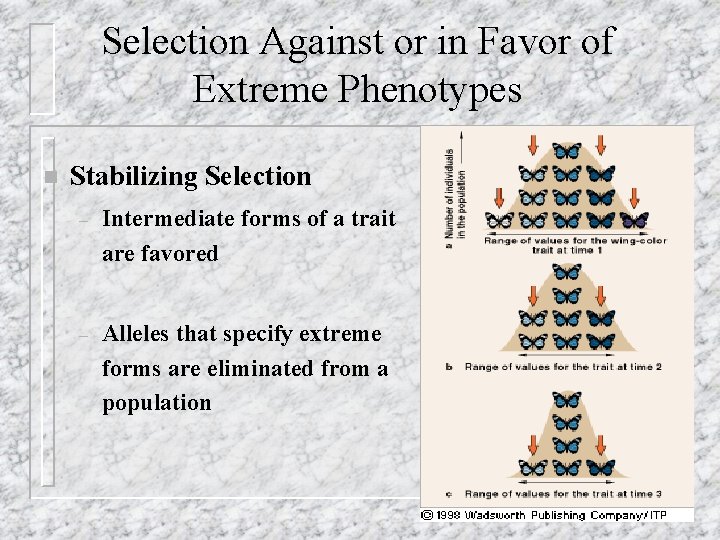
Selection Against or in Favor of Extreme Phenotypes n Stabilizing Selection – Intermediate forms of a trait are favored – Alleles that specify extreme forms are eliminated from a population
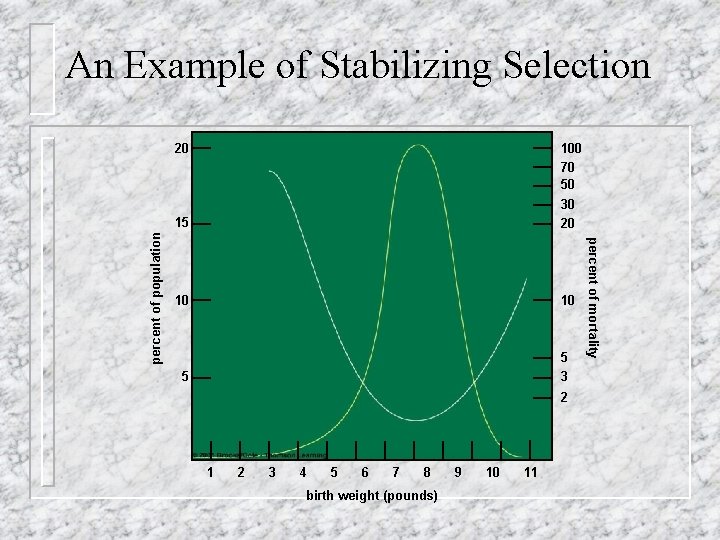
An Example of Stabilizing Selection 100 70 50 15 30 20 10 10 5 5 3 2 1 2 3 4 5 6 7 8 birth weight (pounds) 9 10 11 percent of mortality percent of population 20
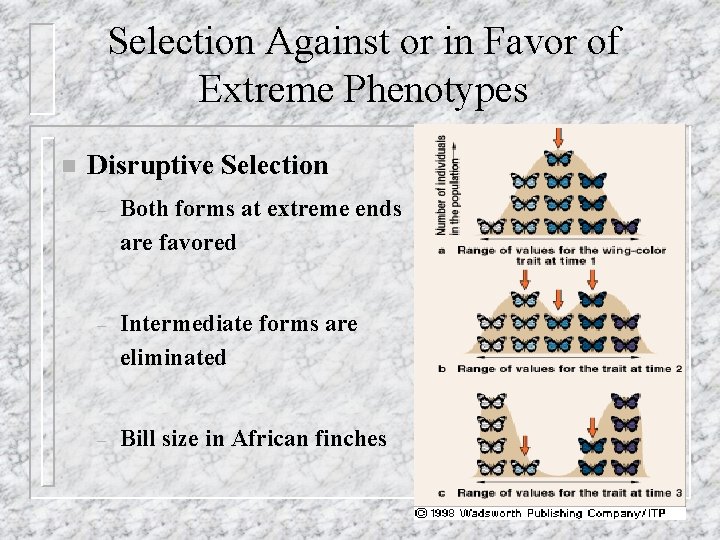
Selection Against or in Favor of Extreme Phenotypes n Disruptive Selection – Both forms at extreme ends are favored – Intermediate forms are eliminated – Bill size in African finches
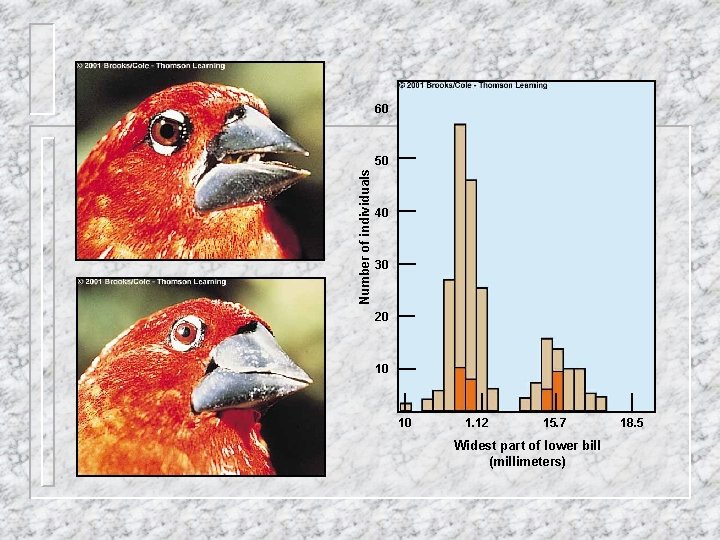
60 Number of individuals 50 40 30 20 10 10 1. 12 15. 7 Widest part of lower bill (millimeters) 18. 5
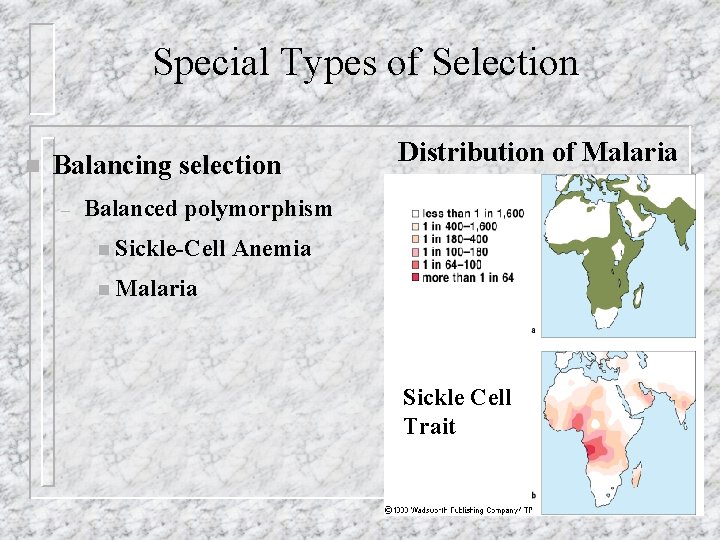
Special Types of Selection n Balancing selection – Distribution of Malaria Balanced polymorphism n Sickle-Cell Anemia n Malaria Sickle Cell Trait
Gene Flow and Genetic Drift n Gene Flow – Flow of alleles n Emigration n and immigration of individuals Genetic Drift – Random change in allele frequencies over generations brought about by chance – In the absence of other forces, drift leads to loss of genetic diversity
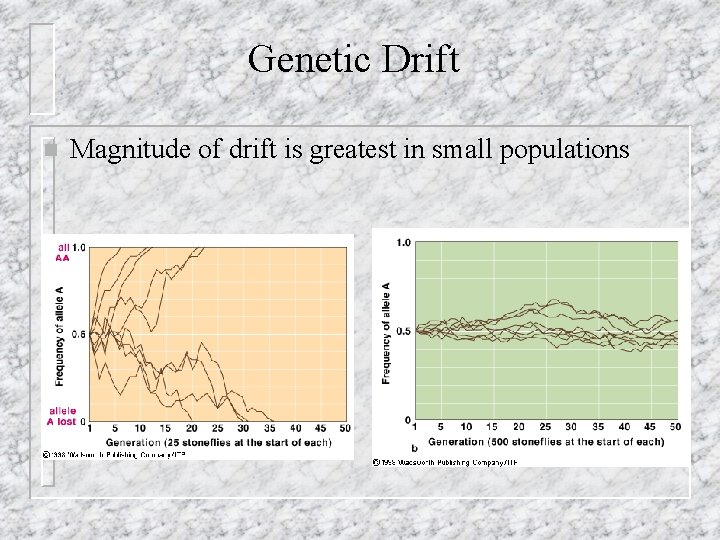
Genetic Drift n Magnitude of drift is greatest in small populations
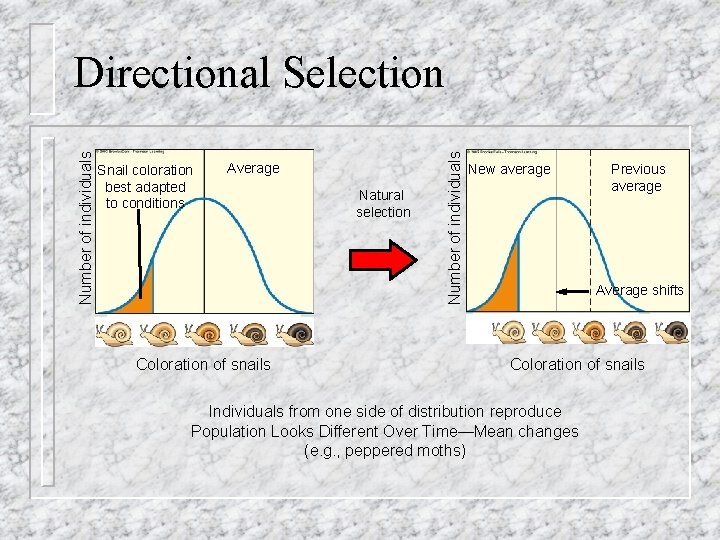
Snail coloration best adapted to conditions Average Coloration of snails Natural selection Number of individuals Directional Selection New average Previous average Average shifts Coloration of snails Individuals from one side of distribution reproduce Population Looks Different Over Time—Mean changes (e. g. , peppered moths)
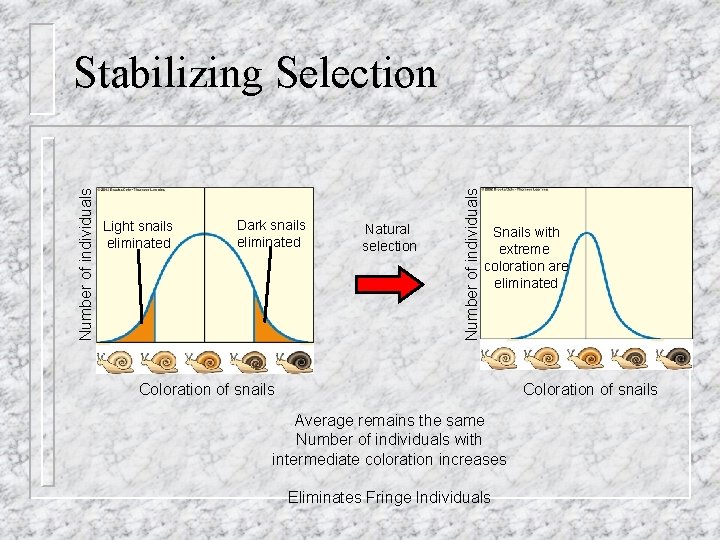
Light snails eliminated Dark snails eliminated Natural selection Number of individuals Stabilizing Selection Snails with extreme coloration are eliminated Coloration of snails Average remains the same Number of individuals with intermediate coloration increases Eliminates Fringe Individuals
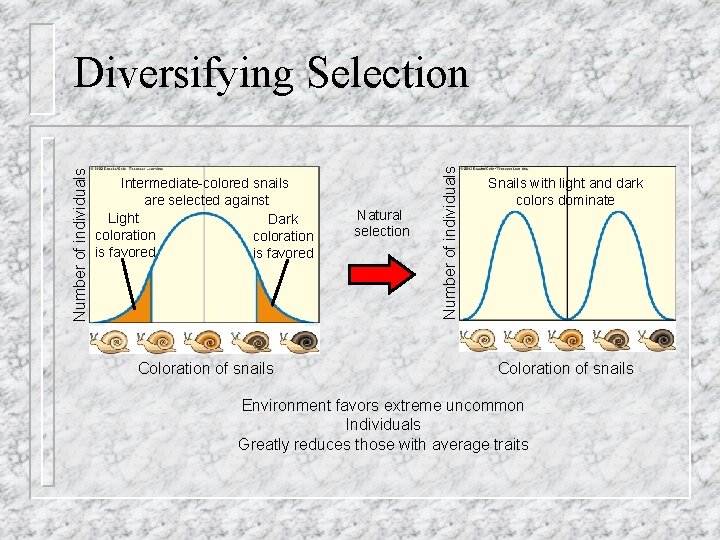
Intermediate-colored snails are selected against Light Dark coloration is favored Coloration of snails Natural selection Number of individuals Diversifying Selection Snails with light and dark colors dominate Coloration of snails Environment favors extreme uncommon Individuals Greatly reduces those with average traits
Coevolution n Interactions between species can cause microevolution – n Adaptation follows adaptation – n Changes in the gene pool of one species can cause changes in the gene pool of the other long term “arms race” between interacting populations of different populations Can also be symbiotic coevolution – – – Angiosperms and insects (pollinators) Corals and zooxanthellae Rhizobium bacteria and legume root nodules
And NUH is the letter I use to spell Nutches, Who live in small caves, known as Niches, for hutches. These Nutches have troubles, the biggest of which is The fact there are many more Nutches than Niches. Each Nutch in a Nich knows that some other Nutch Would like to move into his Nich very much. So each Nutch in a Nich has to watch that small Nich Or Nutches who haven't got Niches will snitch. -On Beyond Zebra (1955) Dr. Seuss
Niches n n n A species functional role in an ecosystem Involves everything that affects its survival and reproduction – Includes range of tolerance of all abiotic factors – Trophic characteristics – How it interacts with biotic and abiotic factors – Role it plays in energy flow and matter cycling Fundamental Niche – Full potential range of physical chemical and biological conditions and resources it could theoretically use if there was no direct competition from other species Realized Niche – Part of its niche actually occupied Generalist vs. Specialist – Lives many different places, eat many foods, tolerate a wide range of conditions vs few, intolerant… – Which strategy is better in a stable environment vs unstable?
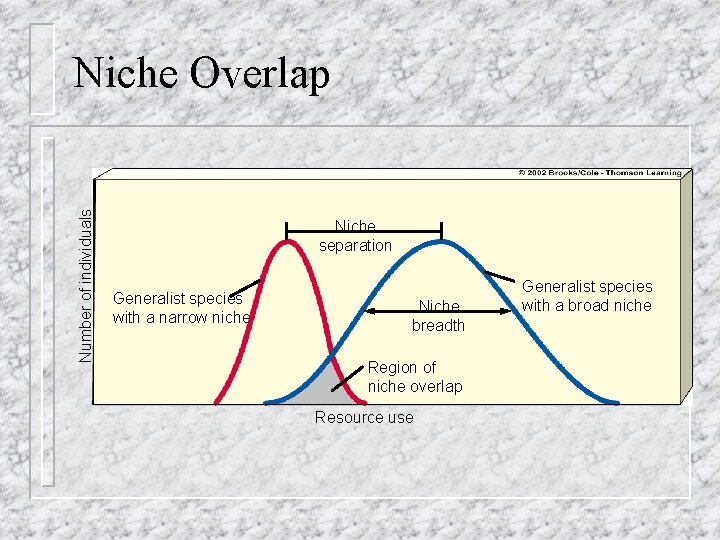
Number of individuals Niche Overlap Niche separation Generalist species with a narrow niche Niche breadth Region of niche overlap Resource use Generalist species with a broad niche
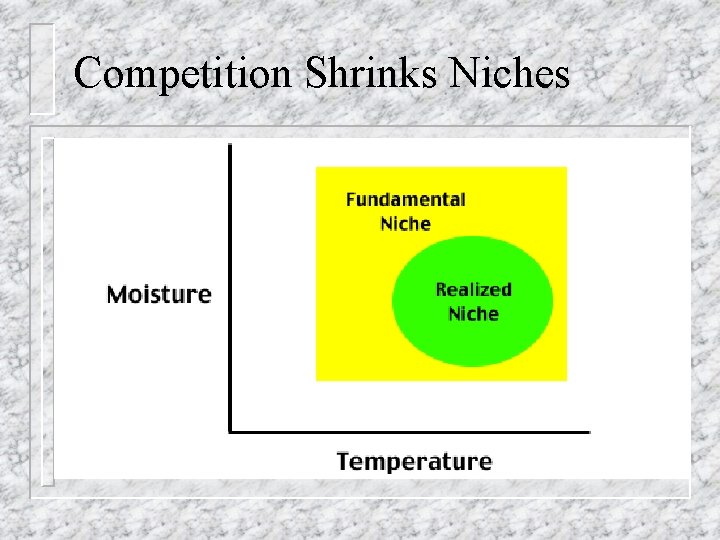
Competition Shrinks Niches
Key Concepts: n A species consist of one or more populations of individuals that can interbreed and produce offspring n Populations of a species have a shared genetic history n Speciation is the process by which daughter species evolve from a parent species
Key Concepts: n Geographic barriers can start the process of speciation – Allopatric speciation n With sympatric speciation, a species can form within the range of a parent species n Parapatric speciation has adjacent populations becoming distinct species while still coming in contact along a common border
What is a Species? n Morphological Species Concept – n Based on appearance alone Biological Species Concept – A species is one or more populations of individuals that are interbreeding under natural conditions and producing fertile offspring, and are reproductively isolated from other such populations
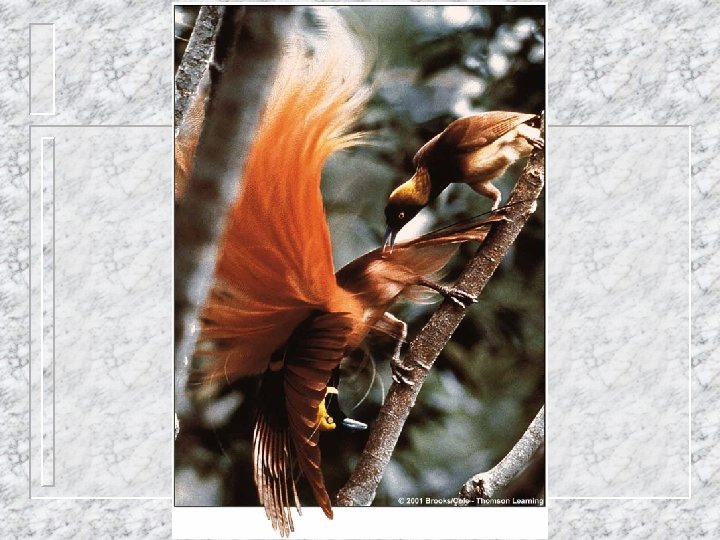
Speciation n Two species arise from one – Requires Reproductive isolation n n n Allopatric – – n Geographic: Physically separated Temporal: Mate at different times Behavioral: Bird calls / mating rituals Anatomical: Picture a mouse and an elephant hooking up Genetic Inviability: Mules Speciation that occurs when 2 or more populations of a species are geographically isolated from one another The allele frequencies in these populations change Members become so different that can no no longer interbreed See animation Sympatric – – Populations evolve with overlapping ranges Behavioral barrier or hybridization or polyploidy
Reproductive Isolating Mechanisms n Any heritable feature of body, form, functioning, or behavior that prevents breeding between one or more genetically divergent populations n Prezygotic or Postzygotic
Pre-Zygotic Isolation n Mating or zygote formation is blocked – Temporal Isolation – Behavioral Isolation – Mechanical Isolation – Ecological Isolation – Gamete Mortality
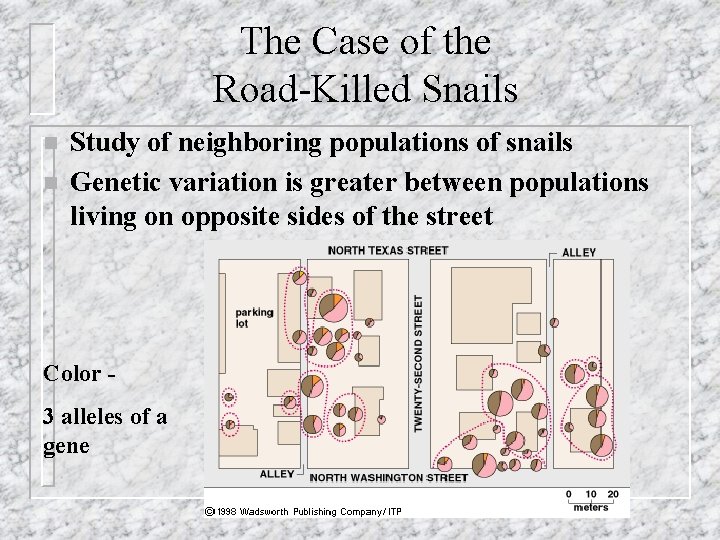
The Case of the Road-Killed Snails n n Study of neighboring populations of snails Genetic variation is greater between populations living on opposite sides of the street Color 3 alleles of a gene
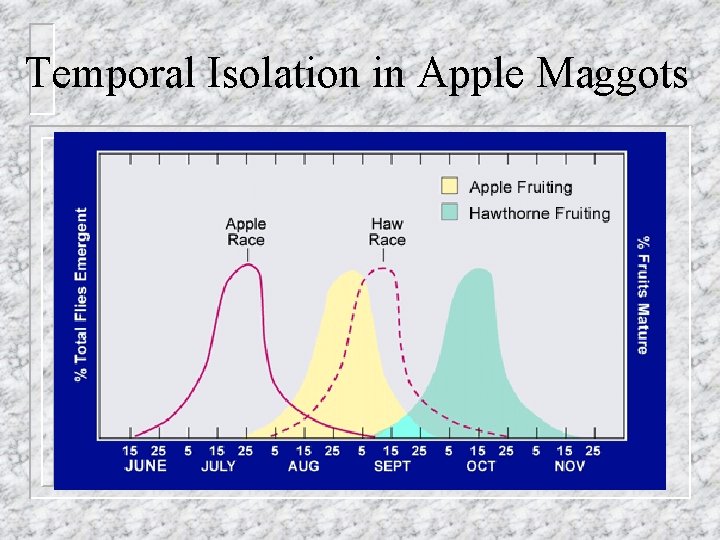
Temporal Isolation in Apple Maggots
Post-Zygotic Isolation n Hybrids don’t work – Zygotic mortality - Egg is fertilized but zygote or embryo dies – Hybrid inviability - First generation hybrid forms but shows low fitness – Hybrid infertility - Hybrid is fully or partially sterile
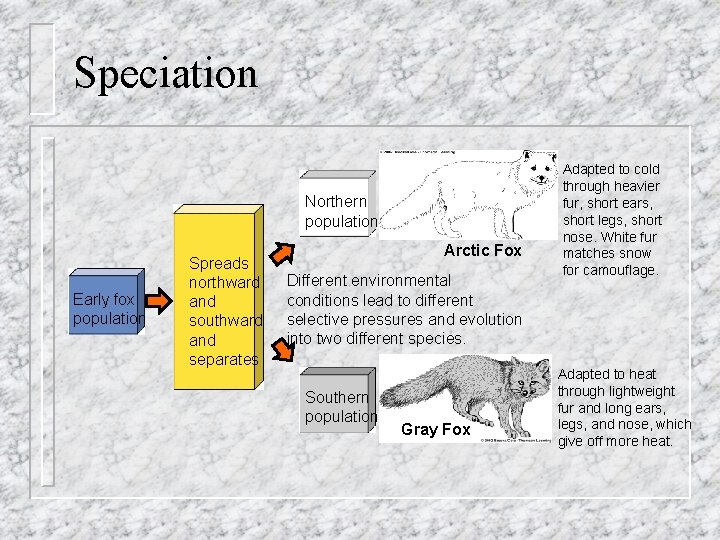
Speciation Northern population Early fox population Spreads northward and southward and separates Arctic Fox Different environmental conditions lead to different selective pressures and evolution into two different species. Southern population Gray Fox Adapted to cold through heavier fur, short ears, short legs, short nose. White fur matches snow for camouflage. Adapted to heat through lightweight fur and long ears, legs, and nose, which give off more heat.
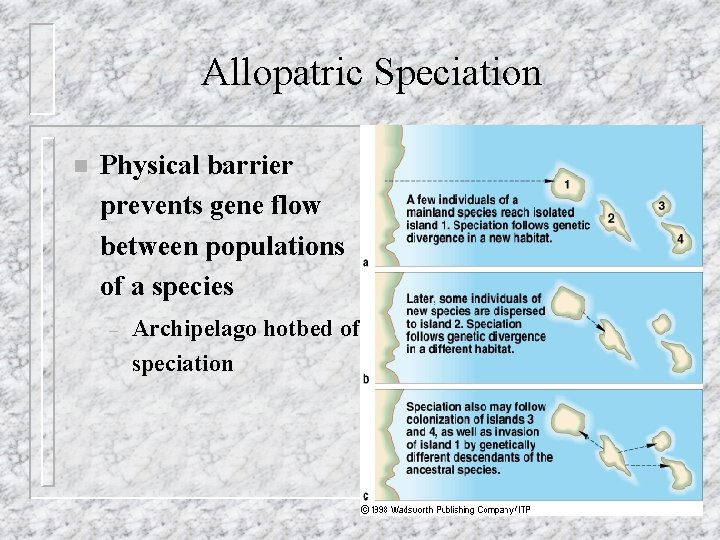
Allopatric Speciation n Physical barrier prevents gene flow between populations of a species – Archipelago hotbed of speciation
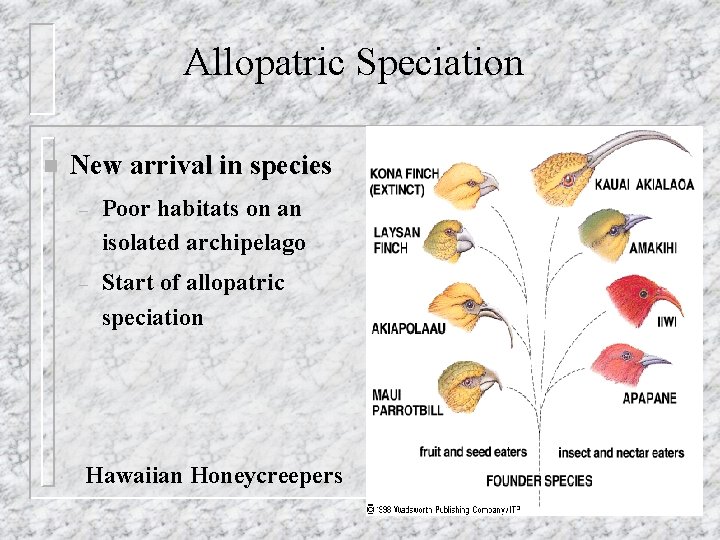
Allopatric Speciation n New arrival in species – Poor habitats on an isolated archipelago – Start of allopatric speciation Hawaiian Honeycreepers
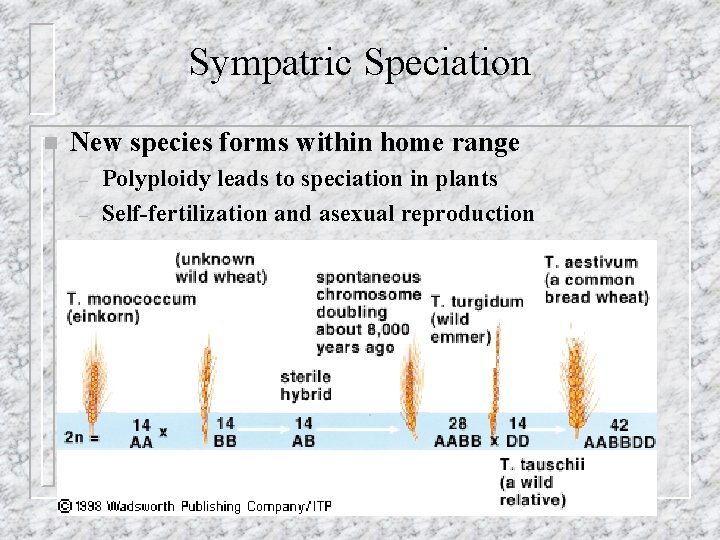
Sympatric Speciation n New species forms within home range – – Polyploidy leads to speciation in plants Self-fertilization and asexual reproduction
Extinction n n The ultimate fate of all species just as death is for all individual organisms 99. 9% of all the species that have ever existed are now extinct – n To a very close approximation, all species are extinct Background vs. Mass Extinction – – – Low rate vs. 25 -90% of total Five great mass extinctions in which numerous new species (including mammals) evolved to fill new or vacated niches in changed environments 10 million years or more for adaptive radiations to rebuild biological diversity following a mass extinction
Extinction in the context of Evolution If the environment changes rapidly and n The species living in these environments do not already possess genes which enable survival in the face of such change and n Random mutations do not accumulate quickly enough then n All members of the unlucky species may die n
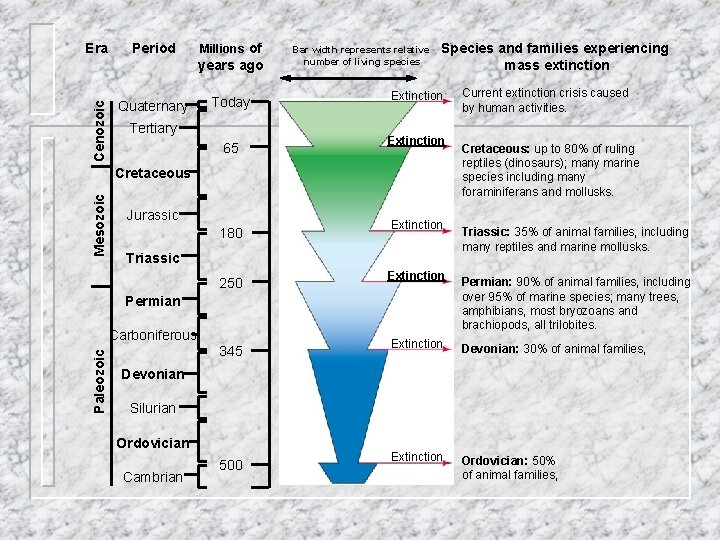
Era Period Millions of Cenozoic years ago Quaternary Today Tertiary 65 Bar width represents relative number of living species Species and families experiencing mass extinction Extinction Mesozoic Cretaceous Jurassic 180 Extinction Triassic 250 Paleozoic 345 Cretaceous: up to 80% of ruling reptiles (dinosaurs); many marine species including many foraminiferans and mollusks. Triassic: 35% of animal families, including many reptiles and marine mollusks. Extinction Permian: 90% of animal families, including over 95% of marine species; many trees, amphibians, most bryozoans and brachiopods, all trilobites. Extinction Devonian: 30% of animal families, Extinction Ordovician: 50% of animal families, Permian Carboniferous Current extinction crisis caused by human activities. Devonian Silurian Ordovician Cambrian 500
Biodiversity n Speciation – Extinction=Biodiversity n Humans major force in the premature extinction of species. Extinction rate increased by 100 -1000 times the natural background rate. As we grow in population over next 50 years, we are expected to take over more of the earth’s surface and productivity. This may cause the premature extinction of up to a QUARTER of the earth’s current species and constitute a SIXTH mass extinction n – – n Genetic engineering won’t solve this problem Only takes existing genes and moves them around Know why this is so important and what we are losing as it disappears….
- Slides: 51