
Evolution 1970 s 1980 s Early 1990 s
- Slides: 29
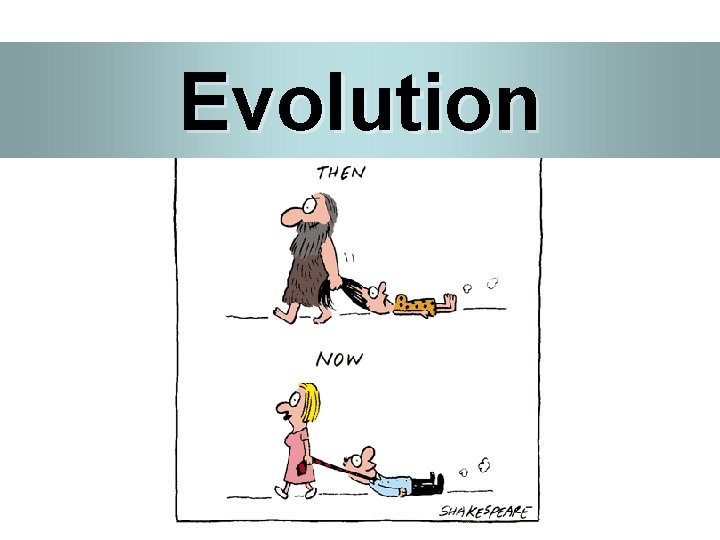
Evolution
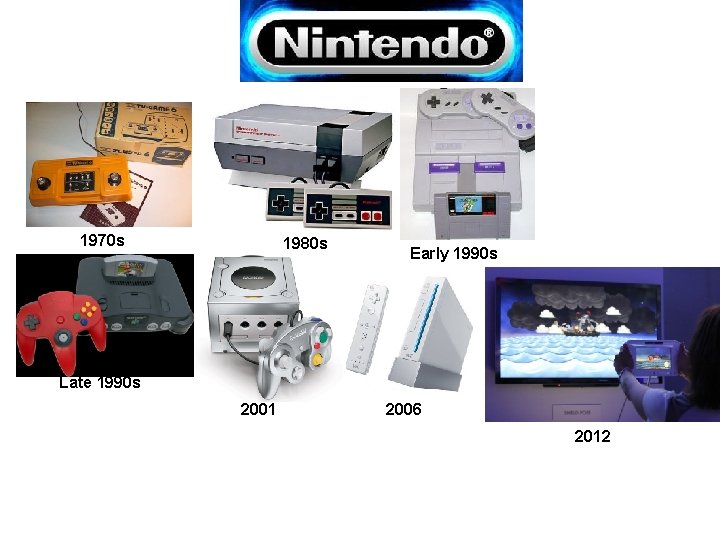
1970 s 1980 s Early 1990 s Late 1990 s 2001 2006 2012
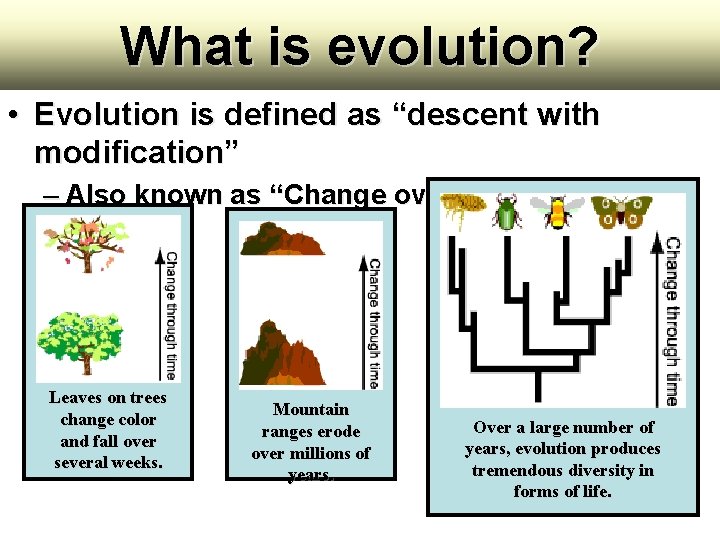
What is evolution? • Evolution is defined as “descent with modification” – Also known as “Change over time” Leaves on trees change color and fall over several weeks. Mountain ranges erode over millions of years. Over a large number of years, evolution produces tremendous diversity in forms of life.
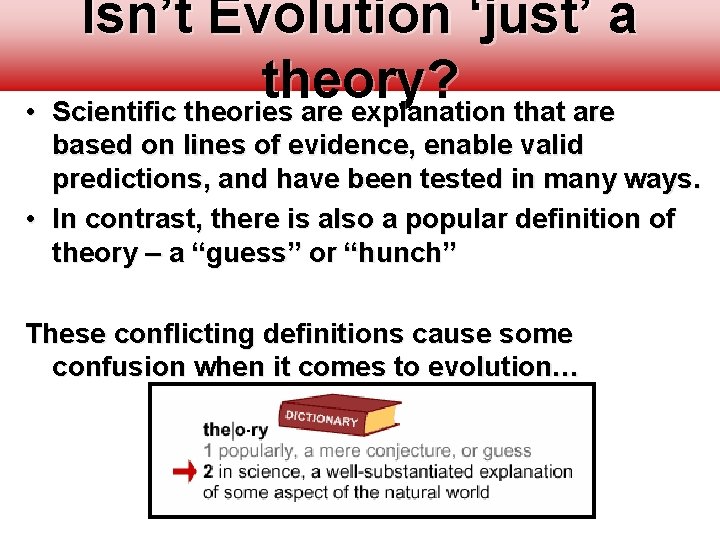
Isn’t Evolution ‘just’ a theory? • Scientific theories are explanation that are based on lines of evidence, enable valid predictions, and have been tested in many ways. • In contrast, there is also a popular definition of theory – a “guess” or “hunch” These conflicting definitions cause some confusion when it comes to evolution…
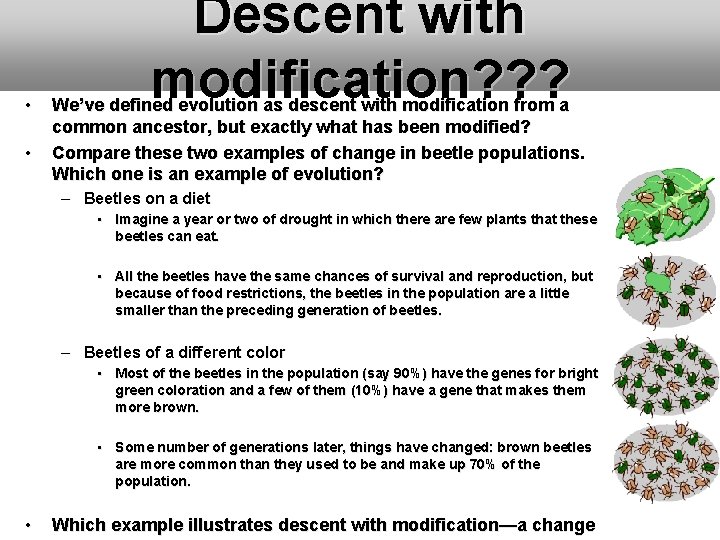
• • Descent with modification? ? ? We’ve defined evolution as descent with modification from a common ancestor, but exactly what has been modified? Compare these two examples of change in beetle populations. Which one is an example of evolution? – Beetles on a diet • Imagine a year or two of drought in which there are few plants that these beetles can eat. • All the beetles have the same chances of survival and reproduction, but because of food restrictions, the beetles in the population are a little smaller than the preceding generation of beetles. – Beetles of a different color • Most of the beetles in the population (say 90%) have the genes for bright green coloration and a few of them (10%) have a gene that makes them more brown. • Some number of generations later, things have changed: brown beetles are more common than they used to be and make up 70% of the population. • Which example illustrates descent with modification—a change
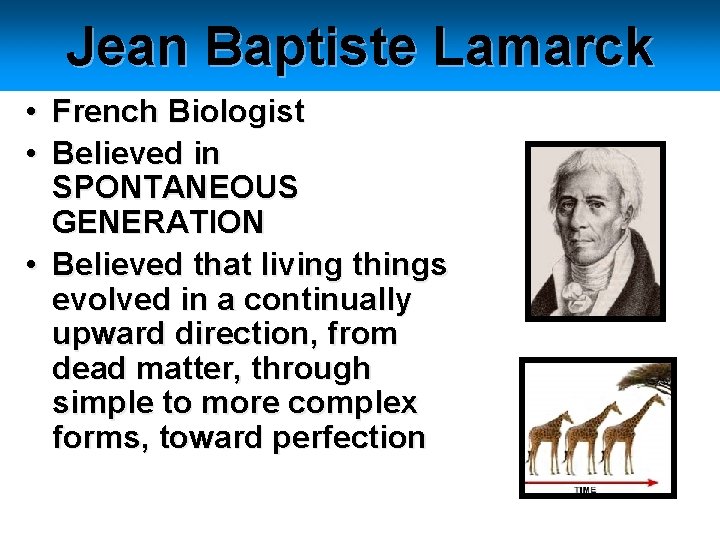
Jean Baptiste Lamarck • French Biologist • Believed in SPONTANEOUS GENERATION • Believed that living things evolved in a continually upward direction, from dead matter, through simple to more complex forms, toward perfection
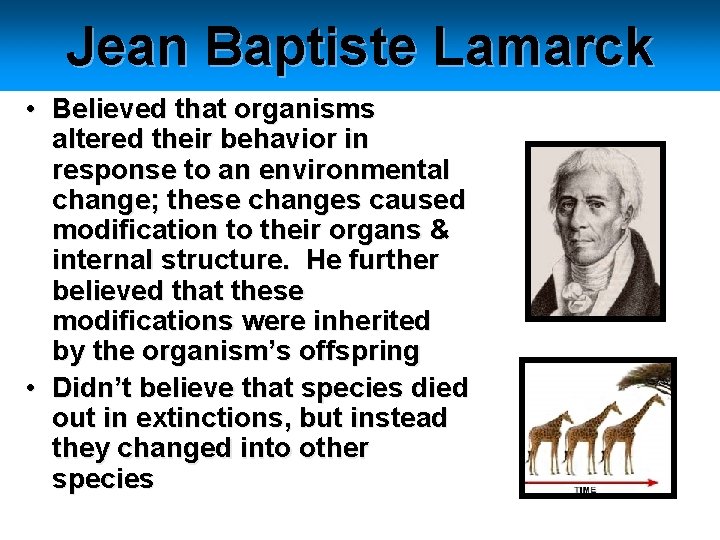
Jean Baptiste Lamarck • Believed that organisms altered their behavior in response to an environmental change; these changes caused modification to their organs & internal structure. He further believed that these modifications were inherited by the organism’s offspring • Didn’t believe that species died out in extinctions, but instead they changed into other species
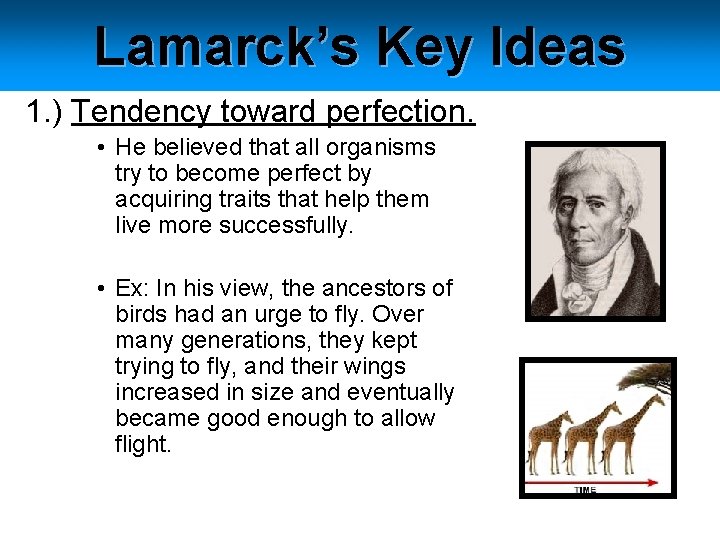
Lamarck’s Key Ideas 1. ) Tendency toward perfection. • He believed that all organisms try to become perfect by acquiring traits that help them live more successfully. • Ex: In his view, the ancestors of birds had an urge to fly. Over many generations, they kept trying to fly, and their wings increased in size and eventually became good enough to allow flight.
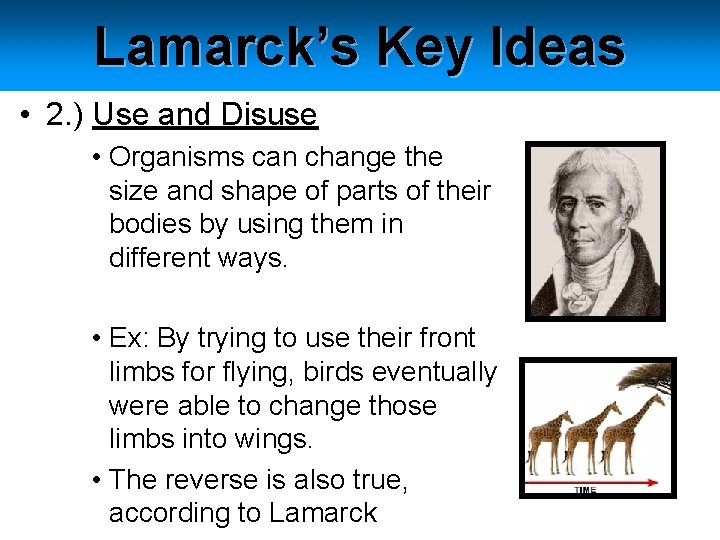
Lamarck’s Key Ideas • 2. ) Use and Disuse • Organisms can change the size and shape of parts of their bodies by using them in different ways. • Ex: By trying to use their front limbs for flying, birds eventually were able to change those limbs into wings. • The reverse is also true, according to Lamarck
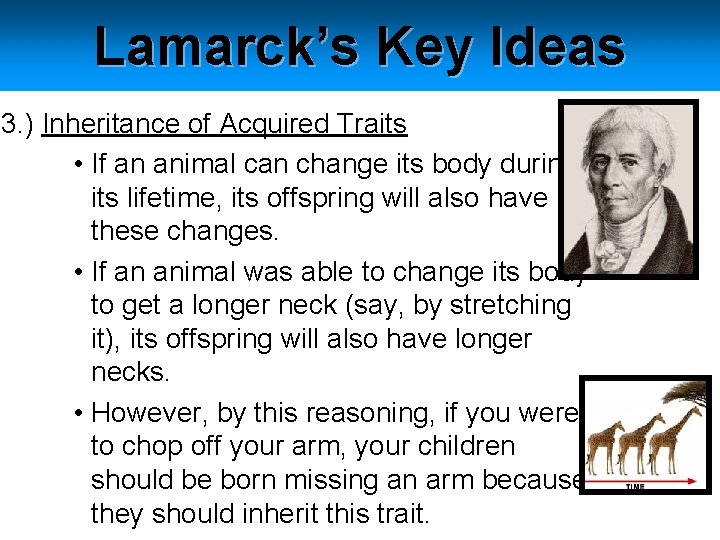
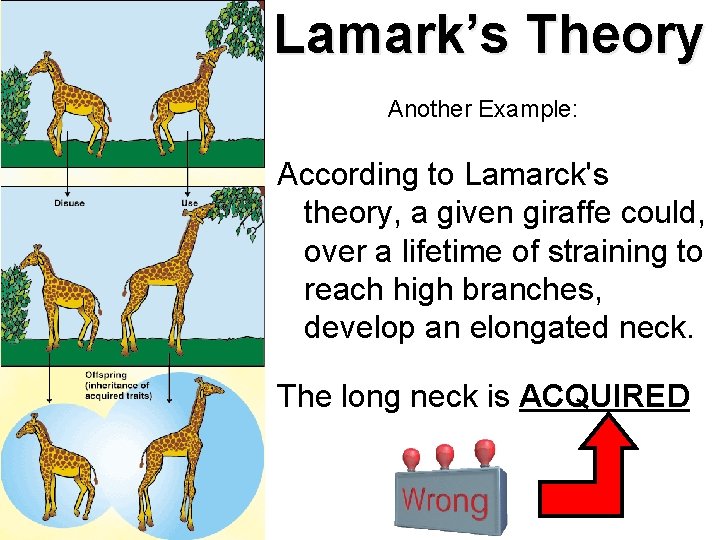
Lamarck’s Key Ideas 3. ) Inheritance of Acquired Traits • If an animal can change its body during its lifetime, its offspring will also have these changes. • If an animal was able to change its body to get a longer neck (say, by stretching it), its offspring will also have longer necks. • However, by this reasoning, if you were to chop off your arm, your children should be born missing an arm because they should inherit this trait.
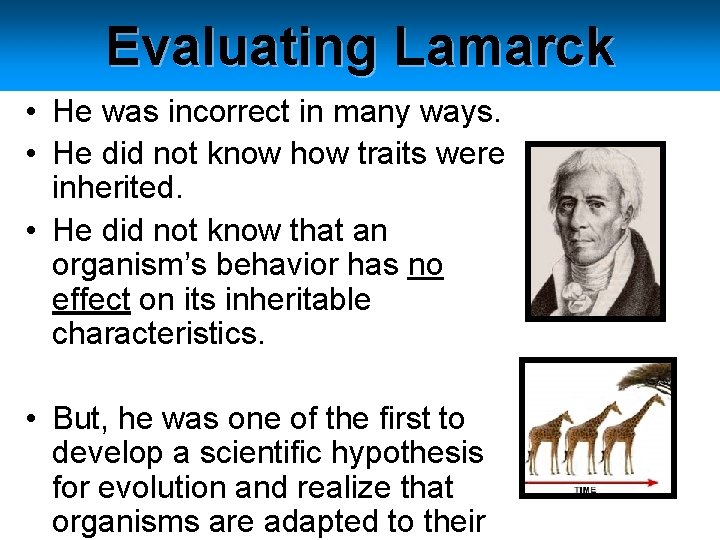
Evaluating Lamarck • He was incorrect in many ways. • He did not know how traits were inherited. • He did not know that an organism’s behavior has no effect on its inheritable characteristics. • But, he was one of the first to develop a scientific hypothesis for evolution and realize that organisms are adapted to their
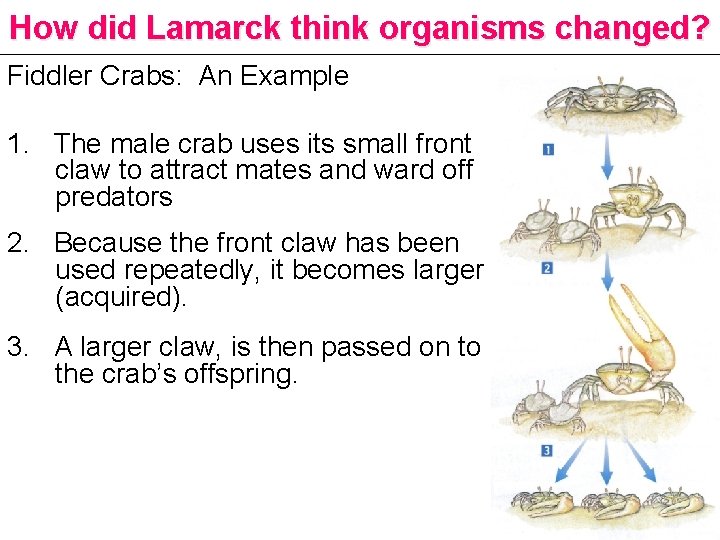
How did Lamarck think organisms changed? Fiddler Crabs: An Example 1. The male crab uses its small front claw to attract mates and ward off predators 2. Because the front claw has been used repeatedly, it becomes larger (acquired). 3. A larger claw, is then passed on to the crab’s offspring.
Lamark’s Theory Another Example: According to Lamarck's theory, a given giraffe could, over a lifetime of straining to reach high branches, develop an elongated neck. The long neck is ACQUIRED
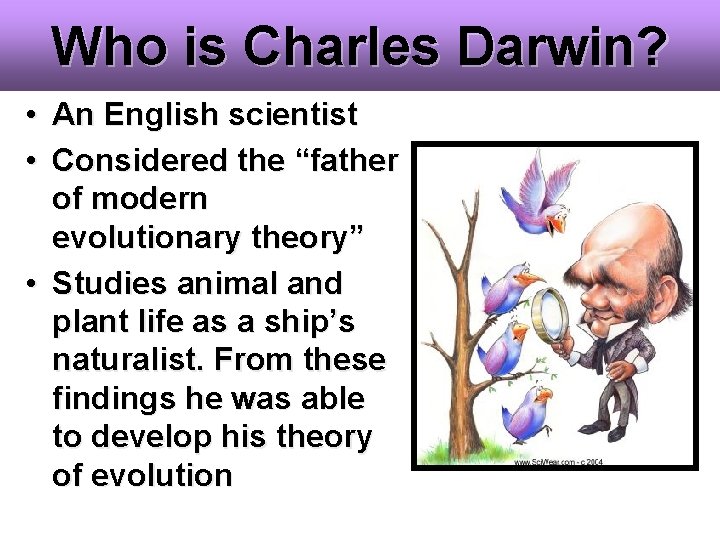
Who is Charles Darwin? • An English scientist • Considered the “father of modern evolutionary theory” • Studies animal and plant life as a ship’s naturalist. From these findings he was able to develop his theory of evolution
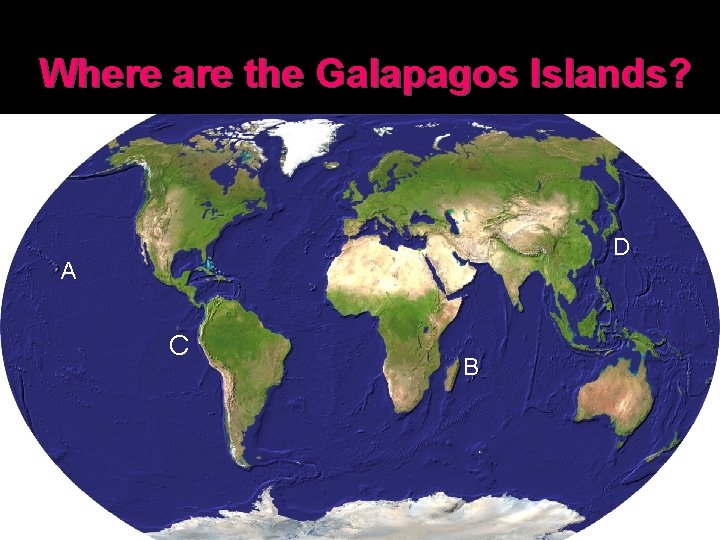
Where are the Galapagos Islands? D A C B
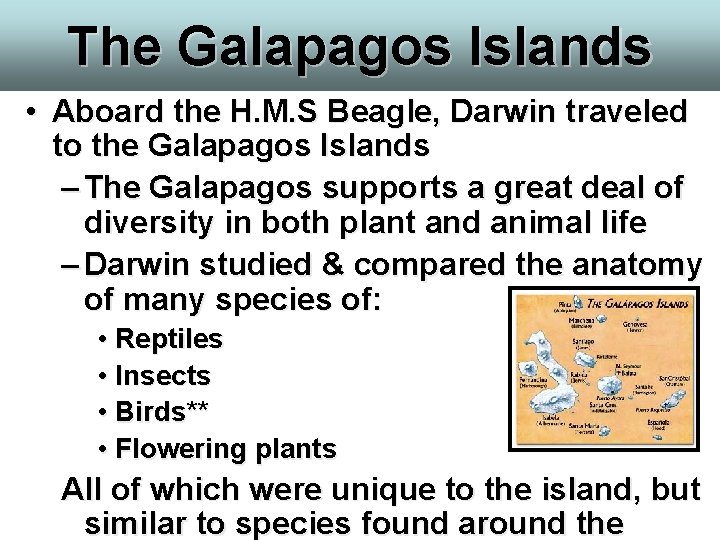
The Galapagos Islands • Aboard the H. M. S Beagle, Darwin traveled to the Galapagos Islands – The Galapagos supports a great deal of diversity in both plant and animal life – Darwin studied & compared the anatomy of many species of: • Reptiles • Insects • Birds** • Flowering plants All of which were unique to the island, but similar to species found around the
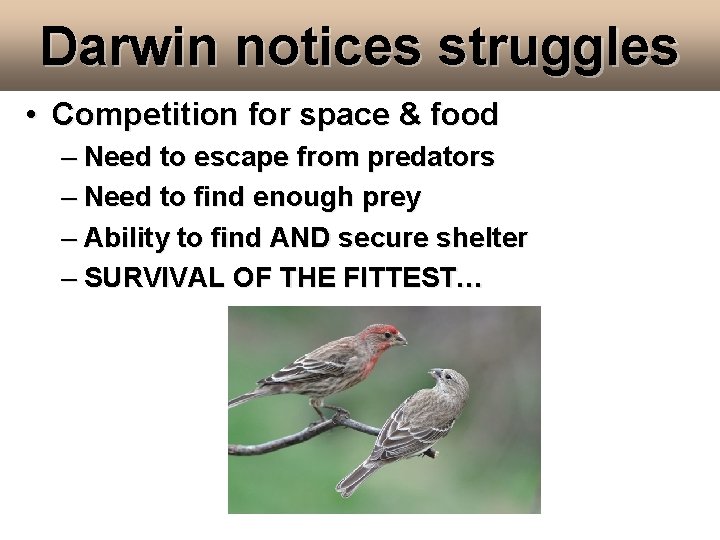
Darwin notices struggles • Competition for space & food – Need to escape from predators – Need to find enough prey – Ability to find AND secure shelter – SURVIVAL OF THE FITTEST…
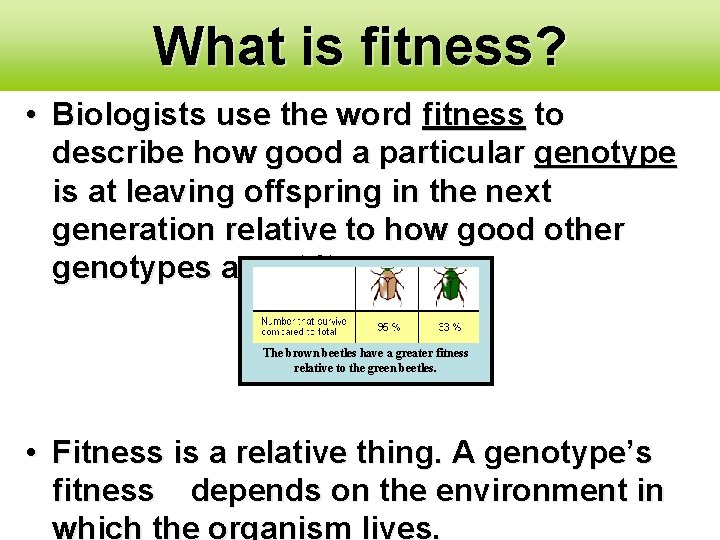
What is fitness? • Biologists use the word fitness to describe how good a particular genotype is at leaving offspring in the next generation relative to how good other genotypes are at it. The brown beetles have a greater fitness relative to the green beetles. • Fitness is a relative thing. A genotype’s fitness depends on the environment in which the organism lives.
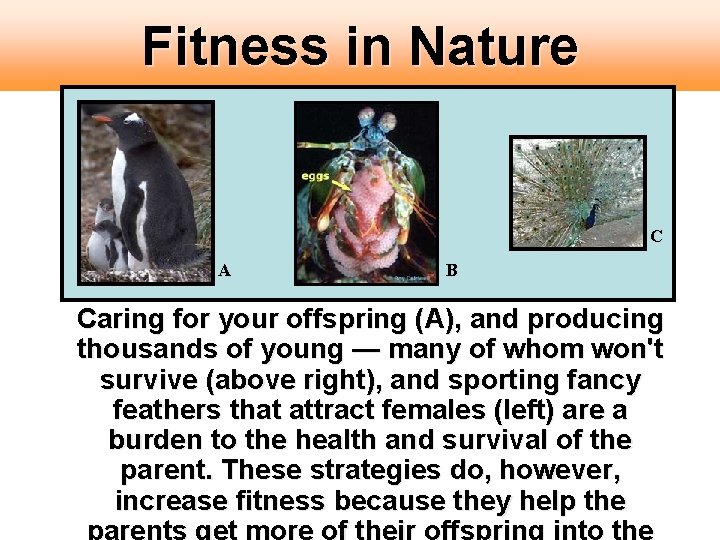
Fitness in Nature C A B Caring for your offspring (A), and producing thousands of young — many of whom won't survive (above right), and sporting fancy feathers that attract females (left) are a burden to the health and survival of the parent. These strategies do, however, increase fitness because they help the parents get more of their offspring into the
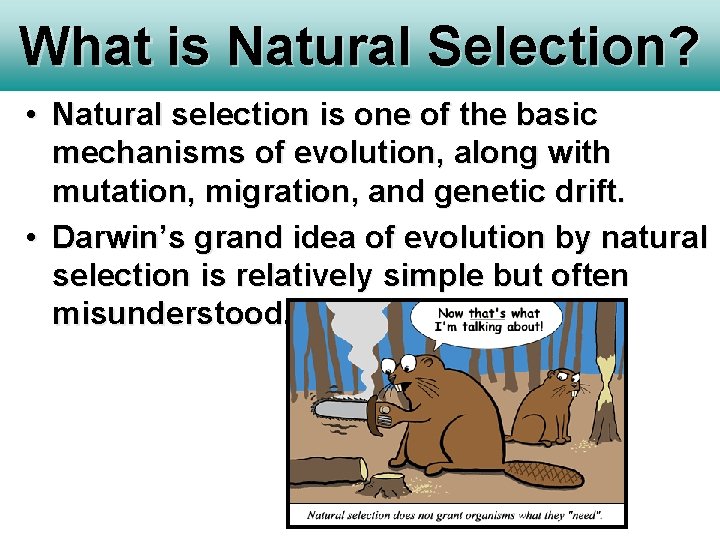
What is Natural Selection? • Natural selection is one of the basic mechanisms of evolution, along with mutation, migration, and genetic drift. • Darwin’s grand idea of evolution by natural selection is relatively simple but often misunderstood.
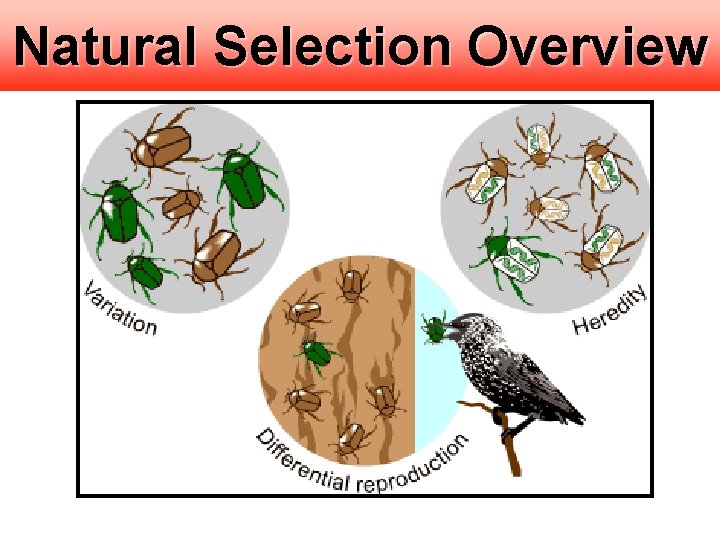
Natural Selection Overview • In nature, there is a tendency towards the overproduction of offspring • In any population of organisms, individuals will exhibit slight variations – Individuals with variations that are favorable for a particular environment are more likely to survive and pass those variations on to the next generation than are individuals with less-favorable variations – Gradually, offspring of survivors will make up a larger proportion of the population
Natural Selection Overview
Natural Selection & Adaptation • Adaptation – Any trait that aids the chances of survival and reproduction of an organism – Can be explained by applying Darwin’s theory of natural selection – We will focus on two types of adaptations: • Structural – Changes in the structure of body parts • Physiological
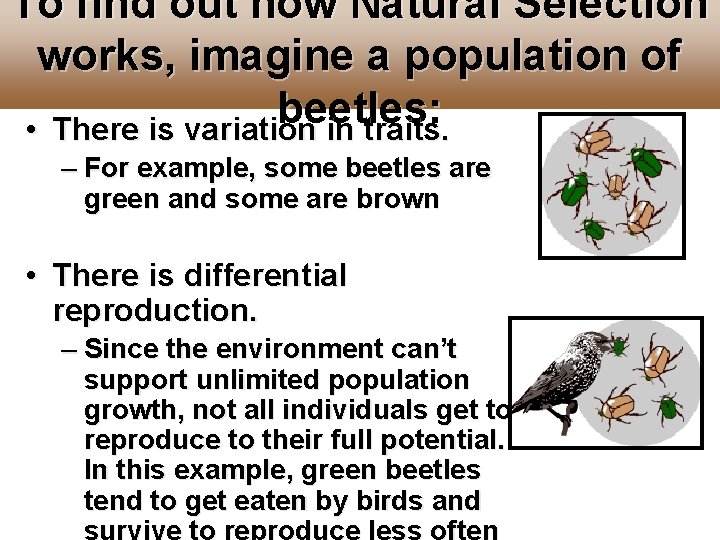
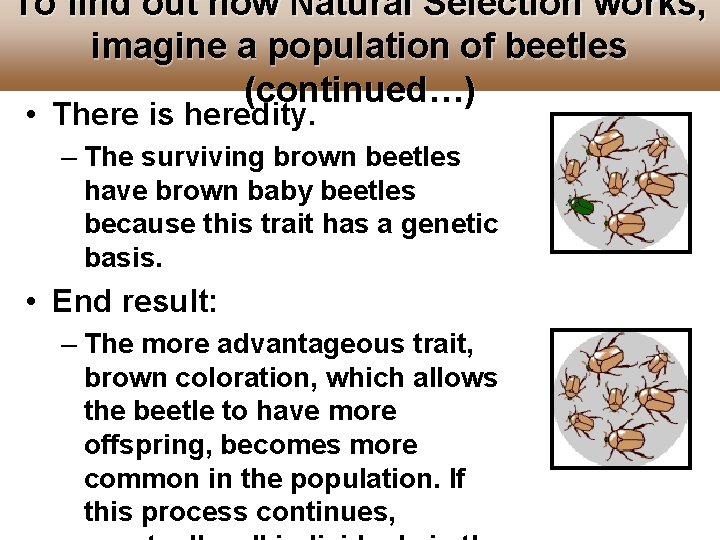
To find out how Natural Selection works, imagine a population of beetles: • There is variation in traits. – For example, some beetles are green and some are brown • There is differential reproduction. – Since the environment can’t support unlimited population growth, not all individuals get to reproduce to their full potential. In this example, green beetles tend to get eaten by birds and survive to reproduce less often
To find out how Natural Selection works, imagine a population of beetles (continued…) • There is heredity. – The surviving brown beetles have brown baby beetles because this trait has a genetic basis. • End result: – The more advantageous trait, brown coloration, which allows the beetle to have more offspring, becomes more common in the population. If this process continues,
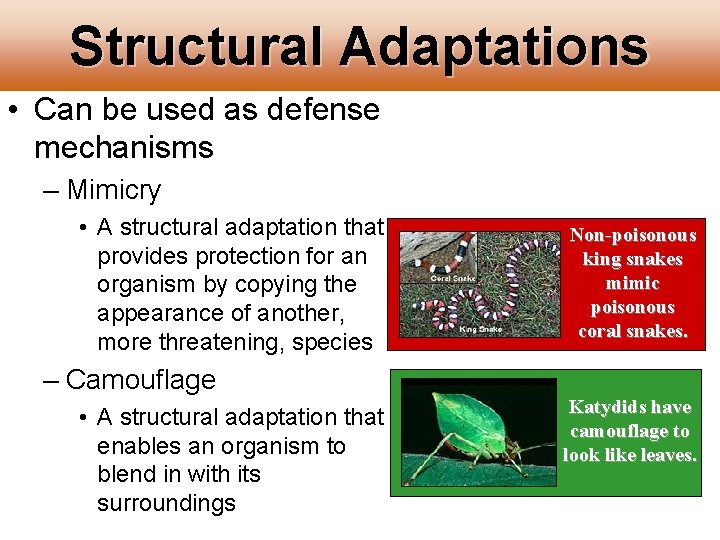
Structural Adaptations • Can be used as defense mechanisms – Mimicry • A structural adaptation that provides protection for an organism by copying the appearance of another, more threatening, species – Camouflage • A structural adaptation that enables an organism to blend in with its surroundings Non-poisonous king snakes mimic poisonous coral snakes. Katydids have camouflage to look like leaves.
Physiological Adaptations • Anti-biotic implications – Individual bacteria in a population show variation – Some bacteria possess a gene that makes them resistant to some antibiotic – When the population is exposed to the antibiotic, some individuals die, but resistant bacteria survive – Resistant bacteria survive and reproduce – In time, the entire population is resistant to a certain antibiotic “Why does Evolution matter NOW? ” http: //www. pbs. org/wgbh/evolution/educators/lesson 6/act 1 notes. html “The Evolution of Antibiotic Resistance” http: //www. pbs. org/wgbh/evolution/educators/lesson 6/act 1. html
“Why does Evolution matter NOW? ”
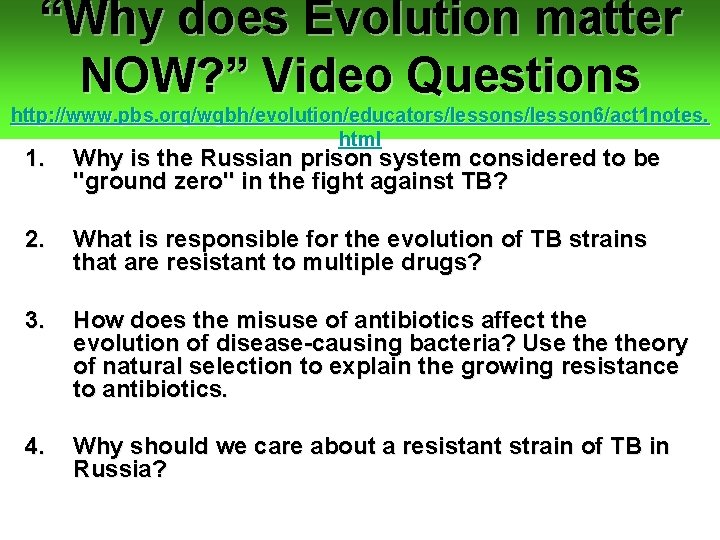
“Why does Evolution matter NOW? ” Video Questions http: //www. pbs. org/wgbh/evolution/educators/lesson 6/act 1 notes. html 1. Why is the Russian prison system considered to be "ground zero" in the fight against TB? 2. What is responsible for the evolution of TB strains that are resistant to multiple drugs? 3. How does the misuse of antibiotics affect the evolution of disease-causing bacteria? Use theory of natural selection to explain the growing resistance to antibiotics. 4. Why should we care about a resistant strain of TB in Russia?