
EVM Definition Analysis Supporting Document for C 80216
- Slides: 33
EVM Definition Analysis: Supporting Document for C 80216 m 10/0616 IEEE 802. 16 Presentation Submission Template (Rev. 9) Document Number: IEEE S 802. 16 m-10/0689 Date Submitted: 2010 -05 -07 Source: Rongzhen Yan, Yang-seok Choi Tom Harel, Hujun Yin, Amir Rubin, Jin Fu and Rui Huang Intel Corporation E-mail: Rongzhen. Yang@intel. com Venue: . RE: Comments on P 802. 16 m/D 5 Purpose: EVM definition and requirement for IEEE 802. 16 m Notice: This document does not represent the agreed views of the IEEE 802. 16 Working Group or any of its subgroups. It represents only the views of the participants listed in the “Source(s)” field above. It is offered as a basis for discussion. It is not binding on the contributor(s), who reserve(s) the right to add, amend or withdraw material contained herein. Release: The contributor grants a free, irrevocable license to the IEEE to incorporate material contained in this contribution, and any modifications thereof, in the creation of an IEEE Standards publication; to copyright in the IEEE’s name any IEEE Standards publication even though it may include portions of this contribution; and at the IEEE’s sole discretion to permit others to reproduce in whole or in part the resulting IEEE Standards publication. The contributor also acknowledges and accepts that this contribution may be made public by IEEE 802. 16. Patent Policy: The contributor is familiar with the IEEE-SA Patent Policy and Procedures: <http: //standards. ieee. org/guides/bylaws/sect 6 -7. html#6> and <http: //standards. ieee. org/guides/opman/sect 6. html#6. 3>. Further information is located at <http: //standards. ieee. org/board/pat-material. html> and <http: //standards. ieee. org/board/pat >.
EVM Definition/Requirement Background • Current 16 m text of EVM: reference to 802. 16 -2009 section 8. 1. 8. 2. 3: – It is EVM definition and limitation for Wireless. MAN-SC, not for OFDM/OFDMA; – The definition doesn’t consider the impaction of EVM noise on modulated tone and unmodulated tones; • 16 e EVM Definition/Requirement in 8. 4. 13. 3: – The limitation in Table 544 was derived from very simply rule, the impaction of EVM noise for capacity loss is not studied; – The EVM noise on modulated and un-modulated tones, are evaluated and limited separately. It is not appreciated because EVM noise on un-moudulated will be changed according to the ratio of occupied bandwidth for modulated tones; – The highest modulation in uplink, 64 QAM, has low possibility to be used in full Tx power, so, the test condition of power reduction compared with the maximum Tx power has not addressed in 16 e;
Agenda • EVM Noise Study and Equation Derivation • EVM Basic Requirements by LLS Result • Power Reduction Study for Uplink EVM Test
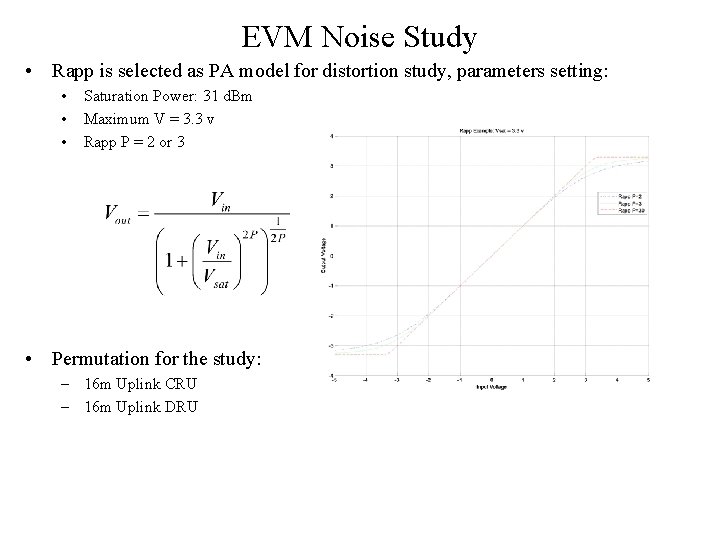
EVM Noise Study • Rapp is selected as PA model for distortion study, parameters setting: • • • Saturation Power: 31 d. Bm Maximum V = 3. 3 v Rapp P = 2 or 3 • Permutation for the study: – 16 m Uplink CRU – 16 m Uplink DRU
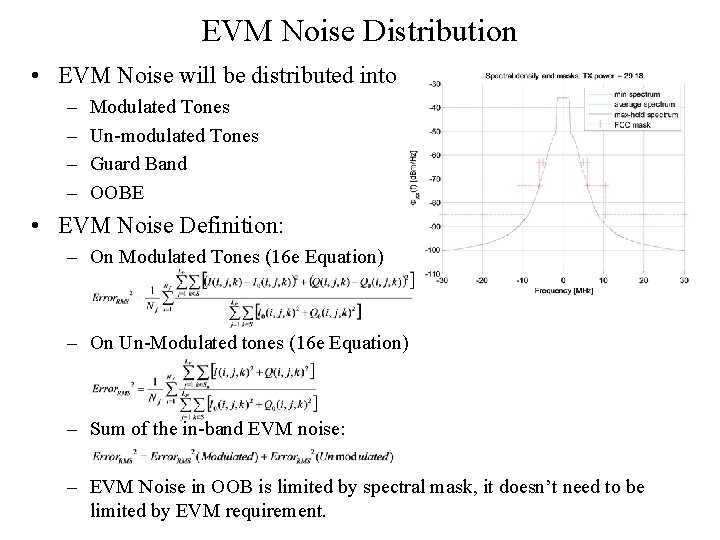
EVM Noise Distribution • EVM Noise will be distributed into – – Modulated Tones Un-modulated Tones Guard Band OOBE • EVM Noise Definition: – On Modulated Tones (16 e Equation) – On Un-Modulated tones (16 e Equation) – Sum of the in-band EVM noise: – EVM Noise in OOB is limited by spectral mask, it doesn’t need to be limited by EVM requirement.
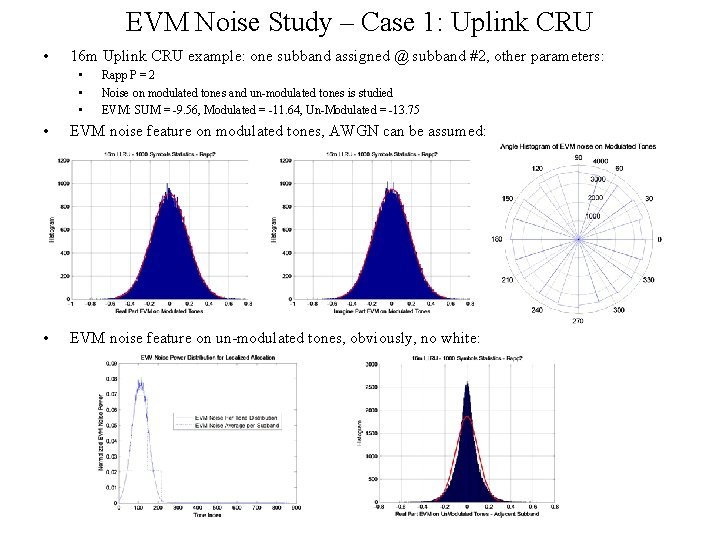
EVM Noise Study – Case 1: Uplink CRU • 16 m Uplink CRU example: one subband assigned @ subband #2, other parameters: • • • Rapp P = 2 Noise on modulated tones and un-modulated tones is studied EVM: SUM = -9. 56, Modulated = -11. 64, Un-Modulated = -13. 75 • EVM noise feature on modulated tones, AWGN can be assumed: • EVM noise feature on un-modulated tones, obviously, no white:
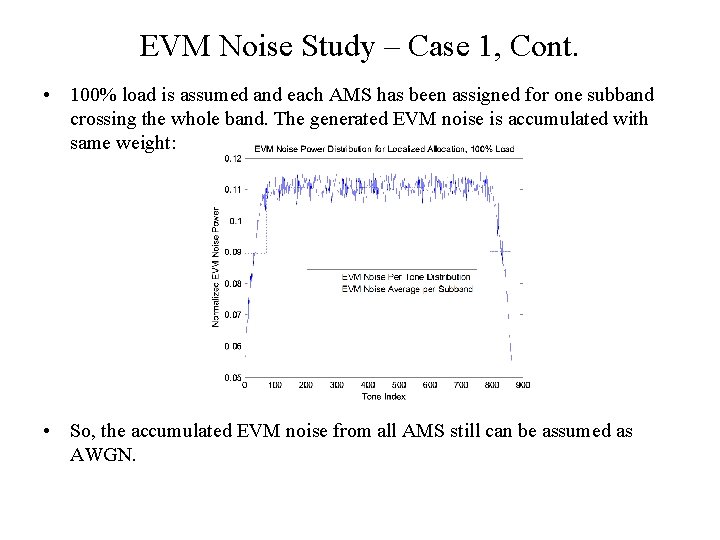
EVM Noise Study – Case 1, Cont. • 100% load is assumed and each AMS has been assigned for one subband crossing the whole band. The generated EVM noise is accumulated with same weight: • So, the accumulated EVM noise from all AMS still can be assumed as AWGN.
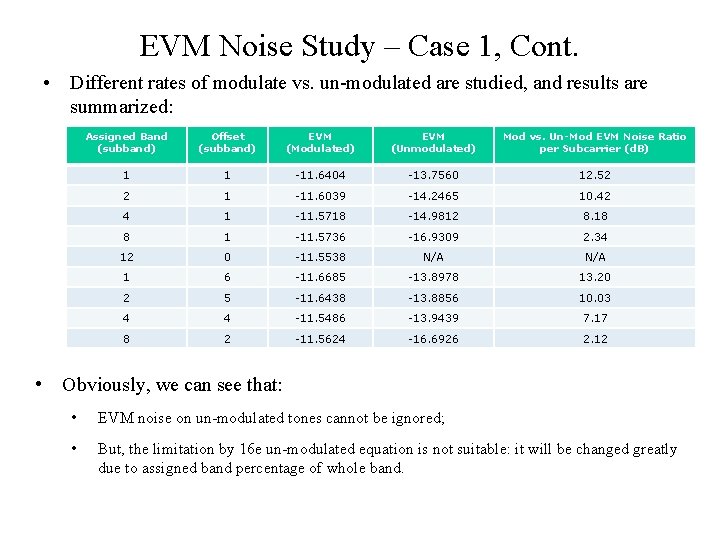
EVM Noise Study – Case 1, Cont. • Different rates of modulate vs. un-modulated are studied, and results are summarized: Assigned Band (subband) Offset (subband) EVM (Modulated) EVM (Unmodulated) Mod vs. Un-Mod EVM Noise Ratio per Subcarrier (d. B) 1 1 -11. 6404 -13. 7560 12. 52 2 1 -11. 6039 -14. 2465 10. 42 4 1 -11. 5718 -14. 9812 8. 18 8 1 -11. 5736 -16. 9309 2. 34 12 0 -11. 5538 N/A 1 6 -11. 6685 -13. 8978 13. 20 2 5 -11. 6438 -13. 8856 10. 03 4 4 -11. 5486 -13. 9439 7. 17 8 2 -11. 5624 -16. 6926 2. 12 • Obviously, we can see that: • EVM noise on un-modulated tones cannot be ignored; • But, the limitation by 16 e un-modulated equation is not suitable: it will be changed greatly due to assigned band percentage of whole band.
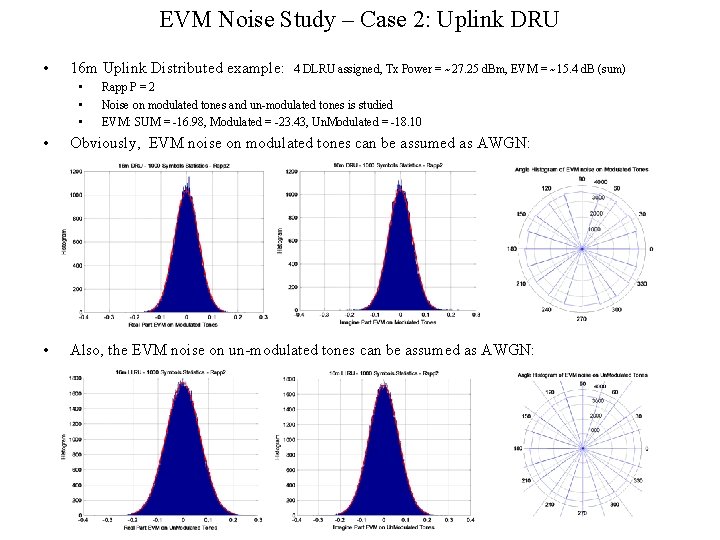
EVM Noise Study – Case 2: Uplink DRU • 16 m Uplink Distributed example: • • • 4 DLRU assigned, Tx Power = ~27. 25 d. Bm, EVM = ~15. 4 d. B (sum) Rapp P = 2 Noise on modulated tones and un-modulated tones is studied EVM: SUM = -16. 98, Modulated = -23. 43, Un. Modulated = -18. 10 • Obviously, EVM noise on modulated tones can be assumed as AWGN: • Also, the EVM noise on un-modulated tones can be assumed as AWGN:
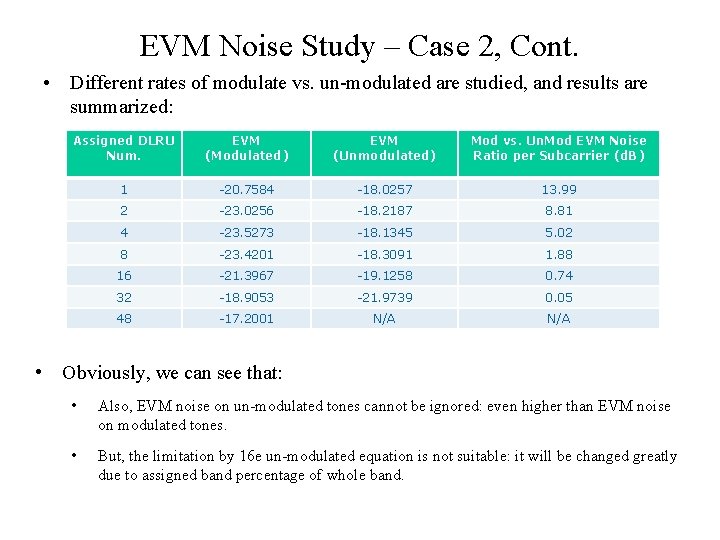
EVM Noise Study – Case 2, Cont. • Different rates of modulate vs. un-modulated are studied, and results are summarized: Assigned DLRU Num. EVM (Modulated) EVM (Unmodulated) Mod vs. Un. Mod EVM Noise Ratio per Subcarrier (d. B) 1 -20. 7584 -18. 0257 13. 99 2 -23. 0256 -18. 2187 8. 81 4 -23. 5273 -18. 1345 5. 02 8 -23. 4201 -18. 3091 1. 88 16 -21. 3967 -19. 1258 0. 74 32 -18. 9053 -21. 9739 0. 05 48 -17. 2001 N/A • Obviously, we can see that: • Also, EVM noise on un-modulated tones cannot be ignored: even higher than EVM noise on modulated tones. • But, the limitation by 16 e un-modulated equation is not suitable: it will be changed greatly due to assigned band percentage of whole band.
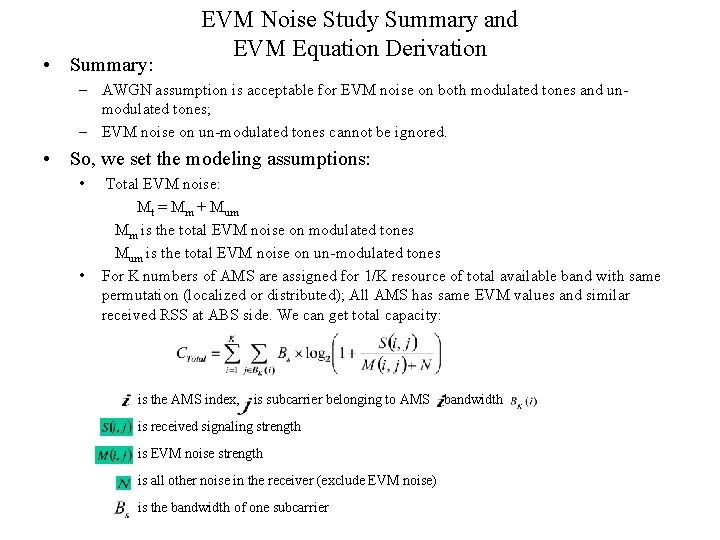
• Summary: EVM Noise Study Summary and EVM Equation Derivation – AWGN assumption is acceptable for EVM noise on both modulated tones and unmodulated tones; – EVM noise on un-modulated tones cannot be ignored. • So, we set the modeling assumptions: • • Total EVM noise: Mt = Mm + Mum Mm is the total EVM noise on modulated tones Mum is the total EVM noise on un-modulated tones For K numbers of AMS are assigned for 1/K resource of total available band with same permutation (localized or distributed); All AMS has same EVM values and similar received RSS at ABS side. We can get total capacity: is the AMS index, is subcarrier belonging to AMS is received signaling strength is EVM noise strength is all other noise in the receiver (exclude EVM noise) is the bandwidth of one subcarrier bandwidth
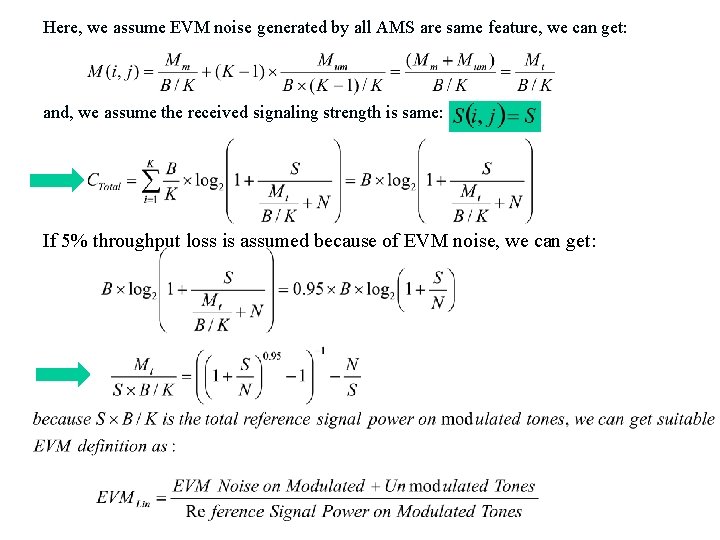
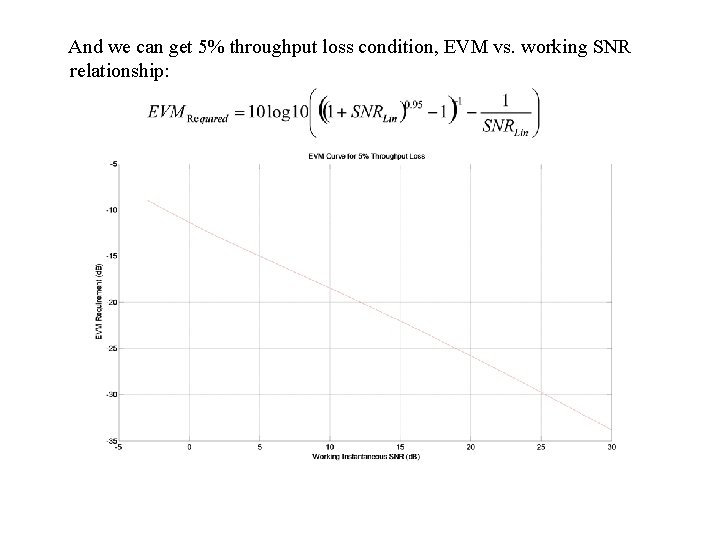
Here, we assume EVM noise generated by all AMS are same feature, we can get: and, we assume the received signaling strength is same: If 5% throughput loss is assumed because of EVM noise, we can get:
And we can get 5% throughput loss condition, EVM vs. working SNR relationship:
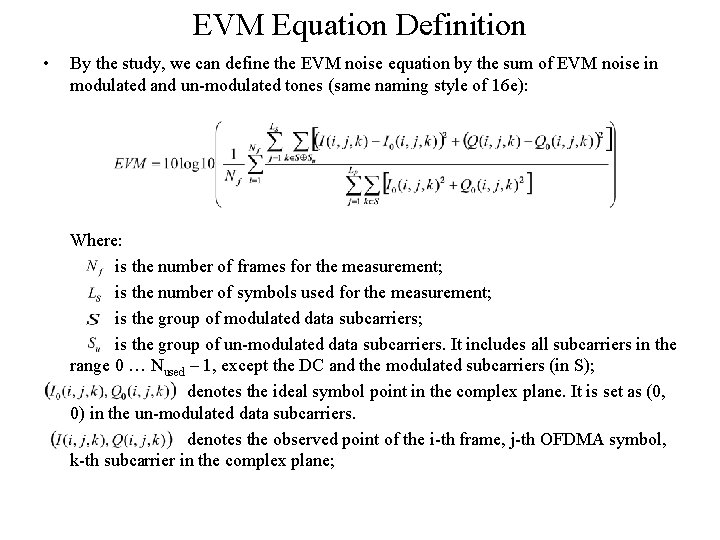
EVM Equation Definition • By the study, we can define the EVM noise equation by the sum of EVM noise in modulated and un-modulated tones (same naming style of 16 e): Where: is the number of frames for the measurement; is the number of symbols used for the measurement; is the group of modulated data subcarriers; is the group of un-modulated data subcarriers. It includes all subcarriers in the range 0 … Nused – 1, except the DC and the modulated subcarriers (in S); denotes the ideal symbol point in the complex plane. It is set as (0, 0) in the un-modulated data subcarriers. denotes the observed point of the i-th frame, j-th OFDMA symbol, k-th subcarrier in the complex plane;
Agenda • EVM Noise Study and Equation Derivation • EVM Basic Requirements by LLS Result • Power Reduction Study for Uplink EVM Test
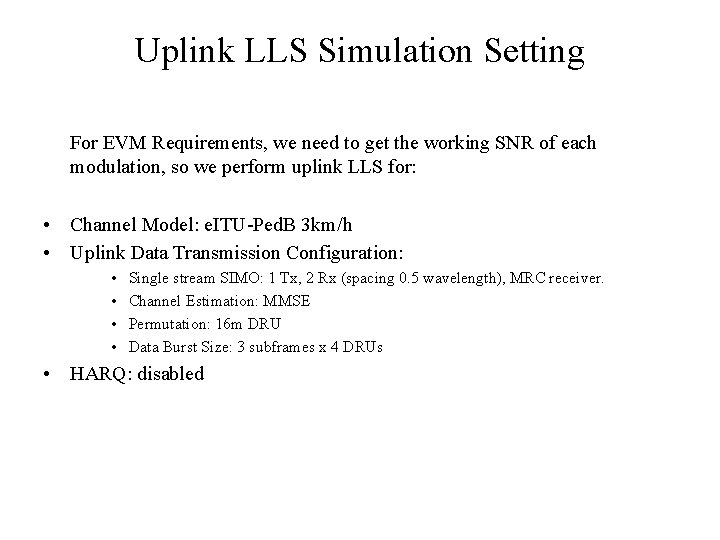
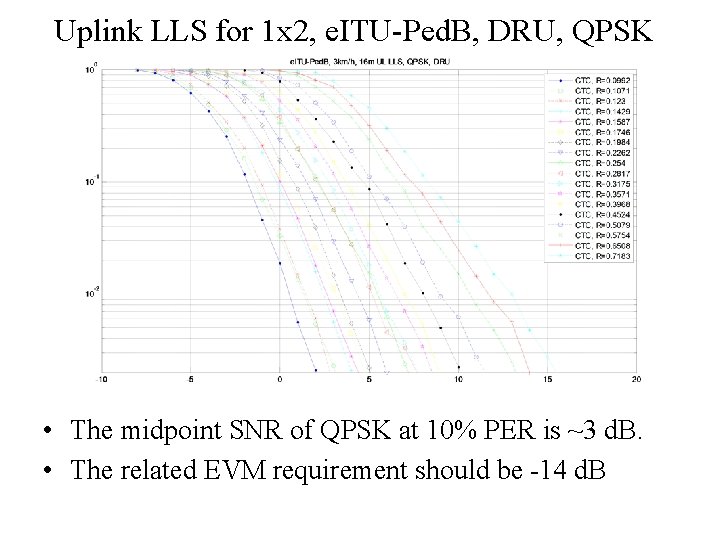
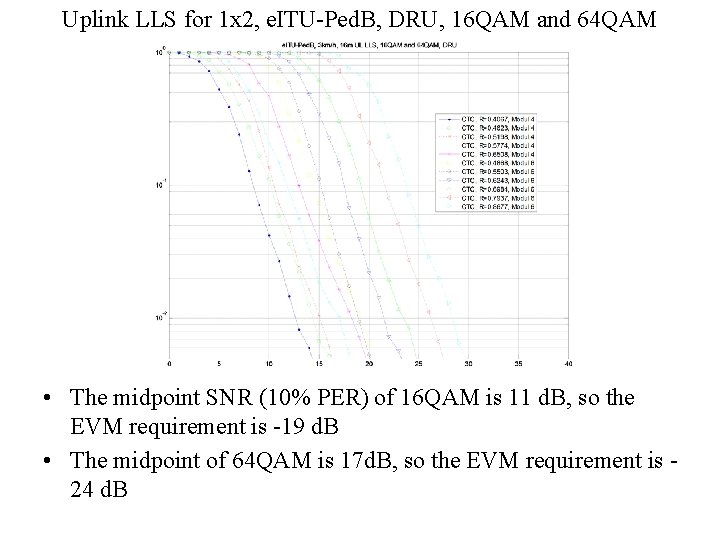
Uplink LLS Simulation Setting For EVM Requirements, we need to get the working SNR of each modulation, so we perform uplink LLS for: • Channel Model: e. ITU-Ped. B 3 km/h • Uplink Data Transmission Configuration: • • Single stream SIMO: 1 Tx, 2 Rx (spacing 0. 5 wavelength), MRC receiver. Channel Estimation: MMSE Permutation: 16 m DRU Data Burst Size: 3 subframes x 4 DRUs • HARQ: disabled
Uplink LLS for 1 x 2, e. ITU-Ped. B, DRU, QPSK • The midpoint SNR of QPSK at 10% PER is ~3 d. B. • The related EVM requirement should be -14 d. B
Uplink LLS for 1 x 2, e. ITU-Ped. B, DRU, 16 QAM and 64 QAM • The midpoint SNR (10% PER) of 16 QAM is 11 d. B, so the EVM requirement is -19 d. B • The midpoint of 64 QAM is 17 d. B, so the EVM requirement is 24 d. B
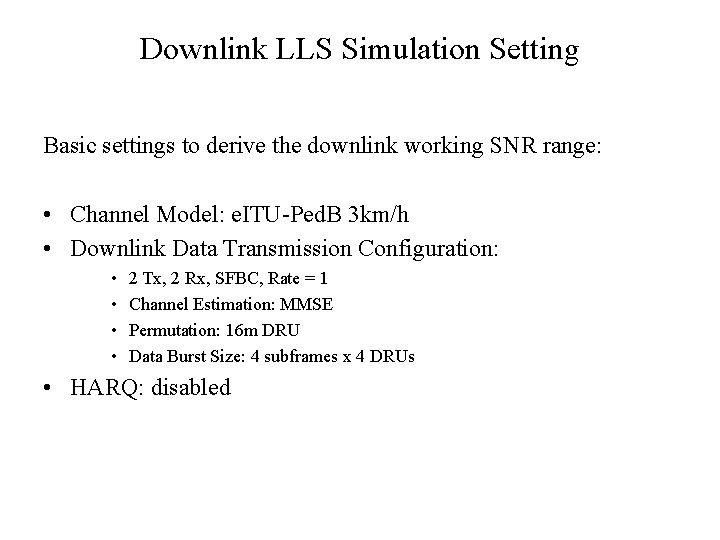
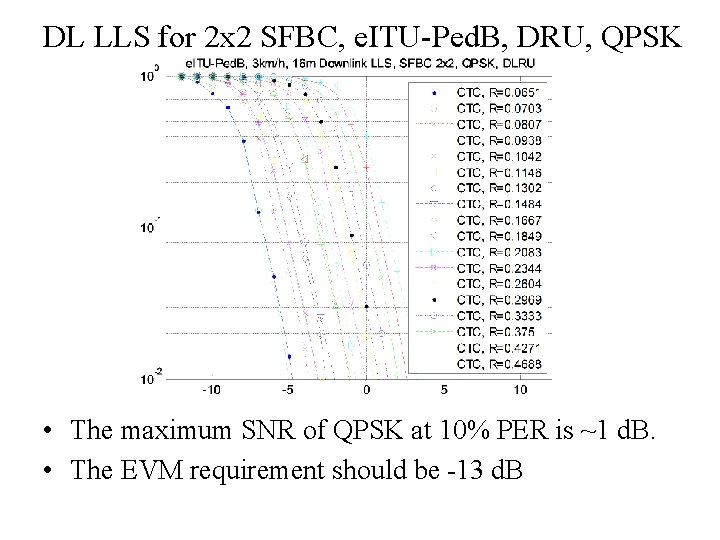
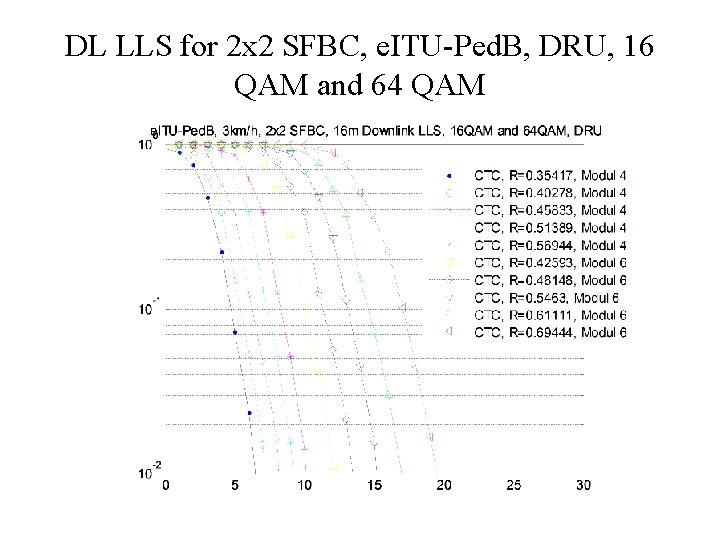
Downlink LLS Simulation Setting Basic settings to derive the downlink working SNR range: • Channel Model: e. ITU-Ped. B 3 km/h • Downlink Data Transmission Configuration: • • 2 Tx, 2 Rx, SFBC, Rate = 1 Channel Estimation: MMSE Permutation: 16 m DRU Data Burst Size: 4 subframes x 4 DRUs • HARQ: disabled
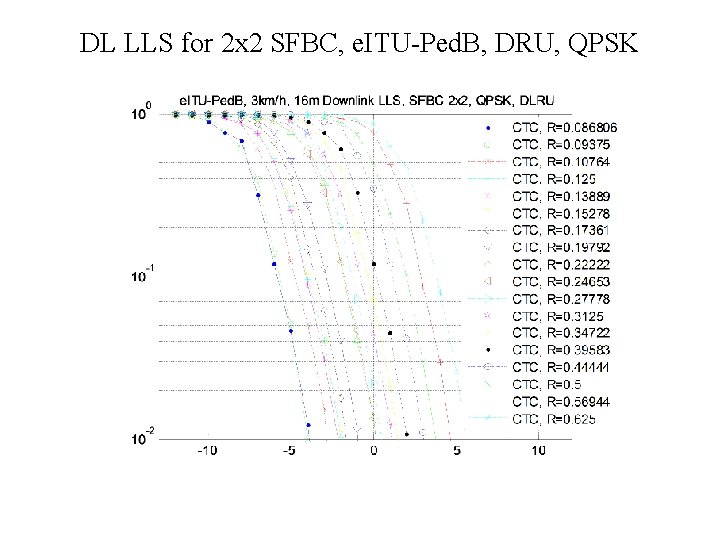
DL LLS for 2 x 2 SFBC, e. ITU-Ped. B, DRU, QPSK • The maximum SNR of QPSK at 10% PER is ~1 d. B. • The EVM requirement should be -13 d. B
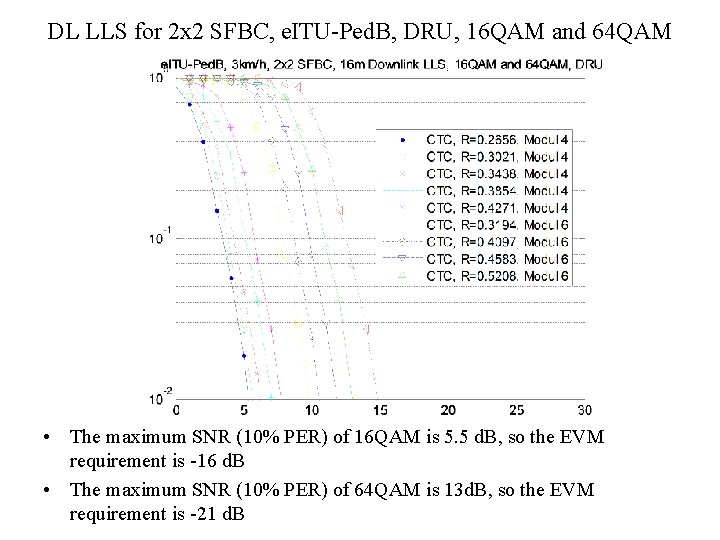
DL LLS for 2 x 2 SFBC, e. ITU-Ped. B, DRU, 16 QAM and 64 QAM • The maximum SNR (10% PER) of 16 QAM is 5. 5 d. B, so the EVM requirement is -16 d. B • The maximum SNR (10% PER) of 64 QAM is 13 d. B, so the EVM requirement is -21 d. B
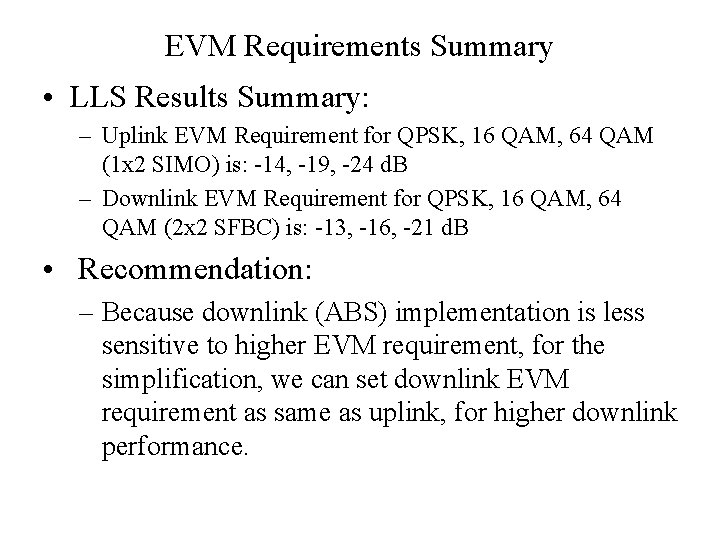
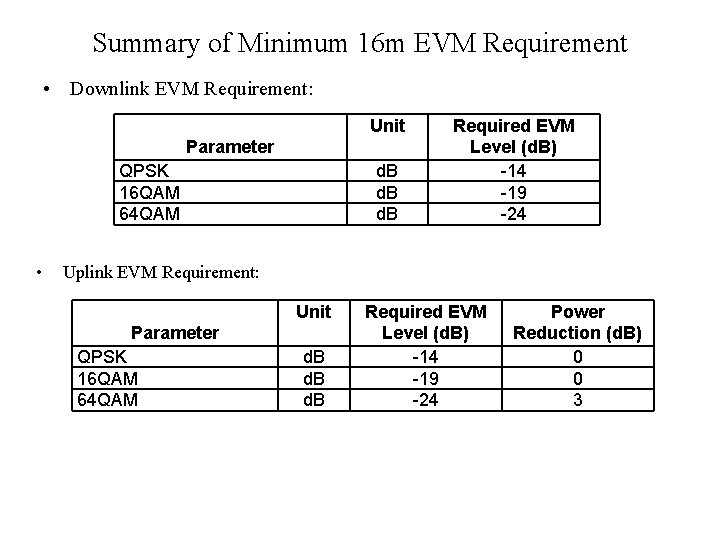
EVM Requirements Summary • LLS Results Summary: – Uplink EVM Requirement for QPSK, 16 QAM, 64 QAM (1 x 2 SIMO) is: -14, -19, -24 d. B – Downlink EVM Requirement for QPSK, 16 QAM, 64 QAM (2 x 2 SFBC) is: -13, -16, -21 d. B • Recommendation: – Because downlink (ABS) implementation is less sensitive to higher EVM requirement, for the simplification, we can set downlink EVM requirement as same as uplink, for higher downlink performance.
Agenda • EVM Noise Study and Equation Derivation • EVM Basic Requirements by LLS Result • Power Reduction Study for Uplink EVM Test
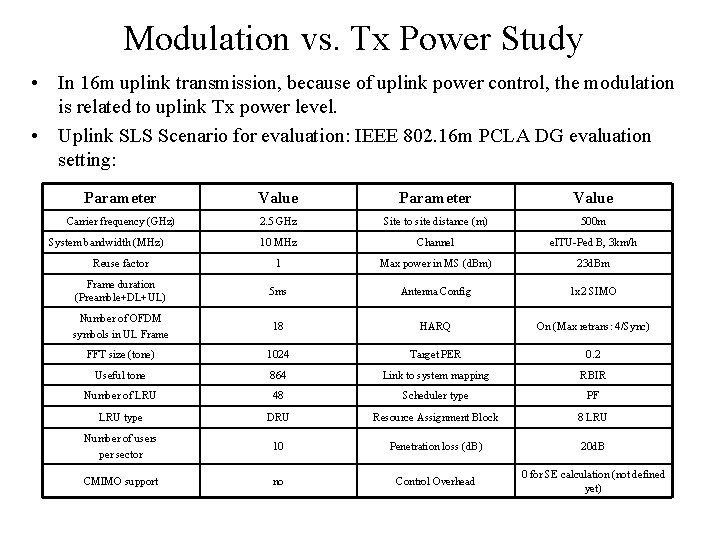
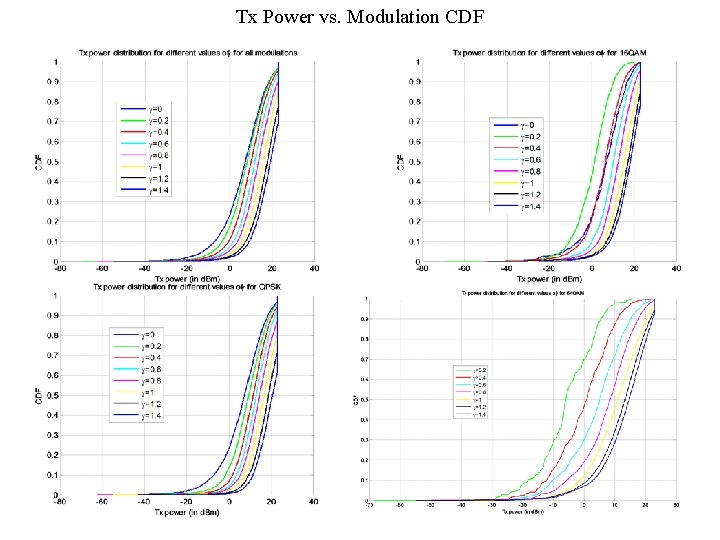
Modulation vs. Tx Power Study • In 16 m uplink transmission, because of uplink power control, the modulation is related to uplink Tx power level. • Uplink SLS Scenario for evaluation: IEEE 802. 16 m PCLA DG evaluation setting: Parameter Value Carrier frequency (GHz) 2. 5 GHz Site to site distance (m) 500 m 10 MHz Channel e. ITU-Ped B, 3 km/h Reuse factor 1 Max power in MS (d. Bm) 23 d. Bm Frame duration (Preamble+DL+UL) 5 ms Antenna Config 1 x 2 SIMO Number of OFDM symbols in UL Frame 18 HARQ On (Max retrans: 4/Sync) FFT size (tone) 1024 Target PER 0. 2 Useful tone 864 Link to system mapping RBIR Number of LRU 48 Scheduler type PF LRU type DRU Resource Assignment Block 8 LRU Number of users per sector 10 Penetration loss (d. B) 20 d. B CMIMO support no Control Overhead 0 for SE calculation (not defined yet) System bandwidth (MHz)
Tx Power vs. Modulation CDF
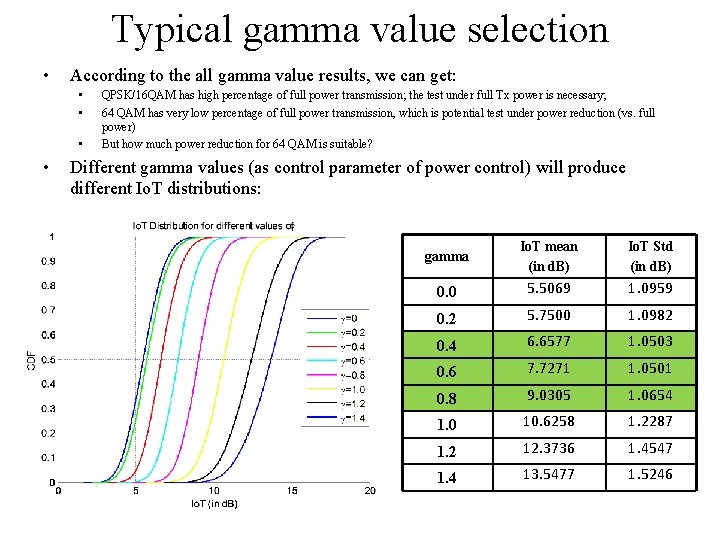
Typical gamma value selection • According to the all gamma value results, we can get: • • QPSK/16 QAM has high percentage of full power transmission; the test under full Tx power is necessary; 64 QAM has very low percentage of full power transmission, which is potential test under power reduction (vs. full power) But how much power reduction for 64 QAM is suitable? Different gamma values (as control parameter of power control) will produce different Io. T distributions: gamma Io. T mean (in d. B) Io. T Std (in d. B) 0. 0 5. 5069 1. 0959 0. 2 5. 7500 1. 0982 0. 4 6. 6577 1. 0503 0. 6 7. 7271 1. 0501 0. 8 9. 0305 1. 0654 1. 0 10. 6258 1. 2287 1. 2 12. 3736 1. 4547 1. 4 13. 5477 1. 5246
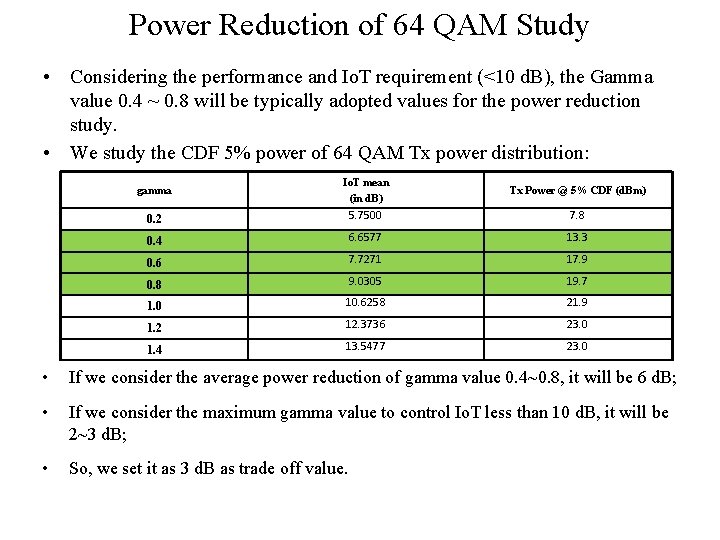
Power Reduction of 64 QAM Study • Considering the performance and Io. T requirement (<10 d. B), the Gamma value 0. 4 ~ 0. 8 will be typically adopted values for the power reduction study. • We study the CDF 5% power of 64 QAM Tx power distribution: gamma Io. T mean (in d. B) Tx Power @ 5% CDF (d. Bm) 0. 2 5. 7500 7. 8 0. 4 6. 6577 13. 3 0. 6 7. 7271 17. 9 0. 8 9. 0305 19. 7 1. 0 10. 6258 21. 9 1. 2 12. 3736 23. 0 1. 4 13. 5477 23. 0 • If we consider the average power reduction of gamma value 0. 4~0. 8, it will be 6 d. B; • If we consider the maximum gamma value to control Io. T less than 10 d. B, it will be 2~3 d. B; • So, we set it as 3 d. B as trade off value.
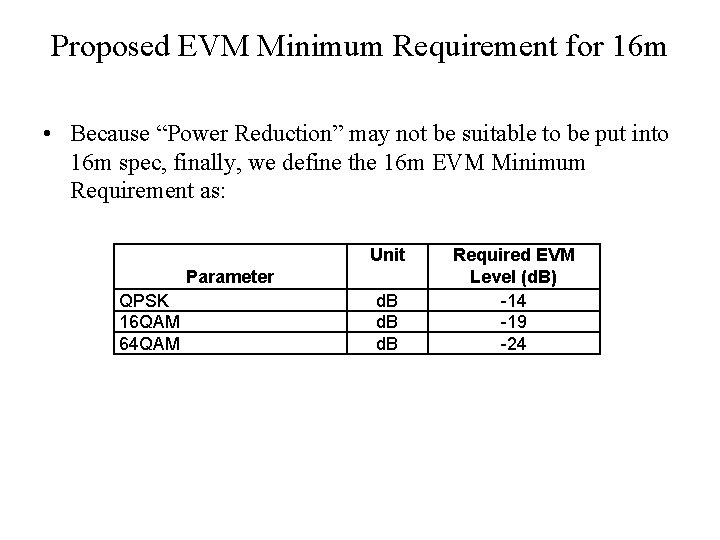
Summary of Minimum 16 m EVM Requirement • Downlink EVM Requirement: Unit Parameter QPSK 16 QAM 64 QAM • d. B Required EVM Level (d. B) -14 -19 -24 Uplink EVM Requirement: Unit Parameter QPSK 16 QAM 64 QAM d. B Required EVM Level (d. B) -14 -19 -24 Power Reduction (d. B) 0 0 3
Proposed EVM Minimum Requirement for 16 m • Because “Power Reduction” may not be suitable to be put into 16 m spec, finally, we define the 16 m EVM Minimum Requirement as: Unit Parameter QPSK 16 QAM 64 QAM d. B Required EVM Level (d. B) -14 -19 -24
Backup slides
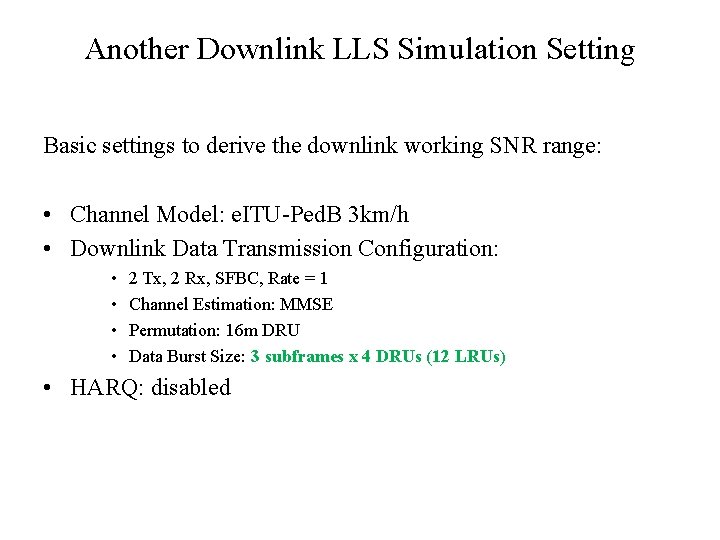
Another Downlink LLS Simulation Setting Basic settings to derive the downlink working SNR range: • Channel Model: e. ITU-Ped. B 3 km/h • Downlink Data Transmission Configuration: • • 2 Tx, 2 Rx, SFBC, Rate = 1 Channel Estimation: MMSE Permutation: 16 m DRU Data Burst Size: 3 subframes x 4 DRUs (12 LRUs) • HARQ: disabled
DL LLS for 2 x 2 SFBC, e. ITU-Ped. B, DRU, QPSK
DL LLS for 2 x 2 SFBC, e. ITU-Ped. B, DRU, 16 QAM and 64 QAM