
Evil sponduli adjectives The adjectives BEAU beautiful VIEUX

Evil sponduli adjectives: The adjectives BEAU (=beautiful), VIEUX (=old) & NOUVEAU (=new) do some pretty weird things! We already know that adjectives in French USUALLY go AFTER the noun (EX: La voiture blanche = the white car) However, BEAU, VIEUX & NOUVEAU go IN FRONT of the noun

Forms: Singular masculine feminine Beau Belle Plural masculine feminine Beaux Belles Vieux Vieille Vieux Nouveau Nouvelle Nouveaux Nouvelles Vieilles

Positions: BEAU – un beau garçon, une belle fille, les beaux garçons, les belles filles VIEUX – un vieux prof, une vieille maison, les vieux chiens, les vieilles règles NOUVEAU – un nouveau livre, une nouvelle étudiante, les nouveaux élèves, les nouvelles

Special forms: Whenever these THREE adjectives are used with a MASCULINE, SINGULAR NOUN starting with a VOWEL or H-, they have a SPECIAL form: Un BEL enfant Un BEL homme Un NOUVEL enfant Un NOUVEL homme Un VIEIL enfant Un VIEIL homme

Now you try: 1. A new backpack = 2. An old house = 3. A handsome boy = 4. An old friend = 5. Two beautiful children = 6. A new uncle = 7. A beautiful school = 8. An old tree = 9. A new apartment building = 10. The beautiful girls =
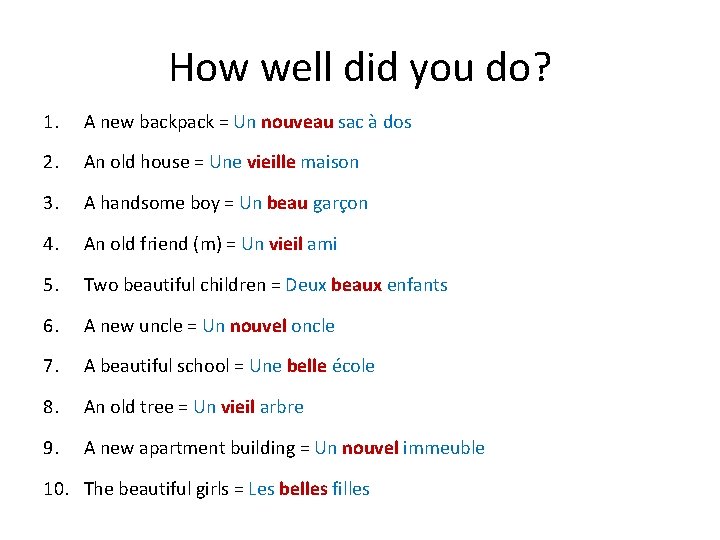
How well did you do? 1. A new backpack = Un nouveau sac à dos 2. An old house = Une vieille maison 3. A handsome boy = Un beau garçon 4. An old friend (m) = Un vieil ami 5. Two beautiful children = Deux beaux enfants 6. A new uncle = Un nouvel oncle 7. A beautiful school = Une belle école 8. An old tree = Un vieil arbre 9. A new apartment building = Un nouvel immeuble 10. The beautiful girls = Les belles filles
- Slides: 6