
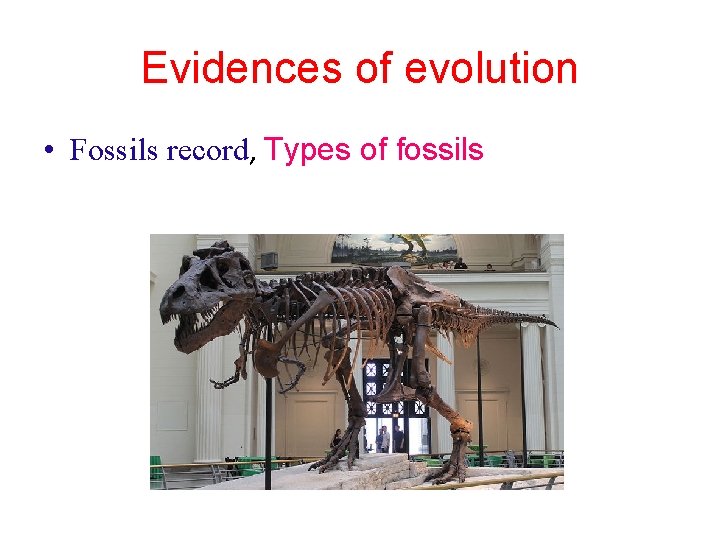
Evidences of evolution Fossils record Types of fossils




- Slides: 177
Evidences of evolution • Fossils record, Types of fossils
• What is fossil? • Fossils are the preserved remains of previously living organisms or their traces, dating from the distant past or ancient time. • Fossils provide evolution. direct evidence of
• They showed that organisms from the past are not the same as those found today. • They show a progression of evolution. • By comparing the anatomies of both modern and extinct species, paleontologists can infer the lineages of those species. • The science which deals with the study of ancient or extinct organisms is known as paleontology.
• What is the Fossil Record? • The "fossil record" refers to the placement of fossils throughout the surface layers of the earth. • Older fossils are buried more deeply than younger ones. • Scientists use the placement of fossils as a guide for determining when life forms existed, and how they evolved.
• For example, we know that flowering plants evolved from non-flowering plants because, in the fossil record, we see flower fossils becoming more and more primitive the deeper we go, until they disappear all together. • There are no flower fossils below a certain depth. • This shows us that flowering plants evolved from nonflowering plants, then began to diversify themselves. • This kind of progression is found throughout the fossil record.
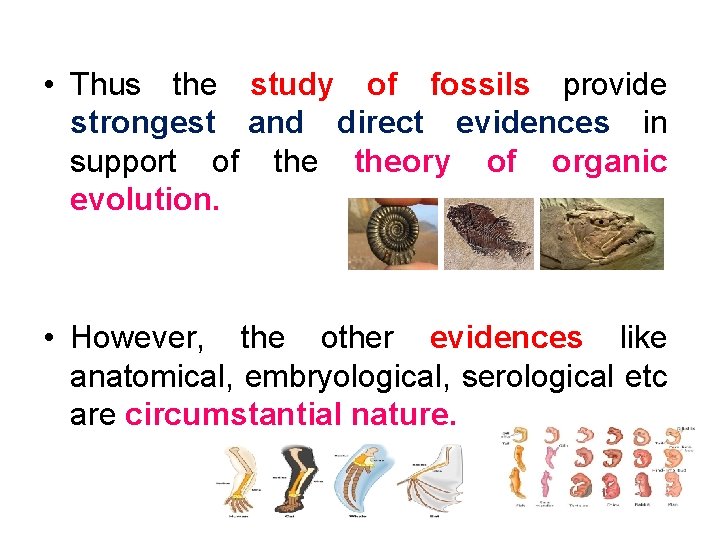
• Thus the study of fossils provide strongest and direct evidences in support of theory of organic evolution. • However, the other evidences like anatomical, embryological, serological etc are circumstantial nature.
• Distribution of Fossils in the Successive Strata of the Rocks: • The distribution of fossils in various strata of the rocks indicates their age i. e. early fossils present in the bottom rocks are simple, however the recent fossils found in the upper layers of the rocks are more complex. • It shows that fossil forms become more and more complex as we proceed from earliest to the recent rocks.
• The rocks of the Proterozoic era contain few fossils. • The rocks of Palaeozoic era contains abundant fossils of invertebrates, fishes and amphibians. • The rocks of the Mesozoic era have the fossils of great reptiles (dinosaurs) and primitive birds and mammals. • The rocks of Coenozoic era contain abundant fossils of mammals.
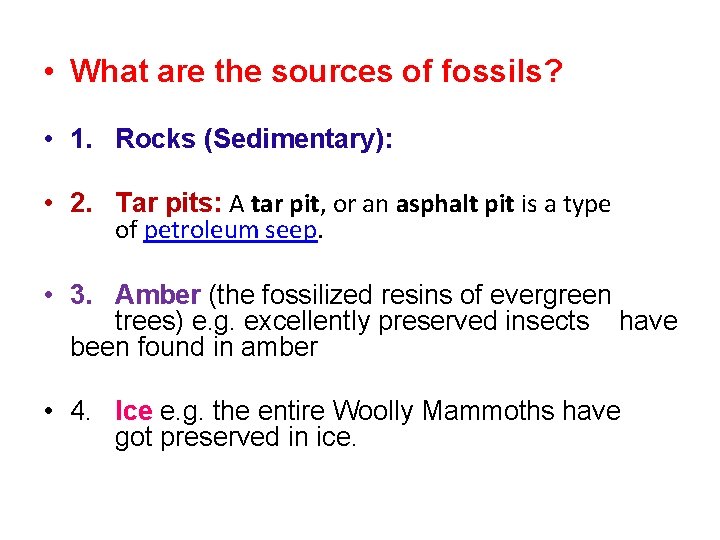
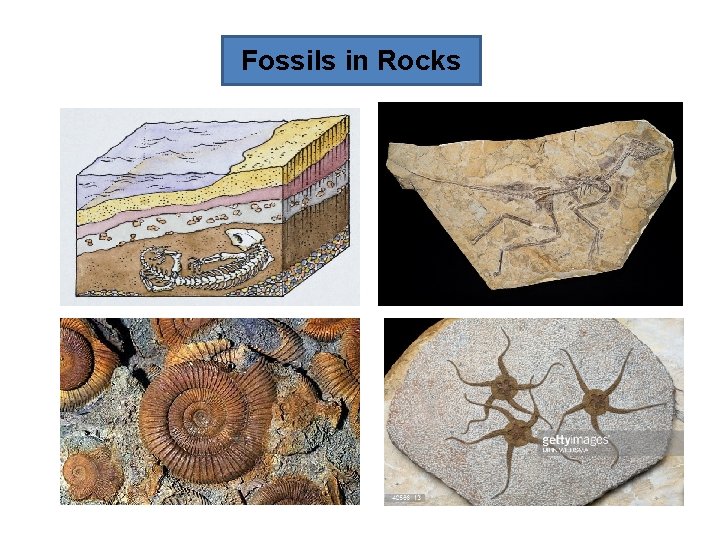
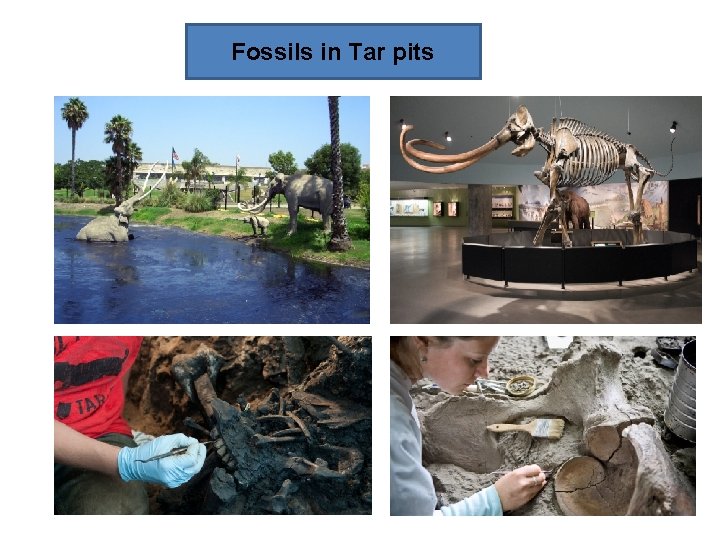
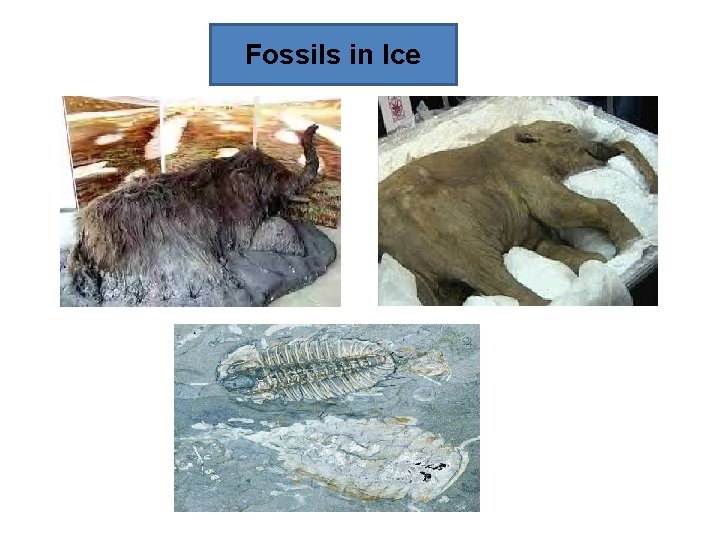
• What are the sources of fossils? • 1. Rocks (Sedimentary): • 2. Tar pits: A tar pit, or an asphalt pit is a type of petroleum seep. • 3. Amber (the fossilized resins of evergreen trees) e. g. excellently preserved insects have been found in amber • 4. Ice e. g. the entire Woolly Mammoths have got preserved in ice.
Fossils in Rocks
Fossils in Tar pits
Fossils in Amber
Fossils in Ice
• How fossils are formed? • Fossils are formed by different ways, but in general, when a plant or animal dies in a watery environment and is buried in mud and silt, their Soft tissues quickly decompose leaving the hard bones or shells behind. • Over time sediment builds over the top and hardens into rock.
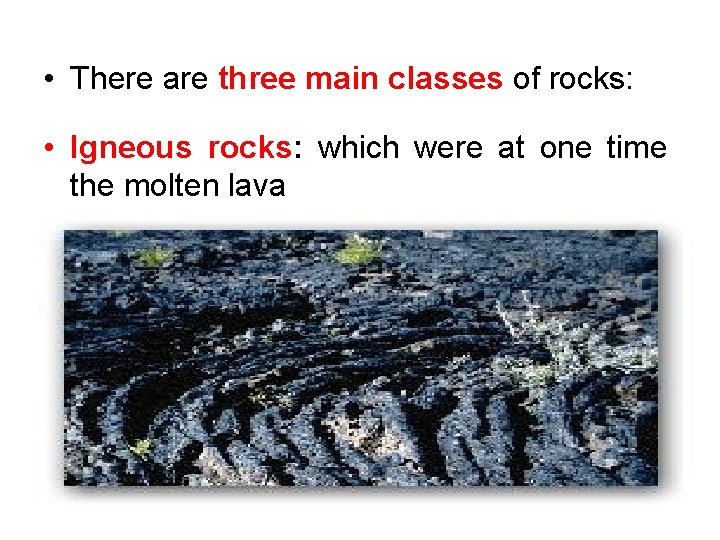
• There are three main classes of rocks: • Igneous rocks: which were at one time the molten lava
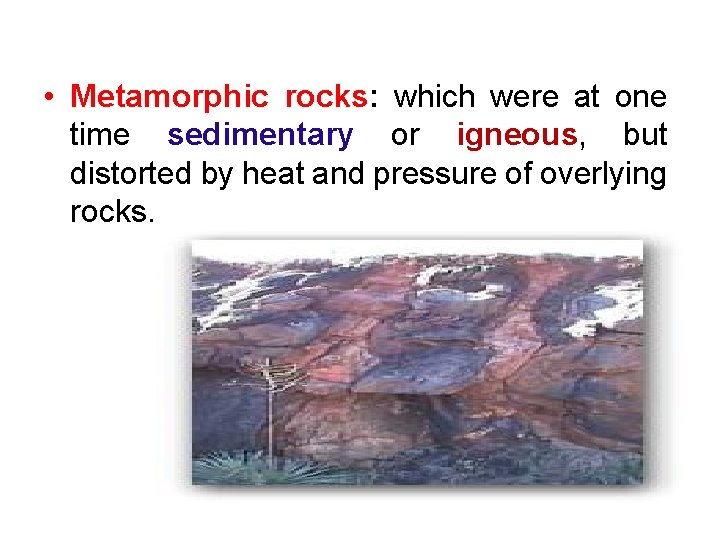
• Metamorphic rocks: which were at one time sedimentary or igneous, but distorted by heat and pressure of overlying rocks.
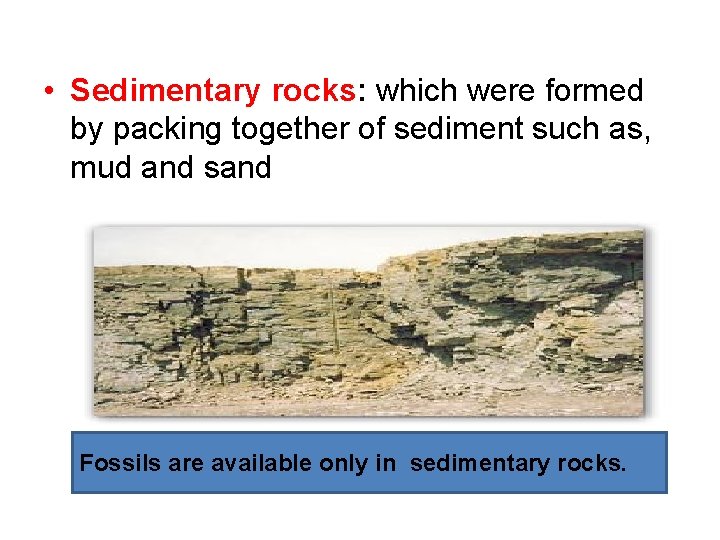
• Sedimentary rocks: which were formed by packing together of sediment such as, mud and sand Fossils are available only in sedimentary rocks.
• PROCESS OF FORMATION OF FOSSILS • The process of formation of fossil is known as fossilization. • All the organisms which die do not become fossils because most of them are rapidly decomposed. • The best place for fossilization is the ocean because salt in water checks the decay of organisms.
• In most cases, soft parts are not preserved and only hard parts such as bones, teeth, shells, woody parts of plants are preserved. • Beside oceanic water, petroleum springs, amber and resins, sand ice also preserved the organisms unchanged.
• In general the Fossils are found in sedimentary rocks. • The sedimentary rocks are formed due to slow settling down of silt, mud or volcanic ash in rivers, lakes and sea. • As the particle settle layer after layer each layer is called stratum.
• The lowest layer which was deposited first contains the fossil of primitive organisms where as those lying at top layers deposited recently contains the fossils of much complex and advanced plants and animals. • Thus fossil records suggest that modern day plants and animals have evolved slowly from much simpler forms of past.
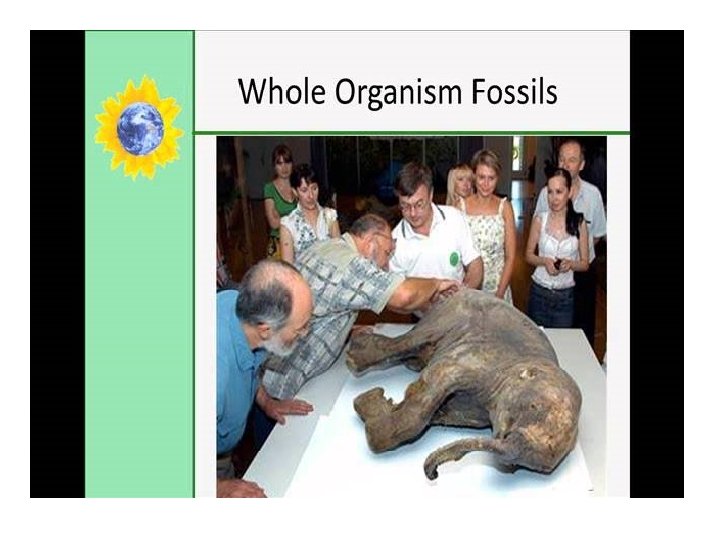
• Fossils are formed by various processes: • 1. Entire organism fossilized • Under exceptionally favourable conditions, the entire animal might get preserved in remarkably good condition, retaining even the finer details of soft parts. • The preserving material can be ice, amber, tar, oil seeps etc. e. g. Wooly mammoths in ice, insects trapped in tree resin (amber), rhinoceros in tar etc.
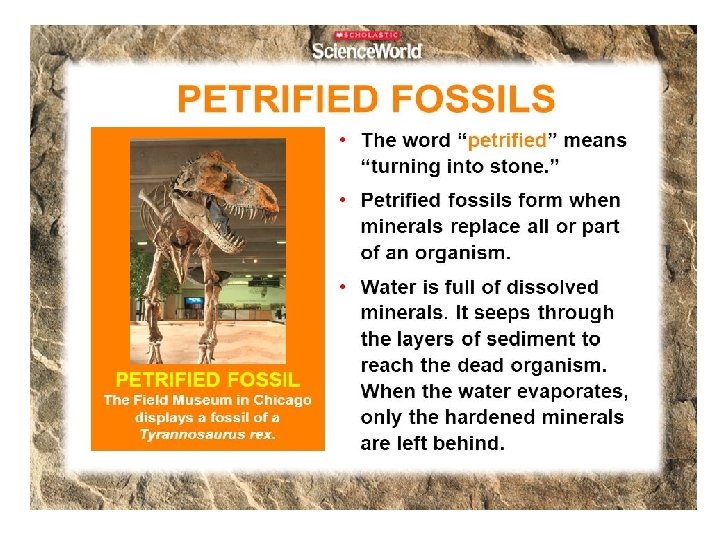
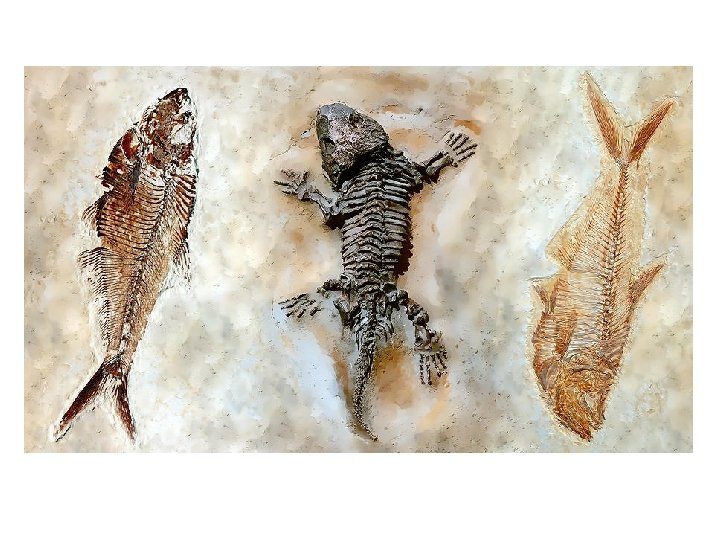
• 2. Petrification/Permineralization • Majority of the fossils are formed by Petrifaction. • It is the process of replacement of organic matter by minerals like sand, lime, iron oxides, silica etc. • In petrifaction decomposers decompose the organic matter of dead organism.
• This decomposed material is carried away by the seepage of water • In such places minerals precipitate. • The minerals become hard to form into a rock. • This rock resembles to the dead organism. Such fossils are called as petrified fossils.
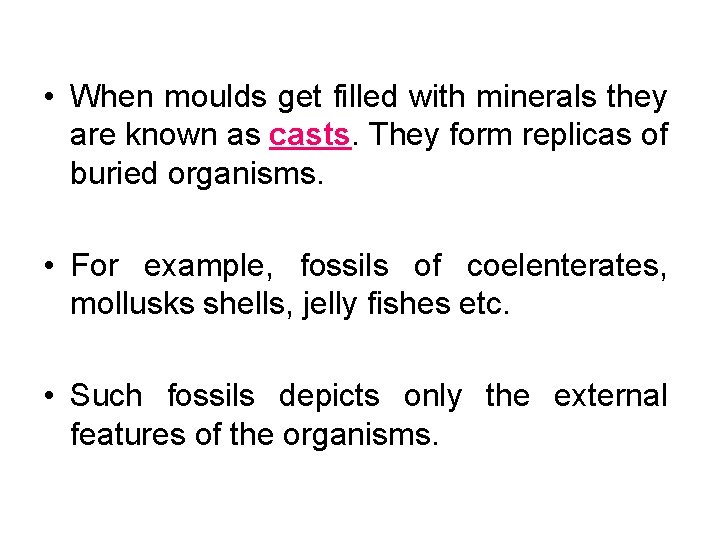
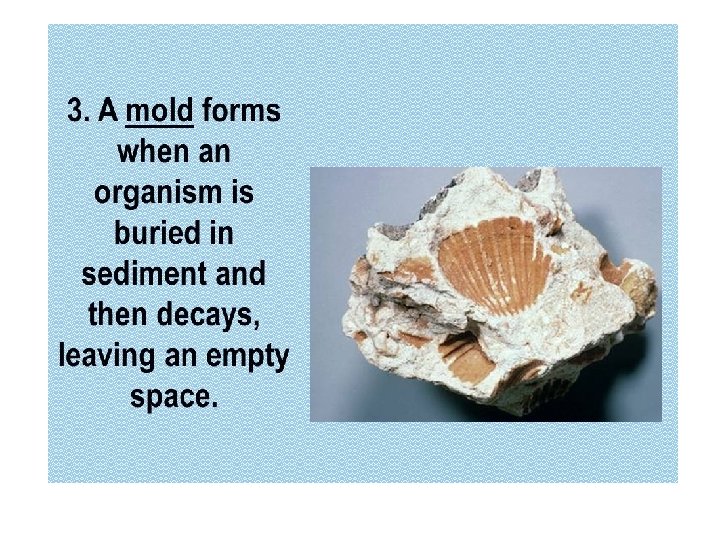
• 3. Moulds and casts or Incrustation: • If the soft bodied animal or plant get buried and their surrounding get hardened, their organic matter get disintegrated leaving only a hollow cavities known as mould. • Thus a mould is an impression of the organism which is exact replica of the organism.
• When moulds get filled with minerals they are known as casts. They form replicas of buried organisms. • For example, fossils of coelenterates, mollusks shells, jelly fishes etc. • Such fossils depicts only the external features of the organisms.
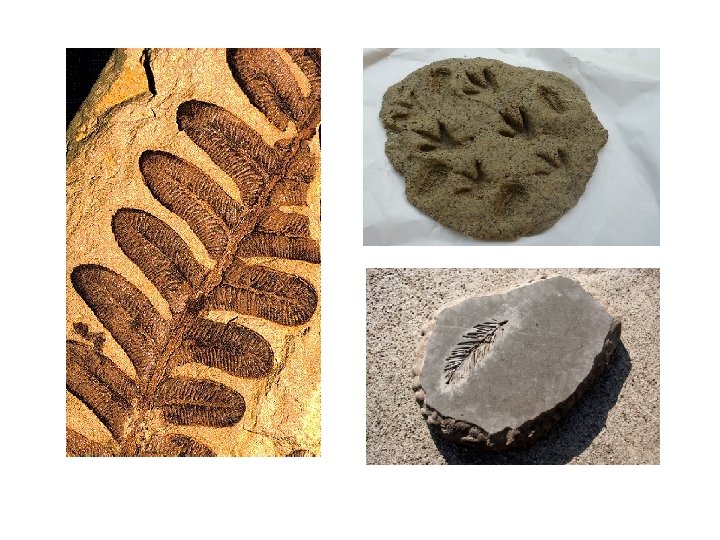
• 4. Impressions: • Like moulds, impressions are also formed when an organism or their parts come in contact with soft clay or mud leaving an impression. • These impressions become permanent and form the fossils. • Many such type of fossils e. g. impression of leave, feather, wing membrane of flying reptiles, skin of dinosaurs etc have been recovered from the stones.
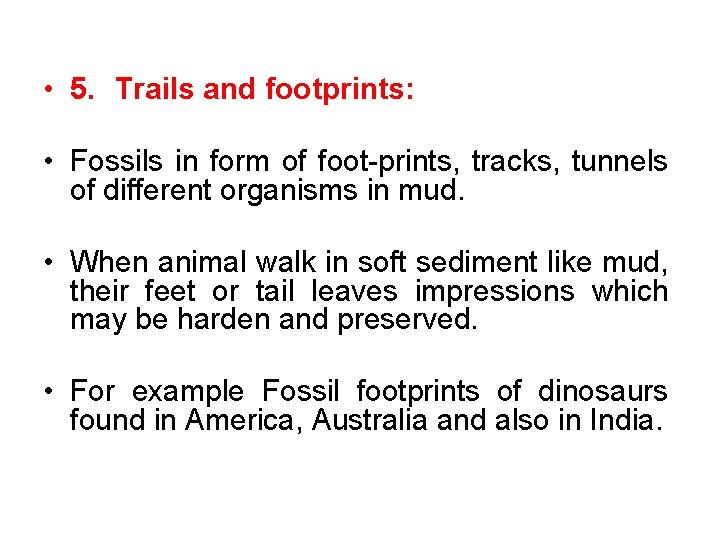
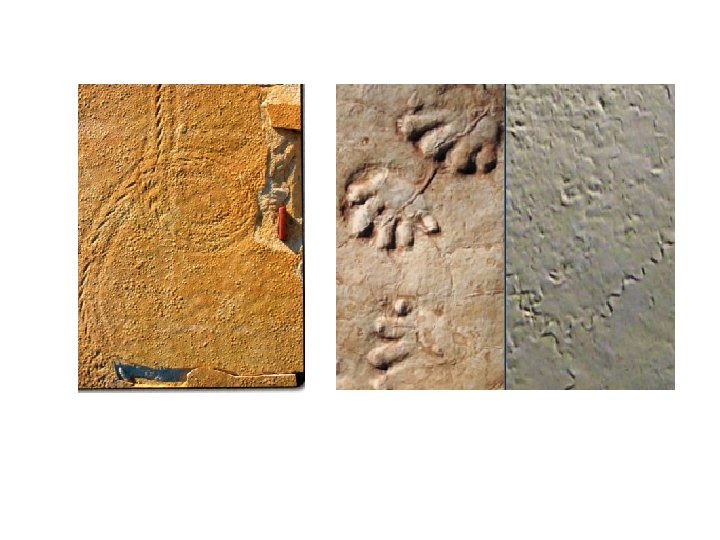
• 5. Trails and footprints: • Fossils in form of foot-prints, tracks, tunnels of different organisms in mud. • When animal walk in soft sediment like mud, their feet or tail leaves impressions which may be harden and preserved. • For example Fossil footprints of dinosaurs found in America, Australia and also in India.
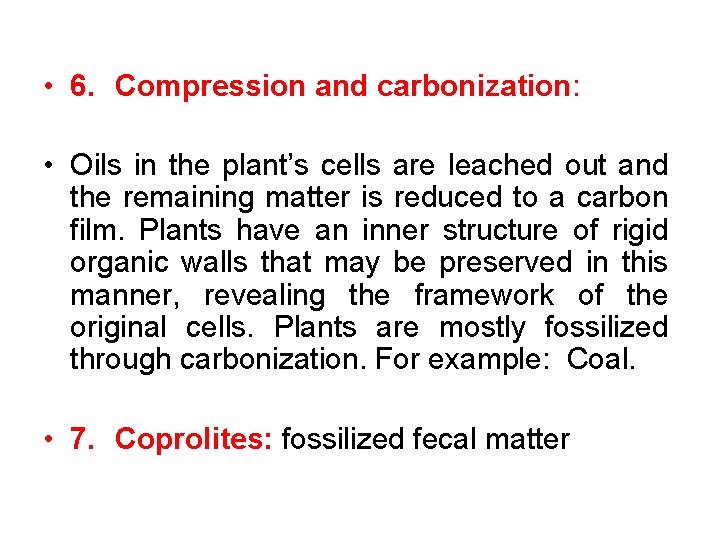
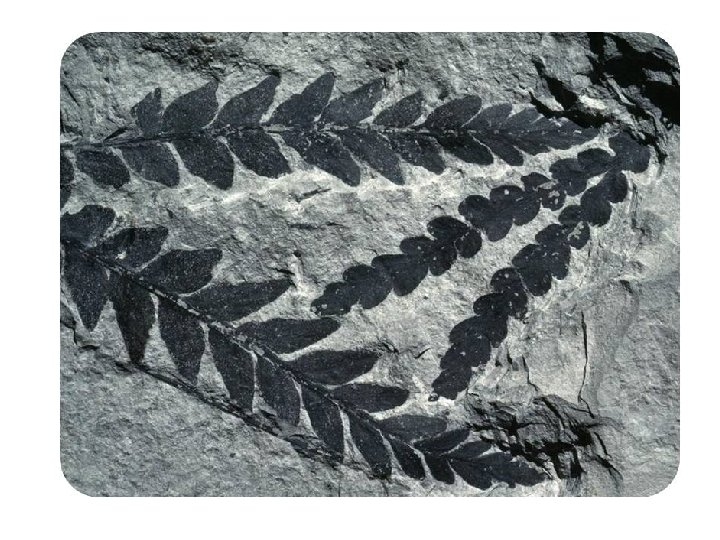
• 6. Compression and carbonization: • Oils in the plant’s cells are leached out and the remaining matter is reduced to a carbon film. Plants have an inner structure of rigid organic walls that may be preserved in this manner, revealing the framework of the original cells. Plants are mostly fossilized through carbonization. For example: Coal. • 7. Coprolites: fossilized fecal matter
• Types of Fossils: • 1. Body fossils: where the hard parts of an organism like shell, tooth, bone etc preserved under the rock. These fossils provide details of shape and function of actual organism. • These fossils can contain the petrified remains of the organisms ranging from microscopic sea dwellers to huge terrestrial dinosaurs
• 2. Sub fossils: These are remains of animals or plants preserved in rocks less than 10, 000 years. • These also include remains of bison trapped in frozen ice or ancient man mummified in cave. • 3. Micro fossils: are those which contain remains of microscopic animals or plants less than 0. 5 mm in size
• 4. Trace fossils: These are fossils of foot prints and trails left in mud by the organisms that lived in past e. g. foot prints of dinosaurs, worm trails. • Such fossils instead of having remains of the organisms contain the information regarding the organisms like walking, crawling, burrowing or feeding habit.
• 5. Coprolites: These are also trace fossils because they provide the indirect information. The word coprolite is derived from the Grk word kopros, meaning "dung“. • These are fossilized droppings or fecal matter of animals that provide information regarding food habits • 6. Gastroliths: Which are found in abundance in the body cavities of certain reptiles which are believed to have been of some use in grinding the stomach contents of the extinct reptiles.
• Determination of age of fossils or dating of fossils: • Fossils reveals the trends in evolution and indicate the history of their ancestors. • So it is very essential to arrange them in a chronological succession. • For arranging them chronologically, the accurate age of the fossil must be known. • This process of finding out the age of a fossil is known as dating of fossils.
• For estimating the age of fossils, there are three methods: • 1. Stratigraphy • 2. Biostratigraphy • 3. Radiometry
• 1. Stratigraphy • Analysis of the succession of strata that have been laid or formed one after the other in a more or less regular succession. • The relative age of the fossil can be determined by the position of the fossil in the sedimentary rock. • The lower the strata, the older are the rock as well as fossil.
• 2. Biostratigraphy • It is the recognition of strata on the basis of fossils of flora and fauna present in the rocks. • By comparing the fossils, the strata in different parts of the earth are identified
• 3. Radiometry or radioactive clock method • This method was introduced by Boltwood in 1907. • It is the most effective and accurate way of calculating the age of fossil by measuring the amount of radioactive material in the igneous rocks or soil.
• It is based upon the disintegrating property of radioactive elements such as Uranium 238, Uranium 235, carbon etc. • The radioactive elements have unstable atomic nuclei that breakdown i. e. they emit electrons from their outer ring at a steady measurable rate to form stable nonradioactive element in a specific time. • The rate of disintegration remain unaffected by any changes in the environment.
• Each radioactive element has its half-life i. e. 01 gm of a radioactive element changes into ½ gm in a fixed or specific time. • Thus half-life of a radioactive substance is defined as “the time taken by a specific radioactive element to decompose to half of its original value”. • So, Half-life periods are calculated on the basis of the ratio of the radioactive material and its products of decay.
• The most commonly used methods for calculating the radioactive materials are: • 1. Uranium-lead method • 2. Carbon-14 method. • 3. Potassium-argon method
• 1. Uranium-lead (U–Pb) dating • In this method, the radioactive substance Uranium 238 which very slowly breakdown into stable lead and helium is measured in the rocks as units of time called half-life.
• The uranium–lead dating method relies on two separate decay chains: • (i) the uranium series from 238 U to 206 Pb, with a half-life of 4. 47 billion years and • (ii) the actinium series from 235 U to 207 Pb, with a half-life of 710 million years.
• Thus half-life of 238 U to 206 Pb is 4. 47 billion years whereas, half-life of 235 U to 207 Pb is 710 million years. • By accurately estimating the 238 Uranium, 235 Uranium, 206 lead and 207 lead in the given rock, the age of the fossils can be calculated. • Draw back: • 1. Only igneous rocks can be tested • 2. Lost, if any, of disintegrated helium or uranium is not sure.
• 2. Carbon-14 method. • This method was discovered by W. F. Libby. • Carbon 14 is created from Nitrogen 14 by cosmic bombardment on the earths upper atmosphere. • One C 14 is equal to one trillion normal C 12.
• When an organism dies or buried, its C 14 • starts disintegration into C 12. • The half-life of C 14 is 5. 6 x 10³ years. • Thus, the amount of C 14 gradually decrease by one-half every half-life until about 40, 000 years it is no longer detected.
• Interpretation of fossil records: • The study of fossils reveals the following information : • 1. That the fossils present in adjacent strata shows more resemblance as compared to the fossils present in distant. • 2. That more recently formed fossils are more alike to the existing species than those which were formed earlier and are preserved in the lower strata.
• 3. By arranging the fossils according to their age (age of the fossils can be determined by determining he age of a rock) many fossil series have been established. • Such series demonstrate as to how various forms of life have changed gradually over a period of millions of years.
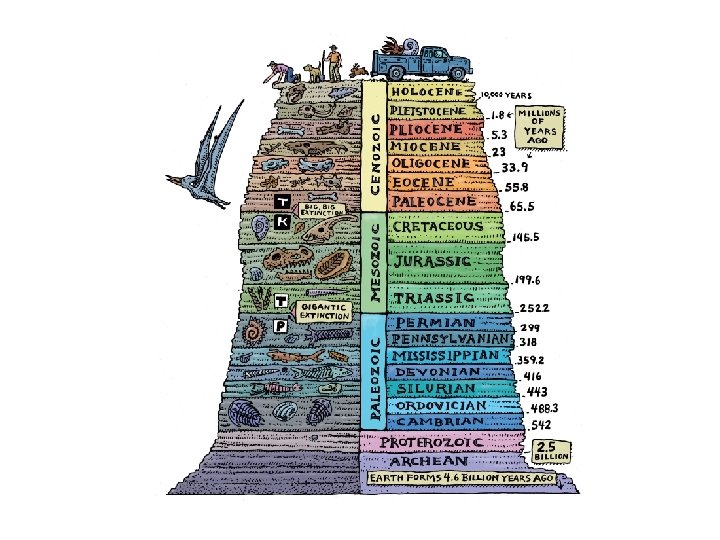
• On the basis of these, it has been possible to correlate the deposits all over the world and put them into a chronological sequence. • Through extensive study of fossils, scientists, geologists and palaentologists have been able to construct a story of life in the form of a geological time scale.
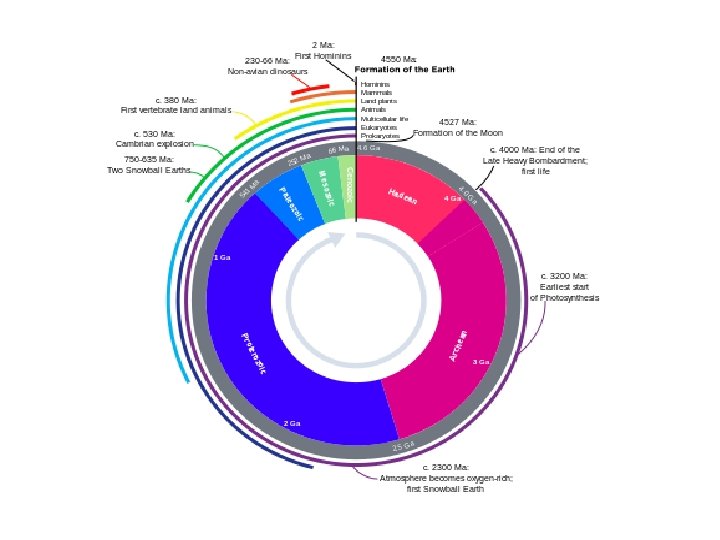
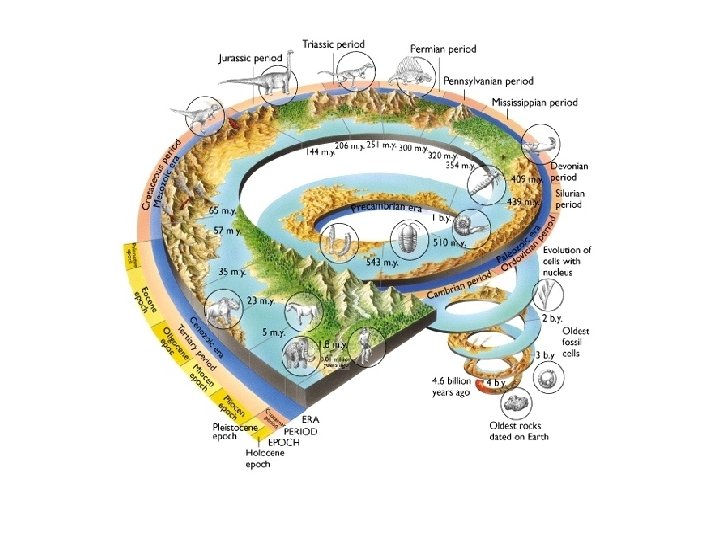
• Geological time scale: • The entire life span of earth is called as Geological time. • This entire life span of earth (i. e. geological time) is divided into different intervals on the basis of significant events. • These events are of different durations and of different categories.
• The major divisions of the geological time are known as Eras. • The Eras have been subdivided into Periods and periods have been subdivided into Epochs. • These eras, periods and epochs are arranged on the time scale in an order of their age, known as Geological Time Scale.
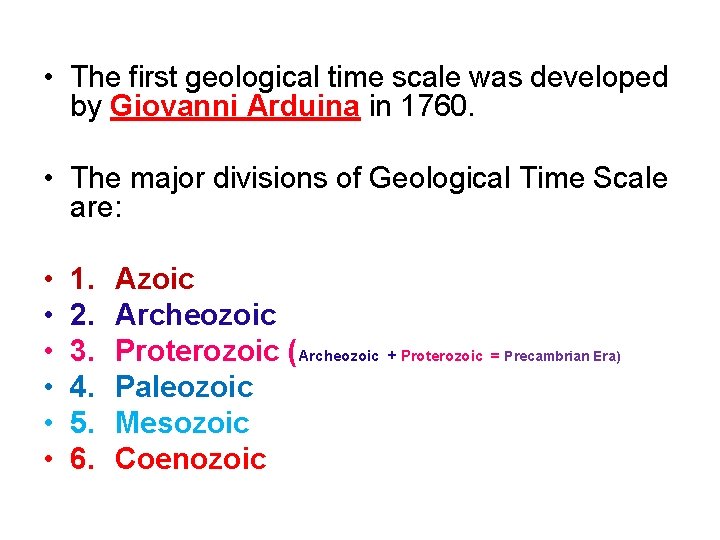
• The first geological time scale was developed by Giovanni Arduina in 1760. • The major divisions of Geological Time Scale are: • • • 1. 2. 3. 4. 5. 6. Azoic Archeozoic Proterozoic (Archeozoic + Proterozoic = Precambrian Era) Paleozoic Mesozoic Coenozoic
• 1. Azoic Era (Without Life) • This is the earliest time of the earth which is characterized by the complete absence of life. • During this period, the earth underwent many changes, which created conditions favourable for the origin of life. • The rocks of this period were only igneous type and were devoid of fossils.
• 2. Archeozoic Era: • It is presumed to have started somewhat 3600 million years ago and continued for 2000 million years. • The geological conditions characterized by catastrophic widespread volcanic eruptions. • No fossils records are available are and
• However, the presence of inorganic lime stones and graphite (pure carbon) in the rocks are indicative of presence of plants and animals. • The organisms might have been simple, unicellular bacteria and algae.
• 3. Proterozoic era (Earliest or Ancient Life): • It started about 1600 million years ago and continued for 900 million or 1000 billion years. • Geological conditions are characterized by large amount of sediments and at least one glaciations. • Fossil record although meager but reveal some complexity.
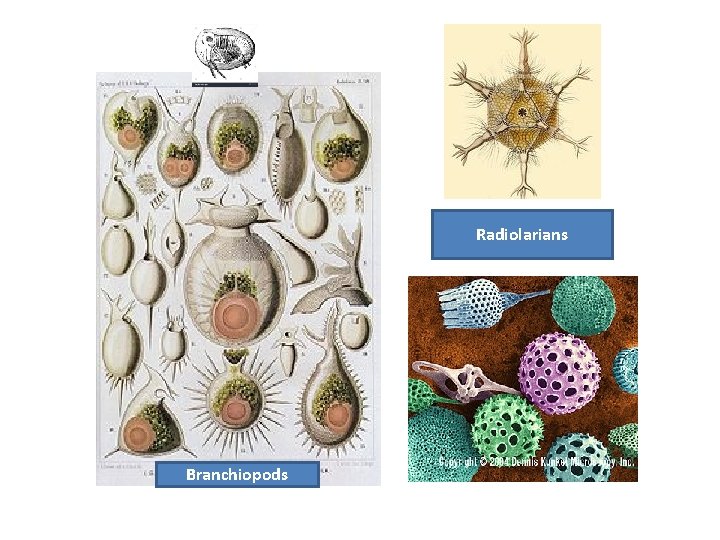
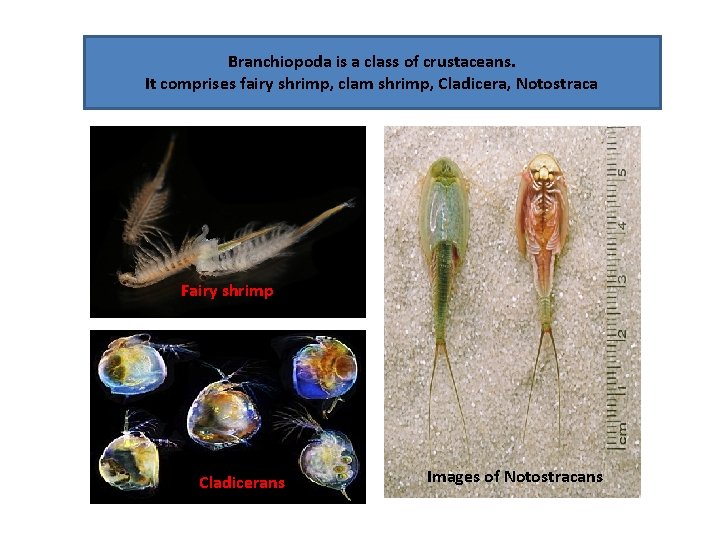
• The flora and fauna of this period include: Algae, fungi, sponges, radiolarians (protozoa), jelly fishes, branchiopods (crustaceans) and worms. • This era was ended with worlds wide mountain building activity.
Radiolarians Branchiopods
Branchiopoda is a class of crustaceans. It comprises fairy shrimp, clam shrimp, Cladicera, Notostraca Fairy shrimp Cladicerans Images of Notostracans
• Because of these changes, the fossil content of rocks between the strata of late proterozoic and early paleozoic era shows discontinuity. • The Archeozoic and Proterozoic era are collectively known as Cryptozoic era or Precambrian Time.
• 4. Paleozoic Era (Time of Ancient Life): • This period started some what 600 million years ago and continued for 370 million years. • Fossil records is very extensive and shows the abundance of different plants and animals both in sea and land. • Almost all the major invertebrate phyla appeared in the early period, where as fossil of first vertebrate appeared late in the era.
• This era is divided into seven periods viz. : • • i. Cambrian period ii. Ordovician period iii. Silurian period iv. Devonian period v. Mississipian period vi. Pennsylvanian period vii. Permian period • Mississipian and Pennsylvanian period are collectively known as Carboniferous period.
• i. Cambrian period • This period started about 600 million years ago and continued for 100 million years, • It started by the melting of glaciers resulting in slow rise of sea level. • Climate was warm.
• Fossils were abundant, mainly of marine plants and animals. • The fauna represent protozoan, sponges, coelenterates, annelids, mollusks, brachiopods, echinodermates, trilobites. • This period ended by great mountain disturbances in north eastern part of North America and Canada and mountain formation activities in European continents
• ii. Ordovician period: • Beginning about 500 million year ago. • Duration 75 million years • Climate uniformly warm with glacial activity. • Period ended by tectonic disturbances in Eastern North America that resulted to the formation of Tectonic mountains
• It marks the appearance of first vertebrates as armoured jawless fishes called Ostracoderms. • First corals appeared in this period and started their reef building. • Snails, starfish, giant cephalopods (members of class molluscs) also appeared.
• iii. Silurian period: • Beginning about 425 million years ago and continued for only 20 million years. • Climate mild, some area were arid. • This period ended by caledonian disturbances in Europe that resulted in rise of caledonian mountain in North greenland, North Africa and east Central Asia.
• The Silurian period is characterized by the occurance of two important events: • a. Appearance of land plants mainly represented by ferns. • b. Evolution of air breathing animals. • The first land animal or air breathers were large scorpion-like arthropods, millipedes and wingless insects
• iv. Devonian period: • This period started about 405 million years ago and continued for 60 million years. • Climate mild with local dryness. • Great volcanic activities, formation of coal, oil, gas took place during this period. • The land plants which made their appearance in Silurian period become widespread.
• Trees were very tall, 30 -40 ft height. • Animal life still thrive abundantly in sea only. • The ammonites, a special group of cephalopods first appeared in this period. • This period is also known as “Age of fishes” because for the first time, fossil records revealed the existence of numerous and varied forms of fishes indicating their abundance and diversification.
• Placoderms or spiny skinned shark evolved and become extinct by the end of this period. • These were the ancestors of Condrichthyes (cartilagenous) and Osteichthyes (boney). • True sharks (Chondrichthyes) appeared in fresh water but migrate to ocean.
• v. Mississipian period: • Started about 345 million years back and continued for 25 million years. • Climate still warm and dry with desert conditions. • Formation of coal, oil, gas, lead, zinc, gold etc occurred during this period.
• Earth was thickly covered with plants related to ferns, spore bearing trees, primitive seed plants and seed bearing ferns. • In the dense forest animal life was also abundance. • The echinoderms become greatly reduced. • Crinoids reached the peak of their development and brachiopods with long radiating spines also become abundant.
• Fossils of terrestrial life are relatively few. • The sharks were more abundant, within which a particular group of shell-crushing sharks reached the highest stage of development. • Their teeth were adapted for crushing the shells of mollusks and arthropods.
vi. Pannsylvanian period: • Started about 320 million years back and continued for 40 million years. • Climate was uniformly mild and damp but become cold with local glaciations. • Numerous occurred. mountain disturbances
• This climate was most suitable for swampy vegetation that resulted in the formation of extensive coal beds. • Insect life was most abundant that was mostly represented by dragonfly, cockroaches etc. • Among the abundant. animals amphibian were more • The significant event of this period was the first appearance of reptiles known as Labyrinthodonts.
• vii. Permian period: • Started about 280 million years ago and continued for 50 million years. • This period was characterized by great changes in the climate as well as topography of the world.
• The shallow seas which covered the region from Nebraska to Texas at the beginning of this period gradually drained off, leaving the dry land. • Widespread glaciations occurred in Southern Hemisphere and extended from Antarctic to the equator in Brazil and Africa. • The climate in general become colder and drier.
• Soft plants were replaced by more hard and woody plants. • Trees like date-palm were appeared. • The marine animals remain unchanged, however, trilobites disappeared completely. • Terrestrial life shows much variations.
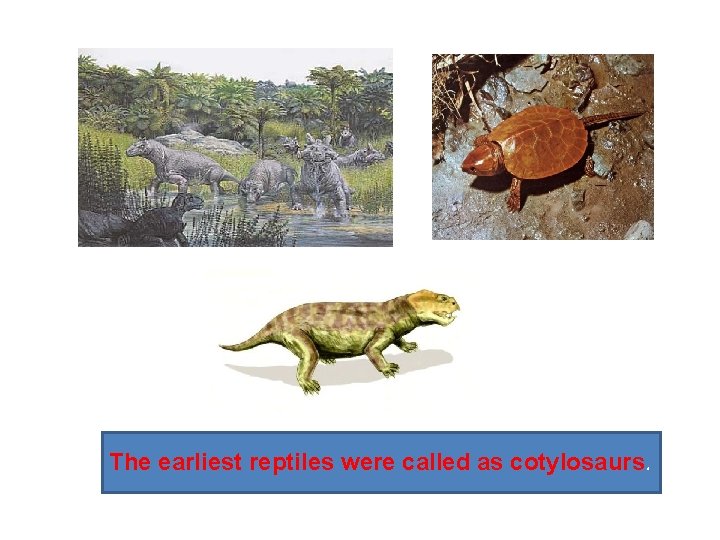
• New genera of mayflies, dragonflies were evolved. beetles, • Reptiles which appeared in Pennsylvanian period shows progressive development. • The first reptile, the Cotylosaures appeared in permian period.
The earliest reptiles were called as cotylosaurs.
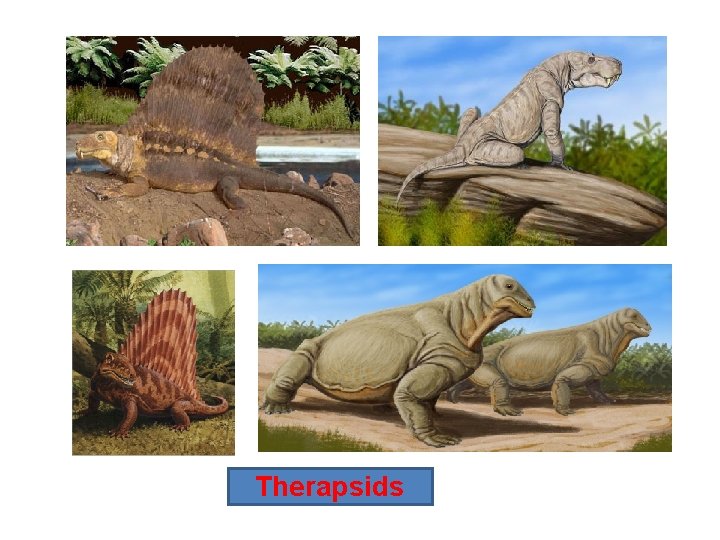
• A group of mammal-like reptiles the Therapsids also evolved in this period. • Many of the paleaozoic forms become extinct because of adaptation in such drastic change in climate, i. e. cooling of water and decrease of sea area.
Therapsids
5. Mesozoic Era (Middle Life) • Started 230 million years ago continued for 180 million years. and • Main features: • 1. Disappearance of ancient amphibians and their replacement by reptiles. • 2. Diversification of reptiles that occupies all habitat and finally the extinction of numerous dinosaurs.
• For this reason this era is has been popularly known as “Age of Reptiles” • The flora of this era shows a time of transition. • Gymnosperms and angiosperms appeared in the late Mesozoic Era. also • The fauna of this era include cephalopods, reptiles, birds and mammals.
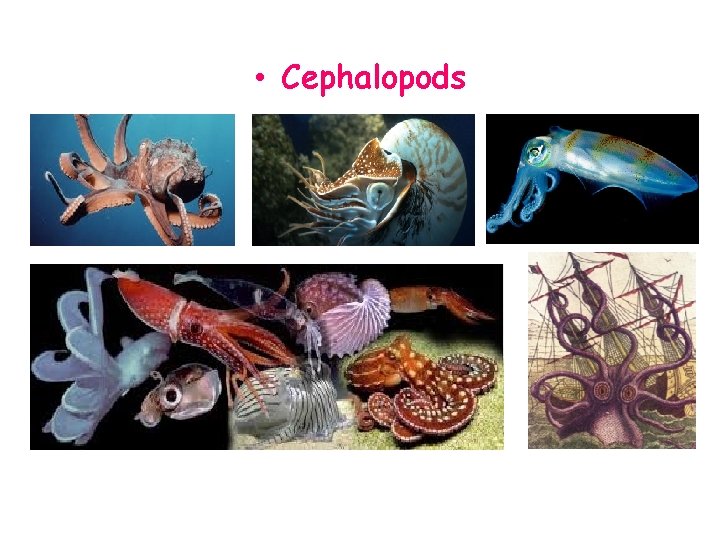
• Cephalopods
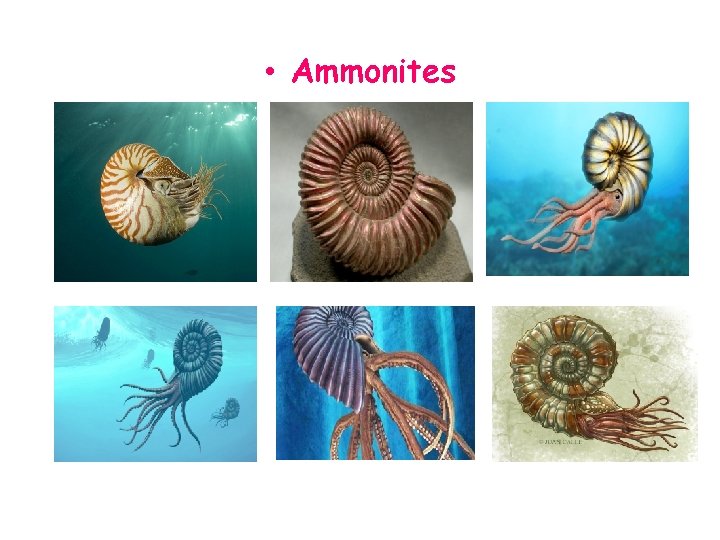
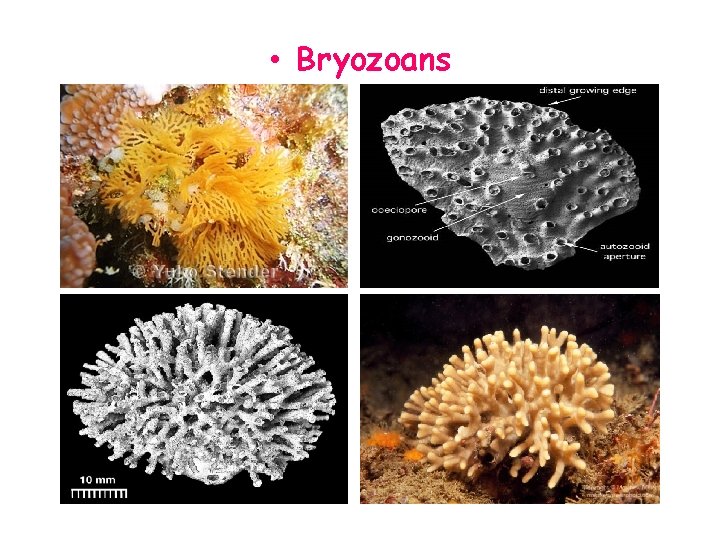
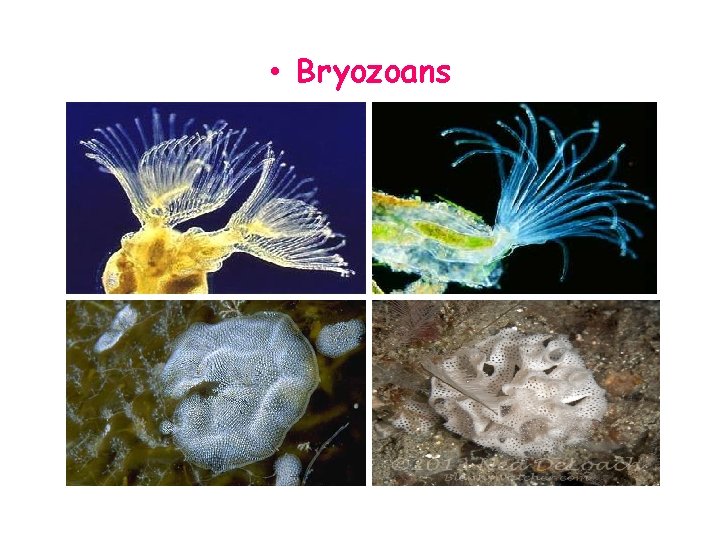
• The development of cephalopods during this era reach to its peak which represent more than 6000 species of ammonites. • Beside cephalopods the other invertebrate of this era were protozoans and bryozoans. • Different groups of molluscs become more diversified.
• Ammonites
• Bryozoans
• Bryozoans
• Arthropods shows much diversity. • The trilobites were replaced by shrimps, crabs, crayfish and lobsters. • Among the vertebrates reptiles obtained their highest altitude and about a dozen different orders evolved which occupied almost the all possible habitat. • Nutritionally some of them were herbivores and some them were carnivores.
• Size varies from very small to 100 ft. in length. • These were the first truly terrestrial vertebrates. • Beside these reptiles, the other important groups of animals that evolved during this era were birds and mammals. • The first fossil bird found in the rocks of Jurassic period belong to genus Archaeopteryx and Archaeornis.
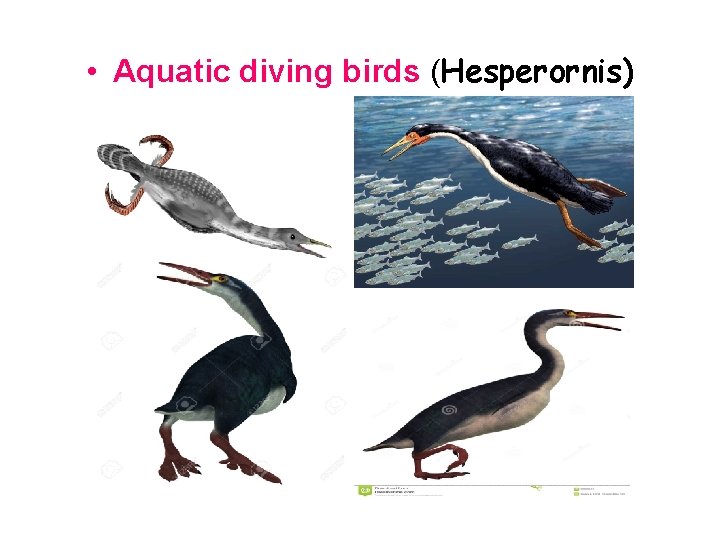
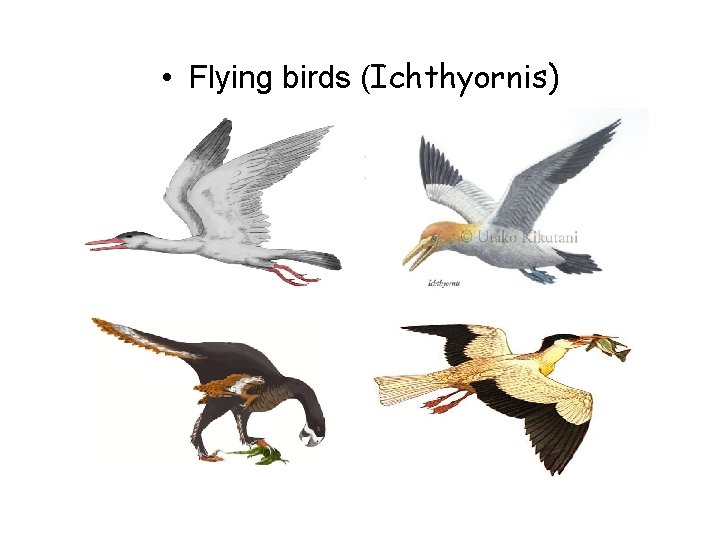
• Fossils of an aquatic diving bird (Hesperornis) and a powerful flying bird (Ichthyornis) have been found from Cretaceous. • The little mammals were evolved in colder regions of North America, Germany. • They were worm-blooded having larger brain and smaller body.
• Aquatic diving birds (Hesperornis)
• Flying birds (Ichthyornis)
• They give rise to young ones and females have milk glands to feed their young ones. • The reason of origin of mammals are: • 1. increasing aridity of climate • 2. extensive glaciations which required the evolution of retention of body heat that resulted in the acquisition of warm blood.
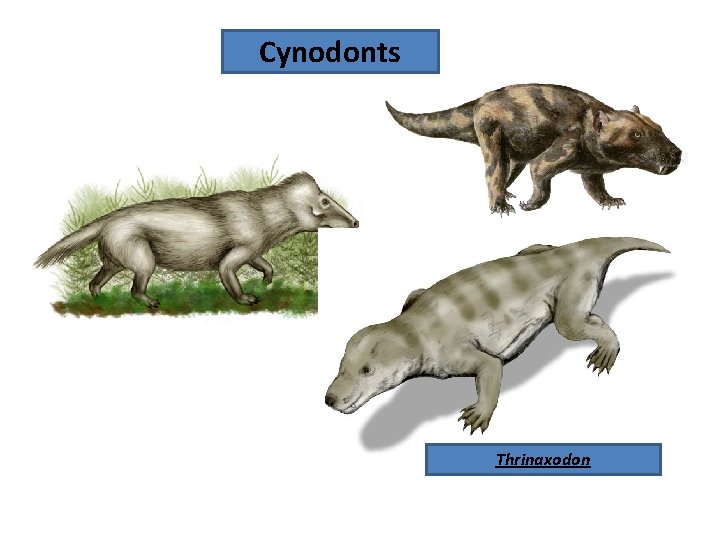
• The ancestor of mammals were cynodontia, a group of reptiles from south Africa. • The cynodonts had dog-like muzzle and heterodont teeth, two occipital condyles. • Structurally, cynodonts bridge the gap between reptiles and mammals
Cynodonts Thrinaxodon
Divisions of Mesozoic Era • The mesozoic era has been divided into three periods: • 1. Triassic period • 2. Jurassic period • 3. Cretaceous period
• 1. Triassic period • Duration: Started 230 million years ago and continued for 50 million years. • Climate: harsh and dry • Flora and fauna: Highly developed gymnosperm such as conifers and cycads which form the forests.
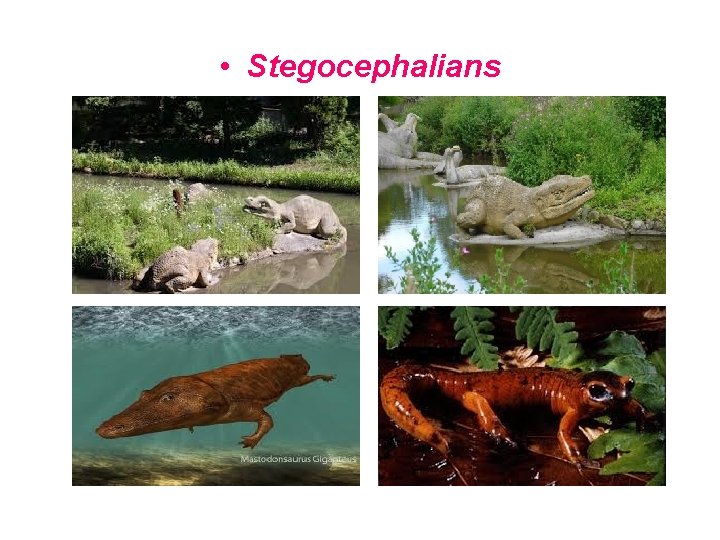
• Primitive amphibians (Stegocephalians) become extinct. • Dinosaurs appeared as very small lizard like forms and within 150 years they become rulers of the earth.
• Stegocephalians
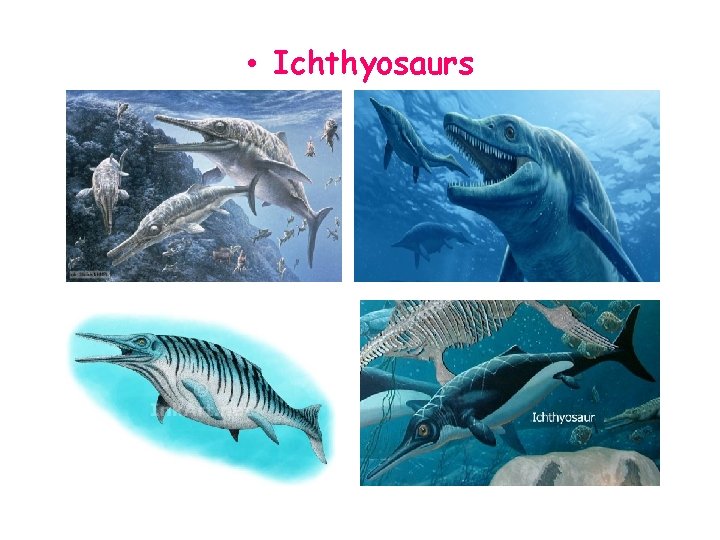
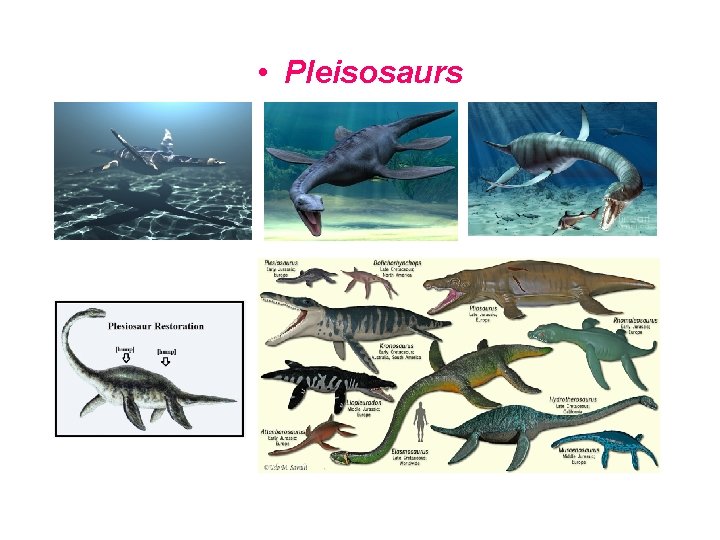
• Some of the reptilian groups returned to sea life (Ichthyosaurs and Pleisosaurs). • The most important event of this period was the first appearance of mammals which retained egg-lying habit.
• Ichthyosaurs
• Pleisosaurs
• 2. Jurassic period • Duration: started about 180 million year ago and continued for 45 million years. • Climate: Mild, warm, humid with plenty of rain fall. • Flora & fauna: Gymnosperm such as conifers and cycads were widespread.
• Angiosperm (flowering plant) appeared for the first time. • Dinosaurs become giant, small mammalian groups flourished. • Other animals such as lizards and crocodiles appeared for the first time.
• 3. Cretaceous period • Duration: Beginning some 135 million years ago and continued for 72 million years. • Cimate: Warm but become cooler later on. • Flora & Fauna: The angiosperm spread all over the world.
• In sea, sharks and bony fishes were much like the modern form. • Most of the dinosaurs were herbivores, few were carnivores. • Snakes appeared for the first time. • Some new verities of birds appeared.
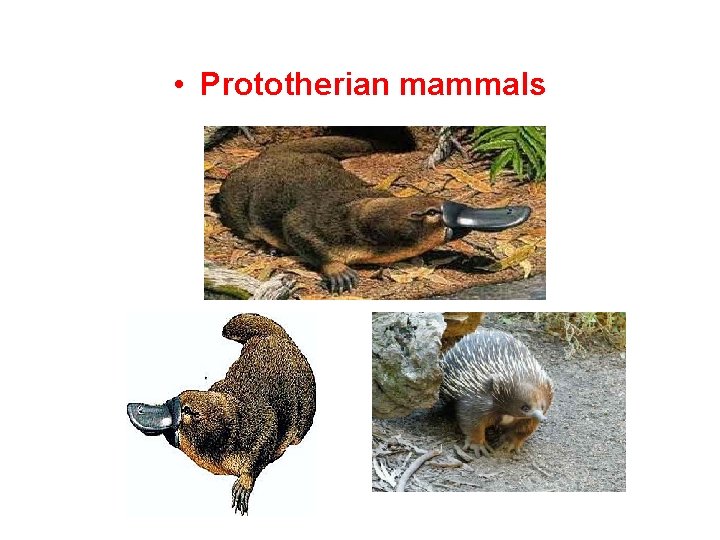
• Mammals were still small. Prototherian mammals have long heavy tail, short pentadactyle limbs and lay eggs. • The marsupials (pouched mammals) diverged from these prototherians followed by eutherians (pacental mammals) form. • At the end of this era, many plant on which many reptile feeds disappeared due to dropping of temperature and dry condition. This resulted in extinction of herbivores animals.
• Prototherian mammals
Coenozoic Era (Era of Recent Life) • Period: Started about 63 million years ago. • It is called as “Age of Mammals” • This era is also marked by great adaptive radiation (divergent evolution) in birds and insects.
• This era has been divided into two periods: • 1. Tertiary period • 2. Quaternary period • 1. Tertiary period: • Period: Started 63 million years ago and continued for 62 million years
• Climate: warm in beginning but gradually become cooler. • Flora and Fauna: Plants as hard wood trees and conifers were present. Grass land appeared for the first time. • Mammals were still small, short legged and flat footed.
• Their teeth modified for various food habits. • Advanced modern placental mammals, including man also evolved in this period. • • • The tertiary period divided into five Epochs: i. Paleocene epoch ii. Eocene epoch iii. Oligocene epoch iv. Miocene epoch v. Pliocene epoch
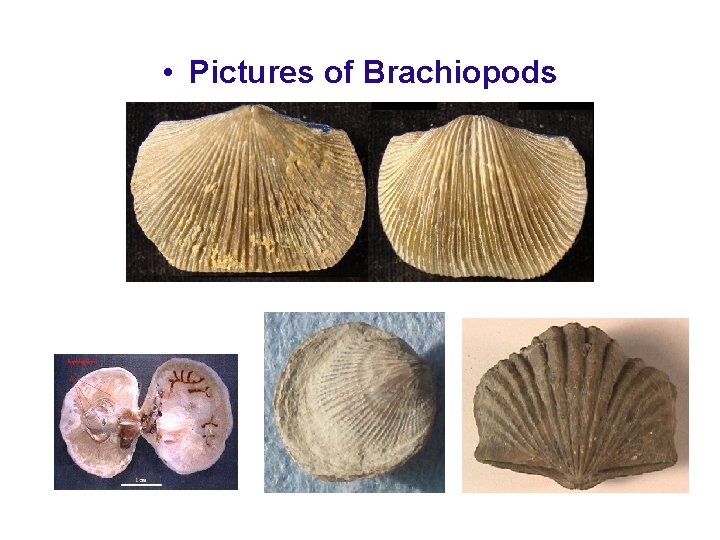
• i. Paleocene epoch • Period: Started 63 million years ago and continued only for 05 million years. • Climate: Mild which is ideal for mammals. • Life: Brachiopods attain their high peak of development. Mammals were primitive, moderate sized and carnivores.
• Pictures of Brachiopods
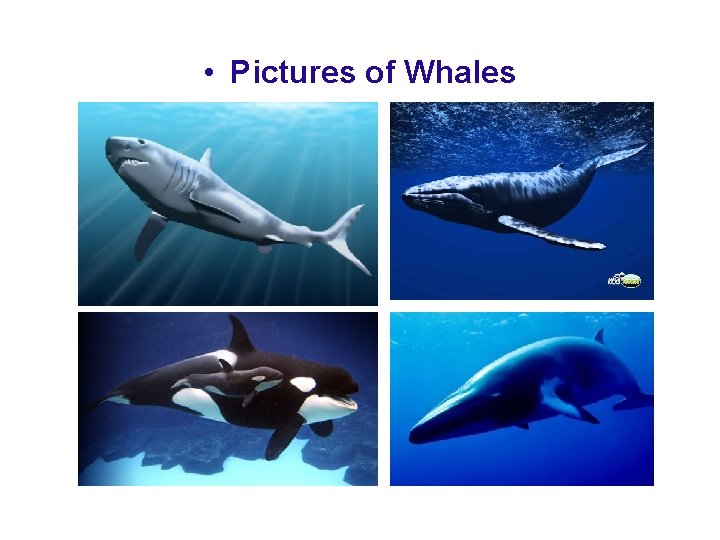
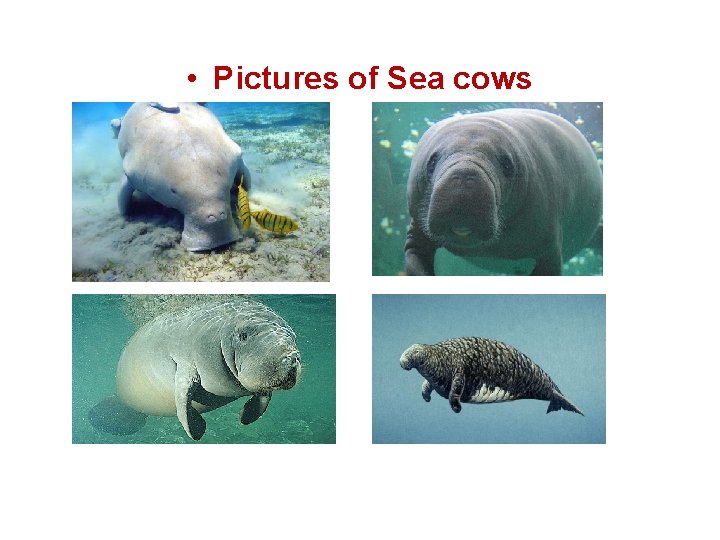
• ii. Eocene epoch • Duration: Started 58 million year back and continued for 22 million years. • Climate: Becoming cooler, mountain eroded. • Flora and fauna: Angiosperm become most abundant and successful. • Diversification of placental mammals take place and many new groups evolved. • At the end of this epoch, two groups of mammals i. e. whales and sea-cows returned to sea.
• Pictures of Whales
• Pictures of Sea cows
• iii. Oligocene epoch • Period: Started about 36 million years ago and continued for 11 million years. • Climate: Still cooler but becoming pleasant. • Flora and fauna: Same as of eocene epoch. However eutherian mammals become more numerous.
• Odd-toed ungulate began to radiate. • The horse of this epoch had three toes. • Rhinoceros attained larger size. • Anthropoid apes also made their appearance in this epoch and turtles, crocodiles and alligators attained their greatest development.
• iv. Miocene epoch • Period: Started 25 million years back and continued for 12 -13 million years. • Climate: Himalayas pushed up. Some region become dry and arid while other were cooler and wetter. • Flora and fauna: Due to cold, deciduous trees become more and more abundant.
• Development continued. of modern mammals • Different orders of carnivores, ungulates, rodents, elephants, bats, whales, dolphins, rats etc were present • The primates present in eocene epoch radiate.
• v. Pliocene epoch • Period: Beginning 13 million years ago and continued for 12 million years. • Flora and fauna: Grass land become more wide spread. Elephants were most numerous. Wild horse were abundant. • Horse and Giraffs spread from Asia toward Europe through India. • Horse had evolved into one-toed form.
• 2. Quaternary period • Duration: about 01 million years. • Climate: Varied and shows climatic zones. • Flora and fauna: All the modern form of life are present in this period.
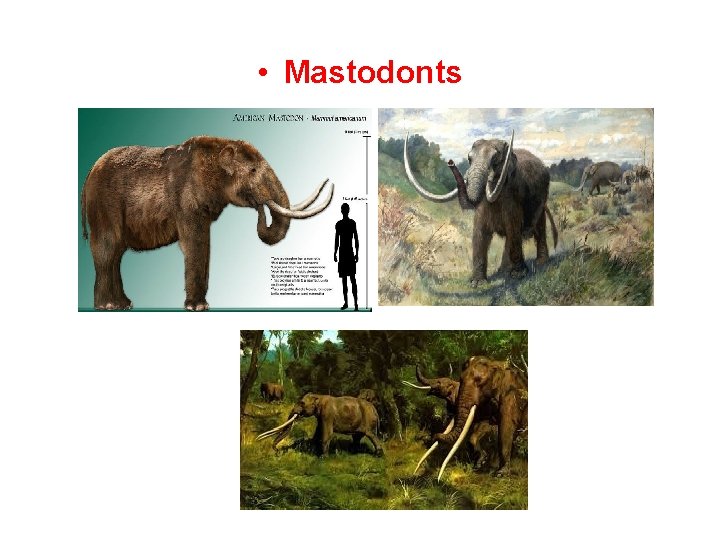
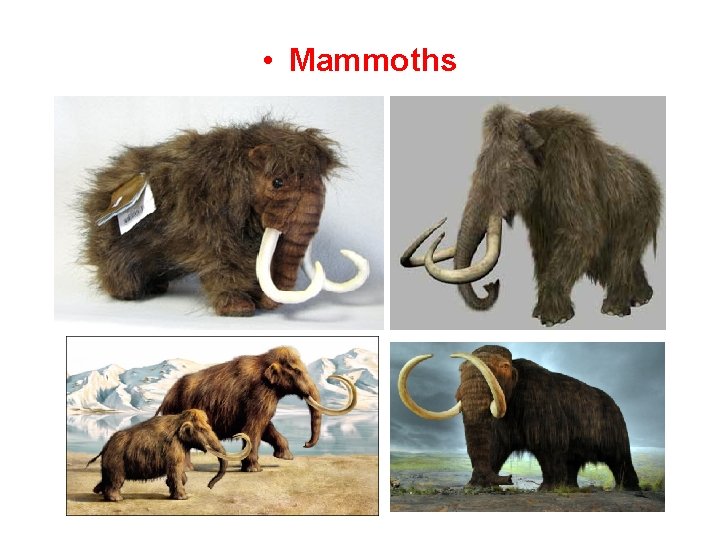
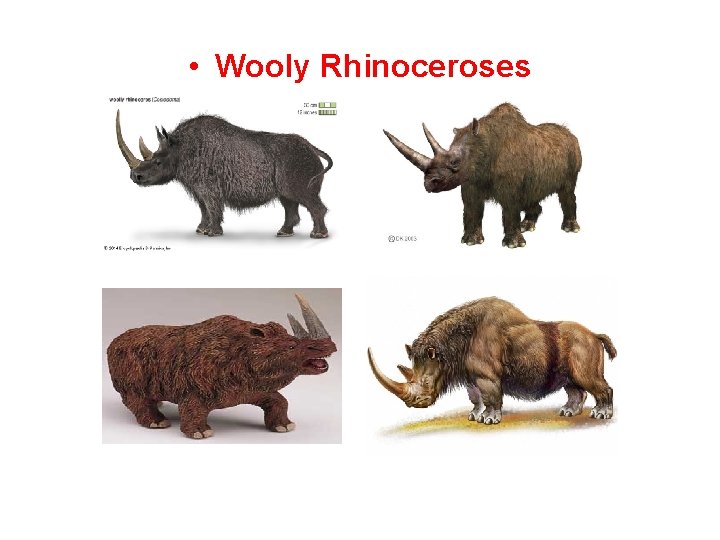
• The members of elephant tribe, the mastodonts, mammoths and wooly rhinoceroses reached their peak of development and finally extinct. • During this period, buffaloes become abundant. • Modern carnivores such as wolves, foxes etc were wide spread.
• Mastodonts
• Mammoths
• Wooly Rhinoceroses
• Most important event of this period was the rise of man. • His success has been his posture which freed his arms and hands and the skull with which he could manipulate tools. • For this reason this is known as “Age of Man”
• This period is divided into two epochs: • i. Pleiocene epoch • ii. Recent epoch • i. Pleiocene epoch: • Started 01 million years back and ended 8 -10 thousand years B. C.
• Due to unusual solar activities and unknown reason repeated glaciation activities occurred as the result of which ice was formed in the polar regions and on the mountains in temperate parts. • These glaciations resulted in the destruction and redistribution of many animals and plant species. • Many mammals like mammoths, elephants, wolves and true horses attained very large size. • The fossils of ancestral form of man and apes have recovered from pleistocene rocks.
• ii. Recent epoch: • The period of last 10, 000 years of the earth history is known as recent epoch. • It include the time after last glaciation. • During this span, forest spread over Europe and North Africa.
• Deserts grew up and new vegetation of herbaceous plants become dominant. • The modern species of man i. e. Homo sapiens evolved. • Despite certain gaps, the chronicle (record) sequence of fossil plants and animal life exhibits an orderly development from simpler to the complex form
• Although, fossils are the only direct evidences to suggest that evolution has actually taken place and that the species are not fixed but ever changing entities. • Unfortunately fossil history of almost every species is incomplete; thereby the evidence of fossils cannot be entirely relied upon in evolutionary studies. • Therefore, other evidences, although circumstantial, have to be taken into consideration while studying evolution. Some of such evidences are outlined below.
Punctuated Equilibrium • Scientists attempt to explain the world around us. • They do this through a series of proposed explanations for observed phenomena called hypotheses. • These hypotheses are then tested over a period of years to determine if they are supported by facts or if they need to be revised.
• Take, for example, evolution. • Scientists have long studied how new species come to be in the world and how these new species descend from ancestors. • The exact mechanism that drives this speciation still eludes (escape, avoid) scientists to some extent, so they are constantly attempting to come up with hypotheses to try and explain their observations.
• One major observation about the world around us has to do with when new species appear in the fossil record. • Has the evolution of life proceeded as a gradual stepwise process, or through relatively long periods of stasis punctuated by short periods of rapid evolution?
• To date, what is clear is that both evolutionary patterns – phyletic gradualism and punctuated equilibrium have played at least some role in the evolution of life. • Gradualism and punctuated equilibrium are two ways in which the evolution of a species can occur. • A species can evolve by only one of these, or by both.
• Both phyletic gradualism and punctuated equilibrium are speciation theory and are valid models for understanding macroevolution. • Phyletic gradualism was proposed by Charles Darwin • However, the punctuated equilibrium was proposed as an alternative hypothesis by Eldridge and Gould to explain the gaps in the fossil record
• The gradualism model depicts evolution as a slow steady process in which organisms change and develop slowly over time. • In contrast, the punctuated equilibrium model depicts evolution as long periods of no evolutionary change followed by rapid periods of change. • Both are models for describing successive evolutionary changes due to the mechanisms of evolution in a time frame.
• Scientists think that species with a shorter evolution evolved mostly by punctuated equilibrium, and those with a longer evolution evolved mostly by gradualism. • Punctuated equilibrium and phyletic gradualism are contrasting patterns of evolution among a spectrum of patterns found in the fossil record. • In punctuated equilibrium, species tend to show morphological stasis between abrupt speciation events, whereas in phyletic gradualism species undergo more continuous change
• Punctuated equilibrium • (Punctuated: interrupted, disrupted, scattered; equilibrium: balance, symmetry, stability) • is a hypothesis devised to explain a pattern of change in the fossil record and how closely related species appear in nature. • The hypothesis states that individual species tend to show little or no change over a long period of geological time and then enter a period of rapid change, which gives rise to new species.
• Further it states that evolution occurs primarily through short bursts of intense speciation, followed by lengthy periods of stasis or equilibrium. • It postulates that nearly 99% of a species’ existence on earth is spent in stasis. • So, if a species appears in fossil records for about 10 million years, it is likely that speciation occurred over the span of less than 100, 000 years. • Once complete however, there is little, if any, morphological change.
• The theory also provides an explanation for the absence of intermediate forms in fossil records, where new species seem to appear from ancestral forms abruptly and ultimately disappear without experiencing any apparent morphological change during their existence. • While this was a shift from the idea that all new species arose due to continuous, gradual and incremental changes, the founders of this theory have also conceded that other modes of evolution could co-exist.
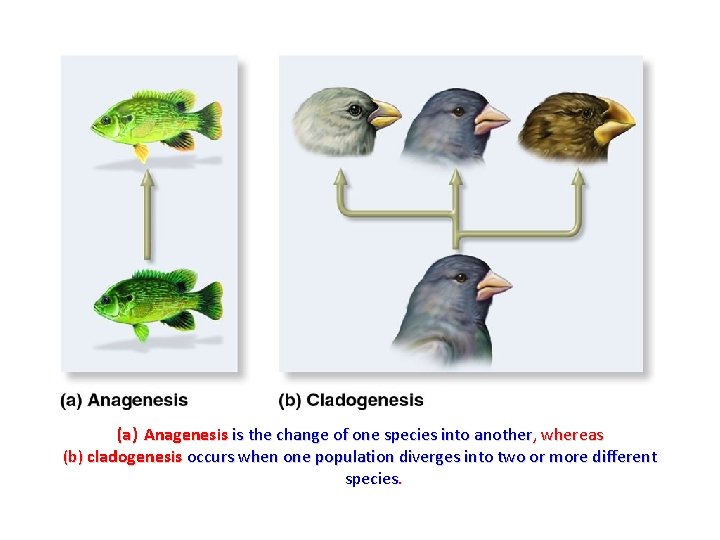
Features of Punctuated Equilibrium • The essential features that make up Punctuated Equilibrium are as follows: • Most speciation is cladogenesis rather than anagenesis; • Most speciation; occurs through peripatric • Large, widespread species don’t change or change slowly; • Daughter species develop in a geographically limited region;
(a) Anagenesis is the change of one species into another, whereas (b) cladogenesis occurs when one population diverges into two or more different species.
• Daughter species develop stratigraphically limited extent; in a • Sampling of the fossil record will reveal a pattern of most species in stasis, with abrupt appearance of new species; • Adaptive change in lineages occurs mostly during periods of speciation; • Trends in adaptation occur through the mechanism of species selection.
• Furthermore, holds that: Punctuated • Evolutionary change speciation events. is Equilibrium connected in • Most species remain pretty much the same once they have come into being. • This lack of substantial change over millions of years is called stasis.
• Speciation events are normally confined to small populations peripheral isolates that have become separated from the bulk of the species. • As these isolated populations are small and transient, we should not expect to find them in the fossil record. • So the absence of the missing links is neatly explained by this theory.
• One of the cornerstones (keystone, basis, foundation) of this hypothesis is that reproductive isolation is necessary for the formation of new species. • This implies that the fossil record at any one place is unlikely to record the process of speciation because new species can evolve only from small, isolated populations. • Therefore, variations will be seen only in fossils of the same age arising from different geographical locations.
• Punctuated equilibrium postulates that genetic and morphological changes that bestow a survival advantage will be amplified quickly in small populations. • The rapid pace of evolution in these isolated groups is also stated as the reason why there is no fossil record of evolution, and new species seem to appear abruptly.
• It also predicts that while intermediates will be rare in the evolution of single species, they will be seen among larger groups. • For example, while, Australopithecus afarensis, is the precursor of modern humans, there are no fossils showing a gradual change in the cranial capacity or body size of the Australopithecus. • However, there are other species such as Homo habilis and Homo erectus that show the transition from Australopithecus towards modern man in terms of cranial capacity and body size.
• Another important feature of this hypothesis is the explanation given for extended periods of stasis. • It implies that the average morphology of a species is under a homogenizing influence. • Interbreeding populations are said to appear static because, in the absence of active selection pressure, any changes are diluted among the large number of individuals.
• A number of explanations have been given for this phenomenon observed in fossil record. • These include the effect of gene flow, assertions that the morphology of a species is under ‘homeostatic’ pressure, and koinophilia or the rejection of mates with unusual attributes.
• Examples of Punctuated Equilibria • Support for punctuated equilibrium is seen in fossil records, and the impact of reproductive isolation has been observed by biologists, systematists and taxonomists across the world. • Given the fact that this is a theory of evolution, its predictions cannot be directly tested.
• While fossil record can provide support for theory, some indications need to arise from the living world. • For example, animals living in similar environments but experiencing reproductive isolation must become incapable of interbreeding, indicating the emergence of a new species.
• Reproductive Isolation among Kingfishers • The study of kingfishers in Papua New Guinea showed the deep impact of reproductive isolation on speciation. • There are three subspecies that reside on the mainland, where the environment can vary wildly from humid, dense rain forest, to monsoon forests with extended dry seasons. • These subspecies can not only interbreed, but are nearly indistinguishable from each other.
• However, on islands a few hundred kilometers away, even when the environment is similar to the nearest part of the mainland, the kingfishers are markedly different. • More species have been found on these smaller islands than in mainland – a landmass spanning nearly 300, 000 square miles. • Similar observations have been made for birds and reptiles and invertebrates across the world, where geographical separation has led to the emergence of new species, while large continuous tracts with varying conditions maintain homogeneous populations.
• Land Snails of Bermuda • About 3 lac years ago, Poecilozonites bermudensis, an air-breathing land snail, colonized the island of Bermuda, possibly carried on driftwood from North America. • The fossils of these snails constitute the large majority of Bermuda’s land fossils and, until recently, one species continued to survive on the island. • The earliest populations of this snail had two stocks, with distinct color banding patterns.
• When these became extinct, a derivative from a peripheral population that was evolving on a separate island became dominant. • Fossil samples taken from six different geological times and from various geographical locations points to the repeated evolution of species from peripherally isolated populations that ultimately led to the formation of the land snail that remained morphologically static till it was observed in the 1950 s.
• Gradualism vs Punctuated Equilibrium • Punctuated equilibrium is often pitted against phyletic gradualism as competing theories of evolution. • Both of these hypothesize about the rate of emergence of species. • Gradualism places importance on the slow appearance of new characters in interbreeding subspecies that, over time, lead to the evolution of a new species from ancestral forms.
• However, this is not supported by fossil data, where new species seem to appear suddenly. • Punctuated equilibrium tries to explain these fossil ‘gaps’ or the absence of intermediate forms, but stating that they exist for very short periods of time, when speciation occurs intensely in an isolated population.
• The criticism of punctuated equilibrium focuses on the possibility that fossil records may simply be incomplete and intermediate forms may still be found in regions where fossils are abundant and well-preserved. • In addition, critics point to the fact that there is no evidence that an external homogenizing influence keeps interbreeding populations in stasis.
• Allopatric speciation – Speciation that occurs after a population splits into two groups that are reproductively isolated from each other. • Koinophilia – Phenomenon where individuals with unusual features are not preferred for sexual reproduction.
• Peripatric speciation – Speciation in a small, isolated, peripheral population. • Phyletic Gradualism – A model that theorizes that speciation is gradual, incremental and slow. • Saltation – Sudden change that occurs over the span of a single generation.