
EvidenceBased Medicine Applying the Concepts to Pediatric Nutrition
Evidence-Based Medicine Applying the Concepts to Pediatric Nutrition Practice and Consultation

What evidence-based medicine is: Evidence-based medicine is the conscientious, explicit and judicious use of current best evidence in making decisions about the care of individual patients. Sacket et al. BMJ 1996
What evidence-based medicine is: The practice of EBM requires the integration of l individual clinical expertise with the l best available external clinical evidence from systematic research.
Evidence Based Medicine is Not: Cook-book medicine l Cost cutting medicine l Restricted to randomized trials and meta -analysis l
“If no randomized trials have been carried out for our patient’s predicament, we follow the trail to the next best external evidence and go from there. ” Sacket et al. BMJ 1996
Why EBM? Clinicians need information l If asked: l » we need it twice a week, » we get it from our text books & journals.
Clinicians really need information! If shadowed: l they need it up to 60 times per week but only 30% of it l and that comes from passers-by » “my textbooks are out of date” » “my journals too disorganized”
Medical textbooks are out-of-date l Fail to recommend Rx up to ten years after it’s been shown to be efficacious. l Continue to recommend therapy up to ten years after it’s been shown to be useless.
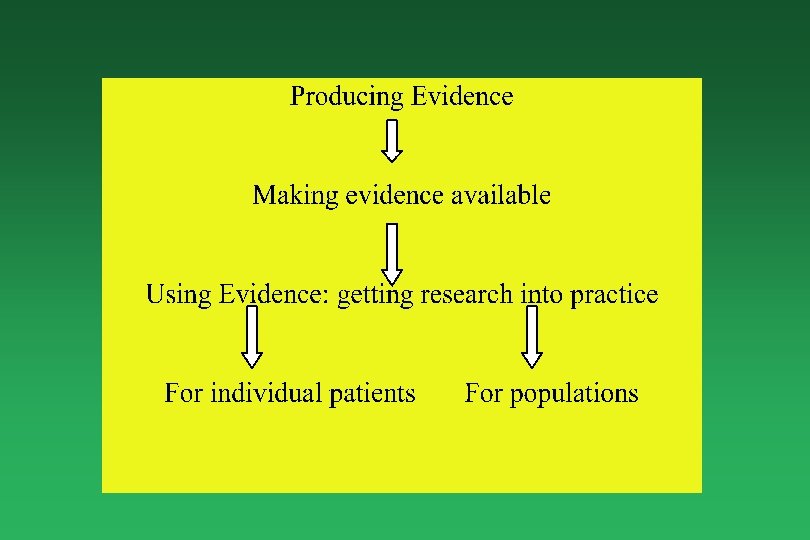
Three solutions Clinical performance can keep up to date: 1 by learning how to practice evidencebased medicine ourselves. 2 by seeking and applying evidence-based medical summaries generated by others. 3 by accepting evidence-based practice protocols developed by our colleagues.
Process of EBM ¬ Define the question Plan and carry out search of the literature ® Critically appraise the literature ¯ Apply the results to your practice ° Evaluate your performance
Step 1: Define Question P - Patient and disease I - Intervention C - Comparative intervention (optional) O - Outcome

Step 2: Search for Evidence Translate PICO Question into a searchable question l Establish a search strategy l » key concepts » boolean operators » synonyms » prioritize » limit

Step 2: Search for Evidence

Step 3: Critically Appraise l http: //healthlinks. washington. edu/help/evidence/
Step 4: Apply Results l Within context of individual patient preferences, values and rights

Evidence, Values, and Resources Values Evidence Resources

The Strength of the Evidence Depends on Study Design
Randomized Controlled Clinical Trial Involves one or more test treatments and a control treatment l Specified outcome measures for evaluating the intervention l Bias free method for assigning treatment l
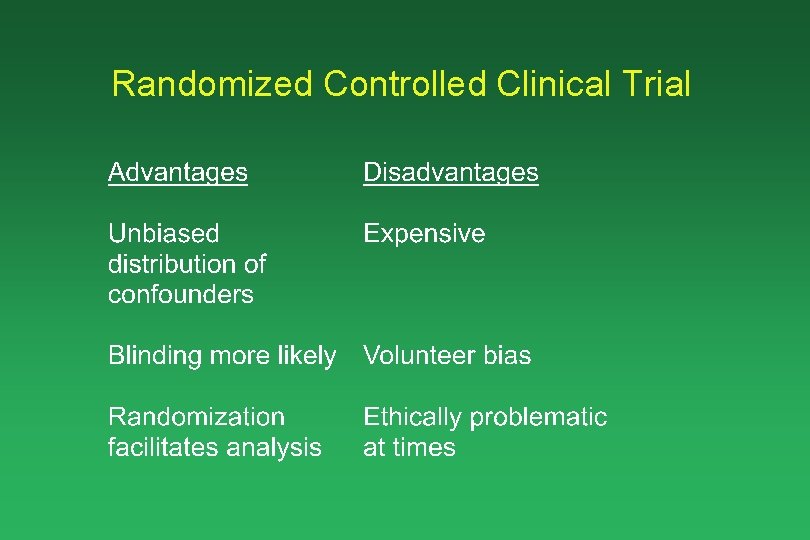
Randomized Controlled Clinical Trial

Confounding Variable “An extrinsic factor that is associated with the predictor variable and a cause of the outcome variable. ” Hulley and Cummings, Designing Clinical Research
Cohort Study l Identification of two groups » one received exposure of interest » one did not receive exposure l Follow cohort through time to observe the outcome of interest
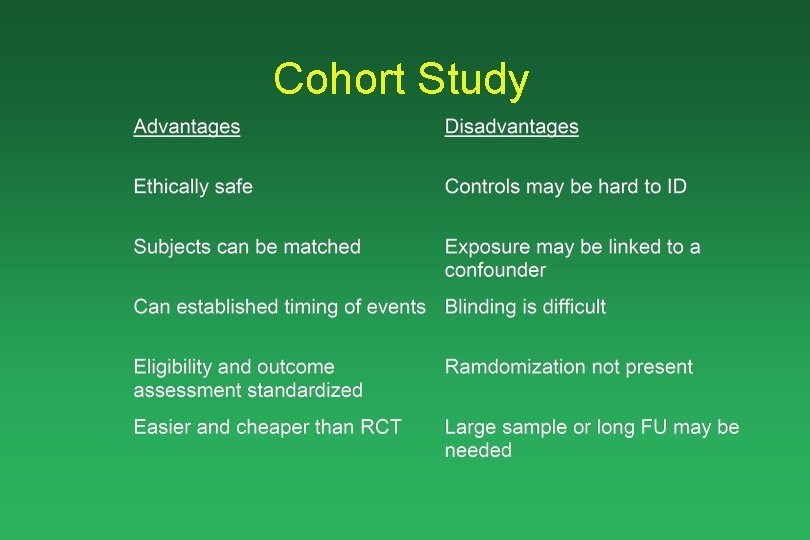
Cohort Study
Case-control Study Identify patients who have the outcome of interest (cases) l Identify controls without the same outcome l Look back to see if they had the exposure of interest l
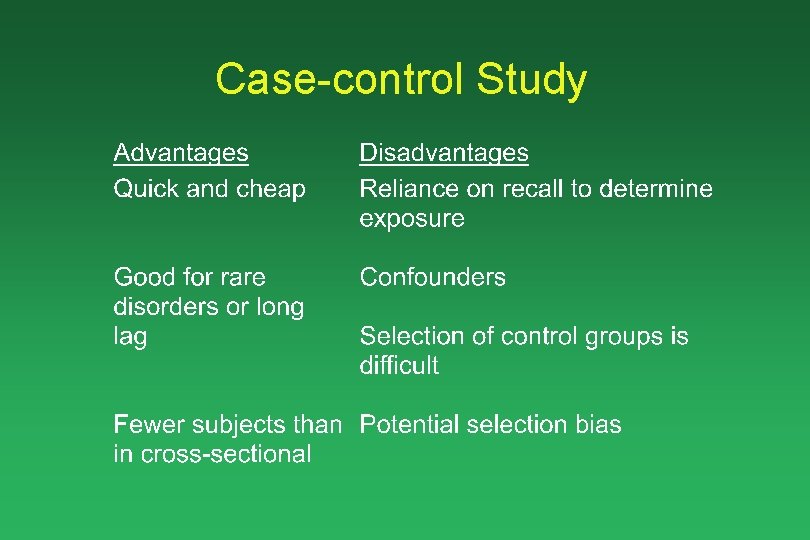
Case-control Study
Cross Sectional Study Observation of a defined population at a single point in time or time interval l Exposures and outcomes determined at same time l
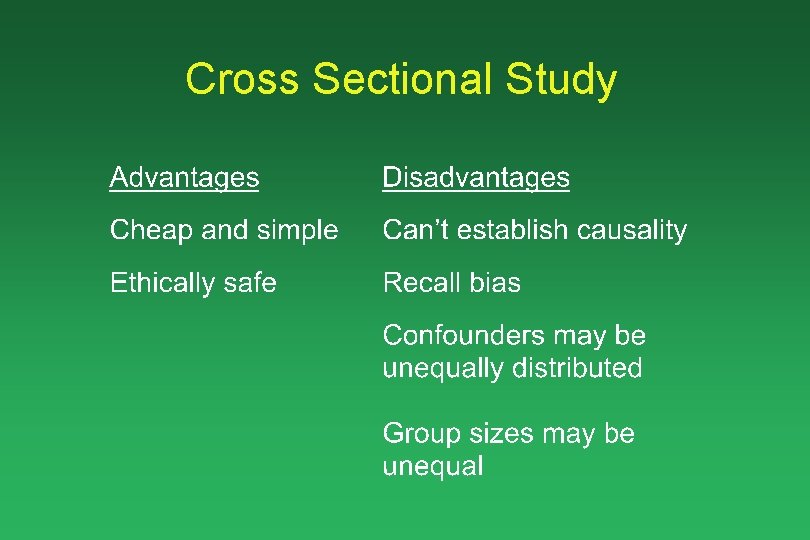
Cross Sectional Study
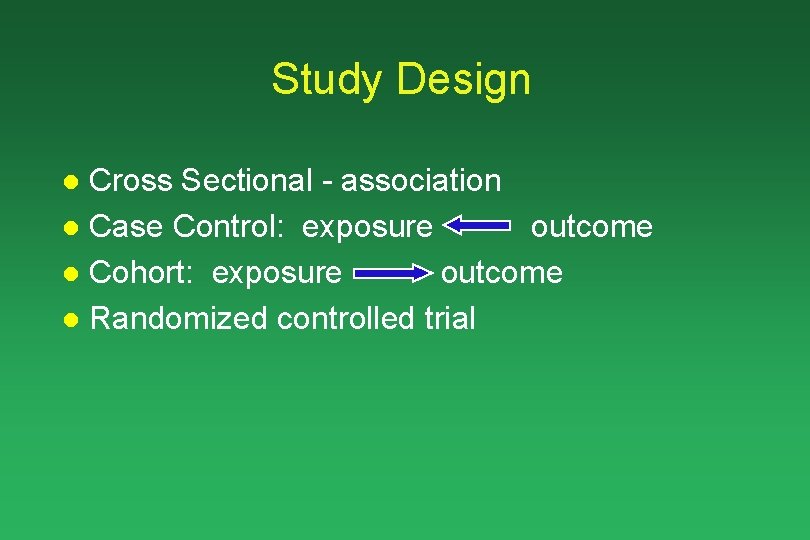
Study Design Cross Sectional - association l Case Control: exposure outcome l Cohort: exposure outcome l Randomized controlled trial l

Meta-analysis Quantitative method of combining the results of independent studies l synthesizing summaries and conclusions l
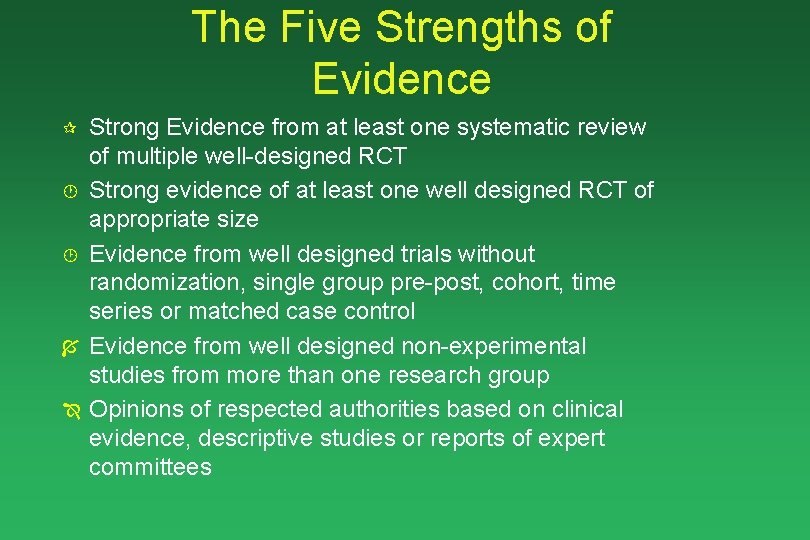
The Five Strengths of Evidence ¶ · ¸ Í Î Strong Evidence from at least one systematic review of multiple well-designed RCT Strong evidence of at least one well designed RCT of appropriate size Evidence from well designed trials without randomization, single group pre-post, cohort, time series or matched case control Evidence from well designed non-experimental studies from more than one research group Opinions of respected authorities based on clinical evidence, descriptive studies or reports of expert committees
Barriers and Bridges Haynes and Haines, BMJ 1998 “Preliminary studies far outnumber definitive ones, and all compete in the medical literature for the attention of readers. ” l “Models for critically appraising evidence have been developed, but applying these is time consuming. ” l
EBM Review: Example A Systematic review of nonpharmacological and nonsurgical therapies for gastroesphageal reflux in infants. Carroll et al. Arch Ped Adol Med. Feb 2002; 156: 109.
Step 1: Define Question P - Patient and disease I - Intervention C - Comparative intervention (optional) O - Outcome
P: Patient and Disease Patient = infants Disease = GERD
I. Intervention (s) Placement upright in an infant seat Elevating the Head Pacifier Use Thickening food with rice flour Thickening food with carob bean gum preparation Changing composition of Formula Changing caloric density or osmolality
C. Comparative Intervention Carob bean gum compared to rice flour
O. Outcome “Effect on reflux” Included: » reflux duration (p. H probe) » reflux frequency (p. H probe) » clinical score » emesis
Search for Evidence Medline, EMBASE, Cochrane, others l search terms: gastroesophageal reflux disease and infants (>2500 articles) l excluded: non-clinical trials, drug or surgical therapy included, study included infants with compound medical problems/prematurity l 10 RCT met selection criteria l
Critically appraise the literature Example: Thickening with rice flour/cereal - 2 studies l Study one: 52 infants randomly received apple juice or apple juice with rice flour, placed in one of 4 positions, monitored with p. H probe for 2 hours. No differences except that more reflux with 30 o elevation and rice flour.
l Study 2. 20 infants with paired feeding crossover design given formula with and without rice cereal thickening and monitored via technetium scintigraphy. No differences on reflux, but decrease in frank emesis.
Apply results “Many conservative measures commonly used to treat GERD in infants have no proven efficacy. ”
Medline http: //www. ncbi. nlm. nih. gov/entrez/query. fcgi? db=Pub. Med l Under “Limits” can select: l » Review » Meta-analysis » Practice Guidelines » Randomized Controlled trial

Cochran Database of Systematic Reviews http: //www. cochranelibrary. com/enter Can search and review abstracts for free l Full text requires subscription l

National Guidelines Clearing House l http: //www. guideline. gov/
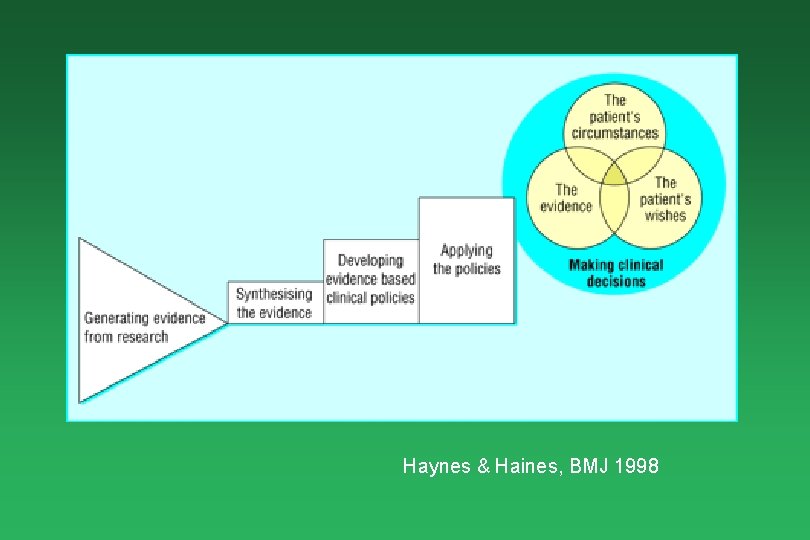
Haynes & Haines, BMJ 1998
- Slides: 45