
EvidenceBased Design Career Pathways Advanced Online and TechnologyEnabled
Evidence-Based Design Career Pathways Advanced Online and Technology-Enabled Learning Strategic Alignment with Workforce Systems Career Coaching: Impact, Effectiveness, and Sustainability Alignment with TAACCCT 1 -3 Outcomes Presented to the Luzerne County Community College Leadership Team Meeting 28 November 2017 Sector Strategies and Employer Engagement 1
• Introduction • The How and the Why of Career Coaching • Participant Satisfaction • The Role of Persistence • Sustainability: Two Thought Experiments 2 2
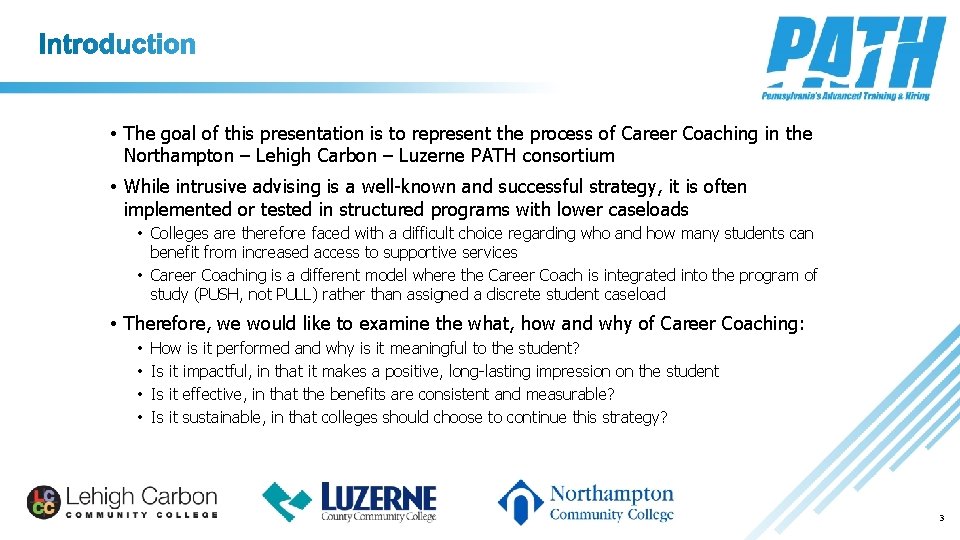
• The goal of this presentation is to represent the process of Career Coaching in the Northampton – Lehigh Carbon – Luzerne PATH consortium • While intrusive advising is a well-known and successful strategy, it is often implemented or tested in structured programs with lower caseloads • Colleges are therefore faced with a difficult choice regarding who and how many students can benefit from increased access to supportive services • Career Coaching is a different model where the Career Coach is integrated into the program of study (PUSH, not PULL) rather than assigned a discrete student caseload • Therefore, we would like to examine the what, how and why of Career Coaching: • • 3 How is it performed and why is it meaningful to the student? Is it impactful, in that it makes a positive, long-lasting impression on the student Is it effective, in that the benefits are consistent and measurable? Is it sustainable, in that colleges should choose to continue this strategy? 3
• Introduction • The How and the Why of Career Coaching • Participant Satisfaction • The Role of Persistence • Sustainability: Two Thought Experiments 4 4
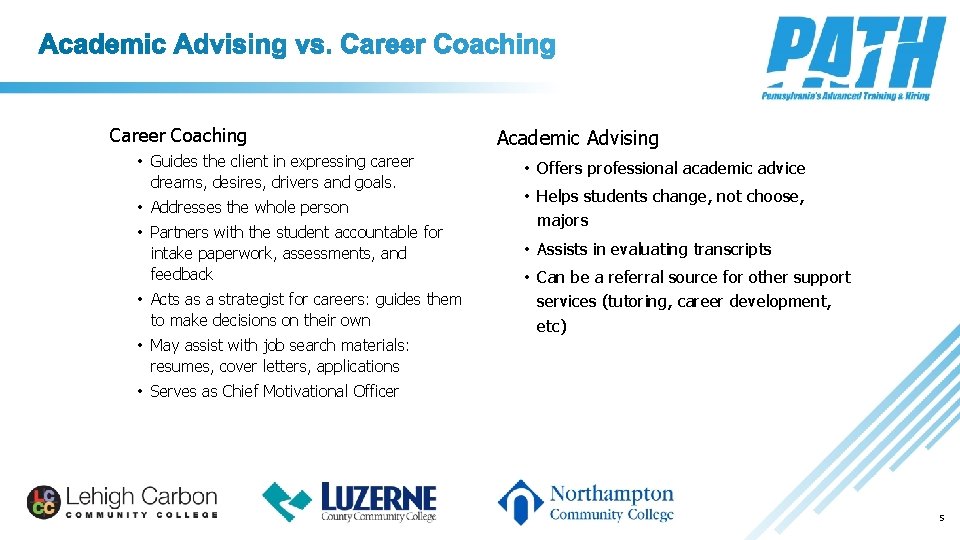
Career Coaching • Guides the client in expressing career dreams, desires, drivers and goals. • Addresses the whole person • Partners with the student accountable for intake paperwork, assessments, and feedback • Acts as a strategist for careers: guides them to make decisions on their own • May assist with job search materials: resumes, cover letters, applications Academic Advising • Offers professional academic advice • Helps students change, not choose, majors • Assists in evaluating transcripts • Can be a referral source for other support services (tutoring, career development, etc) • Serves as Chief Motivational Officer 5 5

• Introduction • The How and the Why of Career Coaching • Participant Satisfaction • The Role of Persistence • Sustainability: Two Thought Experiments 6 6
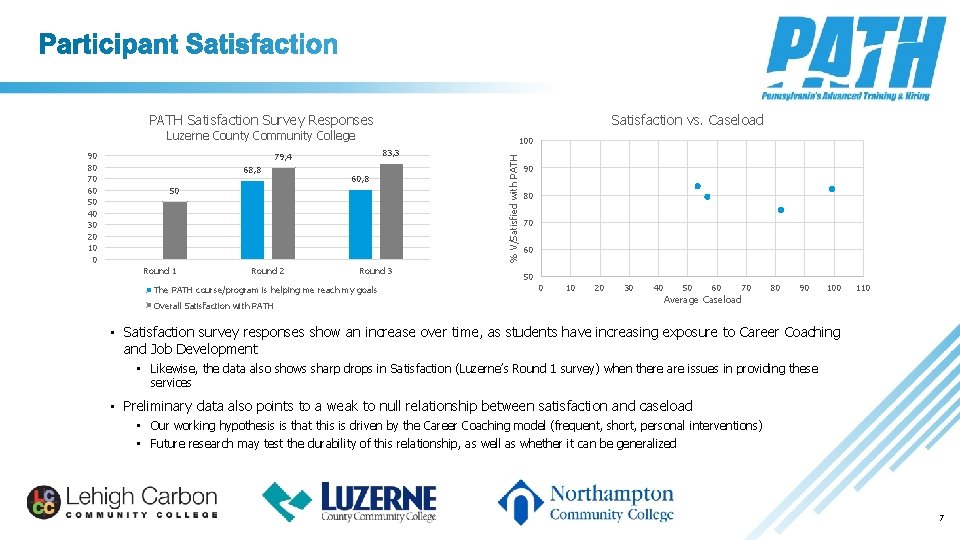
Satisfaction vs. Caseload PATH Satisfaction Survey Responses Luzerne County Community College 100 83, 3 79, 4 68, 8 60, 8 50 Round 1 Round 2 Round 3 The PATH course/program is helping me reach my goals Overall Satisfaction with PATH % V/Satisfied with PATH 90 80 70 60 50 40 30 20 10 0 90 80 70 60 50 0 10 20 30 40 50 60 70 Average Caseload 80 90 100 110 • Satisfaction survey responses show an increase over time, as students have increasing exposure to Career Coaching and Job Development • Likewise, the data also shows sharp drops in Satisfaction (Luzerne’s Round 1 survey) when there are issues in providing these services • Preliminary data also points to a weak to null relationship between satisfaction and caseload • Our working hypothesis is that this is driven by the Career Coaching model (frequent, short, personal interventions) • Future research may test the durability of this relationship, as well as whether it can be generalized 7 7
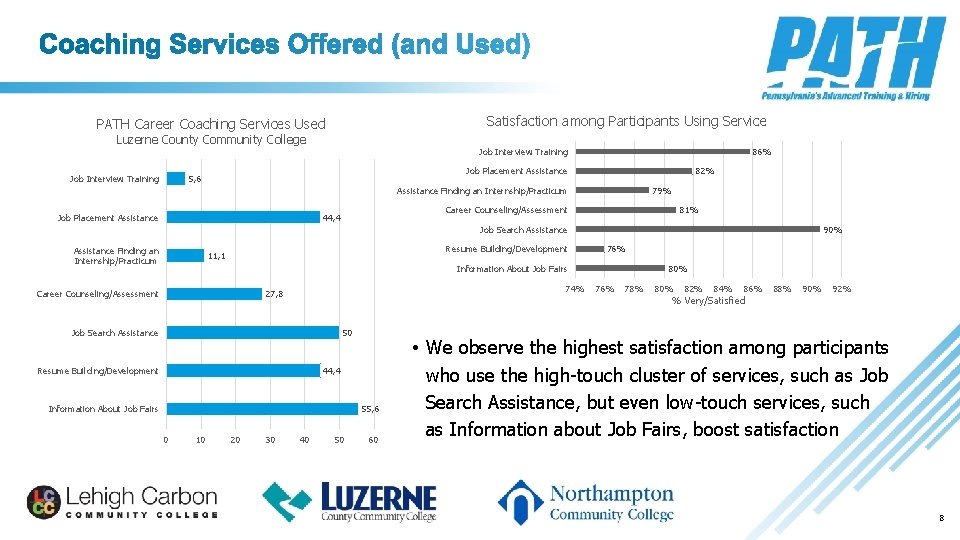
Satisfaction among Participants Using Service PATH Career Coaching Services Used Luzerne County Community College Job Interview Training 86% Job Interview Training Job Placement Assistance 5, 6 82% Assistance Finding an Internship/Practicum Job Placement Assistance 79% 81% Career Counseling/Assessment 44, 4 Job Search Assistance Finding an Internship/Practicum Resume Building/Development 11, 1 76% Information About Job Fairs Career Counseling/Assessment 74% 27, 8 Job Search Assistance 50 Resume Building/Development 44, 4 Information About Job Fairs 55, 6 0 8 90% 10 20 30 40 50 60 80% 76% 78% 80% 82% 84% 86% % Very/Satisfied 88% 90% 92% • We observe the highest satisfaction among participants who use the high-touch cluster of services, such as Job Search Assistance, but even low-touch services, such as Information about Job Fairs, boost satisfaction 8
• Introduction • The How and the Why of Career Coaching • Participant Satisfaction • The Role of Persistence • Sustainability: Two Thought Experiments 9 9
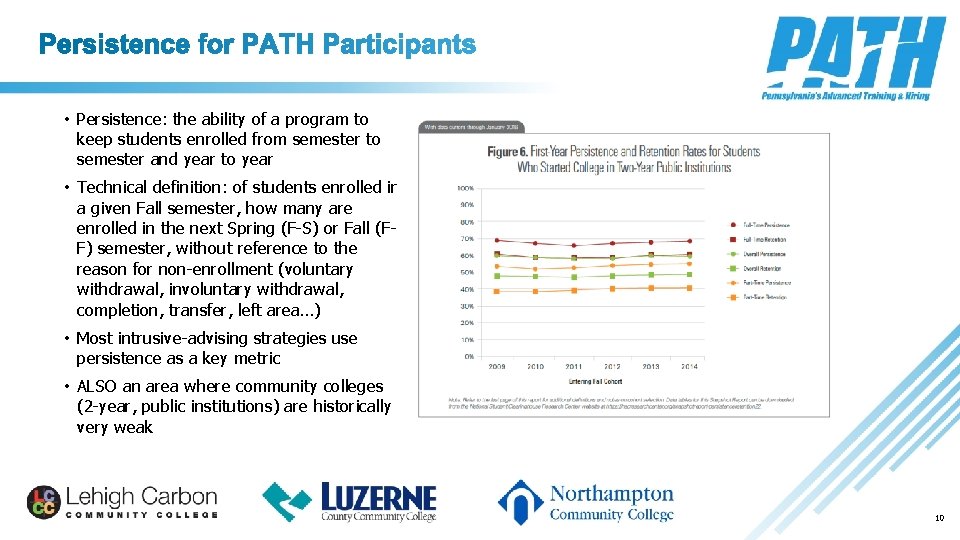
• Persistence: the ability of a program to keep students enrolled from semester to semester and year to year • Technical definition: of students enrolled in a given Fall semester, how many are enrolled in the next Spring (F-S) or Fall (FF) semester, without reference to the reason for non-enrollment (voluntary withdrawal, involuntary withdrawal, completion, transfer, left area…) • Most intrusive-advising strategies use persistence as a key metric • ALSO an area where community colleges (2 -year, public institutions) are historically very weak 10 10
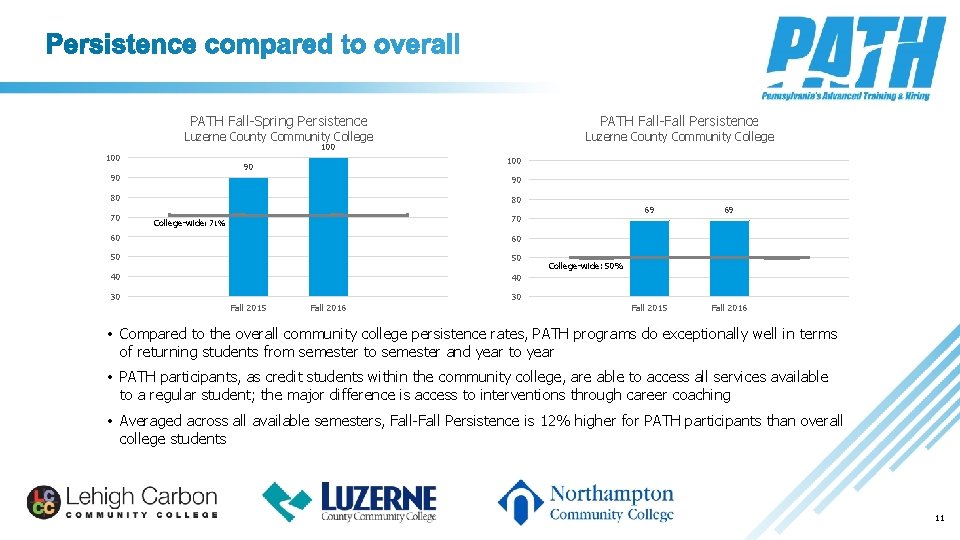
PATH Fall-Spring Persistence PATH Fall-Fall Persistence Luzerne County Community College 100 100 90 90 90 80 80 70 70 College-wide: 71% 60 60 50 50 40 40 30 69 69 Fall 2015 Fall 2016 College-wide: 50% 30 Fall 2015 Fall 2016 • Compared to the overall community college persistence rates, PATH programs do exceptionally well in terms of returning students from semester to semester and year to year • PATH participants, as credit students within the community college, are able to access all services available to a regular student; the major difference is access to interventions through career coaching • Averaged across all available semesters, Fall-Fall Persistence is 12% higher for PATH participants than overall college students 11 11
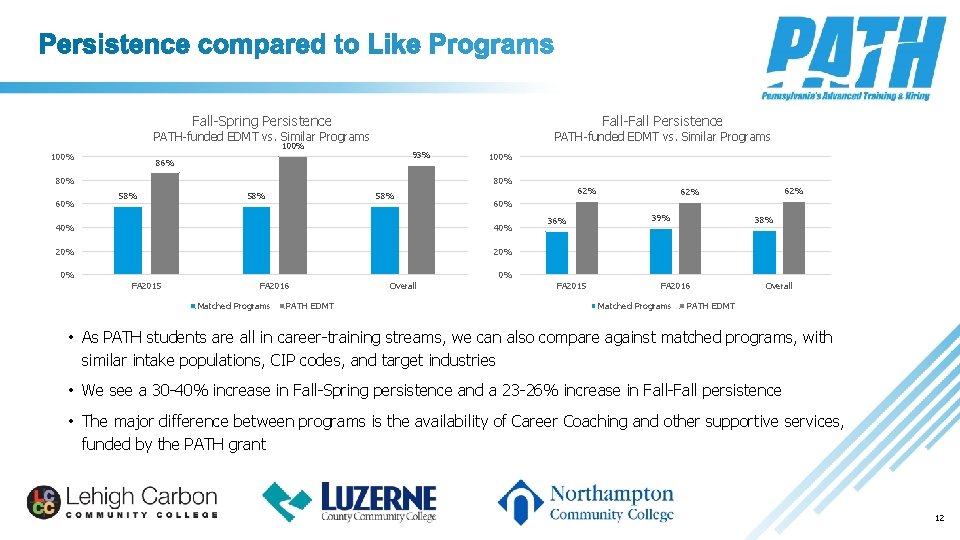
Fall-Spring Persistence Fall-Fall Persistence PATH-funded EDMT vs. Similar Programs 100% 93% 86% 80% 60% 100% 80% 58% 58% 40% 20% 0% 62% 62% 60% 36% 39% 38% 0% FA 2015 FA 2016 Matched Programs PATH EDMT Overall FA 2015 FA 2016 Matched Programs Overall PATH EDMT • As PATH students are all in career-training streams, we can also compare against matched programs, with similar intake populations, CIP codes, and target industries • We see a 30 -40% increase in Fall-Spring persistence and a 23 -26% increase in Fall-Fall persistence • The major difference between programs is the availability of Career Coaching and other supportive services, funded by the PATH grant 12 12
• Introduction • The How and the Why of Career Coaching • Participant Satisfaction • The Role of Persistence • Sustainability: Two Thought Experiments 13 13
• While career coaching has a positive impact on student success metrics, that does not make it sustainable • What could make it sustainable? • It could be part of the expected standard of education • It could be funded by a third party over the long term • It could be the best use of scarce funds • What could make it difficult to replicate? 14 14
• Career Coaching improves Persistence • If a community college is less than fully subscribed, a student that persists is a student that doesn’t have to be recruited • If a community college’s operating catchment is aging or shrinking, improving persistence can be a way to keep the doors open when additional recruitment is no longer feasible • Two thought experiments • Persistence as an alternative to marketing budgets • Persistence as a mechanism to increase tuition revenue 15 15
• As an experiment, let’s consider the impact of enhancing persistence rather than recruiting/recapturing • Assume that the incremental cost to recruit a single student is roughly the marketing budget divided by the number of new students in the following year • Assume that improved persistence over baseline can be directly attributed to the career coach • Therefore, the value of a career coach in marketing terms is the cost to recruit one student, times the number of additional students that we expect to re-enroll • Can a career coach pay for themselves? 16 16
• Working out the benefits using PATH numbers • Marketing budget per new enrollment: range from $277 to $319 per new enrollment, and a mean of $298 • Increase in persistence: range from 20% to 40% • Average PATH Career Coach Caseload: range from 15 to 117 students and a mean of 61 • Marketing-dollar value added per PATH Career Coach: between $3400 and $7800 per year, using the mean caseload, and a high of $15000 using the maximum PATH caseload • This omits all other potential sources of value, such as increased tuition paid, as well as desirable non-dollar attributes, such as increased completion, increased satisfaction, improved enrollment numbers or ability to balance enrollment over the business cycle, support of strategic programs, and so on… 17 17
• As an experiment, let’s consider the impact on tuition income from improved persistence • As in the case before, we assume that improved persistence over baseline can be directly attributed to the career coach • We also assume that faculty costs are variable, but all other budgeted costs are fixed. • Therefore, the budget value of one incremental student is the difference between tuition paid and their share of faculty salaries (total salary divided by student FTE’s) • In this thought experiment, the value of a career coach is the income derived from tuition, less the cost of faculty time to offer those courses, times the number of additional students we expect to re-enroll 18 18
• To close, we can see that the community college benefits from career coaching in at least three distinct ways • Improvements in the financial picture, through increased tuition income and savings in marketing income • Improvements in the performance picture, through improved KPIs in student persistence and completion • Improvements in the satisfaction picture, through improved Overall Satisfaction and Would. Recommend satisfaction metrics 19 19
20 20
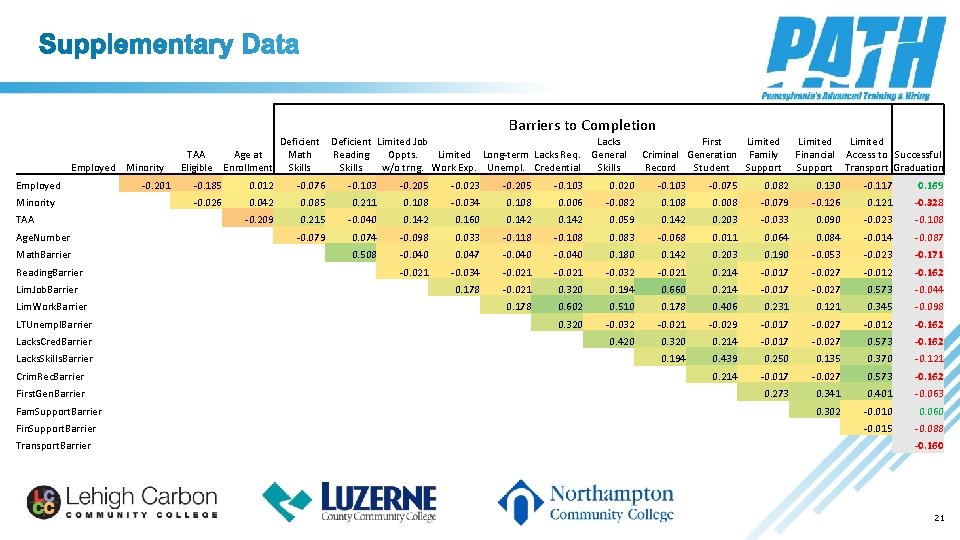
Employed Minority TAA Age. Number Math. Barrier Reading. Barrier Lim. Job. Barrier Lim. Work. Barrier LTUnempl. Barrier Lacks. Cred. Barrier Lacks. Skills. Barrier Crim. Rec. Barrier First. Gen. Barrier Fam. Support. Barrier Fin. Support. Barrier Transport. Barrier 21 -0. 201 TAA Age at Eligible Enrollment Deficient Math Skills Barriers to Completion Deficient Limited Job Lacks Reading Oppts. Limited Long-term Lacks Req. General Skills w/o trng. Work Exp. Unempl. Credential Skills First Limited Criminal Generation Family Record Student Support Limited Financial Access to Successful Support Transport Graduation -0. 185 0. 012 -0. 076 -0. 103 -0. 205 -0. 023 -0. 205 -0. 103 0. 020 -0. 103 -0. 075 0. 082 0. 130 -0. 117 0. 169 -0. 026 0. 042 0. 085 0. 211 0. 108 -0. 034 0. 108 0. 006 -0. 082 0. 108 0. 008 -0. 079 -0. 126 0. 121 -0. 328 -0. 209 0. 215 -0. 040 0. 142 0. 160 0. 142 0. 059 0. 142 0. 203 -0. 033 0. 090 -0. 023 -0. 108 -0. 079 0. 074 -0. 098 0. 033 -0. 118 -0. 108 0. 083 -0. 068 0. 011 0. 064 0. 084 -0. 014 -0. 087 0. 508 -0. 040 0. 047 -0. 040 0. 180 0. 142 0. 203 0. 190 -0. 053 -0. 023 -0. 171 -0. 021 -0. 034 -0. 021 -0. 032 -0. 021 0. 214 -0. 017 -0. 027 -0. 012 -0. 162 0. 178 -0. 021 0. 320 0. 194 0. 660 0. 214 -0. 017 -0. 027 0. 573 -0. 044 0. 178 0. 602 0. 510 0. 178 0. 406 0. 231 0. 121 0. 345 -0. 098 0. 320 -0. 032 -0. 021 -0. 029 -0. 017 -0. 027 -0. 012 -0. 162 0. 420 0. 320 0. 214 -0. 017 -0. 027 0. 573 -0. 162 0. 194 0. 439 0. 250 0. 135 0. 370 -0. 121 0. 214 -0. 017 -0. 027 0. 573 -0. 162 0. 273 0. 341 0. 401 -0. 063 0. 302 -0. 010 0. 060 -0. 015 -0. 088 -0. 160 21
22 22
- Slides: 22