
Evidence of Teaching Evidence refers to artifacts actions
- Slides: 8
Evidence of Teaching • Evidence refers to artifacts, actions or statements, and decisions made by the teacher • Evidence is used as the foundation of the judgment of teaching • Evidence comes in many forms and is determined by your school district
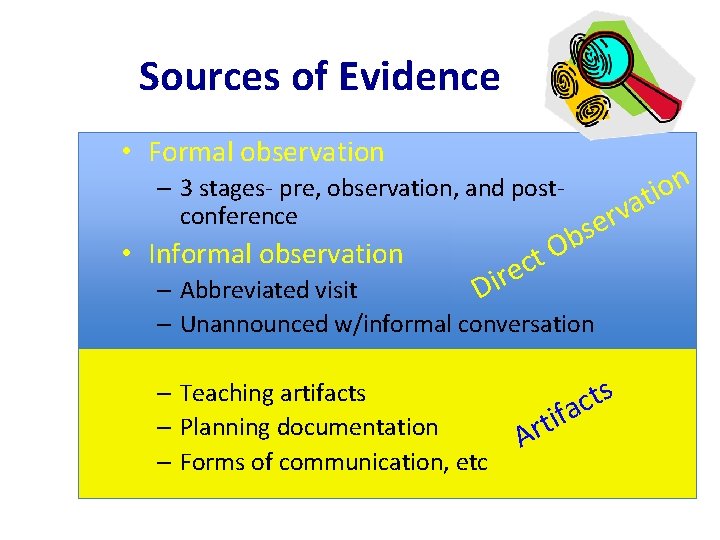
Sources of Evidence • Formal observation – 3 stages- pre, observation, and postconference • Informal observation v r e bs O t ec r i – Abbreviated visit D – Unannounced w/informal conversation – Teaching artifacts – Planning documentation – Forms of communication, etc s t c ifa t r A n o i at
Evidence of Student Learning • Framework explains what teachers can doinput • Indirect evidence is also considered important to judge student learningoutput – Results of state-mandated tests – Student and parent surveys – Teaching artifacts- units, lessons, assessments, communications to parents, etc.
Formal Observation • Pre-conference or “planning conference” – Teacher interview – Review of documents – Discussion of procedure/process • Observation – Gathering of evidence • Post-conference or “reflection conference” – Teacher lesson reflection – Discussion w/teacher
Preconference • Purpose- chance for the teacher to discuss their planning process/skills • Things to consider – Give teachers questions in advance to review – Have teachers bring copies of written materials for lesson – Review the teacher’s lesson prior to the conference • Seen as core part of evaluating Domain 1
Classroom Observation • Focuses on Domains 2 & 3 • One observation may not capture every componentover time a teacher should demonstrate them all** • Observer should – Focus on evidence/facts and avoid interpretation or opinion (adj/adv. ) – Be familiar w/components so they are recognized during lesson – Note what teacher says/does as well as questions, statements, actions (verbal/non verbal) • Recommended to give teacher notes after visit- helps w/transparency
Preparing for the post-conference • Write a brief summary (few paragraphs) recording major events of lesson based on formal observation notes such that a non-observer would get sense of what was observed • Match observation notes to the components within each of the domains & write samples of evidence observed down • Highlight words/phrases within levels of performance that best characterize the lesson
Post-Observation Conference or “Reflection Conference” • Conversation designed to promote teacher thinking and growth • Provides perspective on Domain 4 • Encouraged to have the teacher self-assess in preparation for this conference • Chance to “compare notes” and identify strengths/areas for improvement • Discussion should include a written summary that captures views of both parties