
Evidence of our behavioural health potential Peckham Experiment
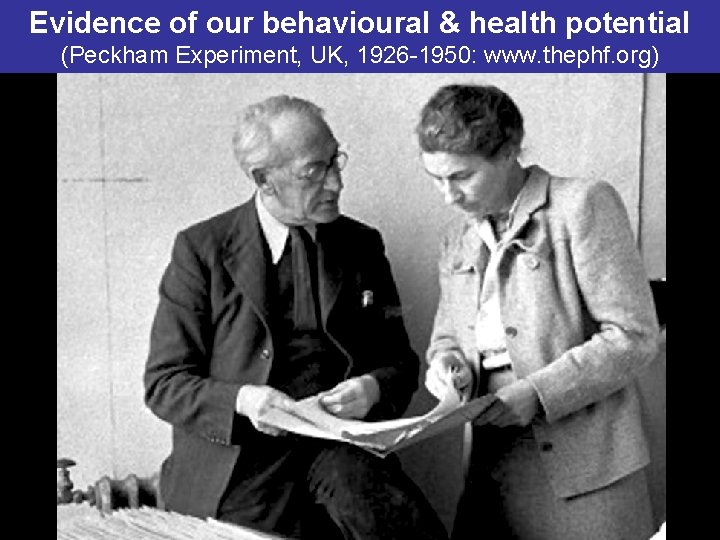
Evidence of our behavioural & health potential (Peckham Experiment, UK, 1926 -1950: www. thephf. org)
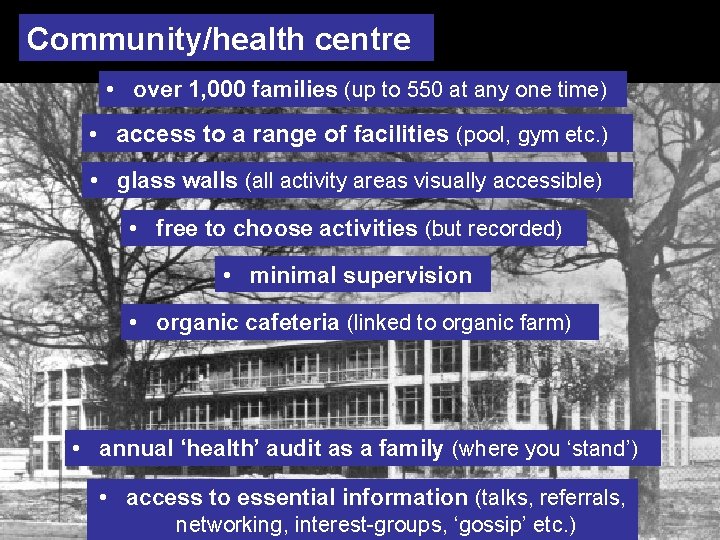
Community/health centre • over 1, 000 families (up to 550 at any one time) • access to a range of facilities (pool, gym etc. ) • glass walls (all activity areas visually accessible) • free to choose activities (but recorded) • minimal supervision • organic cafeteria (linked to organic farm) • annual ‘health’ audit as a family (where you ‘stand’) • access to essential information (talks, referrals, networking, interest-groups, ‘gossip’ etc. )

Peckham Experiment (cont. ) • initial 6 - to 18 -month period of relative chaos (a necessary pre-requisite & recurring stage) • switch from living ‘reactively’ (from the outside-in) to ‘proactively’ (from the inside-out)
![Peckham Experiment (cont. ) Subsequent 12 years (4 years pre-WWII, WWII [closed], & 4](http://slidetodoc.com/presentation_image_h2/955b2323a67ba18c9404c793b0dcbc16/image-4.jpg "Peckham Experiment (cont. ) Subsequent 12 years (4 years pre-WWII, WWII [closed], & 4")
Peckham Experiment (cont. ) Subsequent 12 years (4 years pre-WWII, WWII [closed], & 4 years after): • no marriage breakdowns • no bullying & only one accident • low interest in competitive games • high-level collaboration & joint projects • high skill acquisition • improved health & wellbeing • increased creativity
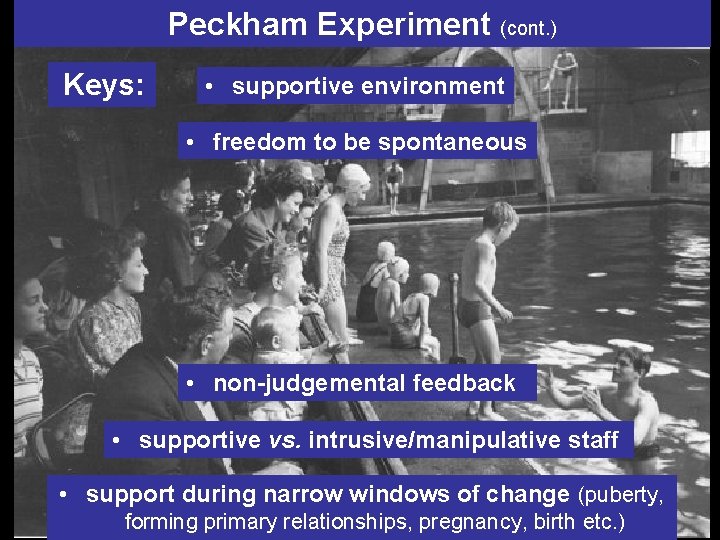
Peckham Experiment (cont. ) Keys: • supportive environment • freedom to be spontaneous • non-judgemental feedback • supportive vs. intrusive/manipulative staff • support during narrow windows of change (puberty, forming primary relationships, pregnancy, birth etc. )

Peckham Experiment (cont. ) Health: (a process) • contagious • spontaneity • facility for mutual synthesis with others & environment http: //www. thephf. org Stallibrass, A. 1989. Being Me and Also Us: Lessons from the Peckham Experiment. Scottish Academic Press, Edinburgh. 275 pp.
- Slides: 6