
Evidence of Evolution by Natural Selection Chapter 22
Evidence of Evolution by Natural Selection Chapter 22. 3
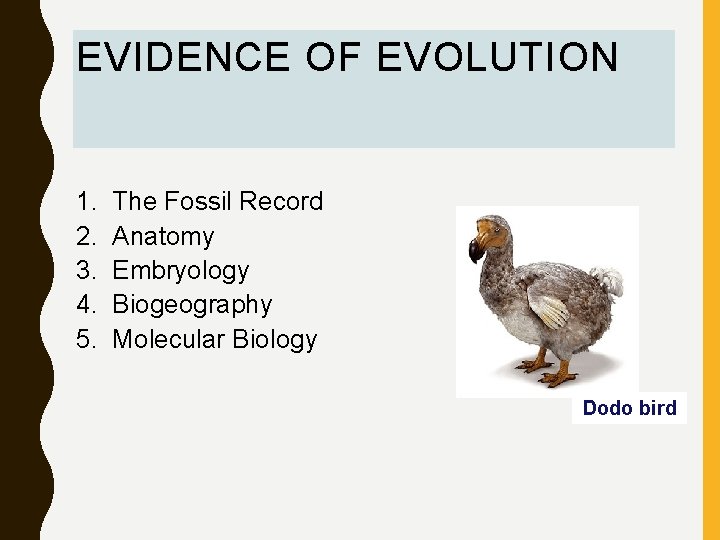
EVIDENCE OF EVOLUTION 1. 2. 3. 4. 5. The Fossil Record Anatomy Embryology Biogeography Molecular Biology Dodo bird
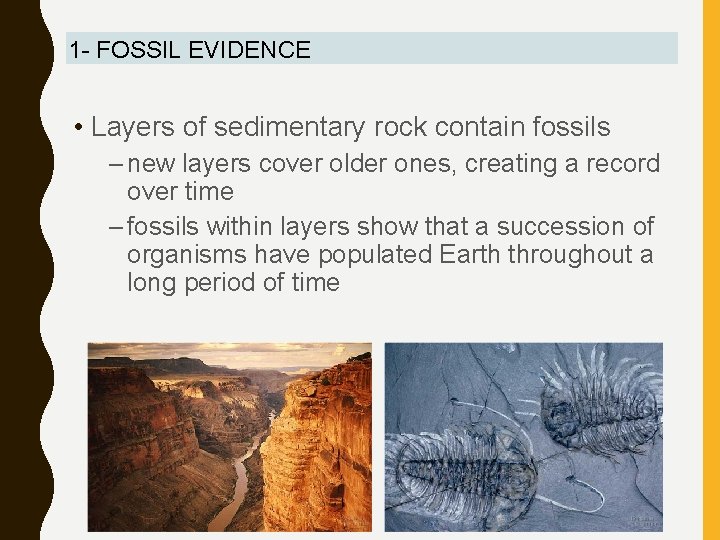
1 - FOSSIL EVIDENCE • Layers of sedimentary rock contain fossils – new layers cover older ones, creating a record over time – fossils within layers show that a succession of organisms have populated Earth throughout a long period of time
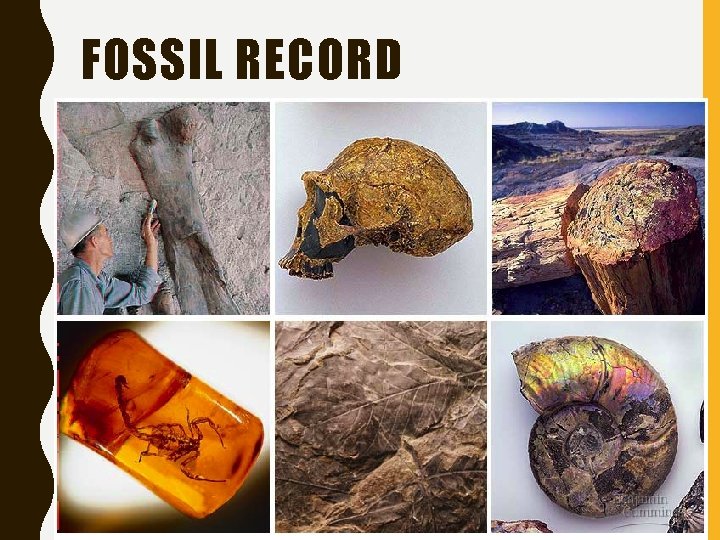
FOSSIL RECORD
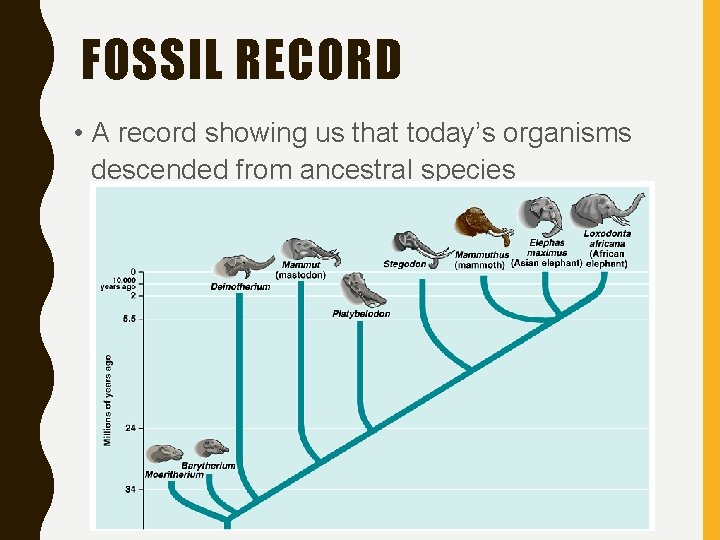
FOSSIL RECORD • A record showing us that today’s organisms descended from ancestral species
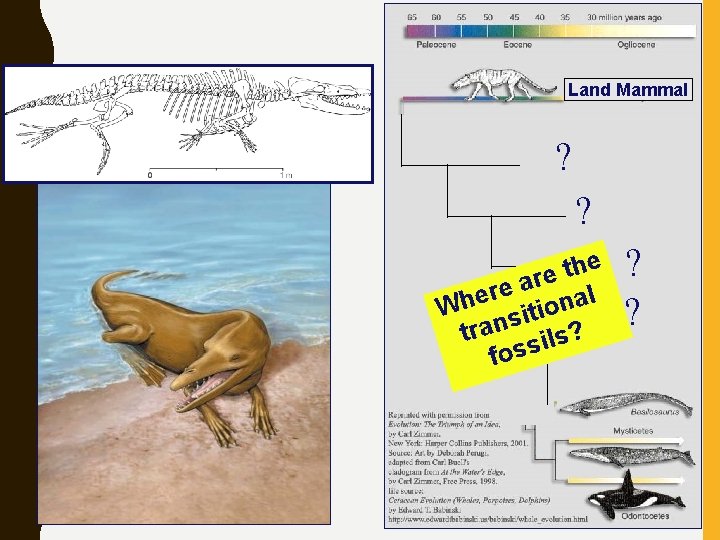
Land Mammal ? ? e h t re a e r l e a h n W io t i s tran sils? fos ? ?
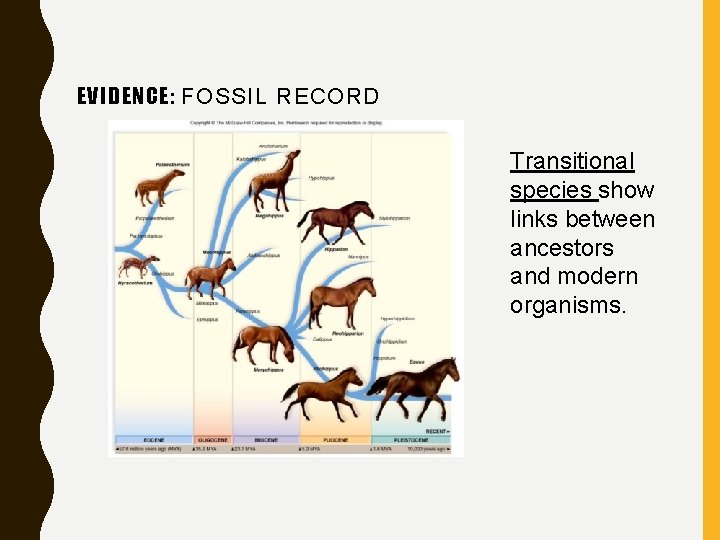
EVIDENCE: FOSSIL RECORD Transitional species show links between ancestors and modern organisms.
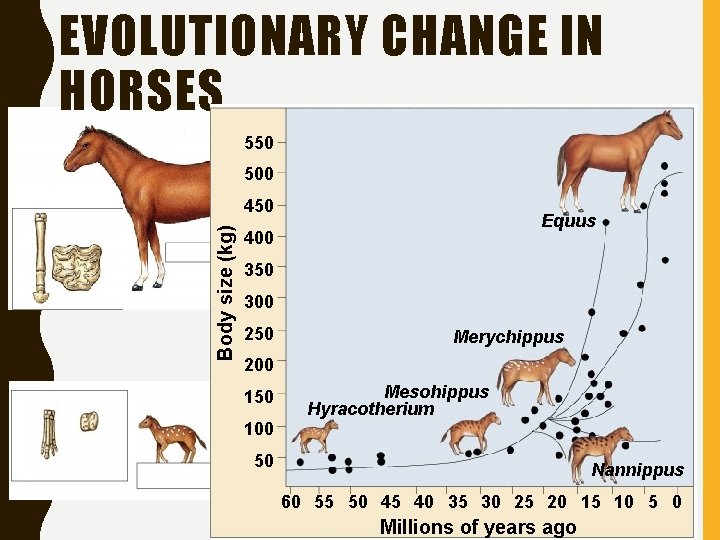
EVOLUTIONARY CHANGE IN HORSES 550 500 Body size (kg) 450 Equus 400 350 300 250 Merychippus 200 150 100 Mesohippus Hyracotherium 50 Nannippus 60 55 50 45 40 35 30 25 20 15 10 5 0 Millions of years ago
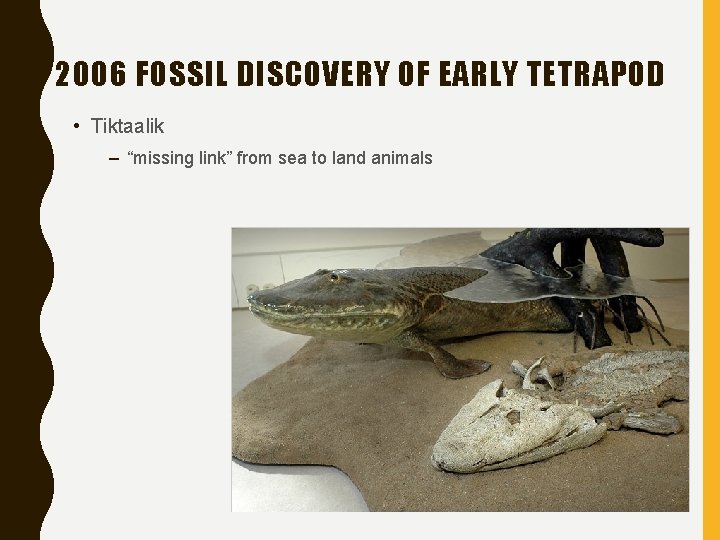
2006 FOSSIL DISCOVERY OF EARLY TETRAPOD • Tiktaalik – “missing link” from sea to land animals
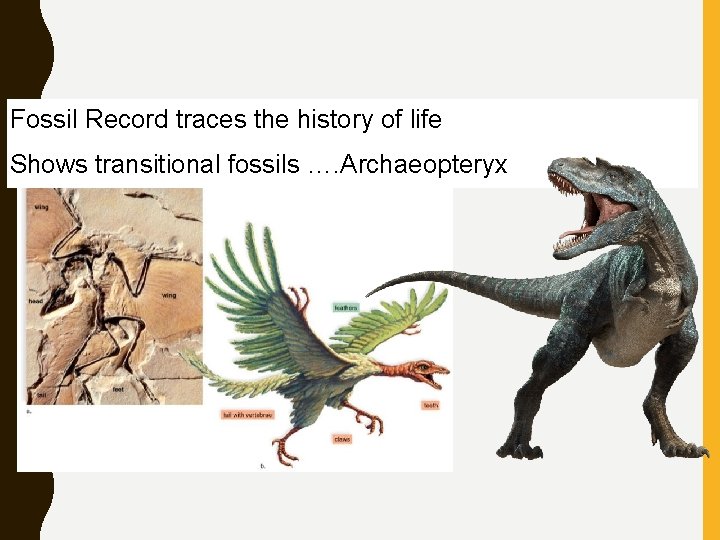
Fossil Record traces the history of life Shows transitional fossils …. Archaeopteryx
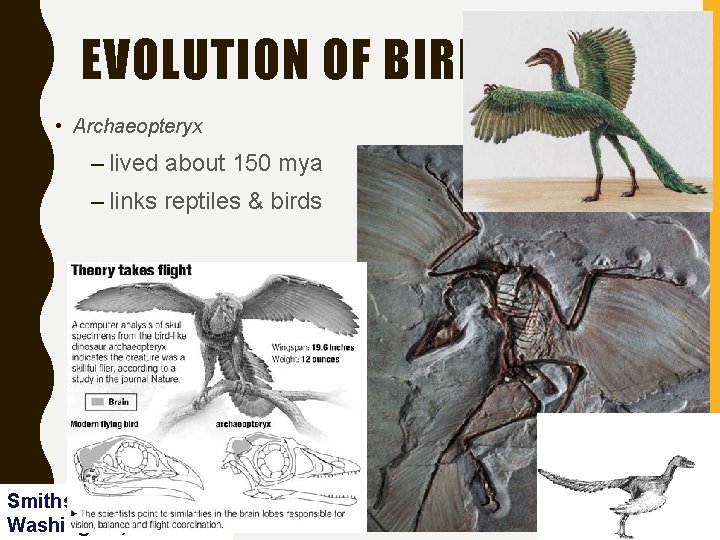
EVOLUTION OF BIRDS • Archaeopteryx – lived about 150 mya – links reptiles & birds Smithsonian Museum, Washington, DC
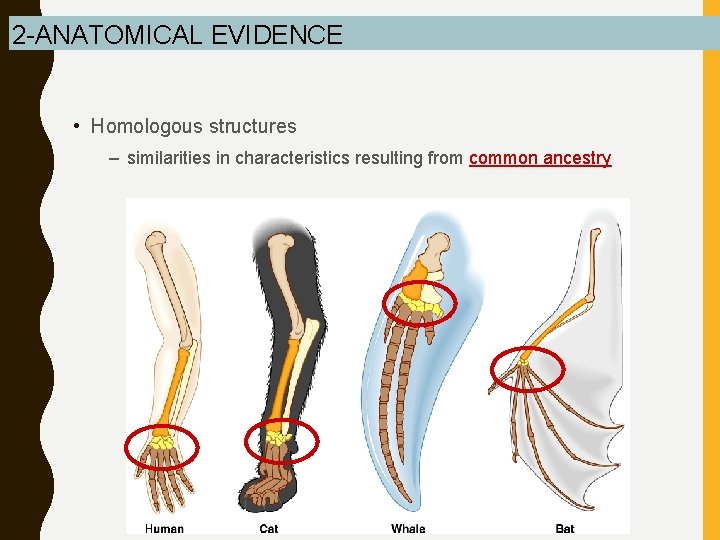
2 -ANATOMICAL EVIDENCE • Homologous structures – similarities in characteristics resulting from common ancestry
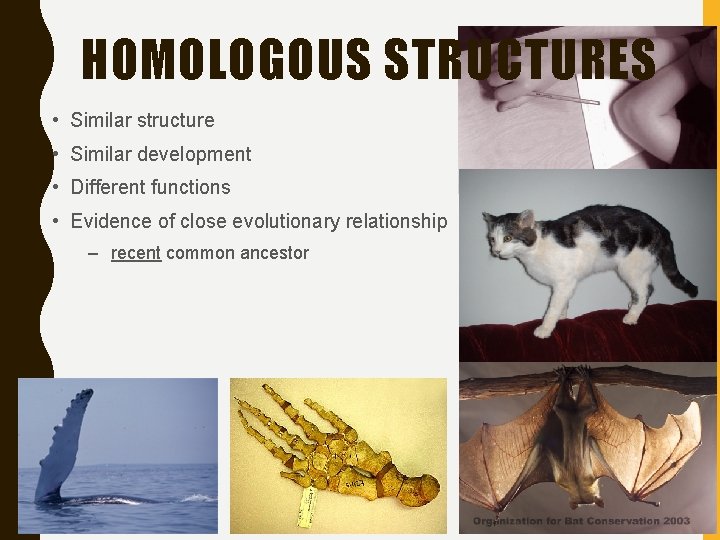
HOMOLOGOUS STRUCTURES • Similar structure • Similar development • Different functions • Evidence of close evolutionary relationship – recent common ancestor
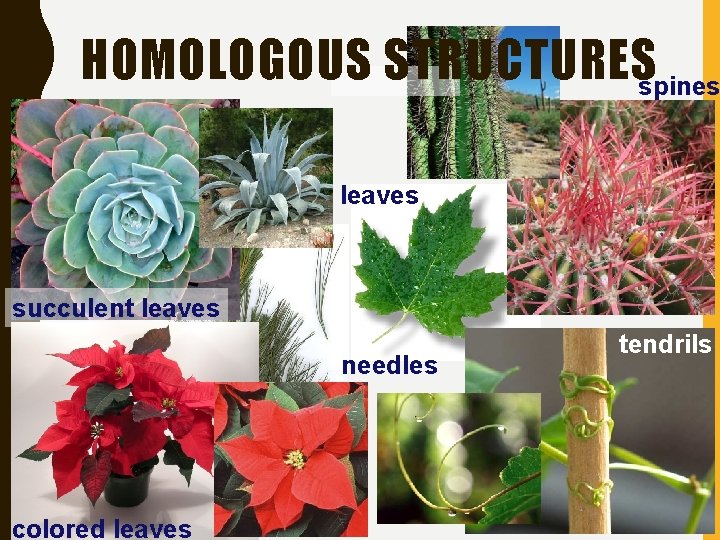
HOMOLOGOUS STRUCTURESspines leaves succulent leaves needles colored leaves tendrils
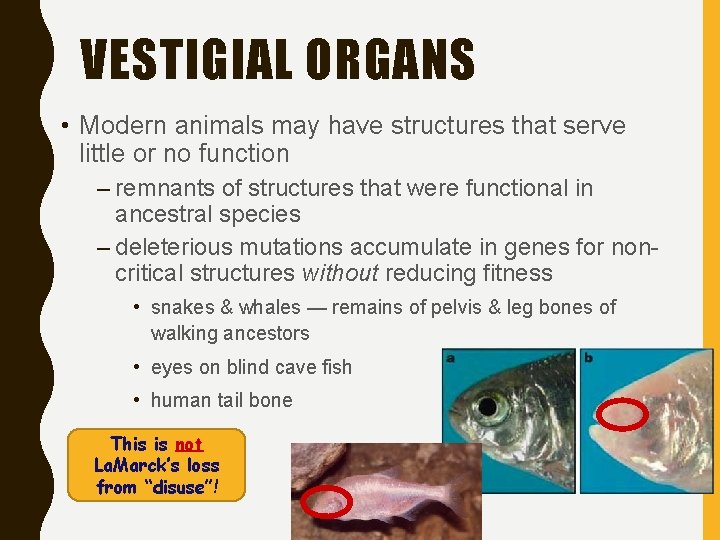
VESTIGIAL ORGANS • Modern animals may have structures that serve little or no function – remnants of structures that were functional in ancestral species – deleterious mutations accumulate in genes for noncritical structures without reducing fitness • snakes & whales — remains of pelvis & leg bones of walking ancestors • eyes on blind cave fish • human tail bone This is not La. Marck’s loss from “disuse”!
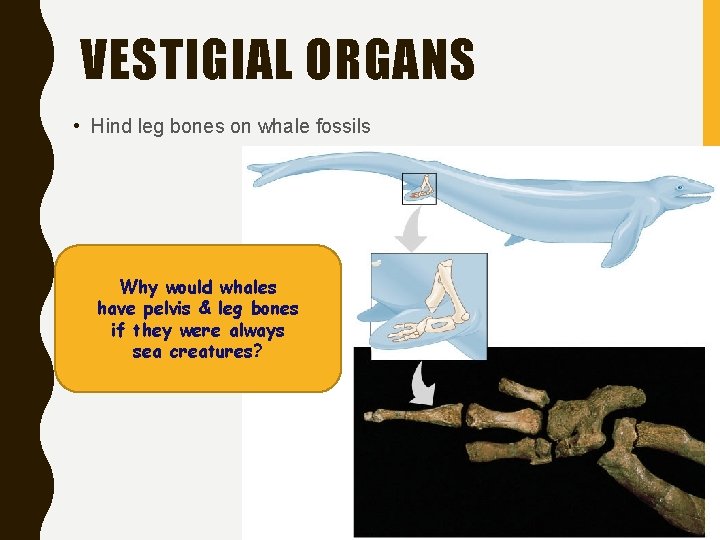
VESTIGIAL ORGANS • Hind leg bones on whale fossils Why would whales have pelvis & leg bones if they were always sea creatures?
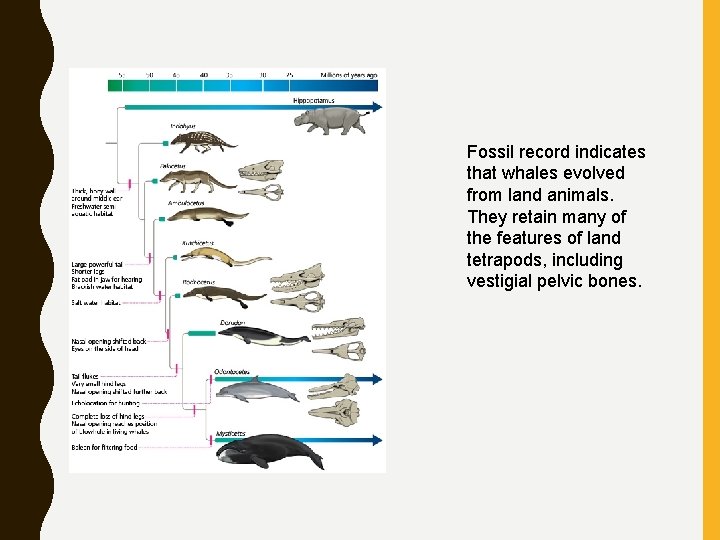
Fossil record indicates that whales evolved from land animals. They retain many of the features of land tetrapods, including vestigial pelvic bones.
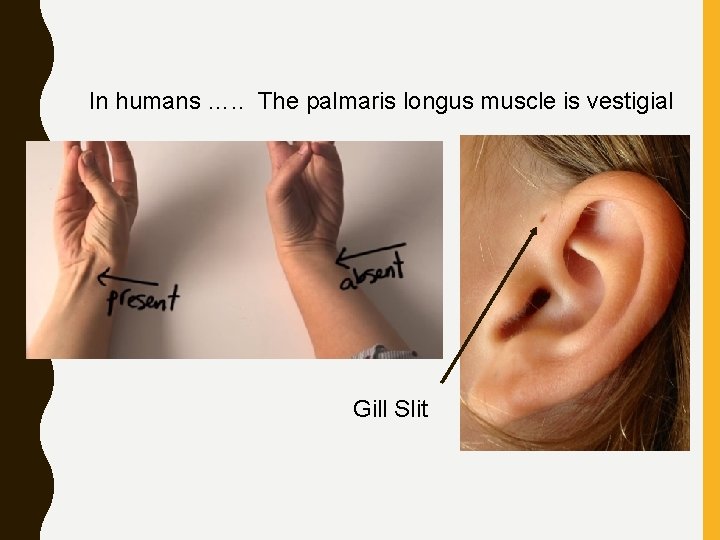
In humans …. . The palmaris longus muscle is vestigial Gill Slit
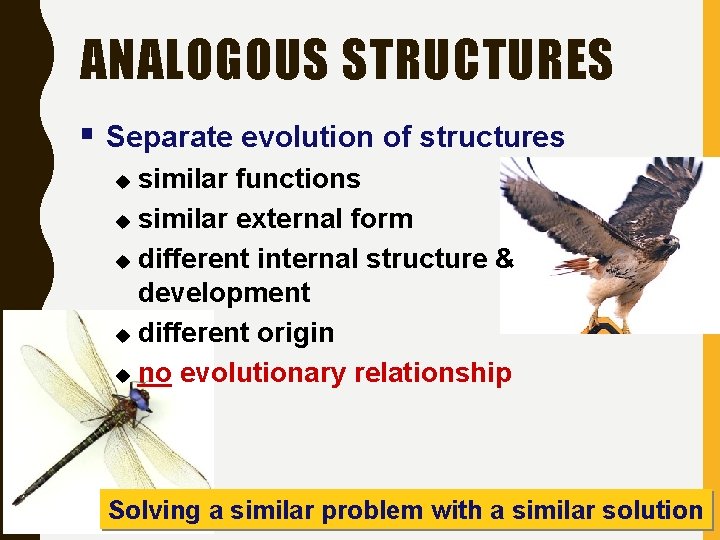
ANALOGOUS STRUCTURES § Separate evolution of structures similar functions u similar external form u different internal structure & development u different origin u no evolutionary relationship u Solving a similar problem with a similar solution
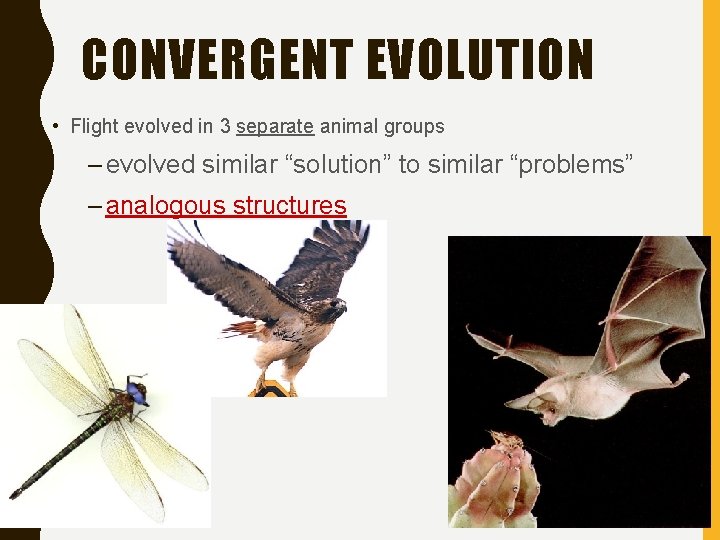
CONVERGENT EVOLUTION • Flight evolved in 3 separate animal groups – evolved similar “solution” to similar “problems” – analogous structures
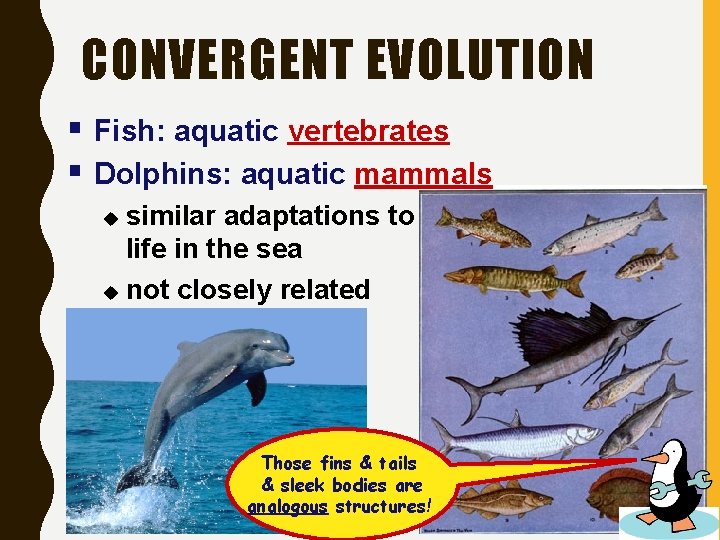
CONVERGENT EVOLUTION § Fish: aquatic vertebrates § Dolphins: aquatic mammals similar adaptations to life in the sea u not closely related u Those fins & tails & sleek bodies are analogous structures!
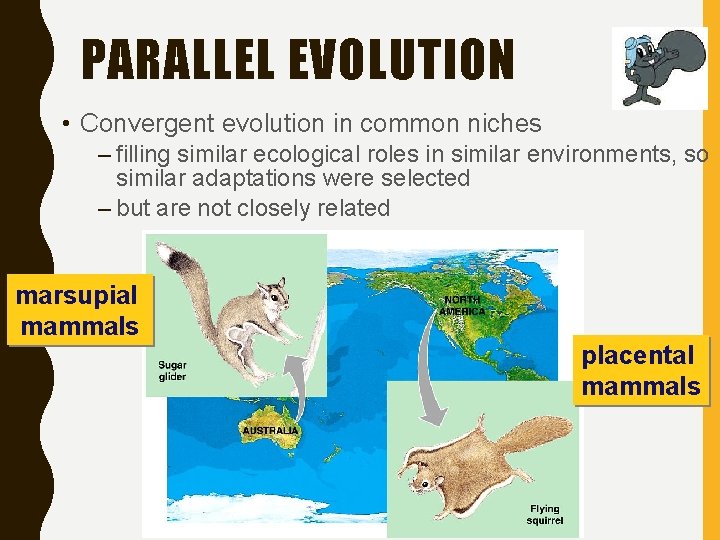
PARALLEL EVOLUTION • Convergent evolution in common niches – filling similar ecological roles in similar environments, so similar adaptations were selected – but are not closely related marsupial mammals placental mammals
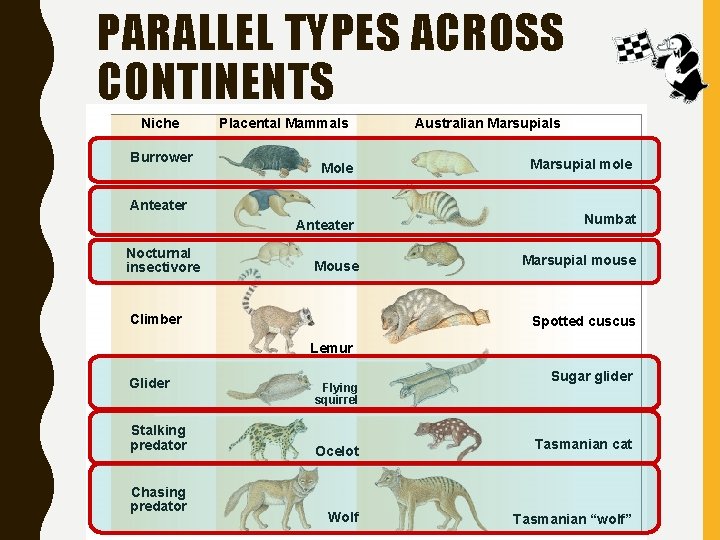
PARALLEL TYPES ACROSS CONTINENTS Niche Burrower Placental Mammals Mole Marsupial mole Anteater Numbat Anteater Nocturnal insectivore Australian Marsupials Mouse Climber Marsupial mouse Spotted cuscus Lemur Glider Stalking predator Chasing predator Flying squirrel Sugar glider Ocelot Tasmanian cat Wolf Tasmanian “wolf”
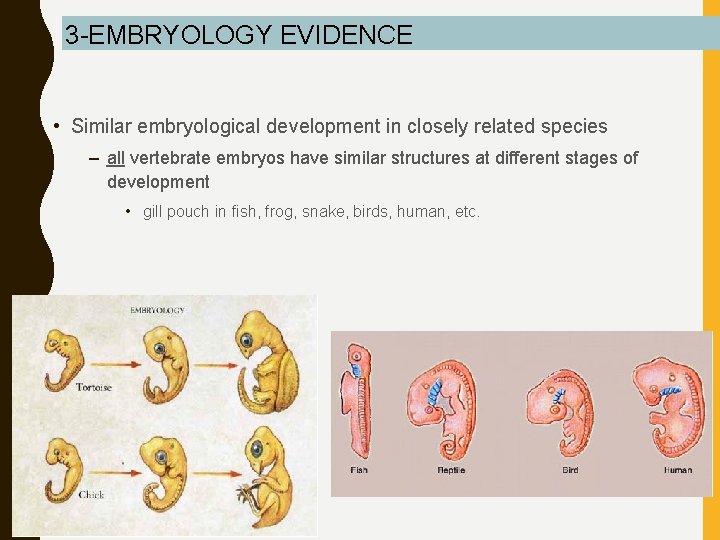
3 -EMBRYOLOGY EVIDENCE • Similar embryological development in closely related species – all vertebrate embryos have similar structures at different stages of development • gill pouch in fish, frog, snake, birds, human, etc.
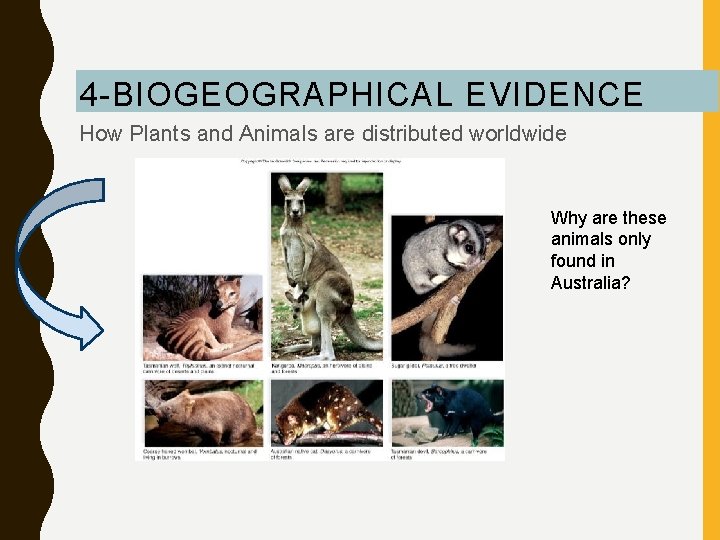
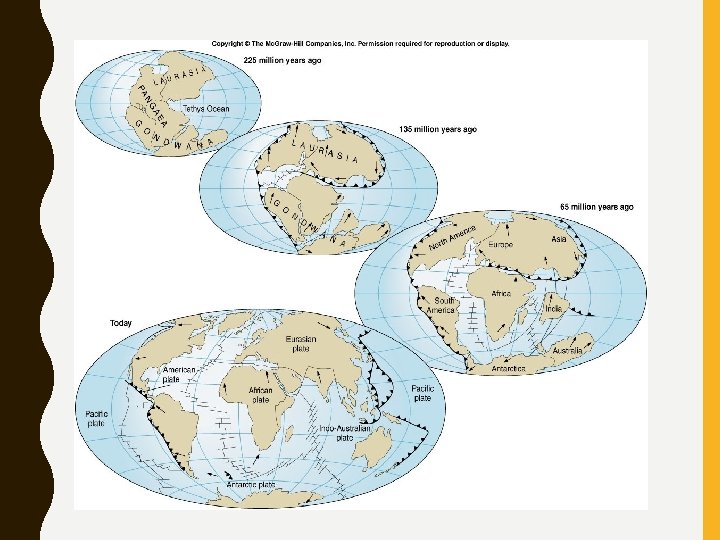
4 -BIOGEOGRAPHICAL EVIDENCE How Plants and Animals are distributed worldwide Why are these animals only found in Australia?
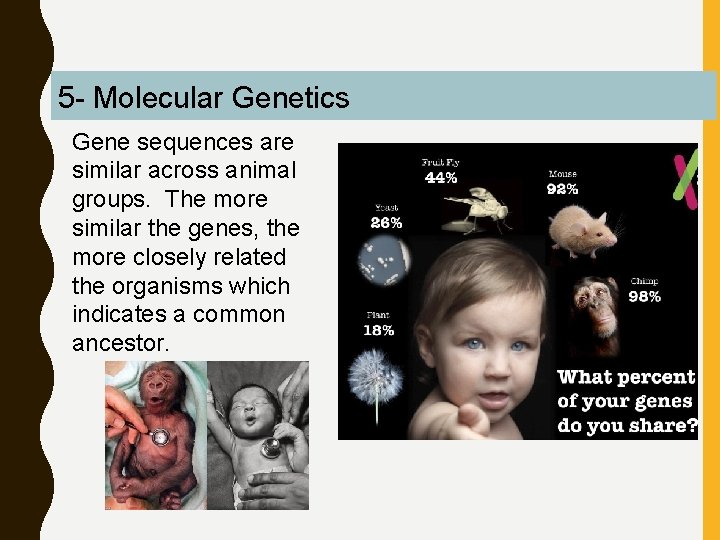
5 - Molecular Genetics Gene sequences are similar across animal groups. The more similar the genes, the more closely related the organisms which indicates a common ancestor.
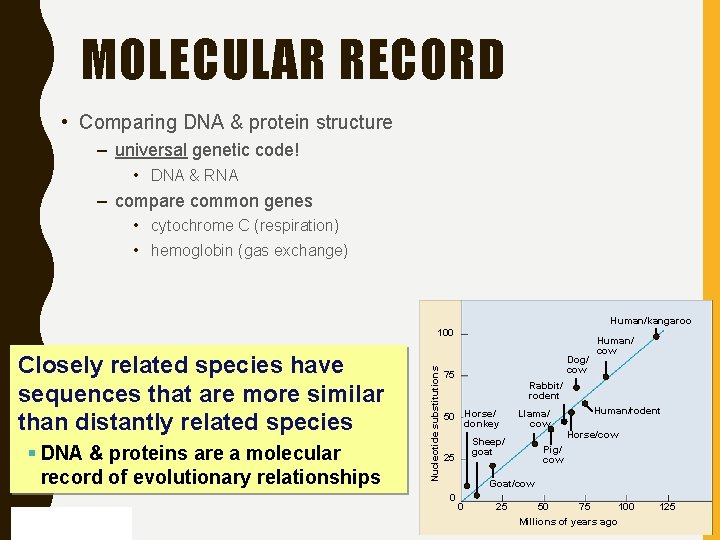
MOLECULAR RECORD • Comparing DNA & protein structure – universal genetic code! • DNA & RNA – compare common genes • cytochrome C (respiration) • hemoglobin (gas exchange) Human/kangaroo Closely related species have sequences that are more similar than distantly related species § DNA & proteins are a molecular record of evolutionary relationships Nucleotide substitutions 100 Dog/ cow 75 Human/ cow Rabbit/ rodent 50 Horse/ donkey Llama/ cow Sheep/ goat 25 Human/rodent Horse/cow Pig/ cow Goat/cow 0 0 25 50 75 100 Millions of years ago 125
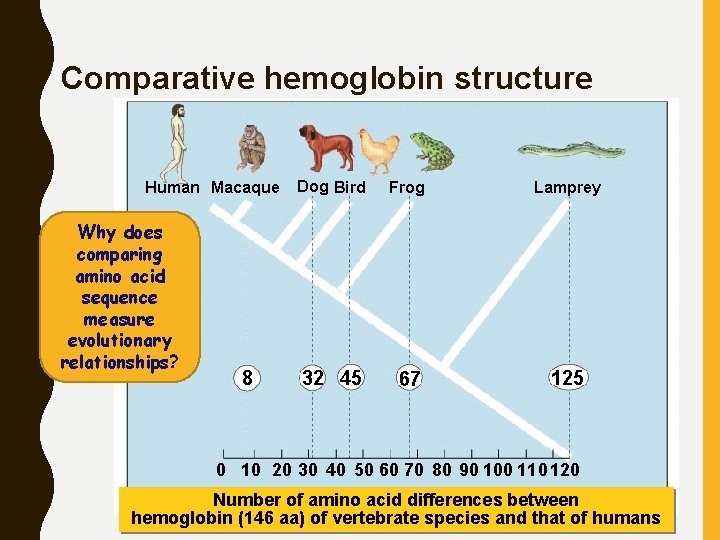
Comparative hemoglobin structure Human Macaque Why does comparing amino acid sequence measure evolutionary relationships? 8 Dog Bird Frog Lamprey 32 45 67 125 0 10 20 30 40 50 60 70 80 90 100 110 120 Number of amino acid differences between hemoglobin (146 aa) of vertebrate species and that of humans
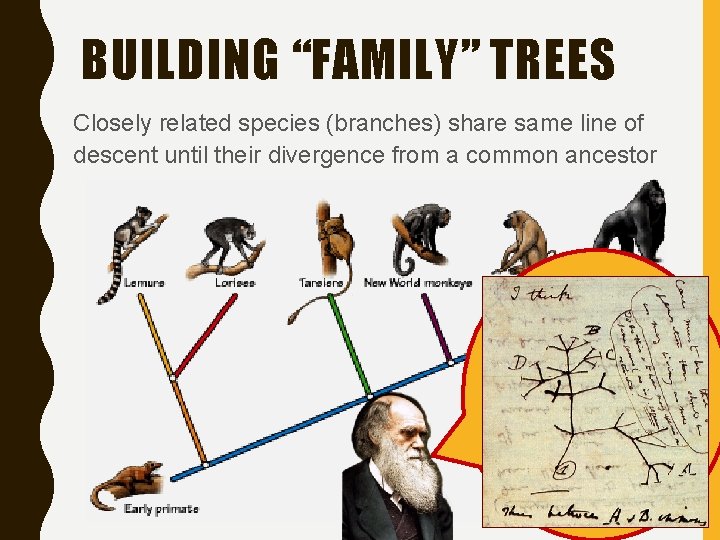
BUILDING “FAMILY” TREES Closely related species (branches) share same line of descent until their divergence from a common ancestor
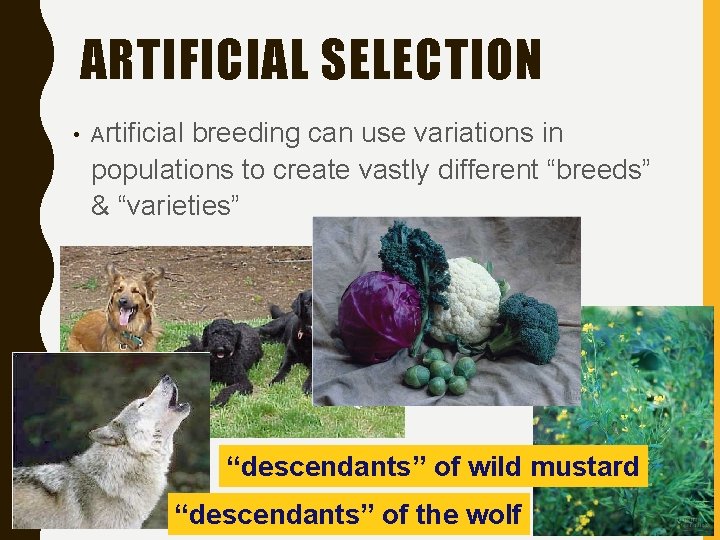
ARTIFICIAL SELECTION • Artificial breeding can use variations in populations to create vastly different “breeds” & “varieties” “descendants” of wild mustard “descendants” of the wolf
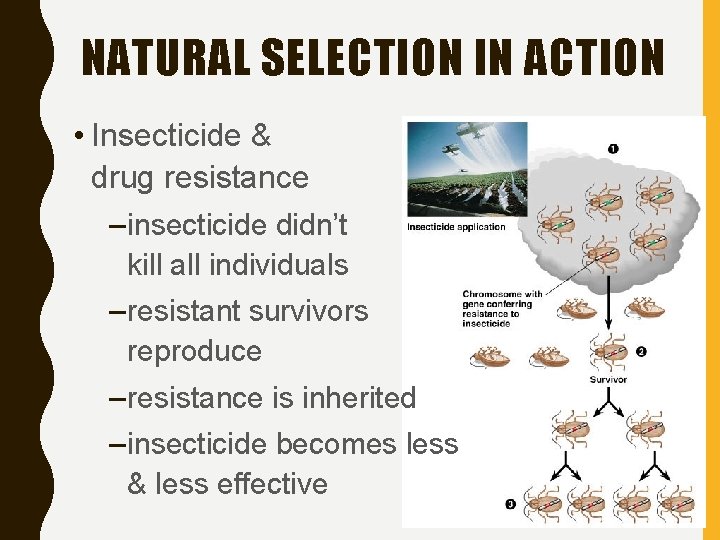
NATURAL SELECTION IN ACTION • Insecticide & drug resistance – insecticide didn’t kill all individuals – resistant survivors reproduce – resistance is inherited – insecticide becomes less & less effective
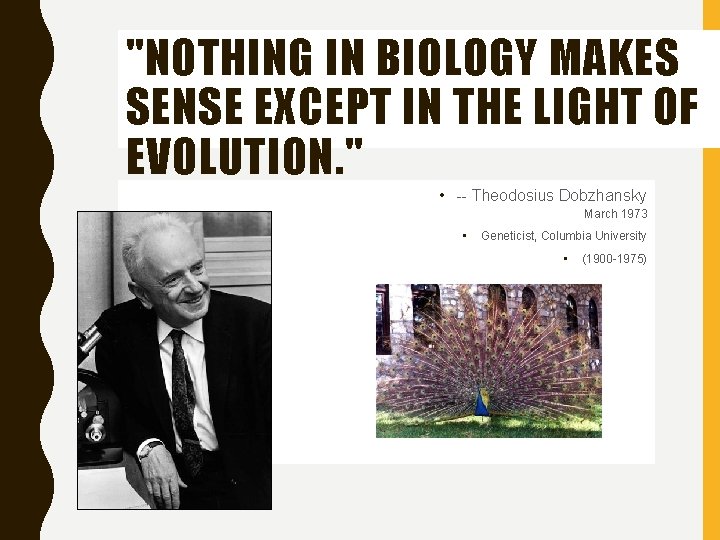
"NOTHING IN BIOLOGY MAKES SENSE EXCEPT IN THE LIGHT OF EVOLUTION. " • -- Theodosius Dobzhansky March 1973 • Geneticist, Columbia University • (1900 -1975)
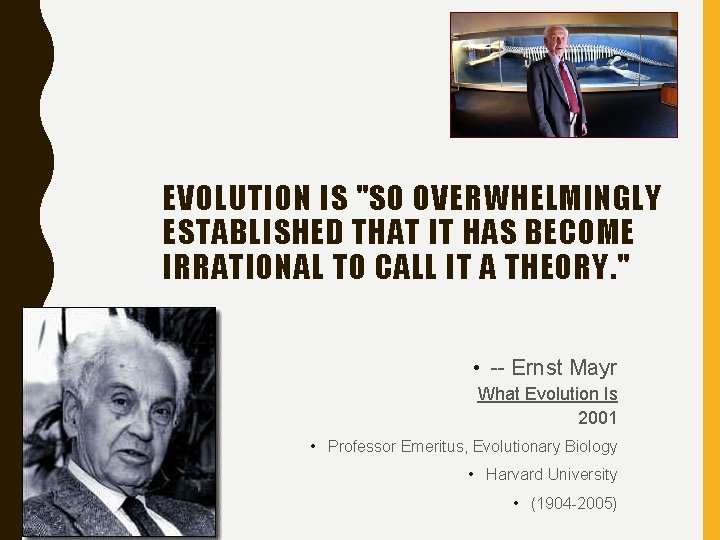
EVOLUTION IS "SO OVERWHELMINGLY ESTABLISHED THAT IT HAS BECOME IRRATIONAL TO CALL IT A THEORY. " • -- Ernst Mayr What Evolution Is 2001 • Professor Emeritus, Evolutionary Biology • Harvard University 2007 -2008 • (1904 -2005)

Don’t be a Dodo… Ask Questions!!
- Slides: 35