
EVIDENCE OF CHANGING SOCIAL NORMS These problems are
EVIDENCE OF CHANGING SOCIAL NORMS § These problems are as a result of deeply entrenched gender-based norms which favour men – but they are slowly changing due to intervention by strengthening the rule of law; increasing number of laws and treaties and by the work of NGO’s in local communities; improving education and the influence of high profile cases in the media. § Watch this clip.
Strategies to tackle gender inequality in India Government Strategies 1. Joined the UN treaty ‘ Committee on the Elimination of Discrimination Against Women (CEDAW). 2. Protection of Women from Domestic Violence Act 2005. 3. Prohibition of Child Marriage Act 2006. 4. The Dowry Prohibition Act 2008. 5. Sexual Harassment of Women at Workplace Act 2013. 6. Establishing Anti-Trafficking Police Units in 2014 with more accurate recording of crimes and victim support programmes. 7. Increasing the number of female police officers as occurred in Delhi in 2014. 8. Companies aiming to be more flexible with flexible working hours and child care facilities.
Strategies to tackle gender inequality in India Strategies by NGOs. 1. Mumbai based NGO ‘SHENA’ believes that investing in women’s health is essential in building viable urban communities. It targets 4 large public health areas - Maternal and Newborn health; Child health and Nutrition; Sexual and reproductive health and Protection of violence against women and children. 2. CARE – charity aimed at empowering girl’s/women’s rights and provides financial assistance for education. 3. Commit 2 Change – seeks to provide education for orphaned girls and other at-risk young women in India. 4. WASH United seeks to educate Indian communities about periods and menstruation, hoping to lessen the taboo of these issues. 5. Women on Wings has created 182, 000 jobs for women in rural India resulting in improved conditions for their entire communities. 6. Women on Wheels programme provides technical, self-empowerment and selfdevelopment training to fully equip women to become self-sustaining professional drivers.
All these strategies are aimed at changing embedded social norms and there is evidence that progress is being made. The government strategies not as effective as those implemented by NGOs. PQ 2020
RESPONSES • Dowries made illegal. https: //www. theguardian. com/global-development/2016/feb/03/india-anti-dowry-films-i-paid-the-price-i-own-your-son-brides-fight-back • Cash incentives schemes e. g. Apni beti apna dhun programme ‘Our Daughter, Our Wealth. ’ • Adolescents’ empowerment programmes e. g. Sabla to induce behaviour change through awareness-raising.
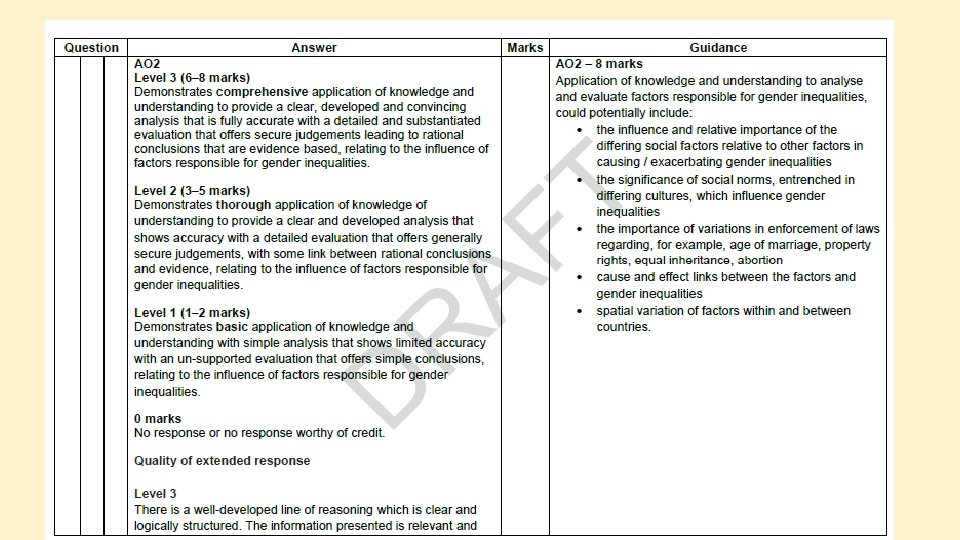
Exam Style Questions Q 1. Social factors are the most important influence responsible for gender inequalities. Discuss. [16 marks]. Q 2. What are the most important factors in explaining gender inequality in a country that you have studied? [16 marks]. Q 3. Discuss the issues of gender inequality in a country that you have studied. [8 marks]. Q 4. With reference to a case study, what are the consequences of gender inequality? [8 marks]. Q 5. With reference to a case study, explain strategies used to address gender inequality issues in a country. [8 marks].
- Slides: 9