
Evidence into Real World Practice in Childrens Services

- Slides: 19
Evidence into Real World Practice in Children’s Services: Creativity and Innovation in Challenging Times. Dawn Roberts Assistant Director Early Help, Family Support and Youth Justice Birmingham Children’s Services. Family Support and Safeguarding Services
2
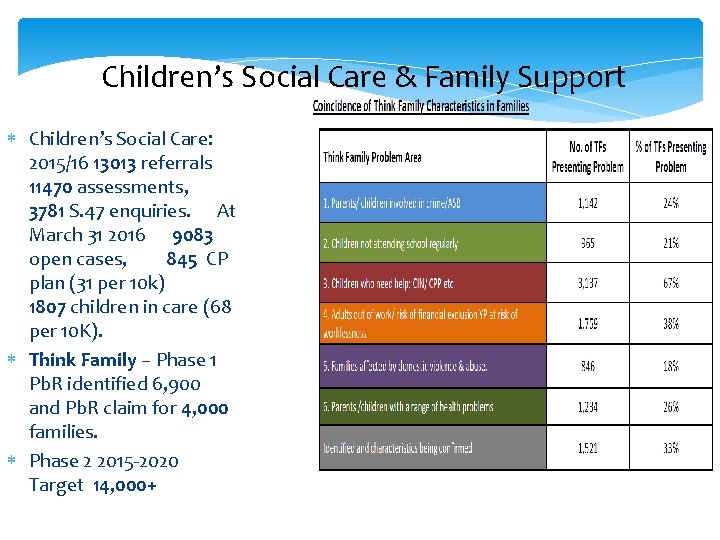
Children’s Social Care & Family Support Children’s Social Care: 2015/16 13013 referrals 11470 assessments, 3781 S. 47 enquiries. At March 31 2016 9083 open cases, 845 CP plan (31 per 10 k) 1807 children in care (68 per 10 K). Think Family – Phase 1 Pb. R identified 6, 900 and Pb. R claim for 4, 000 families. Phase 2 2015 -2020 Target 14, 000+
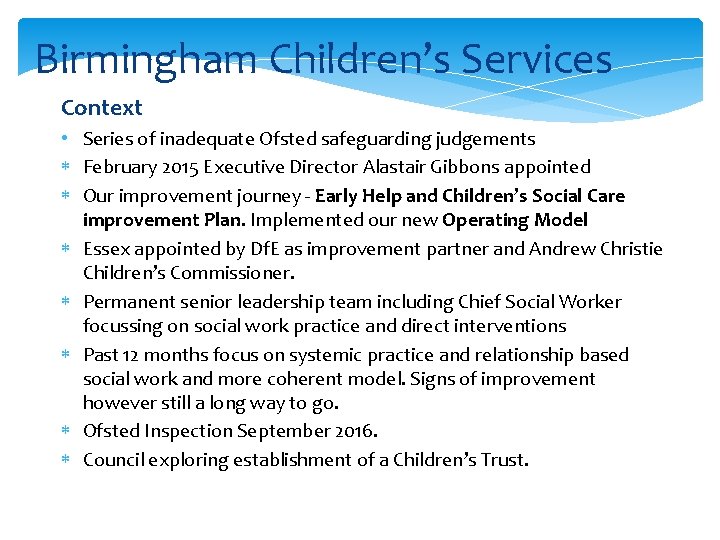
Birmingham Children’s Services Context • Series of inadequate Ofsted safeguarding judgements February 2015 Executive Director Alastair Gibbons appointed Our improvement journey - Early Help and Children’s Social Care improvement Plan. Implemented our new Operating Model Essex appointed by Df. E as improvement partner and Andrew Christie Children’s Commissioner. Permanent senior leadership team including Chief Social Worker focussing on social work practice and direct interventions Past 12 months focus on systemic practice and relationship based social work and more coherent model. Signs of improvement however still a long way to go. Ofsted Inspection September 2016. Council exploring establishment of a Children’s Trust.
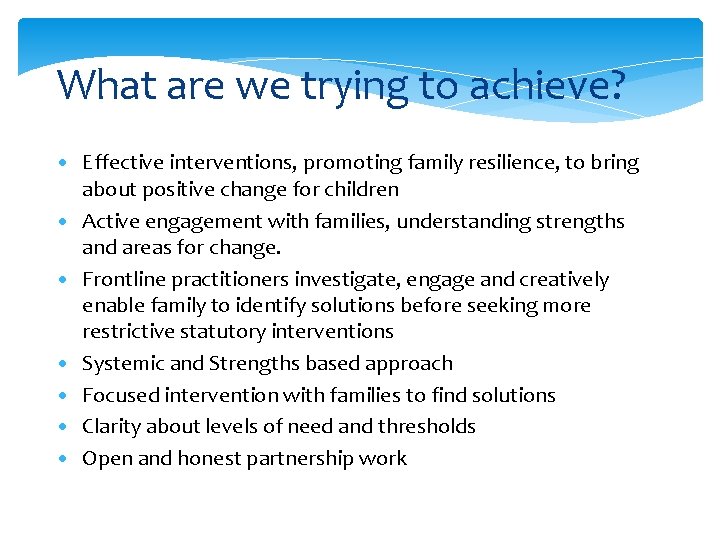
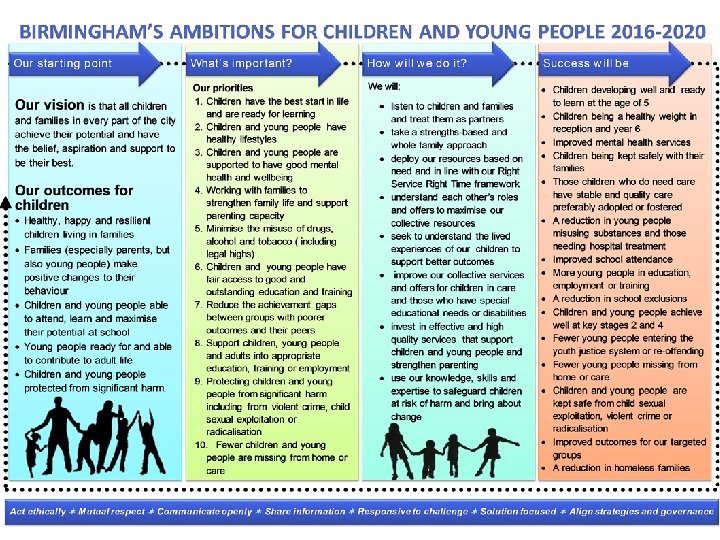
What are we trying to achieve? • Effective interventions, promoting family resilience, to bring about positive change for children • Active engagement with families, understanding strengths and areas for change. • Frontline practitioners investigate, engage and creatively enable family to identify solutions before seeking more restrictive statutory interventions • Systemic and Strengths based approach • Focused intervention with families to find solutions • Clarity about levels of need and thresholds • Open and honest partnership work
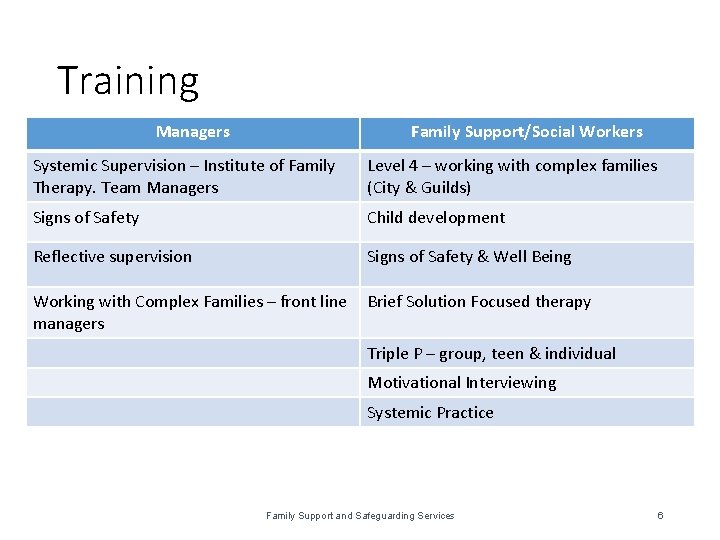
Training Managers Family Support/Social Workers Systemic Supervision – Institute of Family Level 4 – working with complex families Therapy. Team Managers (City & Guilds) Signs of Safety Child development Reflective supervision Signs of Safety & Well Being Working with Complex Families – front line Brief Solution Focused therapy managers Triple P – group, teen & individual Motivational Interviewing Systemic Practice Family Support and Safeguarding Services 6
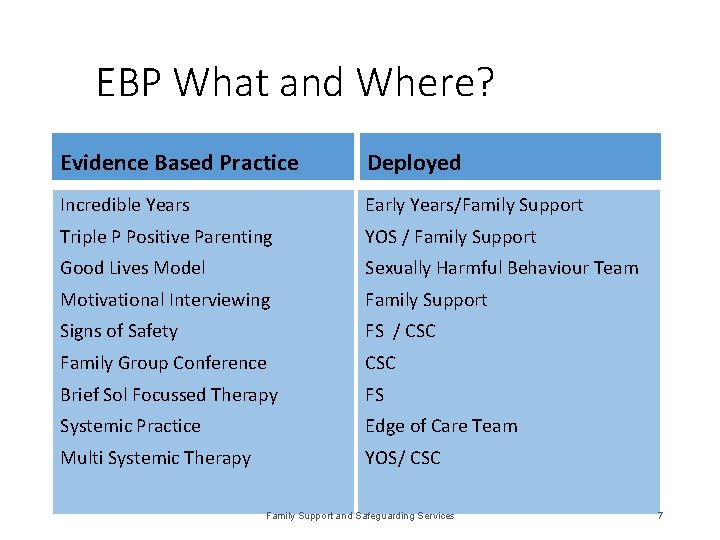
EBP What and Where? Evidence Based Practice Deployed Incredible Years Early Years/Family Support Triple P Positive Parenting YOS / Family Support Good Lives Model Sexually Harmful Behaviour Team Motivational Interviewing Family Support Signs of Safety FS / CSC Family Group Conference CSC Brief Sol Focussed Therapy FS Systemic Practice Edge of Care Team Multi Systemic Therapy YOS/ CSC Family Support and Safeguarding Services 7
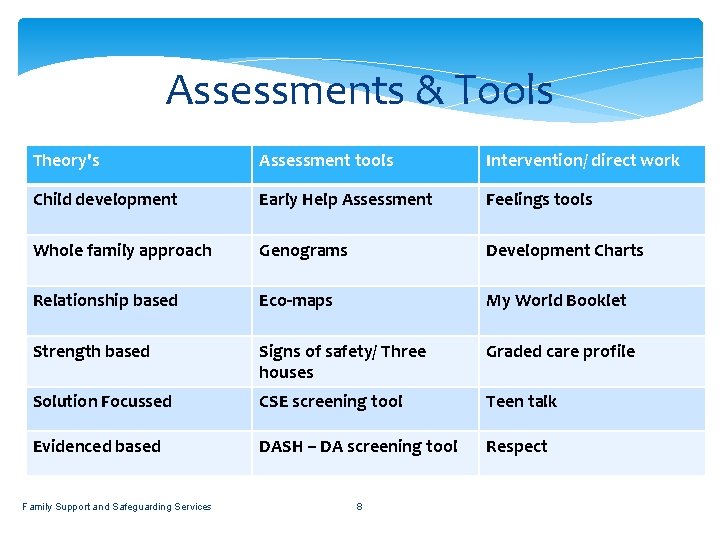
Assessments & Tools Theory's Assessment tools Intervention/ direct work Child development Early Help Assessment Feelings tools Whole family approach Genograms Development Charts Relationship based Eco-maps My World Booklet Strength based Signs of safety/ Three houses Graded care profile Solution Focussed CSE screening tool Teen talk Evidenced based DASH – DA screening tool Respect Family Support and Safeguarding Services 8
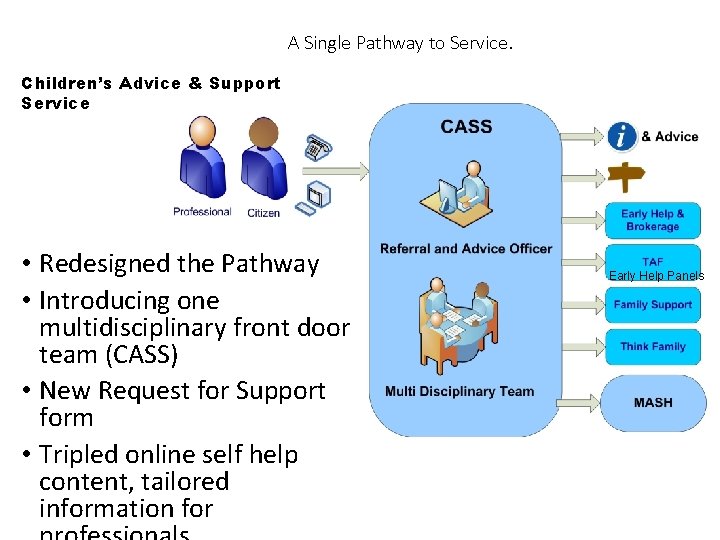
A Single Pathway to Service. Children’s Advice & Support Service • Redesigned the Pathway • Introducing one multidisciplinary front door team (CASS) • New Request for Support form • Tripled online self help content, tailored information for Early Help Panels
Our Outcomes
Early help assessments using The Signs of Safety and Wellbeing Practice Framework
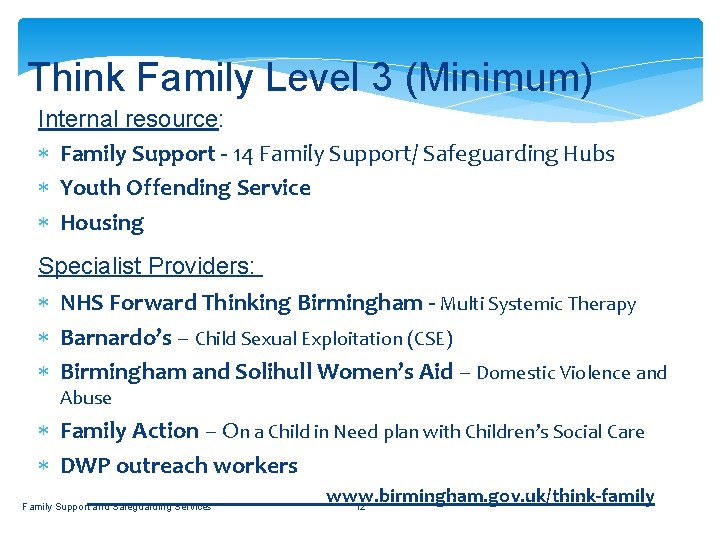
Think Family Level 3 (Minimum) Internal resource: Family Support - 14 Family Support/ Safeguarding Hubs Youth Offending Service Housing Specialist Providers: NHS Forward Thinking Birmingham - Multi Systemic Therapy Barnardo’s – Child Sexual Exploitation (CSE) Birmingham and Solihull Women’s Aid – Domestic Violence and Abuse Family Action – On a Child in Need plan with Children’s Social Care DWP outreach workers Family Support and Safeguarding Services www. birmingham. gov. uk/think-family 12
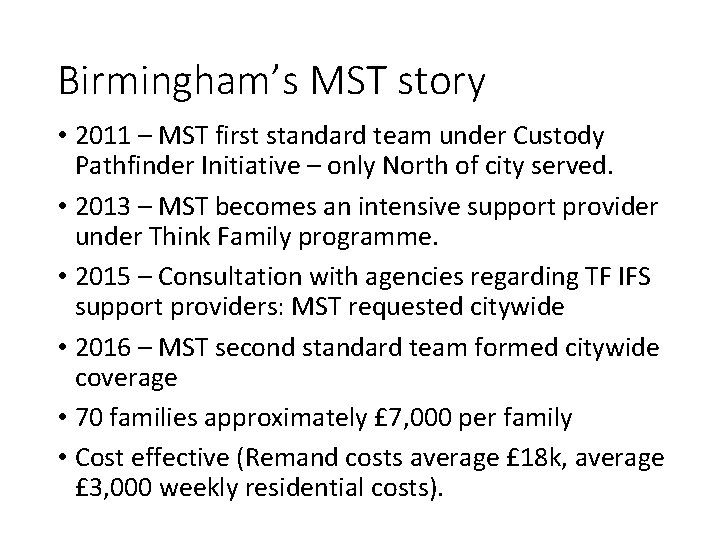
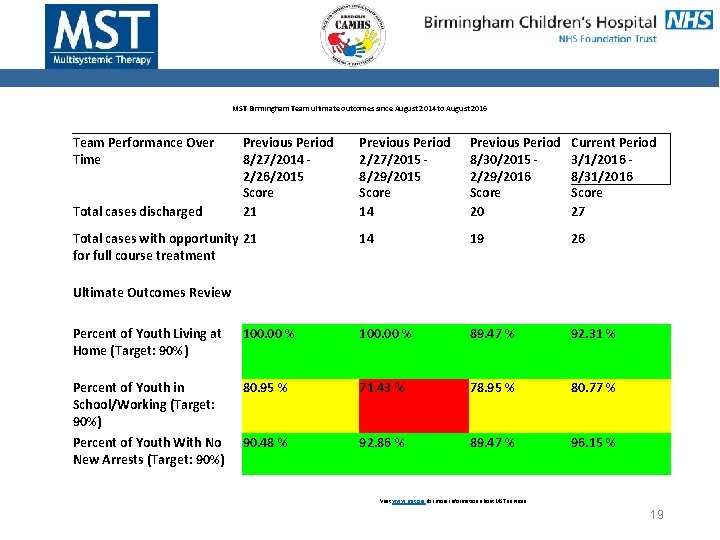
Birmingham’s MST story • 2011 – MST first standard team under Custody Pathfinder Initiative – only North of city served. • 2013 – MST becomes an intensive support provider under Think Family programme. • 2015 – Consultation with agencies regarding TF IFS support providers: MST requested citywide • 2016 – MST second standard team formed citywide coverage • 70 families approximately £ 7, 000 per family • Cost effective (Remand costs average £ 18 k, average £ 3, 000 weekly residential costs).
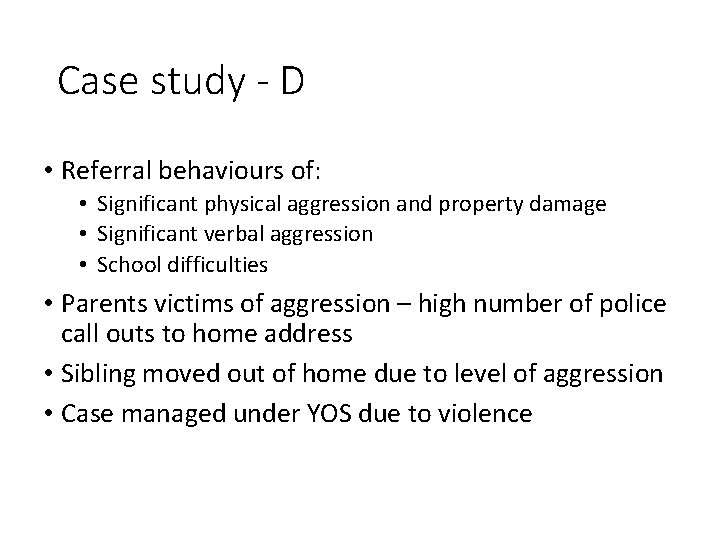
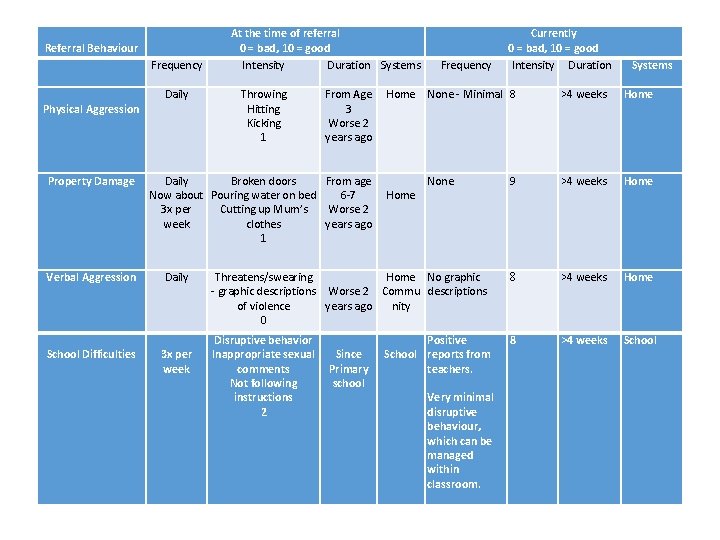
Case study - D • Referral behaviours of: • Significant physical aggression and property damage • Significant verbal aggression • School difficulties • Parents victims of aggression – high number of police call outs to home address • Sibling moved out of home due to level of aggression • Case managed under YOS due to violence
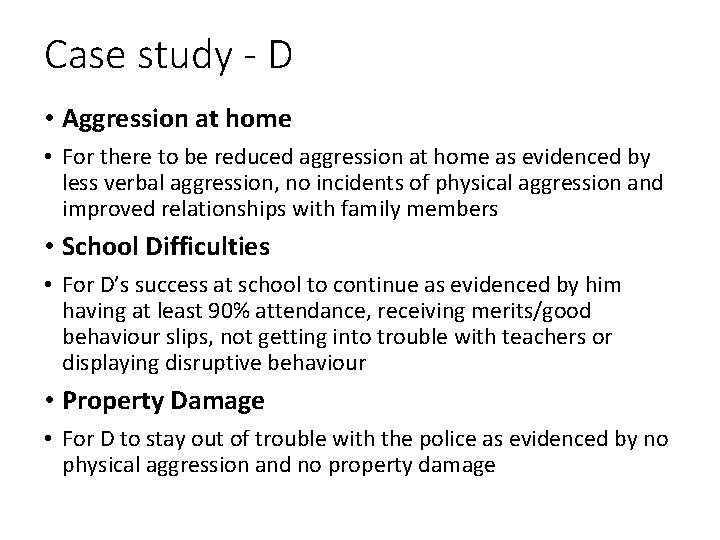
Case study - D • Aggression at home • For there to be reduced aggression at home as evidenced by less verbal aggression, no incidents of physical aggression and improved relationships with family members • School Difficulties • For D’s success at school to continue as evidenced by him having at least 90% attendance, receiving merits/good behaviour slips, not getting into trouble with teachers or displaying disruptive behaviour • Property Damage • For D to stay out of trouble with the police as evidenced by no physical aggression and no property damage
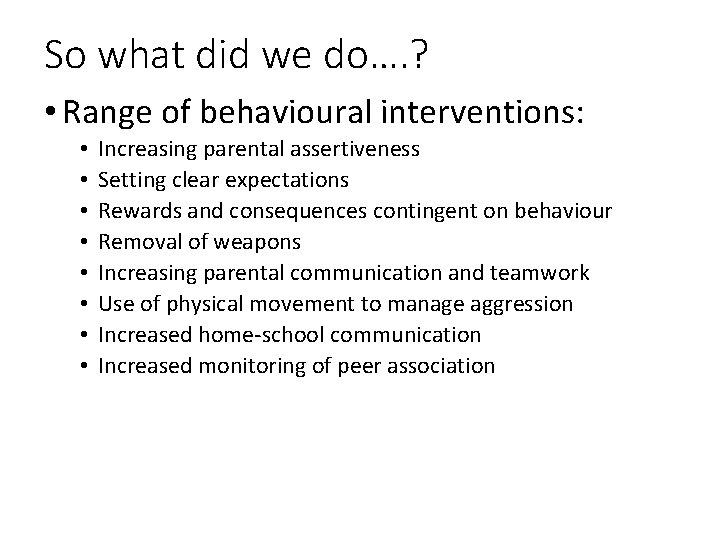
So what did we do…. ? • Range of behavioural interventions: • • Increasing parental assertiveness Setting clear expectations Rewards and consequences contingent on behaviour Removal of weapons Increasing parental communication and teamwork Use of physical movement to manage aggression Increased home-school communication Increased monitoring of peer association
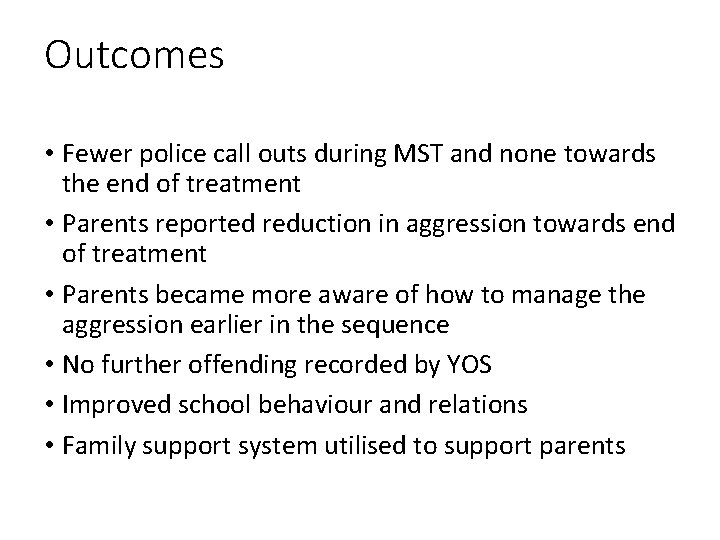
Outcomes • Fewer police call outs during MST and none towards the end of treatment • Parents reported reduction in aggression towards end of treatment • Parents became more aware of how to manage the aggression earlier in the sequence • No further offending recorded by YOS • Improved school behaviour and relations • Family support system utilised to support parents
Referral Behaviour Frequency At the time of referral 0 = bad, 10 = good Intensity Duration Systems Frequency Currently 0 = bad, 10 = good Intensity Duration Daily Throwing From Age Home None - Minimal 8 Physical Aggression Hitting 3 Kicking Worse 2 1 years ago Property Damage Daily Broken doors From age None 9 Now about Pouring water on bed 6 -7 Home 3 x per Cutting up Mum’s Worse 2 week clothes years ago 1 Systems >4 weeks Home Verbal Aggression Daily Threatens/swearing Home No graphic - graphic descriptions Worse 2 Commu descriptions of violence years ago nity 0 8 >4 weeks Home School Difficulties 3 x per week Disruptive behavior Inappropriate sexual Since comments Primary Not following school instructions 2 8 >4 weeks School Positive School reports from teachers. Very minimal disruptive behaviour, which can be managed within classroom.
MST Birmingham Team ultimate outcomes since August 2014 to August 2016 Team Performance Over Time Total cases discharged Previous Period 8/27/2014 - 2/26/2015 Score 21 Total cases with opportunity 21 for full course treatment Previous Period 2/27/2015 - 8/29/2015 Score 14 Previous Period 8/30/2015 - 2/29/2016 Score 20 Current Period 3/1/2016 - 8/31/2016 Score 27 14 19 26 Ultimate Outcomes Review. Percent of Youth Living at Home (Target: 90%) 100. 00 % 89. 47 % 92. 31 % Percent of Youth in School/Working (Target: 90%) Percent of Youth With No New Arrests (Target: 90%) 80. 95 % 71. 43 % 78. 95 % 80. 77 % 90. 48 % 92. 86 % 89. 47 % 96. 15 % Visit www. mst. org for more information about MST services. 19