
Evidence in Balneology the current situation Christoph Gutenbrunner
Evidence in Balneology – the current situation Christoph Gutenbrunner, MD, Ph. D, Professor Department for Physical Medicine and Rehabilitation Institute for Balneology and Medical Climatology Hanover Medical School D-30625 Hannover gutenbrunner. christoph@mh-hannover. de
Overview Introduction: aims and problems Balneology – the problem of definitions Systematic approach to classify studies in Balneology Examples for randomized and non-randomized controlled studies in Balneology and Health Resort Medicine ◦ cardiovascular risk factors ◦ muskuloskeletal diseases ◦ psoriasis Meta-analyses any systematic reviews Conclusion Evidence in Balneology – the current situation Christoph Gutenbrunner 17 th European Congress on PRM Venice, May 23 -26, 2010
Introduction: aims and problems Evidence in Balneology – the current situation Christoph Gutenbrunner 17 th European Congress on PRM Venice, May 23 -26, 2010
Aims look for published data on the evidence of balneotherapy in health conditions including both: ◦ serial intervention of single treatment modality ◦ complex health resort treatments excluding: ◦ effects of single interventions on symptoms look for meta-analyses on these effects but not: looking for evidence of efficacy of involvement of PRM specialists into health resort treatments Evidence in Balneology – the current situation Christoph Gutenbrunner 17 th European Congress on PRM Venice, May 23 -26, 2010
Problems To show the efficacy of a specialty in general (e. g. PRM) or a field or sub-field (e. g. Balneology) may be an illusion ◦ are surgeons efficient? ◦ is drug treatment efficient? Clinical evidence can only be proven of ◦ one agent ◦ one way of application and ◦ one health condition Most therapeutic agents in balneology cannot be proven in double-blind studies Balneotherapy mostly is used in comprehensive concepts Internationally agreed definitions in Balneology are still lacking Evidence in Balneology – the current situation Christoph Gutenbrunner 17 th European Congress on PRM Venice, May 23 -26, 2010
Balneology: the problem of definitions Evidence in Balneology – the current situation Christoph Gutenbrunner 17 th European Congress on PRM Venice, May 23 -26, 2010
Balneotherapy: modalities Substances, e. g. : ◦ Mineral waters (Na, Ca, Mg, Cl, SO 4, H 2 S, CO 2, trace elements) ◦ gases (CO 2, H 2 S, Rn) ◦ peloids (mud, peat, fango and others) Modes of application, e. g. : ◦ bathing ◦ drinking ◦ inhalation Dosage, e. g. : ◦ single use ◦ series ◦ combination Evidence in Balneology – the current situation Christoph Gutenbrunner 17 th European Congress on PRM Venice, May 23 -26, 2010
Lack of uniform definitions The term “Hydrotherapy” is not defined consistently all over the world, e. g. ◦ UK: exercise in pools ◦ Germany: treatments according to Kneipp and related applications of water Related terms are: ◦ balneotherapy, crénotherapy ◦ physiotherapy ◦ naturopathy The lack of consistent definition is a significant barrier for research especially for meta-analyses in the field of hydrotherapy and balneotherapy Evidence in Balneology – the current situation Christoph Gutenbrunner 17 th European Congress on PRM Venice, May 23 -26, 2010
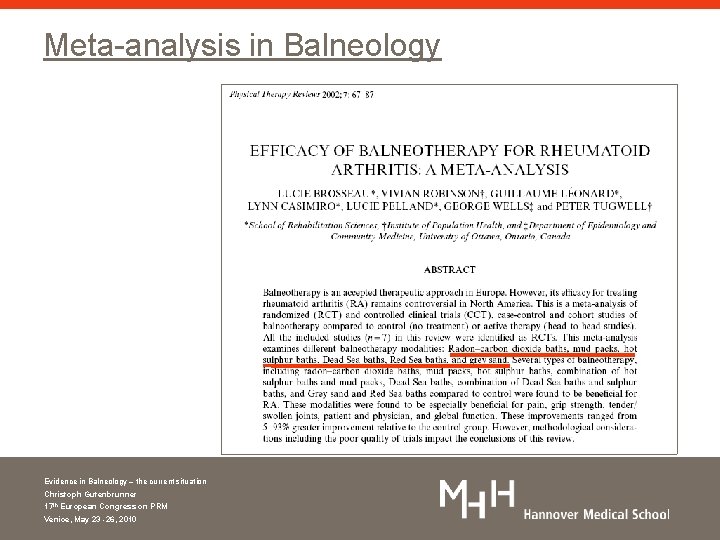
Meta-analysis in Balneology Evidence in Balneology – the current situation Christoph Gutenbrunner 17 th European Congress on PRM Venice, May 23 -26, 2010
Possible Solution To better understand the problem on terms: ◦ differentiate between object and term ◦ Accept scientific language (English) and translate to national languages Agree on definitions and English terms: ◦ a proposal will be published soon ◦ use uniform keywords along these definitions Reflect the question asked: ◦ evidence of efficacy of a specific modality (therapeutic substance and mode of application): clinical trials, metananlyses ◦ or: efficacy of balneology in general: health care research Evidence in Balneology – the current situation Christoph Gutenbrunner 17 th European Congress on PRM Venice, May 23 -26, 2010
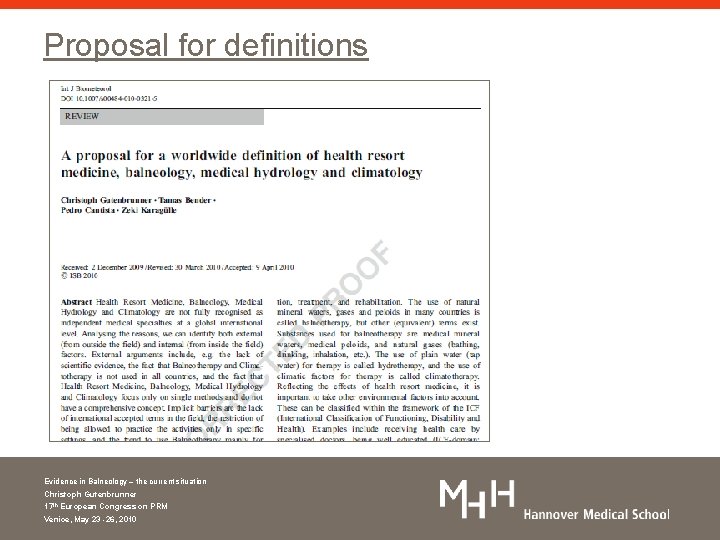
Proposal for definitions Evidence in Balneology – the current situation Christoph Gutenbrunner 17 th European Congress on PRM Venice, May 23 -26, 2010
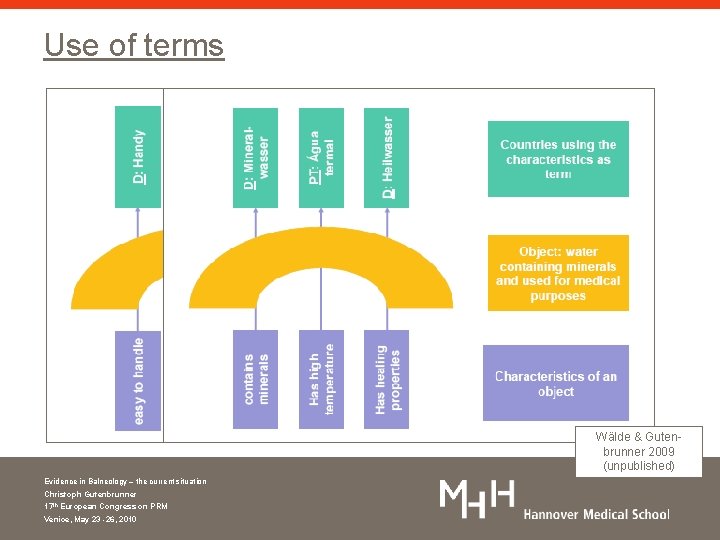
Use of terms Wälde & Gutenbrunner 2009 (unpublished) Evidence in Balneology – the current situation Christoph Gutenbrunner 17 th European Congress on PRM Venice, May 23 -26, 2010

Systematic approach to classify studies in Balneology Evidence in Balneology – the current situation Christoph Gutenbrunner 17 th European Congress on PRM Venice, May 23 -26, 2010
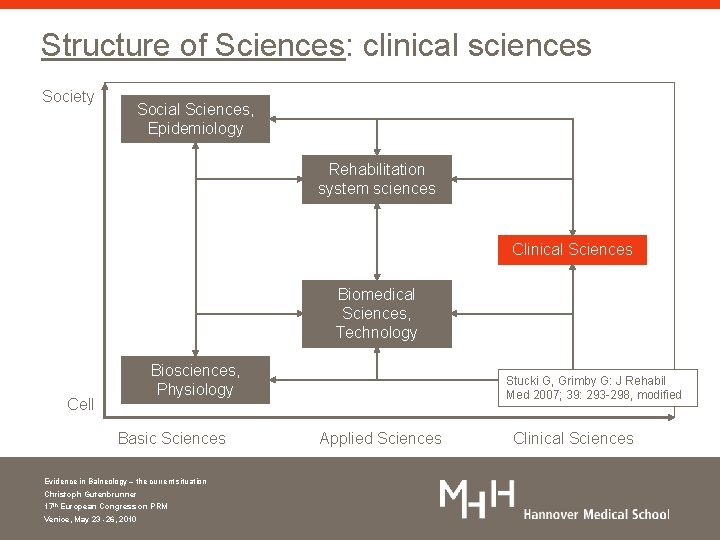
Structure of Sciences: clinical sciences Society Social Sciences, Epidemiology Rehabilitation system sciences Clinical Sciences Biomedical Sciences, Technology Biosciences, Physiology Cell Basic Sciences Evidence in Balneology – the current situation Christoph Gutenbrunner 17 th European Congress on PRM Venice, May 23 -26, 2010 Stucki G, Grimby G: J Rehabil Med 2007; 39: 293 -298, modified Applied Sciences Clinical Sciences
Examples for randomized and nonrandomized controlled studies in Balneology and Health Resort Medicine Evidence in Balneology – the current situation Christoph Gutenbrunner 17 th European Congress on PRM Venice, May 23 -26, 2010
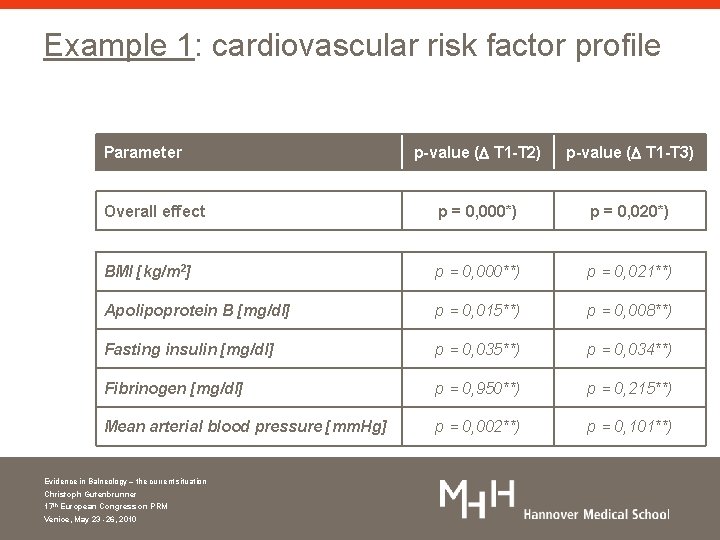
Example 1: cardiovascular risk factor profile Parameter p-value ( T 1 -T 2) p-value ( T 1 -T 3) Overall effect p = 0, 000*) p = 0, 020*) BMI [kg/m 2] p = 0, 000**) p = 0, 021**) Apolipoprotein B [mg/dl] p = 0, 015**) p = 0, 008**) Fasting insulin [mg/dl] p = 0, 035**) p = 0, 034**) Fibrinogen [mg/dl] p = 0, 950**) p = 0, 215**) Mean arterial blood pressure [mm. Hg] p = 0, 002**) p = 0, 101**) Evidence in Balneology – the current situation Christoph Gutenbrunner 17 th European Congress on PRM Venice, May 23 -26, 2010
Example 1: cardiovascular risk factor profile Gutenbrunner et al. : Phys Med Rehab Kuror 2001; 12: 272 -283 Evidence in Balneology – the current situation Christoph Gutenbrunner 17 th European Congress on PRM Venice, May 23 -26, 2010
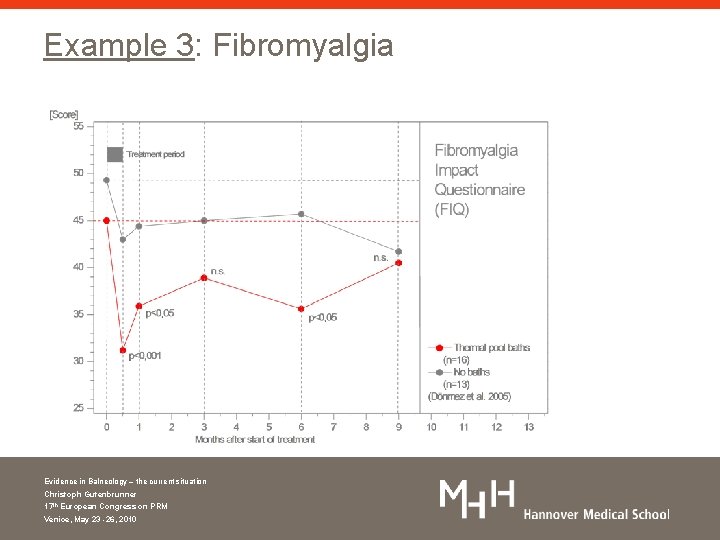
Example 3: Fibromyalgia Evidence in Balneology – the current situation Christoph Gutenbrunner 17 th European Congress on PRM Venice, May 23 -26, 2010
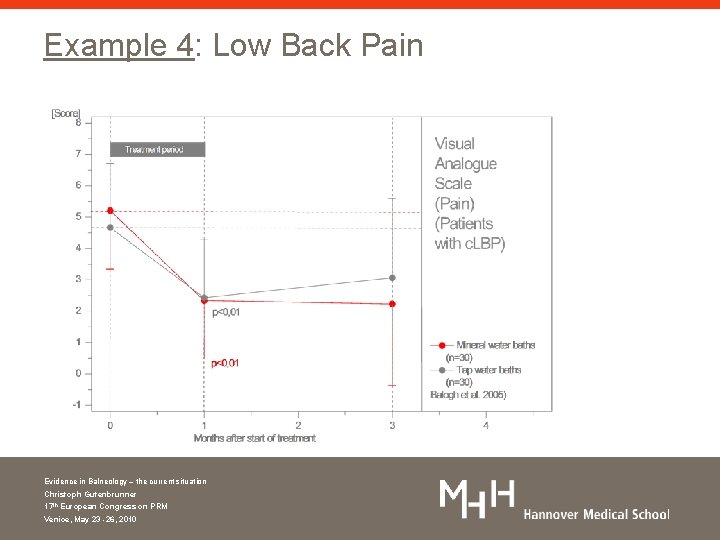
Example 4: Low Back Pain Evidence in Balneology – the current situation Christoph Gutenbrunner 17 th European Congress on PRM Venice, May 23 -26, 2010
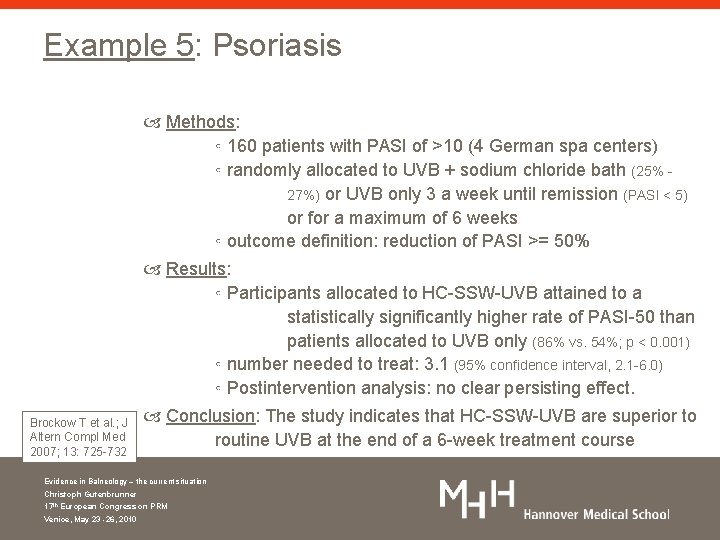
Example 5: Psoriasis Methods: ◦ 160 patients with PASI of >10 (4 German spa centers) ◦ randomly allocated to UVB + sodium chloride bath (25% 27%) or UVB only 3 a week until remission (PASI < 5) or for a maximum of 6 weeks ◦ outcome definition: reduction of PASI >= 50% Results: ◦ Participants allocated to HC-SSW-UVB attained to a statistically significantly higher rate of PASI-50 than patients allocated to UVB only (86% vs. 54%; p < 0. 001) ◦ number needed to treat: 3. 1 (95% confidence interval, 2. 1 -6. 0) ◦ Postintervention analysis: no clear persisting effect. Brockow T et al. ; J Altern Compl Med 2007; 13: 725 -732 Conclusion: The study indicates that HC-SSW-UVB are superior to routine UVB at the end of a 6 -week treatment course Evidence in Balneology – the current situation Christoph Gutenbrunner 17 th European Congress on PRM Venice, May 23 -26, 2010
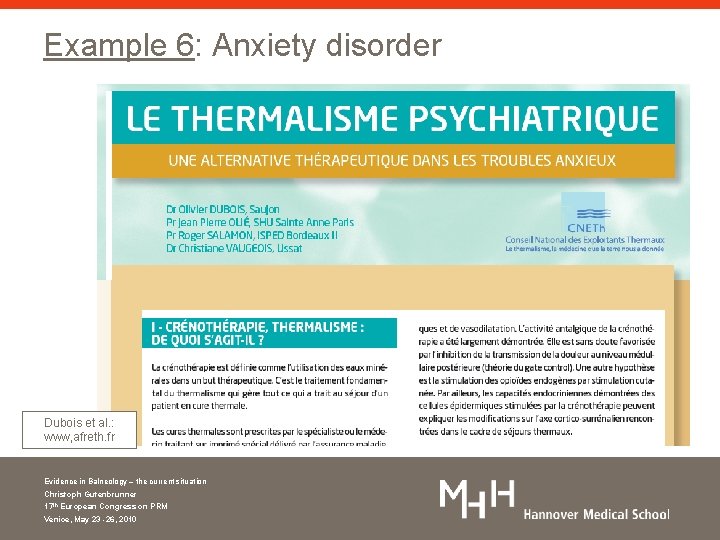
Example 6: Anxiety disorder Dubois et al. : www, afreth. fr Evidence in Balneology – the current situation Christoph Gutenbrunner 17 th European Congress on PRM Venice, May 23 -26, 2010
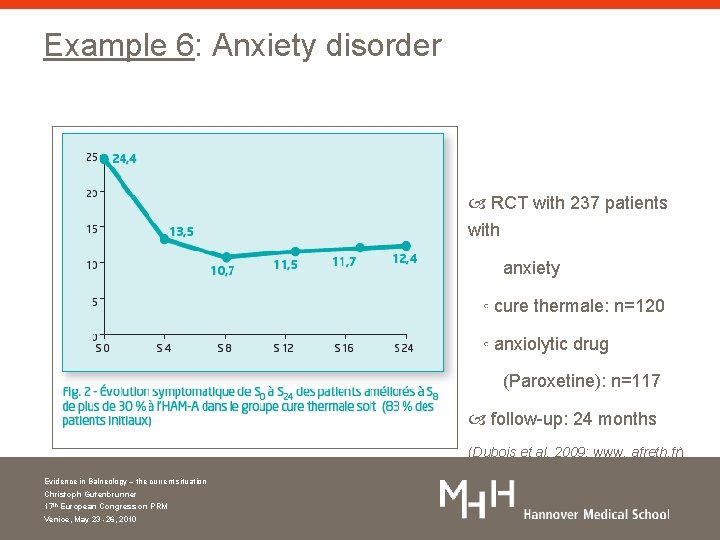
Example 6: Anxiety disorder RCT with 237 patients with anxiety ◦ cure thermale: n=120 ◦ anxiolytic drug (Paroxetine): n=117 follow-up: 24 months (Dubois et al. 2009; www. afreth. fr) Evidence in Balneology – the current situation Christoph Gutenbrunner 17 th European Congress on PRM Venice, May 23 -26, 2010

Meta-analyses and systematic reviews Evidence in Balneology – the current situation Christoph Gutenbrunner 17 th European Congress on PRM Venice, May 23 -26, 2010
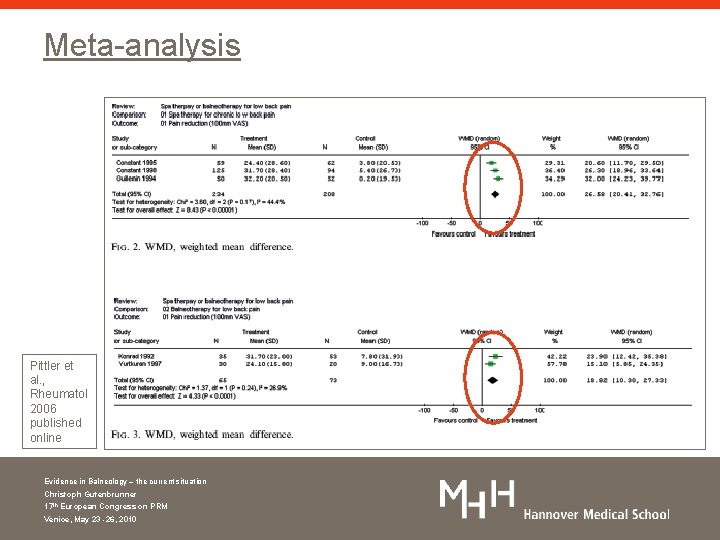
Meta-analysis Pittler et al. , Rheumatol 2006 published online Evidence in Balneology – the current situation Christoph Gutenbrunner 17 th European Congress on PRM Venice, May 23 -26, 2010
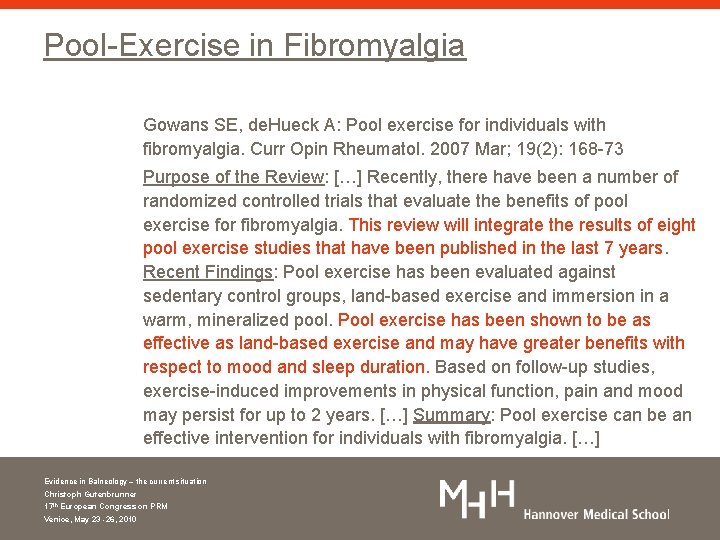
Pool-Exercise in Fibromyalgia Gowans SE, de. Hueck A: Pool exercise for individuals with fibromyalgia. Curr Opin Rheumatol. 2007 Mar; 19(2): 168 -73 Purpose of the Review: […] Recently, there have been a number of randomized controlled trials that evaluate the benefits of pool exercise for fibromyalgia. This review will integrate the results of eight pool exercise studies that have been published in the last 7 years. Recent Findings: Pool exercise has been evaluated against sedentary control groups, land-based exercise and immersion in a warm, mineralized pool. Pool exercise has been shown to be as effective as land-based exercise and may have greater benefits with respect to mood and sleep duration. Based on follow-up studies, exercise-induced improvements in physical function, pain and mood may persist for up to 2 years. […] Summary: Pool exercise can be an effective intervention for individuals with fibromyalgia. […] Evidence in Balneology – the current situation Christoph Gutenbrunner 17 th European Congress on PRM Venice, May 23 -26, 2010
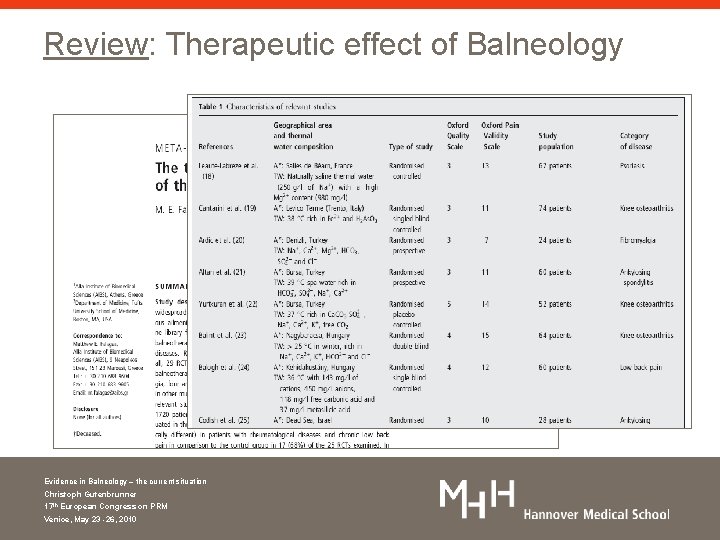
Review: Therapeutic effect of Balneology Evidence in Balneology – the current situation Christoph Gutenbrunner 17 th European Congress on PRM Venice, May 23 -26, 2010
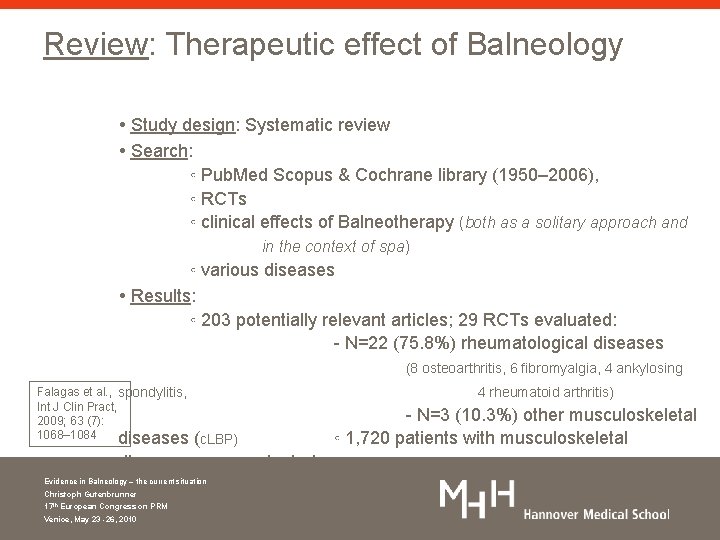
Review: Therapeutic effect of Balneology Study design: Systematic review Search: ◦ Pub. Med Scopus & Cochrane library (1950– 2006), ◦ RCTs ◦ clinical effects of Balneotherapy (both as a solitary approach and in the context of spa) ◦ various diseases Results: ◦ 203 potentially relevant articles; 29 RCTs evaluated: - N=22 (75. 8%) rheumatological diseases (8 osteoarthritis, 6 fibromyalgia, 4 ankylosing Falagas et al. , spondylitis, Int J Clin Pract, 2009; 63 (7): 1068– 1084 diseases (c. LBP) diseases were evaluated Evidence in Balneology – the current situation Christoph Gutenbrunner 17 th European Congress on PRM Venice, May 23 -26, 2010 4 rheumatoid arthritis) - N=3 (10. 3%) other musculoskeletal ◦ 1, 720 patients with musculoskeletal
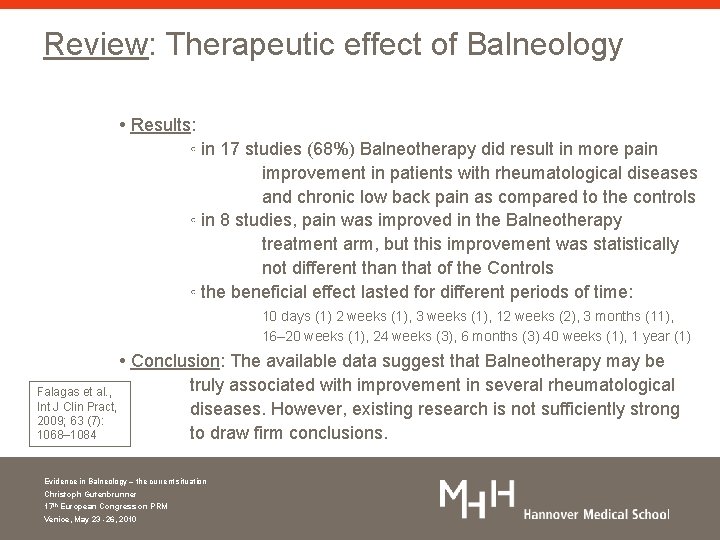
Review: Therapeutic effect of Balneology Results: ◦ in 17 studies (68%) Balneotherapy did result in more pain improvement in patients with rheumatological diseases and chronic low back pain as compared to the controls ◦ in 8 studies, pain was improved in the Balneotherapy treatment arm, but this improvement was statistically not different than that of the Controls ◦ the beneficial effect lasted for different periods of time: 10 days (1) 2 weeks (1), 3 weeks (1), 12 weeks (2), 3 months (11), 16– 20 weeks (1), 24 weeks (3), 6 months (3) 40 weeks (1), 1 year (1) Conclusion: The available data suggest that Balneotherapy may be truly associated with improvement in several rheumatological Falagas et al. , Int J Clin Pract, diseases. However, existing research is not sufficiently strong 2009; 63 (7): to draw firm conclusions. 1068– 1084 Evidence in Balneology – the current situation Christoph Gutenbrunner 17 th European Congress on PRM Venice, May 23 -26, 2010
Conclusion Evidence in Balneology – the current situation Christoph Gutenbrunner 17 th European Congress on PRM Venice, May 23 -26, 2010
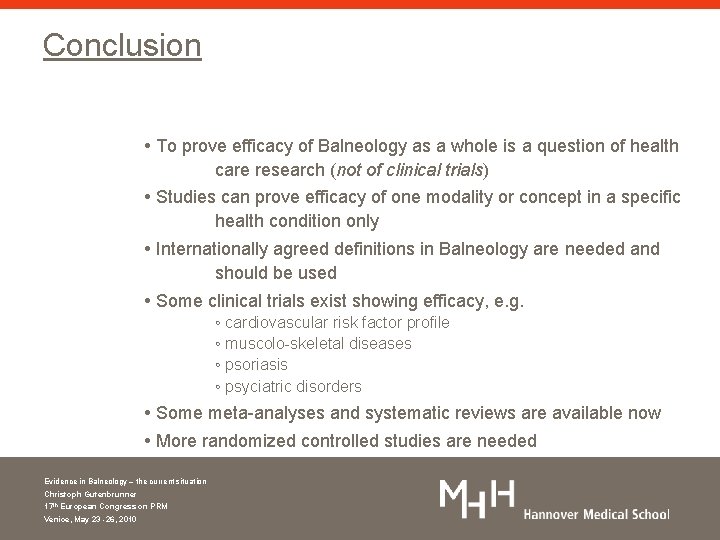
Conclusion To prove efficacy of Balneology as a whole is a question of health care research (not of clinical trials) Studies can prove efficacy of one modality or concept in a specific health condition only Internationally agreed definitions in Balneology are needed and should be used Some clinical trials exist showing efficacy, e. g. ◦ cardiovascular risk factor profile ◦ muscolo-skeletal diseases ◦ psoriasis ◦ psyciatric disorders Some meta-analyses and systematic reviews are available now More randomized controlled studies are needed Evidence in Balneology – the current situation Christoph Gutenbrunner 17 th European Congress on PRM Venice, May 23 -26, 2010
Thank you for you attention Christoph Gutenbrunner, MD, Ph. D, Professor Evidence in Balneology the current Department for Physical–Medicine andsituation Rehabilitation Institute for Gutenbrunner Balneology and Medical Climatology Christoph Hanover Medical School on PRM 17 th European Congress D-30625 Hannover Venice, May 23 -26, 2010 gutenbrunner. christoph@mh-hannover. de r
- Slides: 31